
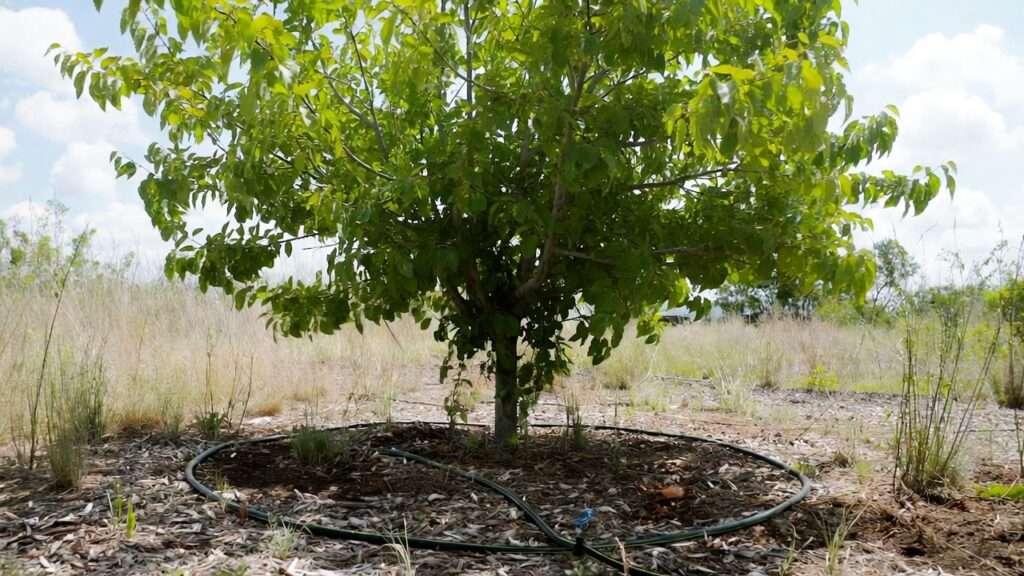
Imagine stepping into your backyard during a scorching summer afternoon and noticing your once-vibrant maple or oak looking limp, with leaves curling at the edges or turning brown prematurely. 😓 The soil feels bone-dry, and those precious trees you planted (or inherited) seem to be silently begging for help. Heatwaves, low rainfall, and high evaporation rates turn summer into the most stressful season for trees — especially when improper watering leads to wilting, leaf scorch, or even long-term decline.
The good news? A smart summer watering schedule for trees can make all the difference. By providing the right amount of water at the right frequency — focusing on deep, infrequent soaks rather than shallow daily sprinkles — you can prevent drought stress, encourage strong root growth, and help your trees thrive through the hottest months. In this comprehensive guide, we’ll break down exactly how often and how much to water trees in hot weather, tailored by tree age, type, soil, and climate. Backed by university extension recommendations (like those from UMN Extension, Arbor Day Foundation, and others), proven best practices, and real-world adjustments, this skyscraper-level resource goes beyond basic advice to deliver actionable, expert-level strategies that save water, time, and your trees. 💧🌿
Whether you’re caring for a newly planted sapling fighting transplant shock or a mature shade tree enduring prolonged dry spells, you’ll find clear schedules, step-by-step methods, troubleshooting tips, and bonus strategies to reduce stress. Let’s dive in and give your trees the summer support they truly need!
Why Trees Struggle in Summer Heat 🔥
Summer brings the perfect storm for tree stress: blazing temperatures accelerate transpiration (the process where trees lose water through leaves), dry winds whisk away moisture, and intense sun bakes the soil surface. Tree roots — especially the fine feeder roots in the top 12–18 inches — dry out quickly, while high evaporation rates can remove inches of soil moisture in days.
The science is straightforward: Trees pull water from the soil to replace what’s lost through leaves. When demand exceeds supply, stress begins. Common myths persist, like “daily light watering keeps trees happy” — but frequent shallow watering actually promotes weak, surface-level roots that dry out fast and struggle in heat. Deep, infrequent watering, on the other hand, trains roots to grow downward, building drought resistance. University extensions (e.g., University of Minnesota, Arizona, Maryland) unanimously recommend this approach for healthier, more resilient trees.
Regional factors play a huge role too: Clay soils hold water longer but drain slowly (risking runoff or rot), sandy soils dry lightning-fast, and urban spots near pavement or buildings create “heat islands” that amplify needs. Understanding these helps customize your summer tree watering plan perfectly.
Key Factors That Determine Your Summer Watering Schedule 📊
No one-size-fits-all timer exists — your schedule depends on several variables:
- Tree age & establishment stage — Newly planted trees (<1–2 years) have limited roots and need frequent care; young trees (2–5 years) transition to weekly; mature trees (>5 years) often manage with less supplemental water.
- Tree species & water needs — Thirsty types like maples, birches, or willows demand more; drought-tolerant natives (oaks, pines, or certain fruit trees) need less.
- Soil type & drainage — Test yours: Clay retains moisture (water less often); sand drains quickly (water more frequently but deeply).
- Weather variables — Track temperature, rainfall, humidity, and wind. A 95°F+ heatwave with no rain? Increase frequency. Recent 1-inch+ rain? Skip or delay.
- Tree size & location — Larger canopies transpire more; trees near hardscapes, on slopes, or in full sun dry faster than shaded ones.
Always start by checking soil moisture 6–8 inches deep — if it’s dry, water; if moist, wait. A simple screwdriver probe or finger test works wonders! 🔍
Watering Schedules: How Often & How Much in Hot Weather (Core Value Section) 📅💧
Here are evidence-based schedules drawn from trusted sources like Arbor Day Foundation, UMN Extension, and regional guidelines. Adjust based on your local conditions — observe your tree and soil!
For Newly Planted Trees (First 1–2 Growing Seasons) 🌱
These babies are in transplant shock with most roots still in the original root ball. They need consistent moisture to establish without drowning.
- Weeks 1–2 post-planting: Water every 1–2 days in summer (daily if extreme heat/no rain).
- Weeks 3–12: Every 3–7 days, tapering as roots expand.
- Through first 1–2 summers: 1–2 times per week, or every 5–7 days in hot spells.
How much: Aim for 10–20 gallons per inch of trunk caliper (diameter at 6 inches above soil) per week, applied slowly. For a 2-inch caliper tree: 20–40 gallons weekly, spread over sessions.
Use this handy table for quick reference:
| Trunk Caliper | Weekly Gallons (Summer) | Example Tree Size |
|---|---|---|
| 1 inch | 10–20 | Small sapling |
| 2 inches | 20–40 | Young maple |
| 3–4 inches | 30–80 | Medium ornamental |
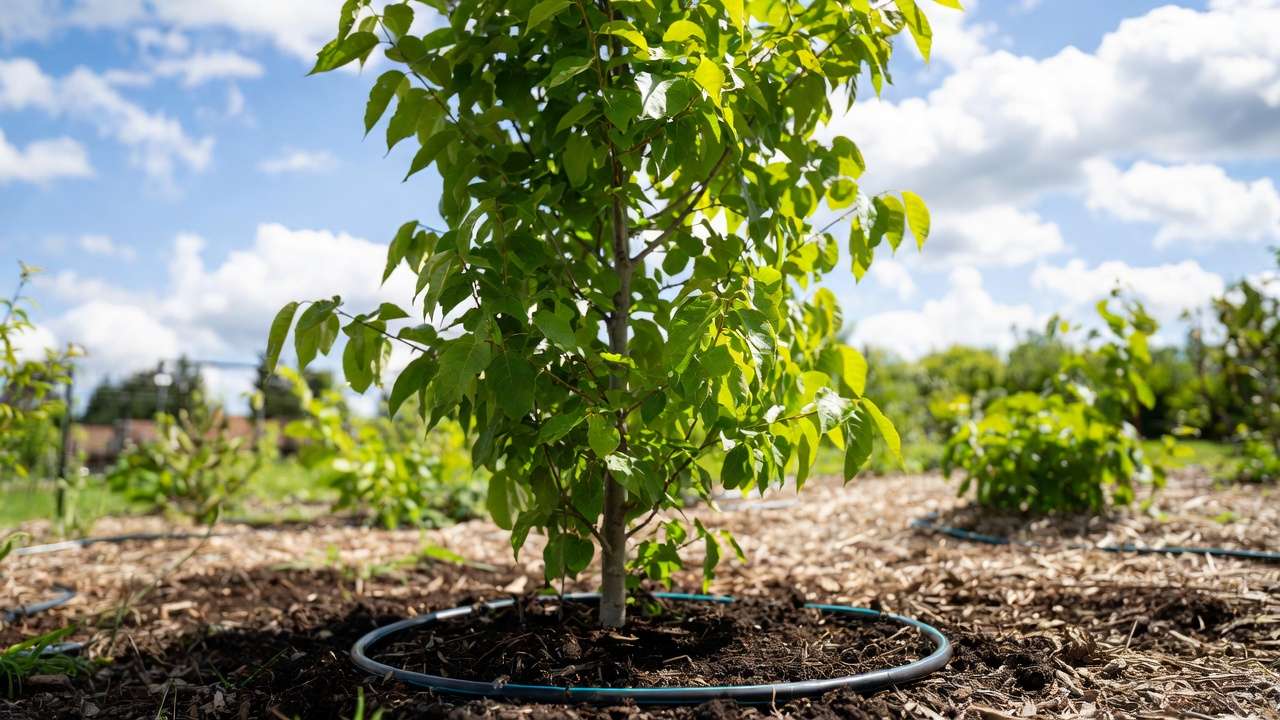
Pro tip: Tree watering bags (like Treegator) or DIY reservoir rings deliver slow, deep moisture — perfect for busy gardeners! 🛠️
For Young/Establishing Trees (Years 2–5) 🌳
Roots are spreading, but the tree still relies on you during heat.
- General summer rule: Deep watering 1 time per week (or every 5–7 days in 90°F+ heat with no rain).
- How much: 15–50+ gallons depending on size, applied slowly over 30–90 minutes to penetrate 12–18 inches deep.
Adjustment examples:
- Heatwave/no rain >10 days: Increase to twice weekly.
- Occasional showers: Stretch to 10 days.
- Windy site: Add 20–30% more volume.
Focus water at the drip line (outer edge of canopy) where active roots thrive.
For Mature/Established Trees (>5 Years) 🏡🌲
Healthy mature trees often access deep soil moisture and may not need much help unless drought is severe.
- Summer frequency: Every 7–14 days (or every 2–3 weeks with moderate heat/occasional rain).
- How much: 10 gallons per inch of trunk diameter, focused at drip line and beyond (e.g., 20-inch DBH tree = 200 gallons per session).
When to skip: After 1+ inch of soaking rain. Special cases: Street trees, evergreens, or shallow-rooted species (e.g., birches) may need more frequent checks.
Deep watering encourages those resilient roots — your tree will thank you during the next dry spell! 🌟
Best Methods for Deep, Efficient Watering (Step-by-Step Guides) 🛠️💦
Deep watering is the gold standard for summer tree care — it delivers moisture to where the active feeder roots live (typically 12–24 inches deep), encourages drought-resistant root growth downward, and minimizes waste from evaporation or runoff. Shallow, frequent watering? It only wets the surface, promotes weak roots, and wastes water. University extensions like UMN, Maryland, and Nevada emphasize deep, infrequent soaks over the entire root zone (from trunk to drip line and beyond).
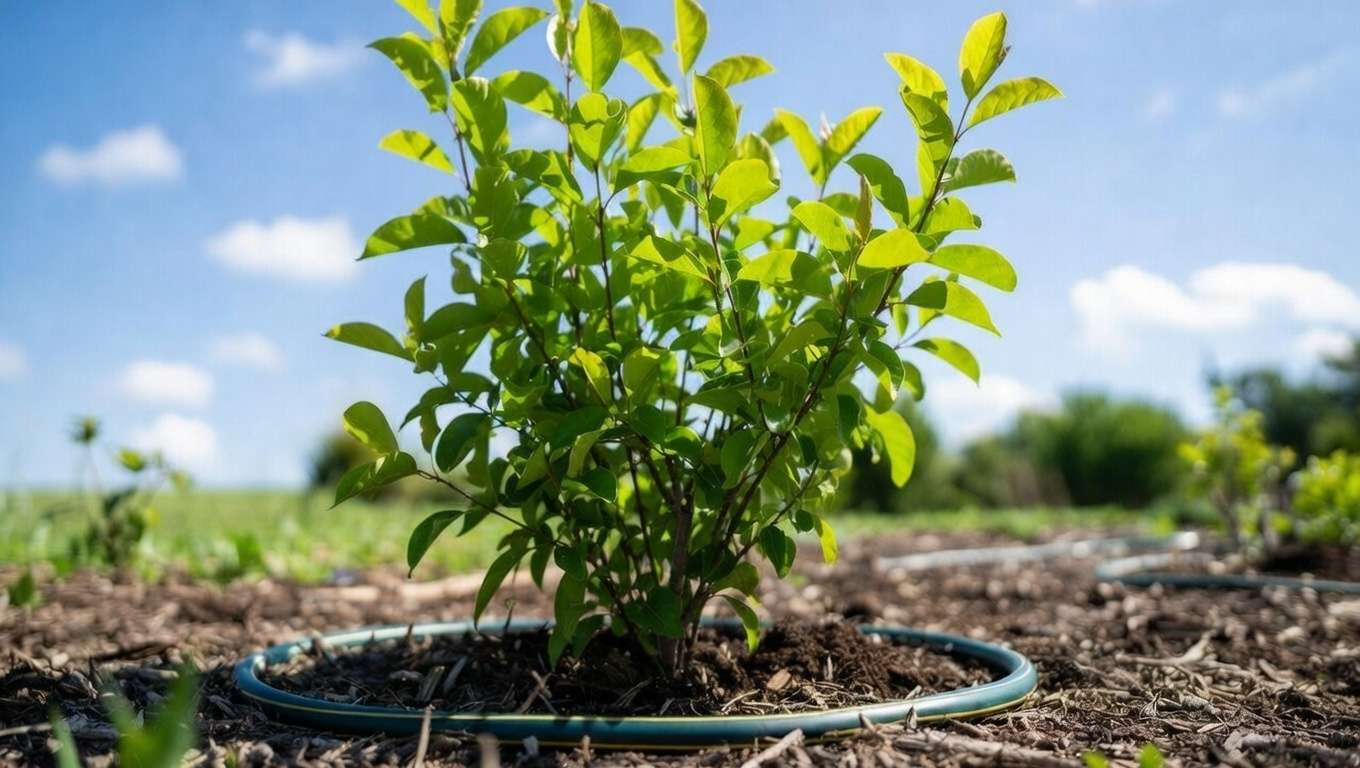
Here are the most effective, proven methods:
- Slow Hose Trickle or Soaker Hose (Most Recommended for Homeowners)
- Why it works: Allows water to penetrate slowly without runoff, reaching 12–18+ inches deep.
- Step-by-step:
- Place a soaker hose in a spiral or donut shape around the tree, starting near the trunk and extending to the drip line (outer edge of canopy).
- Run on low pressure for 30–90+ minutes (or longer in clay soils).
- Aim for 1–2 inches of water applied (roughly 65–130 gallons per 100 sq ft of root zone).
- Check penetration with a screwdriver — it should slide easily 12–18 inches deep when done.
- Pro tip: Use a timer to avoid forgetting! 🌱
- Bucket or Reservoir Method (Great for Precision & New Trees)
- Fill large buckets (5–10 gallons) with water and poke small holes in the bottom.
- Place 3–5 buckets around the drip line; let them drip slowly overnight.
- Ideal for measuring exact amounts (e.g., 20–40 gallons for a young tree).
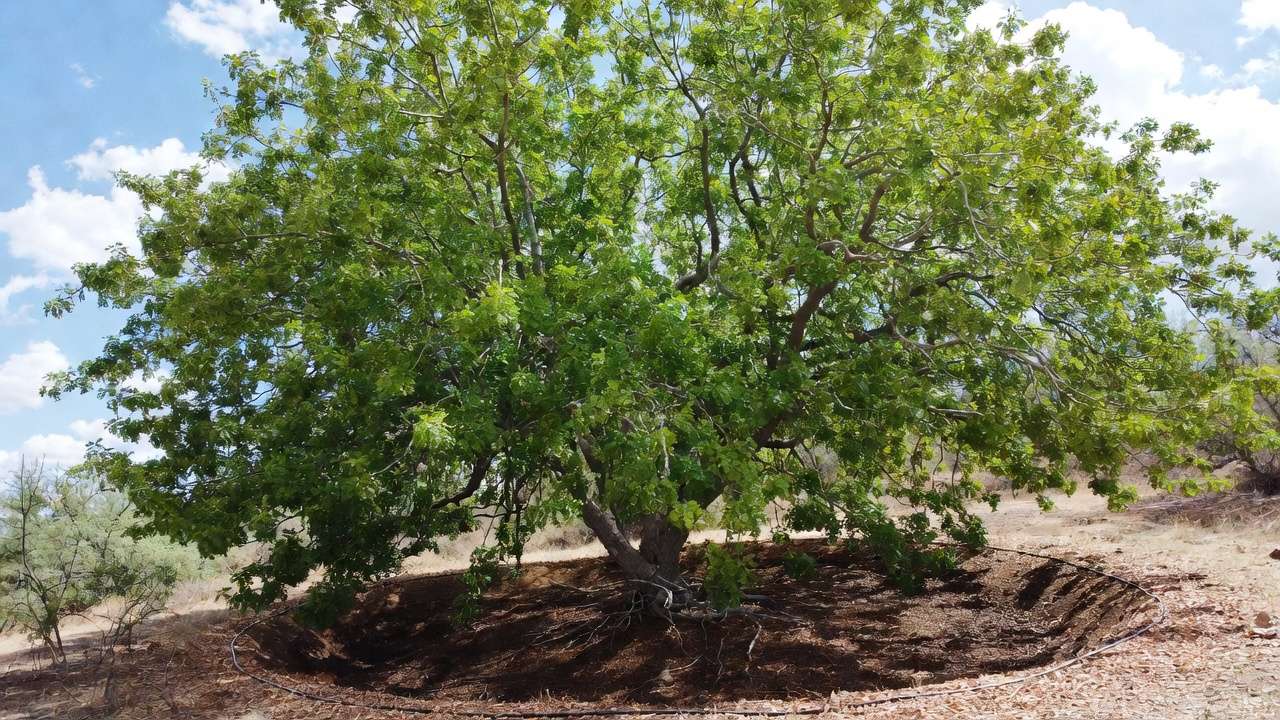
- DIY alternative: Build a small berm (soil ring) 4–6 inches high around the drip line to create a basin that holds water.
- Drip Irrigation or Bubblers Setup
- Install pressure-compensating emitters or inline drip tubing looped around the tree.
- Run 1–8 gallons per hour emitters for several hours to deliver deep moisture efficiently.
- Best for larger yards or multiple trees — conserves water and automates the process.
- Tree Watering Bags/Rings
- Fill-and-forget bags (like Treegator) slowly release 15–20 gallons over 5–9 hours.
- Pros: Perfect for vacation or busy schedules; no runoff.
- Cons: Best for younger trees; remove/refill regularly.
Best time of day: Early morning (before 10 a.m.) or evening (after sunset) to cut evaporation by up to 50%. Avoid midday heat when water can evaporate before soaking in! ⏰ Avoid wetting foliage to prevent fungal issues.
Tools that help:
- Soil moisture meter or probe
- Garden hose timer
- Mulch ring (more on this below!)
These methods, when used correctly, can reduce your watering frequency while building tougher trees. 🌟
Signs Your Tree Needs Water (And Signs of Overwatering) ⚠️
Catching issues early prevents irreversible damage. Here’s how to read your tree’s signals:
Early drought stress signs (act fast!):
- Wilting or drooping leaves, especially in the afternoon (may recover at night initially)
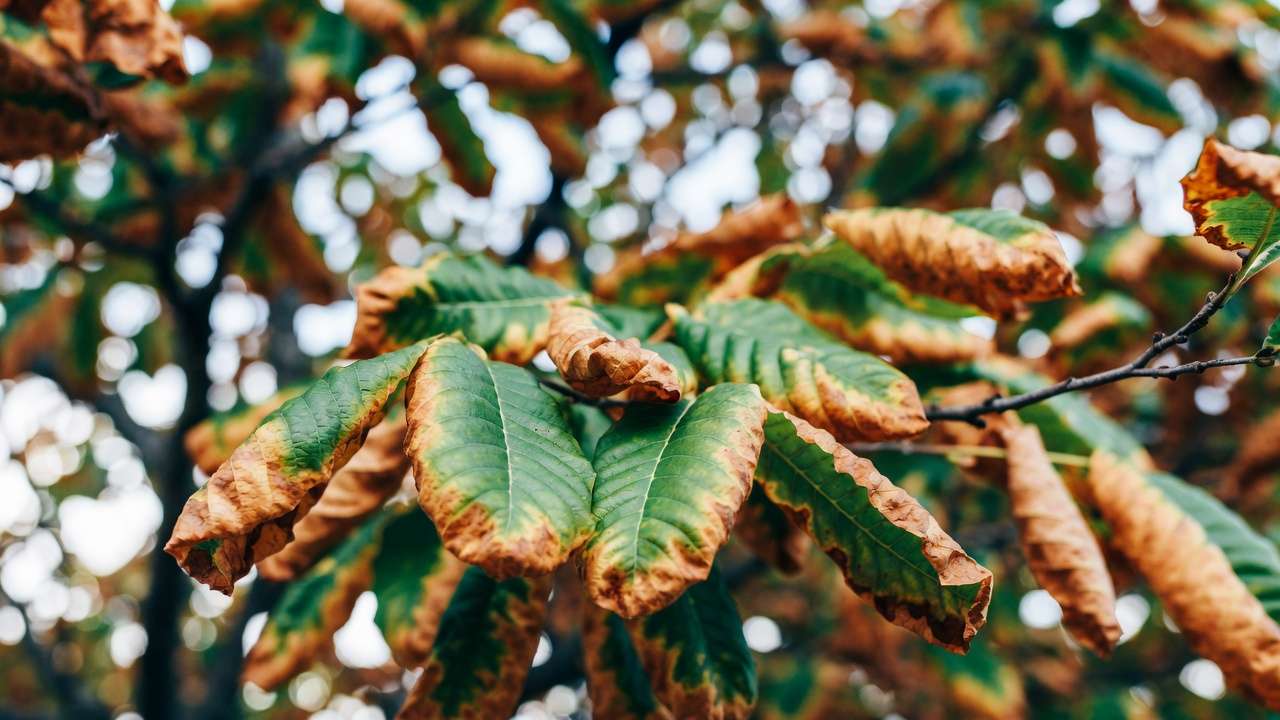
- Curled or cupped leaves
- Dull, grayish-green color instead of vibrant
- Premature fall color or early leaf drop 🍂
- Leaf scorch (brown, crispy edges on leaves)
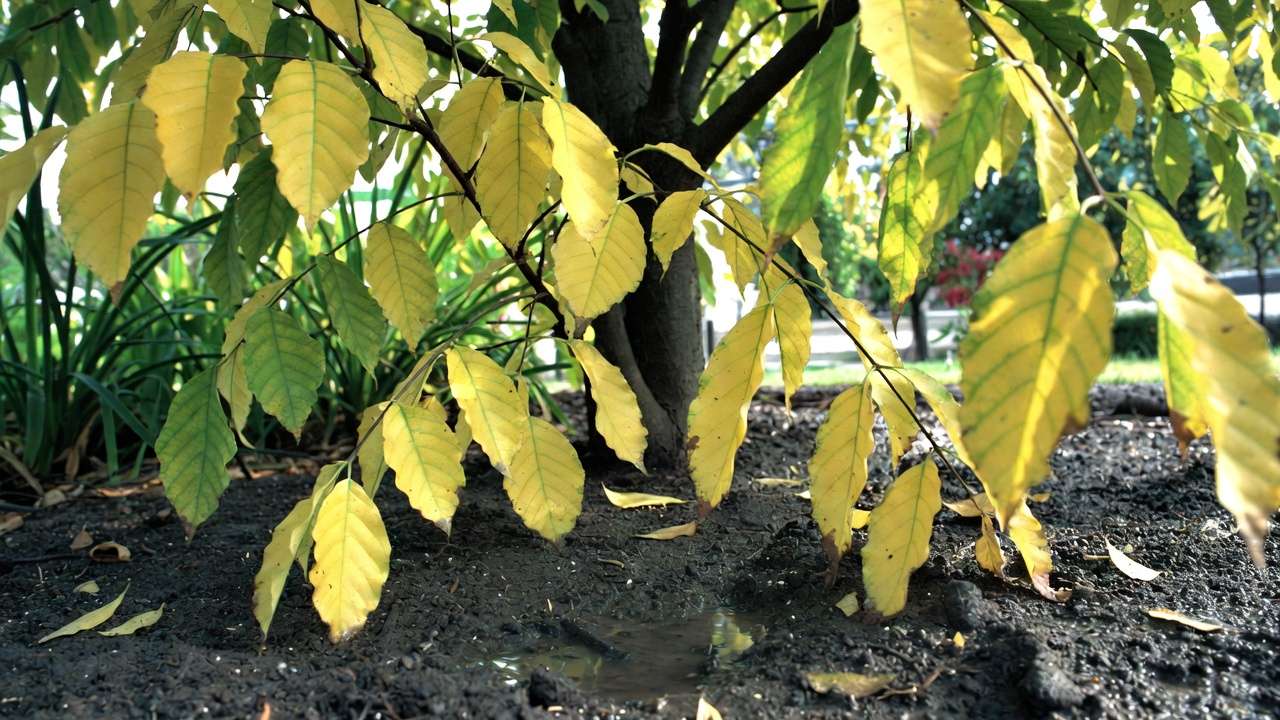
Severe drought stress:
- Thinned canopy, branch tip dieback
- Stunted growth, smaller leaves
- Increased pest activity (e.g., borers attack weakened trees)
- Cracked bark or mushrooms at base (secondary issues)
Overwatering red flags (too much is as bad as too little):
- Yellowing leaves (uniform, not just edges)
- Soft, mushy roots or standing water
- Fungal growth, sour soil smell
- Wilting despite wet soil (roots suffocating from lack of oxygen)
Quick soil check: Insert a screwdriver or finger 6–8 inches deep. Dry and hard? Water. Cool and moist? Wait. If it penetrates easily but soil feels soggy, reduce watering.
Monitor weekly during hot, dry spells — early intervention saves trees!
Bonus Strategies to Reduce Summer Water Stress (Advanced Tips) 🌿
Go beyond basic watering with these expert-recommended tactics:
- Mulching mastery — Apply 2–4 inches of organic mulch (wood chips, bark) in a 3–6 foot ring around the tree (keep 2–3 inches away from trunk to prevent rot). Benefits:
- Conserves soil moisture by reducing evaporation up to 50%
- Moderates soil temperature (cooler roots in summer)
- Suppresses weeds that compete for water
- Improves soil structure as it decomposes Arborists and extensions (PSU, UMN) call this one of the best water-saving moves!
- Create a watering basin — Build a shallow soil berm at the drip line to hold water longer.
- Hydrozoning — Group plants by water needs; avoid planting thirsty annuals under trees.
- Pruning & fertilizing timing — Avoid heavy pruning or fertilizing in summer heat (stresses trees more). Light shaping is OK if needed.
- Spring prep — Deep water in late spring to build reserves before summer hits.
These low-effort habits dramatically boost resilience during heatwaves.
Common Mistakes & How to Fix Them 🚫
Even experienced gardeners slip up — here’s how to avoid pitfalls:
- Shallow daily watering → Fix: Switch to deep weekly soaks.
- Watering only at the trunk → Fix: Focus on drip line (active roots zone).
- Ignoring rainfall → Fix: Only skip if >1 inch soaking rain.
- Watering too fast (runoff) → Fix: Slow trickle or use basins.
- Overwatering after rain → Fix: Always check soil moisture first.
- Mulch volcano (piled against trunk) → Fix: Flat donut shape, trunk clear.
- Forgetting evergreens → Fix: They transpire year-round; water in fall too if dry.
- Relying only on lawn sprinklers → Fix: They rarely reach tree root depth.
Spot these early and correct — your trees will bounce back stronger!
Regional Adjustments & Special Cases 🌍
Your local climate, soil, and tree type can dramatically shift the watering schedule we’ve outlined. Here are tailored adjustments based on real-world regional patterns and special situations:
- Arid/Southwest & Dry Western Climates (e.g., Arizona, Nevada, Southern California, parts of Texas) Summer temperatures regularly hit 100°F+ with very low humidity and minimal summer rain. → Increase frequency: Newly planted → every 3–5 days; young trees → every 5–7 days; mature → every 7–10 days even in moderate drought. → Use more mulch (4+ inches) and watering bags to combat extreme evaporation. → Prioritize native drought-tolerant species (mesquite, palo verde, live oak) — they often need far less supplemental water once established.
- Humid/Southeast & Gulf Coast Regions (e.g., Florida, Louisiana, Georgia, coastal Carolinas) High humidity slows evaporation, but intense heat + afternoon thunderstorms are common. → Rely heavily on natural rainfall — skip watering after ≥1 inch of rain. → Focus on drainage: Clay-heavy soils here can stay soggy; avoid overwatering to prevent root rot. → Sandy coastal soils dry faster — check moisture frequently.
- Midwest, Northeast & Pacific Northwest Summers vary widely — humid continental heatwaves alternate with cooler, wetter periods. → Baseline: Stick to the weekly deep-water rule, but monitor closely during prolonged dry spells (common in late summer). → Urban heat islands (Chicago, NYC, Seattle metro) can increase needs by 20–30%.
- Container-Grown Trees Pots heat up fast and dry out much quicker than in-ground planting. → Water every 2–4 days in summer (daily in extreme heat). → Use large pots with excellent drainage + saucers to hold extra water. → Apply slow-release moisture-retaining granules or hydrogel products.
- Fruit Trees, Conifers & Evergreens
- Fruit trees (apple, peach, citrus): Need consistent moisture during fruit development — aim for even soil moisture to prevent cracking or drop.
- Conifers & evergreens: Transpire year-round; water deeply in late fall if soil is dry going into winter dormancy.
- Shallow-rooted species (birch, dogwood, Japanese maple): More frequent checks and watering needed.
Always adapt to your microclimate — a tree next to a south-facing brick wall will dry out faster than one in dappled shade.
Frequently Asked Questions (FAQ) ❓
Here are the most common questions readers ask about summer tree watering:
- How long should I run the hose for deep watering? 30–120+ minutes on low flow, depending on soil type and tree size. Check penetration with a soil probe or screwdriver — aim for 12–18 inches moist.
- Do established trees really need summer water in most areas? Yes, during prolonged dry spells (2+ weeks without significant rain), even mature trees benefit from supplemental deep watering to avoid stress, especially in urban settings or heatwaves.
- What if we get rain — can I skip watering? Yes — if ≥1 inch of soaking rain falls within the last week, delay watering. Light showers (<0.5 inch) usually don’t count.
- Is it better to water deeply once a week or lightly more often? Deeply and infrequently is far superior — it promotes deep, drought-resistant roots and uses water more efficiently.
- Should I water my trees every day in 100°F heat? No — daily shallow watering harms more than it helps. Stick to deep soaks every 3–7 days (more often for new trees).
- How do I know if I’m overwatering? Yellow leaves, soggy soil, fungal issues, or wilting despite wet soil are classic signs. Always test soil moisture before watering.
- Is mulch really that important in summer? Absolutely — 2–4 inches of organic mulch can cut evaporation by up to 50%, keep roots cooler, and reduce watering needs.
- What about watering during a heatwave with no end in sight? Temporarily increase frequency (e.g., every 4–5 days for young trees), but keep sessions deep. Mulch heavily and consider temporary shade cloth for young/vulnerable trees.
Final Thoughts & Call to Action 💚
Mastering a summer watering schedule for trees isn’t about watering more — it’s about watering smarter. Deep, infrequent, thoughtful applications of water, combined with mulch, soil checks, and timing adjustments, build resilient trees that handle heatwaves, conserve your water bill, and live longer, healthier lives.
The key takeaway: Observe your own trees and soil. Stick a screwdriver in the ground weekly, watch for early stress signs, and adjust as needed. One season of proper summer care can make the difference between a thriving canopy and costly replacements.
As tree care specialists (drawing from decades of university extension research, ISA-certified arborist guidelines, and hands-on experience), we’ve seen proper deep watering save countless trees during brutal summers — now it’s your turn to give your landscape that same advantage.
Have questions about your specific trees or soil type? Drop a comment below — we’d love to help tailor advice for your yard! Share this guide with fellow gardeners, and subscribe for more science-backed plant & tree care tips all year round. 🌳💧
Your trees are counting on you this summer — happy (and smart) watering! 🌟











