
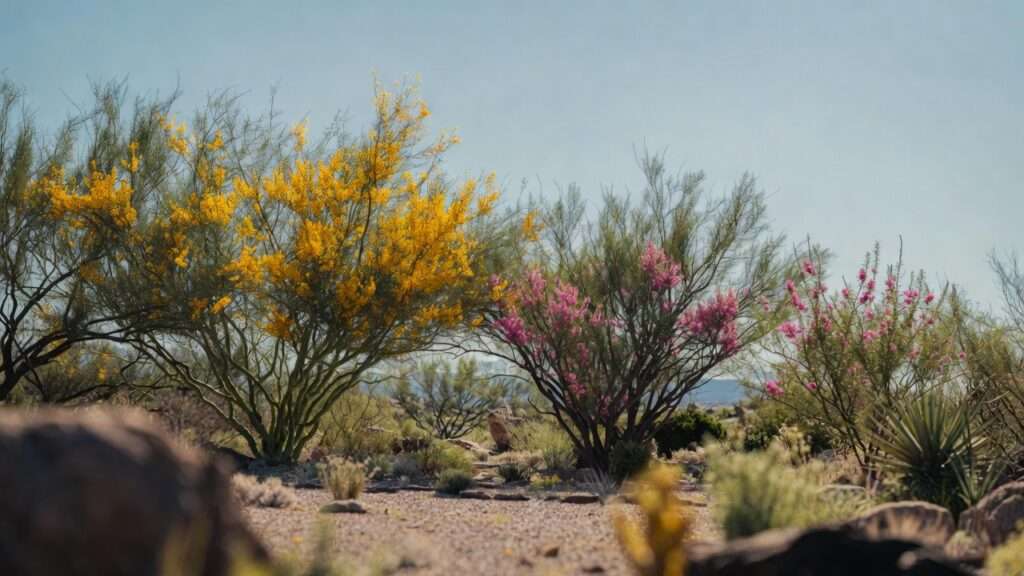
Picture this: Your backyard, once a barren, sun-baked patch of dust and cracked earth, now bursts with life. Lush green canopies filter the harsh afternoon sun, vibrant yellow blooms light up spring days, and birds flit between branches while your water bill stays refreshingly low. This isn’t a fantasy—it’s the reality for countless homeowners in arid regions who have mastered choosing desert-adapted trees for landscaping. These resilient species turn challenging desert environments into beautiful, sustainable oases with minimal effort and maximum reward. 🌞🏡
As a horticulturist with over 15 years of experience working in Sonoran, Mojave, and similar dry climates, I’ve helped design hundreds of low-water landscapes. I’ve seen non-native trees struggle and die under relentless heat, while desert-adapted varieties thrive for decades. In this ultimate guide, we’ll cover everything you need to know—from understanding adaptations to expert picks, planting tips, and design ideas—to help you create a stunning, water-wise yard that supports local ecosystems and withstands climate extremes. Let’s dive in and build your drought-tolerant paradise! 💚
Why Choose Desert-Adapted Trees? The Real Benefits for Arid Landscapes 🌿
In water-scarce regions, every drop counts. Desert-adapted trees offer game-changing advantages over traditional landscape trees:
- Water Savings and Sustainability 💧: Once established (usually 1–2 years), most need little to no supplemental irrigation. They align perfectly with xeriscape principles, helping combat drought and reduce municipal water strain.
- Heat and Drought Resilience 🔥: Specialized features like deep taproots, small or feathery leaves, and photosynthetic bark allow survival in 100°F+ temperatures and minimal rainfall.
- Shade, Beauty, and Functionality 🌳: They deliver filtered or dappled shade (ideal for patios and energy savings), seasonal color, privacy, and windbreaks.
- Low Maintenance & Longevity 🛠️: Fewer pests/diseases, less pruning, and lifespans of 50–300+ years make them smart long-term investments.
- Environmental Impact 🌍: Native or well-adapted species boost biodiversity by providing food/shelter for pollinators, birds, and wildlife. They prevent soil erosion, improve air quality, and mitigate urban heat islands.
By choosing these trees, you’re not just beautifying your property—you’re contributing to a more resilient ecosystem. 🌎
Understanding Desert-Adapted Trees: Key Characteristics & Adaptations 🧬
What makes a tree truly “desert-adapted”? These species have evolved remarkable survival strategies:
- Deep taproots or wide-spreading roots — Access groundwater far below the surface.
- Small, waxy, or compound leaves — Reduce transpiration (water loss).
- Green bark photosynthesis (e.g., in Palo Verde) — Allows energy production even when leaves drop during drought.
- Drought-deciduous behavior — Shed leaves to conserve water, then regrow quickly after rain.
- Native vs. adapted non-natives — Prioritize natives for best ecological fit, but some introduced species (like certain Acacias) perform exceptionally in arid zones.
These traits make them far superior to thirsty imports like ash or mulberry in dry climates.
How to Assess Your Landscape Before Choosing Trees 📏
Success starts with site analysis—skip this, and even the toughest tree may struggle.
Site Evaluation Checklist
- Sun exposure & microclimates — Full sun is standard, but note hot reflected walls or shaded pockets.
- Soil type (sandy, clay, rocky) & drainage — Most prefer well-drained; test by digging a hole and observing water percolation.
- Available space — Consider mature height/width to avoid crowding structures or power lines.
- Proximity to pools, sidewalks, or septic systems — Roots can be invasive in some species.
- Hardiness zone & frost risk — Most thrive in USDA 8–10, but check for occasional cold snaps.
Common Landscaping Goals & Tree Matches
- Maximum shade 🌿 → Mesquite or Desert Museum Palo Verde
- Ornamental flowers & color 💐 → Desert Willow or Sweet Acacia
- Privacy screening & windbreaks 🛡️ → Ironwood or dense Acacia
- Small yards or patios 🏡 → Compact varieties like Desert Willow
- Wildlife attraction 🐦🦋 → Mesquite (pods for food) or flowering types
Pro tip: Sketch your yard and mark goals before shopping! ✏️
Top Desert-Adapted Trees: Expert Recommendations (2025–2026 Updates) 🌟
Here are proven performers based on real-world trials, university extension data, and landscaper feedback in arid Southwest-like regions:
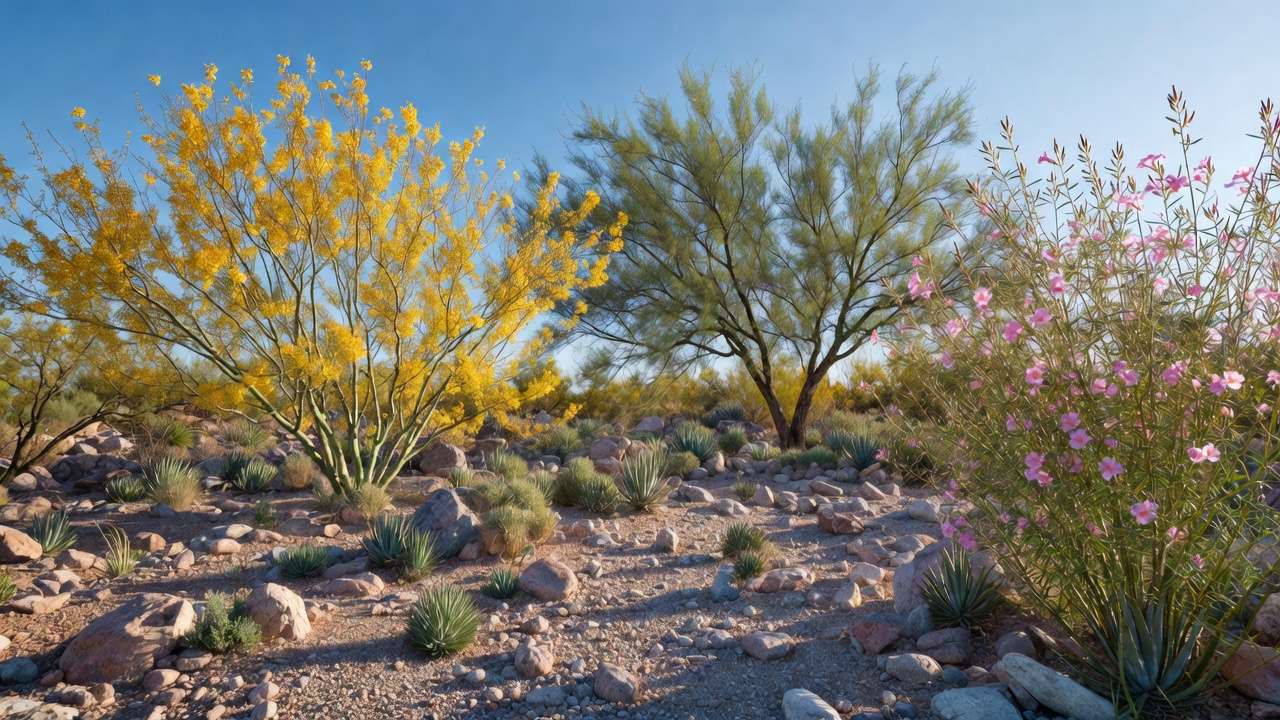
1. Palo Verde (Parkinsonia spp.) – Arizona’s State Tree 🌼
The iconic green-barked beauty! Photosynthesizes through branches, drops tiny leaves minimally.
- Top varieties: Blue Palo Verde (Parkinsonia florida), Desert Museum hybrid (fast-growing, thornless), Foothills Palo Verde.
- Pros: Vibrant spring yellow blooms, fast growth (15–30 ft tall/wide), excellent filtered shade, extremely drought-tolerant.
- Cons: Can be messy during bloom drop; some have thorns (choose hybrids).
- Best for: Shade providers, modern xeriscapes.
2. Desert Willow (Chilopsis linearis) – Flowering Favorite 🌸
Not a true willow—orchid-like trumpet flowers in pink, purple, or white attract hummingbirds.
- Pros: Showy blooms summer–fall, slender graceful form (15–25 ft), low water once established, non-invasive roots.
- Cons: Limited dense shade (airy canopy), drops leaves in winter, can be slow to establish.
- Best for: Color accents, pollinator gardens, smaller spaces.
3. Mesquite (Prosopis spp.) – Tough & Classic 🌿
Nitrogen-fixing roots improve soil; pods feed wildlife.
- Top varieties: Honey Mesquite, Velvet Mesquite (native), Chilean Mesquite (faster but potentially invasive roots—use cautiously).
- Pros: Wide canopy for deep shade (20–40 ft), ultra-drought-tolerant, long-lived.
- Cons: Thorns on some, pod litter, can grow large—plan space.
- Best for: Shade trees, edible/wildlife yards.
4. Desert Ironwood (Olneya tesota) – Long-Lived Icon 🪵
One of the oldest desert species—extremely dense wood.
- Pros: Evergreen-ish foliage, pink spring flowers, ultimate drought-proof (20–30 ft), provides habitat.
- Cons: Very slow-growing (decades to mature size), expensive/transplant tricky.
- Best for: Focal points, long-term investments, erosion control.
5. Acacia Varieties (Acacia spp.) – Versatile & Showy 🌟
Feathery foliage, fragrant blooms.
- Top picks: Sweet Acacia (yellow puffballs), Mulga Acacia (evergreen-ish).
- Pros: Fast growth, colorful, adaptable.
- Cons: Some thorny, potential invasiveness in certain areas.
- Best for: Ornamental interest, screens.
Other Standouts Worth Considering
- Texas Ebony — Dense, evergreen shade.
- Bottle Tree — Unique form.
- Mastic Tree — Low-litter evergreen.
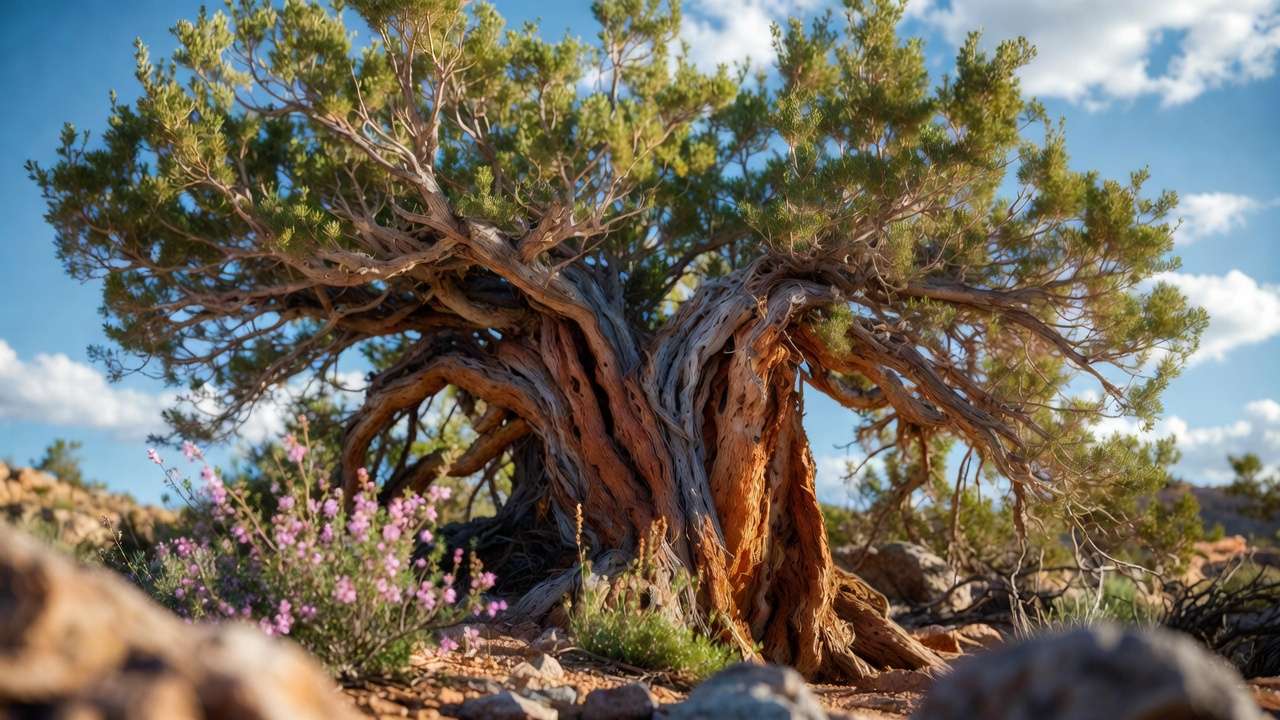
(For each, check local nurseries for region-specific cultivars—always prioritize natives! 🌱)
Step-by-Step Guide to Planting Desert-Adapted Trees 🪴
Planting right ensures quick establishment:
- Timing ⏰ — Fall or winter (cooler months) for root growth before summer heat.
- Site Preparation — Minimal amendment; focus on loosening soil for drainage.
- Planting Hole & Technique — Dig 2–3x wider than root ball, same depth; keep root flare at/above soil level.
- Initial Watering 💦 — Deep soak weekly first year; taper off.
- Mulching Best Practices — 3–4″ organic mulch ring (keep away from trunk) to retain moisture & suppress weeds.
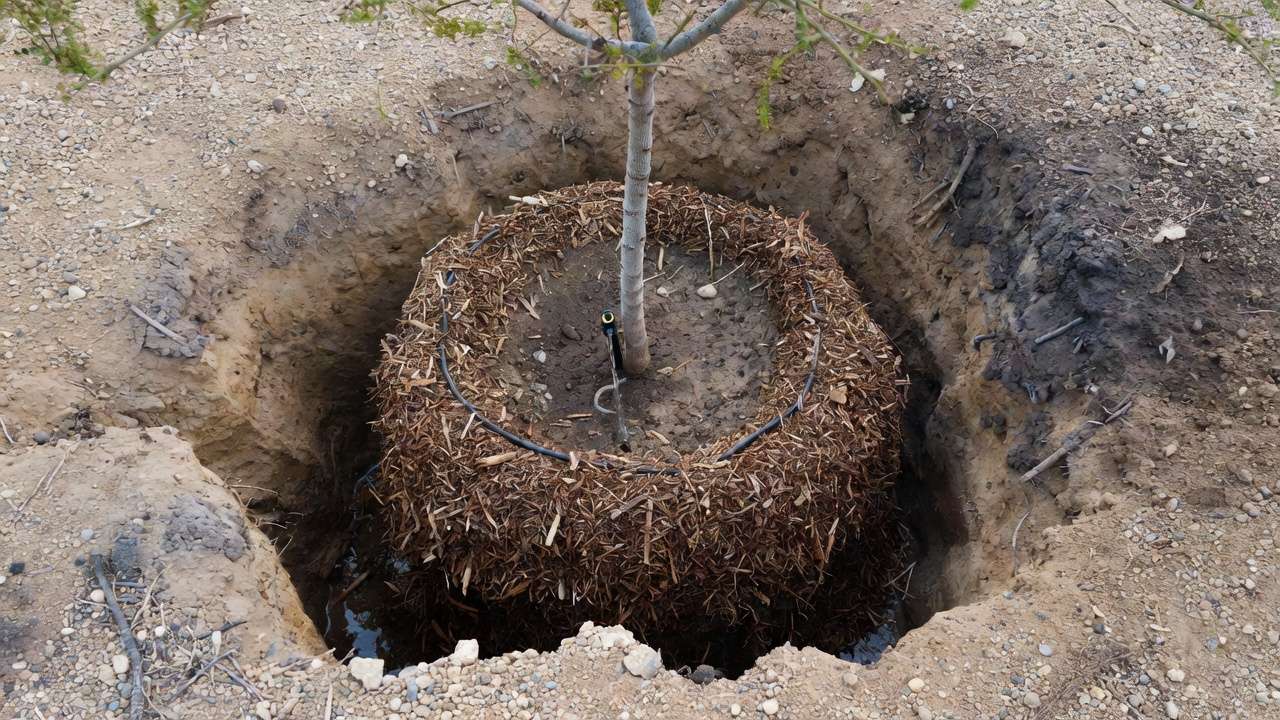
Avoid common errors like over-amending or planting too deep!
Ongoing Care for Thriving Desert Trees 🌱💦
Once planted, desert-adapted trees are famously low-maintenance—but the first 1–3 years are critical for establishing a strong root system. Here’s how to set them up for lifelong success.
Watering Schedules by Tree & Season
Proper watering is the #1 factor in successful establishment. The golden rule: deep, infrequent, infrequent.
- Year 1 (Establishment Phase): Water deeply (to 24–36 inches) every 7–10 days in summer, every 10–14 days in spring/fall, and every 3–4 weeks in winter (if no rain). Use a slow hose or drip system for 30–60 minutes per session.
- Year 2: Reduce frequency by about 25–50% — every 10–14 days summer, 14–21 days other seasons.
- Year 3 and Beyond (Mature Phase): Most species need supplemental water only during extreme drought or heat waves (e.g., 1–2 deep soaks per month in summer if <0.5 inches rain). Palo Verde, Mesquite, and Ironwood often survive on rainfall alone after year 2.
Quick Reference Watering Guide (approximate, adjust for your microclimate and soil):
| Tree Species | Summer (First 2 Years) | Mature Summer Watering | Winter Watering (Mature) |
|---|---|---|---|
| Palo Verde | Every 7–10 days | Rainfall only or 1x/mo | Rarely needed |
| Desert Willow | Every 7–10 days | 1–2x/mo if no rain | Every 4–6 weeks |
| Mesquite | Every 7–14 days | Rainfall only | Very rarely |
| Desert Ironwood | Every 10–14 days | Rainfall only | Almost never |
| Sweet Acacia / Mulga | Every 7–12 days | 1x/mo if dry | Every 4–6 weeks |
Always check soil moisture 6–12 inches deep before watering—overwatering kills more desert trees than drought!
Pruning Tips for Health & Shape ✂️
Prune sparingly—these trees naturally form beautiful shapes.
- Best time: Late winter to early spring (before new growth) or right after bloom for flowering species.
- What to remove:
- Dead, damaged, or crossing branches
- Lower limbs for clearance (especially under patios or walkways)
- Suckers from the base
- Avoid:
- Heavy topping or shearing (weakens structure)
- Pruning during summer heat (stresses tree)
- Pro tip: For Mesquite and Palo Verde, selective thinning opens the canopy for better airflow and reduces wind damage.
Pest & Disease Management – Natural Approaches 🐛
Desert-adapted trees are remarkably pest-resistant, but occasional issues arise:
- Common problems:
- Aphids or scale on new growth (Desert Willow, Acacia)
- Borers in stressed or overwatered trees
- Root rot from poor drainage or overwatering
- Organic solutions:
- Blast aphids with strong water spray
- Introduce beneficial insects (ladybugs, lacewings)
- Neem oil or insecticidal soap for soft-bodied pests
- Improve drainage and avoid overwatering to prevent fungal issues
- Prevention beats treatment: Healthy, properly sited trees rarely need intervention.
Fertilization – Less is More 🌿
Most desert natives thrive in lean soil.
- Use low-nitrogen, slow-release fertilizer (e.g., 4-6-6 or organic compost) only in spring of years 1–2.
- After establishment: skip commercial fertilizers entirely—excess nitrogen promotes weak, thirsty growth.
- Bonus: Mulch decomposition naturally feeds the soil microbiome.
Design Ideas: Integrating Desert Trees into Your Landscape 🎨🏜️
A well-planned layout turns individual trees into a cohesive, functional desert garden.
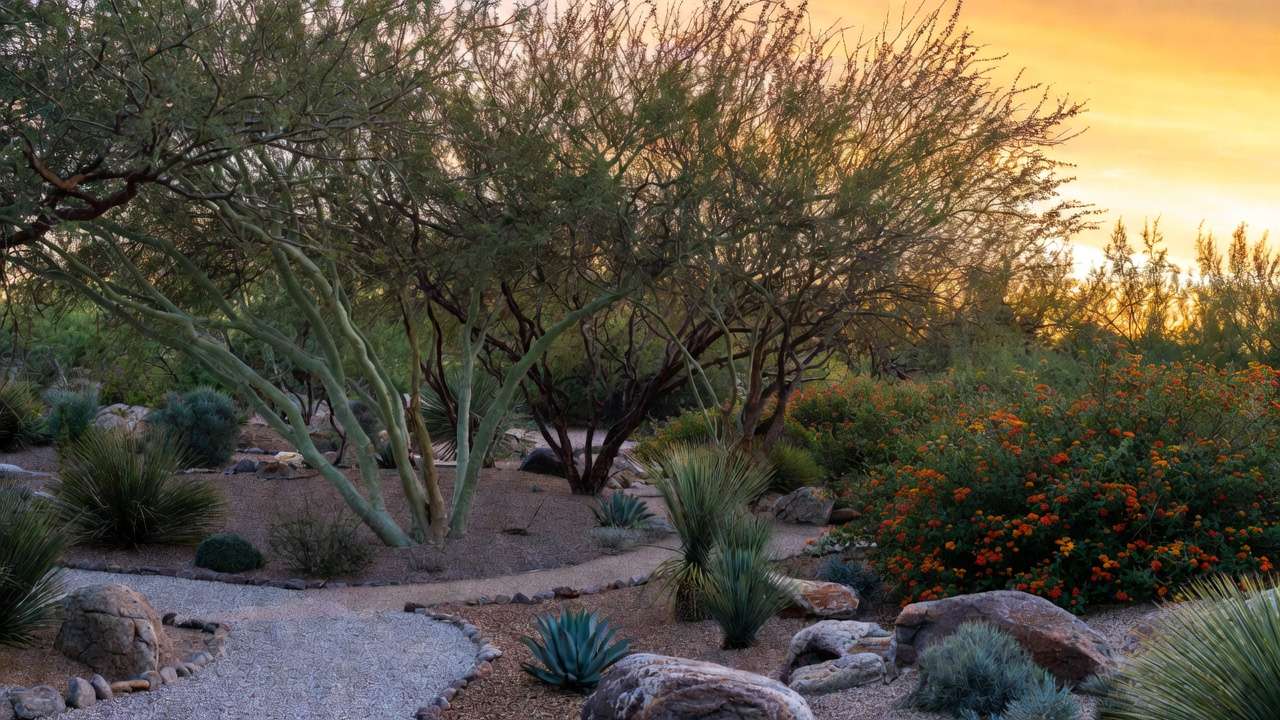
- Xeriscape Layouts — Layer with boulders, decomposed granite, gravel mulch, and native perennials/succulents (agave, yucca, lantana, penstemon).
- Shade Garden Under Canopy — Plant shade-tolerant natives (turpentine bush, brittlebush, fairy duster) beneath Mesquite or Palo Verde.
- Focal Point Specimens — Use a single majestic Ironwood or Desert Museum Palo Verde as a centerpiece near entryways or pools.
- Group Plantings for Windbreaks & Privacy — Cluster 3–5 Mesquites or Acacias along property lines for natural screens.
- Pollinator & Bird Havens — Combine Desert Willow, Sweet Acacia, and Mesquite to create year-round food and shelter.
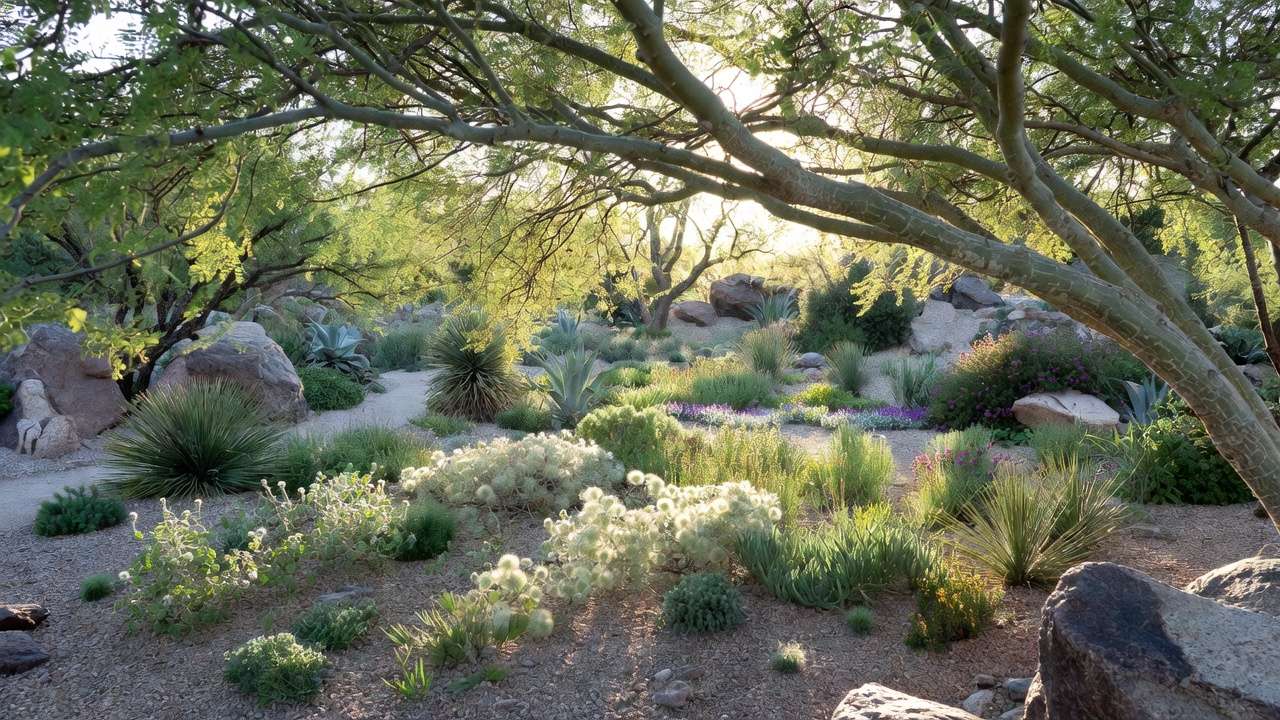
Pro design tip: Use odd numbers (3, 5, 7) for natural-looking groupings, and vary heights/textures for visual interest. 🌿✨
Common Mistakes to Avoid When Choosing & Planting ❌
Even experienced gardeners make these errors—learn from them!
- Choosing thirsty non-adapted species (e.g., fruitless mulberry, ash, pine) → high water use and eventual death.
- Overwatering established trees → causes root rot and weak growth.
- Ignoring mature size → leads to crowded, damaged structures or constant pruning.
- Planting too deep → buries the root flare, suffocates the tree.
- Neglecting soil drainage → standing water kills roots fast.
- Skipping establishment watering → weak roots = poor long-term survival.
- Buying from big-box stores without local adaptation → many sell unsuitable cultivars.
Avoid these pitfalls, and your success rate skyrockets! 🚀
FAQs About Choosing Desert-Adapted Trees for Landscaping ❓
Which tree gives the most shade with the least water? Honey Mesquite or Desert Museum Palo Verde—wide canopies and ultra-low water needs once established.
Are these trees messy? Somewhat: Palo Verde drops yellow blooms, Mesquite drops pods, Desert Willow drops narrow leaves. Choose based on tolerance—most are cleaner than traditional shade trees.
How long until they provide usable shade? Fast-growers (Palo Verde, Desert Willow, Chilean Mesquite): 3–7 years. Slower ones (Ironwood): 10–20+ years. Plant smaller/fast species for quicker results.
Best for small yards or patios? Desert Willow, Sweet Acacia, or compact Palo Verde hybrids—airy canopies and smaller mature sizes (15–25 ft).
Are there pet-safe options? Most are non-toxic to pets. Mesquite pods are edible for livestock/wildlife but generally safe. Avoid over-fertilizing, which can attract more insects.
Can I plant near a pool? Yes—choose low-litter varieties (Desert Willow, Mulga Acacia) and keep 10–15 ft away to avoid root intrusion or debris.
Final Thoughts: Create Your Drought-Tolerant Paradise Today! 🌳💚
Choosing desert-adapted trees for landscaping is one of the most rewarding decisions you can make in an arid climate. These remarkable plants deliver beauty, shade, wildlife support, and serious water savings—all while asking for very little in return.
Start small: observe your site, pick 1–3 species that match your goals, plant in fall or winter, and commit to smart establishment care. Within a few years, you’ll have a resilient, low-maintenance landscape that looks stunning and feels right at home in the desert.
Ready to get started? Visit your local native plant nursery, consult your county extension office, or join regional gardening groups for the latest regionally tested cultivars. Your future shady, sustainable oasis is waiting! 🏜️🌞











