
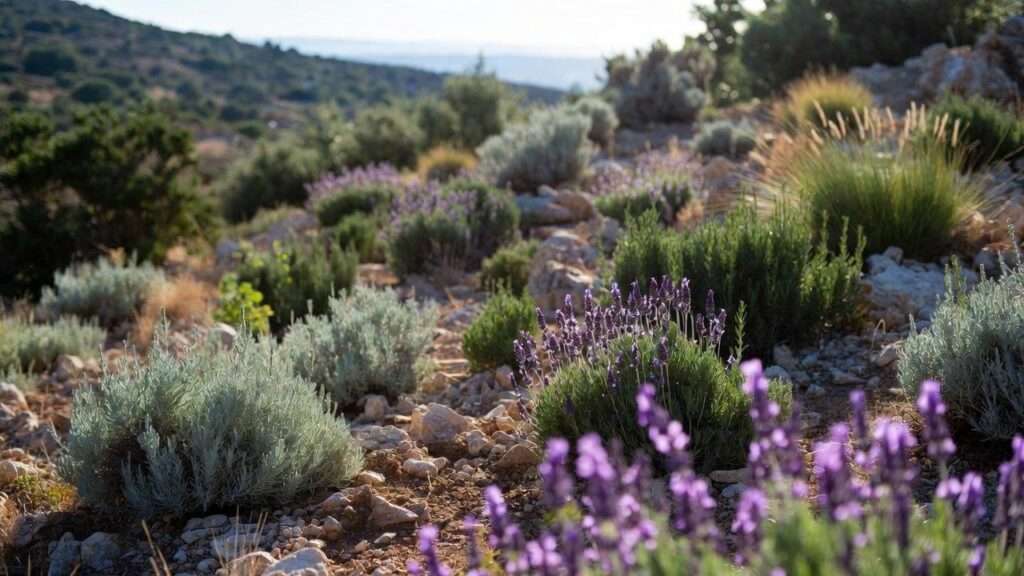
Tired of watching your garden wilt during scorching summer heatwaves or racking up high water bills just to keep everything green? 😩 With climate change bringing more frequent droughts, water restrictions, and the rising cost of irrigation, many homeowners and gardeners face the same frustrating challenge: how to create a lush, attractive outdoor space that doesn’t demand constant watering.
The good news? You don’t have to sacrifice beauty for sustainability. Mediterranean shrubs for low-water gardens offer the perfect solution. These resilient, sun-loving plants hail from the hot, dry regions around the Mediterranean Sea—think coastal Spain, Italy, Greece, and southern France—where long, rainless summers and mild, wet winters are the norm. They’ve evolved clever adaptations like silvery or fuzzy leaves that reflect intense sunlight, deep root systems that tap into soil moisture, waxy coatings to minimize evaporation, and aromatic oils that naturally deter pests. 🌞
In this in-depth guide, as a plant care expert with years of hands-on experience in xeriscaping and drought-tolerant landscaping, I’ll share the top drought-tolerant Mediterranean shrubs that thrive with minimal irrigation once established. You’ll get detailed profiles, proven design ideas, step-by-step planting and care advice, companion suggestions, and troubleshooting tips to build a stunning, low-maintenance garden that saves water, supports pollinators 🐝, boosts biodiversity, and delivers year-round interest. Whether you’re in a dry-summer climate like California, parts of Australia, the southern U.S., or even adapting to hotter UK/European summers, these shrubs deliver effortless elegance and real environmental benefits. Let’s turn your thirsty yard into a thriving Mediterranean oasis! ✨
Why Mediterranean Shrubs Are Perfect for Low-Water Gardens
The magic lies in their origins. Mediterranean climates feature hot, dry summers and cooler, wetter winters—conditions increasingly common worldwide due to shifting weather patterns. Plants from this biome are naturally pre-adapted to drought stress, making them ideal for xeriscape gardens, water-wise landscaping, and sustainable outdoor spaces.
Key adaptations that make them so tough:
- Reflective foliage — Silvery-gray or woolly leaves bounce away harsh sun rays, reducing heat absorption.
- Deep, extensive roots — They seek out moisture far below the surface, needing far less supplemental water after the first 1–2 years.
- Reduced transpiration — Thick cuticles, small or needle-like leaves, and essential oils limit water loss.
- Pest and disease resistance — Aromatic compounds (think rosemary’s camphor scent) repel deer, rabbits, and many insects naturally.
Beyond survival, these shrubs deliver huge rewards:
- Extremely low water needs — Often just rainfall plus one deep soak per month in peak summer 💧
- Deer and rabbit resistance 🌿
- Pollinator paradise — Bees, butterflies, and hummingbirds flock to the blooms 🦋
- Evergreen or semi-evergreen structure for four-season appeal
- Low maintenance — Little pruning, no heavy fertilizers, and tolerance for poor, rocky soils
- Fragrance, color, and texture — From lavender’s calming scent to rockrose’s papery flowers
In my experience working with clients in drought-prone areas, these shrubs consistently outperform many traditional or even native options in hot, low-water settings while creating that dreamy, resort-like Mediterranean vibe—without the guilt of high water use. 🌍
Top 12 Mediterranean Shrubs for Low-Water Gardens
Here are my curated top picks, selected for reliability, beauty, and proven performance in dry conditions. Each includes hardiness zones (USDA), mature size, bloom time, key features, and expert care notes.
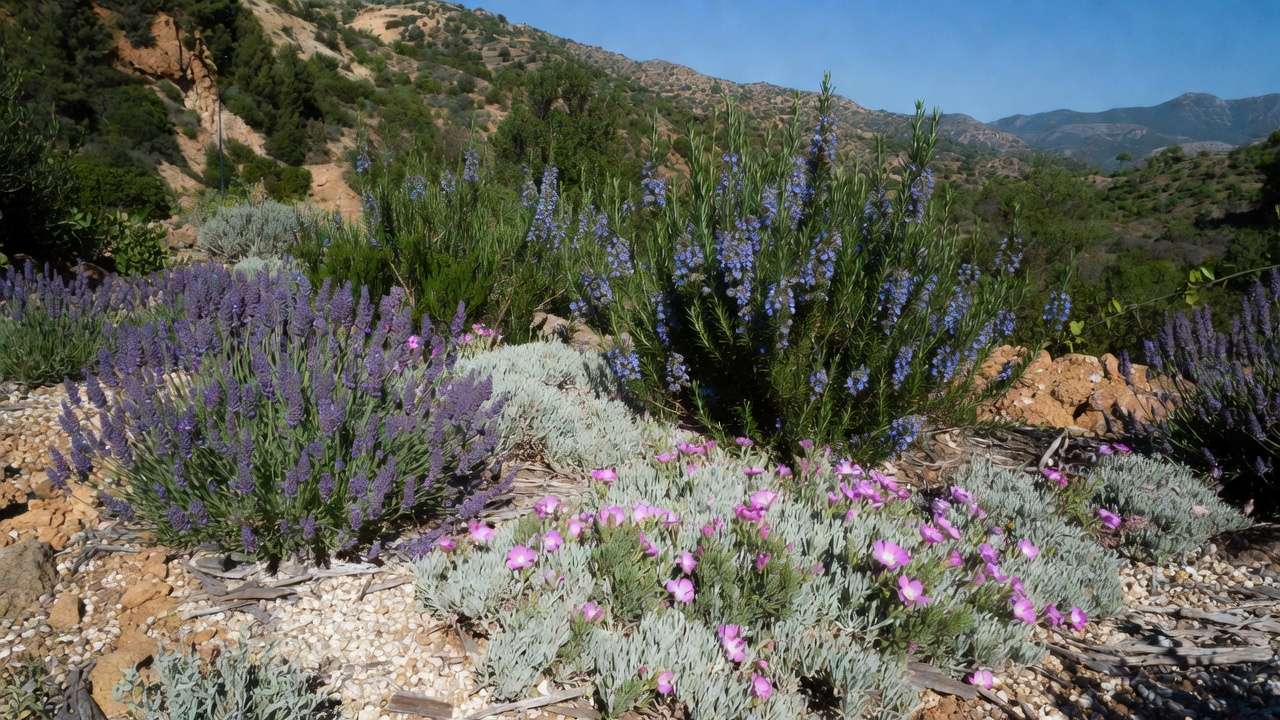
Lavender (Lavandula spp.) 🌸 The undisputed queen of drought-tolerant gardens! Silvery foliage, intoxicating fragrance, and long spikes of purple flowers.
-
- Zones: 5–9 (English lavender hardier; French/Spanish varieties for warmer spots)
- Size: 1–3 ft tall/wide
- Bloom: Summer
- Why it excels: Ultra-low water once established; bee magnet; great for borders or hedges.
- Pro tip: Plant in full sun with excellent drainage—avoid wet feet! Shear lightly after flowering to keep compact. ✨
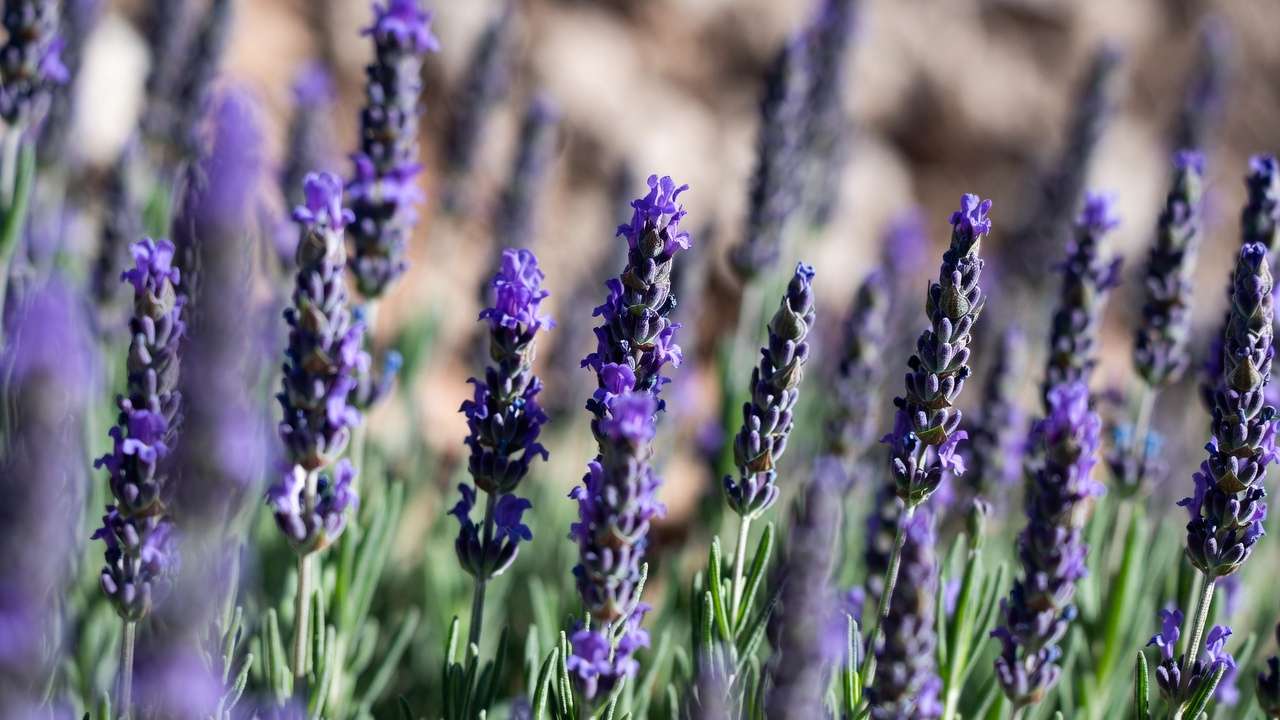
Rosemary (Salvia rosmarinus) 🍃 Edible, evergreen, and incredibly tough—perfect as a hedge or accent. Sky-blue blooms in spring/summer.
-
- Zones: 7–10
- Size: 2–6 ft (upright or trailing varieties)
- Bloom: Spring–summer
- Why it excels: Thrives on neglect; aromatic leaves repel pests; coastal tolerant.
- Pro tip: Prune after blooming for bushiness—use clippings in cooking! 🍴
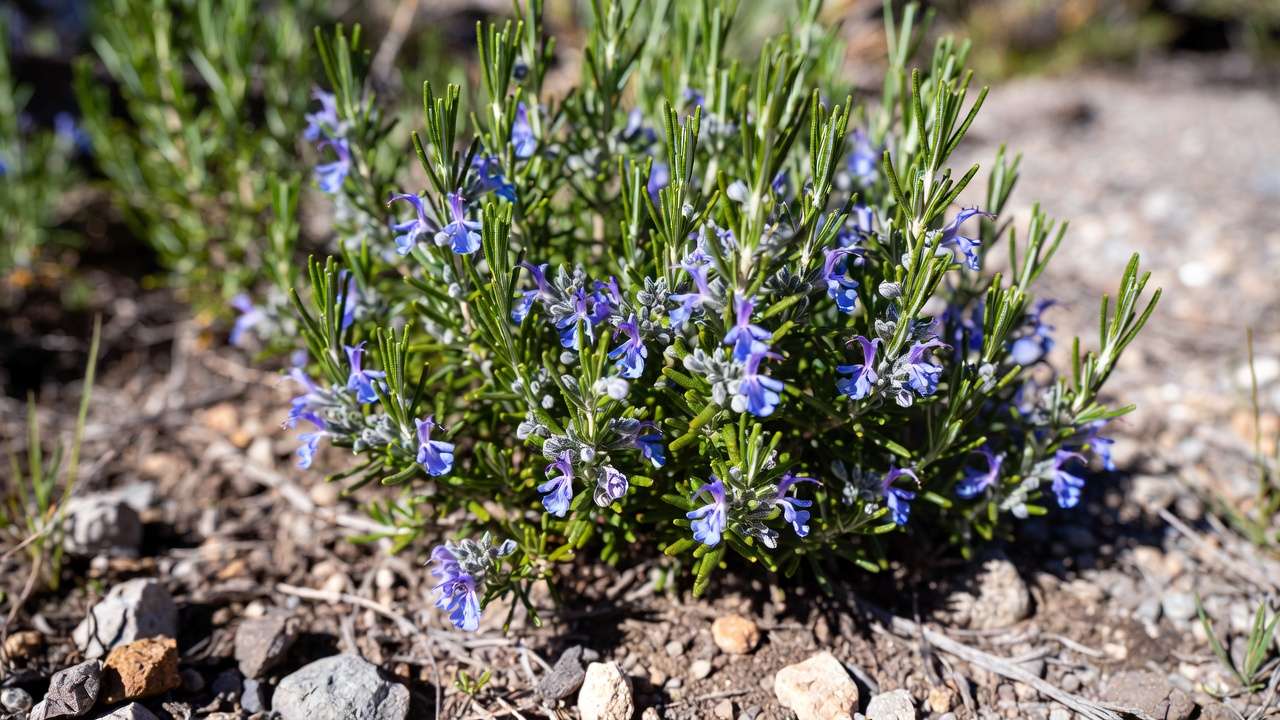
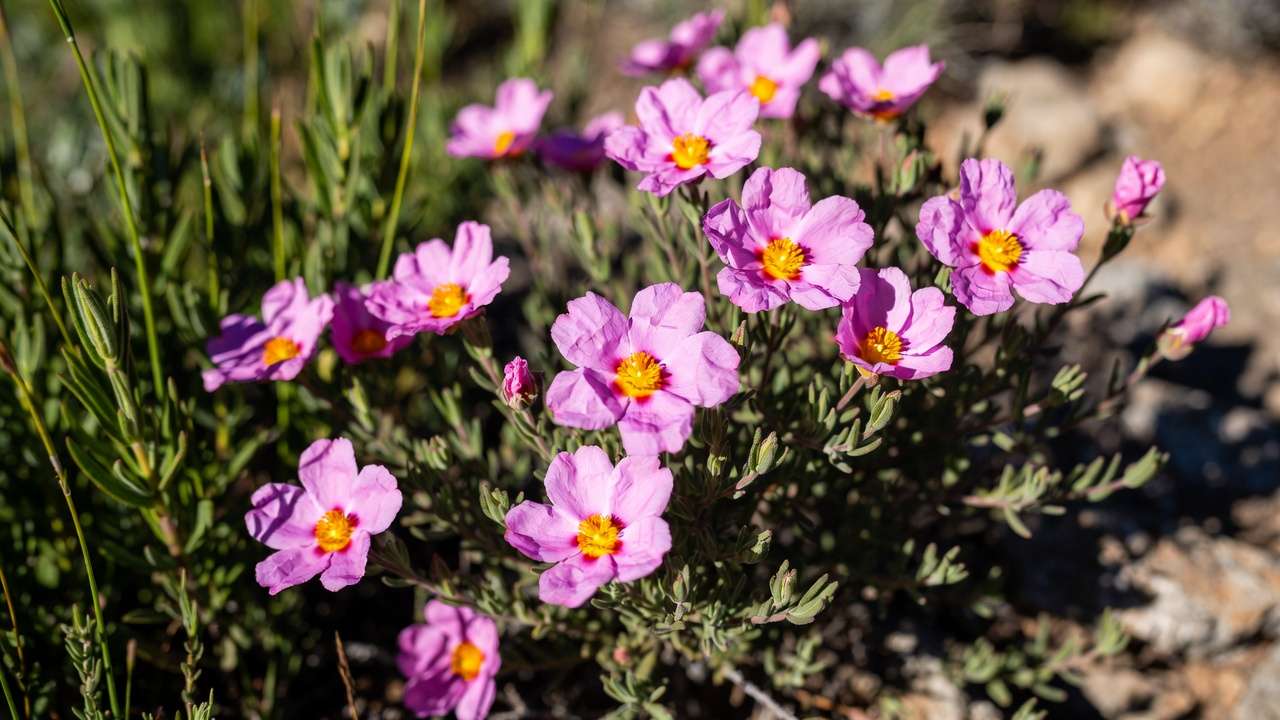
Rockrose (Cistus spp.) 🌺 Showy, papery flowers in white, pink, or magenta; fast-growing and fire-resistant in some regions.
-
- Zones: 8–10 (some to 7)
- Size: 2–5 ft
- Bloom: Late spring–summer
- Why it excels: Heat and drought champion; self-seeds gently in gravel.
- Pro tip: Don’t prune hard—light trim after bloom preserves shape. Avoid overwatering!
- Germander (Teucrium fruticans) 🌀 Silvery-blue-green leaves with lavender-blue flowers; excellent for low hedges or edging.
- Zones: 8–10
- Size: 3–5 ft
- Bloom: Spring–fall
- Why it excels: Tidy, clip-friendly; tolerates poor soil and wind.
- Pro tip: Shear annually for formal look—great in pots too! 🪴
- Santolina (Lavender Cotton) ⚪ Gray-green aromatic cushions with bright yellow button blooms.
- Zones: 6–9
- Size: 1–2 ft
- Bloom: Summer
- Why it excels: Ultra-compact; perfect path filler or groundcover alternative.
- Pro tip: Renew every 3–4 years by hard pruning in spring for fresh growth.
- Jerusalem Sage (Phlomis fruticosa) 🟡 Velvety leaves and whorled golden-yellow flowers on sturdy stems.
- Zones: 7–10
- Size: 3–4 ft
- Bloom: Summer
- Why it excels: Bold texture; long-lasting seed heads add winter interest.
- Pro tip: Cut back spent blooms for rebloom—drought superstar!
- Sage (Salvia officinalis & S. greggii) 🌿 Culinary common sage plus autumn-blooming Autumn Sage varieties.
- Zones: 5–10
- Size: 1–3 ft
- Bloom: Spring–fall (greggii)
- Why it excels: Fragrant, colorful; attracts hummingbirds.
- Pro tip: Pinch tips for bushiness—avoid wet winter soil.
- Pistacia lentiscus (Mastic Tree/Shrub) 🫒 Aromatic evergreen with small red berries; coastal tough.
- Zones: 9–11
- Size: 6–15 ft (can prune smaller)
- Bloom: Insignificant; berries in fall
- Why it excels: Extremely heat/drought/salt tolerant.
- Pro tip: Slow grower—ideal structural backdrop.
- Myrtle (Myrtus communis) ⭐ Glossy green leaves, white fragrant flowers, black berries.
- Zones: 8–10
- Size: 5–10 ft
- Bloom: Summer
- Why it excels: Classic Mediterranean look; evergreen year-round.
- Pro tip: Prune for shape—great for hedges.
- Strawberry Tree (Arbutus unedo) 🍓 Unique red strawberry-like fruits, bell-shaped flowers.
- Zones: 7–10
- Size: 8–15 ft (dwarf varieties available)
- Bloom: Fall–winter; fruits following year
- Why it excels: Multi-season interest; very drought tolerant.
- Pro tip: Slow but worth it—protect young plants from frost.
- Convolvulus cneorum (Silverbush) 🌼 Silvery leaves with white trumpet blooms.
- Zones: 8–10
- Size: 1–2 ft
- Bloom: Spring–summer
- Why it excels: Compact, silvery accent; rock garden favorite.
- Pro tip: Full sun, sharp drainage—short-lived but self-seeds.
- Perovskia (Russian Sage) ☁️ Airy blue flower spikes on silvery stems (shrub-like perennial).
- Zones: 5–9
- Size: 3–4 ft
- Bloom: Late summer–fall
- Why it excels: Long bloom season; airy texture.
- Pro tip: Cut back hard in spring for best form.
These 12 provide a skyscraper-level selection—far more variety than typical lists—covering sizes, colors, bloom times, and uses for truly personalized low-water designs. 🌟
How to Design a Stunning Low-Water Mediterranean Garden 🪨🌿
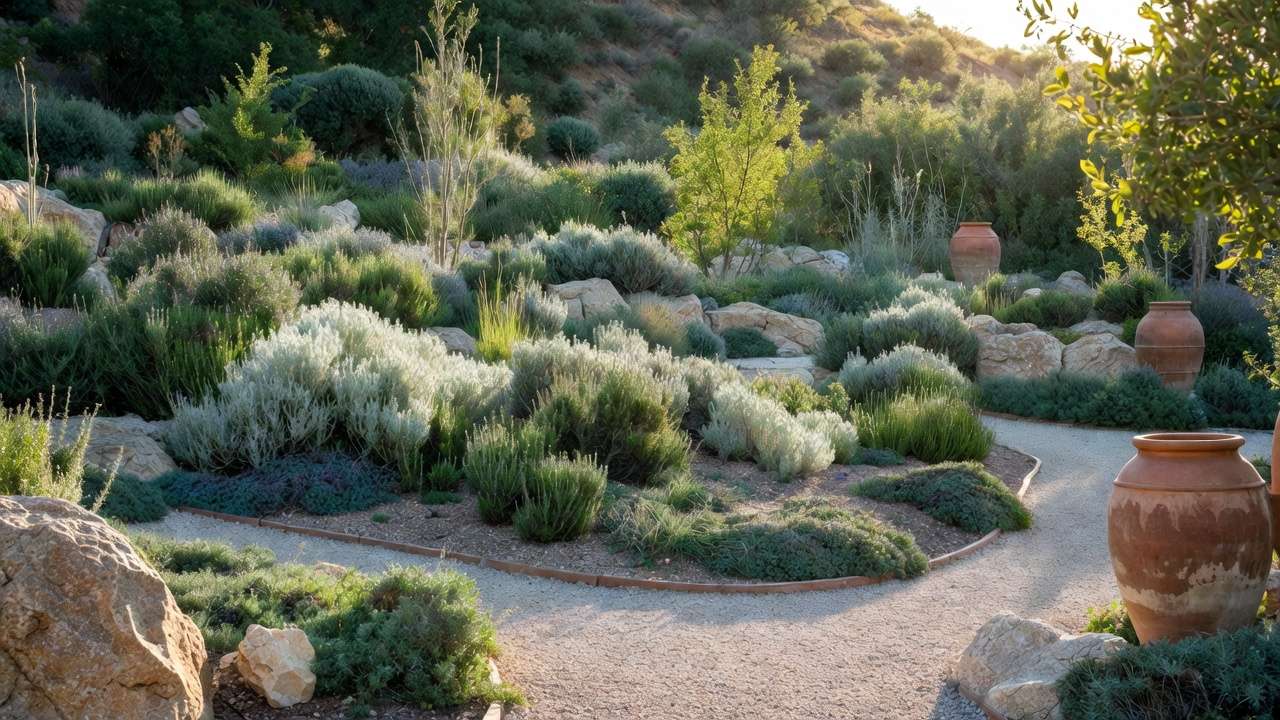
Creating a beautiful, cohesive low-water garden isn’t just about picking the right shrubs—it’s about thoughtful layering, texture play, and smart hardscaping that mimics the natural rocky hillsides of the Mediterranean. The goal? A garden that looks intentional and lush while sipping very little water.
Here are proven design principles that I’ve used successfully in countless drought-tolerant landscapes:
1. Start with a Gravel or Rock Mulch Foundation Replace thirsty lawns with a 2–4 inch layer of pea gravel, decomposed granite, or crushed rock mulch. This reduces weeds, retains soil moisture, reflects heat away from plant roots, and gives that classic Mediterranean crunch underfoot. Pro tip: Choose warm earth tones (beige, tan, terracotta) to echo sun-baked landscapes—avoid stark white gravel that can look too harsh. 🌞
2. Layer Plants for Depth and Interest
- Vertical accents — Tall, narrow evergreens like Italian cypress (Cupressus sempervirens) or dwarf olives (if your zone allows) create dramatic structure and draw the eye upward.
- Mid-level Mediterranean shrubs — Use the stars from our list (lavender, rosemary, rockrose, Jerusalem sage) as the main “body” of the garden. Group in odd numbers (3, 5, 7) for natural flow.
- Low-growers and groundcovers — Edge with santolina, germander, creeping thyme, or Convolvulus cneorum to soften borders and fill gaps.
3. Play with Color and Texture Schemes Popular palettes that always look elegant:
- Silver & Purple Dream — Lavender, santolina, germander, Russian sage, silverbush. Cool, calming, and ultra-reflective in hot sun.
- Sunny Mediterranean Glow — Jerusalem sage, rockrose (pink/yellow varieties), santolina’s yellow buttons, salvias. Warm and cheerful.
- Classic Green Monochrome — Rosemary, myrtle, mastic, germander. Subtle, sophisticated, evergreen backbone with pops of bloom.
Mix leaf shapes: needle-like (rosemary), fuzzy (Jerusalem sage), small oval (myrtle), broad silvery (rockrose) for rich texture contrast. ✨
4. Incorporate Pathways and Hardscaping Curved gravel paths with large stepping stones or flagstone create inviting flow and reduce compacted soil. Add terracotta pots (excellent drainage!) planted with lavender or rosemary for portable color and fragrance near seating areas.
5. Add Finishing Touches
- A small water feature (trickling fountain) for sound without heavy water use.
- Bench or bistro set in a gravel nook surrounded by fragrant shrubs.
- Decorative boulders or olive jars as focal points.
The result? A garden that feels like a sun-drenched villa escape—relaxing, aromatic, and incredibly low-maintenance once established. 🌴
Planting and Care Guide: Step-by-Step for Success 🌱
Follow these steps to give your Mediterranean shrubs the best start and long-term health:
- Site Selection Full sun is non-negotiable—aim for 6–8+ hours daily. Choose well-drained locations; these plants hate wet feet. If your soil is heavy clay, amend generously with coarse sand, grit, or gravel to improve drainage.
- Best Planting Time Fall (September–November) or early spring (February–April) — cooler temperatures reduce transplant shock and allow roots to establish before summer heat.
- Planting Technique
- Dig a hole twice as wide as the root ball, same depth.
- Mix native soil with 20–30% grit/compost (not rich manure—too much fertility causes leggy growth).
- Plant slightly high so the crown sits above soil level to prevent rot.
- Water deeply after planting, then let the top few inches dry between waterings.
- Establishment Watering (Years 1–2) Deep soak every 7–10 days in summer (less in cooler months). Gradually reduce frequency as roots deepen—most need only occasional deep watering by year 2–3.
- Ongoing Care
- Water: Rainfall + supplemental deep soak 1x/month or less in peak summer (many survive on rainfall alone in mild winters).
- Pruning: Light shear after flowering for most (lavender, rosemary, santolina). Avoid heavy cuts on rockrose or myrtle.
- Fertilizer: Almost none! A light application of low-nitrogen organic fertilizer in early spring only if growth is weak.
- Mulch refresh: Top up gravel/rock mulch annually.
- Common Mistakes to Avoid
- Overwatering = root rot death sentence 🚫💦
- Poor drainage = yellow leaves and decline
- Planting too deep = crown rot
- Heavy shade = leggy, sparse growth
- Easy Propagation Bonus Take 4–6 inch semi-ripe cuttings in late summer (rosemary, lavender, germander, salvia). Dip in rooting hormone, plant in gritty mix, keep barely moist—high success rate and free new plants! 🌿
Companion Plants & Enhancements for a Complete Xeriscape 🐝
Round out your design with these low-water partners that thrive alongside Mediterranean shrubs:
- Groundcover companions — Creeping thyme (Thymus serpyllum), oregano, lamb’s ear (Stachys byzantina), yarrow (Achillea).
- Perennials — Sea holly (Eryngium), verbascum, catmint (Nepeta), more salvias.
- Bulbs for seasonal pop — Narcissus, alliums, crocus—bloom early then go dormant in summer.
- Pollinator boosters — Mix in a few California poppy or gaura for extra nectar.
These additions keep the garden buzzing with life while staying firmly in the low-water zone.
Troubleshooting & FAQs ❓
Q: Why is my rockrose getting leggy and bare at the base? A: Normal for older plants. Prune back by 1/3 after flowering (never into old wood) to encourage bushy regrowth. Plant lower growers in front to hide bare stems.
Q: Can these shrubs grow well in containers? A: Absolutely! Use terracotta or breathable pots with excellent drainage holes. Water more frequently than in-ground but still sparingly once established.
Q: What if I’m in a colder zone (6–7)? A: Choose hardier varieties: English lavender, hardy rosemary (‘Arp’ or ‘Gorizia’), Perovskia, Santolina. Provide winter mulch and shelter from wind.
Q: How little water do they really need once established? A: In most dry-summer climates: deep soak every 3–6 weeks in summer if no rain; often just rainfall suffices in winter/spring.
Conclusion & Call to Action 🌞
You no longer need to choose between a beautiful garden and responsible water use. By incorporating these Mediterranean shrubs for low-water gardens, you’ll create an effortless, fragrant, pollinator-friendly landscape that thrives through heatwaves and dry spells—saving time, money, and precious resources.
Start small: Pick 3–5 favorites from the list, plant this fall or next spring, and watch your yard transform into a sustainable Mediterranean retreat. Your future self (and your water bill 💸) will thank you!
Which of these drought-tolerant beauties are you most excited to try? Drop a comment below—I’d love to hear your plans or see your garden progress! 👇🌿











