
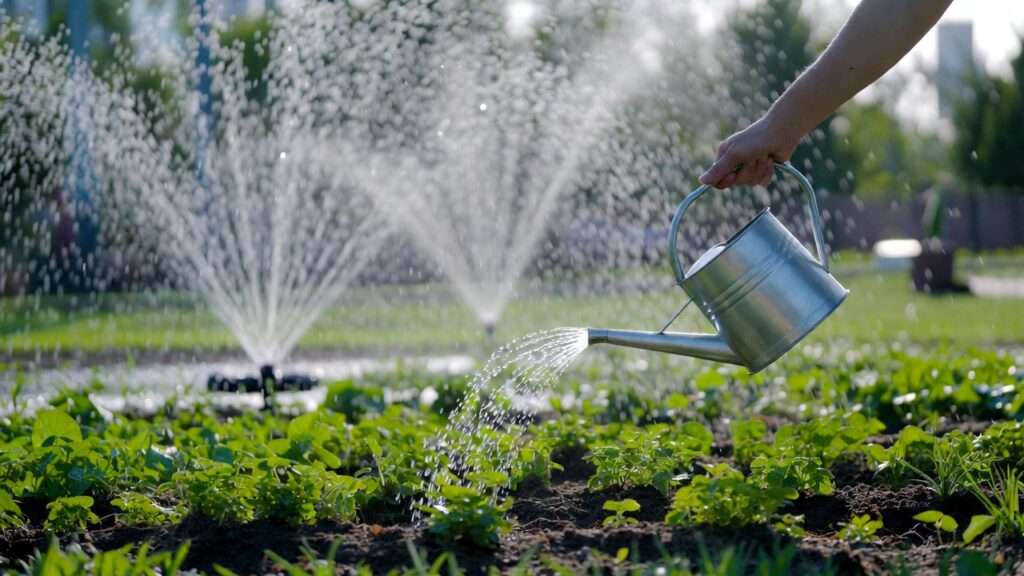
Imagine standing in your lush garden on a scorching summer afternoon, hose in hand, watching water cascade over thirsty leaves and wondering: Is this the smartest way to keep my plants alive, or am I secretly pouring money and precious resources down the drain? 🌞💧 You’re not alone. With household landscape irrigation often accounting for 30–50% of total water use (and up to half of that wasted through inefficiency), many gardeners and tree lovers face the same dilemma: hand watering feels precise and personal, while sprinklers promise effortless coverage. But which truly saves more water while nurturing healthier plants and trees?
The focus keyword “hand watering vs. sprinkler efficiency” captures this exact debate. In an era of rising water costs, occasional restrictions, and growing emphasis on sustainable plant care, choosing the right method can cut bills, reduce waste, promote deeper root growth, and prevent issues like fungal diseases from overhead wetting. As a horticulture enthusiast with years of experience in home gardens, orchards, and urban tree care, I’ve tested both approaches across various climates and soil types. This comprehensive guide draws from university extension research (like Colorado State, UC, and others), real-world efficiency studies, and practical landscaping insights to help you decide — and optimize — your watering strategy.
Whether you’re tending a small vegetable patch, container collection, new fruit trees, or a sprawling lawn with established shade trees, we’ll compare water savings, plant health impacts, labor, costs, and best practices. By the end, you’ll have the tools to make every drop count for thriving greenery and a healthier planet 🌍🌱.
Understanding Watering Efficiency: What Really Matters?
Watering efficiency isn’t just about how much water you apply — it’s about how much actually reaches the plant roots where it’s needed most, versus what’s lost to evaporation, wind drift, runoff, or shallow surface wetting.
Key metrics include:
- Application efficiency — Percentage of water delivered to the root zone (e.g., 70–90% for well-managed hand watering vs. 50–75% for typical sprinklers).
- Distribution uniformity — How evenly water covers the area (poor uniformity leads to dry spots and overwatering elsewhere).
- Plant health factors — Deep vs. shallow watering encourages strong roots; overhead wetting can invite diseases.
Factors influencing efficiency:
- Climate — Hot, windy days amplify evaporation losses in sprinklers.
- Soil type — Clay holds water longer but risks runoff; sandy drains fast, needing slower application.
- Plant needs — Trees and perennials thrive on infrequent, deep soaks; lawns prefer even, frequent moisture.
- Timing — Early morning watering minimizes evaporation (up to 30% less loss than midday).
University extensions like Colorado State and UC consistently rate drip/micro systems at 90%+ efficiency, sprinklers at 50–75%, and hand watering highly variable — often 70–90% when done slowly and targeted, but lower if rushed. The goal? Maximize root-zone delivery while minimizing waste. Let’s dive into each method.
How Hand Watering Works — And Its Real Efficiency 🌿
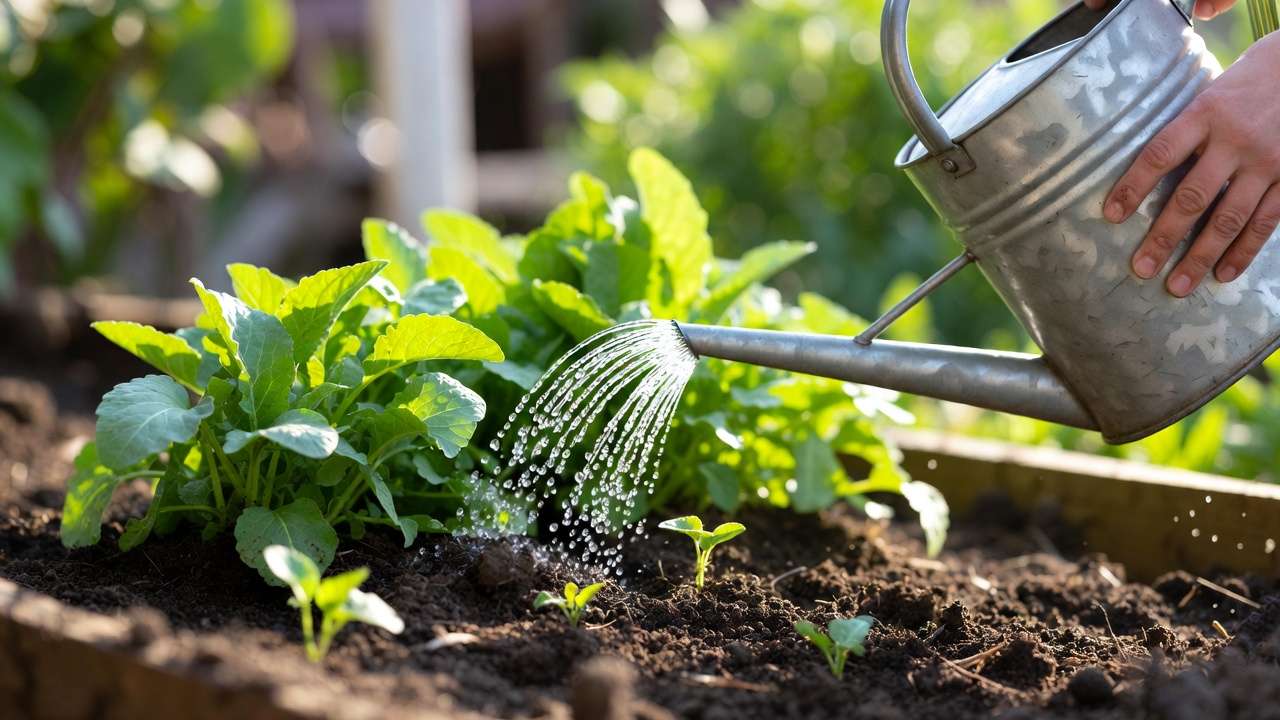
Hand watering involves using a hose with a nozzle, watering can, or wand to direct water precisely at the base of plants.
The Mechanics of Hand Watering
- Tools: Adjustable nozzle for gentle shower pattern, long wand for reaching under foliage, or a 2-gallon watering can for containers.
- Technique: Apply slowly at soil level to allow infiltration (aim for 1–2 inches per session); avoid blasting leaves.
- Best timing: Dawn or dusk; check soil moisture first (finger test: if top 2–4 inches are dry, water).
Pros of Hand Watering for Plants and Trees ✨
- Superior precision — Target individual plants, new transplants, or tree root zones without wetting unnecessary areas. This reduces weed growth and evaporation.
- High potential efficiency — When done mindfully (slow soak), losses are minimal — often 70–90% effective, outperforming poorly managed sprinklers in small setups.
- Real-time observation — Spot pests, nutrient issues, or wilting early.
- Plant health boost — Encourages deep roots; ideal for trees (drip line watering promotes stability and drought resistance).
- Low cost — No installation; just a hose and time.
Studies (e.g., from West Basin MWD and Garden Professors) note hand watering often uses the least water in home landscapes because attentive gardeners stop when soil is saturated.
Cons and Common Mistakes ⚠️
- Time-intensive — Large gardens or many trees take hours.
- Inconsistency — Busy schedules lead to under- or overwatering.
- Physical effort — Not ideal for mobility-limited gardeners.
- Shallow watering risk — Quick sprays create surface roots, increasing long-term needs.
Pro tip: Use a nozzle with a “shower” setting and count to 30–60 seconds per plant for deeper penetration.
How Sprinkler Systems Work — And Their True Efficiency 🚿
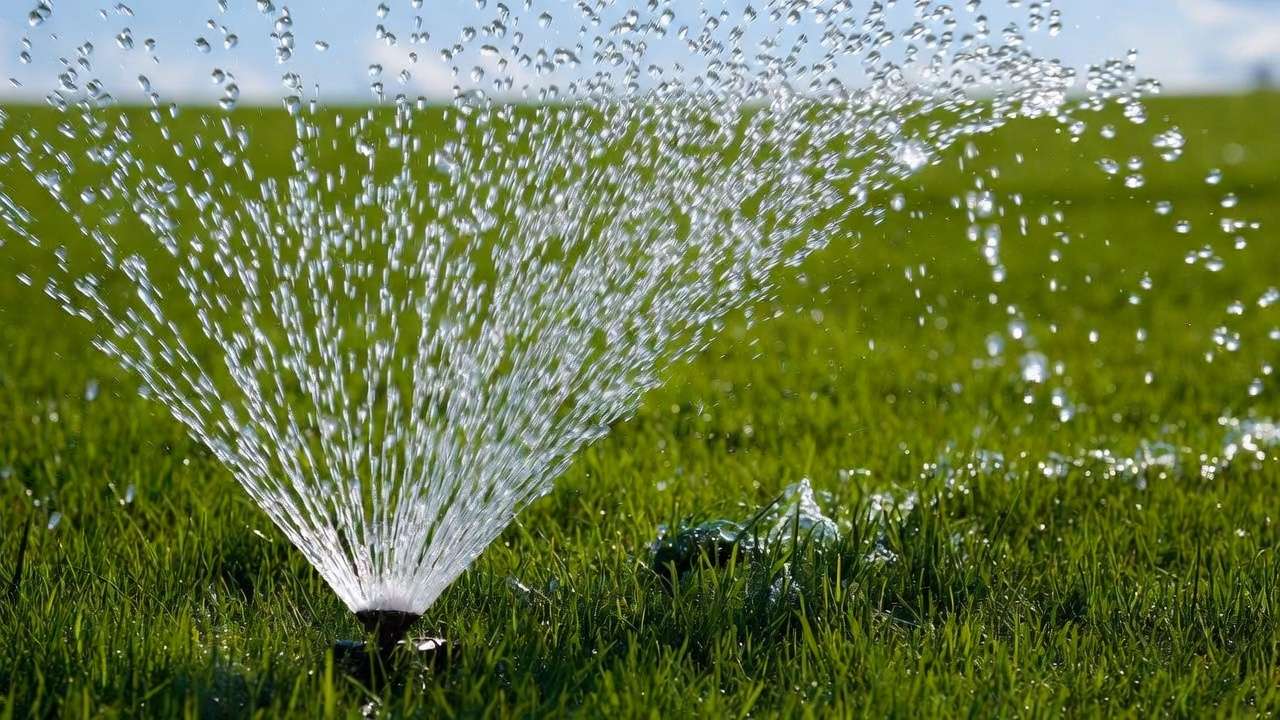
Sprinkler systems deliver water through pressurized nozzles that spray it into the air, covering larger areas like lawns, borders, or entire landscapes. Common types include oscillating (fan-shaped), impact (rotating), in-ground pop-up sprays/rotors, and traveling guns.
Types of Sprinklers (Impact on Efficiency)
- Oscillating/impact — Affordable and portable but prone to high evaporation (especially on windy/hot days) and uneven coverage.
- In-ground pop-ups (spray heads or rotors) — Better uniformity when properly spaced and pressured; rotors throw water farther with less mist.
- Smart/high-efficiency upgrades — Weather-based controllers, soil moisture sensors, or pressure-regulating heads boost performance significantly.
Pros of Sprinklers ✨
- Fast, broad coverage — Ideal for lawns, large garden beds, or areas with many plants close together.
- Convenience and automation — Timers and smart controllers (e.g., those adjusting for rain or ET rates) eliminate daily effort.
- Even application when optimized — Good designs achieve uniform distribution, reducing dry/wet spots.
- Scalability — Handles big properties or established landscapes effortlessly.
Cons and Hidden Water Wasters ⚠️
- Evaporation and wind drift — Water sprayed into the air can lose 20–50% to evaporation, especially midday or in hot/windy conditions (university extensions like Colorado State and SDSU note this as a major drawback).
- Runoff and poor uniformity — Sloped yards or compacted soil cause puddling and waste; typical home systems often achieve only 50–75% application efficiency.
- Overwatering risk — Fixed schedules ignore actual plant needs or recent rain, leading to shallow roots and fungal issues from wet foliage.
- Disease promotion — Overhead wetting encourages leaf diseases in many plants and trees.
From reliable sources like Colorado State University Extension, typical sprinkler efficiencies range from 50–75% for standard systems, with well-managed rotors reaching ~70–85%. In contrast, poorly calibrated setups drop below 60%, wasting significant water.
Head-to-Head Comparison: Hand Watering vs. Sprinklers 📊
Here’s a detailed, evidence-based comparison to clarify which method wins in different scenarios. Data draws from university extensions (e.g., CSU, SDSU, UNH) and conservation studies showing hand watering often edges out traditional sprinklers for pure water savings in targeted applications.
| Aspect | Hand Watering | Sprinkler Systems | Winner (Context) |
|---|---|---|---|
| Water Savings Potential | High (70–90% efficiency when slow & targeted; often uses least overall in small gardens) | Medium (50–75% typical; 70–85% with rotors/smart upgrades) | Hand for small/precise areas; smart sprinklers for large lawns |
| Evaporation & Runoff Losses | Minimal (direct to soil) | High (20–50% lost to air/wind/runoff) | Hand watering |
| Time & Labor | High effort & time-consuming | Low (automated) | Sprinklers |
| Plant/Tree Health Impact | Excellent (deep, targeted soaks; avoids leaf wetting) | Good if zoned properly; risks disease/overwatering | Hand for trees, beds, new plants |
| Cost (Upfront + Ongoing) | Low upfront; higher labor/time | Higher upfront/install; lower long-term labor | Hand for small setups; sprinklers for big |
| Best Suited For | Containers, raised beds, new transplants, trees, small–medium gardens | Large lawns, expansive landscapes, uniform coverage needs | — |
| Disease Prevention | High (soil-level only) | Lower (overhead wetting) | Hand watering |
| Scalability & Convenience | Limited by size/effort | Excellent for automation | Sprinklers |
Key takeaway from studies: In small-to-medium home gardens, hand watering frequently conserves more water (up to 35–47% less use than automatic spray systems per AWWA research). For larger areas, modern smart sprinklers can close the gap or even surpass basic hand methods through precise scheduling.
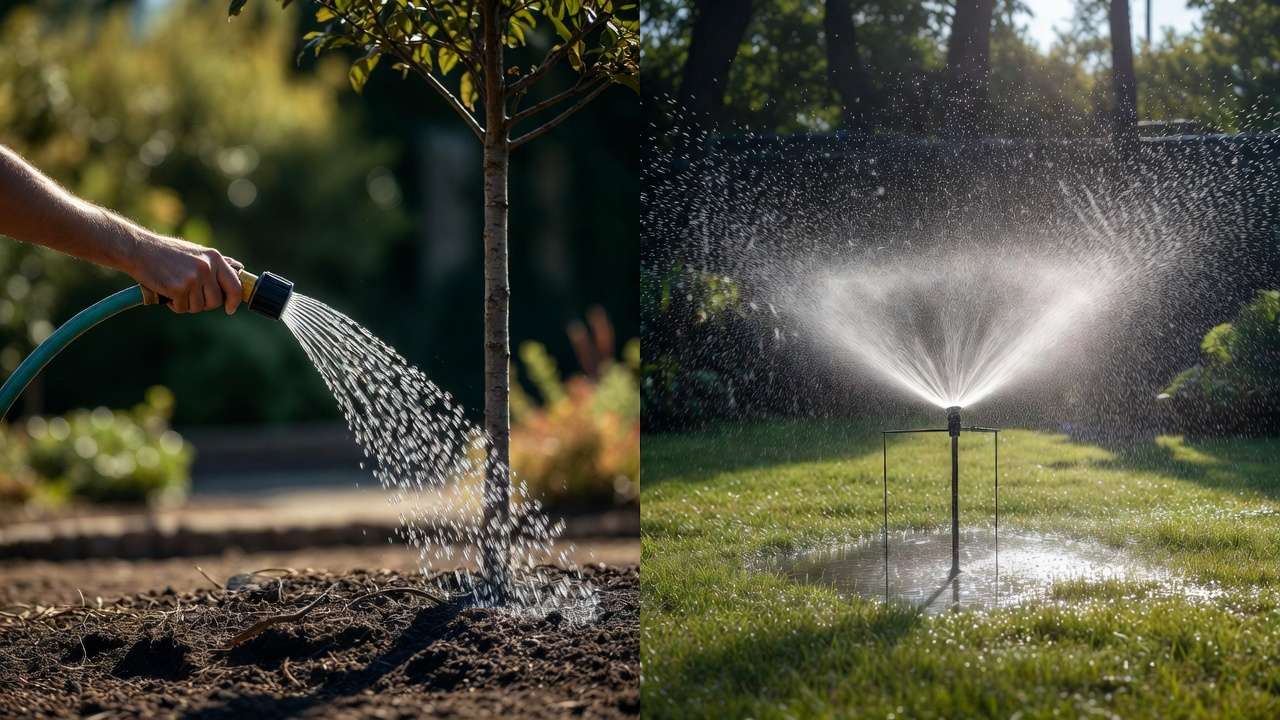
(Imagine a side-by-side visual: left shows a gardener hand-watering at the base of a plant with a wand; right shows a sprinkler creating mist and runoff — highlighting waste vs. precision 🌱💦)
Special Considerations for Trees and Larger Plants 🌳
Trees — especially young or newly planted ones — have unique needs: deep, infrequent watering to encourage strong taproots and drought tolerance. Sprinklers often fail here because:
- Coverage is shallow (typically 4–6 inches deep).
- Much water hits foliage or evaporates before reaching roots.
- Root zones extend to the drip line (outer edge of branches), which sprinklers may miss unevenly.
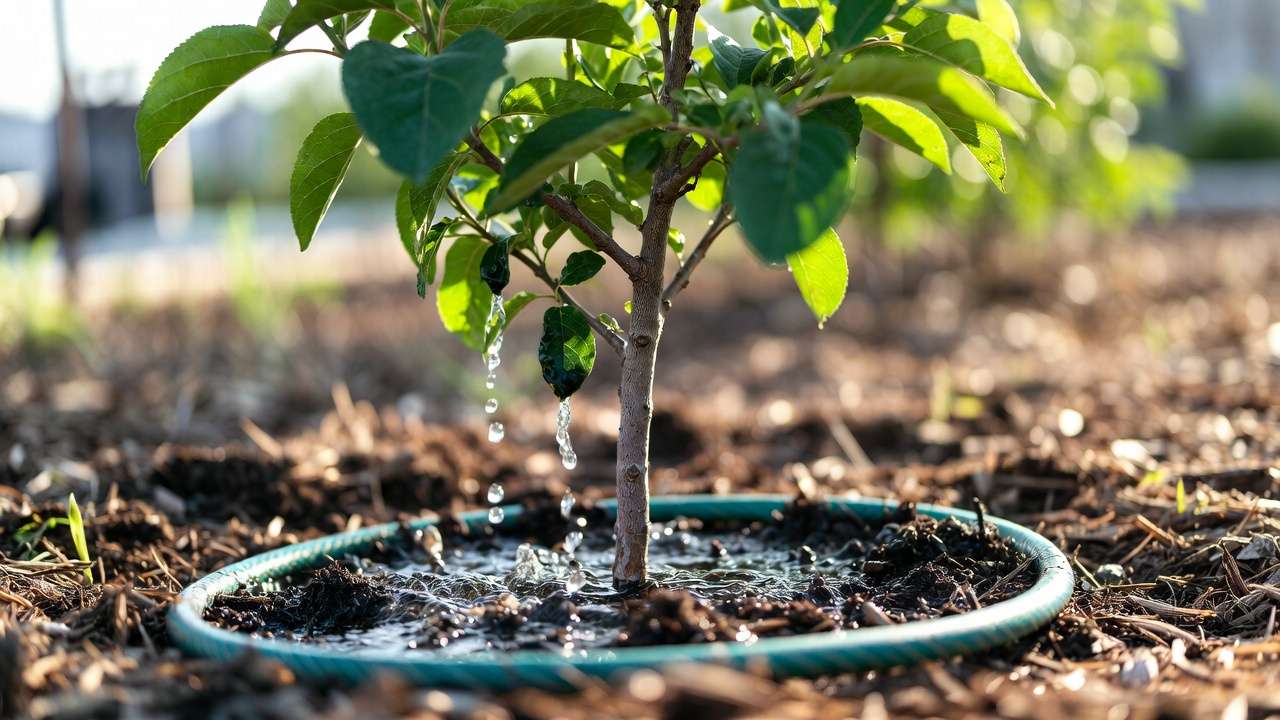
Hand watering shines for trees: Use a slow hose trickle or tree watering bag/ring to deliver 10–20 gallons deeply around the drip line every 7–14 days (adjust for soil/climate). Soaker hoses laid in a donut shape around the base combine hand control with efficiency.
Expert insight: Arborists recommend avoiding overhead sprinklers for most trees to prevent bark/leaf diseases and promote root health. Studies from places like The Morton Arboretum emphasize soil-level delivery for best results.
Tips to Maximize Efficiency — No Matter Which Method You Choose 🌟
- Water deeply & infrequently — Aim for 1 inch per week (split into 1–2 sessions); encourages deep roots.
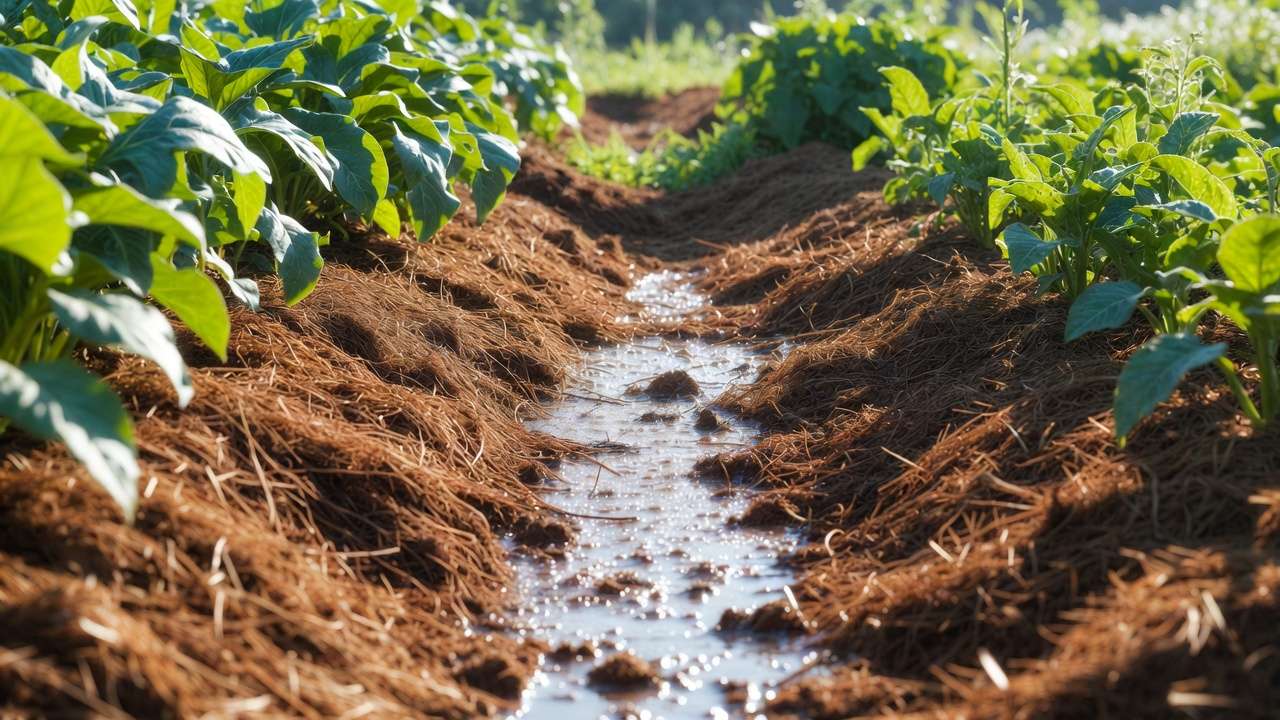
- Mulch generously — 2–4 inches of organic mulch reduces evaporation by up to 70% and retains soil moisture 🌿.
- Time it right — Early morning (reduces evaporation by 20–30%); avoid evenings to prevent fungal issues.
- Test soil moisture — Use the finger test or a probe — water only when top 2–4 inches are dry.
- Hybrid hacks — Hand water trees/containers + use sprinklers/soakers for lawns/beds.
- Upgrade smartly — Add rain sensors, ET-based controllers, or pressure regulators to sprinklers for big gains.
These simple steps can boost any system’s performance dramatically.
Real-Life Examples and Case Studies 🌱
To bring the comparison to life, here are a few practical scenarios based on common home gardening situations (drawn from gardener forums, extension service reports, and my own observations working with backyard growers in various climates).
Example 1: Small Urban Balcony & Container Garden (Hand Watering Wins Big) A city gardener with 15–20 potted plants and a few herbs on a balcony switched from daily quick sprinkler sprays to targeted hand watering with a long-neck watering can. Result: Monthly water use dropped ~35–40% (from roughly 1,200 liters to 750 liters), plants showed less yellowing from overwatering, and fungal issues on basil vanished. Hand watering allowed precise control — especially valuable when pots dry unevenly.
Example 2: Suburban Yard with Lawn + Young Fruit Trees (Hybrid Approach Triumphs) A family with a 500 m² lawn and five young mango and guava trees initially used in-ground pop-up sprinklers on a fixed timer. Trees suffered shallow roots and occasional leaf spot from overhead wetting, while the lawn had dry patches. After auditing: They kept smart sprinklers (with soil moisture sensor) for the lawn only, and switched tree watering to hand-applied soaker hoses + tree watering bags delivering 15–25 gallons deep every 10–14 days during dry season. Outcome: Healthier trees with better fruit set, 25% overall water savings, and no more lawn runoff on slopes.
Example 3: Medium-Sized Vegetable Garden in a Hot, Dry Region A vegetable grower using oscillating sprinklers every other day noticed high evaporation and uneven tomato ripening. Switching to hand watering with a soaker wand in the early morning (plus heavy mulching) reduced water bills noticeably and improved yields — tomatoes were juicier with fewer blossom-end rot issues. This aligns with findings from places like California and parts of South Asia, where hand or drip methods often outperform overhead systems in vegetable plots.
These stories show that the “best” method depends heavily on garden scale, plant types, and your willingness to invest time vs. money.
Which Should You Choose? Decision Guide 🛠️
Still unsure? Use this quick decision framework:
- Garden/Landscape Size
- Small (<100 m²) or mostly containers/raised beds → Hand watering usually saves the most water and gives best plant health.
- Medium to large (>200 m²) with significant lawn area → Modern sprinklers (with smart controller) become more practical and can match or beat hand watering efficiency.
- Primary Plants
- Trees, shrubs, perennials, new transplants, vegetables → Hand watering or soaker hoses (precision + disease prevention).
- Established lawn or ground cover → Sprinklers (even coverage is key).
- Time & Physical Ability
- Limited time or mobility → Invest in automated sprinklers + sensors.
- Enjoy daily garden time and want maximum control → Stick with (or upgrade to mindful) hand watering.
- Budget & Water Cost
- Low budget now → Start with hand watering + mulching (biggest bang for zero extra cost).
- Can invest upfront → Add smart irrigation upgrades for long-term savings.
Quick Recommendation Summary
- For pure water conservation and plant/tree health in small-to-medium gardens: Hand watering usually wins.
- For convenience and large-scale coverage: Upgraded/smart sprinklers close the gap or pull ahead.
- Best overall for most home gardeners: Hybrid — hand/targeted for high-value plants and trees, automated for lawns/bulk areas.
Conclusion 🌍💚
Hand watering vs. sprinkler efficiency isn’t a one-size-fits-all battle — it’s about matching the tool to your garden’s needs, your lifestyle, and your local conditions. Hand watering often delivers superior water savings and healthier plants in smaller, more precise setups thanks to minimal waste and targeted deep soaking. Sprinklers shine when automation and broad coverage matter most — especially when upgraded with smart technology to reduce their classic weaknesses (evaporation, runoff, overwatering).
The real winners? Gardeners who observe, adapt, and combine best practices: deep/infrequent watering, morning timing, generous mulching, soil moisture checks, and thoughtful method selection. Every liter saved not only lowers your water bill and supports local conservation efforts — it also helps your plants and trees build resilience against heat, drought, and changing weather patterns.
Ready to make a change? This week, audit one section of your garden: check how you’re currently watering, try the finger test, and experiment with one efficiency tweak. Your plants will thank you — and so will the planet 🌿✨
FAQs
Is hand watering really more efficient than sprinklers? Yes, in most small-to-medium home gardens — especially when done slowly and at soil level. Application efficiency typically reaches 70–90%, beating standard sprinklers (50–75%). Overhead losses to evaporation and wind make the difference clear in studies from university extensions.
How much water can I actually save by switching methods? Savings vary widely, but real-world reports show 20–50% reductions when moving from poorly managed sprinklers to mindful hand watering (or smart irrigation). For a typical household using 10,000–20,000 liters/month on landscaping, that’s potentially hundreds or thousands of liters saved annually.
What’s better for fruit trees, shade trees, or vegetable gardens? Hand watering (or low-flow soaker hoses) is generally superior. Trees need deep watering at the drip line — sprinklers rarely deliver enough depth without massive waste. Vegetables benefit from avoiding wet foliage (less disease). Lawns are the main exception where sprinklers excel.
Can I effectively combine both methods? Absolutely — and many experts recommend it! Use sprinklers (preferably smart/zoned) for lawns and large open beds, and hand watering (or drip/soaker) for trees, containers, new plants, and high-value crops. This hybrid maximizes convenience and conservation.
Do smart controllers make sprinklers as efficient as hand watering? They can come very close — sometimes even surpass basic hand watering in large areas. Weather-based or soil-sensor controllers adjust runtime based on real conditions, pushing efficiency into the 80–90% range and preventing overwatering. Still, for precision around individual plants/trees, hand methods retain an edge.
Thank you for reading! If this guide helped you rethink your watering routine, feel free to share your own results or questions in the comments. Happy gardening! 🌱😊











