
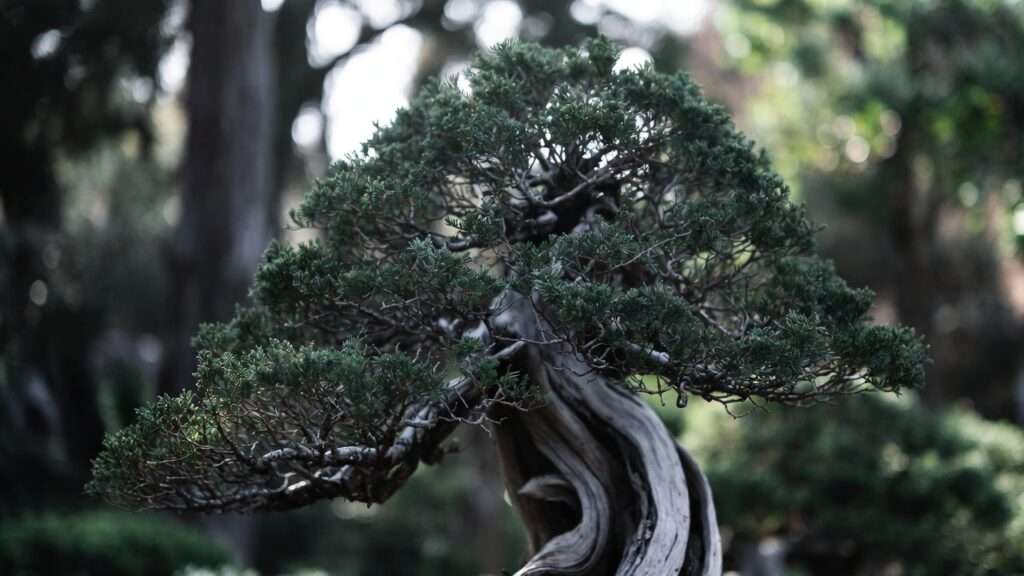
Imagine standing before a young juniper, its trunk smooth and branches full of life, yet something feels missing. It lacks that ancient, weathered majesty of a tree that has battled storms for centuries. Now picture the same tree transformed: stark, twisted jin branches reaching like skeletal fingers, dramatic shari strips flowing down the trunk like lightning scars, evoking silent stories of survival. This is the power of creating bonsai deadwood (jin and shari) — the advanced technique that adds instant age, depth, and artistic drama to your miniature trees. 🌲⛰️
Deadwood features are among the most captivating elements in bonsai artistry. Jin refers to dead, stripped branches that mimic lightning-struck or wind-broken limbs, while shari represents deadwood on the trunk itself, exposing heartwood in elegant, flowing patterns. When done correctly, these features make even a 10-year-old bonsai appear centuries old, enhancing its narrative and visual impact. But many hobbyists hesitate: fear of killing the tree, ending up with unnatural “carved” results, or simply not knowing where to start holds them back.
As a bonsai enthusiast with over 15 years of hands-on experience styling conifers from nursery stock to collected yamadori, I’ve created hundreds of jin and shari features. This comprehensive guide draws from traditional Japanese techniques, modern refinements, and real-world trial-and-error to help you achieve natural-looking, safe deadwood. Whether you’re a beginner dipping into advanced styling or an intermediate artist seeking more realism, you’ll gain the confidence, tools, and step-by-step process to transform your trees without unnecessary risk. Let’s unlock that hidden ancient beauty together! 🚀
Understanding Jin and Shari: The Foundations of Bonsai Deadwood 🎨
Before picking up any tool, grasp what makes deadwood authentic and beautiful.
What is Jin? Jin is the Japanese term for dead branches or twigs on a bonsai. In nature, these occur from lightning, disease, or harsh weather, leaving bare, weathered wood. On bonsai, we intentionally create jin to simulate this aged look, typically on secondary branches, jinsu (small dead twigs), or apex leaders for dramatic effect. The key is realism: jagged, tapered ends with subtle texture, never perfectly straight or uniform.
What is Shari? Shari involves stripping bark from the trunk to expose dead heartwood, often in flowing strips that follow the tree’s natural movement. It can be narrow lines accentuating taper or broader areas for bold contrast. Related forms include sabamiki (split trunk) and uro (hollowed deadwood), but true shari maintains live veins that supply the foliage.
Why deadwood works so well on certain species 🌱 Conifers like juniper (especially Shimpaku), pine (Black, White, Scots), larch, spruce, and cedar excel because they have fibrous, durable wood that carves beautifully and resists rot when preserved. Deciduous trees (maple, elm, beech) rarely feature deadwood, as their wood decays quickly and lacks the visual contrast.
Aesthetic principles Deadwood must serve the overall design: it enhances trunk movement, balances foliage pads, and tells a story (e.g., a tree “surviving” on a cliff). Follow the live vein rule—preserve continuous paths of live cambium from roots to foliage. Overuse can make a tree look damaged rather than artistic.
Expert insight: True masters treat deadwood as an extension of the tree’s “personality.” Observe natural yamadori specimens; their jin and shari follow wood grain and stress lines, never arbitrary cuts.
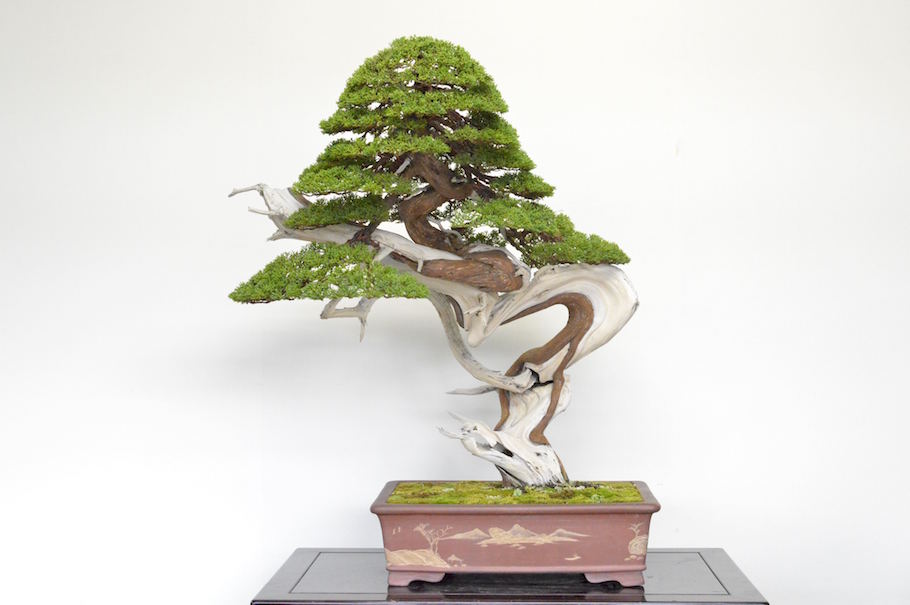
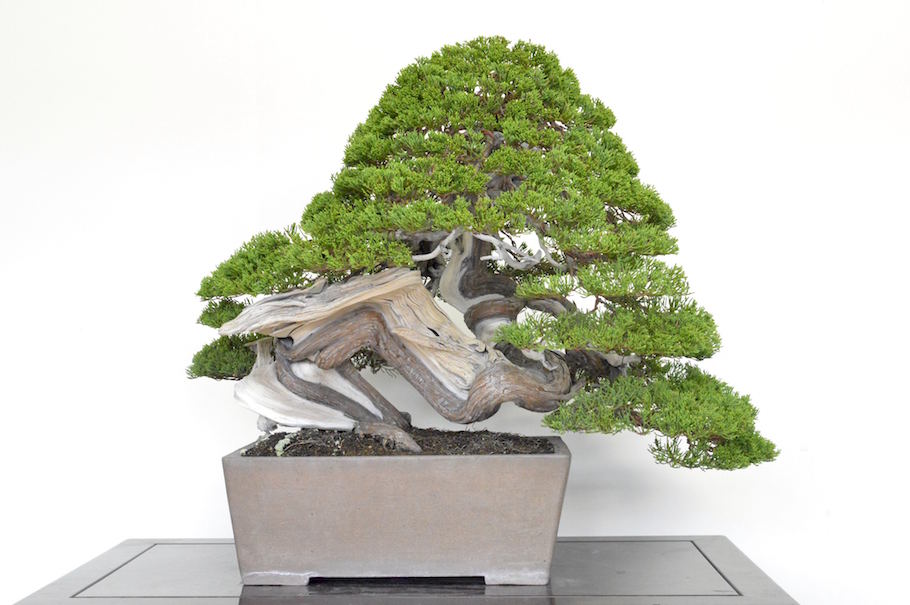
These examples show stunning natural jin and shari on junipers — notice the flowing, uneven textures and how deadwood complements the living foliage without overwhelming it. 🌟
When and Why to Create Deadwood: Timing and Tree Health First 🩺🌿
Deadwood creation stresses the tree, so timing and health are critical.
Best seasons Early spring (just before bud break) or late summer/early fall (after growth hardens but before cold). Sap flow aids healing at edges, and the tree recovers quickly. Avoid mid-summer (heat stress) or deep winter (slow healing).
Signs your tree is ready
- Strong vigor with healthy foliage and roots
- Established nebari and good taper
- At least 2-3 years in training pot
Never attempt on weak, recently repotted, or young (<5 years) trees unless on sacrifice branches.
Health precautions Limit deadwood to 30-40% of surface area max. Always preserve at least one strong live vein path. Monitor for dieback post-creation.
Common mistakes that kill trees ⚠️
- Removing too much live tissue
- Carving during active growth without aftercare
- Ignoring species-specific wood properties
Pro tip: Start small—create one jin on a back branch to test your tree’s response.
Essential Tools and Materials for Professional Results 🔧🛠️
Quality tools make the difference between amateur and pro-level deadwood.
Must-have basics
- Jin pliers (specialized for twisting/peeling fibers)
- Sharp concave cutters
- Grafting knife or sharp hobby knife
- Small chisels and carving tools
- Rotary tool (Dremel) with carving bits (for advanced texture)
Preservatives & finishing
- Lime sulfur (traditional whitener and fungicide)
- Alternatives: wood hardener, polysulfide sealers, or natural aging (UV exposure)
- Fine sandpaper, brushes, gloves, and eye protection
Budget vs. pro setups Beginners can start with basic jin pliers (~$20-40) and lime sulfur. Invest in quality as skills grow—Japanese tools last decades.
Safety first: Wear a mask when applying lime sulfur (strong odor and fumes). 😷
Here’s a classic lime-sulfured deadwood close-up and some premium lime sulfur products — the signature bright white evolves to softer silver-gray over time.
Step-by-Step: Creating Natural-Looking Jin (Dead Branches) ✂️🌿
Now we get to the hands-on part. Creating jin is a rewarding process that requires patience and observation. Always work slowly—it’s easier to remove more wood later than to fix over-carving.
- Select the perfect branch Choose branches that enhance the design: secondary branches, back branches for depth, or apex leaders for drama. Avoid primary branches that carry major foliage pads unless you’re confident. The branch should have natural taper and interesting movement. 🌿
- Prepare the tree Thin needles or foliage first to expose the branch fully. Reduce water slightly 1-2 days before to make bark easier to peel (but don’t stress the tree). Protect live tissue nearby with tape if needed.
- Strip the bark safely Score the bark circumferentially at the base and tip with a sharp knife. Use jin pliers to grip and twist/peel fibers in the direction of growth. Pull slowly for torn, natural edges—avoid clean strips. Leave some fibrous “strings” for realism.
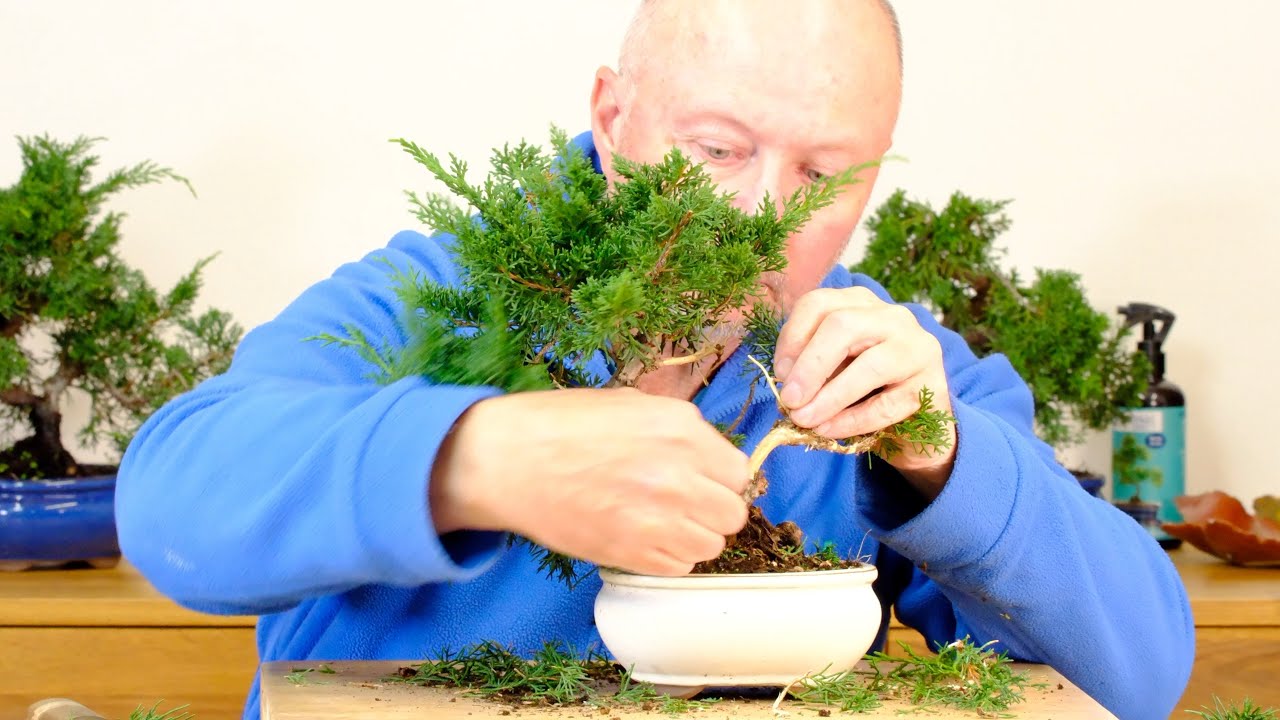
This image captures a skilled artist carefully creating jin on a Chinese juniper—notice the gentle twisting motion with jin pliers for authentic texture.
- Shape and refine Use a grafting knife or small chisel to carve subtle hollows, cracks, and ridges following the wood grain. Taper the jin toward the tip, making it thinner and more irregular. Avoid pencil-straight or uniform appearance.
- Taper and shorten Break or carve the tip to look naturally snapped. Create slight bends or twists for character.
- Apply preservative Brush on undiluted lime sulfur (2-3 coats, letting each dry). Place in direct sun to accelerate bleaching from bright white to silver-gray. Alternatives: wood hardener for natural tones or no treatment for subtle aging.
- Aftercare Mist foliage daily, keep soil moist, and place in partial shade for 4-6 weeks. Watch for callus formation at edges—it creates beautiful rolls over time.
Pro tips:
- Practice on dead collected branches first.
- Photograph at every stage for reference.
- If fibers tear too cleanly, roughen with a wire brush. 📸
Step-by-Step: Mastering Shari (Dead Trunk Features) 🪵🔥
Shari is more advanced and permanent—plan carefully!
- Plan your design Study the trunk’s movement and live vein paths (visible as slight ridges or greener bark). Sketch shari areas on paper or mentally. Shari should flow with the trunk’s curves, never cross live veins completely.
- Mark and score Use a pencil or chalk to outline shari zones. Score edges lightly with a knife to define boundaries.
- Remove bark precisely Start at the top and work down. Score, then peel with jin pliers or knife. Follow natural contours for organic shapes.
- Carve depth and texture Hollow subtle grooves and create ridges to mimic weathering. Keep depth shallow (1-3 mm) initially—deep carving risks rot.

Before-and-after magic on a juniper: the left shows a young tree, the right reveals dramatic shari and jin that add instant age and character.
- Balance front/back Create shari on multiple sides for 360° interest, but ensure live veins connect roots to apex uninterrupted.
- Preserve and whiten Apply lime sulfur generously. For variation, use diluted mixes or pigments for brown/gray tones.
- Healing and integration Over 1-3 years, callus rolls form around shari edges, framing the deadwood beautifully.
Expert variations:
- Narrow shari lines for elegance
- Broad sabamiki-style splits for bold drama (advanced only!)
Finishing Touches: Bleaching, Coloring, and Protecting Deadwood 🎨🛡️
- Lime sulfur application — Multiple thin coats > one thick. Sun exposure = faster aging to realistic silver.
- Natural alternatives — Skip bleach and let UV/weather gray the wood naturally (takes longer but very authentic).
- Protection — Apply wood hardener or polysulfide sealer yearly to prevent cracking/rot in humid climates.
- Maintenance — Re-apply preservative every 1-2 years; gently brush off loose fibers.

A classic array of bonsai tools—including jin pliers, concave cutters, and carving knives—essential for precise deadwood work.
Common Mistakes and How to Avoid Them 🚫
Even experienced bonsai artists occasionally make errors when creating deadwood. Here are the most frequent pitfalls and practical ways to sidestep them:
- Over-carving or removing too much live tissue Symptom: Large areas of foliage yellowing or dying back months later. Prevention: Never remove more than 30–40% of the trunk/branch surface in one session. Always leave clear, wide live veins (at least 1–2 cm wide) connecting roots to foliage. Mark live veins with chalk before starting.
- Creating unnaturally straight, symmetrical, or “pencil-like” deadwood Symptom: Jin looks artificial, like it was made with a lathe. Prevention: Embrace irregularity. Twist fibers unevenly, carve asymmetrical hollows, and vary thickness along the length. Study photos of wild, weathered trees for inspiration.
- Ignoring species-specific wood properties Symptom: Deadwood cracks, rots, or discolors strangely (especially on pines vs. junipers). Prevention: Juniper and larch take aggressive carving and lime sulfur beautifully. Pines prefer subtler jin and resist deep shari. Deciduous species almost never suit deadwood.
- Wrong timing leading to excessive dieback Symptom: Tips of remaining branches wilt despite good watering. Prevention: Stick to early spring or late summer. Avoid working on trees that have just been repotted, defoliated, or wired heavily.
- Applying lime sulfur too thickly or in hot sun without dilution Symptom: Burning of adjacent live bark or unnatural chalky residue. Prevention: Use thin coats, dilute first coat 50:50 with water, and apply in shade. Let each coat dry fully before the next.
Quick fix if you overdo it: Immediately seal accidental live-tissue damage with cut paste or wound sealant and increase shade/humidity for recovery.
Species-Specific Tips for Stunning Results 🌳
Different conifers respond uniquely to deadwood techniques. Here’s a practical cheat sheet:
- Shimpaku / Sargent Juniper (Juniperus chinensis ‘Shimpaku’) The deadwood superstar. Fibrous wood peels beautifully, holds dramatic shari and jin for decades. Ideal for bold, extensive deadwood. Lime sulfur turns brilliant white → silver-gray.
- Procumbens Juniper & other creeping junipers Excellent for flowing, ribbon-like shari that accentuates dramatic trunk movement. Create jin on lower branches for “windswept” drama.
- Black Pine (Pinus thunbergii) & White Pine (Pinus parviflora) Best for refined jin on branches rather than heavy trunk shari. Wood is denser—carve more delicately. Many masters prefer natural aging over lime sulfur for softer, brownish tones.
- Larch (Larix spp.) Naturally produces dead lower branches in the wild—mimicking this looks very authentic. Excellent candidate for both jin and moderate shari.
- Spruce (Picea spp.) & Cedar (Cedrus spp.) Great texture and durability. Spruce takes very fine carving; cedar develops beautiful silvery patina with age.
- Species to approach cautiously or avoid Maples, elms, beeches, ficus—wood decays rapidly, lacks visual contrast, and rarely appears convincing.
Gallery of Inspiration: Real Examples and Case Studies 📷
- Young nursery Shimpaku → dramatic triple-trunk with flowing shari and multiple jin after 4 years of development. The shari starts narrow at the apex and widens elegantly toward the base, perfectly following trunk taper.
- Collected yamadori Black Pine → subtle jin on several secondary branches, no shari. Natural aging + light wire brushing created soft gray tones without lime sulfur—very understated and elegant.
- Cascade-style Procumbens Juniper → long, sweeping shari down the cascading trunk, mimicking a cliff-side survivor. Multiple jin on the “windward” side reinforce the story of constant exposure.
- Larch forest planting → several trees featuring natural-looking jin from lower branches, creating a sense of ancient woodland.
(If you have your own before/after photos, share them in the comments—I love featuring reader transformations!)
Frequently Asked Questions (FAQs) ❓
Is creating deadwood safe for my tree? Yes—if done correctly, on healthy vigorous conifers, during the right season, and without removing too much live tissue. Many trees live decades with extensive deadwood.
How long does it take for jin and shari to look natural? Lime-sulfured deadwood looks bright white immediately, softens to realistic silver-gray in 6–18 months with sun exposure. Untreated wood grays naturally over 2–5 years.
Can beginners create good deadwood? Absolutely—start with one small jin on a back branch of a vigorous juniper. Practice peeling and carving technique on dead collected wood first.
What if the wood cracks, splits, or starts to rot? Minor surface cracks are normal and add character. Deep rot is rare in properly preserved deadwood. Apply wood hardener or lime sulfur annually in humid climates.
Are there lime sulfur alternatives for organic growers? Yes—try a mix of vinegar + steel wool (creates iron acetate for graying), or simply let UV and weather do the work (slower but very natural).
Conclusion: Bring Ancient Majesty to Your Bonsai Collection 🏆🌟
Creating bonsai deadwood (jin and shari) is one of the most transformative and rewarding techniques in the art. It teaches patience, observation, respect for the living tree, and the beauty of imperfection—core principles of wabi-sabi that define great bonsai.
Key takeaways:
- Plan around live vein paths and natural wood grain
- Start small, work slowly, preserve tree health
- Use quality tools and proper preservatives
- Embrace irregularity for realism
- Enjoy the process—the tree will tell you when it’s happy
Your challenge this season: select one healthy conifer, create just one tasteful jin on a back branch, and watch how it changes the entire character of the tree. Then come back and share your progress in the comments—I’d love to see your results and answer questions along the way.
May your bonsai continue to grow in both age and wisdom. 🍃✨











