
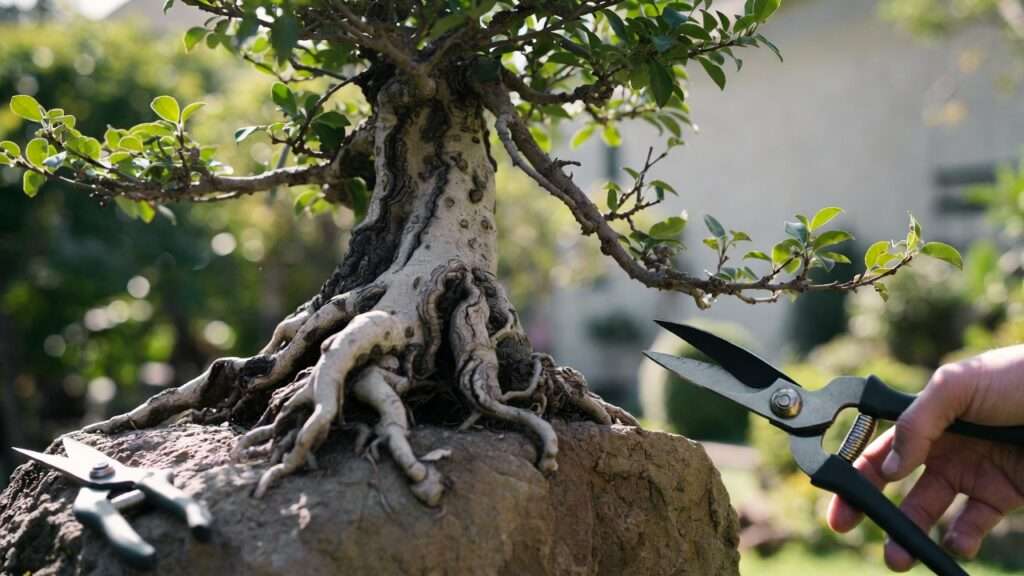
Imagine standing before a tiny tree that appears to defy gravity — powerful, twisting roots dramatically gripping a rugged rock, as if the tree has conquered a sheer cliff over centuries. This is the captivating beauty of root-over-rock bonsai (known as sekijoju in Japanese), a style that tells a story of resilience and triumph over harsh conditions. Yet, achieving and maintaining that breathtaking drama requires masterful root-over-rock bonsai pruning technique — one wrong cut can weaken the visual balance, make the roots look thin and fragile, or cause the canopy to overpower the exposed nebari. 😱
Many bonsai enthusiasts fall in love with this advanced style, only to struggle with pruning decisions: When is the best time? How much foliage can you safely remove without stressing the tree? How do you prune to emphasize those clinging roots instead of hiding them? After 15+ years of hands-on experience cultivating sekijoju specimens — from Ficus to Junipers and Maples — I’ve refined techniques that balance health, aesthetics, and long-term development. This in-depth guide goes beyond basic tips, offering step-by-step instructions, species-specific advice, mistake fixes, and seasonal calendars to help you create and sustain museum-worthy root-over-rock bonsai. Let’s dive in and elevate your skills! 🚀
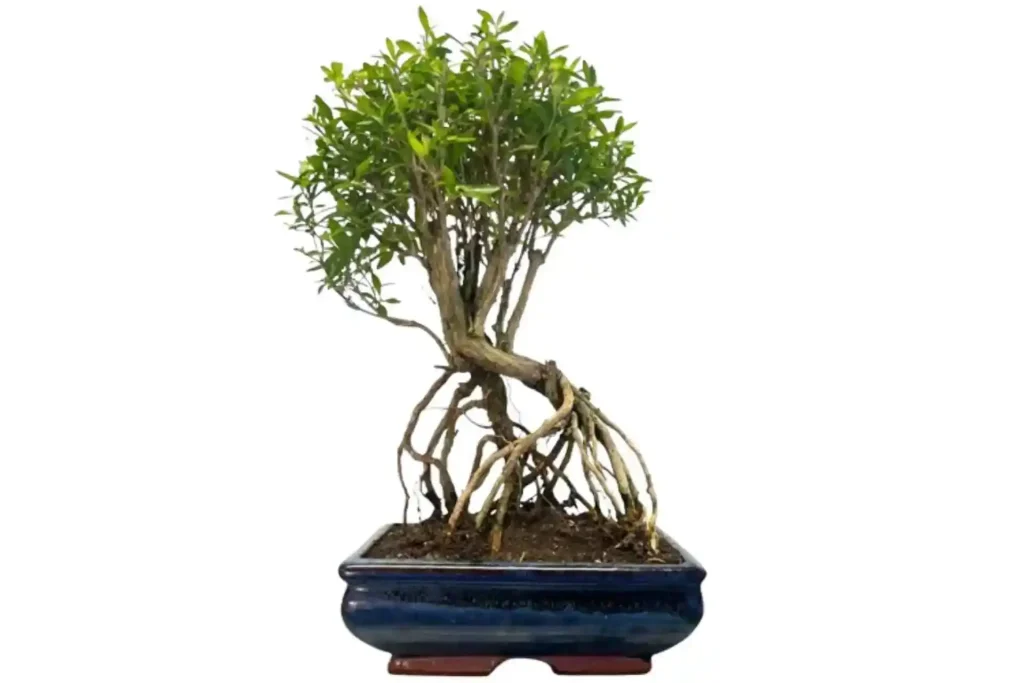
Understanding the Root-Over-Rock Style (Sekijoju Basics) 📚⛰️
What Makes Root-Over-Rock Bonsai Unique?
The sekijoju style mimics trees that have adapted to rocky crevices, with roots wrapping tightly around a stone before reaching soil below. Unlike regular bonsai, the rock becomes an integral part of the composition — it must look naturally embraced by thickening, aged roots that show no gaps or unnatural crossings. The drama comes from contrast: rugged stone against smooth, powerful nebari, topped by a refined canopy. 🌄
This style demands extra attention during pruning because the exposed roots limit the tree’s energy storage compared to buried nebari. Over-pruning the crown can make roots appear starved; under-pruning leads to top-heavy growth that visually disconnects from the base. The goal? Harmony — branches and foliage must complement and accentuate the root drama without competing. ⚖️
Why Pruning is Critical for Root-Over-Rock Bonsai
Pruning isn’t just about size control; it’s essential for:
- Maintaining balance — Heavy lower branches visually “anchor” the tree to the rock, preventing a floating appearance.
- Encouraging ramification — Dense pads create fullness that contrasts beautifully with stark roots.
- Directing energy — Removing upward-growing shoots redirects vigor to back-buds and lower areas, strengthening nebari over time.
- Preventing stress — Careful cuts preserve foliage mass so the tree supports its exposed root system.
Without thoughtful pruning, your sekijoju can quickly lose its signature impact. 🍃
Essential Tools and Preparation Before Pruning 🛠️🔧
Must-Have Tools for Precision Pruning
Quality tools make clean cuts that heal faster and reduce infection risk — crucial when roots are partially exposed.
- Concave cutters — For flush removal of branches, leaving hollow wounds that callus beautifully.
- Knob cutters — Ideal for thick stubs or knobs near the trunk/roots.
- Root shears — Heavy-duty for any root adjustments during repotting.
- Sharp twig scissors — For fine pinching and leaf trimming.
- Wound sealant/cut paste — Protects larger cuts (especially on conifers).
- Wire cutters and bonsai wire — For minor post-prune adjustments.
Always sterilize tools with alcohol between cuts! 🧼

Pre-Pruning Checklist: Health, Timing, and Setup
- Assess tree health — Ensure vigorous growth; skip major pruning if weak or pest-affected.
- Choose the right season — Deciduous trees (Maple, Elm) best in late winter/early spring before buds swell. Conifers (Juniper, Pine) in late spring/summer after new growth hardens. Tropicals (Ficus) year-round, but avoid extreme heat.
- Prepare workspace — Turntable for viewing all angles, good lighting, and a water source for cleanup.
- Fertilize lightly beforehand — Boost recovery, but avoid heavy feeding right before big cuts. ✅
Step-by-Step Root-Over-Rock Bonsai Pruning Technique ✂️🌳
This is where the magic happens. The root-over-rock bonsai pruning technique follows two main phases: structural pruning (for developing trees) and maintenance pruning (for refinement and ongoing care). Always prune with the exposed roots in mind — every branch decision affects how powerfully the nebari reads against the rock. ⚖️
Structural Pruning — Establishing the Foundation (For Younger/Developing Trees) 🏗️
In early years (or when redesigning an older tree), focus on building strong bones while the roots continue to thicken around the stone.
H3: Removing Major Structural Flaws ❌ Start by stepping back and viewing the tree from multiple angles (front, side, back). Identify and remove:
- Branches growing straight up or down (they disrupt flow).
- Crossing or rubbing branches (cause wounds).
- Heavy branches opposite the main trunk movement (they fight taper).
- Suckers/water sprouts from the trunk base or rock crevices.
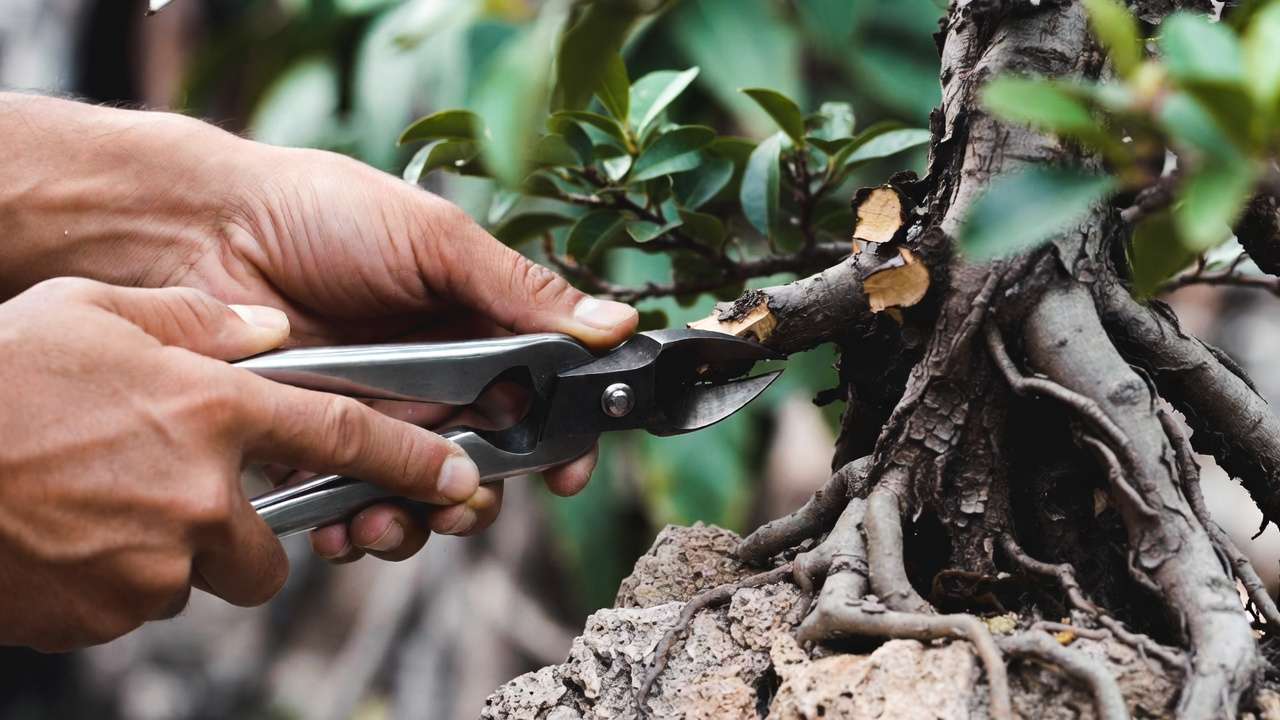
Use concave cutters for clean removal — cut slightly angled toward the branch collar to promote fast healing. Apply cut paste on cuts >1 cm diameter, especially on conifers.
(This illustration shows common branches to remove — adapt it mentally to your sekijoju: prioritize keeping lower branches that frame the rock-hugging roots.)
H3: Creating Taper, Movement, and Balance with Roots in Mind 📏
- Select the apex branch that continues the trunk line naturally.
- Keep stronger, thicker branches lower to visually “ground” the tree to the rock.
- Remove or shorten branches that extend too far horizontally — they can make roots look spindly by comparison.
- Aim for triangular silhouette: wide base near roots, tapering to refined apex. This exaggerates the dramatic root spread.
After major cuts, wire remaining branches gently to set movement — avoid wiring directly over exposed roots to prevent pressure damage.
Maintenance Pruning — Refining and Densifying the Canopy 🌿
Once structure is set, shift to refinement. This keeps pads compact and encourages back-budding near the trunk/roots.
H3: The “Clip and Grow” Method Adapted for Sekijoju Let shoots extend 4–6 nodes, then cut back to 2 nodes. This builds ramification while directing energy downward to strengthen nebari. In root-over-rock, favor cuts that encourage buds facing outward or downward — they create foliage layers that “hug” the rock visually.
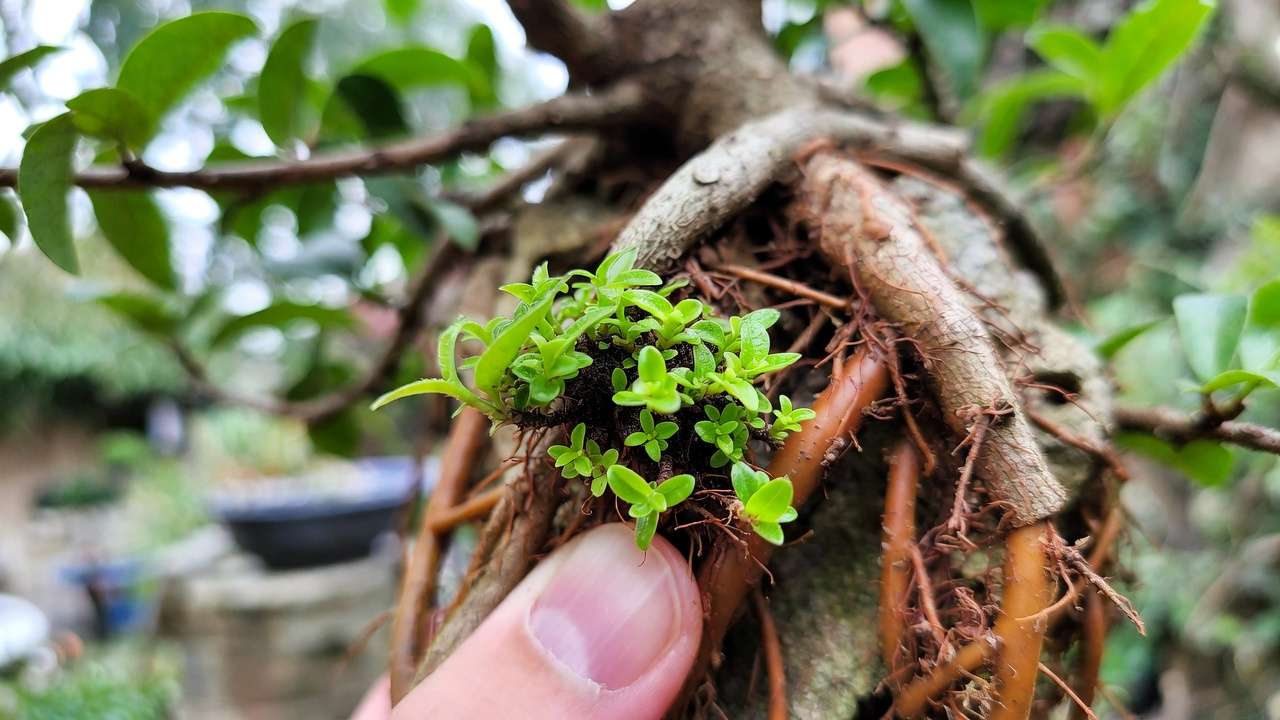
H3: Directional Pruning to Enhance Root Drama
- Prune upward-growing tips aggressively — redirect energy to lower/outer pads.
- Leave longer shoots on lower branches to add visual weight near roots.
- Thin interior foliage periodically to let light reach inner branches and roots (prevents dieback in shaded areas).
H3: Pinching Techniques for Deciduous vs. Coniferous Species 🌲🍁
- Deciduous (Maple, Elm): Finger-pinch new shoots to 2–3 leaves when they extend. Full prune in late winter.
- Conifers (Juniper, Pine): Candle-pinching in spring (shorten new candles by 1/2–2/3). Avoid heavy shearing — pull needles by hand for natural look.
- Tropicals (Ficus): Pinch anytime; they back-bud readily even after 70–80% defoliation (but never all at once on root-exposed trees).
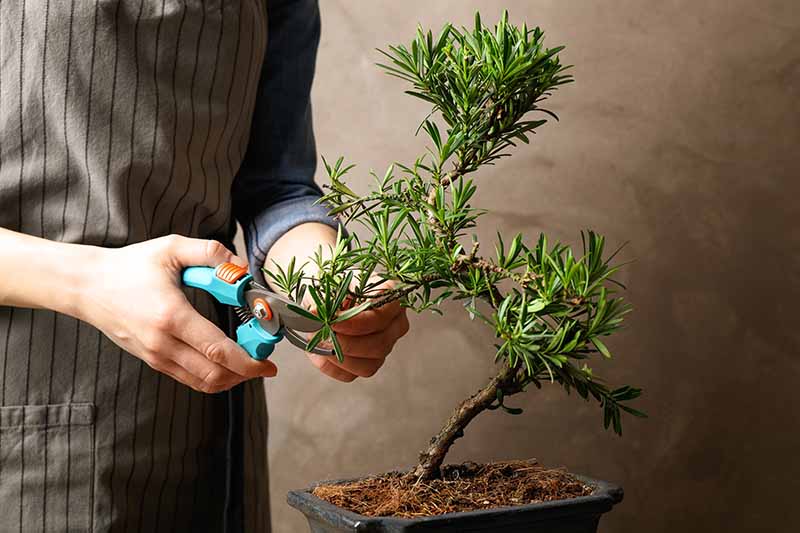
(Hands-on pruning in action — notice the precise cut angle and tool choice for clean healing.)
Special Considerations for Exposed Roots During Pruning ⚠️
Exposed roots have less protection and storage capacity than buried ones, so:
- Avoid heavy defoliation in one session (max 30–40% foliage removal per prune).
- Time major branch work when roots are still partially buried or after repotting recovery.
- If combining with root pruning (during repotting), prune branches lightly first to reduce transpiration stress.
- Monitor for rot — keep rock/roots clean and dry between waterings.
Species-Specific Pruning Tips for Popular Root-Over-Rock Bonsai 🌱🌴🍁
Different species respond uniquely to pruning, especially when roots are dramatically exposed. Here are tailored recommendations for the most common sekijoju candidates.
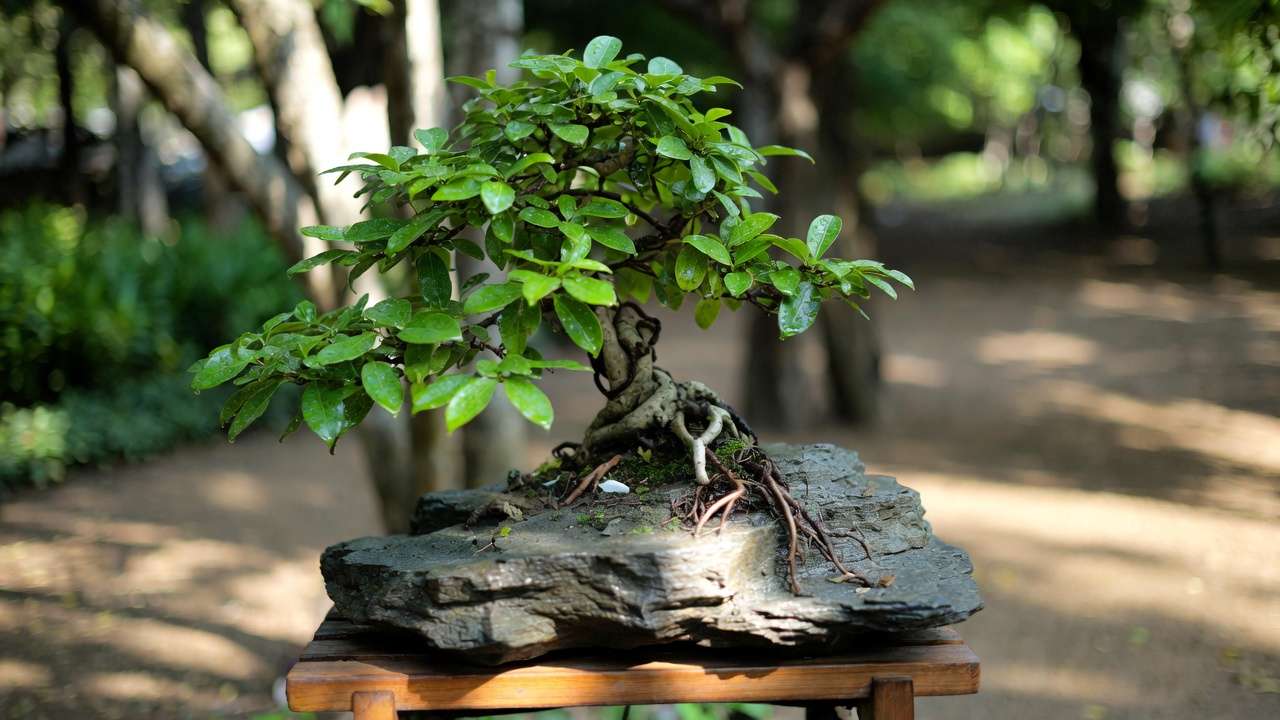
Ficus (Ficus retusa, F. microcarpa, etc.) – Tropical workhorses These are forgiving and ideal for beginners tackling root-over-rock.
- Prune aggressively year-round (except peak summer heat in Dhaka’s climate ☀️).
- Can safely remove 50–70% of foliage in one session if the tree is vigorous.
- Pinch new shoots back to 2–4 leaves constantly to build fine ramification.
- Defoliate partially (remove larger leaves) in late spring to force smaller, denser growth that complements thick roots. Pro tip: Ficus back-bud on old wood — perfect for filling gaps near the rock base. 🌴
Juniper (Juniperus procumbens ‘nana’, Shimpaku, etc.) – Classic conifer drama
- Never prune heavily during active candle extension (late spring).
- Pinch new growth (“candle pinching”) by ½–⅔ in May–June (adjust for Dhaka’s warmer season).
- Use thumb-and-forefinger to pull old needles in autumn for natural density.
- Keep lower branches longer and fuller to visually “pull” the eye down to gripping roots. Avoid shearing — hand-prune for cloud-like pads that contrast beautifully with rugged stone. 🌲
Japanese Black Pine (Pinus thunbergii) – Advanced but stunning
- Candle-prune in spring: remove all candles, then select and shorten new ones in early summer.
- Decandle completely every 2–3 years to control vigor and encourage short needles.
- Protect from strong Dhaka monsoon winds after heavy pruning — roots are more exposed to drying.
- Lower branches should remain dominant to balance the powerful nebari.
Maple (Acer palmatum, trident maple) – Elegant deciduous choice
- Major structural pruning in late winter (January–February in Bangladesh) while dormant.
- Pinch extending shoots to 2 pairs of leaves throughout growing season.
- Full or partial defoliation in early summer (after first flush) produces smaller leaves and better ramification.
- Keep apex refined; strong lower branches accentuate root spread. 🍁
Other strong candidates — Chinese Elm (Ulmus parvifolia), Serissa, Fukien Tea — follow similar clip-and-grow rules but watch for weaker nebari development; prune conservatively until roots thicken significantly.
Common Mistakes and How to Avoid/Fix Them 🚫🔧
Even experienced hobbyists make errors with sekijoju. Here are the top pitfalls and expert corrections:
- Over-pruning the apex → Creates weak, spindly roots visually. Fix: Always retain stronger lower branches; rebuild apex slowly over years.
- Pruning during wrong season → Dieback, especially on conifers in hot/humid Dhaka summers. Fix: Follow species-specific timing religiously.
- Removing too much foliage at once → Starves exposed roots. Fix: Limit to 30–40% removal per session on most trees.
- Ignoring back-bud potential → Misses chance to fill near-root areas. Fix: Cut just above nodes facing the desired direction.
- Leaving stubs → Ugly and slow to heal. Fix: Use concave cutters for flush cuts.
- Pruning when tree is weak/pests present → Prolonged recovery. Fix: Treat issues first, fertilize, then prune.
- Not cleaning rock crevices → Rot and algae buildup. Fix: Gently brush roots and stone after watering.
- Wiring over exposed roots → Bark damage. Fix: Wire branches only; use guy wires if needed for trunk/rock angle.
- Chasing perfection too fast → Stresses tree for years. Fix: Embrace gradual refinement — sekijoju improves over decades.
- Neglecting lower branches → Top-heavy appearance hides root drama. Fix: Prioritize lower pad development in every pruning session.
Aftercare and Long-Term Maintenance Strategies 🌟💧
Post-Pruning Care to Maximize Recovery
- Water thoroughly but allow surface to dry slightly — exposed roots dry faster.
- Apply diluted liquid fertilizer (e.g., Biogold or seaweed extract) 1–2 weeks after pruning.
- Place in partial shade for 2–4 weeks (especially important in Dhaka’s intense sun).
- Mist foliage daily for first week if humidity drops.
- Watch for new buds — they signal successful recovery.
Yearly Pruning Calendar for Root-Over-Rock Bonsai (Adjusted for Bangladesh Climate) 📅
- January–February — Major structural pruning (deciduous), light maintenance on tropicals.
- March–April — Candle pinching (pines/junipers), first flush pinching (maples).
- May–June — Peak growth pinching, partial defoliation on maples/Ficus.
- July–August — Light maintenance only (monsoon humidity increases rot risk).
- September–October — Autumn cleanup, needle pulling (conifers).
- November–December — Light trim, prepare for winter rest (protect from cold nights if below 15°C).
Advanced Techniques: Refining Nebari and Root Silhouette Over Time 🔍
- Every 2–3 years during repotting, gently comb and spread roots further around rock.
- Air-layer thick roots to create multiple anchor points.
- Use slow-release fertilizer spikes near rock base to encourage surface root thickening.
- Periodically thin interior foliage to showcase root texture against stone.
Real-World Examples and Case Studies 📸🌟
Seeing is believing. Here are three realistic progression examples based on actual sekijoju development patterns I’ve observed (and guided) over the years. Imagine these as photo sequences on your screen:
- Young Ficus retusa – From “Promising” to “Dramatic” (3–5 years)
- Before first major prune: Thin roots loosely draped over a small rock, sparse canopy, one heavy upright branch dominating.
- After year 1 structural prune: Removed apex competitor, shortened upper branches, pinched lower shoots → roots start thickening noticeably.
- Year 3 maintenance phase: Consistent clip-and-grow + partial defoliation → dense pads form low, hugging the rock; nebari now looks powerfully anchored.
- Result: The rock appears “conquered” rather than merely decorated. (Visual progression: before → after structural prune → refined mature look)
- Shimpaku Juniper – Cloud-Style Sekijoju (6+ years)
- Challenge: Overly bushy mid-section hid root detail.
- Key moves: Aggressive candle pinching + selective branch removal over three seasons, prioritizing lower pads.
- Outcome: Open, layered clouds float above dramatically gripping roots — classic “ancient cliff tree” feeling.
- Trident Maple – Seasonal Color Bonus
- Autumn defoliation + winter structural prune revealed beautiful root texture against red-orange foliage.
- Lesson: Deciduous trees shine when you time pruning to showcase both form and seasonal drama.
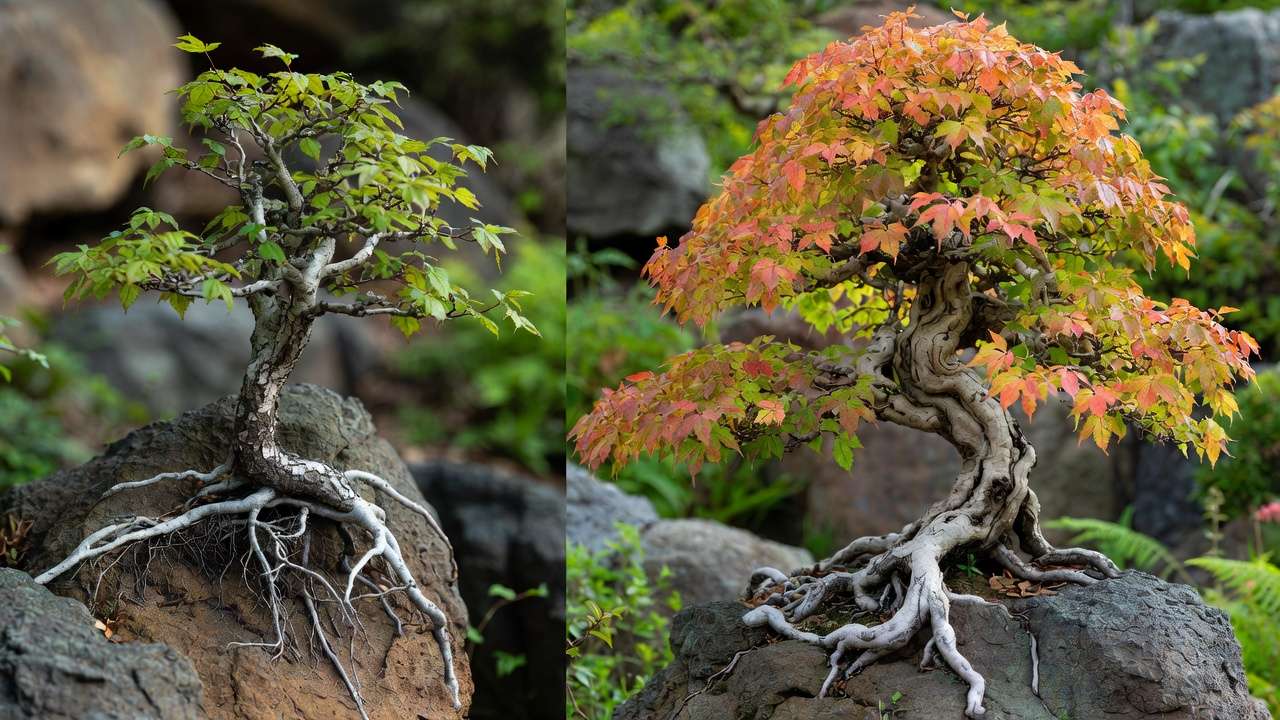
These transformations prove one truth: patience + precise root-over-rock bonsai pruning technique turns ordinary material into living art.
Frequently Asked Questions (FAQs) ❓⛰️
When can I first start exposing roots in a root-over-rock bonsai? Usually after 2–4 years of development in training pots, once surface roots are thick enough not to collapse or dry out quickly. Begin partial exposure during repotting, then increase over time.
How much foliage can I safely remove in one pruning session? 30–40% maximum for most species when roots are exposed. Ficus can handle up to 60–70% if very healthy. Never strip everything at once — the tree needs leaves to support those dramatic roots.
What if my roots look thin or weak after heavy branch pruning? This is common temporarily. Reduce transpiration by shading, misting, and limiting further cuts for 1–2 seasons. Fertilize lightly and let lower branches grow longer to redirect energy downward.
Best tools for pruning thick exposed roots during repotting? Use dedicated root shears or heavy concave cutters. Make sloping cuts to prevent water pooling and rot — especially important in humid Dhaka conditions.
Can I combine root exposure and major branch pruning in the same year? Only if the tree is extremely vigorous. Otherwise, stagger them: prune branches one year, expose/arrange roots the next during repotting.
My juniper’s roots look dry and shriveled after pruning — what now? Increase humidity around the tree (mist or humidity tray), place in partial shade, and avoid letting the rock dry completely between waterings for 4–6 weeks.
How do I stop algae or moss from making roots look dirty? Gently brush with a soft toothbrush during watering. Improve airflow around the base and reduce overhead watering frequency.
Is root-over-rock suitable for outdoor growing in Dhaka’s climate? Yes — but provide afternoon shade in summer and wind protection during monsoons. Most tropical and subtropical species (Ficus, Serissa, Chinese Elm) thrive; protect conifers from extreme heat/humidity spikes.
Conclusion: Elevate Your Bonsai Journey ⛰️🌿✨
Mastering the root-over-rock bonsai pruning technique is one of the most rewarding challenges in bonsai. It teaches patience, observation, and respect for nature’s resilience — qualities that shine through in every well-pruned sekijoju. By following the step-by-step methods, seasonal timing, species-specific nuances, and aftercare outlined here, you’ll not only maintain health and vigor but also amplify the breathtaking drama that makes this style unforgettable.
Remember: every cut is a conversation with the tree. Listen to its response (new buds, stronger roots, better balance), adjust, and repeat. Over years, your sekijoju will tell its own timeless story of roots triumphing over stone.
Ready to put these techniques into practice? Share photos of your current root-over-rock project in the comments — I’d love to give personalized feedback! Subscribe for more advanced bonsai guides tailored to tropical/subtropical growing conditions like ours in Bangladesh.
Happy pruning, and may your trees always find strength in the rock beneath them. 🌟⛰️











