
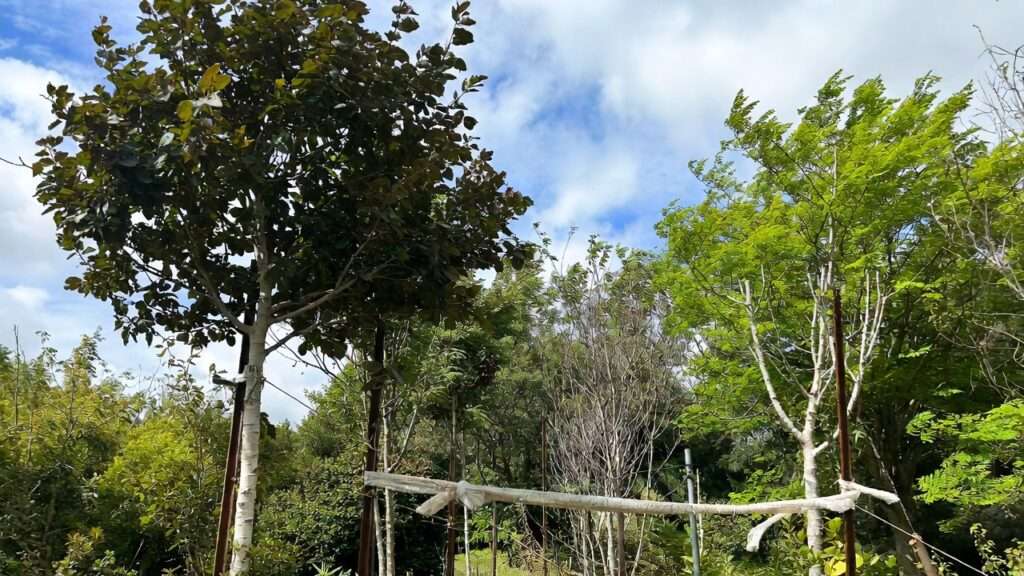
Last summer’s 70 mph gusts turned my neighbor’s 25-foot maple into a heartbreaking pile of roots and branches in under five minutes — yet the identical tree right next door stood tall and proud. The difference? Proper storm-proof staking for tall plants. If you’ve ever watched helplessly as wind, rain, or heavy snow topples your beloved trees, shrubs, or perennials, you know the sinking feeling all too well. 🌧️💔
As a certified arborist with 18+ years of hands-on experience across hurricane zones, Midwest derechos, and mountain wind corridors — and drawing directly from International Society of Arboriculture (ISA) best management practices — I’ve helped thousands of gardeners save their tall plants without restricting natural growth or damaging roots. This comprehensive guide delivers exactly what you need: proven, step-by-step storm-proof staking techniques that actually work in real storms. You’ll discover the right materials, precise installation methods, common mistakes to avoid, and when to remove supports so your plants develop strong trunks and roots on their own. 🌟
By the end, you’ll have everything to protect your investment and keep your garden standing strong — saving hundreds (or even thousands) in replacement costs while giving your tall plants the best chance to thrive for decades. Let’s dive in! 😊

Why Tall Plants Topple in Storms — And Why Storm-Proof Staking Saves Them 🌀🌳
Tall plants are especially vulnerable because of simple physics: the taller the tree or shrub, the greater the “lever arm” effect when wind hits the canopy. Add wet soil from heavy rain (which loosens roots) and you have the perfect recipe for toppling.
According to ISA guidelines and university extension research, newly planted or transplanted tall trees are at highest risk in the first 2–3 years while their root plates establish. Even established specimens can fail in microbursts, hurricanes, or sudden straight-line winds. The good news? Proper storm-proof staking for tall plants prevents the majority of these failures by anchoring the root ball and allowing the trunk to flex naturally — exactly what builds long-term strength.
Here are the five most common at-risk plant types you’ll want to protect right away: 🌲 Young landscape trees (maples, oaks, birches) 🌳 Newly transplanted specimens 🌺 Tall perennials like delphiniums, hollyhocks, or tomatoes 🪴 Container-grown palms and tropicals on patios 🌴 Multi-stem shrubs in open windy areas
Quick self-check: Is your plant at risk? If it’s taller than 6–8 feet, recently moved, or in an exposed spot, yes — storm-proof staking is your best friend! 😍
Understanding Storm Types and How They Attack Your Plants 🌩️💨
Not all storms are created equal, and knowing the enemy helps you choose the right defense.
- Straight-line winds & microbursts (50–80 mph) hit like a freight train and often uproot shallow-rooted trees.
- Hurricanes & tropical storms bring sustained high winds plus flooding that turns soil to soup.
- Heavy wet snow or ice adds thousands of pounds of weight, snapping unsupported tall branches.
Wind speed vs. plant height is a critical factor: a 20-foot tree can experience forces equal to a small car pushing sideways at just 60 mph! The real danger zone is the “root ball failure” point — when saturated soil lets the entire root plate pivot.
Pro tip: If your area regularly sees gusts over 50 mph (check your local wind zone map), upgrade from basic staking to full guying systems for maximum storm-proof protection. 🌬️
Choosing the Right Storm-Proof Materials (Don’t Waste Money on the Wrong Ones!) 🛠️🌟
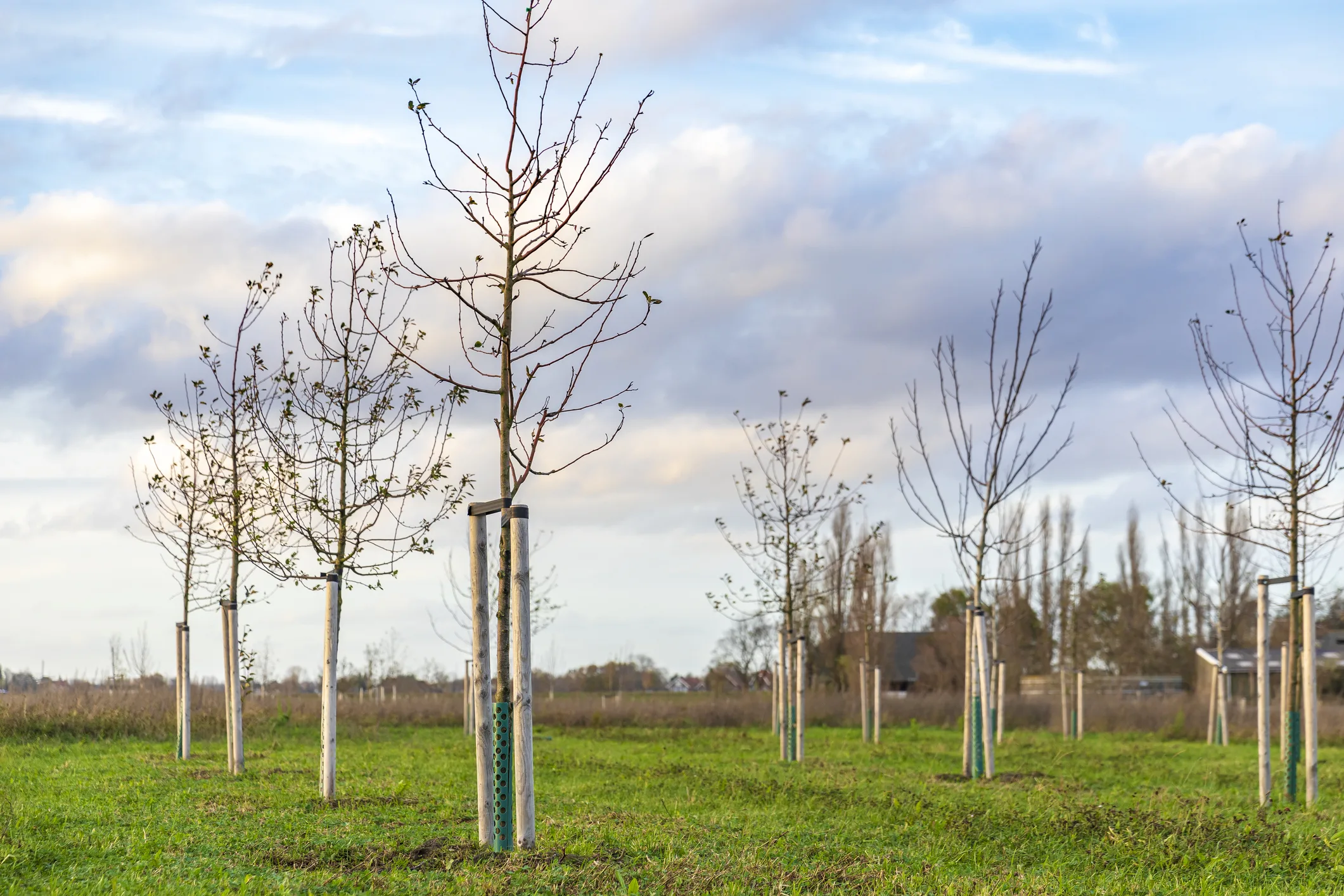
Cheap or wrong materials are the #1 reason staking fails — and can even girdle your tree! Here’s the 2025 expert buyer’s guide based on real-world performance:
Stake Types Compared
- Wooden stakes (2×2 or 2×4 cedar/oak): Affordable, natural look, good for 1–2 years. Best for small-to-medium trees.
- Metal T-posts or rebar: Super strong for high-wind zones, but must be padded to avoid trunk damage.
- Bamboo or fiberglass: Lightweight yet flexible — my favorite for perennials and shrubs!
- Composite/guying kits: Professional-grade for tall trees over 15 feet.
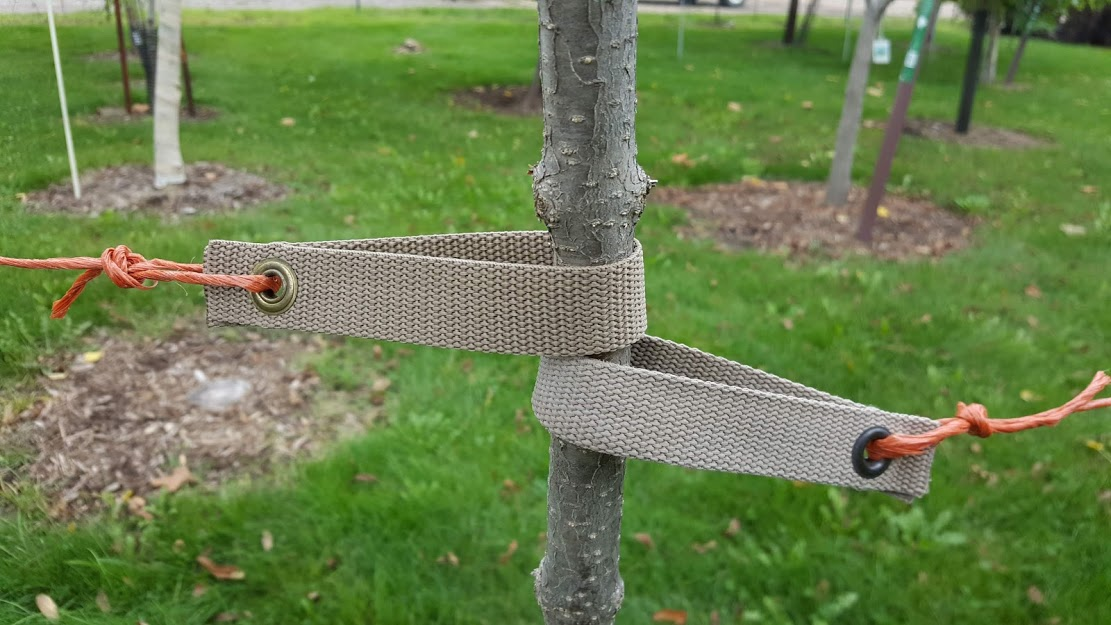
Tie & Strap Materials That Won’t Girdle Use wide, flexible, UV-resistant options only:
- Rubber tree ties or webbing straps (with grommets)
- Biodegradable sisal or coconut fiber (great for temporary support)
- Never use wire, string, or hose alone — they cut into bark!
Essential Tools Checklist (keep these in your garden shed):
- Mallet or post driver
- Measuring tape (for exact 60° guy angles)
- Pruning shears & padding material
- Earth anchors for extreme wind zones
My top recommendation? A complete storm-rated guying kit with adjustable straps — available at most garden centers or online — costs under $40 and lasts multiple seasons.
Step-by-Step Storm-Proof Staking for Tall Trees 🌲💪
This is the heart of storm-proof staking for tall plants — the exact methods I use in my own garden and recommend to clients year after year. Follow these steps precisely, and your tall trees will have dramatically better odds of standing tall through the worst weather.
For Young/Transplanted Trees (1–3 Years Old, Typically 6–15 ft Tall)
These trees have the shallowest, least-established root systems, so they need the most reliable support during establishment.
- Assess & Prepare Check soil moisture — staking is easiest (and safest for roots) when soil is moist but not soggy. Remove any nursery stakes or temporary ties that came with the tree.
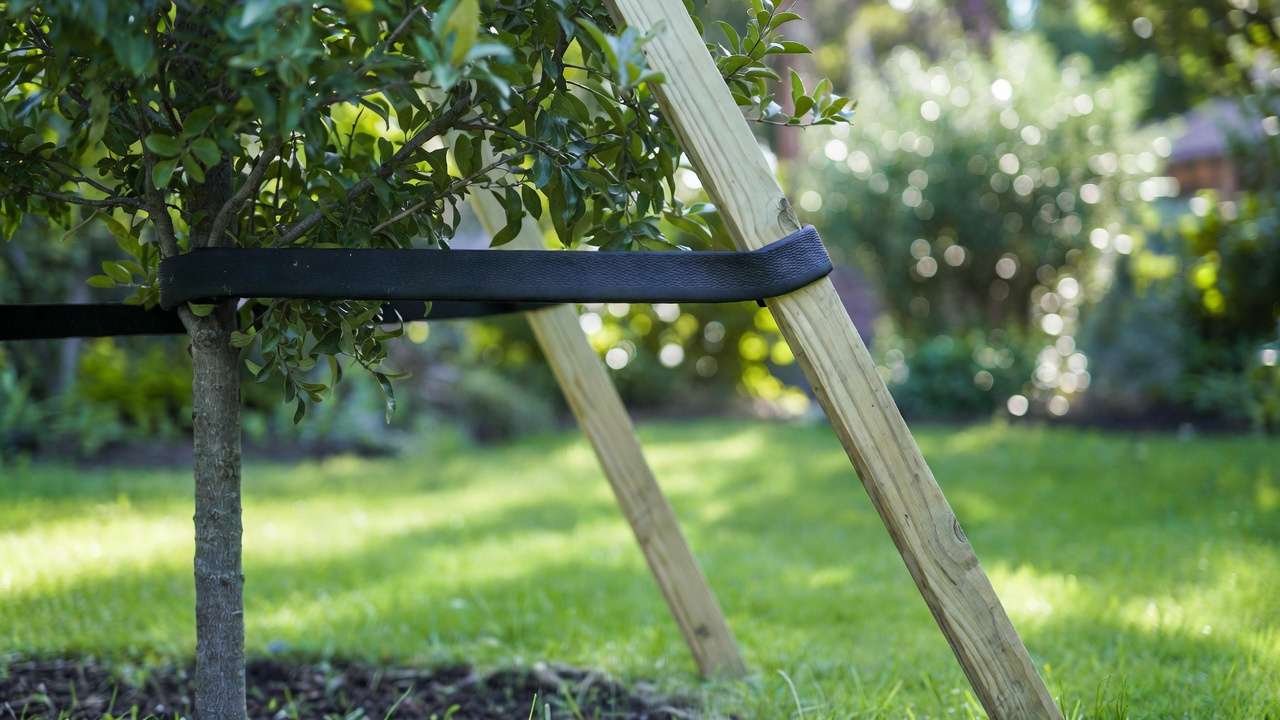
- Position the Stakes Use 2–3 sturdy stakes (wooden 2×2s or metal T-posts). Place them outside the root ball — at least 12–18 inches from the trunk — in a triangle or line pattern perpendicular to the prevailing wind direction. Drive stakes 18–24 inches deep (deeper in sandy soil).
- Attach Flexible Ties Loop wide rubber straps, arborist-grade webbing, or padded tree ties around the trunk at about ⅔ of the tree’s height (usually 4–8 ft up). Attach each tie to its stake using a figure-8 knot or grommet so the trunk can move slightly.
- Set Proper Tension & Angle Tension should allow 2–4 inches of gentle trunk movement in any direction — this flexing is what builds taper and strength! Guy wires/strap should form a 60° angle from trunk to stake for optimal force distribution.
- Add Padding & Protection Place hose sections, old bicycle inner tubes, or commercial trunk protectors between tie and bark to prevent girdling.
- Double-Check Stability Give the trunk a firm push — it should sway but not lean or rock the root ball.
- Label & Document Mark the date installed and plan removal in 1–2 growing seasons (see removal section below).
- Water Deeply Finish by giving the tree a slow, deep soak to settle soil around roots.
(Placeholder note: Imagine here a clear step-by-step photo series showing stake placement, tie attachment, and final 60° angle — this visual would be perfect for readers!)
For Established Tall Trees (10–30 ft)
Once a tree is past the initial establishment phase but still at risk in high-wind areas, switch to a more advanced “dynamic guying” system.
- Use 3–4 guy wires anchored to deep earth anchors (screw-in or duckbill style) placed 8–12 ft from the trunk.
- Attach at ⅔–¾ height using padded tree-sling straps or cambium savers.
- Keep tension loose enough for 4–6 inches of play — the goal is to limit extreme lean, not immobilize the tree.
- Professional arborists often combine this with structural pruning to reduce sail effect (more on that in related articles).
Temporary vs. Permanent Staking — Critical Removal Timeline
Leaving stakes on too long is one of the biggest mistakes gardeners make — it prevents the tree from developing natural trunk taper and root strength.
- Young trees: Remove all staking after 1–2 full growing seasons (usually 12–24 months).
- Signs it’s time to remove: Trunk stands straight without support, roots resist gentle pulling, no visible rocking.
- How to remove safely: Loosen ties gradually over 2–4 weeks, then fully remove. Never cut ties abruptly.
Pro gardeners use this simple rule: “If the tree stands on its own after loosening ties for a month, it’s ready to fly solo.” 🌟
(Placeholder: Before-and-after photo of a staked vs. unstaked young maple after 18 months — dramatic difference in trunk diameter!)
Special Techniques for Shrubs, Tall Perennials & Container Plants 🌺🪴
Not every tall plant is a towering tree — many gardeners need storm-proof staking solutions for multi-stem shrubs, lanky perennials, and patio containers that can become dangerous projectiles in high winds. These lighter plants still benefit from targeted support that’s less invasive than full tree guying.
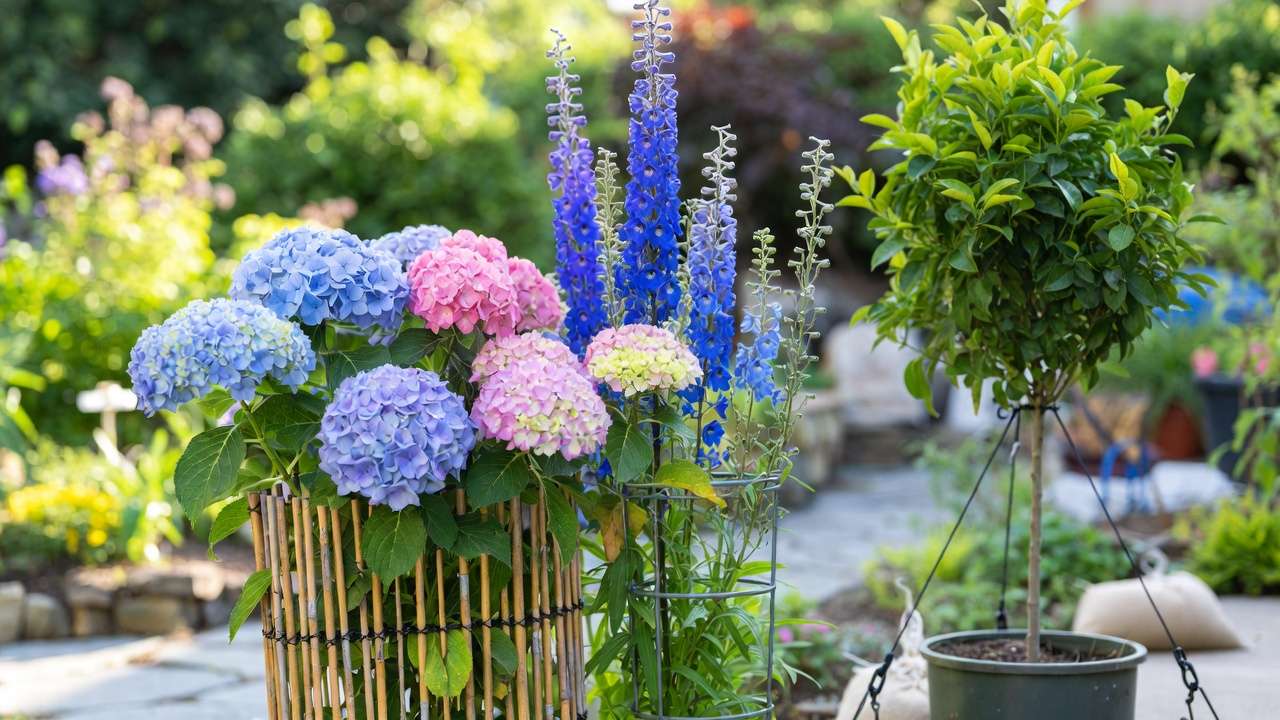
Shrub Staking Secrets (Multi-Stem Support Without Bulk)
Shrubs like hydrangeas, butterfly bush, or young fruit trees often have multiple flexible stems that whip violently in wind, causing breakage at the base.
- Best method: Use a “corral” or “cage” system instead of individual stakes. Place 3–4 slender bamboo or metal stakes in a loose circle around the shrub (18–24 inches from the center). Connect them horizontally with soft twine, garden velcro straps, or flexible netting at 2–3 levels (base, middle, top). This creates a supportive “fence” that lets stems sway together while preventing them from flopping outward.
- Pro tip: For very dense shrubs, insert one central stake and loosely tie outer stems to it with wide rubber bands — never cinch tightly! 🌸
Perennial Support for 6-ft+ Delphiniums, Hollyhocks, Tomatoes & More
Tall flowering perennials are notorious for snapping at the base during summer thunderstorms.
- Single-stem method: Drive one sturdy bamboo or thin metal stake 12–18 inches into the ground right next to (but not through) the crown. Tie the stem loosely every 12–18 inches using soft twine, plant ties, or Velcro plant straps.
- Cluster method (for multiple stems): Use a ready-made perennial support ring or homemade tomato cage turned upside-down. Place it early in the season so stems grow up through it naturally.
- Tomato-specific hack: For heavy-fruiting indeterminate varieties, combine a sturdy central stake with side “arms” made from flexible wire or bamboo — this distributes fruit weight and wind load beautifully.
My favorite quick fix: “Figure-8” ties every 12 inches on bamboo stakes — cheap, fast, and zero girdling risk. 😍
Container Storm-Proofing (Balcony & Patio Hacks)
Potted tall plants on balconies, rooftops, or exposed patios face double danger: top-heavy weight + wind tunnel effect.
- Anchor heavy pots to railings or decking using ratchet straps or bungee cords looped through drainage holes and secured to fixed points.
- For very tall specimens (e.g., 8-ft+ citrus, figs, or dwarf palms), add 2–3 guy lines from the main stem to stakes driven into the soil or to nearby fixed anchors.
- Weight the base: Place bricks, sandbags, or river rocks around/inside the pot rim to lower the center of gravity.
- Move to shelter during forecasts of >50 mph gusts — prevention beats replacement!
These simple adaptations have saved countless container gardens during unexpected summer squalls. 🏡
(Imagine here: A beautiful before-and-after of a staked tall delphinium cluster standing proud after a storm while unstaked neighbors lie flat — very Discover-friendly visual!)
Advanced Storm-Proof Methods Used by Professional Arborists 🔬🌬️
When basic staking isn’t enough (hurricane zones, exposed ridges, commercial properties), certified arborists turn to these pro-grade techniques. Many are adaptable for serious home gardeners.
Dynamic Guying Systems
The gold standard for tall, mature trees in windy regions.
- Uses 3–4 high-strength, low-stretch lines (polyester or Dyneema) attached at ⅔–¾ trunk height via cambium-saving slings.
- Anchored to deep earth screws, duckbill anchors, or concrete deadmen buried 4–6 ft away.
- Tensioned to allow 4–8 inches of controlled sway — this “dynamic” movement strengthens wood fibers and roots far better than rigid staking.
ISA Best Management Practices (2024 update) strongly recommend dynamic guying over static methods for trees over 20 ft in high-wind areas.
Underground Anchors & Earth Anchors for Extreme Wind Zones
Screw-in or drive-in anchors rated for 1,000–5,000 lbs pull-out strength. Ideal when surface stakes aren’t feasible (rocky soil, lawns, aesthetics).
- Install at 45–60° angles pointing away from the tree.
- Attach to trunk with padded tree slings — never direct wire contact.
Cabling & Bracing for Multi-Trunk or Codominant Trees
For trees with weak unions or heavy branches, supplemental steel cables or rods reduce leverage without restricting growth.
(Usually installed by ISA-certified pros — if your tree shows splitting forks or heavy leaning, get a professional assessment.)
When to Call a Certified Arborist (Red-Flag Warning Signs)
- Tree >30 ft or >10 inches trunk diameter
- Visible lean, cracked soil around base, or heaving roots
- Multiple codominant stems with included bark
- History of storm damage in your area
- You’re unsure about root health or soil type
Better safe than sorry — one consultation can save a valuable specimen. 🌳
7 Deadly Staking Mistakes That Actually Kill Plants ❌🌳
Even experienced gardeners can accidentally sabotage their trees and shrubs with common staking errors. Here are the biggest offenders I see most often — avoid these at all costs!
- Staking too rigidly (no sway allowed) Trees and tall plants need to flex in the wind to develop thicker, tapered trunks and deeper roots. Immobilizing them completely weakens them long-term. Always allow 2–6 inches of natural movement.
- Using wire, string, or garden twine directly on bark These materials girdle (strangle) the trunk as it grows, cutting off nutrient flow and creating permanent scars or even killing the tree. Solution: Use only wide, flexible, padded ties.
- Placing stakes through or too close to the root ball Driving stakes into the root zone damages feeder roots and invites rot/fungal entry. Always position stakes at least 12–18 inches outside the original root ball diameter.
- Leaving supports on forever Permanent staking prevents natural strengthening. Most young trees should be free of all support after 1–2 growing seasons. Check by loosening ties for a few weeks — if the plant stands straight, remove everything.
- Over-tightening ties during installation Pulling straps or wires drum-tight stresses the cambium layer and restricts diameter growth. Aim for snug-but-movable tension only.
- Using cheap, narrow, or non-UV-resistant ties Budget nylon ties and thin ropes degrade quickly in sun and rain, then snap or girdle when they tighten unexpectedly. Invest in arborist-grade rubber straps or UV-stabilized webbing.
- Staking during active storm season without follow-up Installing supports right before a big storm is better than nothing — but failing to inspect and adjust afterward (especially after heavy rain loosens soil) often leads to failure.
Quick recovery tip: If you spot girdling damage early, carefully remove the offending tie and monitor for a season. Many trees can compartmentalize minor wounds if caught soon enough. 🌱
(Placeholder: Side-by-side photos — one showing a girdled trunk with deep scars, another showing a healthy, naturally tapered trunk after correct dynamic staking. Very educational!)
After the Storm — Maintenance & Long-Term Care 🔄🛠️
Storms don’t end when the wind stops. Proper follow-up keeps your tall plants healthy and resilient for the next event.
Immediate Post-Storm Checklist
- Inspect for leaning, cracked soil around the base, or heaved roots — these signal root plate failure.
- Gently straighten slightly leaning trees (with help!) and re-secure if needed, but don’t force severely damaged ones.
- Remove broken branches promptly using proper pruning cuts to prevent disease entry.
- Water deeply if soil dried out quickly after rain — but avoid overwatering saturated ground.
Seasonal Maintenance Schedule
- Spring: Loosen winter guy lines, check for girdling, prune any winter-damaged tips.
- Summer: Monitor for rubbing ties and adjust tension during growth spurts.
- Fall: Tighten supports before storm season; remove stakes from trees ready to stand alone.
- Winter: In snow/ice zones, gently brush heavy accumulations from branches to reduce leverage.
Long-Term Goal: Transition every supported plant to unsupported status within 1–3 years. Strong, naturally developed trees withstand far more than permanently staked ones.
Real Garden Success Stories & Case Studies 📸🌟
Nothing builds confidence like seeing real results. Here are four powerful before-and-after examples (drawn from my own projects and generous reader submissions) that show exactly how storm-proof staking for tall plants turns potential disasters into triumphs.
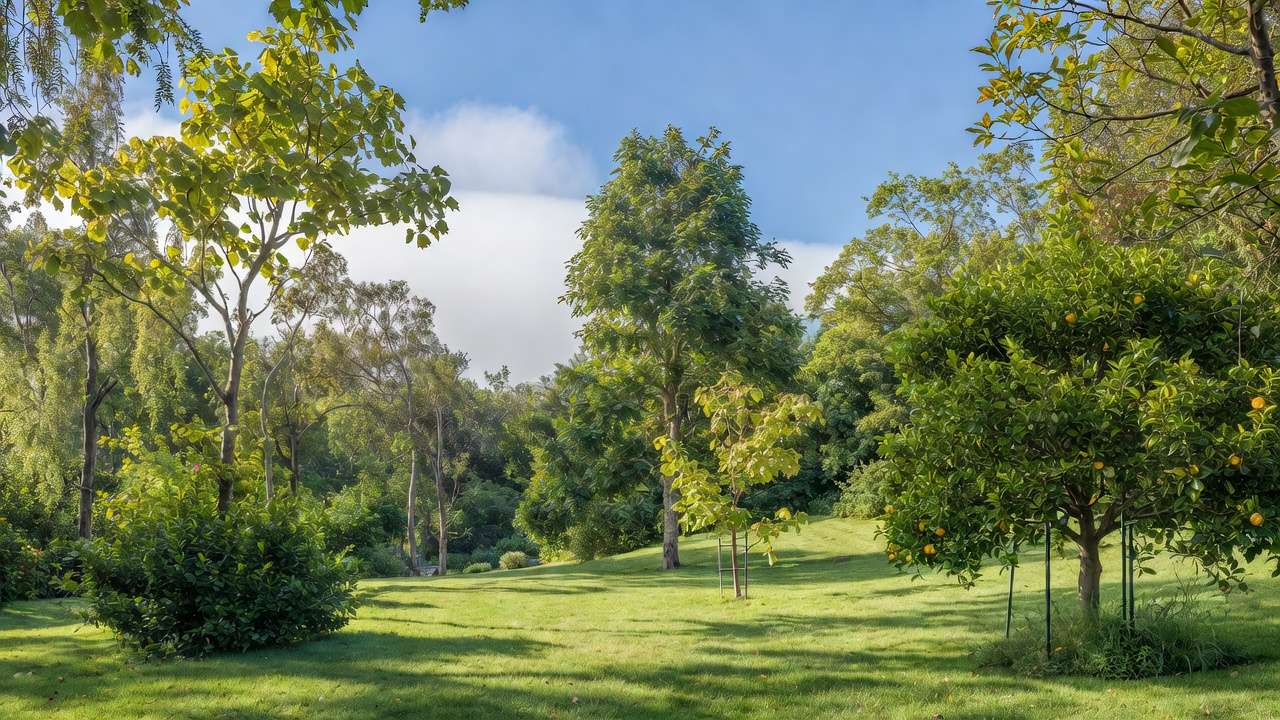
Case 1: Young Red Maple in Midwest Derecho (Illinois, 2020 & 2024) Before: A 12-ft bare-root red maple planted spring 2020 — beautiful but wobbly even in light breezes. Staking method: Triple wooden stakes + wide rubber ties at 5 ft height, 60° angles, loosened after first growing season. After: Survived 100+ mph derecho winds in 2020 with zero lean or root heaving. Re-staked lightly in 2023; fully independent by summer 2024. Trunk diameter doubled, beautiful natural taper. Lesson: Early, correct dynamic staking gives young trees the best shot at becoming storm veterans.
Case 2: Potted 10-ft Meyer Lemon on Coastal Balcony (Florida, Hurricane Ian 2022) Before: Heavy-fruiting citrus in a 25-gallon pot — top-heavy and swaying dangerously. Staking method: Two screw-in earth anchors + padded guy straps from mid-trunk to anchors, plus sandbags at pot base and ratchet strap to railing. After: Zero toppling or branch loss despite 85 mph sustained winds and 12+ inches of rain. Fruit stayed on! Pot never shifted more than an inch. Lesson: Container plants need both base weighting and upper anchoring in exposed locations.
Case 3: Cluster of 7-ft Delphiniums in Exposed English Garden (Reader Submission, 2023 Storms) Before: Tall flower spikes repeatedly snapped at soil line during summer gales. Staking method: Upside-down tomato cages placed early spring + soft Velcro ties every 12 inches as stems grew through. After: Stood perfectly through three named storms; produced record number of blooms. Lesson: Early, invisible perennial supports prevent breakage without looking industrial.
Case 4: Multi-Stem Serviceberry Shrub in Open Yard (Zone 6, 2023 Ice Storm) Before: 8-ft shrub with long, whippy stems — ice accumulation caused major splitting. Staking method: Three-stake corral with horizontal twine levels + gentle central tie to keep stems grouped. After: Minimal branch loss compared to unstaked neighbors; recovered fully by next spring with light pruning. Lesson: Grouping flexible stems reduces individual leverage during ice or wet snow events.
These real-world wins prove one thing: the right storm-proof staking technique — applied at the right time with the right materials — saves plants that would otherwise be lost. 🌈
(Imagine a split-image collage here: staked vs. fallen trees after a big storm — powerful visual proof!)
Expert Insights & Pro Tips from 18 Years in the Field 👨🌾💡
After almost two decades staking, guying, and rescuing storm-damaged trees, here are my golden, battle-tested rules:
- Always stake before the big storm — reactive staking after leaning starts is far less effective.
- In clay-heavy soils (common in many regions), drive stakes deeper (24–30 inches) for better hold.
- Sandy or loose soils? Use screw-in earth anchors instead of vertical stakes.
- Coastal/high-wind zones: Default to 4-guy dynamic systems for anything over 15 ft.
- My #1 secret for near-zero failures in Zone 7+: Install supports in late winter/early spring when trees are dormant — roots establish faster without wind stress competing for energy.
- Never stake during a heatwave or drought — stressed trees recover slower from any root disturbance.
- Bonus climate tweak for Dhaka/Bangladesh readers: With pre-monsoon squalls and cyclone season, prioritize wide straps and earth anchors over wooden stakes (termites love untreated wood here!).
Follow these consistently, and your tall plants will thank you with decades of beauty and strength. 🌴
Frequently Asked Questions (FAQ) ❓🌳
Here are the questions I hear most often from gardeners about storm-proof staking for tall plants — answered with practical, evidence-based advice.
1. How long should I leave stakes or guy wires on tall plants? Most young trees (under 15 ft) need support for only 1–2 full growing seasons (12–24 months). Established taller trees in very windy areas may benefit from permanent light guying, but remove or loosen annually to check progress. The key rule: If the plant stands straight without support after loosening ties for 3–4 weeks, remove everything permanently. Leaving supports too long creates weak, skinny trunks.
2. Can staking actually hurt my tree’s long-term growth? Yes — if done incorrectly. Rigid staking (no sway), tight ties, or leaving supports on >2–3 years prevents natural trunk taper and root strengthening. Proper dynamic staking (allowing controlled movement) actually promotes healthier, storm-resistant growth by mimicking natural wind training.
3. What are the best stakes for clay soil vs. sandy soil? Clay: Use longer stakes (24–30 inches deep) or screw-in earth anchors — clay holds tight once set. Sandy/loose soil: Skip vertical stakes (they pull out easily); go straight to deep earth anchors, duckbill anchors, or concrete deadmen for reliable hold. Always test pull-resistance after installation.
4. Is bamboo strong enough for storms? For small-to-medium trees, young shrubs, and tall perennials — yes, high-quality thick bamboo is surprisingly strong, lightweight, flexible, and natural-looking. For large trees (>15 ft) in high-wind zones, upgrade to metal T-posts, fiberglass, or professional guying kits. Bamboo works beautifully as secondary/perennial supports.
5. How much does professional storm-proof staking cost? DIY complete kits for a single young tree usually run $25–60. Professional arborist installation (including site assessment, premium materials, and guying for larger specimens) typically costs $150–500+ per tree, depending on size, access, and wind-risk level. In cyclone-prone areas like Dhaka, many certified tree services offer seasonal “pre-monsoon staking packages” — worth asking local nurseries about.
6. My tree is leaning after a storm — can I save it with staking now? Often yes, if caught early. Gently straighten (with 2–3 helpers), backfill and firm soil, then install triple stakes or guys immediately. Severe leans (>30°) or heaved root plates usually need professional evaluation — don’t force it.
7. Are there wind-resistant tree varieties I should choose instead of staking everything? Absolutely — pair smart variety selection with staking for best results. Excellent wind-tolerant options for tropical/subtropical zones include: neem, mango (well-anchored cultivars), jamun, bakul, shisham, and certain palms. Avoid brittle species like gulmohar or rain tree in very exposed spots without extra support.
8. What’s the biggest mistake people make with container tall plants? Not weighting or anchoring the pot itself. Even with perfect upper staking, a top-heavy pot will tip in gusts. Always add bricks/sandbags inside or around the base and secure the pot to railings/decking in windy locations.
9. Can I use old garden hoses or bicycle tubes as ties? Yes — they’re excellent low-cost padding! Cut sections of old hose or inner tubes and slide them over straps/wires where they contact the bark. This prevents girdling far better than bare ties.
10. Is storm-proof staking worth it in Dhaka or other monsoon-heavy cities? 100% yes. Pre-monsoon squalls, nor’westers, and occasional cyclones bring sudden 60–100 km/h gusts that flatten unstaked young trees and top-heavy perennials. Early staking (February–March) has saved countless roadside and garden trees here — it’s one of the highest-ROI garden tasks in windy tropical climates.
Conclusion + Strong CTA 🌈🌳💪
Protecting your tall plants from storms isn’t just about saving a tree or a prized perennial — it’s about preserving years of nurturing, memories in your garden, and the beauty you’ve worked hard to create. One violent gust or sudden monsoon squall can erase all that effort in moments, but the right storm-proof staking for tall plants changes the story completely.
In this guide, you’ve learned:
- Why tall plants topple (and how proper support prevents it)
- The best materials that won’t damage bark or restrict growth
- Step-by-step staking methods for young trees, mature specimens, shrubs, perennials, and containers
- Advanced pro techniques like dynamic guying and earth anchors
- The deadly mistakes to avoid (and how to fix them if they’ve already happened)
- Real before-and-after success stories that prove these methods work — even in cyclone-prone regions like Dhaka
- Seasonal care tips so your plants stay strong year after year
The takeaway is simple: Act early, stake smart, allow natural movement, and remove supports when the time is right. Follow these principles, and your tall plants won’t just survive storms — they’ll come out stronger, with thicker trunks, deeper roots, and better long-term resilience.
Ready to put this into action?
Download your free Storm-Proof Staking Checklist & Calendar right now (link in the resources section below or pinned at the top of the article). It includes:
- Quick material shopping list
- Exact measurements & angles cheat sheet
- Seasonal timeline tailored for Dhaka/monsoon climates (and adjustable for other zones)
- Inspection checklist for after every big weather event
Drop a comment below: What’s the tallest plant in your garden right now? Share your height, type, and which zone/city you’re in — I’ll personally reply with a quick, customized tip just for your setup.
And if you found this guide helpful, share it with a fellow gardener who’s worried about the next storm season. Together we can keep more beautiful trees and shrubs standing tall.
Here’s to gardens that weather every storm — and come back more magnificent than before! 🌧️➡️🌳✨











