
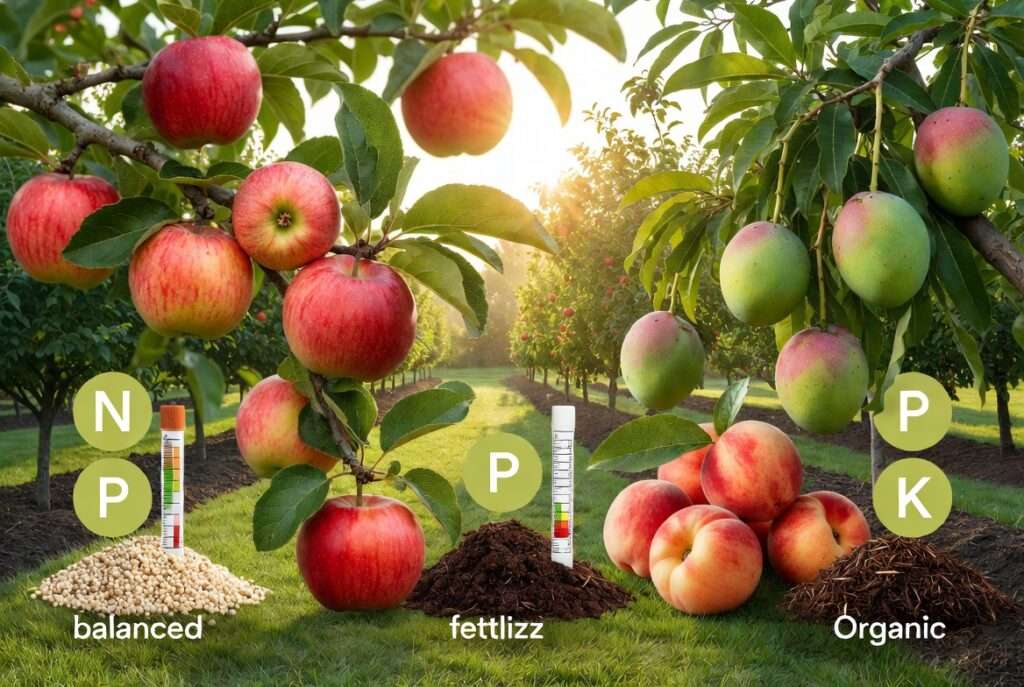
Imagine stepping into your backyard orchard next harvest season and seeing branches so heavy with perfect, sweet fruit that they almost touch the ground — all because you finally nailed the right orchard fertilization schedules by species. 🌟
If you’ve ever felt overwhelmed by conflicting advice like “just use 10-10-10 every spring” only to watch your apple trees grow lush leaves but zero fruit, or your mangoes drop blossoms early, you’re not alone. Generic one-size-fits-all fertilizer tips can actually harm your trees, leading to weak roots, nutrient burn, poor fruit set, or even disease outbreaks.
That’s exactly why this complete, species-by-species guide exists. Drawing from decades of university extension research (including UCANR, University of Florida IFAS, MSU Extension, Tennessee Extension, and TNAU recommendations for tropical growers), I’ve compiled the most practical, up-to-date orchard fertilization schedules by species you’ll find anywhere. Whether you grow apples in a temperate climate or mangoes in a subtropical monsoon region like Bangladesh, you’ll get exact timing, rates, NPK ratios, and pro tips tailored to your trees.
By the end, you’ll have a ready-to-use plan that boosts tree health, increases yields by 30–50%, and gives you sweeter, larger fruit with fewer problems. Let’s grow that dream orchard together! 🍏🥭
:max_bytes(150000):strip_icc()/GettyImages-816897922-b58839ab0e4648c7a265eb2cdb4ef119.jpg)
Why Species-Specific Fertilization Schedules Matter 🌳
Fruit trees aren’t all the same — and neither are their nutrient needs. Pome fruits (apples, pears) focus on balanced growth and strong wood, while stone fruits (peaches, cherries) crave more nitrogen for vigorous spring flushes. Evergreen citrus and tropicals like mango and avocado need year-round feeding with extra potassium and micronutrients to support continuous fruiting.
Using the wrong schedule can cause:
- Excessive leafy growth at the expense of fruit (too much nitrogen on pears)
- Blossom drop or fruit cracking (boron or calcium imbalance in stone fruits)
- Weak root systems and increased pest/disease pressure
- Wasted money and potential environmental runoff
The payoff of getting it right? Stronger trees, better disease resistance, higher-quality harvests, and trees that keep producing abundantly for 20–50+ years. This guide eliminates guesswork and replaces it with science-backed confidence. 💪
Fruit Tree Nutrition Fundamentals 📊
Understanding the basics makes every schedule easier to follow.
Macronutrients (the big three):
- Nitrogen (N) → Drives leafy growth and overall vigor. Too little = pale leaves and slow growth. Too much = lots of leaves, few flowers/fruits.
- Phosphorus (P) → Essential for root development, flowering, and fruit set.
- Potassium (K) → Boosts fruit quality, disease resistance, and drought tolerance.
Key micronutrients often overlooked:
- Zinc & Boron → Critical for pollination and fruit development (especially in apples, peaches, and citrus).
- Magnesium & Iron → Prevent yellowing leaves (chlorosis).
- Calcium → Prevents disorders like bitter pit in apples.
Nutrient demand changes with tree age: young establishing trees need more balanced growth support, while mature bearing trees shift toward fruit production. Soil pH (ideally 6.0–7.0 for most species) dramatically affects how well trees can absorb these nutrients.
The Non-Negotiable First Step – Soil Testing & Site Preparation 🧪
Before you touch a single fertilizer bag, test your soil. This single step prevents 90% of common fertilization mistakes and saves you money long-term.
How to do it:
- Collect samples from 6–8 spots around the drip line of each tree (6–8 inches deep).
- Mix them, air-dry, and send to a local agricultural lab or use a reliable home kit.
- Test for pH, N-P-K levels, organic matter, and micronutrients.
Ideal pH range: 6.0–7.0 for most orchard trees. Below 5.5? Add lime. Above 7.5? Add sulfur or pine needles.
For readers in monsoon climates (hello, fellow South Asian growers!), test before and after the rainy season — heavy rains can leach nutrients fast.
Pro tip: Retest every 2–3 years or after major amendments. Keep records — it’s the smartest habit any orchardist can adopt.

Interpreting results example:
- Low nitrogen + pH 5.8 → Apply lime first, then a balanced organic fertilizer in early spring.
- High phosphorus but low potassium → Choose a low-P, high-K formula (e.g., 8-4-12).
General Orchard Fertilization Principles 🗓️
Timing is everything. Here are the universal rules before we dive into species-specific schedules:
- Deciduous trees (apple, pear, peach, cherry, plum): Main feeding in early spring just before bud break. Light fall application optional for potassium.
- Evergreen/citrus & tropicals: Split into 3–4 smaller applications throughout the growing season.
- Calculation method: Reliable “trunk diameter” rule — ½ pound of actual nitrogen per inch of trunk diameter (measured 6 inches above soil) for mature trees. Young trees: ¼–⅓ pound.
- Organic vs. synthetic: Both work when used correctly. Organic (compost, manure, fish emulsion) builds long-term soil health 🌿. Synthetic gives fast results but needs careful application to avoid burn.
- Application tips: Water deeply after fertilizing. Mulch 3–4 inches deep (keep away from trunk). Never fertilize during extreme drought or right before heavy rain.
Safety first: Always wear gloves, avoid windy days, and keep fertilizers away from children and pets.
These principles apply across every species you’ll read about next — and they’re the foundation of a thriving, productive orchard.
Complete Fertilization Schedules by Tree Species 📅
This is the heart of the guide: precise, research-backed orchard fertilization schedules by species. All recommendations draw from trusted university extensions (UA Cooperative Extension, UF/IFAS, UCANR, MSU, TNAU, and others) and are adjusted for both temperate and subtropical/monsoon climates. Always start with a soil test and adjust based on tree response, growth (aim for 12–18 inches of new shoot growth on young trees, 8–12 inches on mature), and leaf/fruit quality.
Use the trunk diameter method as a reliable backup: Measure trunk diameter 6–12 inches above ground. Apply roughly 0.1 lb actual nitrogen per inch for most stone and pome fruits (max 1 lb N/tree for mature trees). Pears need about half that to avoid excessive growth and fire blight risk.
Apply fertilizer in a wide band from 1–2 feet away from the trunk out to the drip line. Water deeply afterward and maintain 3–4 inches of organic mulch (keep it off the trunk). 🌿
H3: Apple Trees 🍎 Apples are moderate feeders. They need balanced nutrition for strong wood, good fruit set, and prevention of disorders like bitter pit (calcium-related).
- Young trees (1–3 years): Focus on establishment with balanced 10-10-10 or 12-12-12. Apply ½ lb fertilizer per year of age in early spring (pre-bud break).
- Mature bearing trees: 0.1 lb actual N per inch trunk diameter (max ~1 lb N/tree). Split into 2 applications if growth is vigorous: 60–70% in early spring, remainder after fruit set if needed.
- Recommended NPK: Often 10-10-10 with added zinc and boron. For organic: composted manure + bone meal + wood ash.
Sample Schedule Table (per mature tree, adjust by soil test):
| Tree Age/Stage | Timing | Fertilizer Example | Amount (approx.) |
|---|---|---|---|
| Young (1–4 yrs) | Early spring | 10-10-10 | ½ lb per year of age |
| Mature | Pre-bud break (Feb–Mar) | 10-10-10 or 16-16-16 | 5–10 lbs (0.5–1 lb N) |
| Mature (optional) | Post-harvest (fall) | High-K (low N) | 2–4 lbs |
Expert tips: Zinc deficiency is common — foliar spray zinc sulfate at bud swell. Boron helps pollination. If leaves show interveinal chlorosis, check magnesium/iron. In monsoon areas, apply after heavy rains to replace leached nutrients.
H3: Pear Trees 🍐 Pears are lighter feeders than apples and sensitive to excess nitrogen (promotes fire blight). Keep N lower for strong fruiting wood.
- Use ~0.05 lb actual N per inch trunk diameter (half of apples, max 0.5 lb N/tree).
- Preferred fertilizer: Lower-N formulas like 6-6-6 or 8-8-8 with micronutrients.
- Timing: Single early spring application (Feb–Mar) before bud break. Avoid late-season N.
Sample Schedule: For a 5-inch trunk mature pear — ~0.25 lb actual N (about 2.5–4 lbs of 8-8-8). Young trees: ¼–½ lb per year of age.
Pro insight: Pears benefit from good potassium for fruit quality. Monitor for magnesium deficiency (yellowing between veins on older leaves).
H3: Peach, Nectarine & Other Stone Fruits 🍑 Stone fruits are vigorous growers and need more nitrogen for strong spring flushes and fruit sizing.
- Young trees: 1/8–¼ lb N per tree in first year, increasing gradually.
- Mature trees: 0.1–0.15 lb N per inch trunk diameter. Split applications work well: 50–60% pre-bud break, 40–50% after fruit set (to support sizing without excess vegetative growth).
- NPK: 12-4-8 or 10-10-10 with zinc emphasis (peaches are zinc-hungry).
Sample Schedule (mature peach): 1–1.5 lbs of 12-4-8 in late winter/early spring + lighter follow-up if needed. In subtropical areas, split into 3 applications from Feb–June.
Stone fruit notes: Thin fruit early to prevent branch breakage and improve size/quality. Potassium helps fruit sweetness and color.
H3: Cherry Trees 🍒 (Sweet & Tart) Sweet cherries need moderate N; tart cherries are slightly hungrier.
- Timing: Early spring (dormant to bud swell). Sweet cherries: lighter rates to avoid soft fruit.
- Rates: Similar to apples/peaches (0.1 lb N/inch diameter). Tart cherries may take a bit more.
- Micronutrients: Boron and zinc critical for fruit set.
Schedule tip: Apply after soil warms. Avoid fertilizing during bloom or heavy fruit development to prevent splitting.
H3: Plum & Apricot Trees Balanced feeders with emphasis on potassium for fruit quality and disease resistance.
- Schedule: Early spring main application + possible light post-harvest K boost.
- Rates: 0.1 lb N per inch diameter. Plums respond well to 10-10-10; apricots like slightly higher P for roots/fruit set.
Synergy note: Combine with pruning — fertilize after dormant pruning to fuel regrowth.
H3: Citrus Trees 🍊 (Orange, Lemon, Lime, Grapefruit) Citrus are evergreen and need year-round feeding with multiple smaller applications (3–4 splits ideal). They crave potassium and micronutrients for fruit quality and rind health.
- Young trees: Frequent light feeds (every 6–8 weeks) to build canopy.
- Mature trees: 1–1.5 lb actual N per tree/year, split into 3–4 applications. Higher K for fruit sizing and sweetness.
- Timing (temperate): Jan–Feb, Mar–Apr, May–Jun. In subtropical/monsoon climates: Add a post-monsoon boost.
- Recommended: 8-8-8 or citrus-specific blends with Mg, Zn, Fe, Mn. Foliar sprays for quick micronutrient correction.
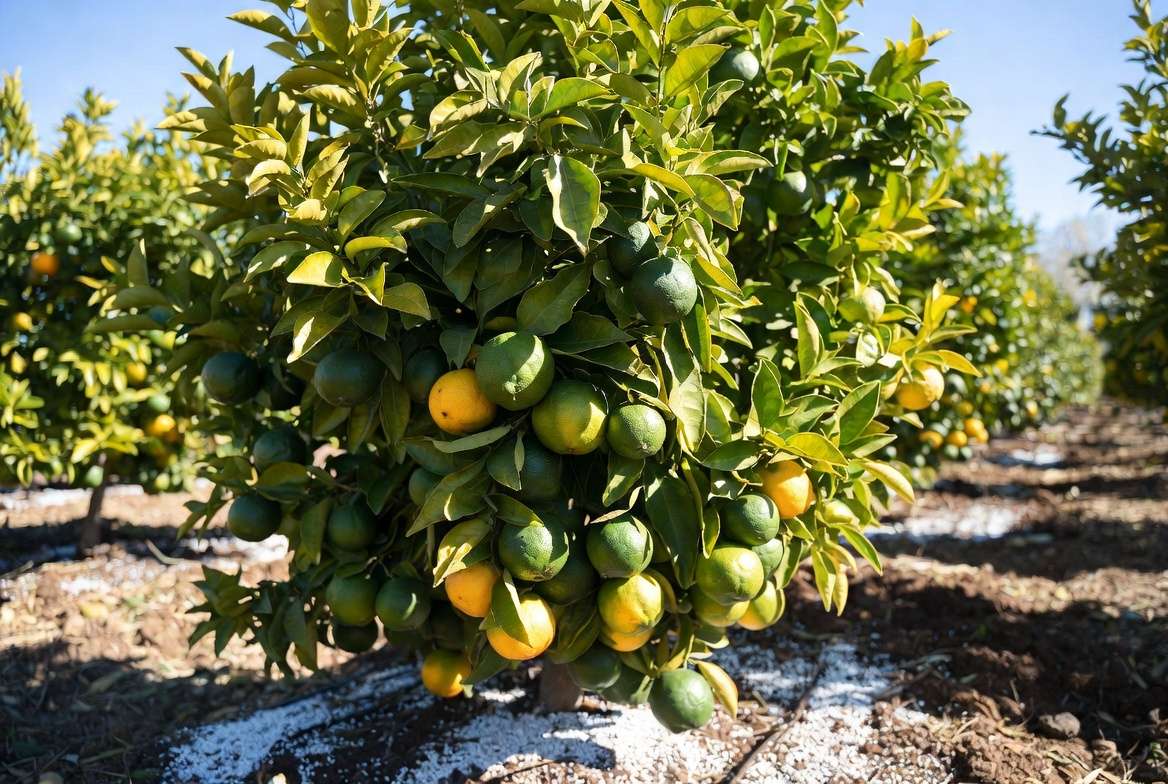
Sample Schedule (mature orange): Divide total fertilizer into thirds — early spring (bloom), post-fruit set, and summer. Lemons/limes may need 10% more.
Citrus pro tip: Yellowing leaves? Likely zinc or iron deficiency — use chelated foliar sprays. In high-rainfall areas like Dhaka, split more frequently to counter leaching.
H3: Mango Trees 🥭 Highly relevant for South Asian growers! Mangoes need careful timing around flowering and monsoon to avoid vegetative flush at the expense of fruit.
- Young trees (1–5 years): Monthly light feeds during growing season or follow TNAU-style: Increase gradually (e.g., Year 1: 100g N, 50g P, 100g K).
- Mature bearing trees: 1 kg N, 0.5–1 kg P, 1–1.5 kg K per tree/year (from TNAU/ICAR guidelines). Split into 2–3 doses: After harvest (June/July), pre-flowering (Sept–Oct), and sometimes fruit development.
- Apply 45–90 cm from trunk to drip line. Incorporate well and irrigate if dry.
- Organic options: Well-rotten FYM (50 kg/tree) + neem cake. Foliar 3% urea pre-flowering in sandy soils.
Monsoon-adapted schedule (Bangladesh/India context): Main dose post-harvest + October dose. Avoid heavy N during flower induction. Use K-rich fertilizers for better fruit retention and quality.
H3: Avocado Trees 🥑 Avocados need steady nutrition with emphasis on zinc and boron. Young trees: Frequent small doses. Mature: Balanced with higher K during fruiting.
- Schedule: 3–4 splits from spring through summer. Heavy mulch helps retain moisture and nutrients.
H3: Other Popular Orchard Trees
- Guava: Split 3 applications (after harvest, pre-flowering, fruiting). Balanced 10-10-10 or organic compost.
- Fig: Moderate feeder — light spring N + potassium. Drought-tolerant once established.
- Pomegranate: Potassium-focused for fruit color and sweetness. Apply post-harvest and early fruit set.
These schedules are starting points — observe your trees! Vigorous growth with good fruit set means you’re on track. Pale leaves or poor yields signal adjustment time. 🔍
How to Apply Fertilizer the Right Way for Best Results 🛠️ Proper application is just as important as choosing the right schedule. Even the best orchard fertilization schedules by species can fail if nutrients don’t reach the roots safely.
Recommended methods:
- Broadcast spreading: Scatter fertilizer evenly from 1–2 feet away from the trunk out to (and slightly beyond) the drip line — where most feeder roots live. This is the simplest and most effective for home orchards.
- Banding: Place in shallow trenches or bands 1–2 feet from the trunk for better efficiency in larger trees.
- Drip-line focus: Concentrate slightly more along the outer canopy edge where active roots are concentrated.
Always water deeply (at least 1 inch) immediately after application to move nutrients into the root zone and prevent burn. Never pile fertilizer against the trunk — it can cause bark damage or root injury.
Mulching synergy: Apply 3–4 inches of organic mulch (wood chips, straw, or composted leaves) after fertilizing. Keep mulch 4–6 inches away from the trunk to discourage rodents and disease. Mulch conserves moisture, moderates soil temperature, and slowly releases nutrients as it breaks down. 🌿
Foliar feeding as a supplement: For quick correction of micronutrient deficiencies (zinc, iron, magnesium), use chelated foliar sprays during active growth. These are absorbed through leaves within hours. Great for citrus and mango in high-rainfall areas where soil nutrients leach quickly.
Tools you’ll need: Measuring cup or scale, gloves, garden rake or hoe for light incorporation, and a hose or irrigation system. For larger orchards, a broadcast spreader saves time.
Common mistakes to skip: Fertilizing during drought (nutrients stay on surface), applying on frozen or waterlogged soil, or using high-nitrogen formulas late in the season (encourages tender growth prone to frost or pests).
Seasonal Fertilization Calendar & Climate Adaptations 📆
A visual month-by-month plan helps you stay consistent, especially in mixed orchards.
Temperate climate example (apples, pears, peaches, cherries):
- Late winter/early spring (Feb–Mar): Main application for deciduous trees — just before bud break.
- Post-fruit set (May–June): Light follow-up for stone fruits if growth is lagging.
- Fall (post-harvest): Optional low-N, high-K boost for root strength and winter hardiness.
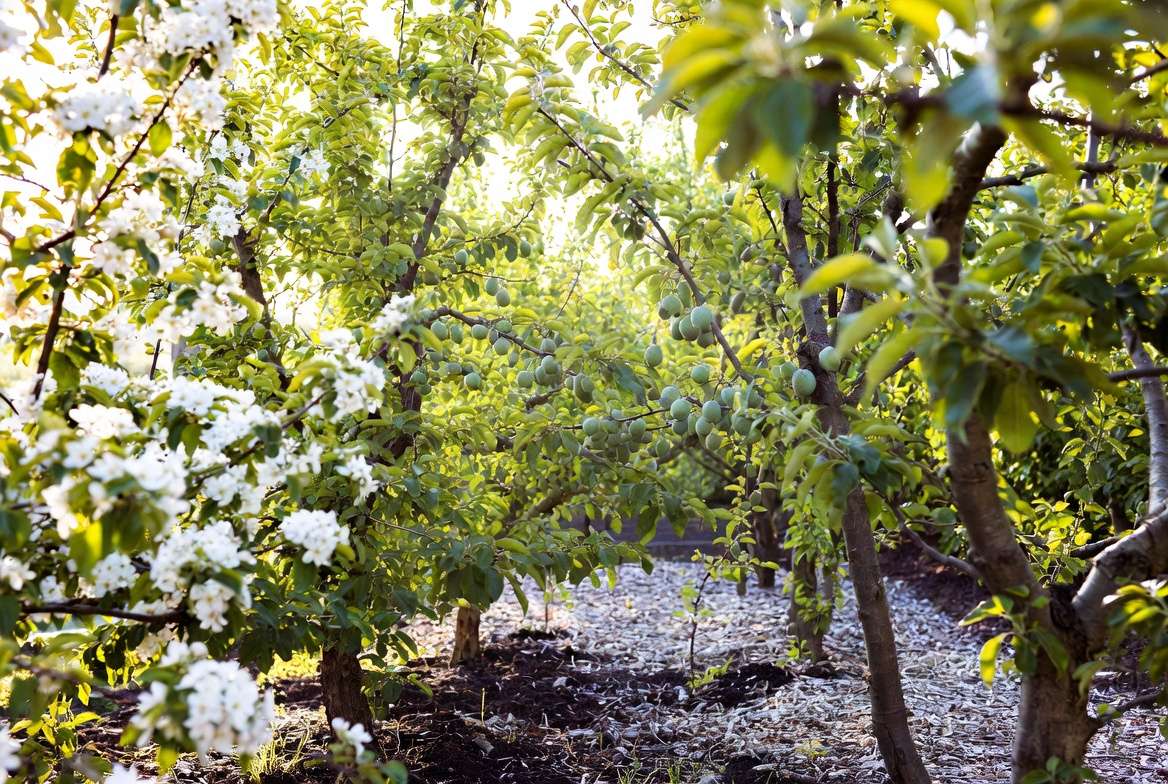
Subtropical/monsoon climate example (mango, citrus, guava — relevant for regions like Bangladesh):
- Post-harvest (June–July): Major dose to recover tree strength after fruiting.
- Pre-flowering (Sept–Oct): Balanced or K-rich to support bloom and fruit set.
- During/after monsoon: Split smaller doses or use slow-release to counter heavy leaching from rains.
- Dry season adjustments: Irrigate before and after feeding; focus on micronutrients via foliar sprays.
Customizable mixed-orchard calendar template (you can copy this into a notebook or spreadsheet):
- January–February: Soil test + dormant/deciduous main feed.
- March–May: Citrus/mango splits + stone fruit follow-ups.
- June–August: Monitor growth, light feeds if needed, post-monsoon recovery.
- September–October: Pre-flowering boosts for tropicals.
- November–December: Minimal or none — let trees harden off.
Adapt for your location: In hot, humid areas, split applications more frequently and use lower rates per dose to avoid runoff. In cooler zones, concentrate feeding in spring when roots become active.
Organic Fertilization Strategies for Sustainable Orchards ♻️
Many growers prefer organic options for long-term soil health and to support beneficial microbes.
Excellent organic sources:
- Composted manure or FYM (farmyard manure): 20–50 kg per mature tree annually (use TNAU guidelines: 30–50 kg for mango/citrus).
- Compost: Homemade or purchased — rich in micronutrients and improves soil structure.
- Bone meal or rock phosphate: For phosphorus and calcium (great for root development and fruit set).
- Wood ash or kelp meal: Potassium and trace minerals.
- Fish emulsion or seaweed extract: Quick-acting liquid for foliar or soil drench.
- Cover crops: Clover or legumes planted between trees fix nitrogen naturally.
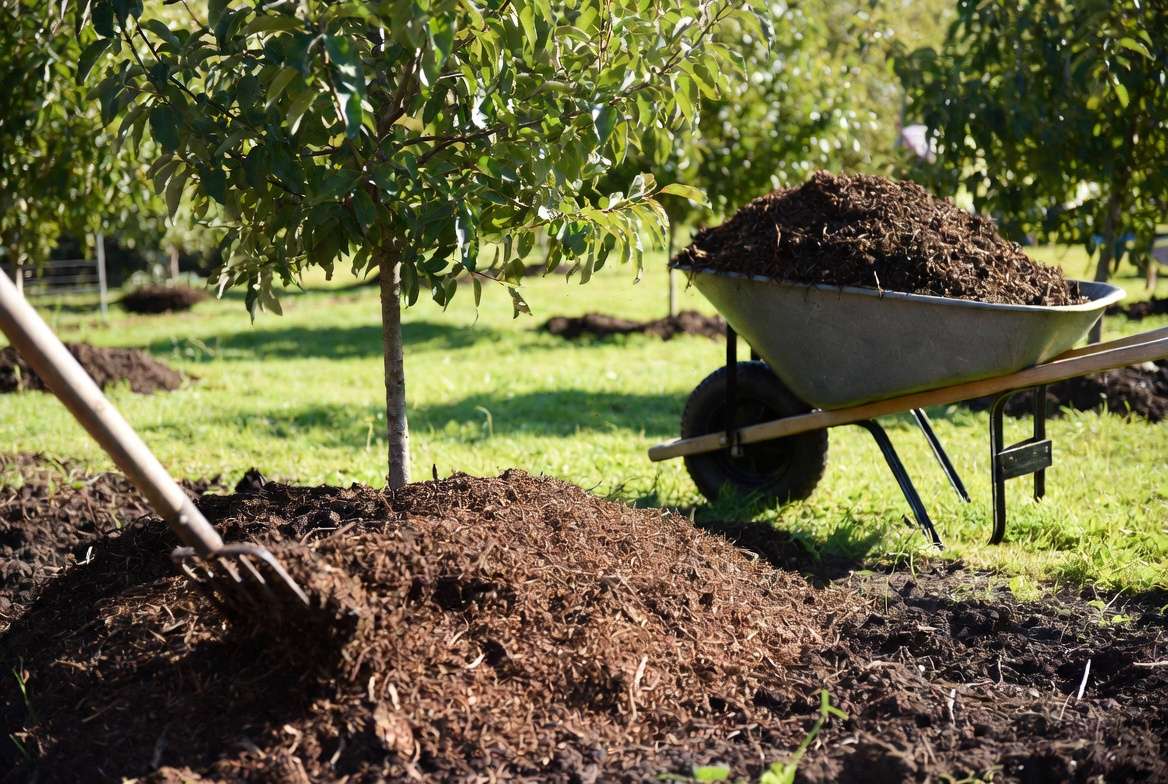
Homemade recipe example: Mix 50% compost, 30% aged manure, 10% bone meal, 10% wood ash. Apply in a 4–6 inch layer under mulch annually.
Timing for organics: Same as synthetic but often in larger volumes since they release slowly. Combine with green manures or compost teas for boosted results.
Organic approaches build resilient soil over years, reduce dependency on purchased inputs, and produce fruit with superior flavor and nutrition. They pair beautifully with the species-specific schedules above.
Identifying & Correcting Nutrient Deficiencies 🔍
Even with perfect schedules, deficiencies can appear due to soil pH, weather, or root issues. Learn to read your trees like a book.
Common symptoms and fixes:
- Nitrogen (N): Pale yellow older leaves, slow growth → Apply balanced fertilizer or composted manure in spring.
- Phosphorus (P): Purple/reddish leaves, poor root/fruit development → Bone meal or rock phosphate.
- Potassium (K): Scorched leaf edges, small/poorly colored fruit → Wood ash or high-K fertilizer.
- Zinc (Zn): Small, narrow “little leaf,” rosette growth (common in apples, peaches, citrus) → Foliar zinc sulfate at bud swell.
- Iron (Fe): Yellow leaves with green veins (chlorosis, worse in alkaline soil) → Chelated iron foliar or soil drench.
- Boron (B): Brittle leaves, poor fruit set, corky fruit (apples, mango) → Careful foliar boron spray (don’t overdo — toxicity is easy).
- Magnesium (Mg): Yellowing between veins on older leaves → Epsom salts (magnesium sulfate) foliar or soil.
Quick diagnostic chart tip: Take photos of leaves and compare against university extension guides. For confirmation, combine soil test with leaf tissue analysis (send samples to a local lab).
Correction rule: Fix pH first if off-range, then address macronutrients, followed by targeted micronutrients. Foliar sprays give fast relief while soil amendments build reserves.
Expert Tips for Maximum Yields & Tree Longevity ✨
- Integrate fertilization with pruning: Feed after dormant pruning to fuel strong regrowth.
- Fruit thinning: Remove excess young fruit so remaining ones get better nutrition and size.
- Companion planting: Grow nitrogen-fixing legumes or pest-repelling herbs near trees.
- Leaf/soil monitoring: Annual testing + visual checks beat calendar-only approaches.
- Water management: Consistent moisture (not waterlogging) is essential for nutrient uptake.
- Advanced technique: Use fertigation (fertilizer through drip irrigation) for precise, efficient delivery in larger setups.
- For subtropical growers: Time mango feeds carefully around flowering to avoid excessive vegetative growth during monsoon.
Follow these and your trees will reward you with decades of abundant, high-quality harvests.
10 Common Fertilization Mistakes to Avoid ⚠️
- Skipping soil tests — leads to over- or under-feeding.
- Applying too much nitrogen — causes lush leaves but few fruits and disease issues.
- Fertilizing too late in season — promotes tender growth vulnerable to cold or pests.
- Placing fertilizer against the trunk — burns bark and roots.
- Ignoring pH — nutrients become unavailable even if present.
- Not watering after application — nutrients stay on surface or burn roots.
- Using the same rate for young vs. mature trees.
- Overlooking micronutrients — zinc/boron deficiencies are sneaky yield robbers.
- Fertilizing during drought or heavy rain without adjustment.
- Relying only on generic “fruit tree” blends without species-specific tweaks.
Avoid these and you’ll save money while growing healthier trees.
Frequently Asked Questions (FAQs) ❓
Q: When should I start fertilizing young apple trees? A: Light applications begin in the second year after planting. Use ½ lb of balanced fertilizer per year of age in early spring. Focus more on establishment and soil building in year one.
Q: How much fertilizer per inch of trunk diameter? A: General rule: 0.1 lb actual nitrogen per inch for most pome and stone fruits (max ~1 lb N/tree). Pears need about half that (0.05 lb). Always confirm with soil test.
Q: Can I use the same schedule for mango trees in Bangladesh? A: Yes, with monsoon adaptations. Follow TNAU/ICAR-style splits: post-harvest and pre-flowering (Sept–Oct). Use 1 kg N, 0.5–1 kg P, 1–1.5 kg K per mature tree, plus FYM. Adjust for local soil and rainfall leaching. 🌧️
Q: Is organic fertilizer enough for high yields? A: Absolutely — when applied consistently in adequate volumes. Combine compost, manure, and targeted amendments. Many commercial organic orchards achieve excellent results.
Q: My citrus leaves are yellowing. What should I do? A: Likely zinc or iron deficiency. Apply chelated micronutrient foliar spray on new flushes. Check soil pH (citrus prefer slightly acidic) and split NPK feeds year-round.
Q: How often should I re-test soil? A: Every 2–3 years, or sooner if you notice problems. Test before major changes.
Q: Can I fertilize during flowering or fruit set? A: Avoid high-N during bloom. Light balanced or K-focused feeds post-fruit set are often beneficial for sizing.
Q: What’s the best fertilizer for peaches? A: Higher-nitrogen formulas (12-4-8 or similar) with zinc. Split applications support vigorous growth and large, sweet fruit.
Q: Do container fruit trees need different schedules? A: Yes — more frequent, lighter feeds (every 4–6 weeks during growth) because nutrients leach faster from pots. Use slow-release or liquid options.
Q: My trees have good growth but poor fruit. What’s wrong? A: Possible potassium, boron, or calcium shortfall — or over-thinning/pruning issues. Check micronutrients and fruit load.
Conclusion 🌟
Mastering orchard fertilization schedules by species transforms guesswork into confident, results-driven tree care. From the moderate needs of apple and pear trees to the vigorous demands of peaches, the year-round feeding rhythm of citrus, and the carefully timed applications for mangoes in monsoon climates, each species has its own sweet spot for nutrients, timing, and rates.
By starting with a soil test, following the tailored schedules outlined here, applying fertilizers correctly, and monitoring your trees’ response, you’ll build stronger root systems, enjoy better disease resistance, and harvest larger, sweeter, higher-quality fruit year after year. Many growers see yield increases of 30–50% simply by moving from generic advice to species-specific plans.











