
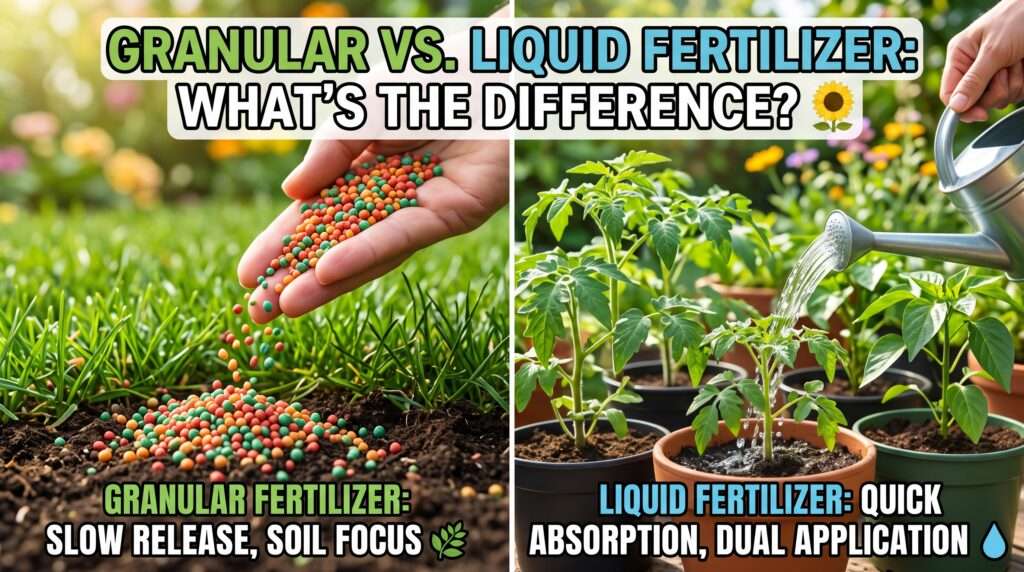
Picture this: you are standing in the aisles of your local garden center, staring at endless rows of heavy bags and colorful bottles of plant food. Back home, your tomatoes are struggling to set fruit, your monstera’s leaves are looking a bit pale, and your lawn needs a boost. You know they need nutrients, but which type is the right choice? Understanding the granular vs. liquid fertilizer differences is the single most important step in preventing root damage, saving money, and finally achieving that lush, vigorous growth you have been aiming for.
Misapplying fertilizer is one of the most common mistakes both novice and experienced gardeners make. Choosing the wrong delivery method often leads to wasted product, devastating fertilizer burn, or nutrient leaching before your plants can even absorb a single drop.
📌 Quick Takeaway: Liquid fertilizer delivers immediate, water-soluble nutrients directly to roots and foliage—making it the ideal choice for quick emergency fixes, container houseplants, and fast-growing vegetables. Granular fertilizer releases nutrients slowly over weeks or months as it breaks down—making it the perfect foundation for long-term soil building, seasonal lawn care, large trees, and established outdoor garden beds.
Whether you are managing a few prized indoor plants or a sprawling backyard homestead, this complete guide will break down the exact mechanics of plant nutrition, compare the core differences between solid and liquid feeds, and provide a professional-grade strategy for when to use each.
🌱 Section 1: The Core Mechanics: What Are Granular and Liquid Fertilizers?
To truly understand how to feed your garden, we first need to look beneath the soil surface. Plants do not “eat” food the way humans do; they absorb elemental ions (like nitrogen, phosphorus, and potassium) dissolved in water. The form in which you introduce these elements dictates how and when your plants can actually use them.
🪨 What is Granular Fertilizer?
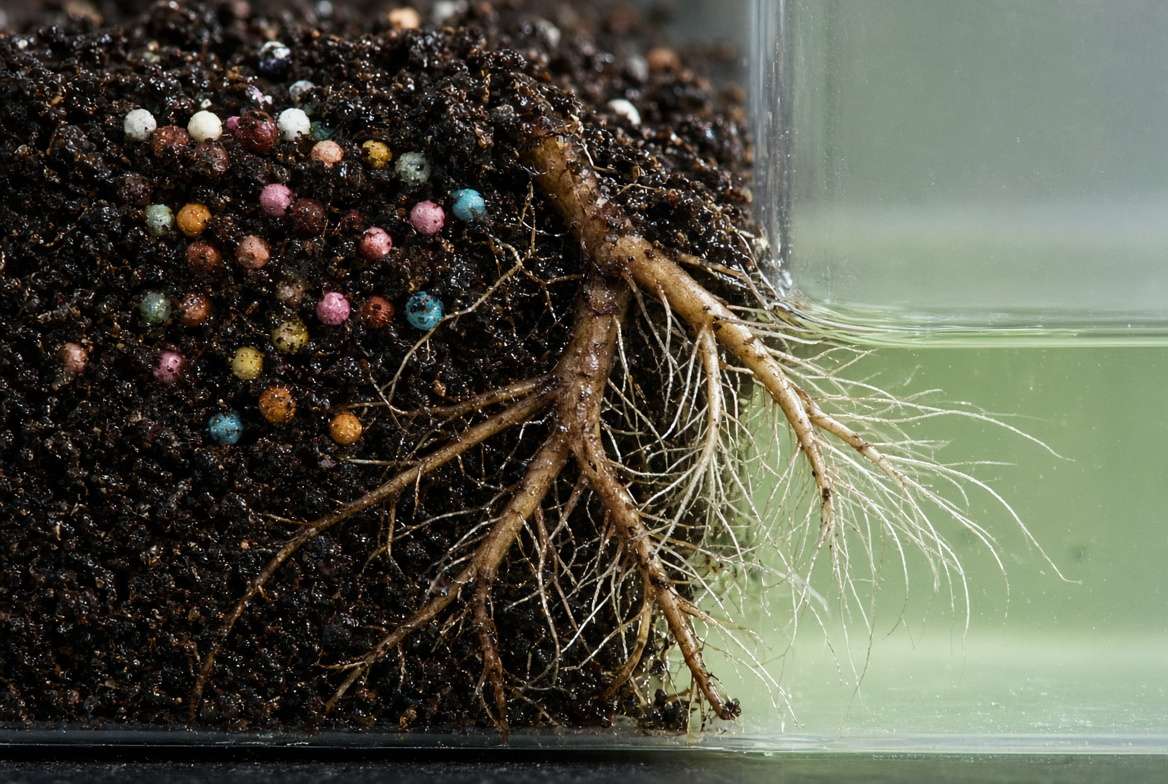
Granular fertilizers come in dry, solid forms—typically as small pellets, beads, or prills. You apply them by broadcasting them across the soil surface, scratching them into the topsoil, or mixing them into your potting medium before planting.
Granular feeds generally fall into two distinct categories:
-
Quick-Release Granular: These dry pellets are highly water-soluble. Once you water them in, they dissolve rapidly, sending a flush of nutrients into the soil within a few days.
-
Slow-Release or Controlled-Release Fertilizer (SRF/CRF): These are the true heavy lifters of the landscaping world. The nutrients are encased in a permeable coating (often sulfur or polymer-based). They rely on soil moisture, ambient temperature, and active soil microbes to slowly break down the coating. This means they drip-feed nutrients to your plant’s root system over a sustained period of 2 to 9 months, depending on the formulation.
Because granular fertilizers require physical and biological breakdown, they encourage a robust, active root system as the plant naturally seeks out the gradually dissolving minerals.
💧 What is Liquid Fertilizer?
Liquid fertilizers are fast-acting, highly concentrated nutrient solutions. They are sold either as pre-mixed liquids in pump bottles or as water-soluble powders and crystals that you must dilute in water before use.
There are two primary ways to apply liquid feeds:
-
Soil Drenching: Pouring the diluted mixture directly over the root zone. The nutrients are immediately available in their ionic form, allowing the plant’s root hairs to suck them up instantly along with the water.
-
Foliar Feeding: Spraying a fine mist of the diluted fertilizer directly onto the plant’s leaves. Plants can absorb certain trace minerals and macronutrients through their stomata (tiny pores on the leaf surface), offering an incredibly fast rescue for acute nutrient deficiencies.
Liquid fertilizers bypass the microbial breakdown process entirely. They do not need to wait for soil bacteria to process them; they deliver an immediate, mainline dose of nutrition right when the plant demands it.
🔬 Section 2: Granular vs. Liquid Fertilizer Differences: The 6 Critical Comparison Pillars
Choosing between these two forms is not about which is universally “better”—it is about matching the delivery mechanism to the plant’s current life stage and environment. Here is exactly how they stack up across six vital metrics.
⚡ 1. Nutrient Availability & Absorption Speed
The most significant difference between liquid and granular options is the timeline of absorption.
-
Liquid: If you have a plant suffering from severe yellowing (chlorosis) or a nitrogen deficiency, liquid fertilizer acts like an IV drip. The plant can begin utilizing the nutrients within hours to days, resulting in rapid green-up and accelerated vegetative growth.
-
Granular: Even quick-release granulars take time to dissolve, and slow-release varieties take weeks to begin working effectively. However, this delay is a massive benefit for steady, structural growth, preventing the weak, leggy growth surges often caused by liquid nitrogen spikes.
🧑🌾 2. Application Method & Ease of Use
Your garden’s size and your personal time constraints play a major role here.
-
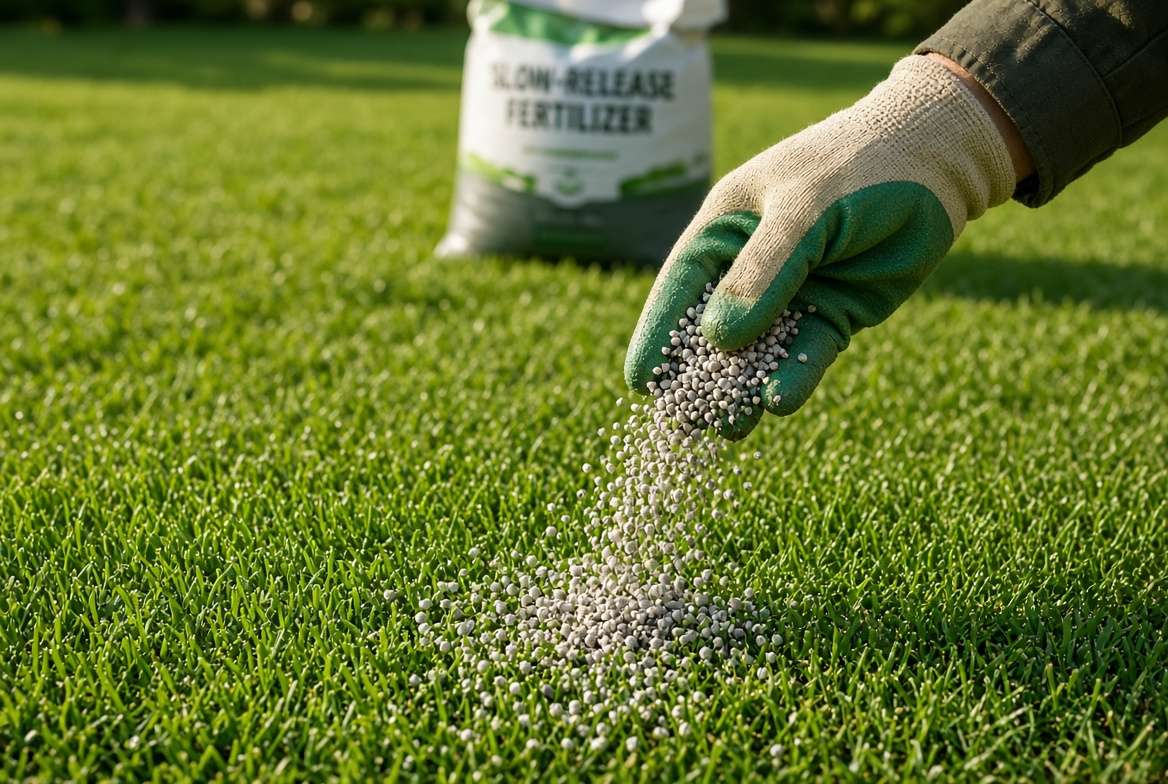
Granular: Best for large areas. You can load a broadcast spreader and feed an entire half-acre lawn in twenty minutes. In garden beds, you simply top-dress the soil and let the rain or your irrigation system do the rest of the work.
-
Liquid: Requires precise measuring and mixing. While hose-end sprayers make liquid application easier for medium-sized gardens, applying liquid feeds to a massive property can be labor-intensive. For indoor houseplants, however, liquid is incredibly convenient—just add a few drops to your watering can.
🔥 3. Uniformity, Precision & Fertilizer Burn Risks
Fertilizer burn happens when high concentrations of synthetic salts pull moisture out of plant roots, causing the edges of leaves to crisp and brown (desiccation).
-
Liquid: When diluted correctly according to the label, liquid fertilizer distributes perfectly evenly throughout the soil profile, coating the entire root ball. The burn risk is quite low. However, if you apply it undiluted, the high salt index will severely scorch the roots almost instantly.
-
Granular: If you accidentally drop a clump of dry fertilizer pellets directly against a plant’s main stem or crown, it creates a toxic “hot spot.” As those concentrated pellets dissolve, they will burn the plant tissue they touch. Always spread granular feeds evenly along the drip line.
⏳ 4. Longevity & Feeding Cadence
-
Granular: This is the “set it and forget it” option. A high-quality coated slow-release granular only needs to be applied once or twice a season (every 6 to 12 weeks).
-
Liquid: Because it flushes through the soil quickly, liquid feeds require a high-maintenance schedule. During peak growing seasons, you will likely need to apply a liquid booster every 7 to 14 days.
🌍 5. Soil Health, Microbial Impact & Leaching
-
Granular: Organic granular fertilizers (like bone meal, kelp meal, and alfalfa) actively improve soil structure. As they decompose, they provide a long-term food source for beneficial soil bacteria, earthworms, and mycorrhizal fungi. They are anchored in the soil and rarely wash away.
-
Liquid: Liquids do very little to improve long-term soil health or texture. Furthermore, they have a high “leaching” potential. If you apply liquid fertilizer and then get a massive rainstorm the next day, the water-soluble nutrients will wash straight past the root zone and out into the watershed, completely wasting your application.
💰 6. Cost-Effectiveness, Storage & Shelf Life
-
Granular: Highly cost-effective for large square footage. A single 40lb bag can feed an entire landscape. As long as it is stored in a dry, sealed container, granular fertilizer has an indefinite shelf life.
-
Liquid: Excellent for small collections, but cost-prohibitive for large-scale farming or landscaping. Liquid concentrates can also degrade over time; they may settle, crystallize in freezing temperatures, or spoil if they are organic fish emulsions.
📊 Comprehensive Comparison Matrix
🪴 Section 3: Which Fertilizer Does Your Plant Actually Need?
Understanding the granular vs. liquid fertilizer differences is only half the battle; applying that knowledge to specific garden scenarios is where you truly see results. Different plants in different environments have wildly different metabolic needs. Here is exactly what the experts recommend based on what you are growing.
🏡 Houseplants & Indoor Container Gardens
Growing plants indoors in containers is an entirely different ecosystem than an outdoor garden. Most indoor potting soils are sterile mixes of peat moss, coco coir, and perlite. Because they lack the active microbiome and earthworms found in natural topsoil, heavy organic granular fertilizers (like blood meal or raw compost) will simply sit on the surface and rot, often attracting fungus gnats instead of feeding your plant. Furthermore, because pots are closed systems, heavy synthetic granulars can cause toxic salt accumulations in the soil.
-
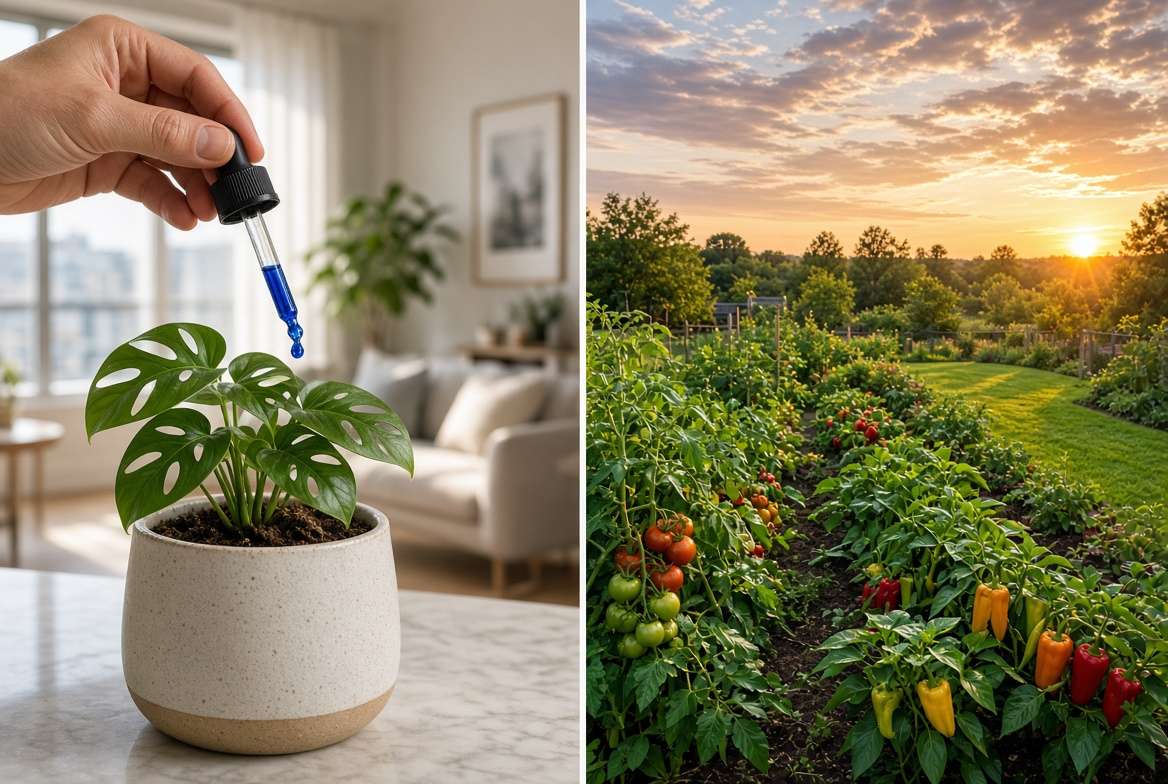
The Expert Pick: For indoor jungles, use a high-quality liquid plant food diluted to half-strength (“weakly, weekly” is a famous grower’s motto) or rely on polymer-coated slow-release mini-prills (like Osmocote) that break down via moisture rather than microbes. 🌿
🌾 Lawns & Turfgrass
Lawns are massive, hungry monocultures. If you were to spray a purely liquid high-nitrogen fertilizer across a lawn in spring, you would trigger a massive, chaotic surge of top growth. You would be mowing twice a week, and the grass would exhaust its root reserves.
-
The Expert Pick: Lawns demand slow-release granular fertilizer. Applying a granular feed allows for a slow, steady trickle of nitrogen that sustains green growth over several months while encouraging deep, drought-resistant roots. Exception: If you are hosting a backyard event and need a rapid green-up without triggering a growth surge, a quick foliar spray of liquid chelated iron works wonders. ⛳
🍅 Vegetable Gardens & Heavy Feeders
Vegetables are the marathon runners of the plant world. A tomato plant, for instance, needs high nitrogen early in the season to push out stems and leaves (vegetative growth). But once it starts flowering, it needs a dramatic shift toward phosphorus and potassium to set heavy, juicy fruit. Raised beds, popular for veggies, also drain very quickly, meaning liquid fertilizers often wash right through the soil before the roots can catch them.
-
The Expert Pick: Use a granular organic fertilizer mixed into the soil at planting time to establish a strong base. Once the plants begin flowering, switch to targeted, phosphorus-rich liquid root drenches every 10–14 days to support massive yields. 🌶️
🌳 Trees, Shrubs & Perennial Borders
Large woody plants have deep, expansive root zones that stretch far beyond their drip line (the outer circumference of the branches). Pouring a liquid fertilizer around the trunk is practically useless; the liquid will wash away in the top two inches of soil long before it reaches the deep feeder roots.
-
The Expert Pick: For trees and shrubs, always use a slow-release granular fertilizer. Broadcast it evenly in a wide ring around the drip line, or use fertilizer spikes driven deep into the soil. This forces the nutrients down to where the structural roots are actively foraging. 🌲
🏆 Section 4: The Master Gardener “Hybrid Strategy”
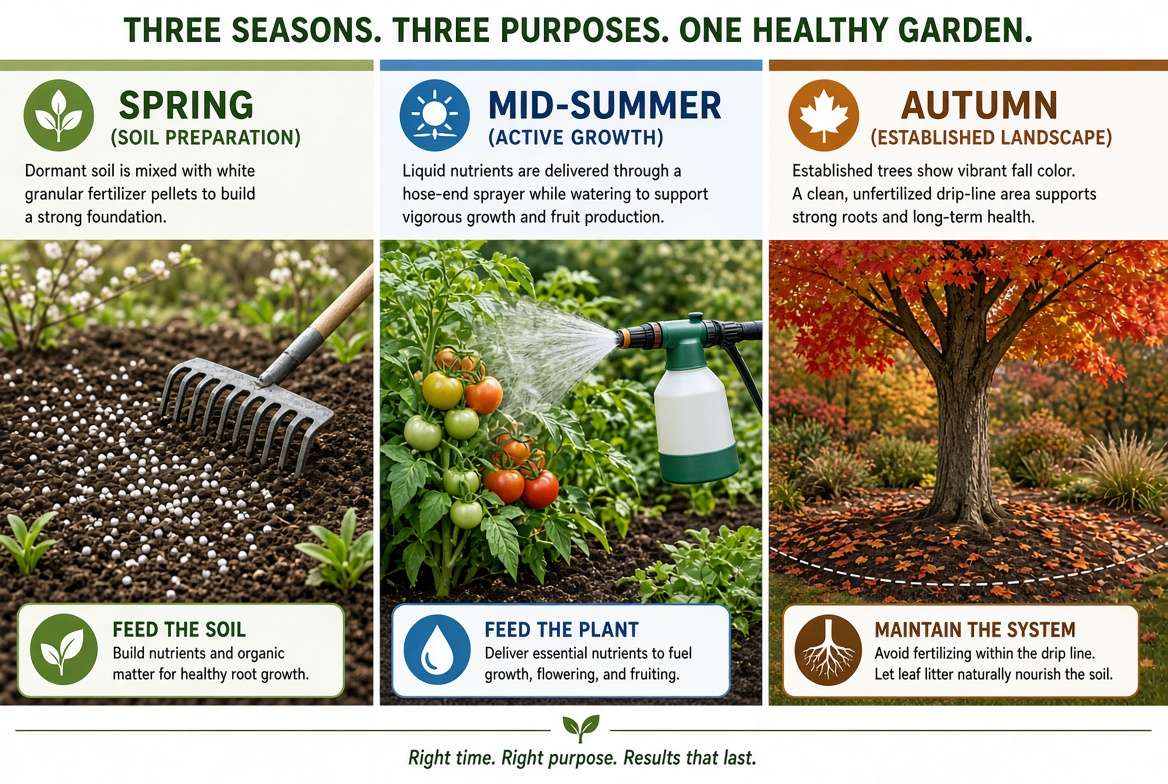
You do not have to choose a side in the granular vs. liquid debate. In fact, professional horticulturists and championship growers use both in a highly orchestrated sequence known as the “Hybrid Strategy.” Knowing exactly when to use granular vs. liquid fertilizer gives you absolute control over your garden’s performance.
-
Step 1: The Baseline Foundation (Spring) 🌷 As the soil warms up and dormancy breaks, prepare your beds. Incorporate a balanced, slow-release granular fertilizer (like a 4-4-4 organic mix) into your garden beds, raised planters, and tree drip lines. This establishes a “pantry” of nutrients that will slowly break down and sustain the plants over the next three to four months.
-
Step 2: The Tactical Booster (Mid-Summer) ☀️ During peak growing season, plants experience extreme stress from heat, drought, heavy fruit production, or pest attacks. This is when you deploy your liquid fertilizer. Use targeted liquid root drenches or implement a foliar feeding guide to spray the leaves directly. This provides an immediate rescue dose of energy to push plants through the hardest part of the summer without waiting for soil microbes to process solid food.
-
Step 3: The Late-Season Taper (Autumn) 🍂 As temperatures begin to drop, completely stop using fast-acting liquid fertilizers. Pushing quick, tender new growth right before a frost is a death sentence for perennials and shrubs. Allow the remaining granular nutrients in the soil to slowly taper off, signaling to the plant that it is time to harden off and prepare for winter dormancy.
⚠️ Section 5: Common Application Mistakes to Avoid
Even the most expensive, premium fertilizer will harm your garden if applied incorrectly. Avoid these frequent missteps:
-
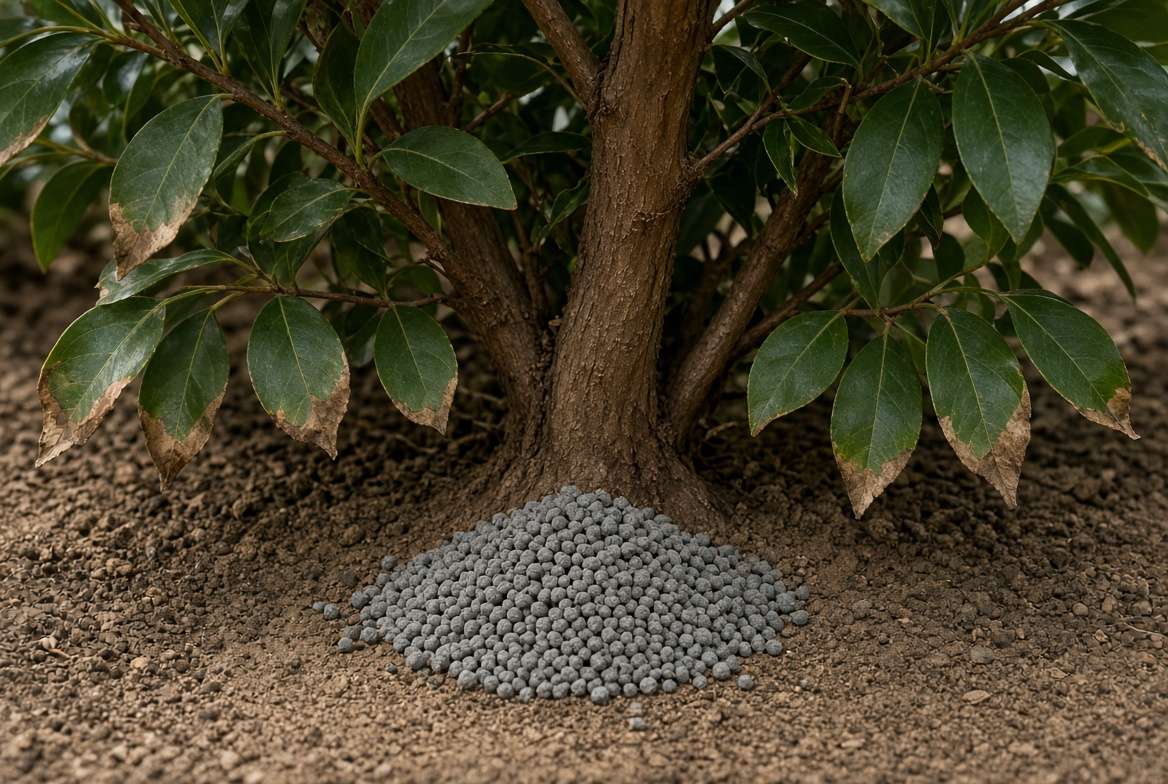
The “Volcano” Granular Dump: Never pile granular fertilizer directly against the stem, trunk, or crown of a plant. As the salts dissolve, they will burn the delicate stem tissue, causing rot and potentially killing the plant. Always scatter granules in a wide ring away from the main stem.
-
Midday Foliar Spraying: Spraying liquid foliar fertilizers under the intense midday sun is a recipe for disaster. The liquid droplets can act like tiny magnifying glasses, focusing the sun’s rays and scorching the foliage. Only apply liquid foliar feeds in the early morning or late evening when the stomata are open and the sun is low. 💧
-
Fertilizing Bone-Dry Soil: Never apply liquid fertilizer to a thirsty plant. When a plant is severely dehydrated, its roots will rapidly suck up anything available. If that liquid is a heavily concentrated fertilizer salt, it will instantly scorch the root hairs. Always hydrate your plants with plain water a few hours before feeding them.
-
Flying Blind Without a Soil Test: Applying heavy doses of granular phosphorus and potassium year after year without a soil test can create a toxic buildup in your yard. More is not always better; overloading the soil with one nutrient can actually “lock out” the plant’s ability to absorb others (like calcium or iron). 🧪
❓ Frequently Asked Questions
Can I dissolve granular fertilizer in water to make liquid fertilizer?
Generally, no. Unless a granular fertilizer is explicitly labeled as “water-soluble” (like blue crystal feeds), standard agricultural granulars contain insoluble binders, crushed rock, and slow-release coatings that will not dissolve. You will end up with a sludgy mess at the bottom of your watering can, and the liquid you pour off will have a highly unpredictable concentration that could easily burn your plants.
Which fertilizer is better for reviving a dying, nutrient-deficient plant?
If a plant is rapidly yellowing, dropping leaves, and showing acute signs of starvation, liquid fertilizer is the only correct choice. It delivers immediate, life-saving nutrition directly into the plant’s vascular system within 24 hours. Once the plant stabilizes, you can apply a slow-release granular to prevent the deficiency from returning. 🚑
How does heavy rain impact granular vs. liquid applications?
Heavy, persistent rain is the enemy of liquid fertilizer. Because the nutrients are already fully dissolved, a heavy downpour will flush them straight through porous soil and out of the root zone (leaching). Granular fertilizer, on the other hand, needs moisture to work. Moderate rain is perfectly fine and actually helps activate the granular breakdown process.
Is liquid fertilizer more expensive than granular over a full season?
Yes, significantly. While a bottle of liquid feed might seem cheap upfront, a massive percentage of what you are paying for is just water and packaging. To feed a half-acre garden for an entire season using only liquid feeds would cost a small fortune and require dozens of applications. A single $30 bag of high-quality granular fertilizer can cover the same area for six months. 💸
🎯 Final Practical Action Checklist
Navigating the fertilizer aisle does not have to be overwhelming. When determining your plant care routine, just let the plant’s immediate environment and current needs dictate the menu.
-
For emergency green-up, potted houseplants, & fast-growing veggies: Reach for a balanced liquid fertilizer diluted to half-strength to provide instant, safe nutrition.
-
For seasonal maintenance, turfgrass lawns, trees, & landscape beds: Apply a coated slow-release granular formula once in the spring to build long-term soil health.
-
For maximum garden yield & competition-level blooms: Combine a spring granular foundation with bi-weekly mid-season liquid boosts to create an unstoppable hybrid feeding program.
By matching the right fertilizer to the right job, you will save time, protect your local watershed from chemical runoff, and cultivate a deeply resilient garden that thrives season after season. Happy growing! 🌱











