
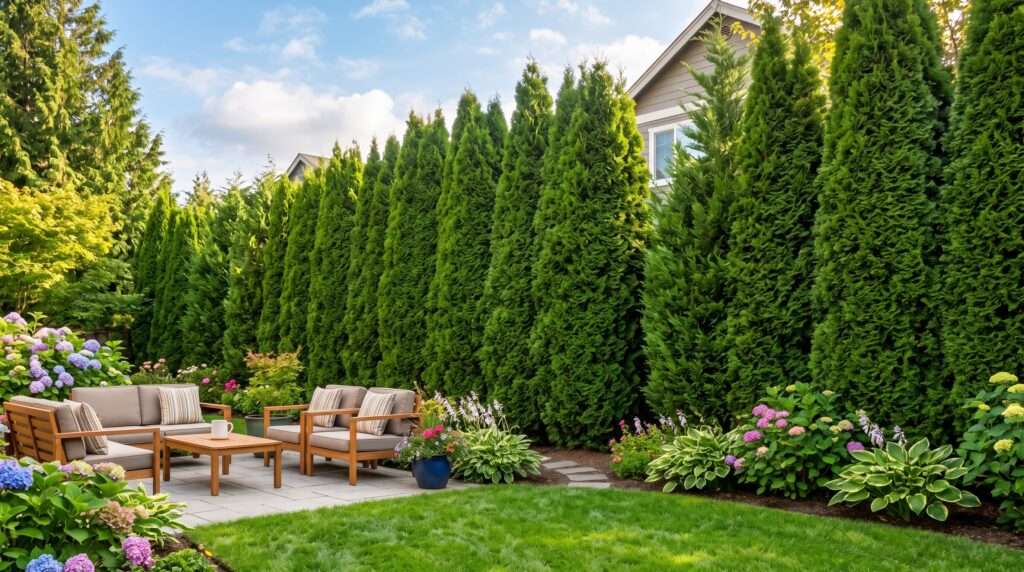
Imagine this: You step out onto your back patio on a beautiful Saturday morning. The coffee is hot, the birds are singing, and you’re ready to relax in your private sanctuary. But as you sit down, you lock eyes with your neighbor who is mowing their lawn just a few feet away. Suddenly, your private oasis feels like a public park.
If this sounds familiar, you are not alone. Fences are expensive to build, often restricted by strict Homeowner Association (HOA) height limits, and they simply lack natural beauty. The ultimate, eco-friendly solution to this universal problem is screening planting. By strategically selecting and positioning specific trees and shrubs, you can create a gorgeous, living barrier that transforms your yard into a secluded retreat.
As a plant care specialist and arborist who has helped hundreds of homeowners design custom landscapes, I’ve seen firsthand how the right privacy trees can completely change the feel of a property. In this comprehensive guide, we will dive deep into the top 7 fast-growing trees for privacy, the exact spacing formulas you need for success, and professional care tips to get your “living wall” growing as quickly as possible. Grab your gardening gloves, and let’s reclaim your backyard! 🧤🌿
🌿 What is Screening Planting? (And Why You Need It)
For those new to landscaping, screening planting involves strategically grouping trees, shrubs, or tall grasses to create a dense, natural barrier that blocks unwanted views, wind, or noise. Unlike a static wooden or vinyl fence, a living screen grows, breathes, and adds dynamic beauty to your property throughout the seasons.
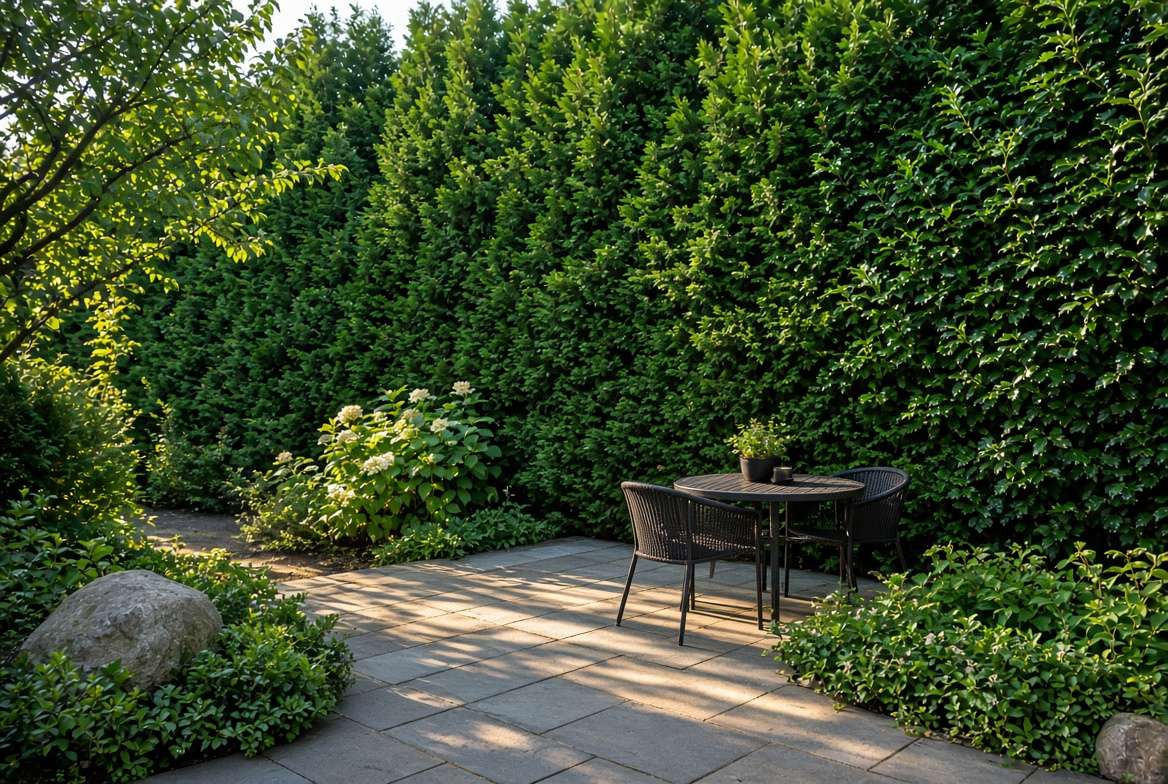
While the primary goal for most homeowners is backyard privacy, a well-planned evergreen screen offers incredible secondary benefits that a traditional fence simply cannot match:
-
🌬️ Windbreaks and Microclimate Regulation: A solid row of evergreen trees can drastically reduce wind chill in the winter and block hot, drying winds in the summer, effectively lowering your home’s heating and cooling costs.
-
🔇 Noise Reduction: Do you live near a busy road or highway? The dense foliage of privacy trees acts as a natural acoustic buffer, absorbing and deflecting traffic noise.
-
🦋 Wildlife Habitat: Screening plants provide essential shelter, nesting sites, and sometimes food (like berries) for local birds and beneficial pollinators, boosting your yard’s biodiversity.
-
📈 Boosting Property Value: A mature, well-maintained privacy hedge adds immense curb appeal and can significantly increase your property’s resale value. Buyers love a “move-in ready” private yard! 🏡
📐 The Golden Rules of Screening Planting: Read Before You Dig
Before we get to the exciting part—picking out your trees—we need to talk about preparation. The biggest mistake homeowners make is buying trees on impulse and planting them incorrectly. To ensure your investment thrives, you must follow these foundational rules.
Assess Your Hardiness Zone & Microclimate 🗺️
The key to fast growth is keeping the tree happy. A tree that struggles to survive in your climate will never grow quickly. Always check your USDA Hardiness Zone before purchasing. Furthermore, assess your yard’s microclimate. Is the planting area in full sun, partial shade, or deep shade? Does the soil drain well, or does water pool there after a rainstorm? Matching the tree to your specific site conditions is non-negotiable for a healthy screen.
The Spacing Equation (Avoid the “Crowded Forest” Mistake) 📏
When you want privacy yesterday, the temptation is to plant trees incredibly close together. This is a fatal flaw. While it provides instant gratification, the trees will eventually compete for water, nutrients, and sunlight. The lower branches will die off due to lack of light, leaving you with ugly gaps at the bottom.
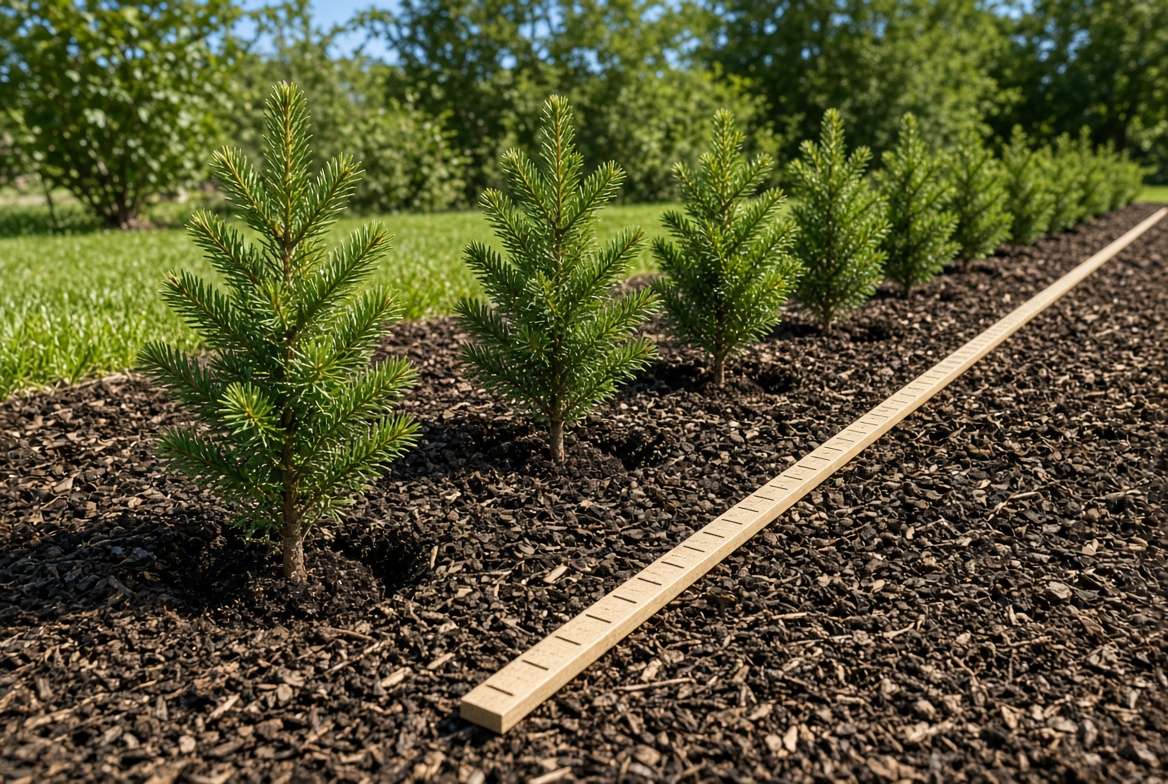
Expert Tip for Maximum Density: Instead of a single, straight line, use the zig-zag (staggered) planting method. Plant two parallel rows, offsetting the trees in the back row to fill the gaps of the front row. This allows you to plant them slightly closer together visually while giving their root systems plenty of room to expand to their mature width. For most large evergreens, aim for 6 to 10 feet of space between the trunks, depending on the species.
HOA Rules and Property Lines 📋
Always check your HOA guidelines; while they might limit a wooden fence to 6 feet, they often have no height limits on trees! However, you must respect property lines. Plant your trees far enough inside your property so that when they reach their mature width, they aren’t encroaching on your neighbor’s yard. Finally, always Call Before You Dig (811 in the US) to ensure you aren’t planting massive root systems over crucial underground utility lines. Safety and trustworthiness first! 👷♂️
🌲 The 7 Best Fast-Growing Trees for Screening Planting
Now that you have the knowledge of a pro, let’s select your trees. Here are the top seven fast-growing varieties that landscape architects rely on for total backyard privacy.
1. Thuja Green Giant (The Heavyweight Champion) 🥊
If you have a large property and need a massive privacy wall fast, the Thuja standishii x plicata ‘Green Giant’ is the undisputed king.
-
Growth Rate: Exceptional (3 to 5 feet per year once established).
-
USDA Zones: 5-9.
-
Light Needs: Full sun to partial shade.
-
Mature Size: 40-60 feet tall, 12-18 feet wide.
-
Why it’s great: It is remarkably disease-resistant, handles heavy snow loads without snapping, and is highly deer-resistant (a major plus for suburban yards).
-
Arborist Insight: Because of its massive mature footprint, do not plant Green Giants in tiny urban courtyards or right up against the side of your house. They need room to flex!
2. Leyland Cypress (The Classic Feathery Screen) 🪶
The Leyland Cypress (Cuprocyparis leylandii) has been the go-to privacy tree for decades, known for its soft, feathery foliage and rapid growth.
-
Growth Rate: Very Fast (3 to 4 feet per year).
-
USDA Zones: 6-10.
-
Light Needs: Full sun.
-
Mature Size: 60-70 feet tall, 15-20 feet wide.
-
Why it’s great: It creates an incredibly dense, solid wall of green that blocks wind and sightlines perfectly. It’s also quite salt-tolerant, making it great for coastal properties.
-
Drawbacks to Note: To be completely transparent, Leyland Cypress can be prone to Seiridium canker and bagworms, especially if stressed by drought. They require more active monitoring and maintenance than the Green Giant.
3. Emerald Green Arborvitae (The Small-Yard Hero) 🏡
Not everyone has a sprawling estate. If you have a compact suburban yard or a narrow side yard, the Emerald Green Arborvitae (Thuja occidentalis ‘Smaragd’) is your best friend.
-
Growth Rate: Moderate (1 to 2 feet per year).
-
USDA Zones: 3-8.
-
Light Needs: Full sun (can tolerate light shade).
-
Mature Size: 12-15 feet tall, 3-4 feet wide.
-
Why it’s great: It naturally grows in a very tight, narrow, columnar shape. It rarely needs pruning to maintain its neat appearance.
-
Expert Tip: Because they stay so narrow, you can plant them relatively close together (about 2.5 to 3 feet apart from trunk to trunk) to form a solid, manicured wall along a fence line.
4. Nellie R. Stevens Holly (The Berry-Producing Wall) 🍒
If you want to break away from the traditional needle-bearing conifers, the Nellie R. Stevens Holly (Ilex x ‘Nellie R. Stevens’) is a spectacular broadleaf evergreen option.
-
Growth Rate: Fast (2 to 3 feet per year).
-
USDA Zones: 6-9.
-
Light Needs: Full sun to partial shade.
-
Mature Size: 15-25 feet tall, 8-12 feet wide.
-
Why it’s great: It creates an incredibly dense, impenetrable screen with glossy, dark green leaves year-round. As a bonus, it produces abundant, vibrant red berries in the winter, which look beautiful against the snow and attract local birds.
-
Expert Tip: Unlike some hollies that require both a male and female plant to produce berries, the Nellie R. Stevens is partially parthenocarpic, meaning it can produce fruit without a male pollinator (though having a male Chinese holly nearby will increase berry production).
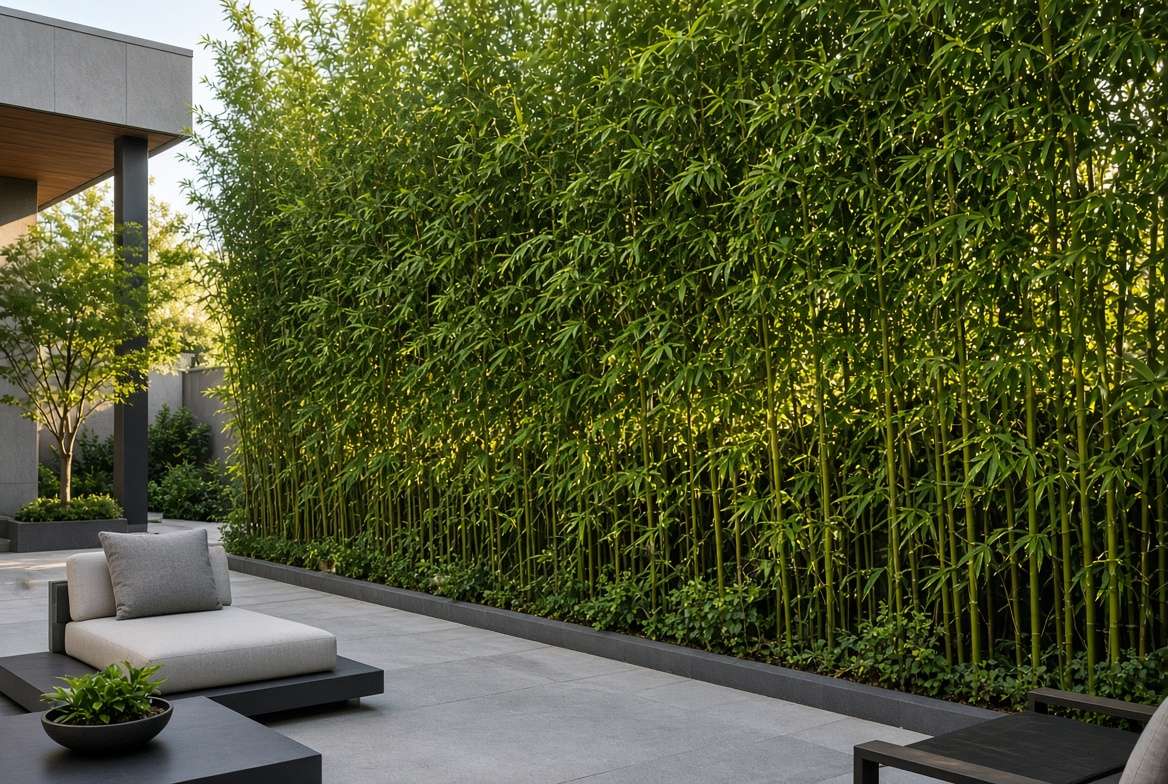
5. Clumping Bamboo – Fargesia varieties (The Modern Screen) 🎋
For urban gardens, contemporary landscapes, or areas where you need a screen instantly, bamboo is unparalleled in its speed. However, you must choose the right type to avoid a landscaping disaster.
-
Growth Rate: Extremely Fast (Can reach mature height in 1-3 years).
-
USDA Zones: 5-9 (varies heavily by species; Fargesia rufa is incredibly cold hardy).
-
Light Needs: Full sun to partial shade.
-
Mature Size: 10-15 feet tall, 4-6 feet wide per clump.
-
Why it’s great: It offers a sleek, modern aesthetic and beautiful movement in the wind.
-
Crucial Distinction: You must purchase clumping bamboo (like Fargesia), not running bamboo. Running bamboo spreads aggressively via underground rhizomes and will quickly invade your yard and your neighbor’s property, often requiring heavy machinery to remove. Clumping bamboo behaves politely, slowly expanding in a tight circle.
6. Eastern Redcedar (The Drought-Tolerant Survivor) ☀️
Despite the name, the Eastern Redcedar (Juniperus virginiana) is actually a native juniper, and it is one of the toughest trees you can plant.
-
Growth Rate: Moderate to Fast (1 to 2 feet per year).
-
USDA Zones: 2-9.
-
Light Needs: Full sun.
-
Mature Size: 40-50 feet tall, 8-20 feet wide.
-
Why it’s great: If you have poor, rocky, or compacted clay soil where nothing else seems to grow, the Eastern Redcedar will likely thrive. Once established, it is exceptionally drought-tolerant and handles harsh conditions with ease. It also provides premium nesting sites and food for cedar waxwings and other songbirds.
7. Spartan Juniper (The Elegant Windbreak) 🌪️
If you want the formal, manicured look of an Italian Cypress but live in a cooler climate where they struggle, the Spartan Juniper (Juniperus chinensis ‘Spartan’) is an excellent alternative.
-
Growth Rate: Moderate (1 to 2 feet per year).
-
USDA Zones: 4-9.
-
Light Needs: Full sun.
-
Mature Size: 15-20 feet tall, 4-5 feet wide.
-
Why it’s great: It boasts a very rich, deep green foliage that holds its color beautifully through the winter. Because it naturally grows in a tight, pyramidal or columnar shape, it requires almost zero pruning to look professional and elegant.
💧 Pro-Level Care: How to Accelerate Your Screen’s Growth
Choosing the right fast-growing tree is only half the battle. How you plant and care for them in the first two years dictates how quickly they will establish their root systems and shoot up to provide that coveted privacy. Here are the secrets the pros use.
Soil Preparation and Trenching 🌱
When planting a long row of privacy trees, digging a continuous trench is often vastly superior to digging individual holes. A trench loosens the soil along the entire planting line, encouraging the roots to spread laterally and intertwine, which anchors the trees more securely against high winds.
Before planting, test your soil. If you have heavy clay, amend the backfill soil with organic compost to improve drainage. Trees sitting in waterlogged “bathtubs” of heavy clay will suffer from root rot and stunted growth.
Deep Watering Techniques for Deep Roots 🚰
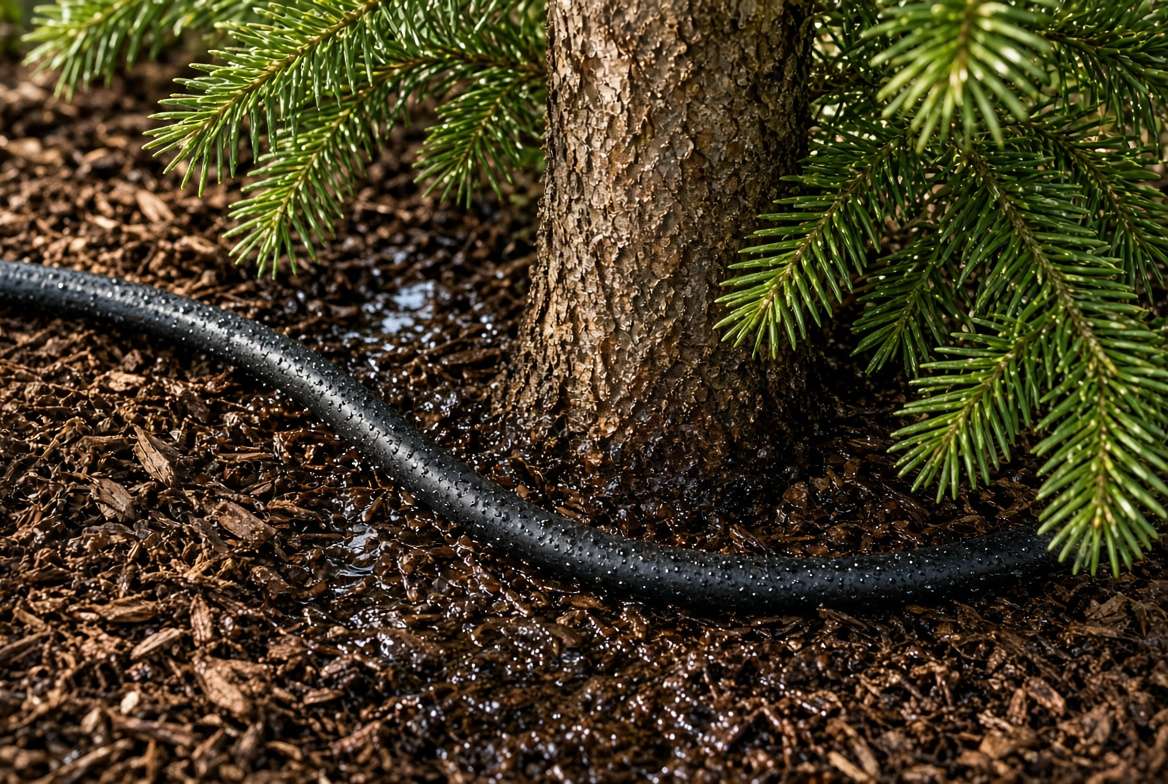
The quickest way to kill a newly planted evergreen is shallow, frequent watering. Sprinklers are great for grass, but terrible for trees. You want to encourage the tree roots to grow deep into the earth where the soil stays cool and moist.
The Solution: Use soaker hoses or drip irrigation lines. Snake a soaker hose along the base of your screening planting and run it on a low trickle for 1 to 2 hours, once or twice a week (depending on rainfall and temperatures). This delivers water slowly, allowing it to penetrate deeply without running off.
Mulching and Fertilizing Timelines 🍂
Mulch is a tree’s best friend. It suppresses weeds (which compete for water), regulates soil temperature, and retains moisture. Apply a 2-3 inch layer of organic wood mulch around the base of the trees.
The Mulch Donut Rule: Never pile mulch up against the trunk of the tree! This creates a “mulch volcano,” which invites rot, pests, and disease. Instead, create a “donut” shape, leaving a few inches of bare soil directly around the trunk.
Hold off on heavy fertilizing during the first year of planting; you want the tree to focus its energy on growing roots, not pushing out weak, floppy top growth. In year two, you can apply a slow-release, granular evergreen fertilizer in the early spring.
⚠️ 3 Common Screening Planting Mistakes to Avoid
Even with the best intentions, it’s easy to make mistakes that compromise the health of your living wall. Avoid these three common pitfalls:
-
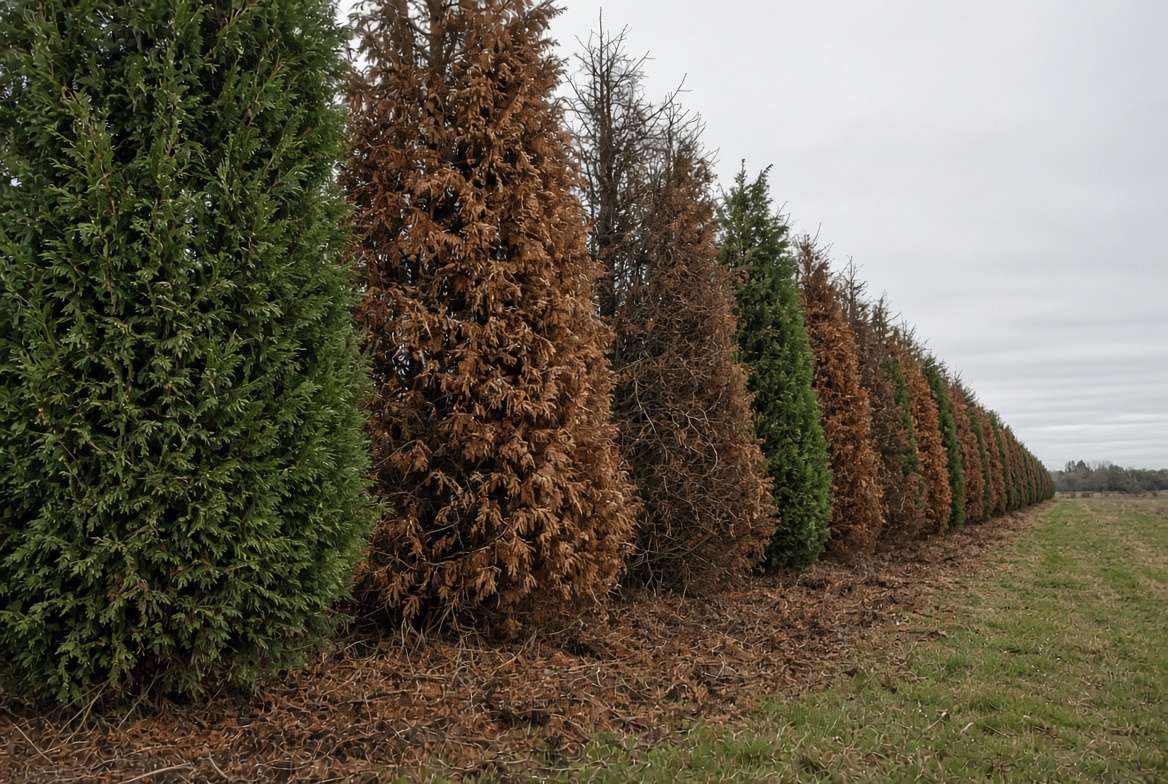
Mistake 1: The Monoculture Trap. Planting 30 identical trees in a row looks great, but it’s an ecological risk. If a specific pest or disease (like bagworms or blight) enters the neighborhood, your entire privacy screen could be wiped out in one season. Whenever possible, mix 2 or 3 different species (e.g., staggering Green Giants with Nellie R. Stevens Hollies) to create a resilient, diverse screen.
-
Mistake 2: Ignoring Winter Sun Angles. Evergreens block the sun 365 days a year. Before planting a 40-foot wall of Green Giants on the south side of your property, remember that they will cast a massive, permanent shadow over your yard, potentially ruining your vegetable garden or making your patio cold and damp in the winter.
-
Mistake 3: Failing to Prune for Structure Early On. While trees like the Green Giant grow fast, they sometimes grow multiple “leaders” (the main central trunk). If left unaddressed, heavy snow or ice can wedge between these leaders and split the tree in half. Prune out competing leaders when the tree is young to establish one strong, central trunk.
❓ Frequently Asked Questions (FAQs)
How close to the fence can I do my screening planting? Never plant a tree directly against a fence. You must account for the tree’s mature width. If a tree grows 10 feet wide, its center trunk should be planted at least 5 to 6 feet away from the fence line. Planting too close will warp your fence, restrict airflow (leading to fungal diseases), and cause the back half of the tree to die off.
What is the absolute fastest-growing privacy tree? In optimal conditions, the Thuja Green Giant and the Leyland Cypress tie for the fastest evergreen conifers, often pushing 3 to 5 feet of new growth per year. If you include non-conifers, clumping bamboo is technically the fastest, often reaching its mature height in just a few seasons.
Can I plant privacy screens in the middle of summer? You can, but it is highly discouraged. Planting in the heat of July or August places immense heat and drought stress on a young tree. The absolute best times for screening planting are early fall (which gives roots time to establish over winter) or early spring (after the ground thaws but before the intense heat arrives).
Do deer eat arborvitae? Yes, deer absolutely love Emerald Green Arborvitae—they treat them like a winter salad bar. If you have heavy deer pressure in your area, avoid Emerald Greens and opt for deer-resistant options like the Thuja Green Giant, Nellie R. Stevens Holly, or Spartan Juniper.
🌟 Conclusion: Cultivating Your Private Sanctuary
Investing in screening planting is one of the most rewarding landscaping projects you can undertake. While it requires a bit of patience compared to unrolling a chain-link fence, the long-term payoff is unmatched. By carefully selecting the right fast-growing trees for your hardiness zone, spacing them correctly, and providing deep, consistent watering in those crucial early years, you are building a living, breathing barrier.
This living wall will not only block out nosy neighbors and street noise, but it will also elevate your property value, clean the air, and provide a beautiful, green backdrop for your family’s outdoor memories.
Now it’s your turn! What USDA Hardiness Zone do you live in, and which of these 7 privacy trees are you thinking about adding to your yard? Let me know in the comments below, or check out our related guide on How to Install a Drip Irrigation System for Your Trees to give your new screen the best possible start! 🌱💬











