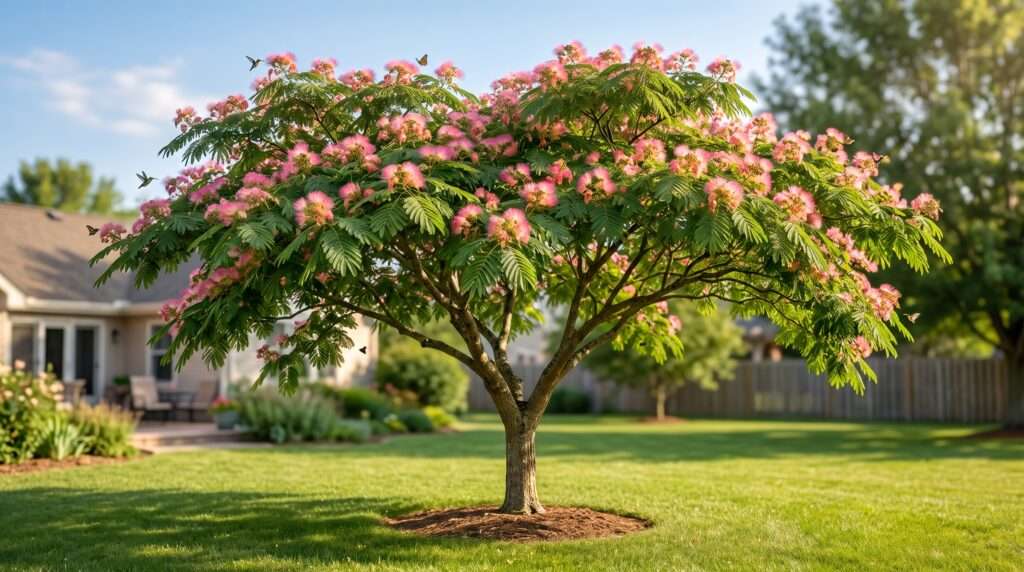
Imagine stepping into your backyard on a warm, breezy mid-summer afternoon. The air is thick with a sweet, almost tropical peach-like fragrance, and darting above you is a flurry of hummingbirds and butterflies. They are drawn to a spectacular canopy of fluffy, bright pink powder-puff blossoms resting on delicate, fern-like foliage. This is the enchanting magic of the mimosa tree.
However, if you mention this plant to an experienced landscaper, you might get a deep sigh. Known scientifically as Albizia julibrissin, this stunning ornamental tree has a notorious reputation. For decades, gardeners have had a love-hate relationship with it. It’s a breathtakingly fast grower that provides instant shade and unmatched beauty, but it is also an aggressive, messy spreader that can quickly dominate your landscape and threaten local ecosystems if left unchecked.
So, do you have to banish this gorgeous pink beauty from your garden forever? Not necessarily.
In this comprehensive guide, we are going to dive deep into the botany, behavior, and expert care required to cultivate a healthy silk tree responsibly. Whether you are considering planting one or trying to tame a mature beast currently taking over your lawn, you will learn the exact pruning, placement, and maintenance strategies needed to enjoy the beauty of the mimosa tree—without the backyard takeover. Let’s dig in! 🌸
🌿 What is a Mimosa Tree? (And Why Do Gardeners Love It?)
Before we can manage its wild side, we need to understand what makes this tree tick. The mimosa is not a true mimosa species at all, but rather a member of the Fabaceae (legume or pea) family.
A Brief History and Botanical Profile 📖
Native to southwestern and eastern Asia—ranging from Iran all the way to Japan—Albizia julibrissin is most commonly referred to as the Persian Silk Tree, the Pink Siris, or simply the Silk Tree. It was first introduced to the United States in the late 1700s by French botanist André Michaux, who brought it to his botanical garden in Charleston, South Carolina.
Because of its exotic look, high heat tolerance, and ability to thrive in poor soils, it quickly became a highly sought-after ornamental tree across North America, particularly in the South.
Mimosa Tree at a Glance:
The Visual Appeal and Wildlife Benefits 🦋
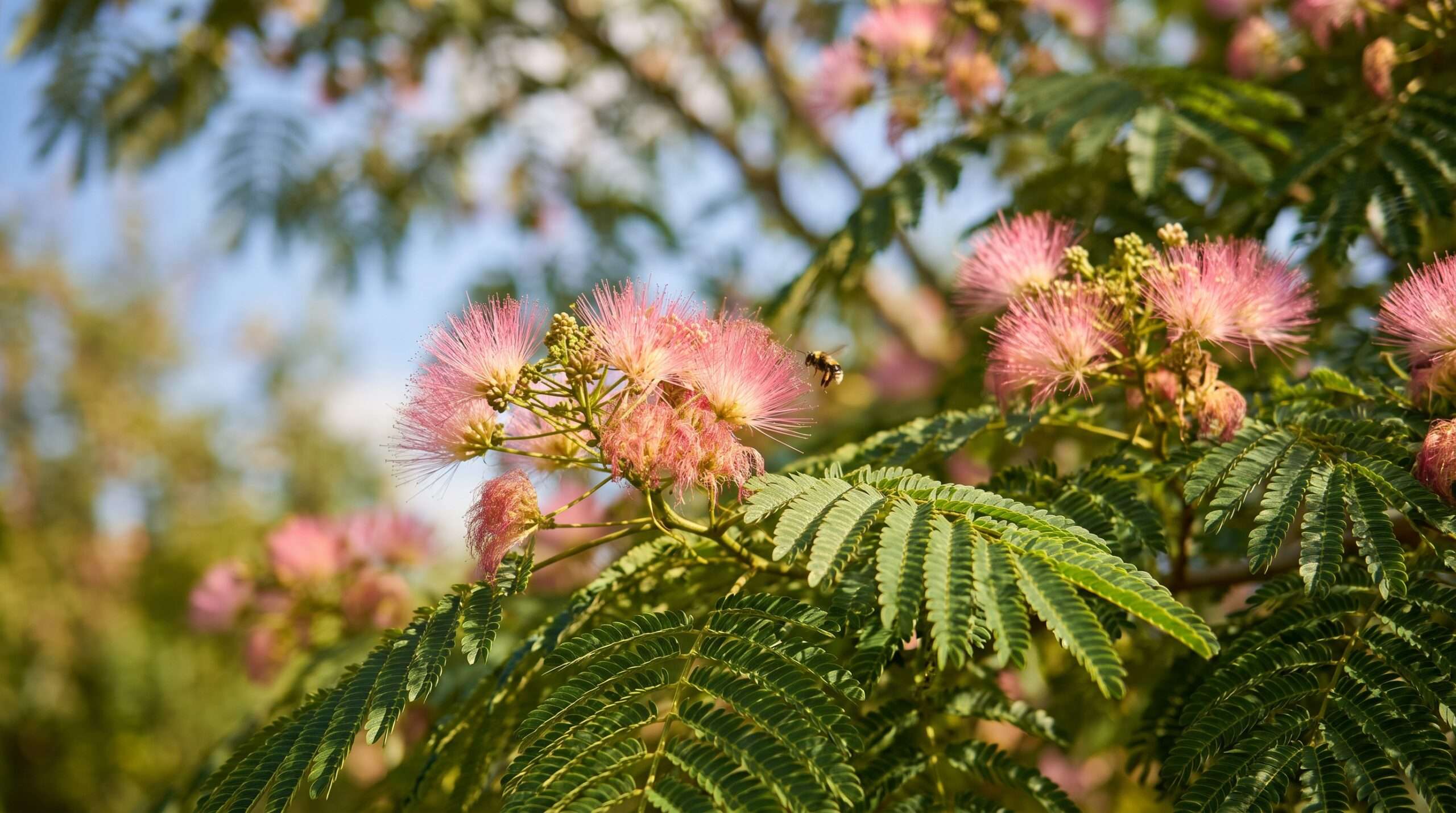
The primary reason homeowners are drawn to the silk tree is its undeniable aesthetic value. The tree naturally forms a wide, umbrella-like or vase-shaped canopy, which makes it an incredible specimen for dappled shade.
Its leaves are “bipinnate,” meaning they are divided into tiny, fern-like leaflets that fold up sensitively at night or during heavy rain storms (a phenomenon known as nyctinasty). During its blooming season, the tree erupts in clusters of thread-like stamens that look like glowing pink pom-poms. These fragrant blossoms are a magnet for local wildlife. If you want to support pollinators, the mimosa acts as a vibrant feeding hub for bees, monarch butterflies, and hummingbirds.
Furthermore, it is incredibly fast-growing. A young sapling can shoot up an astonishing 2 to 3 feet per year, making it a tempting solution for new homeowners desperate for a quick landscape anchor.
☀️ Ideal Growing Conditions for a Thriving Silk Tree
If you decide to plant one, providing the right environment is crucial—not just for the health of the tree, but to ensure it grows strong rather than leggy and weak.
Sunlight Requirements 🌞
For the most robust growth and the heaviest blanket of pink blossoms, your tree needs full sun. This means it should receive at least 6 to 8 hours of direct, unfiltered sunlight each day. While the tree can tolerate partial shade, a lack of adequate sunlight will result in sparse flowering, a lopsided canopy as the tree stretches for light, and a weaker trunk structure.
Soil Preferences and Tolerance 🌱
Here is where the tree reveals its rugged survivalist nature. Because it belongs to the legume family, the mimosa tree is a nitrogen-fixer. It has a symbiotic relationship with bacteria in its root nodules that allows it to pull nitrogen directly from the atmosphere and convert it into fertilizer.
Because it makes its own food, it can thrive in almost any soil condition:
-
Highly acidic to highly alkaline pH levels.
-
Compact clay, loose sand, or rocky loam.
-
Nutrient-depleted coastal soils.
The only strict requirement? Drainage. While it survives in poor soil, it despises “wet feet.” Planting it in a low-lying, boggy area with standing water will quickly lead to root rot and fungal diseases.
Climate and USDA Hardiness Zones 🗺️
Mimosa trees perform beautifully in USDA Hardiness Zones 6 through 9. They absolutely love hot, humid, baking summer weather. Once their root system is established (usually after the first two to three growing seasons), they are highly drought-tolerant.
However, they are sensitive to extreme cold. A harsh, prolonged winter in Zone 5 or lower will often cause severe dieback to the ground, though the resilient roots may send up new shoots the following spring.
🛑 The Big Catch: Managing the Mimosa’s Aggressive Nature
As an authoritative landscape steward, it is vital to acknowledge the “dark side” of Albizia julibrissin. You cannot plant this tree and simply walk away. It requires vigilant, active management.
Are Mimosa Trees Invasive? 🌍
In short: Yes. In many parts of the United States—particularly from the Mid-Atlantic down through the Southeast (Florida, Georgia, Texas) and parts of the Midwest—the mimosa is classified as an invasive exotic species.
It escapes cultivation easily because of its prolific seed production. When it naturalizes in wild forests, its dense, umbrella-shaped canopy blocks out the sun, preventing native understory plants, shrubs, and hardwood seedlings from growing. Before planting, always check with your local agricultural extension office to ensure it is legal and safe to plant in your specific county.
The Mess Factor: Seed Pods and Debris 🍂
If you plant a silk tree over a patio, driveway, or pool, you will likely regret it. It is notoriously messy.
-
Summer: The faded, sticky flower heads drop in large, slippery clumps.
-
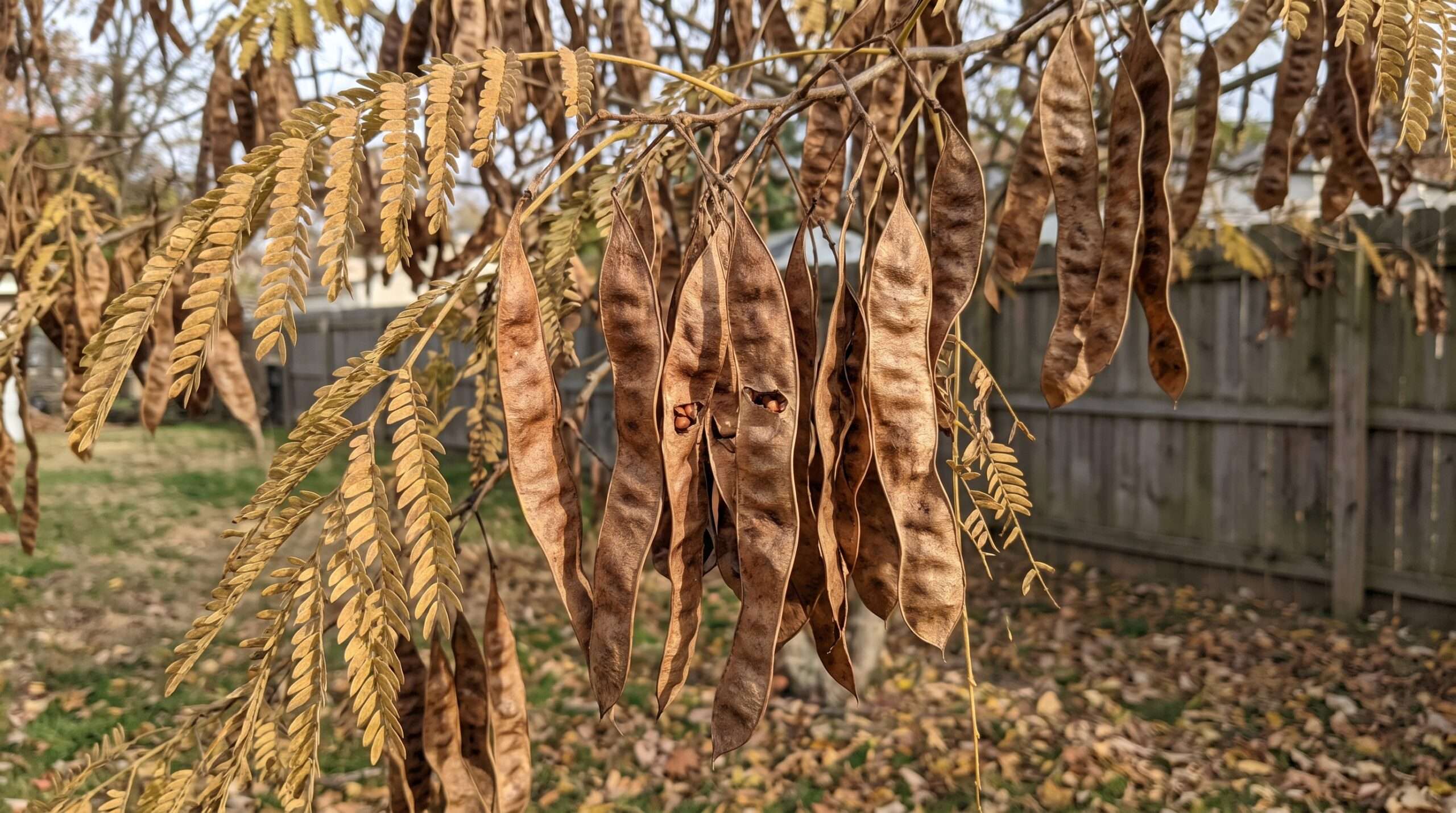
Autumn: The tree produces thousands of 6-inch-long, flat brown seed pods (resembling snap peas). These pods dry out, rattle in the wind, and drop aggressively over several months, cluttering lawns and clogging gutters.
Invasive Root Systems: Will it Damage My Foundation? 🏡
This tree survives droughts by utilizing a shallow, aggressive, and far-reaching root system that aggressively hunts for moisture. If planted too close to a house, those strong roots can lift sidewalks, crack asphalt driveways, and invade underground plumbing or septic lines in search of water. Furthermore, these roots constantly send up “suckers”—tiny clone saplings that will pop up in your pristine lawn or garden beds up to 20 feet away from the main trunk.
✂️ Step-by-Step: How to Grow and Prune Responsibly (The “No Takeover” Method)
If you are committed to the captivating beauty of the mimosa tree, you must embrace the role of an active gardener. By controlling its environment and managing its growth habits, you can mitigate almost all of its negative traits. Here is the ultimate “No Takeover” protocol.
Choosing the Perfect Location 📍
Because of the aggressive root system and the mess of dropped seed pods, location is everything. Follow the Golden Rule of Distance: Plant your silk tree a minimum of 20 to 30 feet away from your home’s foundation, underground plumbing, septic fields, paved driveways, and swimming pools.
The ideal spot is an open, grassy lawn area. Why? Because as the tree inevitably drops seeds or sends up root suckers, you can simply run over these invasive sprouts with your lawnmower during your weekly yard maintenance. If you plant it near a complex flower bed, you will spend your summers on your hands and knees pulling up stubborn mimosa saplings.
Watering and Fertilizing (Less is More) 💧
When your tree is a young sapling, water it deeply once a week to help it establish a strong, deep root system. Once the tree is mature, it is incredibly drought-tolerant and will rely solely on natural rainfall.
Expert Warning: Do not apply nitrogen-heavy fertilizer to this tree! Remember, the mimosa is a nitrogen-fixer. If you give it supplemental fertilizer, it will grow at a terrifyingly rapid pace. This forced, rapid growth produces incredibly brittle, weak wood that is highly susceptible to snapping during summer thunderstorms or winter ice storms. Let it feed itself.
Strategic Pruning Techniques 🪚
Proper pruning is the secret to a healthy, structurally sound mimosa tree. The wood is naturally weak, so you must train the branches early to prevent dangerous splitting.
-
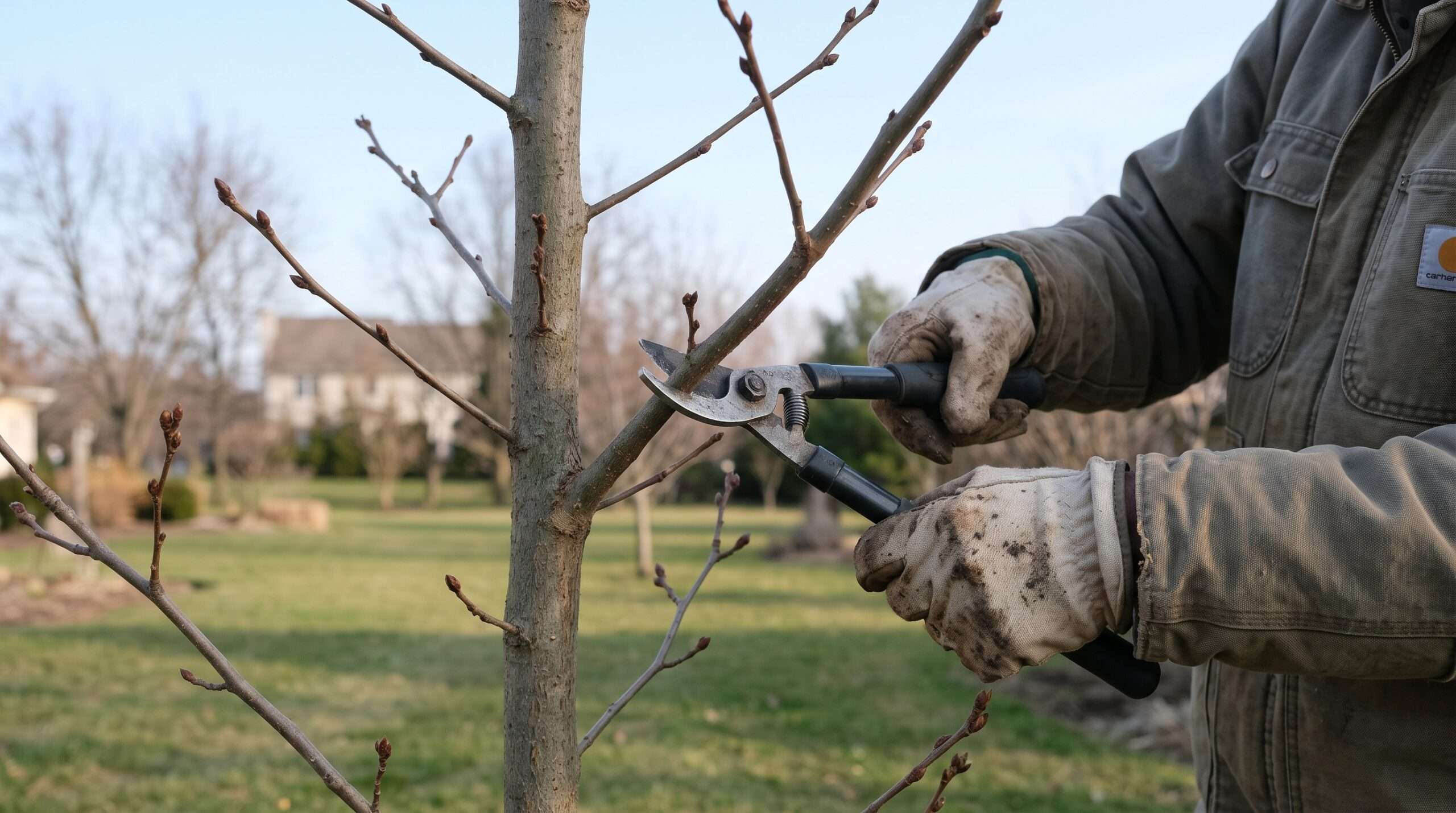
When to Prune: Always prune during late winter or early spring while the tree is completely dormant. Because it blooms on new wood, pruning in late winter ensures you won’t cut off the upcoming summer’s flowers.
-
Fixing Weak Crotches: Look for branches that form a tight, narrow “V” shape at the trunk. These are weak connections that will split under heavy winds. Prune them out, favoring branches that form a wider “U” shape.
-
Canopy Raising: As the tree grows, carefully remove the lowest branches to “raise the canopy.” This encourages an umbrella shape and allows you to easily walk (or mow) beneath it.
Seedling Control: Stopping the Spread Before It Starts 🚫
To be an environmentally responsible owner, you must stop the tree from spreading into local woodlands.
-
Lawn Management: Mow your grass regularly to cut down root suckers.
-
Pre-Emergent Weed Control: Apply a pre-emergent herbicide in nearby garden beds in early spring to prevent rogue mimosa seeds from germinating.
-
Manual Clean-Up: Rake up the fallen seed pods in late autumn and dispose of them in yard waste bags—do not put them in your compost bin, or you will accidentally spread the seeds across your entire garden!
🐛 Common Pests and Diseases (And How to Fix Them)
Even the toughest survivor trees have their kryptonite. When caring for a mimosa tree, you need to watch out for two specific, highly destructive threats.
The Infamous Mimosa Webworm 🕸️
If you look up into your canopy in mid-summer and notice the leaves turning brown, webbing together in ugly clumps, or looking like they’ve been skeletonized, you have the Mimosa Webworm (Homadaula anisocastra). These tiny caterpillars spin grayish webs around the foliage and feast on the tender leaflets.
-
The Fix: For a mild infestation, you can prune out the webbed branches and destroy them. For a larger takeover, use an organic, targeted spray like Bt (Bacillus thuringiensis) or a horticultural neem oil. Apply it thoroughly as soon as you spot the first generation of worms in early summer.
Mimosa Vascular Wilt (The Silent Killer) 🥀
This is the most devastating disease to strike the Albizia julibrissin. Caused by the soil-borne fungus Fusarium oxysporum f. sp. perniciosum, this wilt is aggressive and fatal. Symptoms include yellowing leaves in early summer, severe branch dieback, and cracked bark that oozes frothy sap. The fungus clogs the tree’s vascular system, preventing water from reaching the canopy.
-
The Fix: Tragically, there is no cure for Mimosa Vascular Wilt. Once a tree is infected, it will die—often within a single season. The only defense is prevention. If you live in an area where this wilt is common, only purchase wilt-resistant cultivars such as ‘Union’, ‘Charlotte’, or ‘Tryon’. Furthermore, if a tree dies of wilt in your yard, never plant another mimosa in that same soil, as the fungus remains active in the ground for years.
🌳 Stunning Native Alternatives to the Mimosa Tree
Are the invasive roots, weak wood, and messy seed pods making you second-guess your decision? That is the mark of a wise gardener! If you want the visual impact of a mimosa but prefer an eco-friendly, native plant that supports your local environment, consider these stunning alternatives:
-
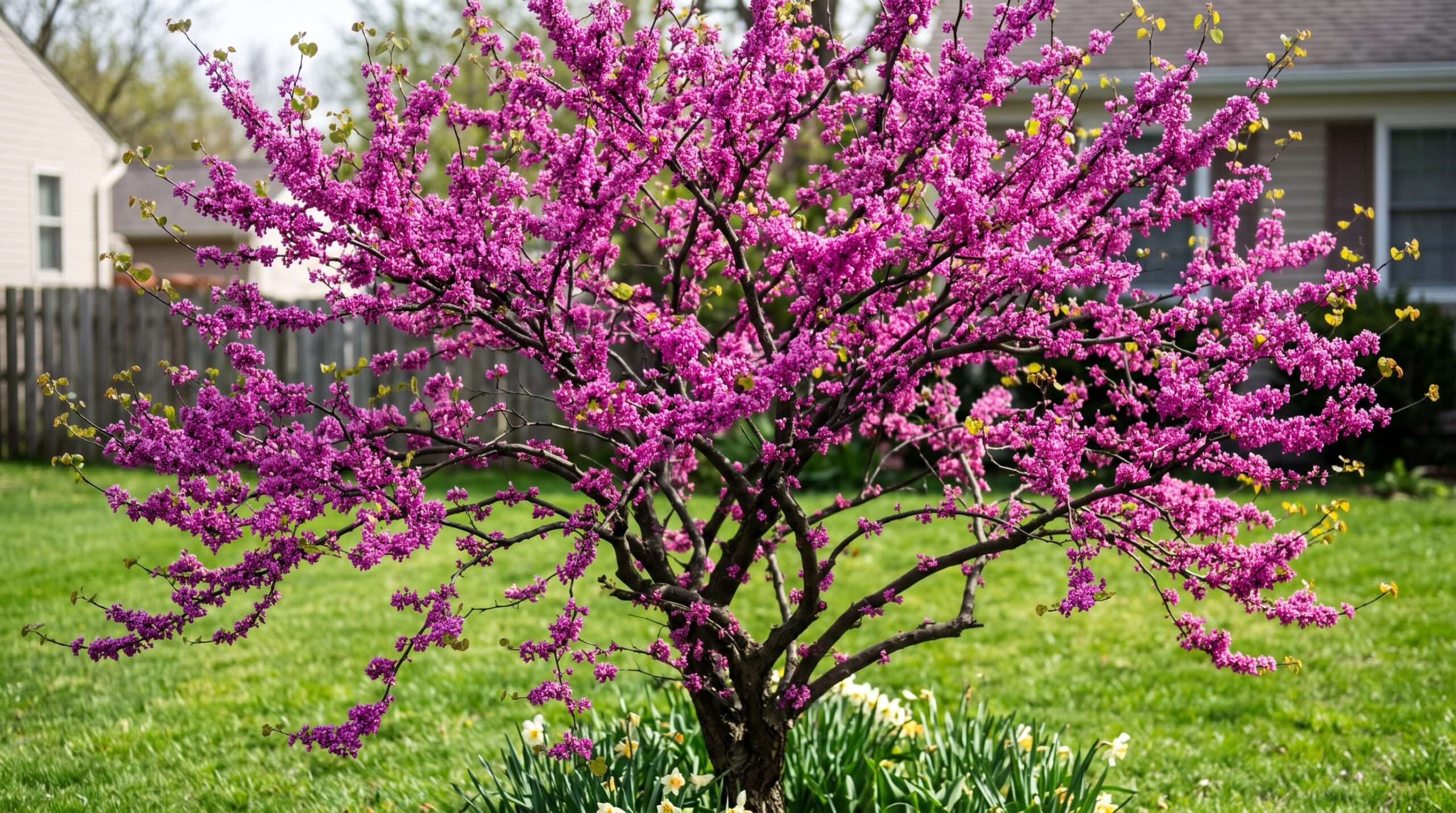
Eastern Redbud (Cercis canadensis): If you love the pink color, the Redbud is a magnificent native choice. It bursts into vibrant magenta-pink flowers in early spring before its heart-shaped leaves even emerge.
-
White Fringe Tree (Chionanthus virginicus): Looking for that fluffy, cloud-like bloom? The Fringe Tree offers spectacular, fragrant, thread-like white blossoms in early summer and is exceptionally resilient.
-
Desert Willow (Chilopsis linearis): If you love the wispy, delicate foliage and high heat/drought tolerance of the mimosa, the Desert Willow is perfect. It produces beautiful, trumpet-shaped pink and purple flowers and behaves beautifully in a landscaped yard.
❓ Frequently Asked Questions (FAQs) About Mimosa Trees
How long do Mimosa trees live? ⏳ Unlike massive oaks or maples that outlive generations, the mimosa is a short-lived tree. Because of its rapid growth, brittle wood, and susceptibility to vascular wilt, a typical mimosa tree will only live for 15 to 20 years in a residential landscape.
Can you grow a Mimosa tree in a pot? 🪴 Yes! In fact, this is an excellent, responsible way to enjoy the tree. Growing a mimosa in a large patio container severely restricts its root system, keeping it small (like a bonsai or patio shrub) and completely preventing it from sending invasive root suckers into your lawn.
Are Mimosa tree flowers or pods toxic to dogs and cats? 🐾 While the pink flowers are generally harmless, the seed pods are toxic to pets and livestock. The seeds contain potent alkaloids and saponins that can cause severe gastrointestinal distress, vomiting, and muscle tremors if ingested. If you have curious dogs that chew on yard debris, you should avoid planting this tree.
Why is my Mimosa tree not blooming? 🌸 If your tree is all foliage and no flowers, it is likely suffering from either a lack of sunlight (they require full, baking sun) or too much nitrogen in the soil. Remember, nitrogen fuels green leaf growth at the expense of flower production.
📝 Final Thoughts: Is the Mimosa Tree Right for Your Yard?
The mimosa tree is the ultimate botanical paradox. It is undeniably one of the most visually stunning, fragrant, and fast-growing ornamental trees available to home gardeners. Yet, its invasive tendencies, messy debris, and brittle wood mean it is not a “plant it and forget it” addition to your landscape.
To grow a mimosa tree successfully, you must be a proactive landscape manager. By giving it plenty of space, practicing strategic pruning, managing the dropped seed pods, and planting wilt-resistant cultivars, you can safely cultivate this pink wonder.
However, if you want a low-maintenance, eco-friendly yard, you might be better off exploring beautiful native alternatives like the Eastern Redbud.
What is your experience with the silk tree? Do you consider it a breathtaking garden treasure or an invasive nightmare? Let us know in the comments below, and don’t forget to explore our other expert tree care guides to keep your landscape thriving! ✨