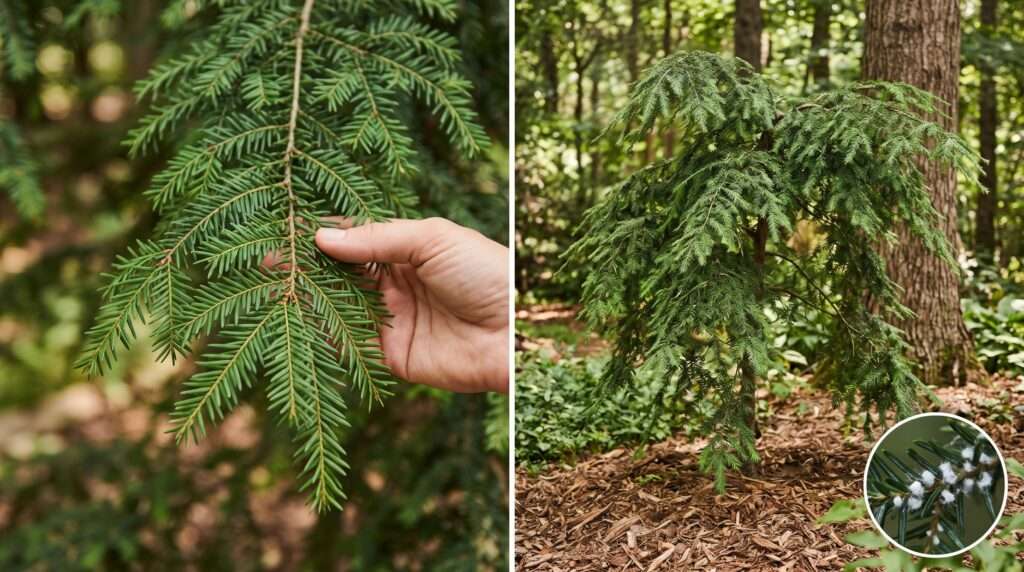
Few evergreens rival the graceful, feathery elegance of hemlock trees. Unlike stiff spruces or prickly pines, hemlocks drape the landscape in soft, arching branches that sway gently in the breeze and thrive in deep shade where other conifers struggle to survive. Whether you rely on them for a lush, year-round privacy screen or admire a towering, century-old specimen in your backyard, these trees are true cornerstones of the woodland garden.
Yet, there is a silent threat lurking beneath those delicate needles. Across North America, microscopic sap-sucking pests can turn a thriving, healthy hemlock into a brittle, leafless skeleton in just a few years if left unchecked.
Before we dive into how to protect them, let’s clear up the most common myth right away: hemlock trees (Tsuga species) are not poisonous. They have zero botanical relation to “poison hemlock” (Conium maculatum), the toxic flowering weed in the carrot family famous for ending Socrates’ life. Your landscape hemlocks are completely safe around kids and pets—they just need the right care to stay safe themselves.
In this complete, arborist-backed guide, you will learn exactly how to plant, water, prune, and maintain vibrant hemlocks—plus a step-by-step battle plan to spot and stop deadly pests before it’s too late. 🌱
🌿 Know Your Hemlock: 4 Common Species & Their Pest Resistance
Not all hemlocks behave the same way in the landscape, and—crucially—they do not share the same vulnerability to invasive pests. Identifying which species you have is the first step toward building the right care plan.
| Hemlock Species | Native Region | Mature Height | USDA Zones | Woolly Adelgid Resistance |
|---|---|---|---|---|
| Eastern Hemlock (Tsuga canadensis) | Eastern North America | 40–70 ft | 3–7 | ❌ Very Low (Highly Vulnerable) |
| Carolina Hemlock (Tsuga caroliniana) | Southern Appalachians | 40–60 ft | 4–7 | ❌ Very Low (Highly Vulnerable) |
| Western Hemlock (Tsuga heterophylla) | Pacific Northwest | 100–150+ ft | 6–9 | ✅ High (Naturally Resistant) |
| Mountain Hemlock (Tsuga mertensiana) | Western Mountains | 50–100 ft | 5–8 | ✅ High (Naturally Resistant) |
Eastern Hemlock (Tsuga canadensis)
The undisputed king of shade-tolerant evergreens in the eastern United States and Canada. Eastern hemlocks tolerate heavy pruning, making them the gold standard for dense, formal hedges and privacy screens. Unfortunately, they lack natural defenses against the invasive Hemlock Woolly Adelgid (HWA) and require vigilant monitoring.
Carolina Hemlock (Tsuga caroliniana)
Slightly more compact and adaptable to urban soils and heat than its Eastern cousin, the Carolina hemlock has a denser, more pyramidal habit with needles radiating in all directions around the twig. Like the Eastern hemlock, it is highly susceptible to HWA and benefits from proactive protection.
Western Hemlock (Tsuga heterophylla) & Mountain Hemlock (Tsuga mertensiana)
Native to the Pacific Northwest and western alpine slopes, these species co-evolved with native populations of woolly adelgids. As a result, they possess natural resistance and rarely suffer fatal damage unless they are severely stressed by drought or poor soil conditions.
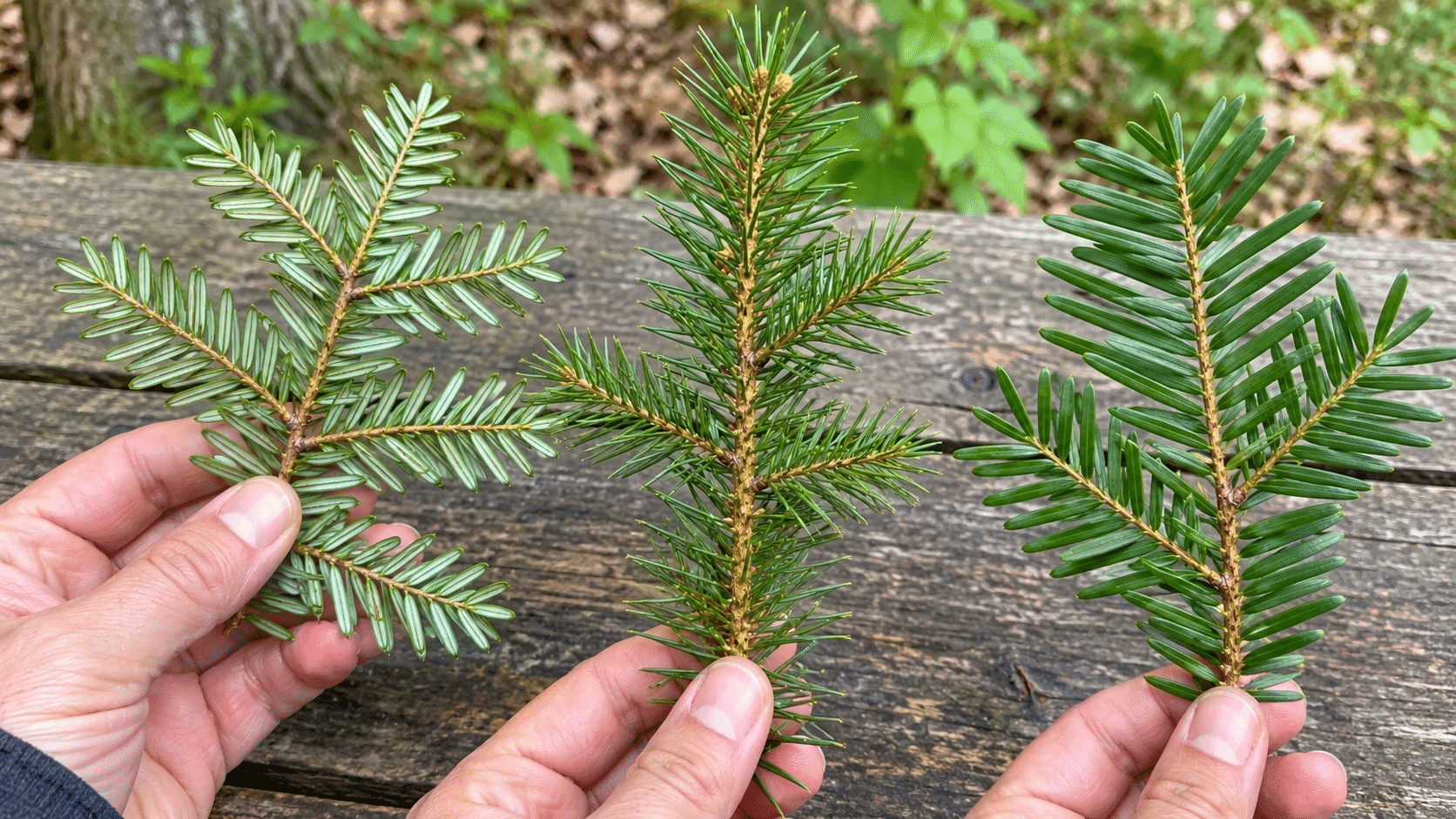
💡 Expert ID Tip: Not sure if you have a hemlock, a spruce, or a fir? Look closely at the needles. Hemlock needles are short, flat, soft to the touch, and rounded at the tips, with two distinct white stomatal stripes running along the underside. They attach to the twig via tiny woody stems (petioles), giving the branches a flat, feathery appearance.
☀️ Essential Care Guide for Thriving Hemlock Trees
In arboriculture, the best defense against any pest or disease is a vigorous, unstressed tree. Stressed hemlocks emit chemical signals that attract insects and lack the energy reserves needed to recover from sap loss. Here is how to dial in their environment.
Sunlight & Site Selection 🌤️
Hemlocks are the champions of shade. In the wild, they grow beneath the canopy of towering hardwoods in cool, moist ravines.
-
Ideal Light: Partial shade, dappled sunlight, or morning sun with afternoon shade.
-
What to Avoid: Avoid planting hemlocks on harsh, south- or west-facing slopes exposed to blistering afternoon sun and drying winter winds. In cooler northern zones (Zones 3–5), they can handle full sun only if the soil stays consistently moist.
Soil & Mulching Requirements 🪴
Hemlocks have shallow, fibrous root systems that sit close to the soil surface. Because of this, soil quality and root protection are non-negotiable.
-
Soil Type & pH: They crave cool, rich, well-draining loamy soil with an acidic pH between 5.0 and 6.0. Heavy, compacted clay that holds standing water will quickly trigger fatal root rot.
-
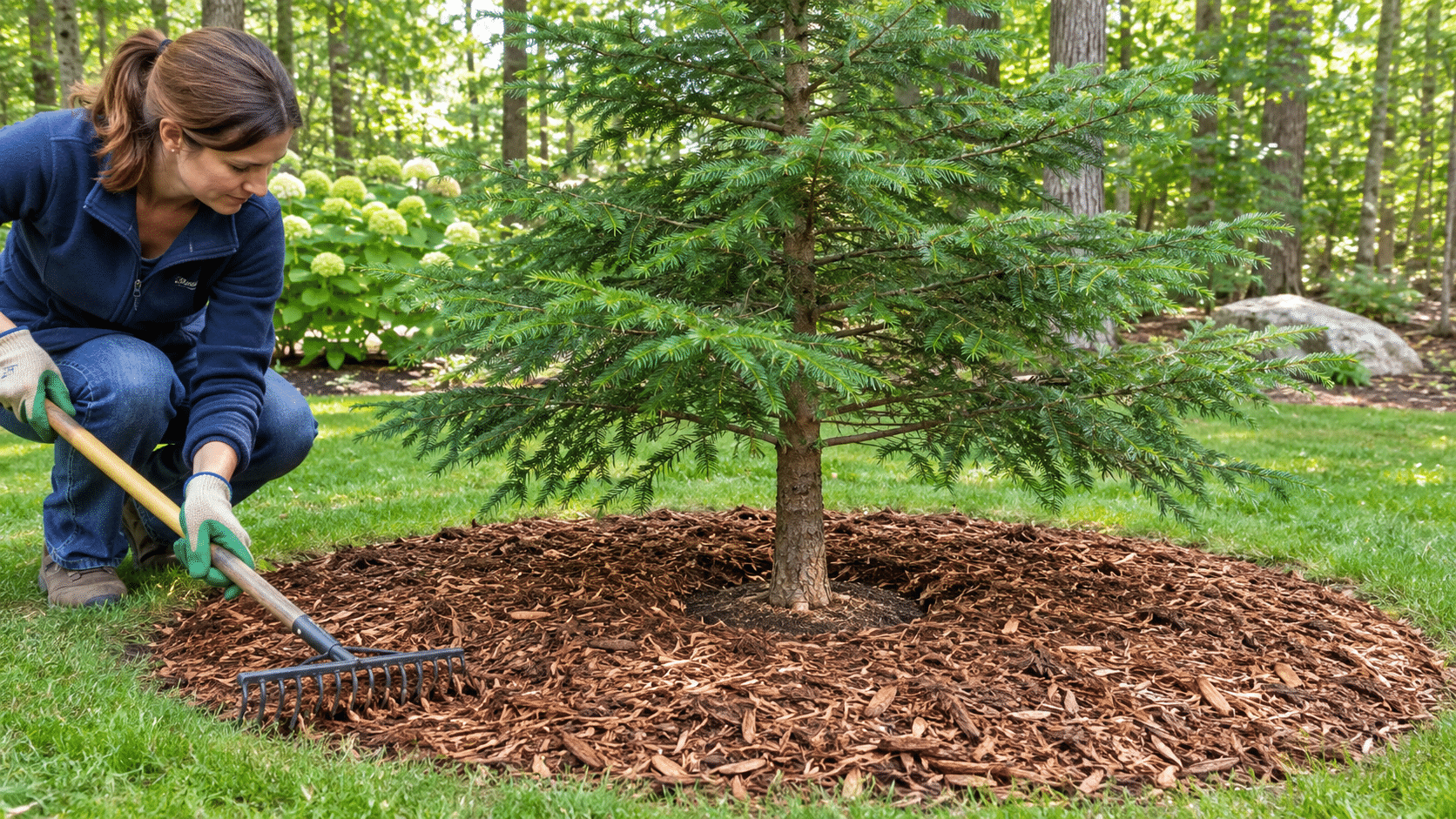
Mulching Best Practice: Spread a 2- to 3-inch layer of shredded bark, pine needles, or organic woodchips in a wide ring extending out to the tree’s dripline. Keep the mulch pulled back 3–4 inches from the trunk flare to prevent bark rot. Mulch mimics the forest floor, keeping shallow roots cool, locking in moisture, and preventing soil compaction from lawnmowers and foot traffic.
Watering Schedule 💧
Because their roots stay near the surface, hemlock trees are notoriously intolerant of drought.
-
Newly Planted Trees (Years 1–2): Water deeply 1 to 2 times per week during dry spells, delivering about 1 inch of water per week.
-
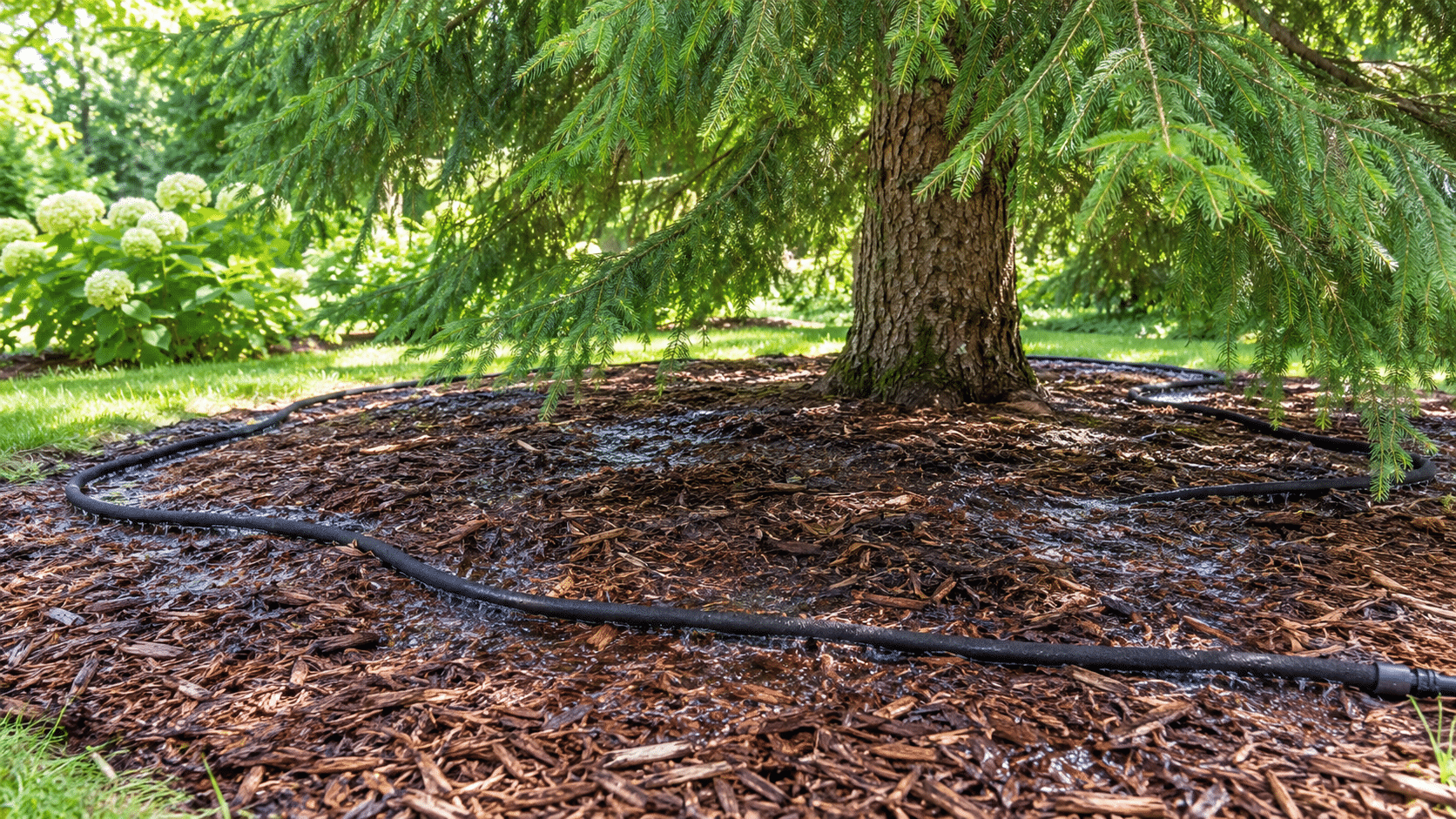
Established Trees: Supplemental watering is essential during extended summer droughts. Run a soaker hose slowly at the dripline so water penetrates 6 to 8 inches deep.
-
Winter Prep: Give your hemlocks a thorough, deep soaking in late autumn right before the ground freezes. Evergreens continue losing moisture through their needles all winter; hydrating them in fall prevents ugly, brown “winter burn.”
The Golden Rule of Fertilizing (⚠️ Critical Warning!)
Many homeowners assume that a yellowing or thinning hemlock needs a boost of fertilizer. Stop and inspect your tree first.
Healthy, uninfested hemlocks growing in organically rich, mulched soil rarely need synthetic fertilizers at all. More importantly, never apply soluble nitrogen fertilizer to a hemlock tree that has—or might have—Hemlock Woolly Adelgid or Elongate Hemlock Scale. Research from university forestry extensions consistently proves that high nitrogen levels in tree sap actually supercharge pest reproduction and survival, accelerating the tree’s decline. Stick to top-dressing with compost and organic woodchip mulch instead.
Pruning & Shaping ✂️
Hemlocks respond remarkably well to pruning and can be maintained as a tight hedge or left to grow naturally.
-
Best Timing: Prune in late winter to early spring just before the new flush of bright-green spring growth emerges. Avoid heavy pruning in late summer or fall, as it stimulates tender new shoots that will be killed by early frosts.
-
Hedge-Shaping Secret: If you shear hemlocks into a privacy hedge, always taper the sides so the base is slightly wider than the top (like a subtle pyramid). This ensures sunlight reaches the lower branches, preventing the bottom of your hedge from turning bare and woody.
🐛 The #1 Threat: Identifying & Stopping Hemlock Woolly Adelgid (HWA)
If you live in the eastern half of North America and own hemlock trees, there is one pest you must know by heart: the Hemlock Woolly Adelgid (Adelges tsugae).
What Is Hemlock Woolly Adelgid? 🔎
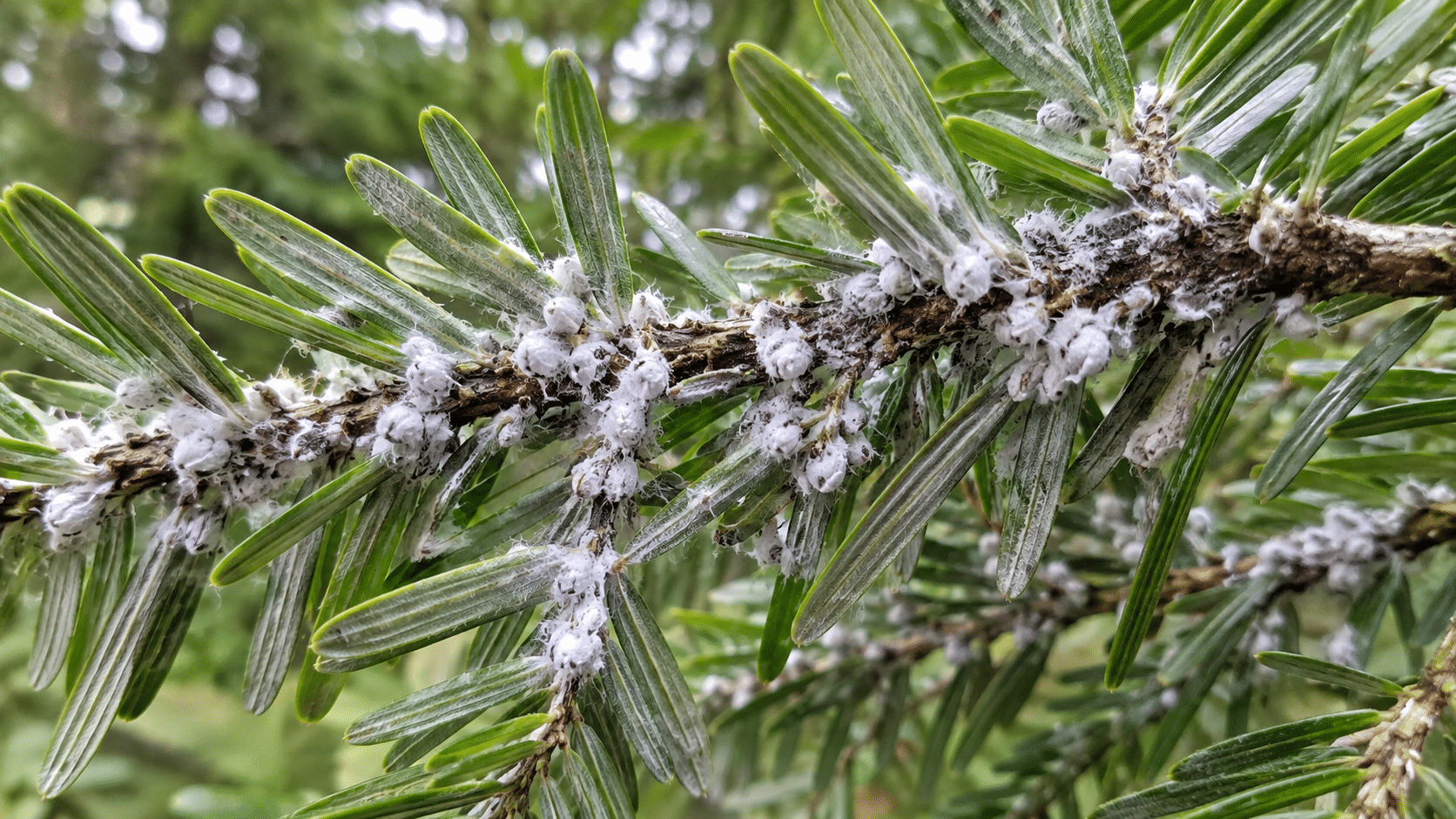
Accidentally introduced from Japan in the mid-20th century, HWA is a tiny, aphid-like piercing-sucking insect. It attaches itself to the base of hemlock needles and inserts a long, straw-like mouthpart (stylet) directly into the twig’s nutrient-storage cells.
As it feeds on the tree’s sap, it disrupts nutrient flow and triggers a toxic physiological response. New bud growth stops, needles drop, and branches die. Without intervention, an infested mature hemlock can perish in as little as 3 to 10 years.
How to Spot an Infestation Early (The “Snow” Test) ❄️
Early detection is the difference between a simple treatment and a costly tree removal. Because the insects themselves are microscopic, you are looking for the protective white wax they secrete.
-
The Visual Tell: Flip over the branches and inspect the undersides of the twigs at the base of the needles. From late fall through early spring, HWA produces tiny, white, cottony egg sacs that look like miniature Q-tip tips or flecks of snow clinging to the twigs.
-
Secondary Symptoms: If you spot these signs from a distance, the infestation is already advancing:
-
Foliage shifting from rich, glossy green to a dull gray-green or washed-out yellow.
-
Premature needle drop, leaving the canopy looking sparse and “see-through.”
-
Lack of bright-green new growth tips in spring.
-
Branch dieback that typically starts at the bottom of the canopy and works its way upward.
-
Understanding the HWA Life Cycle (Why Timing Matters) 🗓️
Unlike almost every other garden pest, Hemlock Woolly Adelgid loves the cold.
-
Summer (Dormancy): During the heat of summer, young nymphs go dormant (aestivate) at the base of the needles, appearing as tiny black specks with a faint white halo.
-
Fall through Spring (Active Feeding): As temperatures drop in October and November, HWA wakes up, feeds aggressively all winter, and lays eggs inside those telltale white woolly sacs in late winter and early spring.
-
Why This Matters: Because they are actively feeding in fall and spring, these are the prime windows to inspect your trees and apply treatments.
🚨 Biosecurity Alert: If you find white woolly sacs on your hemlock, do not clip off an infested branch and drive it to your local garden center or extension office for identification! HWA “crawlers” (the mobile nymph stage) easily blow off branches onto clothing, car vents, and healthy trees, accidentally spreading the infestation to new neighborhoods. Instead, take crisp, close-up photos with your smartphone and show those to a certified arborist.
🛡️ Proven Treatment Options to Save Your Hemlock Trees
Finding Hemlock Woolly Adelgid on your trees is scary, but it is not an automatic death sentence. With a targeted Integrated Pest Management (IPM) plan, you can knock out the infestation and protect your hemlock trees for years to come. The right method depends largely on the size of your tree, the severity of the infestation, and how close it is to water.
1. Horticultural Oils & Insecticidal Soaps (Best for Small Trees & Hedges) 🧴
If you are caring for young hemlocks or a pruned privacy hedge under 10–15 feet tall, contact sprays like horticultural oil or insecticidal soap are effective, low-toxicity options.
-
How They Work: These sprays coat and smother the adelgids on contact, disrupting their waxy protective coating and cell membranes. Because they leave no long-term chemical residue, they are much gentler on beneficial insects.
-
The Catch: You must achieve 100% thorough coverage, especially on the undersides of every twig and needle. Any adelgids you miss will quickly repopulate.
-
Application Tips: Spray in early spring or fall when temperatures are mild (between 40°F and 85°F) and no freezing nights are in the forecast. Avoid spraying during heatwaves or drought stress, as oils can scorch sensitive needles.
2. Systemic Insecticides (Best for Mature & Tall Trees) 💉
For towering mature hemlocks where spraying the entire canopy is impossible, systemic insecticides are the gold standard recommended by forestry extensions and certified arborists. These treatments are absorbed by the tree and transported up through the vascular system directly into the needles where HWA feeds.
-
Imidacloprid (Long-Term Protection): Applied as a soil drench around the base of the trunk or via professional trunk injection. It moves slowly—taking 3 to 12 months to fully reach the top of a tall canopy—but once established, it provides rock-solid protection lasting 1 to 5+ years (and sometimes up to 7 years in forest settings). Because it is slow-acting, it is best for healthy trees with light-to-moderate infestations.
-
Dinotefuran (Fast-Acting Knockdown): Applied as a basal bark spray or soil drench, dinotefuran is highly water-soluble and rushes into the canopy within 2 to 4 weeks. Arborists often use it for heavily infested trees that need immediate relief, or pair it with imidacloprid for both instant knockdown and multi-year protection. (Note: Always check your local and state pesticide regulations, as neonicotinoids like imidacloprid and dinotefuran are restricted for homeowner use in certain states.)
-
Non-Neonicotinoid Option (Eco-Sensitive Sites): If your hemlocks grow near streams, ponds, or wells—or if you prefer to avoid neonicotinoids—ask an arborist about azadirachtin-based trunk injections (such as TreeAzin). Derived from neem tree seeds, this botanical systemic disrupts pest growth and reproduction with minimal environmental runoff.
💡 Pollinator Safety Note: Unlike flowering trees, hemlock trees are wind-pollinated and do not produce nectar that attracts bees. Still, when applying any soil drench, always keep the treatment strictly within the mulch ring at the base of the hemlock and away from nearby flowering perennials or weeds.
3. Biological Controls (The Future of Hemlock Conservation) 🐞
If you manage a large wooded property or simply love tree science, there is exciting news on the conservation front. Because chemical treatments aren’t practical across millions of acres of wild forest, entomologists are actively releasing specialized predator insects from the Pacific Northwest and Japan—most notably the tiny tooth-necked fungus beetle (Laricobius nigrinus) and silver flies (Leucotaraxis species).
These predators feed exclusively on Hemlock Woolly Adelgid and are active during the same cool winter months. While biological controls are currently focused on large forest stands rather than single backyard trees, they represent a major long-term breakthrough for saving native hemlocks.
When to Call a Certified Arborist 📞
While homeowners can easily manage small hedges with horticultural oil, it is best to bring in an ISA-Certified Arborist if:
-
Your tree is over 15–20 feet tall and requires calibrated soil or trunk injections.
-
Your hemlocks are located near a stream, pond, wetland, or drinking-water well.
-
You see significant canopy dieback. As a general arboricultural rule, hemlocks with less than 50% canopy dieback can usually be saved with prompt systemic treatment and good watering. Once a tree has lost more than 50% to 75% of its foliage, its vascular system may be too damaged to absorb systemic treatments effectively.
🕸️ Other Common Hemlock Pests & Diseases to Watch Out For
While HWA steals most of the headlines, a few other troublemakers can target stressed hemlock trees. Knowing how to tell them apart ensures you don’t waste time on the wrong treatment.
Elongate Hemlock Scale (EHS)
Often found teaming up with Hemlock Woolly Adelgid, Elongate Hemlock Scale (Fiorinia externa) is another invasive sap-feeder. Instead of white wool, look for tiny, flat, brown or tan elongated waxy shells clinging to the undersides of needles. Heavy infestations cause yellow banding on the needles and premature shedding.
-
Key Difference: Imidacloprid does not control Elongate Hemlock Scale. If your tree has EHS, you will need horticultural oil (timed for the spring crawler stage) or a professional dinotefuran treatment.
Spruce Spider Mites
Unlike most spider mites that love blistering heat, the spruce spider mite (Oligonychus ununguis) is a cool-season pest that peaks in spring and fall. Look for fine stippling (tiny yellow speckles) on the needles, a dull bronzed cast, and delicate webbing between twigs.
-
Quick Test: Hold a sheet of white paper under a branch and tap it firmly. If tiny specks fall onto the paper and start crawling—and leave a reddish-brown smear when gently wiped—you have spider mites. Miticides or horticultural oil sprays in spring and fall keep them in check.
Root Rot (Phytophthora)
If your hemlock’s needles are turning uniformly brown and the tree is declining rapidly—with zero signs of insects on the twigs—check the soil. Hemlocks planted in heavy, soggy clay or low-lying areas with poor drainage are prime targets for Phytophthora root rot. Because there is no reliable cure once root rot advances, prevention through well-draining soil, proper planting depth, and avoiding overwatering is everything.
📅 Seasonal Hemlock Care Calendar (At-a-Glance Checklist)
Staying ahead of hemlock problems takes less than 15 minutes a season. Bookmark this quick checklist to keep your trees thriving year-round:
❓ Frequently Asked Questions About Hemlock Trees
Are hemlock trees poisonous to humans or dogs?
No. Landscape hemlock trees (Tsuga species) are completely non-toxic to humans, dogs, cats, and horses. The confusion comes from “poison hemlock” (Conium maculatum), an unrelated, highly toxic herbaceous weed in the carrot family. The tree was simply named “hemlock” by early European settlers who thought its crushed needles smelled similar to the poisonous plant.
Can a hemlock tree recover from Hemlock Woolly Adelgid?
Yes, provided you catch the infestation early enough. If your tree still has at least 50% healthy green foliage and you treat it with an effective systemic insecticide (paired with consistent watering and mulching), it can stop the pest, flush out fresh bright-green needles the following spring, and make a full recovery over 2 to 3 years.
How fast do hemlock trees grow?
Under ideal conditions—cool, moist, acidic soil and dappled shade—most hemlock species have a moderate growth rate of 12 to 24 inches per year. Newly planted trees may grow slightly slower during their first two years while they focus energy on establishing their shallow root system.
What is the best time of year to treat hemlocks for woolly adelgid?
The two best windows for systemic soil treatments are early spring (after the ground thaws) and autumn (from September through November before the ground freezes). During these periods, soil moisture is naturally higher—helping the tree pull the treatment up into the canopy—and the adelgids are actively feeding.
🌲 Final Thoughts: Protecting Your Hemlocks for Decades to Come
Caring for hemlock trees really comes down to two simple pillars: proactive root care and vigilant inspection. Give them cool, acidic, well-mulched soil, keep them hydrated through dry summers, and resist the urge to push growth with heavy nitrogen fertilizers. Then, make it a habit to flip over a few branches every winter and spring to check for those telltale flecks of white wool.
Take five minutes this week to walk out and inspect the undersides of your hemlock twigs—catching a pest early can save a tree that will shade and beautify your yard for generations. Have you spotted unusual needles or white fuzz on your hemlocks? Drop your questions in the comments below and let’s troubleshoot it together! 🌿✨