
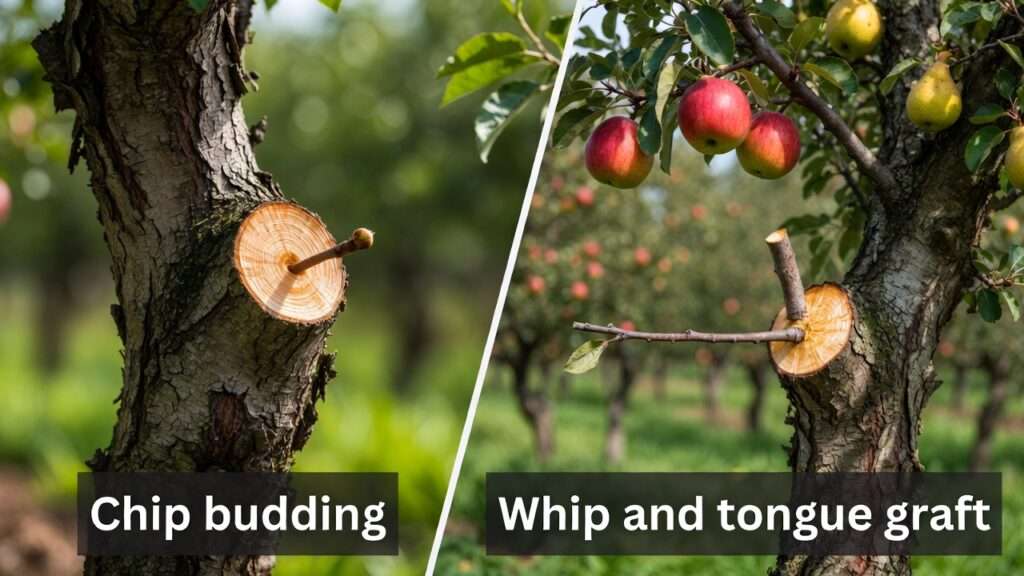
Imagine this: You’ve finally sourced that perfect heirloom apple scion from a rare old tree, or you’ve fallen in love with a juicy pear variety at the farmers’ market. You want to multiply it — maybe create a small home orchard, replace a declining tree, or even gift clones to friends. But then the question hits: Which grafting technique should I actually use?
Chip budding vs. whip-and-tongue graft — these two classic propagation methods dominate fruit tree nurseries, extension services, and serious home orchards worldwide. Both can produce beautiful, long-lived trees… yet they differ dramatically in timing, scion usage, skill required, union strength, and speed of results.
Choosing the wrong one for your situation can mean lower success rates, wasted precious scion wood, delayed fruiting, or even weak unions that snap years later in a storm.
In this comprehensive, expert-level guide, we’ll break down chip budding vs. whip-and-tongue graft step by step — comparing real-world performance, backed by university trials, commercial nursery practices, and decades of hands-on experience from growers in temperate and subtropical climates (including regions like Bangladesh where monsoon timing adds unique challenges).
By the end, you’ll know exactly which method to reach for depending on your rootstock, scion availability, season, and goals — so you can propagate fruit trees with confidence and higher take rates. Let’s graft smarter, not harder! 🌱✂️
Why Grafting Matters for Fruit Trees (Quick Foundation Recap)
Grafting is not just a propagation trick — it’s the cornerstone of modern fruit growing.
By joining a desirable scion (the upper part carrying the fruit variety) to a selected rootstock, you gain:
- Controlled tree size (dwarf, semi-dwarf, standard)
- Earlier fruit production (often 2–4 years instead of 7–10 from seed)
- Improved disease and pest resistance (e.g., fire blight tolerant rootstocks for apples)
- Better adaptation to soil, drainage, and climate
- Preservation of named cultivars that don’t come true from seed
Both chip budding and whip-and-tongue grafting achieve vascular cambium-to-cambium contact — the magic layer where healing and nutrient transport happen. But the way they create that contact, and when they’re best performed, makes all the difference.
Deep Dive: What Exactly Is Chip Budding? 🌿
Chip budding (also called “patch budding” or “chip-and-tee” in some older texts) is a highly efficient form of bud grafting. Instead of using an entire shoot, you insert only a single dormant bud attached to a small shield or “chip” of wood and bark.
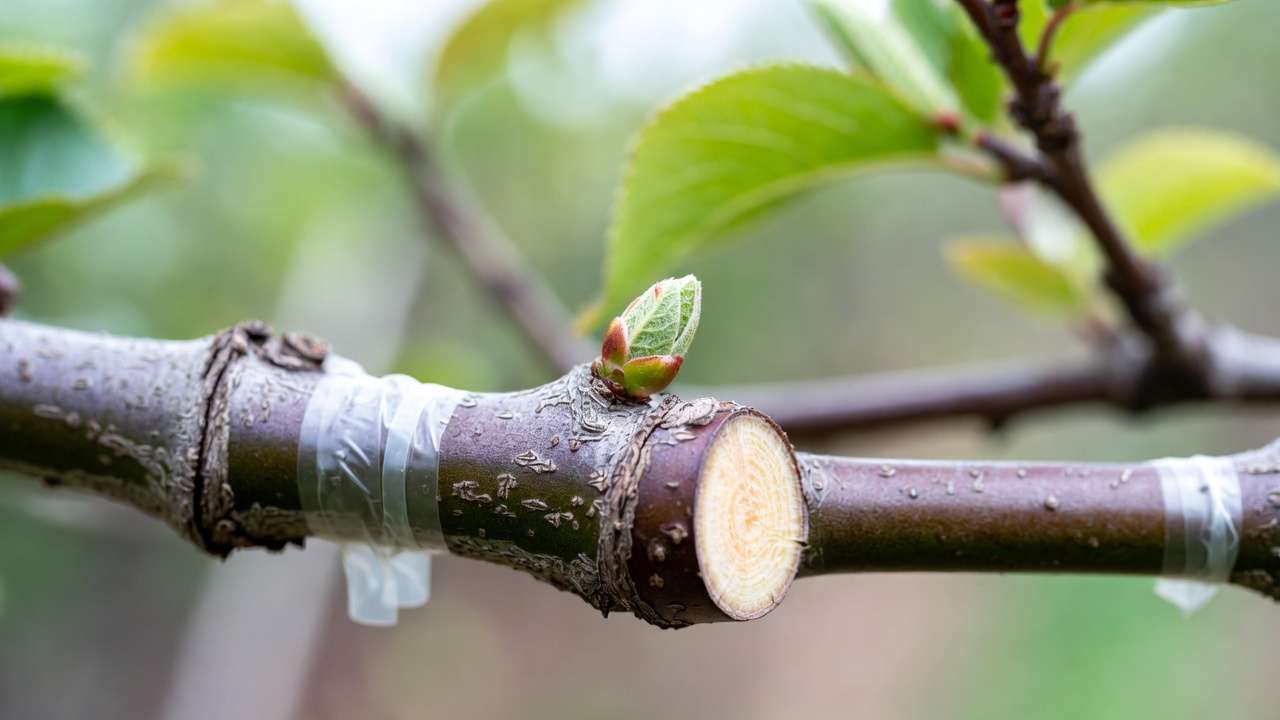
How Chip Budding Works – Step-by-Step
- Collect budwood — Use healthy, disease-free, current-season or one-year-old shoots. Cut in late summer/fall or late winter. Store in moist sand or fridge (around 0–4°C).
- Prepare the bud chip — With a very sharp knife, make two angled cuts about 2–3 cm long to remove an oval or shield-shaped piece containing one bud and a thin layer of wood.
- Cut the rootstock — Make a matching inverted-T or straight cut on the rootstock stem (usually 1-year-old whip). Lift the bark/wood slightly if needed.
- Insert and align — Slide the chip in so the cambium layers touch on at least one side (ideally both). The bud should face outward.
- Secure tightly — Wrap with budding rubber, grafting tape, or parafilm — leaving the bud exposed. Some growers wax the top cut.
- Aftercare — Protect from direct sun and drying winds. Check union in 4–8 weeks.
Ideal Timing Windows for Chip Budding
- Primary season: Late summer to early autumn (August–October in most temperate/subtropical zones) when the bark is still active but buds are mature.
- Secondary season: Dormant period (late winter–very early spring) before sap rises. This flexibility is a huge advantage in places like Khulna, where late summer budding can dodge early monsoon damage while still allowing good callusing before winter slowdown. ⏰
Key Advantages of Chip Budding
- Extremely economical on scion wood — one 30 cm branch can yield 10–25 grafts
- No need for bark slipping (unlike traditional T-budding)
- Produces very clean, straight trees with uniform growth
- Excellent for high-volume propagation (nurseries love it)
- Often achieves 85–95% take rates with good technique
- Works beautifully on apples, pears, plums, peaches, nectarines, cherries, and many ornamentals
Real Drawbacks to Consider
- Demands razor-sharp knife skills — a mismatched cambium = instant failure
- The bud usually remains dormant until the following spring → slower visible progress
- Less forgiving for absolute beginners than whip grafting
- Union, while strong long-term, is mechanically less interlocking than whip-and-tongue
Deep Dive: What Exactly Is Whip-and-Tongue Graft? 📏🔗
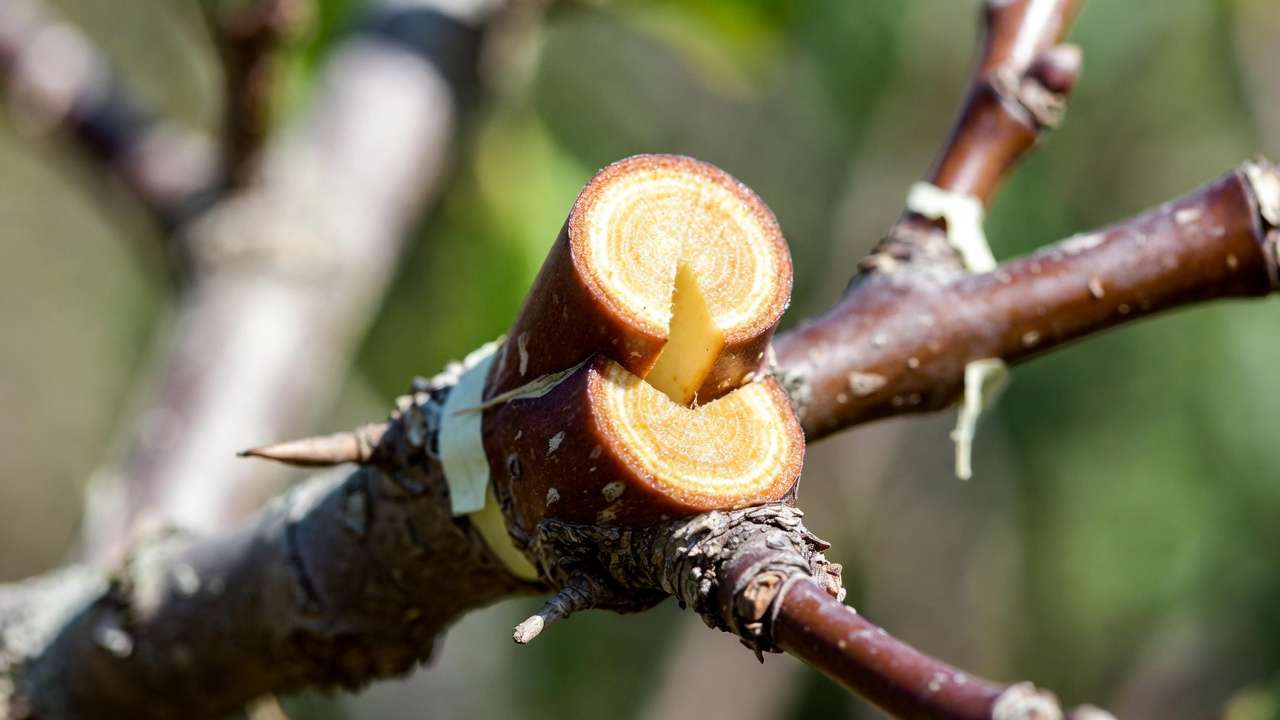
The whip-and-tongue (also simply called “whip graft” or “tongue graft”) is the gold-standard bench graft for many fruit growers when maximum union strength and rapid growth are priorities.
How Whip-and-Tongue Works – Step-by-Step
- Select matching wood — Scion and rootstock should be roughly the same diameter (pencil-thick is ideal). Both must be fully dormant.
- Make the long cut — Cut both pieces at a long, matching 30–45° angle (about 3–5 cm long).
- Cut the tongues — About one-third from the tip, slice downward on the scion and upward on the rootstock to create interlocking “tongues” that slide together like puzzle pieces.
- Join and align — Push together so cambiums align on at least one side (ideally both). The tongues lock everything in place.
- Bind securely — Wrap tightly with grafting tape or parafilm from bottom to top. Cover the entire union and top cut with grafting wax or sealant.
- Store or plant — Keep in cool, humid conditions (callusing room or moist peat/sawdust) until growth begins, or plant directly in pots/field.
Ideal Timing
Late winter to early spring — before buds swell but after the danger of deep freezes passes. In many regions this is January–March. Indoor bench grafting gives perfect temperature and humidity control. ❄️➡️🌱
Standout Advantages of Whip-and-Tongue
- Superior mechanical strength — the interlocking tongues create compression and resist breakage even under heavy fruit loads or wind
- Maximum cambium contact → very high success rates (90–98% on apples/pears with good matches)
- Rapid shoot growth — scions often push vigorous shoots in the first season
- Long-term durability — unions remain solid for decades
- Excellent for top-working mature trees and field grafting
Main Limitations
- Consumes more scion wood (usually 15–20 cm per graft)
- Requires near-perfect diameter match for best results
- Timing is stricter (dormant season only)
- More cuts = higher chance of error for beginners
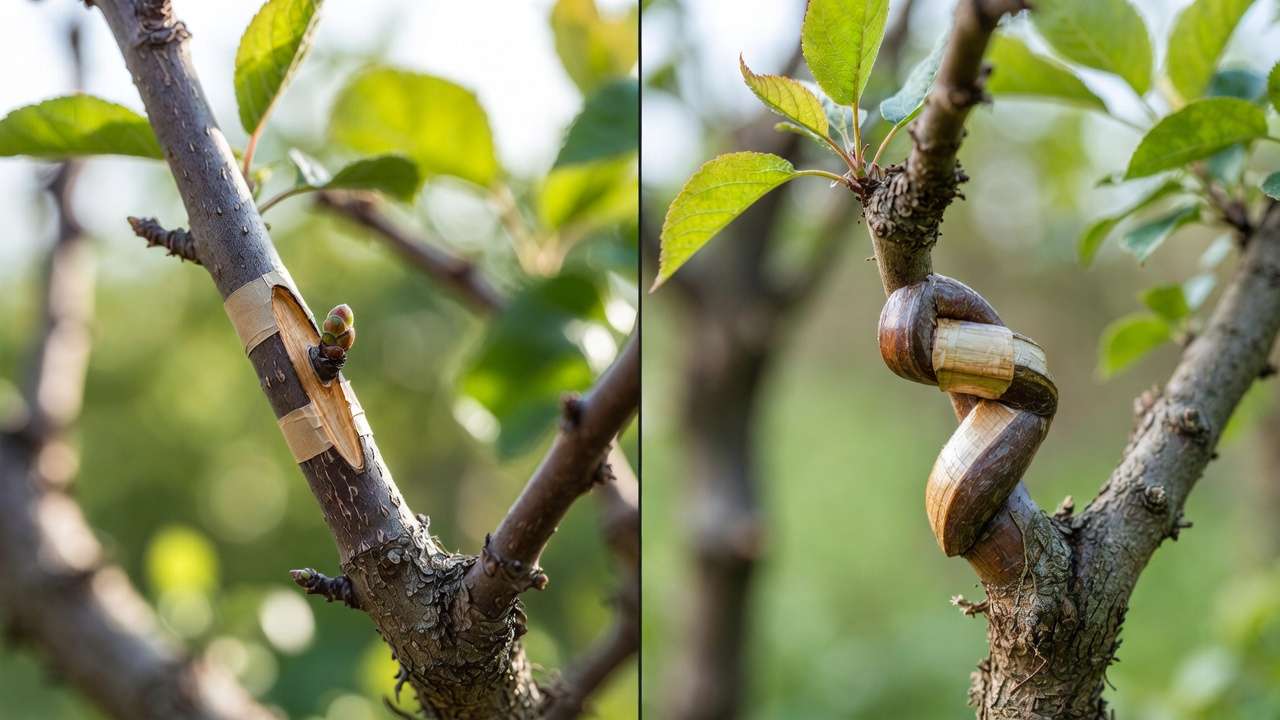
Head-to-Head Comparison: Chip Budding vs. Whip-and-Tongue Graft ⚔️
To make your decision easier, here’s a detailed side-by-side breakdown based on university extension resources (like those from UKY, MSU, UNH, and Cornell), commercial nursery practices, and grower forums with thousands of real propagations reported. Success rates vary by species, timing, skill, and conditions — but patterns emerge clearly for apples, pears, stone fruits, and more.
| Aspect | Chip Budding | Whip-and-Tongue Graft | Winner? (For Most Home Growers) 🤔 |
|---|---|---|---|
| Scion Material Required | Minimal — 1 bud + small chip per graft (10–25+ grafts from one 30 cm branch) | More — 15–25 cm shoot with multiple buds (1–4 grafts per branch) | Chip Budding 🌟 (saves rare varieties!) |
| Timing Flexibility | High: Late summer/early fall (Aug–Oct) or dormant (late winter/early spring) | Strict: Dormant season only (late winter–early spring, before bud swell) | Chip Budding 🌟 (great for Khulna’s warm winters & monsoon timing) |
| Skill Level Needed | Moderate to high (precise cambium matching, sharp cuts) | High (matching diameters, accurate tongues) | Slight edge to Chip for beginners once practiced |
| Typical Success Rate | 80–95%+ with good technique (higher on apples/pears in late summer) | 90–98% on compatible species like apples/pears (often tops charts) | Whip-and-Tongue 🌟 (mechanical lock helps) |
| Union Strength (Long-Term) | Very strong & uniform; straighter growth, excellent for 15+ years | Exceptionally strong due to interlocking tongues & compression | Whip-and-Tongue 🌟 (preferred for top-working mature trees) |
| Initial Growth Speed | Slower start — bud often dormant until next spring | Faster — vigorous shoots often in first season | Whip-and-Tongue 🌟 |
| Best For | Limited scion wood, high-volume propagation, flexible seasons, nurseries | Maximum strength, quick establishment, home orchards wanting fast fruiting | Depends on your needs! |
| Common Species | Apples, pears, plums, peaches, cherries, citrus, figs | Apples, pears (best), some stone fruits | Tie — both excel on pome fruits 🍎🍐 |
From extension guides (e.g., Wisconsin Fruit Program notes chip budding’s stronger long-term unions and straighter growth vs. T-budding) and grower reports (e.g., 90%+ on whip-and-tongue for equal-diameter matches), whip-and-tongue often edges out for reliability in apples/pears. But chip budding wins big when scion is scarce or timing is off — a lifesaver in subtropical areas like Khulna where dormant windows can be short and humid.
Which Method Should You Choose for Your Fruit Trees? Decision Guide 🧭
- Go with Chip Budding if:
- You have limited scion wood from a prized heirloom or rare variety (e.g., a special mango, jackfruit, or guava cutting from a neighbor).
- You’re propagating in late summer/fall to beat early monsoons or use active-season callusing.
- You want to make dozens of trees efficiently (nurseries’ favorite for this reason).
- You’re okay with waiting until next spring for visible growth — patience pays off with uniform, straight trees. Perfect for: Apples, pears, stone fruits, citrus in warmer zones like Bangladesh. 🍊
- Go with Whip-and-Tongue if:
- You prioritize rock-solid unions that withstand wind, heavy crops, or storms for 15–30+ years.
- You want faster results — strong shoots and earlier fruiting potential.
- You have matching-diameter dormant wood and can graft indoors during cool months.
- You’re top-working older trees or building a multi-variety “fruit salad” tree. Ideal for: Home orchards focused on apples, pears; many growers call it the “gold standard” for strength.
Expert Hybrid Tip — Many serious propagators use both! Chip bud in late summer for bulk new trees, then whip-and-tongue in spring for high-value repairs or vigorous starters. In Khulna’s climate (warm winters, humid summers), try chip budding August–September for best callusing before cooler slowdowns. 🌡️
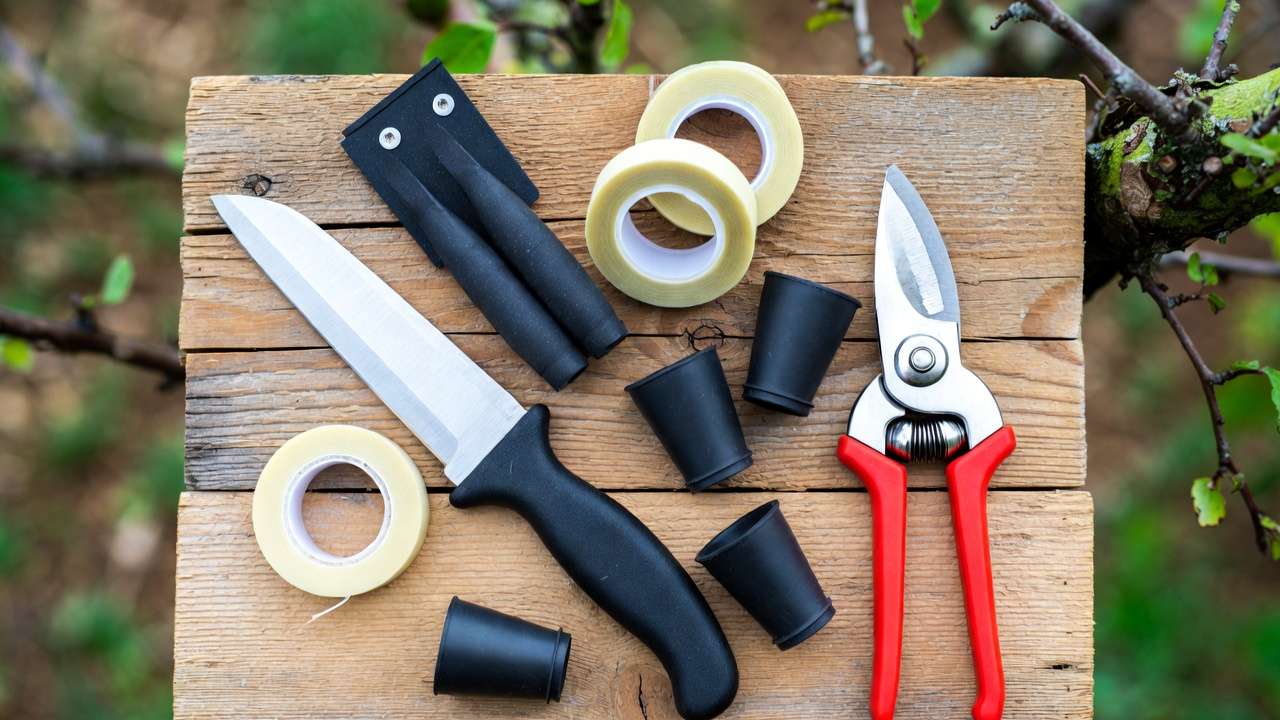
Essential Tools and Materials for Success 🛠️✨
No matter the method, quality tools boost take rates dramatically:
- Sharp grafting knife — Fixed-blade like Victorinox or Felco (razor edge is non-negotiable!).
- Grafting tape/parafilm/budding rubbers — Parafilm seals moisture perfectly; budding rubbers auto-degrade.
- Pruning shears & labels — Sharp bypass shears for clean cuts; waterproof tags to track varieties.
- Grafting wax or sealant — For whip-and-tongue tops to prevent drying.
- Sterilizing solution — Rubbing alcohol or bleach dip between cuts to avoid disease spread.
- Storage bags & moist medium — For scion wood (fridge at 0–4°C with damp paper).
Pro tip: Practice cuts on scrap branches first — muscle memory saves precious scions! 🔪
Common Mistakes to Avoid (and Fixes) ❌➡️✅
Even experts slip up — here are the top pitfalls:
- Misaligned cambium → Failure #1. Fix: Use magnification if needed; practice alignment.
- Dull knife → Tears tissue, invites infection. Fix: Hone or replace regularly.
- Drying out → Deadly in Khulna’s heat/humidity swings. Fix: Wrap immediately; use humid callusing box.
- Wrong timing → Buds push too soon or freeze. Fix: Follow local phenology — watch mango/lychee flowering cues.
- Over-tight wrapping → Girdles the union. Fix: Snug but not strangling; check in 4–6 weeks.
Avoid these, and your success jumps 20–30% easily.
Aftercare Tips for Maximum Take Rates & Healthy Trees 💚🌱
- Protect the graft — Shade cloth or paper bags against sun; windbreaks in open areas.
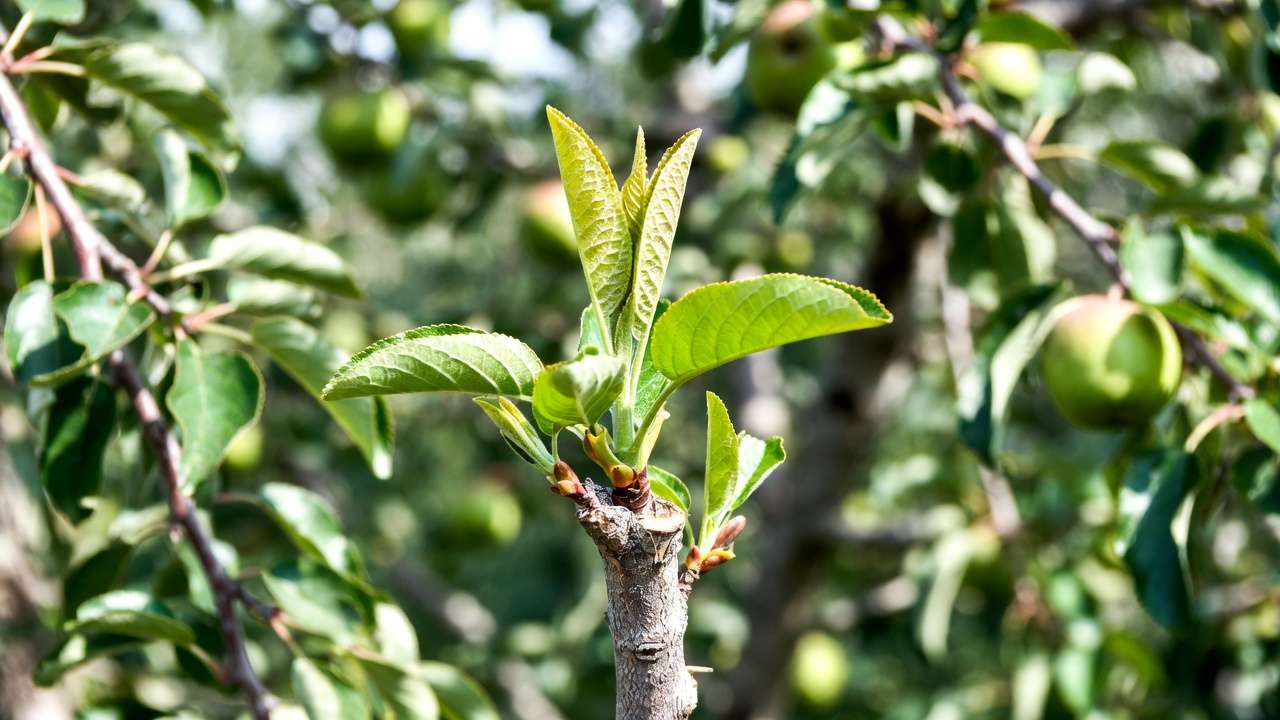
- Monitor healing — 4–8 weeks for callus; green under tape = success!
- Remove restraints — Carefully cut tape/rubber once union is solid (usually 6–12 months).
- Water & fertilize wisely — Consistent moisture (not soggy); light balanced feed after growth starts.
- Pest/disease watch — Aphids love new shoots — neem or insecticidal soap early.
- Winter protection — In cooler Khulna nights, mulch base; no heavy frost worry usually.
With good aftercare, even 80% takes become thriving trees.
Real-World Examples and Case Studies from Growers 🌍🍎
- Apple home orchard (USA Northeast) — Whip-and-tongue on semi-dwarf rootstocks produced vigorous, fruiting trees in 3 years; unions held under 20+ kg crop loads.
- Rare pear variety (limited scion) — Chip budding yielded 18 trees from one branch; all uniform and straight-growing after 2 seasons.
- Subtropical stone fruits (similar to Bangladesh) — Late-summer chip budding on peaches/plums avoided dormant-season risks; 90%+ takes reported.
- Top-working old mango tree — Whip-and-tongue on thicker branches for strength; chip on thinner shoots for variety addition.
Growers consistently report: Whip for speed/strength, chip for efficiency/flexibility.
Frequently Asked Questions (FAQs) ❓
Q: Which has better long-term strength for 15+ year-old apple trees? A: Whip-and-tongue usually wins — interlocking design resists breakage better under load (per grower forums & extension notes). Chip unions are very strong too, especially vs. older T-bud methods.
Q: Can beginners succeed? A: Absolutely! Start with chip budding (fewer complex cuts), practice on willow/poplar, then graduate to whip-and-tongue. Many get 70%+ on first tries with sharp tools.
Q: Best for pears, apples, or stone fruits in warm climates? A: Both work great on pome fruits (apples/pears). Chip budding shines for stone fruits & flexibility in places like Khulna.
Q: How many trees from limited scion? A: Chip: 10–25+; Whip-and-tongue: 1–4. Big difference!
Q: Any Khulna-specific advice? A: Chip bud in Aug–Sep for monsoon callusing; store scions cool/humid. Avoid peak rainy season grafting outdoors.
Final Thoughts: Build Your Ultimate Fruit Tree Toolkit! 🌳🍐
Mastering chip budding vs. whip-and-tongue graft unlocks endless possibilities — from preserving local heirlooms to creating a diverse backyard orchard bursting with mangoes, guavas, apples, pears, and more.
Neither is “better” universally — it’s about matching the method to your scion, season, and goals. Experiment with both (start small!), track your results, and watch your success soar. Propagation is part art, part science, and 100% rewarding.
Ready to graft? Which method are you trying first? Drop your questions or successes in the comments — happy propagating.✂️🌱🍎











