
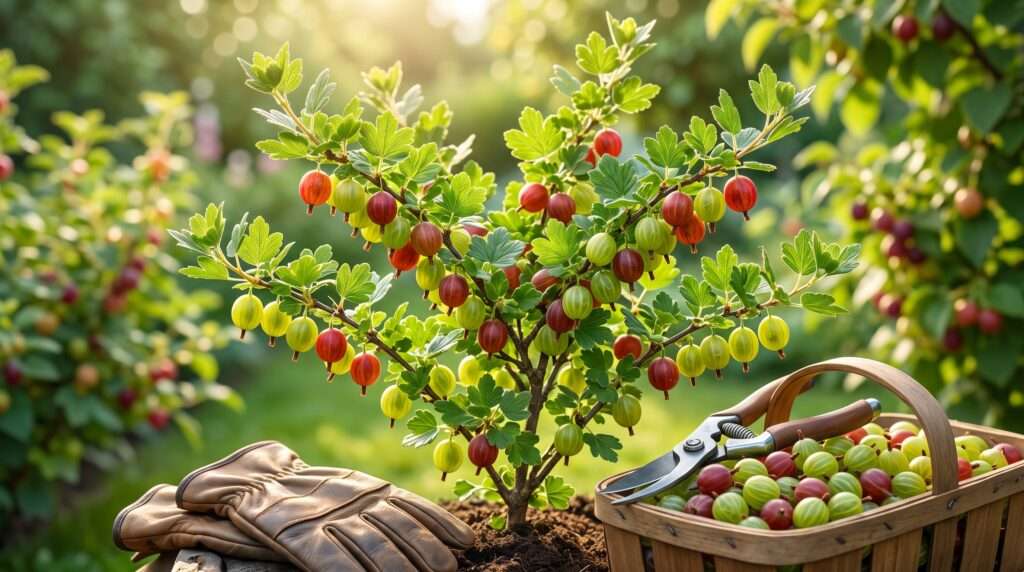
Gooseberries are the forgotten jewels of the summer garden—delightfully tart, incredibly versatile, and perfect for jams, jellies, and fresh snacking. Yet, many enthusiastic home gardeners abandon them after just a few seasons. Why? Because they find themselves battling out-of-control thorny branches, sudden defoliation from pests, or crop-ruining fungal infections.
Growing these delicious berries doesn’t have to be a battle. By mastering a few specific techniques, you can easily transform a tangled, disease-prone bush into a heavy-yielding garden centerpiece. In this comprehensive guide, we will uncover exactly how to care for a gooseberry plant from soil preparation all the way to harvest.
We will dive deep into the “open goblet” pruning secret that guarantees better airflow, fewer diseases, and baskets full of sweet-tart berries. Whether you are a beginner or a seasoned orchardist looking to improve your yield, you’ll find everything you need here. Ready to grow the best fruit on the block? Let’s dig in! 🥧✨
Why Proper Care Makes or Breaks Your Gooseberry Plant 🌱
To truly master gooseberry plant care, you have to understand how this unique shrub operates. Unlike some fruiting bushes that produce berries on brand-new green growth, gooseberries (part of the Ribes genus) primarily fruit on older wood—specifically 2- to 3-year-old branches. Wood that is four years or older becomes woody, weak, and significantly less productive.
This fruiting habit means that passive gardening won’t work. If you simply plant a gooseberry bush and leave it alone, it will quickly become a dense, impenetrable thicket of old, non-producing wood.
Furthermore, the golden rule of gooseberry cultivation is managing sunlight and airflow. Gooseberries are notoriously susceptible to powdery mildew, a fungal disease that thrives in stagnant, humid environments. Proper care isn’t just about watering and feeding the plant; it’s about actively managing its shape to ensure every leaf and branch has room to breathe. Proper pruning and spacing are the absolute best organic defenses against disease!
Choosing the Right Variety: American vs. European Gooseberries 🌎
Before you even touch a trowel, choosing the correct cultivar sets the foundation for your success. Gooseberries are broadly divided into two main categories, each with distinct advantages and challenges.

American Gooseberries (The Hardy Survivors) 🇺🇸
Native to North America (Ribes hirtellum), these varieties are exceptionally cold-hardy, vigorous, and naturally resistant to devastating diseases like powdery mildew and white pine blister rust.
-
Pros: Highly disease-resistant, easier for beginners, excellent cold tolerance.
-
Cons: The fruit is generally smaller than European types.
-
Top Picks:
-
Pixwell: Features fewer thorns and produces lovely pinkish berries.
-
Poorman: Widely considered the best-tasting American variety, yielding highly sweet, red fruit on vigorous bushes.
-
European Gooseberries (The Flavor Kings) 🌍
Originating in Europe (Ribes uva-crispa), these are the traditional gooseberries prized by chefs and bakers. They produce large, plump, incredibly flavorful berries that range in color from translucent green to deep ruby red.
-
Pros: Larger fruit, superior complex flavors, highly prized for culinary uses.
-
Cons: Generally more susceptible to powdery mildew and leaf spot.
-
Top Picks:
-
Invicta: A heavy-yielding green variety that boasts surprisingly good mildew resistance for a European type.
-
Top Mildew-Resistant Cultivars to Plant 🏆
If you want the best of both worlds—European flavor with American-style disease resistance—look for modern hybrid cultivars. Expert growers highly recommend the Finnish “Hinnomaki” line.
💡 Expert Tip: Check your local agricultural regulations before planting. In parts of the US (like Maine and North Carolina), planting Ribes species is restricted due to white pine blister rust, a disease that uses gooseberries as an alternate host before attacking white pine trees.
Planting Your Gooseberry Bush for a Strong Start 🪴
A well-planted gooseberry bush can produce heavy crops for 15 to 20 years, so taking the time to prepare the site is an investment that pays massive dividends.
Sunlight and Soil Requirements ☀️
-
Sunlight: Here is a surprising fact—gooseberries are one of the rare fruiting shrubs that can actually tolerate, and sometimes prefer, partial shade! While they fruit best in full sun in cooler northern climates, gardeners in warmer zones (USDA zones 6 and above) should plant them where they receive morning sun and afternoon shade to prevent the leaves from scorching.
-
Soil: They prefer a slightly acidic soil pH between 6.0 and 6.8. The soil must be well-draining but moisture-retentive. Heavy clay soils that waterlog in winter will cause root rot, while overly sandy soils will dry out too fast. Amend your planting site heavily with rich organic matter, such as aged manure or high-quality compost, to create a loamy texture.
When and How to Plant Bare-Root vs. Potted 🌱
Gooseberries break dormancy incredibly early in the spring—often while frost is still on the ground.
-
Timing: The best time to plant is in late autumn or very early spring.
-
The Process:
-
Dig a hole twice as wide as the root ball but only just as deep.
-
If planting a bare-root plant, soak the roots in a bucket of water for 2 hours prior to planting.
-
Place the bush in the hole, ensuring the previous soil mark on the stem is level with your garden soil.
-
Backfill with a mix of native soil and compost, firming it down gently to remove air pockets. Water deeply immediately after planting.
-
-
Spacing Rules: Space your bushes 4 to 5 feet apart. It might look like too much space when the plants are small, but once they mature, this gap is strictly necessary to allow wind to blow between the bushes, drying the leaves and preventing fungal spores from taking hold.
The Ultimate Gooseberry Pruning Guide (The “Secret” to Success) ✂️
If there is one section of this guide you memorize, make it this one. Pruning is the absolute most critical aspect of gooseberry plant care. Without it, your plant will become a tangled, unproductive, disease-ridden mess. With it, you’ll enjoy heavy yields of massive, easy-to-pick berries.

The Goal: Achieving the “Open Goblet” Shape 🍷
When pruning a gooseberry bush, your goal is to create an “open goblet” or “open center” shape. Imagine a wine glass on a short stem. The center of the bush should be completely hollow, with 6 to 8 strong main branches radiating outward in a circle.
Why is this shape so important?
-
Air Circulation: A hollow center allows wind to blow right through the bush, drying out wet leaves rapidly and denying fungal spores (like powdery mildew) the humid environment they need to germinate.
-
Sunlight Penetration: Sunlight can reach the inner branches, encouraging fruit ripening and sweeter berries.
-
Painless Harvesting: An open center means you can reach into the bush to harvest berries without getting your arms shredded by thorns!
Winter Pruning (The Heavy Lifting) ❄️
Winter is when you establish the structure of the bush. Perform this pruning in late winter or early spring (February or March), while the plant is still fully dormant but the worst of the deep winter freezes have passed.
The 4-Year Rule: Remember that gooseberries fruit best on 2- and 3-year-old wood. Branches that are 4 years or older become dark, thick, woody, and highly unproductive.
-
Step 1: Identify any wood that is 4 years old (it will be the thickest, darkest wood with peeling bark). Cut it completely away at the base of the plant.
-
Step 2: Remove any dead, diseased, or broken branches.
-
Step 3: Cut away any low-hanging branches that are touching or close to the ground. Fruit on these branches will rot or be eaten by pests.
-
Step 4: Thin out the center. Remove any branches that are crossing over each other or growing inward toward the center of the bush.
Leave behind a balanced mix of 1-year, 2-year, and 3-year-old branches—aiming for about 6 to 8 strong canes in total. Trim the tips of the remaining branches by about one-third to encourage healthy branching in the spring.
Summer Pruning (The Yield Booster) ☀️
While winter pruning handles the structure, summer pruning controls the wild, leafy growth and redirects the plant’s energy into ripening the fruit.
Perform summer pruning around mid-June to early July, just as the berries are swelling.
-
The Technique (“Spur Pruning”): Look at the new, soft green growth coming off the main structural branches. Snip all of these new side shoots back so that only 5 leaves remain on each shoot.
-
The Result: By stopping the plant from pushing endless green leaves, the plant channels its sugars straight into the developing berries. Furthermore, this clears away excess foliage, exposing the fruit to the sun to ripen perfectly!
Essential Gooseberry Plant Care Throughout the Year 🗓️
Beyond the pruning shears, your gooseberry plant needs a consistent routine to truly thrive. Fortunately, they are relatively low-maintenance once established.
Watering Rules to Prevent Split Fruit 💧
Gooseberries have a shallow root system, meaning they are highly sensitive to drought. However, irregular watering is actually more dangerous than no watering at all.
If a gooseberry bush is allowed to dry out completely, the skin of the developing berries hardens. If you then suddenly drench the plant (or a heavy rainstorm hits), the plant sucks up the water, the fruit swells rapidly, and the hardened skins burst open! Split fruit is immediately ruined and attracts wasps and rot.
-
The Rule: Provide a consistent 1 inch of water per week.
-
The Method: Always water at the base of the plant (using a drip line or soaker hose). Never use overhead sprinklers, as constantly wet leaves are an open invitation to powdery mildew and leaf spot.
Feeding and Mulching (Why Potash is Your Best Friend) 🍂
Many gardeners make the mistake of hitting their fruit bushes with high-nitrogen, general-purpose fertilizers. For a gooseberry bush, too much nitrogen causes an explosion of weak, sappy, leafy growth that attracts aphids and mildew while reducing fruit production.
-
Fertilizing: Gooseberries are hungry for Potassium (often sold as Sulphate of Potash). Potassium strengthens the plant’s cell walls (boosting disease resistance) and drastically improves the size and flavor of the fruit. Apply a handful of Sulphate of Potash around the drip line of the bush in late winter just before the plant breaks dormancy.
-
Mulching: To protect those shallow roots and retain soil moisture, apply a thick 2- to 3-inch layer of organic mulch (like compost, leaf mold, or wood chips) every spring. Crucial Warning: Keep the mulch pulled a few inches away from the actual trunk of the bush to prevent collar rot.

Beating Pests and Diseases (Keeping Your Harvest Safe) 🛡️
Even with perfect care, nature happens. Being proactive is the best way to protect your harvest.
Preventing and Treating Powdery Mildew 🍄
Powdery mildew looks exactly like it sounds—a white, dusty powder coating the leaves, stems, and eventually the fruit itself, rendering it inedible.
-
Prevention: The “open goblet” pruning method is your #1 defense. Ensure adequate spacing and only plant mildew-resistant varieties if you live in a humid climate.
-
Treatment: If you spot mildew, act fast. You can spray organic fungicidal soaps or a homemade mixture of 1 tablespoon baking soda, 1 teaspoon dormant oil, and 1 gallon of water. Spray in the early morning so the leaves dry quickly.
The Dreaded Gooseberry Sawfly 🐛
This is the single most destructive pest to a gooseberry plant. The adult sawfly lays eggs on the underside of leaves low down in the center of the bush. When they hatch, the pale green caterpillars with black spots are ravenous. They can strip an entire bush down to the bare stems in just 3 to 4 days!
-
The Fix: Vigilance is key. Starting in mid-spring, lift the lower branches and inspect the inner leaves weekly. If you see the larvae, you can hand-pick them (they are harmless to humans) or spray an organic biological control like Bt (Bacillus thuringiensis), which targets caterpillars specifically without harming beneficial pollinators.

Protecting Your Crop from Birds 🐦
Birds love ripe gooseberries just as much as we do. As soon as the berries begin to take on color and soften, it’s a race against the local avian population.
-
The Solution: Throwing a bird net over the bush is the most effective method. Ensure the net is pulled tight and pegged to the ground so birds don’t get trapped underneath it.
Harvesting Your Bountiful Crop 🧺
You’ve pruned, watered, and protected your plant all year. Now comes the reward!
When to Pick (For Cooking vs. Fresh Eating) 🥧
Unlike many fruits, gooseberries give you two distinct harvesting windows depending on what you want to do with them.
-
Early Summer (For Cooking): In June, the berries will be full-sized, firm, and green. They are extremely tart at this stage. This is the perfect time to harvest if you are making jams, pies, or tarts, as the high natural pectin content helps jams set beautifully. (Bonus: thinning out every other berry now allows the remaining fruit to grow even larger!)
-
Mid-to-Late Summer (For Fresh Eating): Leave the remaining berries on the bush for another 3 to 4 weeks. They will soften, swell, and change color (depending on the variety, to translucent yellow, pink, or deep red). These are bursting with complex, sweet-tart flavor and are perfect for eating right out of hand.
The “Tongs and Gloves” Harvesting Trick 🧤
Let’s address the elephant in the room: the thorns. American gooseberries, in particular, possess vicious spikes that can make harvesting a painful chore.
-
Expert Insight: Ditch the gentle approach. Wear a long-sleeved canvas shirt and thick leather gardening gloves. Bring a pair of kitchen tongs out to the garden. Use the tongs to firmly grab a branch and pull it upward and outward. This exposes the underside of the branch where the berries hang clustered together, allowing your gloved hand to strip them off safely and quickly!

Expert FAQs About Gooseberry Plant Care ❓
Can gooseberries grow in pots? Absolutely! Because they have shallow roots, they perform wonderfully in large containers. Choose a pot that is at least 18-24 inches in diameter. Use a high-quality soil mix, ensure the pot has excellent drainage, and be prepared to water them more frequently than in-ground plants. Hinnomaki varieties are particularly good for container growing.
Why is my gooseberry plant not fruiting? The most common reasons are:
-
Lack of pruning: The bush is choked with old wood (remember, wood over 4 years old barely produces).
-
Frost damage: Because they flower so early in spring, a late, hard frost can kill the blossoms before they pollinate. If a late frost is forecasted, throw a horticultural fleece over the bush overnight.
-
White Pine Blister Rust: If planted near a white pine tree, the disease can stunt the plant entirely.
How long does a gooseberry bush live? With proper annual pruning to encourage new replacement canes, a healthy gooseberry bush can produce heavy fruit crops for 15 to 20 years.
💡 Conclusion
Learning how to care for a gooseberry plant doesn’t require a degree in horticulture—it just requires a little bit of structural discipline. By committing to the “open goblet” pruning shape, providing a steady supply of moisture, and feeding your soil with potassium, you will bypass the heartbreak of powdery mildew and sawfly invasions.
Whether you are dreaming of traditional English gooseberry fools, tart summer pies, or just a sweet snack straight from the garden, these tough, rewarding plants deserve a spot in your landscape.
So grab your leather gloves, sharpen those pruning shears, and get ready for the most bountiful harvest of your gardening journey!
Have you ever grown gooseberries before? Do you prefer them tart for baking or sweet for snacking? Share your experiences and your favorite gooseberry recipes in the comments below! 👇











