
Have you ever watched your favorite Monstera stretch desperately toward the window, developing those long, leggy stems with tiny leaves? 😔 Or noticed your once-vibrant fiddle leaf fig dropping leaves like confetti, leaving you wondering what went wrong? The harsh truth is that improper lighting is the #1 reason most indoor plants struggle or fail — far more than watering mistakes or poor soil.
In my years of caring for (and rescuing!) thousands of houseplants, I’ve seen the same pattern repeat: enthusiastic plant parents provide love, fertilizer, and humidity… but forget that light is literally the food plants need for photosynthesis. Without the right amount, quality, and duration of light, your green friends can’t produce energy, leading to weak growth, pest problems, and disappointment.
The good news? You can fix this — and prevent it entirely — by creating a personalized plant lighting plan. This comprehensive guide walks you through every step, from assessing your home’s natural light to choosing grow lights and optimizing setups for year-round thriving. By the end, you’ll have the tools to transform your space into a lush, healthy indoor jungle. 🌱💚
Let’s dive in and give your plants the light they deserve!
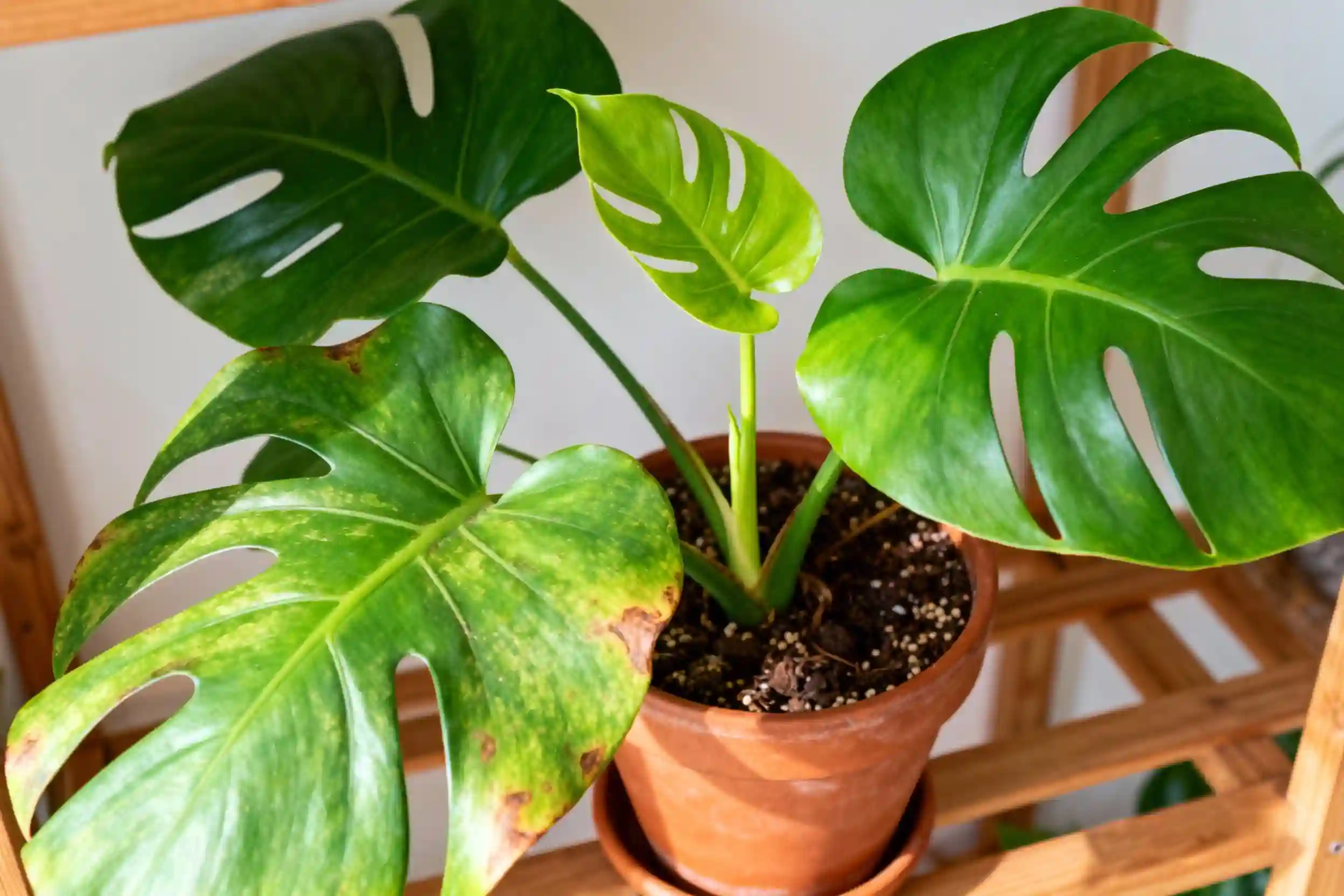
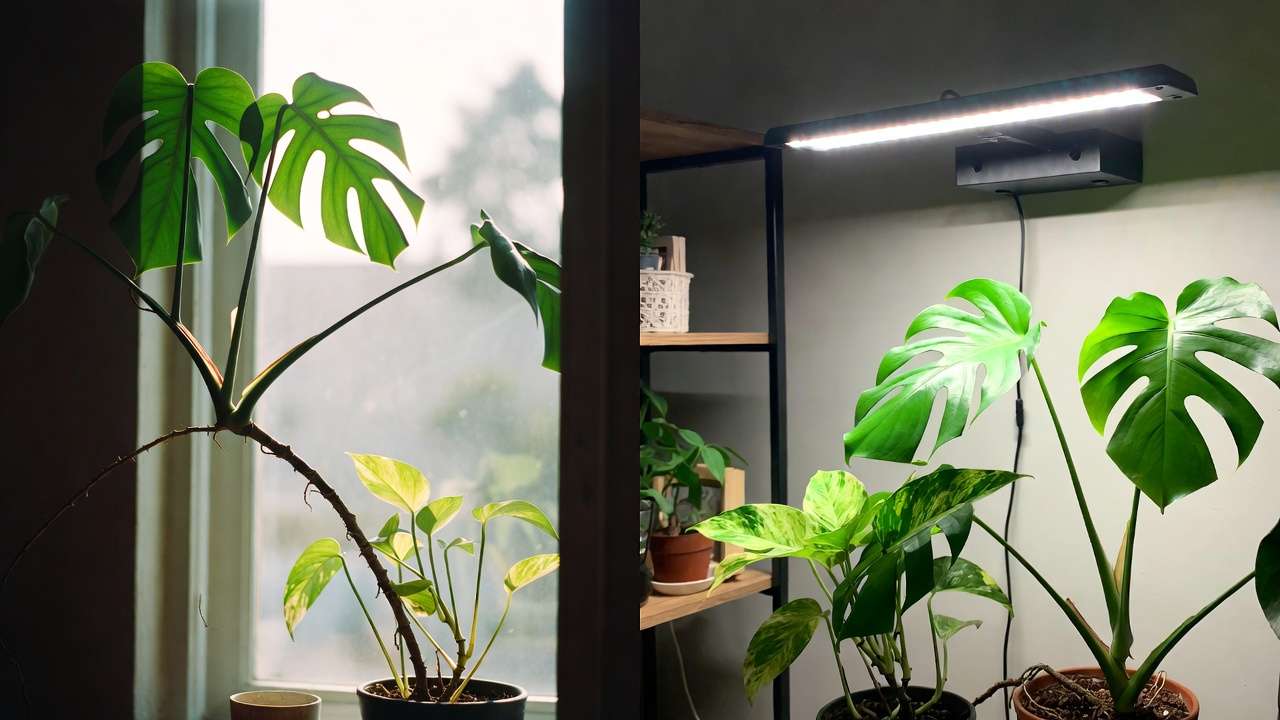
Image: A striking before-and-after of a Monstera: leggy and stretched on one side, compact and vibrant under proper lighting on the other.
Understanding Indoor Plant Lighting Basics 🌤️
To create an effective lighting plan, you first need to understand what plants actually “see” and use.
Why Plants Need the Right Light (Photosynthesis 101) Plants convert light energy into sugars through photosynthesis — it’s their version of eating! The key metrics are:
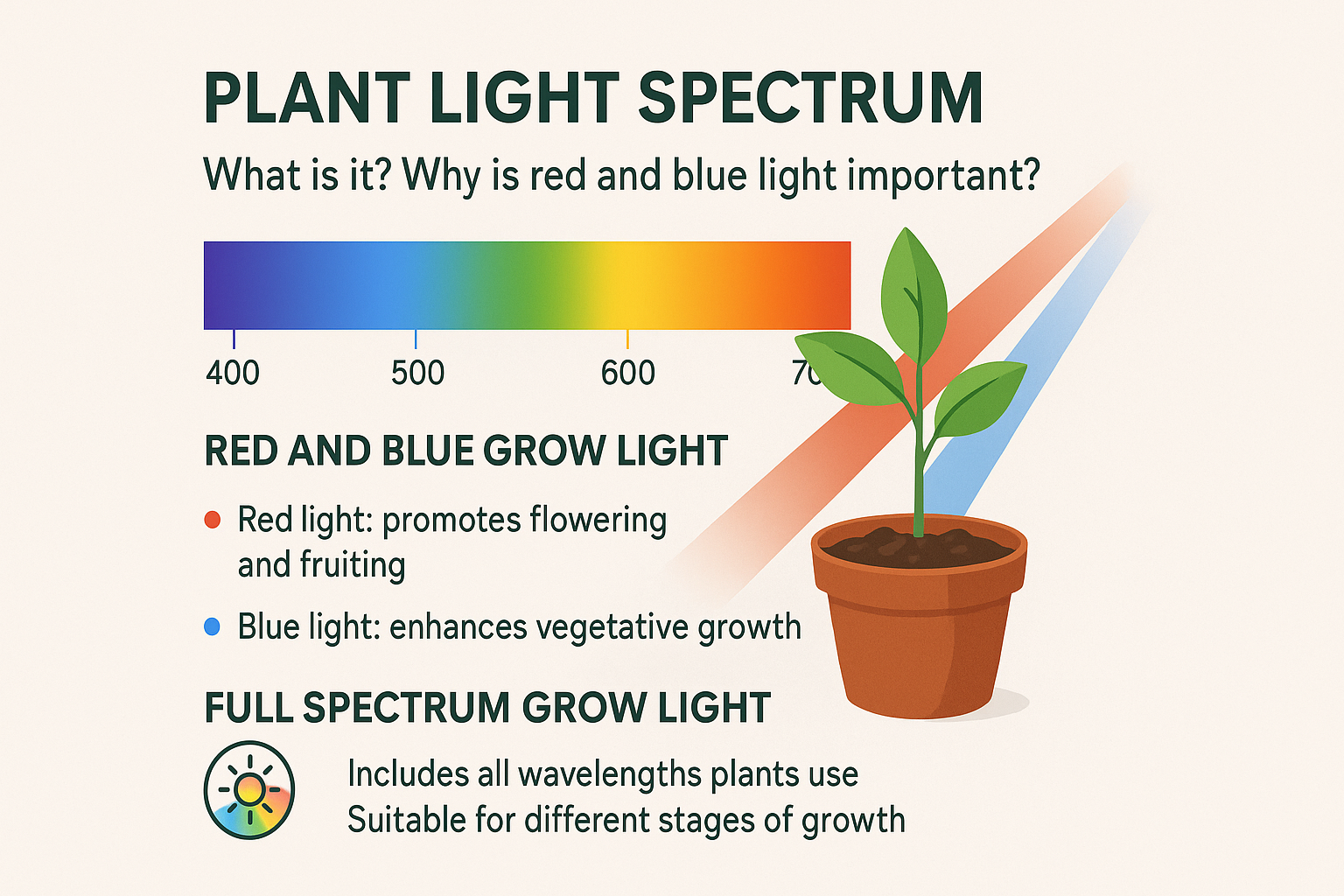
- PAR (Photosynthetically Active Radiation): The usable light wavelengths (400–700 nm).
- PPFD (Photosynthetic Photon Flux Density): Measures light intensity hitting the leaves (μmol/m²/s).
- DLI (Daily Light Integral): Total light over a day (mol/m²/day) — think of it as a plant’s “daily calorie intake.”
Most houseplants thrive with 100–500 PPFD for 10–14 hours, but needs vary wildly.
Natural vs. Artificial Light: What’s Realistic Indoors? Indoors, natural light drops dramatically:
- Bright direct sun near a south-facing window: 500–2000+ PPFD.
- Bright indirect (a few feet from window): 200–500 PPFD.
- Medium/low (north-facing or far from windows): <100 PPFD.
In places like apartments or northern climates (or during winter), natural light often falls short — that’s where supplemental grow lights become game-changers.
Light Quality, Intensity, Duration, and Distance
- Quality/Spectrum: Full-spectrum (mimicking sunlight) is best. Blue wavelengths promote compact foliage; red boosts flowering.
- Intensity: Too low = leggy growth; too high = leaf burn.
- Duration: 12–16 hours/day for most foliage plants.
- Distance: Closer = brighter but hotter — LEDs run cool, so 6–24 inches is common.
Image: Infographic showing the plant light spectrum with emphasis on blue for vegetative growth and red for flowering.
Step 1: Assess Your Current Indoor Light Conditions 🏠🔍
Before adding anything, map what you already have.
How to Measure Light in Your Home (Tools & Free Methods)
- Free: Use a smartphone light meter app (e.g., “Photone” or “Light Meter”). Place phone at plant height, facing up.
- Pro: Affordable PAR meter (~$50–150) for precise PPFD readings.
- Quick test: Hold your hand in the spot — if shadow is sharp, it’s bright; fuzzy = medium/low.
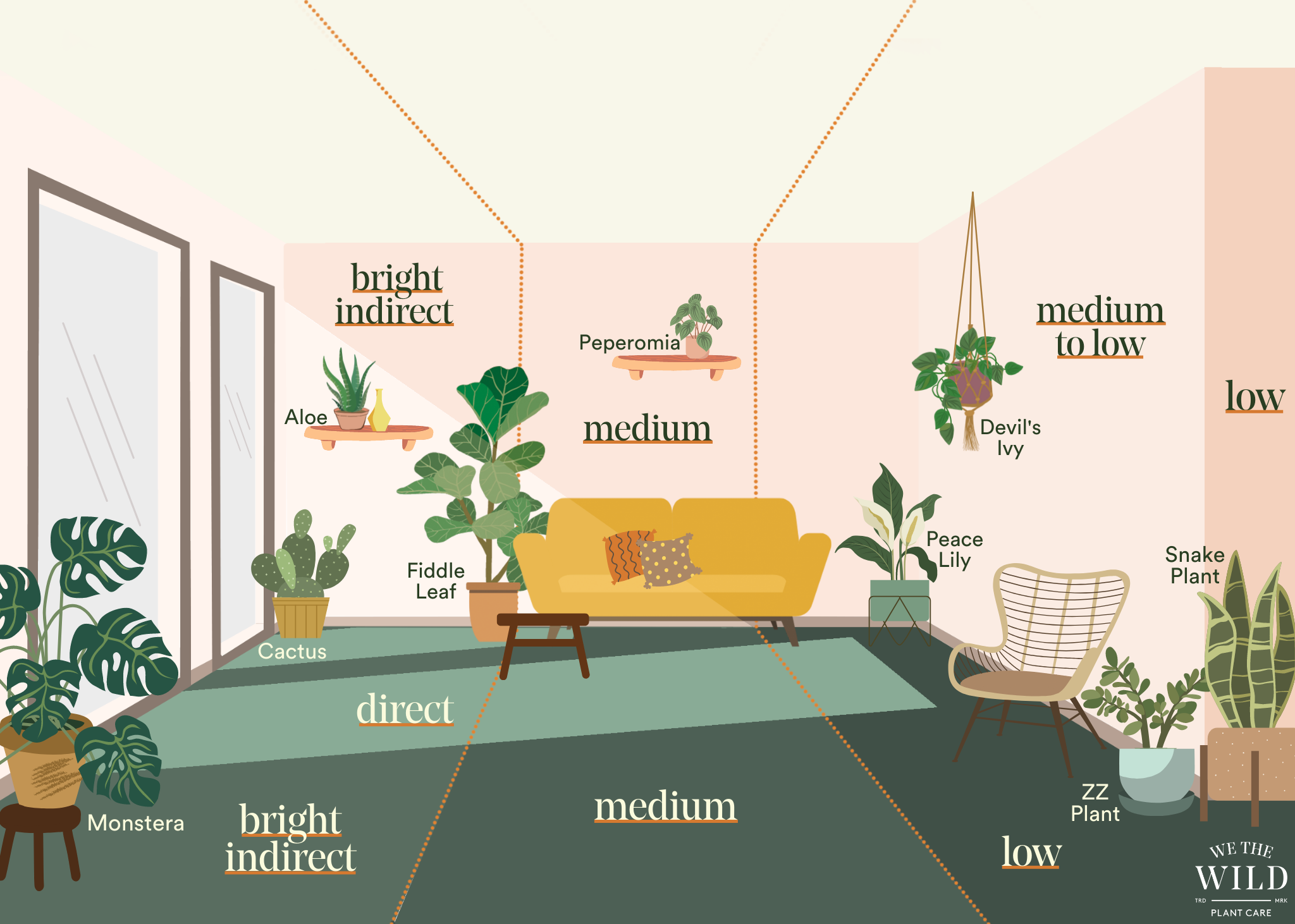
Identify Your Light Zones (Low, Medium, Bright Indirect, Direct) Observe over a day:
- Direct sun: Harsh midday beams (great for succulents).
- Bright indirect: Well-lit but no direct rays (ideal for most tropicals).
- Medium: A few feet from window.
- Low: Corners, north-facing, or shaded areas.
Checklist:
- ☑ Walk room-by-room at 10 AM and 3 PM.
- ☑ Note window direction (south = brightest in Northern Hemisphere).
- ☑ Mark seasonal changes (winter light drops 50%+).
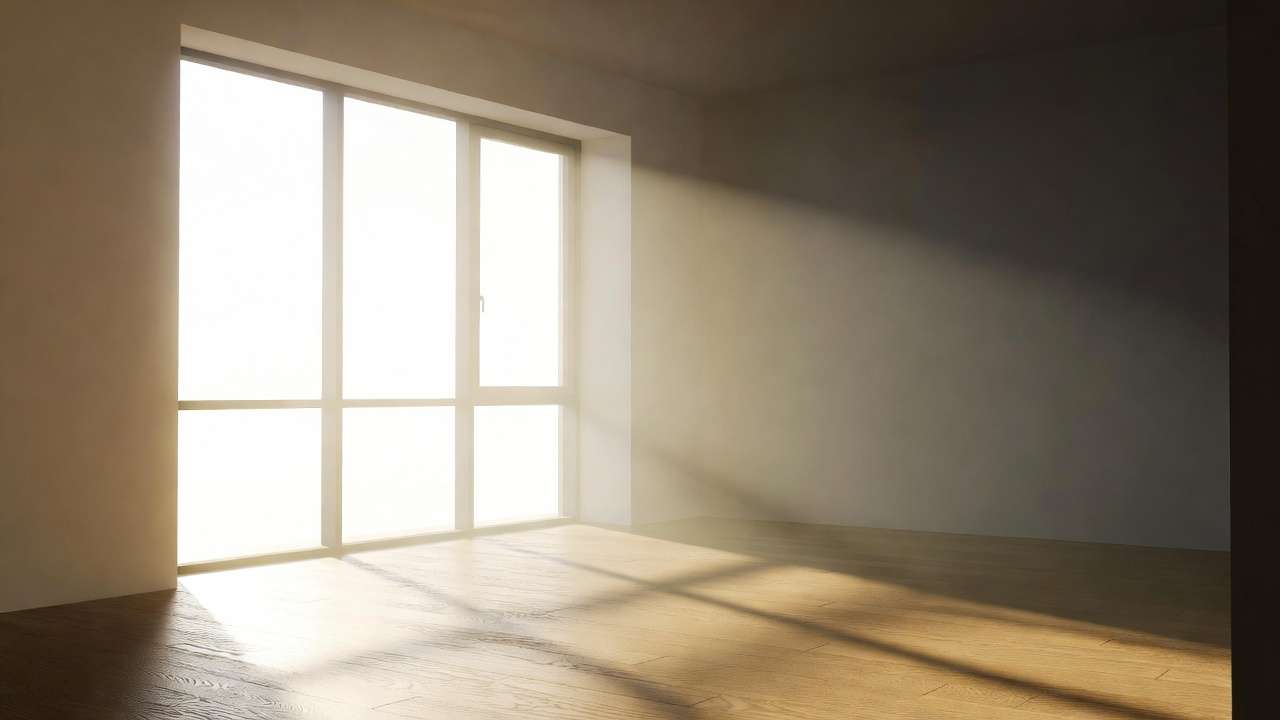
Image: Illustrated home layout diagram showing labeled light zones near windows.
Step 2: Match Plants to Their Ideal Light Requirements 🌱📊
Now that you’ve mapped your home’s light zones, the next critical step is pairing each plant with the lighting level it actually prefers. Mismatching here is the second most common reason indoor plants struggle — even the best grow light won’t save a high-light cactus stuck in a dark corner!
Here’s a clear breakdown of light categories with real-world examples. (All PPFD numbers are approximate midday averages for healthy growth.)
Low-Light Tolerant Plants (Under 100–200 PPFD) These forgiving beauties thrive in the dimmest corners of most homes — perfect for bathrooms, offices, or north-facing rooms.
- Snake plant (Sansevieria) — practically indestructible
- ZZ plant (Zamioculcas zamiifolia) — glossy and low-maintenance
- Pothos (Epipremnum aureum) — the classic beginner trailing plant
- Peace lily (Spathiphyllum) — elegant white blooms even in shade
- Cast iron plant (Aspidistra elatior) — true to its name
Signs of too little light: Very slow growth, smaller new leaves, loss of variegation. Signs of too much light: Rare, but scorched tips can appear in very bright direct sun.
Medium / Bright Indirect Light Lovers (200–500 PPFD) This is the “Goldilocks zone” for the majority of popular tropical houseplants — bright enough to fuel lush growth without burning delicate leaves. Ideal placement: 3–10 feet from an east, west, or south window (or supplemented with grow lights).
- Monstera deliciosa — iconic split leaves when happy
- Fiddle leaf fig (Ficus lyrata) — dramatic statement plant
- Philodendron (most varieties) — heart-leaf, Brasil, Birkin, etc.
- Rubber plant (Ficus elastica) — bold, glossy foliage
- Calathea, Stromanthe, Maranta (prayer plants) — stunning patterns, but picky about light consistency
- Bird of paradise (Strelitzia reginae) — needs bright indirect to eventually bloom
Signs of too little light: Leggy, stretched stems (etiolation), smaller leaves, fading variegation. Signs of too much light: Brown crispy edges, bleached patches.
High-Light & Direct Sun Plants (500+ PPFD) These sun-worshippers demand the brightest spots — south- or west-facing windows with several hours of direct sun, or powerful grow lights.
- Most succulents (Echeveria, Haworthia, Sedum)
- Cacti (especially desert types)
- Citrus trees (lemon, lime, calamondin)
- Jade plant (Crassula ovata)
- Herbs like basil, rosemary, thyme (when grown indoors)
- Croton (Codiaeum variegatum) — vivid color requires strong light
Flowering & Fruiting Plants Many need higher red-light intensity to set buds: African violets, orchids (Phalaenopsis), anthurium, kalanchoe, Christmas cactus. Aim for 300–600 PPFD with 12–14 hours of light.
Comprehensive Indoor Plant Light Requirements Cheat Sheet (save or screenshot this!)
| Plant Type | Preferred PPFD Range | Natural Placement Example | Grow Light Needed? | Key Signs of Incorrect Light |
|---|---|---|---|---|
| Low-light tolerant | 50–200 | North window, far from windows | Rarely | Slow growth, small leaves |
| Medium/Bright indirect | 200–500 | East/west window, 3–8 ft away | Often in winter | Leggy stems, pale new growth |
| High/direct sun | 500–1500+ | South window, unshaded | Sometimes | Burnt tips (too much), stretching (too little) |
| Flowering/fruiting | 300–800 | Brightest spot + red-spectrum boost | Frequently | No buds/flowers despite health |
Image: A clean, colorful grid chart showing popular houseplants grouped by light level with cute icons (sun, partial sun, shade) next to each.
Step 3: Choose the Right Grow Lights (If Needed) 💡🔌
If your natural light assessment shows most areas fall below your plants’ needs (very common in apartments, basements, or winter months), supplemental lighting is essential — and modern grow lights make it easier and more attractive than ever.
Types of Grow Lights Compared
- Full-Spectrum LED (current gold standard) Pros: Energy-efficient, low heat, long lifespan (50,000+ hours), adjustable spectrum/intensity, no mercury. Cons: Higher upfront cost (but pays off quickly).
- Fluorescent T5/T8 Pros: Affordable, good for seedlings/large shelves. Cons: Bulkier, higher electricity use, more heat.
- CFL (compact fluorescent) Pros: Cheap entry point. Cons: Poor spectrum, short life, inefficient.
- HID (high-intensity discharge) Pros: Extremely bright. Cons: Very hot, high energy use — not recommended for homes.
Key Specs to Look For
- Full-spectrum (4000–6500K for foliage, 3000–4000K for flowering)
- PPFD output at intended distance (check manufacturer charts)
- Dimmable and timer-compatible
- Low heat emission (LEDs win here)
- CRI >90 for true color rendering (your plants look prettier too!)
Recommended Grow Lights for Different Setups (2025–2026 favorites)
- Small shelf / 1–3 plants: SANSI 15W or 24W clip-on full-spectrum bulb (~$20–35)
- Medium collection (plant stand/shelf): Barrina T5/T8 LED shop lights daisy-chained or Spider Farmer SF-1000
- Large jungle / floor plants: VIPARSPECTRA XS1500 or Mars Hydro TS series (adjustable height)
- Aesthetic-focused: Modern grow light panels like Soltech Aspect or Aspect2 (blend beautifully into decor)
Expert Insight From years of testing dozens of lights on client collections and my own 100+ plant home jungle: Skip the cheap purple “blurple” LEDs — plants grow, but they look washed out and growth is often slower. Invest in dimmable full-spectrum LEDs with good reviews; they deliver 2–3× better results for only 20–40% more cost.
Image: Side-by-side product-style photos of three popular grow light types: a sleek clip-on bulb, a slim bar fixture under a shelf, and a large modern panel hanging above tall plants.
Step 4: Design Your Personalized Plant Lighting Plan 🗺️✨
This is the heart of the process — where you turn observations and plant knowledge into an actionable, beautiful setup. Follow these steps exactly, and you’ll have a lighting plan tailored to your space, plants, and lifestyle.
Map Your Plants & Calculate Needs
- Make a simple list or spreadsheet of every plant in your collection.
- Name / type
- Current location / light zone
- Ideal PPFD range (from the cheat sheet)
- Preferred daily light hours
- Group plants by similar light requirements:
- Low-light crew → one dim corner or shelf
- Medium/bright indirect gang → main living area windows + supplemental lights
- High-light sun-lovers → closest to the brightest window
- Identify gaps: Circle any plant whose current zone is 100+ PPFD below its ideal range. These need grow lights first.
Set Up Supplemental Lighting Schedules
- Foliage-heavy tropicals (Monstera, Philodendron, Pothos, etc.): 12–14 hours/day
- Succulents, cacti, herbs: 10–14 hours (they often tolerate slightly less but grow faster with more)
- Flowering plants (African violets, orchids): 12–16 hours with emphasis on red spectrum
- Seedlings / propagation / high-energy growers: 14–18 hours
Pro timing tips:
- Use an inexpensive digital timer (or smart plug) to automate sunrise/sunset simulation.
- Example schedule for most homes: Lights on at 7 AM, off at 9 PM (14 hours) — mimics long summer days year-round.
- In winter (especially in northern latitudes or cloudy regions like parts of Bangladesh), extend to 15–16 hours if plants show stretching.
Placement & Distance Guidelines
- LED panels / bars: Hang or place 12–24 inches above canopy (closer for small plants, farther for tall ones).
- Clip-on / gooseneck bulbs: 6–18 inches from top leaves — adjust as plants grow.
- Rule of thumb: If leaves feel warm to the touch after 30 minutes, raise the light slightly (even LEDs produce minimal heat, but sensitive foliage can still burn).
- Rotate plants ¼ turn every 7–10 days for even growth (prevents leaning toward the light source).
Seasonal Adjustments & Troubleshooting
- Winter boost: Increase hours by 1–2 and/or add a second light layer for low-DLI months.
- Summer fade: Reduce hours slightly or raise lights if direct sun becomes too intense.
- Quick fixes for common issues:
- Leggy new growth → Move closer to light or add 2–4 more hours/day
- Crispy brown leaf edges → Raise light 4–6 inches or add sheer curtain
- Pale/yellow leaves → Check for overwatering first, then increase light intensity
Image: Step-by-step visual guide showing: 1) Empty shelf → 2) Plants grouped by light needs → 3) Lights installed at proper distance → 4) Timer plugged in and lush final result.
Step 5: Implement, Monitor, and Optimize Your Plan 🔄📈
A great lighting plan isn’t “set it and forget it” — it’s a living system that improves with observation.
Tools for Ongoing Success
- Smartphone apps: Photone (free PAR meter), Planta or Greg (reminders + light tracking)
- Journal: Note weekly observations — new leaf size, color changes, any stretching
- Affordable upgrades: Lux meter (~$15), basic hygrometer/thermometer combo (light affects humidity too)
Common Mistakes to Avoid
- Leaving lights on 24/7 (plants need dark periods for respiration)
- Using regular household LEDs (they lack proper red/blue wavelengths)
- Placing lights too far away (intensity drops dramatically with distance — inverse square law!)
- Ignoring dust on bulbs (can reduce output by 20–30% — wipe monthly)
Pro Tips from Experienced Growers
- Layer lighting: Combine natural window light + overhead grow lights for even coverage.
- Create “light zones” on multi-tier shelves using different wattage bulbs.
- Clean leaves regularly — dust blocks light absorption dramatically.
- Pair with proper humidity (50–70%) and airflow — happy plants under good light still need balanced care.
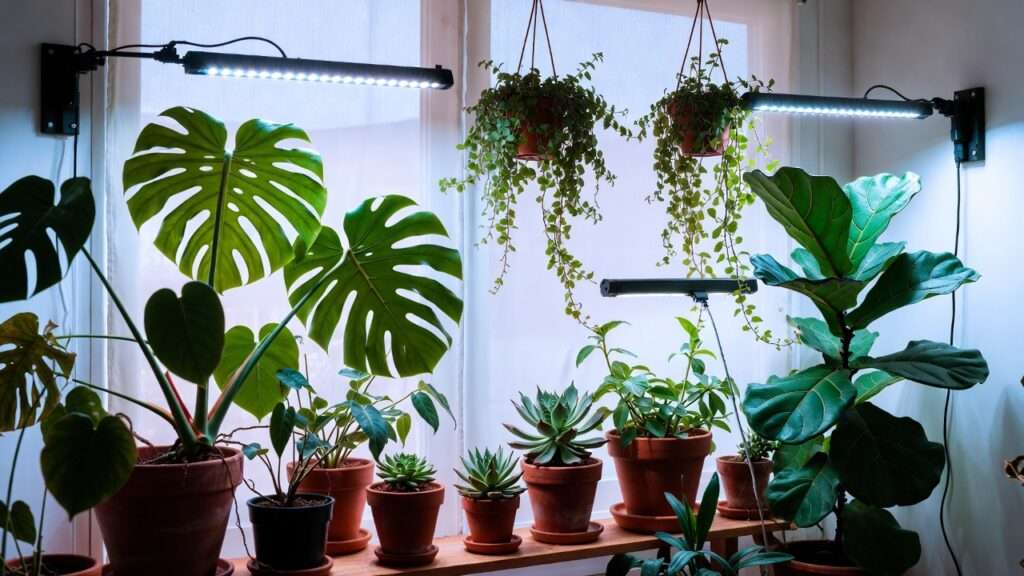
Image: A stunning, well-lit indoor plant shelf showing healthy, compact growth under layered LED bars and natural window light.
Real-Life Examples & Case Studies 🌿🏡
To make this all feel more tangible, here are two real-world scenarios (inspired by common client setups I’ve helped with and my own home jungle in a similar subtropical climate like Khulna — lots of humidity but variable indoor light due to monsoon seasons and apartment layouts).
Example 1: Small Apartment Transformation (Low-to-Medium Natural Light)
- Situation: 400 sq ft apartment, north-east facing windows, heavy monsoon cloud cover for months. Plants included: 2 Pothos, 1 ZZ plant, 1 small Monstera, 1 peace lily, and a few succulents struggling on a windowsill.
- Assessment: Natural light maxed at ~120 PPFD near window, dropping to 40–60 PPFD in corners.
- Lighting Plan Implemented:
- Two Barrina T5 LED strips (4 ft, 6500K full-spectrum) mounted under a floating shelf (18 inches above plants).
- One SANSI 24W clip-on full-spectrum bulb for the Monstera (placed 12 inches above).
- Timer: 7 AM – 9 PM (14 hours).
- Results after 3 months: Monstera produced 5 new fenestrated leaves (previously leggy with 1 leaf every 4 months), Pothos variegation returned bright, succulents moved to brightest window corner + occasional direct sun, no more leaf drop. Total cost: ~$85 USD.
- Key takeaway: Layering affordable shelf lights + one targeted bulb made a dramatic difference without rewiring or major decor changes.
Example 2: Large Living Room Jungle (Mixed Light Zones)
- Situation: Spacious south-west facing living room with good winter light but intense summer sun. Collection: 40+ plants including fiddle leaf fig, bird of paradise, multiple philodendrons, calatheas, succulents, and a young citrus tree.
- Assessment: South window = 800–1500 PPFD direct (great for high-light plants), but deeper room areas dropped to 150–300 PPFD.
- Lighting Plan Implemented:
- Natural light maximized: High-light plants (citrus, succulents, fiddle leaf) within 3 ft of window.
- Two VIPARSPECTRA XS1500 panels (dimmable, hung on adjustable chains) for the middle zone (philodendrons, monsteras, calatheas) — 16–20 inches above canopy, 60% intensity, 13 hours/day.
- Seasonal tweak: Summer dim to 50% + sheer curtains; winter full 100% + 15 hours.
- Results after 6 months: Fiddle leaf doubled in size with no brown tips, calatheas stopped curling, bird of paradise produced first new leaf in years, citrus set fruit indoors.
- Key takeaway: Grouping by light needs + adjustable hanging lights allowed a dense, thriving collection without constant relocation.
Image: Before-and-after split photo of a multi-tier plant shelf: left side shows sparse, stretched plants under poor light; right side shows compact, vibrant growth under installed LED bars.
Frequently Asked Questions (FAQs) ❓
How many hours should grow lights be on for indoor plants? Most foliage houseplants thrive with 12–14 hours. Flowering/fruiting types often prefer 14–16 hours. Never run lights 24/7 — plants need 8–10 hours of darkness for proper respiration and hormone balance.
Can regular household LED bulbs work as grow lights? Not effectively. Standard LEDs lack sufficient red and blue wavelengths plants use most for photosynthesis. Full-spectrum grow lights (or high-CRI 5000–6500K LEDs designed for plants) deliver far better results.
What if my plants get too much light? Symptoms include bleached/yellow patches, crispy brown edges, or curling leaves. Solution: Raise lights 4–8 inches, reduce hours by 1–2, or add sheer curtains/filter.
Do grow lights use a lot of electricity? Modern full-spectrum LEDs are very efficient: a 100W panel running 14 hours/day costs roughly $1–3/month (depending on local rates). Much cheaper than replacing dead plants!
How far should grow lights be from plants? 6–24 inches depending on wattage and type. Follow manufacturer PPFD charts — closer for low-wattage clip-ons, farther for powerful panels to avoid burn.
Will grow lights help during monsoon season / cloudy weather? Absolutely. In regions with extended overcast periods (common in Khulna during monsoon), supplemental lighting prevents stretching and maintains growth momentum.
Image: Collage of common houseplant “light problems” with labels: leggy Monstera, burnt succulent, happy thriving collection.
Conclusion 🌟
Creating a plant lighting plan is one of the highest-ROI things you can do for your indoor plants. Once you assess your space, match plants to their needs, choose appropriate lights, and dial in the schedule, you’ll see healthier foliage, faster growth, fewer pests, and — most importantly — far less heartbreak from losing beloved plants.
Start small: Pick 2–3 struggling plants this week, measure their current light, and add one targeted grow light. Track progress over the next month and adjust. Your green friends will thank you with vibrant new leaves and that lush, jungle vibe we all chase. 🌿💚
Have you created a lighting plan yet? Drop a comment below with your setup or biggest lighting challenge — I’d love to help troubleshoot!











