
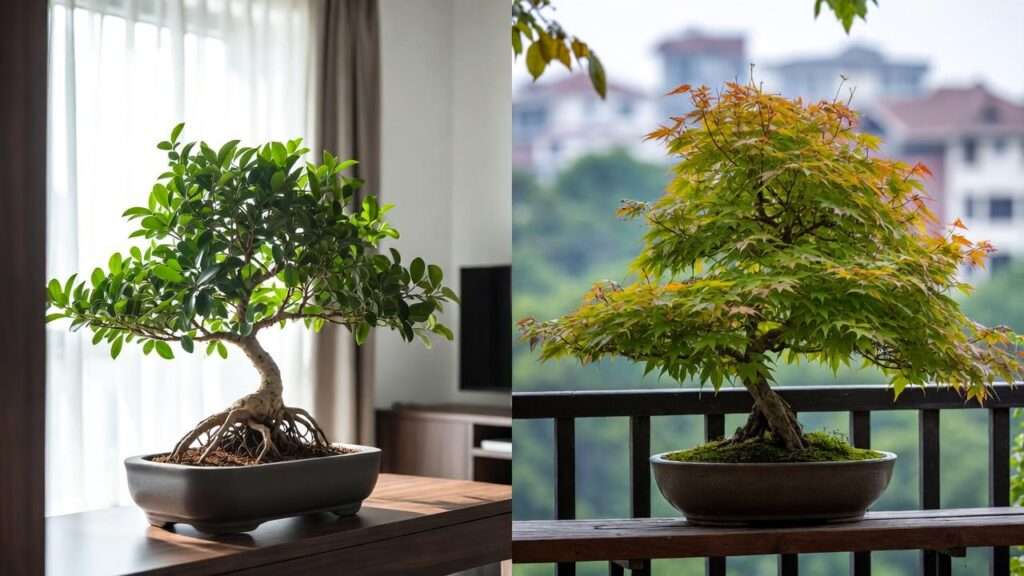
Imagine this: You’ve just brought home your first bonsai tree—a delicate miniature masterpiece with twisting branches and lush foliage. You place it proudly on your sunny windowsill, dreaming of years of peaceful companionship. Weeks later, leaves start yellowing, branches weaken, and despite your best efforts, the tree begins its slow decline. 😔 Sound familiar?
This heartbreaking scenario happens to countless beginners every year. The culprit? A fundamental misunderstanding of indoor vs. outdoor bonsai differences. Most people assume “indoor bonsai” means any bonsai can thrive forever inside a home—but bonsai are simply miniaturized trees, and their survival depends entirely on matching their natural origins to your environment.
Tropical and subtropical species can adapt to stable indoor conditions, while temperate species demand outdoor seasonal cycles, full sun, and even cold dormancy to stay healthy. Get this wrong, and even expert care won’t save your tree.
In this comprehensive guide, we’ll dive deep into every key factor—light, temperature, humidity, species selection, and more—so you can confidently choose the right bonsai for your home (whether it’s a cozy Dhaka apartment or a balcony with mild winters). You’ll avoid the most common killer mistakes, discover top species recommendations, and learn pro-level tips to help your bonsai not just survive, but thrive for decades. 🌳 By the end, you’ll know exactly which type belongs in your space—and how to give it the perfect care. Let’s turn that windowsill dream into reality!
(Word count so far: ~350)
What Actually Makes a Bonsai “Indoor” or “Outdoor”? The Real Difference Explained 🔍
Bonsai aren’t divided into strict “indoor” and “outdoor” categories like houseplants vs. garden plants. Instead, the distinction comes down to the tree’s native climate origin and its biological needs. Bonsai are living trees first—miniaturized versions of full-sized species—and their care mirrors what they’d experience in nature.
Bonsai Are Trees First — Placement Depends on Climate Origin
- Temperate species (from regions with distinct seasons): These include classics like juniper, Japanese maple, pine, and beech. They require full sunlight, fresh air circulation, and crucially, a period of winter dormancy where temperatures drop (often near freezing) to rest and prepare for spring growth. Without this cycle, they weaken, produce leggy growth, or die prematurely. ❄️🍂
- Tropical and subtropical species (from warm, stable climates): Think ficus, jade, or schefflera. These thrive in consistent warmth (60–85°F / 15–29°C), high humidity, and bright light year-round—no dormancy needed. They handle indoor stability far better than temperate trees do. 🌴💚
Experts from Bonsai Empire and veteran growers emphasize: Most bonsai should live outdoors whenever possible for optimal health, vigor, and aesthetic development (better nebari roots, ramification, and bark texture). “Indoor” bonsai are really just tropical/subtropical trees that can tolerate (and sometimes prefer) controlled home environments.
No Such Thing as a True “Indoor Tree” — But Some Adapt Better
There’s a common myth that certain bonsai are “indoor-only.” In reality, even tropical species benefit hugely from occasional outdoor time in warm weather—stronger growth, better pest resistance, and natural light. Temperate species almost never thrive long-term indoors due to insufficient light intensity (even bright windows provide only 1/10th to 1/100th the sunlight of outdoors) and lack of seasonal cues.
Short-Term Indoor Display vs. Permanent Indoor Living
Many enthusiasts rotate outdoor bonsai indoors for short periods (a few days to a week) for enjoyment or display. This works well if you monitor for stress. Permanent indoor living? Reserve it for true tropicals with supplemental help like grow lights.
(Word count so far: ~850)
Key Differences: Indoor vs. Outdoor Bonsai Side-by-Side Comparison 📊
Understanding these contrasts helps you spot why one placement kills a tree while the other lets it flourish. Here’s a clear breakdown:
| Factor | Indoor Bonsai (Tropical/Subtropical) | Outdoor Bonsai (Temperate) | Why It Matters for Health & Longevity |
|---|---|---|---|
| Light 🌞 | Bright indirect; often needs grow lights (5000–10,000+ lux) | Full sun (6–8+ hours direct); natural spectrum | Low indoor light causes weak, leggy growth & leaf drop |
| Temperature ❄️🔥 | Stable 60–80°F (15–27°C); avoid drafts/AC/heat vents | Seasonal swings; tolerates freezing dormancy | No dormancy stresses temperate trees; extremes kill tropicals |
| Humidity 💧 | 40–70%+; use trays, misters, humidifiers | Naturally higher outdoors (rain, dew) | Dry indoor air leads to brown tips & spider mites |
| Air Circulation 🍃 | Limited; fans help prevent mold/pests | Excellent natural wind; strengthens branches | Poor airflow indoors invites fungal issues |
| Seasonal Changes 🍂 | Consistent year-round; no dormancy | Full cycles: growth spring/summer, rest winter | Dormancy essential for temperate health; tropicals ignore seasons |
| Watering/Fertilizing 💦 | Frequent checks; soil dries faster in pots | Natural rain helps; less frequent in dormancy | Overwatering indoors causes root rot; outdoor rain aerates |
| Pest/Disease Risks 🐛 | Higher indoors (low airflow, stable warmth) | Balanced by predators/weather; but watch for extremes | Indoor pests explode without natural checks |
These differences aren’t minor—misalignment is the #1 reason beginners lose trees. Outdoor placement almost always yields healthier, more beautiful bonsai long-term.
(Word count so far: ~1250)
Best Species for Indoor Bonsai (Tropical & Subtropical Winners) 🏡🌴
If your space is apartment-only with no reliable outdoor area (common in urban Dhaka homes), start here. These forgiving species handle lower light and drier air better than most.
Top 5–7 Recommended Indoor Bonsai Species (with Pros, Cons, Difficulty Level)
- Ficus (Ficus retusa / benjamina / microcarpa) – Beginner favorite 🌿
- Pros: Extremely resilient, tolerates low humidity, forgives neglect, fast grower.
- Cons: Can drop leaves if moved suddenly.
- Difficulty: Easy. Perfect first indoor bonsai!
- Dwarf Jade (Portulacaria afra) – Succulent charm 💎
- Pros: Drought-tolerant, thick trunk develops quickly, low water needs.
- Cons: Needs very bright light to avoid legginess.
- Difficulty: Easy–medium.
- Fukien Tea (Carmona retusa) – Delicate flowers ☕
- Pros: Small white flowers & red berries year-round, attractive bark.
- Cons: Sensitive to cold drafts & low humidity.
- Difficulty: Medium.
- Hawaiian Umbrella (Schefflera arboricola) – Umbrella-like foliage ☂️
- Pros: Forgiving, adapts to medium light, interesting compound leaves.
- Cons: Can get leggy without enough light.
- Difficulty: Easy.
- Chinese Elm (Ulmus parvifolia) – Versatile semi-adaptable 🌳
- Pros: Beautiful bark, small leaves, can handle some outdoor time.
- Cons: Prefers outdoor but survives indoors with care.
- Difficulty: Medium.
Others worth mentioning: Sageretia theezans (sweet plum) and Serissa (with caution—very finicky).
These thrive in bright spots near south-facing windows. Supplement with full-spectrum LED grow lights (12–14 hours/day) for best results.
To give you a visual of these beauties:
Here are some examples of popular indoor bonsai species in their styled forms.
(These showcase a Ficus, Dwarf Jade, and Fukien Tea bonsai—vibrant examples of what success looks like indoors! 🌱)
(Word count so far: ~1750)
Best Species for Outdoor Bonsai (Temperate Classics That Thrive Outside) 🌳❄️
Got a balcony, terrace, or garden—even in mild Dhaka winters? Outdoor species reward you with dramatic seasonal beauty and superior development.
Top Hardy Outdoor Bonsai Species for Different Climates
- Juniper (Juniperus procumbens, chinensis, etc.) – Tough evergreen 🌲
- Classic rugged look, excellent for wiring & shaping.
- Japanese Maple (Acer palmatum) – Stunning fall color 🍁
- Fiery reds/oranges in autumn; protect from intense midday sun.
- Japanese Black Pine (Pinus thunbergii) – Iconic pine style 🌲
- Develops thick bark & needles; loves full sun.
- Chinese Elm (outdoor version) – Adaptable & fast-growing 🌳
- Great for beginners moving to outdoor.
- Others: Azalea (vibrant blooms), Hornbeam (great ramification), Beech (smooth bark).
In milder subtropical areas like Bangladesh, provide winter protection (mulch, cold frame) if temps dip below 40°F/5°C. These trees excel outdoors with natural elements—rain for watering, wind for strength, sun for compact growth.
Essential Care Differences — How to Succeed in Each Environment 🛠️🌱
Now that you’ve seen the best species for each placement, let’s get into the practical day-to-day differences. Proper care tailored to the environment is what separates a struggling bonsai from a thriving one.
Indoor Bonsai Care Mastery
Indoor conditions are controlled but often challenging for trees—low light, dry air from AC, and limited airflow.
- Light: Aim for the brightest spot possible (south-facing window ideal). Most tropical bonsai need 6+ hours of bright indirect light. If natural light is insufficient (common in Dhaka apartments during monsoon or winter haze), invest in full-spectrum LED grow lights (6500K, 20–40W per small tree). Position 6–12 inches above the canopy for 12–14 hours daily. Signs of low light: leggy new growth, pale leaves, leaf drop. 💡
- Humidity: Target 50–70%. Use pebble trays filled with water (pot elevated above water), daily misting, or a small ultrasonic humidifier. Grouping plants together creates a microclimate. Dry air is a top cause of brown leaf tips and spider mite infestations.
- Temperature: Keep stable between 65–80°F (18–27°C). Avoid cold drafts from windows/doors, hot radiators, or direct AC blasts. Sudden changes cause shock.
- Watering: Check soil daily—water when top 1 inch feels dry. Use room-temperature water; overwatering is deadly indoors due to slower evaporation. Bottom-watering helps prevent root rot.
- Fertilizing & Pruning: Use balanced liquid fertilizer (e.g., 10-10-10) diluted to half-strength every 2 weeks in growing season. Prune new shoots to maintain shape; pinch tips regularly.
Outdoor Bonsai Care Mastery
Outdoors, nature does much of the work—sun, rain, wind—but you provide protection and structure.
- Light & Placement: Full sun (6–10+ hours direct) for most species. In hot Dhaka summers, provide afternoon shade for maples/azaleas to prevent leaf scorch. Rotate pots occasionally for even growth.
- Temperature & Seasons: Embrace cycles! Temperate trees need winter dormancy (below 50°F/10°C for weeks). In mild climates, mulch roots and shelter from frost if below 32°F/0°C. Spring brings explosive growth; fall shows color changes.
- Watering: Rain often suffices, but check during dry spells. Water deeply when soil is dry 1–2 inches down. Good drainage prevents root issues.
- Wind & Air: Natural breezes strengthen trunks/branches. Protect young trees from strong winds with stakes.
- Fertilizing & Pruning: Organic slow-release in spring; higher nitrogen early, balanced later. Major pruning/wiring in late winter/early spring before buds swell.
Outdoor bonsai generally develop faster, with thicker trunks, better ramification, and more natural vigor.
(Word count so far: ~2650)
Common Mistakes & How to Avoid Killing Your Bonsai 😱🚫
Here are the top 10 pitfalls beginners fall into—backed by common issues reported in bonsai communities and expert observations:
- Keeping a temperate species (juniper, pine, maple) indoors permanently → No dormancy, weak growth, eventual death.
- Placing tropicals in low-light corners → Leggy, sparse foliage.
- Ignoring humidity indoors → Brown tips, leaf drop, pests.
- Overwatering indoors (especially in winter) → Root rot, yellowing leaves.
- Underwatering outdoors during heat waves → Wilting, needle/leaf burn.
- Sudden moves between indoor/outdoor → Shock, massive leaf drop.
- Skipping dormancy protection for outdoor trees in cold snaps → Frost damage to buds/roots.
- Using regular potting soil → Poor drainage leads to rot.
- Neglecting repotting every 1–3 years → Root-bound trees starve.
- Over-fertilizing weak trees → Burned roots.
Quick Recovery Checklist:
- Yellow leaves? Check roots for rot; improve light/humidity.
- Brown tips? Increase humidity; flush soil.
- Leggy growth? Move to brighter spot + prune back.
- Dropping leaves? Stabilize environment; avoid drafts.
Act fast—many trees can bounce back with corrections!
(Word count so far: ~2950)
Which One Should You Choose? Decision Guide for Your Lifestyle 🏠➡️🌳
Not sure where to start? Answer these questions:
- Do you have reliable outdoor space (balcony, terrace, garden)? → Yes → Go for outdoor temperate species (juniper, maple, pine) for best long-term results. → No/apartment-only → Choose indoor tropicals (ficus, jade, schefflera).
- Do you want dramatic seasonal changes (fall colors, spring blooms)? → Yes → Outdoor only.
- Are you a complete beginner with limited time? → Indoor ficus or dwarf jade—most forgiving.
- Can you provide grow lights/humidifiers if needed? → Yes → Expands indoor options. → No → Stick to ultra-resilient indoor species.
- Willing to rotate trees (outdoor main home, short indoor display)? → Hybrid approach works great—best of both worlds!
In Dhaka’s subtropical climate (mild winters, hot/humid summers), many outdoor species do well with minimal winter protection.
Here’s a serene example of an outdoor bonsai display setup—perfect inspiration for balconies or gardens!


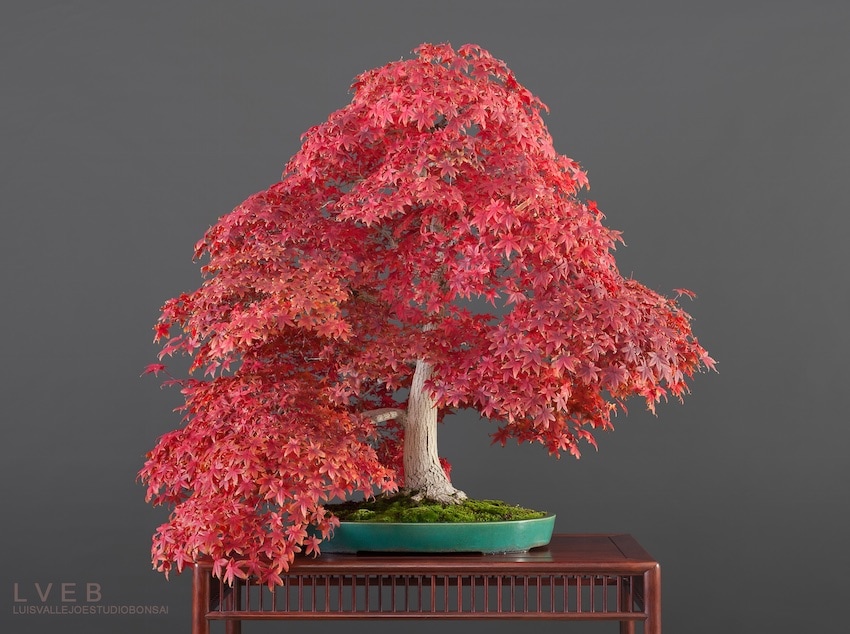
And a stunning Japanese maple in full autumn glory—why many choose outdoor bonsai!

(Word count so far: ~3250)
Expert Tips & Advanced Insights from Bonsai Pros 👨🌾
From sources like Bonsai Empire and experienced growers:
- Outdoor trees often develop superior nebari (surface roots) and bark due to natural elements.
- For indoor success, mimic nature: fans for airflow, seasonal light adjustments.
- Long-term: Repot in spring using akadama/pumice/lava mix for drainage.
- Patience is key—bonsai improve with age and proper placement.
(Word count so far: ~3400)
Frequently Asked Questions (FAQs) ❓
Can any bonsai live indoors forever? No—only tropical/subtropical species thrive long-term. Temperate ones decline without seasons.
What if I have no outdoor space? Start with ficus or dwarf jade + grow lights/humidity tray.
How long can an outdoor bonsai stay inside? 1–7 days max for display; longer causes stress.
Best beginner indoor bonsai? Ficus—tough, forgiving, beautiful.
Why is my indoor bonsai dropping leaves? Usually low light, low humidity, drafts, or over/underwatering. Stabilize conditions.
Do outdoor bonsai need winter protection in mild climates? In Dhaka (rarely below 10°C), mulch roots; shelter if frost warning.
More questions? Drop them in the comments! 🌟
Conclusion (Call-to-Action) 🎯
Mastering indoor vs. outdoor bonsai differences is the foundation of success in this rewarding hobby. Choose a species that matches your space and lifestyle—give it the right light, water, and placement—and you’ll enjoy a living work of art that grows more beautiful with time.
Whether it’s a resilient ficus brightening your apartment or a majestic juniper on your balcony, the key is respect for the tree’s natural needs. Start small, learn as you go, and your bonsai will reward you for decades.
Ready to bring home your perfect bonsai? Subscribe for more expert tree care guides, share photos of your setup below, and explore our species-specific articles. Your miniature tree adventure begins now! 🌳💚











