

Have you ever planted what seemed like the perfect tree or shrub in your yard… only to watch it struggle or even die, while the exact same variety thrives just a few feet away or in a neighbor’s garden? 🌱❌ It’s frustrating, isn’t it? You follow all the care instructions, water diligently, fertilize on schedule — yet some plants refuse to cooperate.
The hidden culprit is rarely your green thumb. It’s your yard’s microclimate mapping — those tiny, hyper-local climate pockets that create dramatic differences in temperature, moisture, wind, and sunlight right within your own property. A south-facing brick wall can act like a cozy heater, while a low spot near the fence becomes a chilly frost pocket that kills tender buds overnight.
Understanding and mapping these microclimates is one of the most powerful, yet underused, skills in home gardening and tree care. Once you master it, you can:
- Plant trees and perennials in spots where they’ll truly thrive 🌳
- Stretch your effective growing zone by 1–2 zones safely
- Reduce plant losses, transplant shock, and wasted money
- Extend your harvest season for fruits, veggies, and ornamentals
As a horticulturist with over 15 years of experience helping homeowners across various climates turn struggling yards into lush, productive spaces (including consulting for extension services and master gardener programs), I’ve seen microclimate mapping transform gardens time and time again.
In this comprehensive guide, we’ll walk through exactly how to observe, document, map, and use your yard’s microclimates — with step-by-step instructions, real examples, plant recommendations, advanced tricks, and common pitfalls to avoid. Let’s unlock your yard’s true potential! 🚀
What Exactly Is a Microclimate in Your Yard? 🔍
A microclimate is a small-scale variation in climate conditions that differs from the broader regional or USDA hardiness zone average. These differences can span just a few feet and include:
- Temperature swings of 5–15°F (3–8°C) or more
- Variations in humidity, wind speed, sunlight hours, and soil moisture
- Frost occurrence, heat buildup, or cold air pooling
While your USDA zone gives a general guideline (based on average annual minimum winter temperatures), it doesn’t account for what happens in your specific yard. Urban heat islands, slopes, buildings, trees, and paving all create unique pockets.
For example:
- A south-facing brick wall absorbs daytime heat and radiates it at night, creating a warm microclimate perfect for borderline hardy plants like figs or certain citrus in cooler zones 🌞
- A low-lying area at the bottom of a slope collects cold air at night, forming frost pockets that can damage early-blooming trees like peaches or magnolias ❄️
In many yards, you can find 5–10 distinct microclimates — enough to grow a surprising variety of plants if you place them strategically.

(These visuals show example sun mapping and garden layout sketches to help visualize microclimate zones.)
Why Microclimate Mapping Is a Game-Changer for Plant & Tree Health 🌳💚
Mapping isn’t just academic — it directly solves painful, real-world gardening problems:
- Prevent winter kill and branch dieback on young trees and shrubs by avoiding frost pockets
- Reduce transplant shock and establishment failures by matching plants to ideal conditions
- Optimize fruit set and quality — many fruit trees need protected warm spots for reliable crops
- Extend growing seasons — warm pockets let you start seeds earlier or grow tender perennials
- Save water and reduce stress — pair drought-tolerant plants with hot/dry zones and moisture-lovers with shaded, damp areas
- Cut costs — fewer dead plants means less replacement spending
Real example: A Zone 6b homeowner I advised planted a fig tree against a south-facing brick wall instead of in an open lawn spot. The tree survived -10°F winters with minimal protection and produced abundant fruit — something most Zone 6 figs never achieve.
By understanding your yard’s microclimates, you garden with nature instead of fighting it. 🌱❤️
Key Factors That Create Microclimates in Your Yard 🗺️
Several elements interact to form these pockets. Pay attention to:
- Sun exposure & orientation ☀️ — South-facing areas get maximum sun and warmth; north sides stay cooler and shadier.
- Topography & slopes ⛰️ — Cold air drains downhill, pooling in valleys or low spots (frost pockets). Warm air rises up slopes.
- Structures & hardscapes — House walls, fences, patios, driveways reflect heat and block wind.
- Existing vegetation — Tree canopies create shade and humidity; hedges act as windbreaks.
- Soil & drainage — Well-drained slopes warm faster; heavy clay in low areas stays wet and cold.
- Wind patterns 🌬️ — Exposed areas dry out foliage quickly; sheltered corners stay humid.
- Urban influences — Nearby pavement, buildings, or lights create heat islands.
These factors change seasonally — summer heat pockets can become winter frost traps if not observed carefully.
(Fig tree thriving against a warm south-facing brick wall — a classic heat-sink microclimate.)
Step-by-Step Guide: How to Map Microclimates in Your Yard 📍
Step 1: Gather Your Tools & Prepare 🛠️
You don’t need fancy equipment:
- Graph paper or a free garden planner app (e.g., Garden Planner, Canva, or SketchUp basics)
- Compass or phone app for north orientation
- Digital min/max thermometer (inexpensive models work great)
- Wooden stakes/flags/markers
- Notebook or phone notes app for observations
- Optional: Soil thermometer, rain gauge, anemometer app
Start with a rough base map of your yard: house, fences, trees, beds, paths — north arrow up.
Step 2: Observe & Document Over Time 👀
Observe during key seasons:
- Early spring & late fall → frost patterns
- Summer → heat & sun intensity
- Multiple days for patterns
Track at consistent times: 9 AM, noon, 3 PM, and evening. Note:
- Sun/shade boundaries (mark shadows)
- Temperature highs/lows in different spots
- Wind direction & strength
- Wet/dry soil areas
- Frost or dew patterns
Pro tip: Use a cheap min-max thermometer placed at plant height (6–12 inches off ground) for accurate readings.

(Thermometer in garden soil and weather monitoring tools in action.)
Pro tip: Use a cheap min-max thermometer placed at plant height (6–12 inches off ground) for accurate readings. Ground-level readings often reveal the most relevant plant microclimates — air temperatures a foot or two higher can be 3–5°F warmer on calm nights.
Spend at least 2–4 weeks (ideally spread across seasons) collecting data before finalizing your map. One unusually warm or cold week can mislead you.
Step 3: Identify & Categorize Your Zones (H3) 🏷️
Once you have several days/weeks of observations, group your yard into distinct microclimate types. Here are the most common categories homeowners discover:
- Warm / Heat-Sink Zones 🔥 South- and west-facing walls, paved patios, south-facing slopes. These can be 8–15°F warmer than open areas on winter nights and stay noticeably hotter in summer.
- Cool / Shaded Zones ❄️ North-facing walls, under dense tree canopies, deep shade from buildings. Ideal for shade-loving perennials, ferns, hostas, and acid-loving shrubs.
- Frost Pocket / Cold-Air Drainage Zones 🥶 Low-lying areas, dips, valley bottoms, spots blocked by fences or hedges that trap cold air. Avoid planting early-flowering fruit trees, tender perennials, or marginally hardy species here.
- Windy / Exposed Zones 🌬️ Open lawn areas, hilltops, corners where wind funnels between structures. These dry out soil and foliage quickly — perfect for tough, wind-resistant natives, ornamental grasses, and some evergreens.
- Hot / Dry Zones 🌵 Near asphalt driveways, concrete patios, or south-facing reflective surfaces. Great for drought-tolerant natives, succulents, lavender, rosemary, and Mediterranean herbs/trees.
- Moist / Humid Zones 💧 Poorly drained low spots, areas under dense shade with mulch or leaf litter, north-facing slopes with clay soil. Excellent for moisture-loving plants like hydrangeas, astilbe, cardinal flower, and certain willows.
Mark these zones clearly on your base map using colors, symbols, or labels (red = hot, blue = cold, green = moist, yellow = windy, etc.).
Step 4: Create Your Personal Microclimate Map (H3) 🎨
Now turn your observations into a visual map:
- Draw or use software to create a scaled base plan of your yard (north at the top).
- Overlay your house, fences, major trees, beds, and paths.
- Use colored markers, shading, or icons to show each microclimate type.
- Add notes for special observations (e.g., “frost line here most winters,” “soil stays soggy after rain”).
Digital options that work beautifully:
- Garden Planner (paid but excellent)
- Canva (free templates)
- Google Drawings or Google My Maps (free and shareable)
- Inkarnate or simple drawing apps for artistic gardeners
Save versions for different seasons if your yard changes dramatically (e.g., deciduous trees lose leaves in winter, opening up more sun).
(Example of a hand-drawn microclimate map with color-coded zones and plant placement notes — very similar to what many successful gardeners create.)
Step 5: Validate & Refine Your Map (H3) ✅
Your map is a living document — test it!
- Plant “sacrificial” indicator plants in questionable spots the first year:
- Tender annuals (e.g., impatiens, coleus) to reveal frost pockets
- Heat-sensitive plants (e.g., lettuce) in suspected hot zones
- Wind-sensitive plants (e.g., large-leaf hostas) in exposed areas
- Monitor survival, growth rate, leaf scorch, wilting, or early/late flowering.
- Adjust boundaries after the first winter and summer — most people refine their maps 2–3 times before they feel confident.
Once validated, this map becomes your lifelong planting blueprint.
Best Plants & Trees for Each Microclimate Type (H2) 🌿🌲
Matching plants to their ideal microclimate dramatically increases success rates. Here are proven performers by zone type (tailored to common temperate/subtropical climates; adjust for your USDA zone):
Warm / Heat-Sink Zones 🔥
- Fruit trees: Fig, persimmon, hardy kiwi, late-blooming peach/apricot varieties
- Shrubs: Rosemary, lavender, pomegranate, bay laurel
- Perennials: Russian sage, yarrow, sedum, agastache
- Zone-stretchers: Olive (in pots with protection), citrus (Meyer lemon, kumquat)
Cool / Shaded Zones ❄️
- Trees: Japanese maple, dogwood, serviceberry, eastern redbud
- Shrubs: Hydrangea (some varieties), rhododendron, azalea, mountain laurel
- Perennials: Ferns, hosta, astilbe, bleeding heart, coral bells
Frost Pocket / Cold-Air Drainage Zones 🥶
- Trees: Hardy evergreens (spruce, fir, arborvitae), sugar maple, oaks
- Shrubs: Potentilla, spirea, ninebark, elderberry
- Avoid: Early-blooming stone fruits, magnolias, tender perennials
Windy / Exposed Zones 🌬️
- Trees: Eastern red cedar, juniper, honey locust, hawthorn
- Shrubs: Rugosa rose, butterfly bush, lilac, sumac
- Grasses & perennials: Switchgrass, little bluestem, yucca, black-eyed Susan
Hot / Dry Zones 🌵
- Trees: Honey locust, redbud (western types), desert willow
- Shrubs: Texas sage, caryopteris, butterfly bush, lantana
- Perennials: Gaura, penstemon, coreopsis, echinacea
Moist / Humid Zones 💧
- Trees: Bald cypress, river birch, swamp white oak, willows
- Shrubs: Buttonbush, summersweet, wintersweet, red osier dogwood
- Perennials: Cardinal flower, turtlehead, ligularia, joe-pye weed
Always cross-check with your local extension service for regionally adapted cultivars.
Advanced Techniques: Creating or Enhancing Microclimates (H2) 🔧
Once you’ve mapped your existing microclimates, you can actively improve or even create new ones to grow plants that would otherwise struggle in your overall zone. These techniques draw from proven permaculture, extension service, and professional landscaping practices.
- Build heat sinks with thermal mass 🔥 Place stone walls, large rocks, water barrels, or dark-colored containers against south/west exposures. These absorb solar heat during the day and release it slowly at night, raising local temperatures by 5–10°F in winter. Excellent for figs, citrus in pots, or early tomatoes.

(Example of thermal mass — rocks and structures creating a warm pocket for lush growth.)
- Install windbreaks 🌬️ Plant dense evergreen hedges (arborvitae, holly, Leyland cypress), bamboo screens, or permeable fences to slow drying winds. Position them perpendicular to prevailing winds. This reduces evaporation and leaf scorch while creating sheltered humid zones behind them.
- Use earth berms and mounds ⛰️ Build low raised mounds or berms (1–3 ft high) on the north side of planting areas to block cold winds and improve drainage/heat retention on slopes. South-facing slopes of berms warm up faster in spring.
- Strategic shade & moisture control ☂️ Install shade cloth, lattice, or tall perennials to cool hot zones in summer. Add mulch layers (3–4 inches) or rain gardens in dry spots to retain moisture longer.
- Water features & reflective surfaces 💦 Small ponds, fountains, or even birdbaths increase local humidity. Light-colored gravel or pale walls reflect more light into shaded areas.
These tweaks can effectively push your yard’s capabilities — many gardeners grow Zone 8 plants reliably in Zone 6 with smart enhancements.

(Protected garden bed with windbreak fencing and stone elements creating ideal conditions.)
Common Mistakes to Avoid When Mapping & Planting (H2) ⚠️
Even experienced gardeners slip up. Watch out for:
- Relying on a single day/week of observation — weather varies; collect data over multiple seasons.
- Ignoring soil temperature — air temp matters, but soil temp drives root growth (use a soil probe).
- Planting tender species in frost pockets without protection the first year.
- Forgetting seasonal shifts — deciduous trees drop leaves, suddenly exposing areas to more winter sun/cold.
- Overlooking urban effects — nearby pavement or AC units can create unintended hot/dry spots.
- Planting too densely in new microclimate zones before testing — give plants room to show their true performance.
Avoid these, and your success rate skyrockets.
Real-Life Case Studies & Examples (H2) 📖
Case 1: Sloped Suburban Yard in Zone 6b A homeowner mapped cold air pooling at the base of a gentle slope (frost pocket). They moved peach and apricot trees to the mid-slope warm zone and planted hardy spruces at the bottom. Result: No more flower loss to late frosts; first reliable peach harvest in 4 years.
Case 2: Urban Backyard Heat Island (Zone 7a) Dense buildings created hot, dry pockets near the house. The gardener added a stone patio edge as a heat sink and planted figs, rosemary, and pomegranates there. Meanwhile, a shady north corner hosted ferns and Japanese maples. The yard now supports a wider diversity than the regional zone suggests.
Case 3: Small Balcony/Patio in a City Apartment Even tiny spaces have microclimates! A south-facing railing corner stayed warmer; the gardener used pots with dark ceramic for heat retention and grew dwarf citrus successfully, while north-side pots held shade lovers.
These stories show microclimate awareness works at any scale.
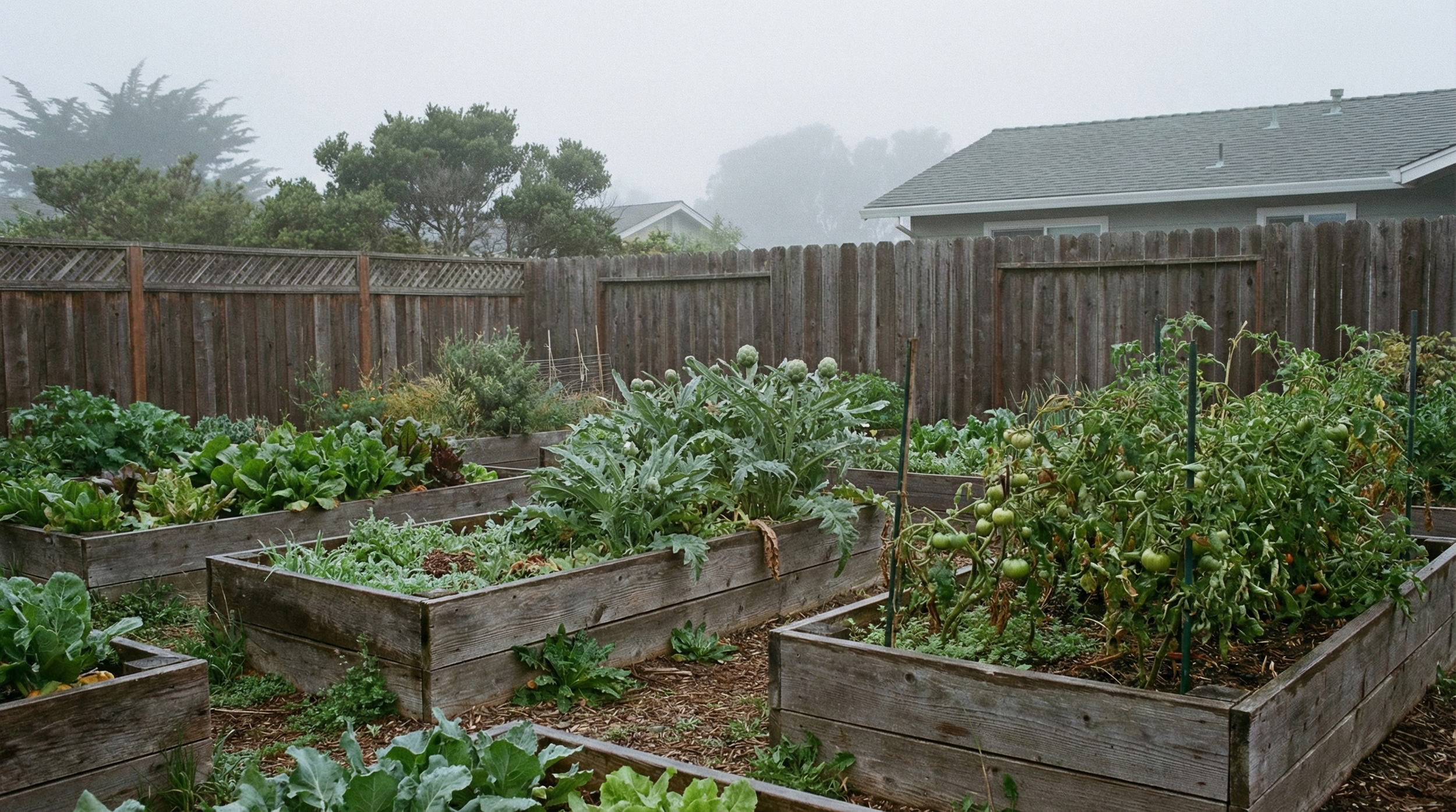
(Foggy coastal garden showing how structures and layout create protected planting pockets.)
Expert Tips from Horticulturists & Master Gardeners (H2) 💡
- “Always prioritize soil temperature over air temperature for perennials and trees — roots feel the real conditions.” — Adapted from university extension soil specialists.
- Monitor overnight lows in winter; one hard freeze in a frost pocket can wipe out years of growth.
- Use free tools like the USDA Plant Hardiness Zone Map for baseline, but treat it as a starting point only.
- Join local master gardener groups — they often share region-specific microclimate hacks.
- Revisit your map every 2–3 years; mature trees and new structures change everything.
FAQs About Microclimate Mapping in Your Yard (H2) ❓
How long does it take to map my yard properly? 2–6 weeks of active observation spread over spring, summer, and fall is ideal. You can start planting based on initial notes and refine later.
Can I map microclimates in winter only? Winter reveals frost pockets best, but you’ll miss summer heat/dry zones. Year-round data is strongest.
Does this work for container gardening? Absolutely! Pots on patios or against walls create their own mini microclimates — move them seasonally for optimization.
What if my yard is very flat with no obvious slopes? Structures, trees, and paving still create big differences. Focus on sun patterns and wind tunnels.
Is microclimate mapping worth it for small yards? Yes — even 10×10 ft spaces can have 3–4 zones, letting you grow more variety successfully.
How do microclimates interact with climate change? They become even more important — warmer overall trends let you push boundaries further in protected pockets.
Can kids or beginners do this? Definitely! Make it a fun family project — use colored flags and simple charts.
Conclusion: Take Control of Your Yard’s Hidden Climates Today (H2) 🌟
Microclimate mapping isn’t complicated science — it’s observant, practical gardening that puts you in charge. By understanding the tiny climate worlds in your yard, you stop guessing and start succeeding: healthier trees, thriving plants, fewer disappointments, and more joy from every season.
Grab some paper (or your phone), a thermometer, and start watching this weekend. Sketch your base map, note those sun shadows and chilly corners, and watch your garden transform.
Your plants — and future you — will thank you! 🌳❤️
What microclimate surprises have you found in your yard? Share in the comments — I’d love to hear your stories and tips!











