
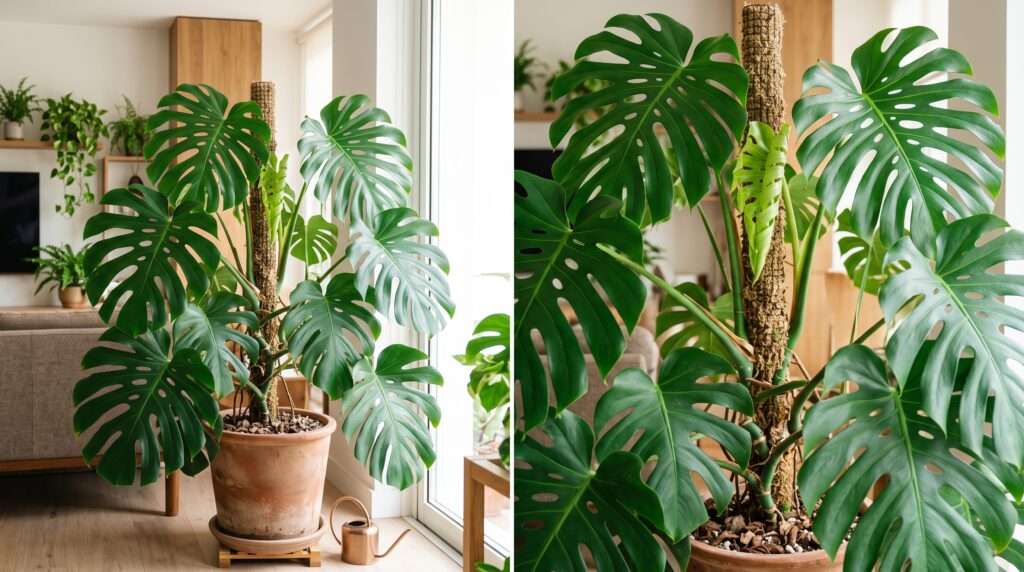
Picture this: you walk into your living room, and there it is—a towering, vibrant jungle giant, its massive, perfectly split leaves reaching toward the sunlight. It is the ultimate indoor aesthetic, breathing life and wild tropical energy into your space. But for many indoor plant enthusiasts, this vision remains a frustrating dream. If you find yourself staring at a bush of small, solid, heart-shaped green leaves, wondering why your monstera plant isn’t transforming into the iconic beauty you see on magazine covers, you are not alone.
As a horticulturist who has spent years diagnosing, reviving, and propagating tropical aroids for indoor environments, I hear the same question every single week: “Why won’t my leaves split?”
Those beautiful cuts and holes are called fenestrations, and they don’t happen by accident. They are a sign of a mature, thriving plant that is receiving exactly what it needs. In this comprehensive guide, we are going to dive deep into the science of Monstera deliciosa care. By the end of this article, you will have the exact, expert-backed blueprint to trigger explosive growth, encourage massive fenestrations, and cultivate the Swiss cheese plant of your dreams. Let’s unlock your plant’s true potential! ✨
🪴 Understanding Your Monstera Plant: Roots in the Rainforest
To master indoor plant care, you must first understand where your plant comes from. The Monstera deliciosa originates from the dense, humid tropical rainforests of Central America, specifically stretching from southern Mexico down to Panama.
In its natural habitat, it doesn’t start its life in a cozy terracotta pot. It begins on the forest floor, a creeping vine desperately searching for a dark, towering tree trunk. Once it finds a tree, it begins its ascent toward the canopy, changing its physical form as it climbs closer to the sun.

Why Do They Split? (The Science of Fenestrations) 🧬
Those iconic splits and holes are not just for our aesthetic pleasure; they are a brilliant evolutionary survival mechanism. As the Monstera climbs higher into the rainforest canopy, its leaves grow substantially larger. Solid leaves of that size would act like sails, catching the harsh hurricane winds and heavy tropical downpours common in Central America, which would snap the plant’s stems.
Fenestrations allow wind and heavy rain to pass right through the foliage without causing structural damage. Furthermore, the holes act as windows (the word fenestration comes from the Latin fenestra, meaning window), allowing dappled sunlight to penetrate through the massive upper canopy leaves down to the lower leaves and roots near the forest floor.
Expert Insight 🔬: Botanical studies on the Araceae family reveal that fenestration development is primarily light-dependent and age-dependent. A juvenile Monstera grown in suboptimal conditions may remain in its crawling, solid-leaf stage indefinitely. It requires the environmental triggers of structural support (climbing) and high light intensity to activate its mature morphogenesis.
☀️ The Holy Trinity of Monstera Plant Care: Light, Water, and Soil
If you want massive, split leaves, you need to perfect the foundational elements of its environment. We call this the Holy Trinity of tropical houseplant care.
🌤️ 1. Light Requirements (The Real Secret to Splits)
Let’s immediately debunk the most damaging myth in the houseplant world: The Monstera is not a low-light plant.
While they can survive in a dark corner of your bedroom, they will merely exist in a state of suspended animation. They will produce small, leggy stems and tiny, solid leaves. To trigger fenestrations, your plant needs energy, and energy comes from photosynthesis.
The Sweet Spot: Your Monstera craves bright, indirect sunlight.
-
Ideal Placement: An East-facing window where it receives gentle morning sun, or a South/West-facing window shielded by a sheer white curtain.
-
Direct Sun Warning: While mature Monsteras in the wild can handle direct tropical sun, indoor plants acclimatized to lower light will suffer severe sunburn (large, bleached, crispy white or brown patches) if suddenly exposed to harsh afternoon rays.
-
The Winter Slump: If your home lacks natural light, or during the dark winter months, investing in a full-spectrum LED grow light is a game-changer. Position it about 12-18 inches above the highest foliage for 10-12 hours a day to keep the plant actively growing.
💧 2. Watering Mastery: Finding the Balance
Watering is where many well-meaning plant parents make fatal errors. The goal is to mimic the wet-dry cycles of a tropical rainforest, not a stagnant swamp.
The Soak and Dry Method 🚿 Never water your plant on a strict calendar schedule (e.g., “every Sunday”). Environmental factors like temperature, humidity, and light dictate how fast your plant uses water. Instead, use the Soak and Dry method:
-
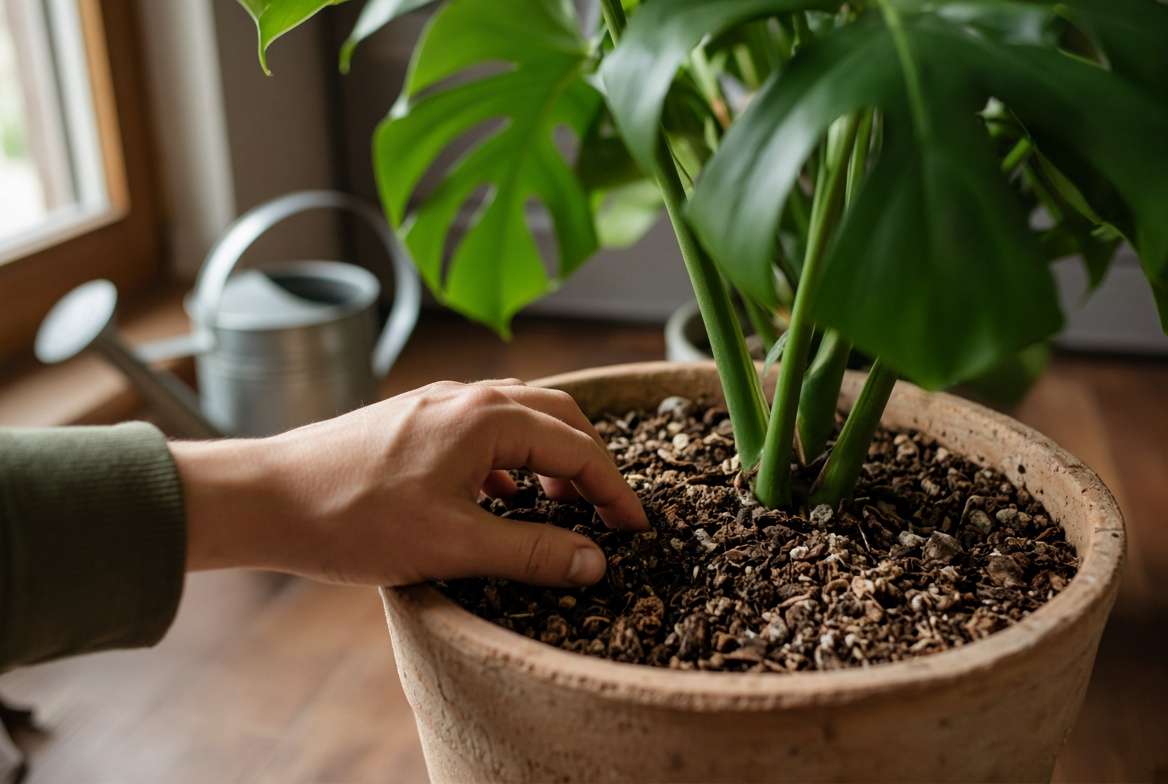
Insert your finger, a wooden chopstick, or a moisture meter into the soil.
-
Wait until the top 2 to 3 inches of the soil are completely dry before watering.
-
When it is time to water, soak the soil thoroughly until water runs freely out of the drainage holes at the bottom of the pot. This flushes out excess mineral salts and ensures deep root hydration.
Seasonal Adjustments 🍂 During the active growing season (Spring and Summer), your Monstera will drink rapidly. You may find yourself watering every 7-10 days. During its winter dormancy, growth slows significantly, and the soil will take much longer to dry out. You might only water every 2-3 weeks. Always check the soil first!
-
Overwatering (The Silent Killer): If your Monstera leaves are turning a sickly, mushy yellow starting from the bottom of the plant, and the soil smells slightly sour, you are overwatering. This leads to root rot.
-
Underwatering: If the leaves have brown, crispy edges, or the entire plant looks limp and droopy but the stems aren’t mushy, it is severely dehydrated.
🪨 3. The Ultimate Aroid Soil Recipe
If there is one area where commercially available indoor plant care products fail us, it is standard potting soil. Most off-the-shelf “indoor plant soil” is far too dense and peat-heavy. It is designed to retain maximum moisture, which is the exact opposite of what an epiphytic jungle plant wants.
Why Regular Potting Soil Fails: In the wild, your Monstera deliciosa anchors its roots into the loose, airy debris of the forest floor—a mixture of fallen leaves, decaying bark, and charcoal from old fires. Dense potting soil suffocates those thick, fleshy roots, preventing oxygen exchange and inevitably leading to root rot.
The Chunky Aroid Mix Recipe 🥣
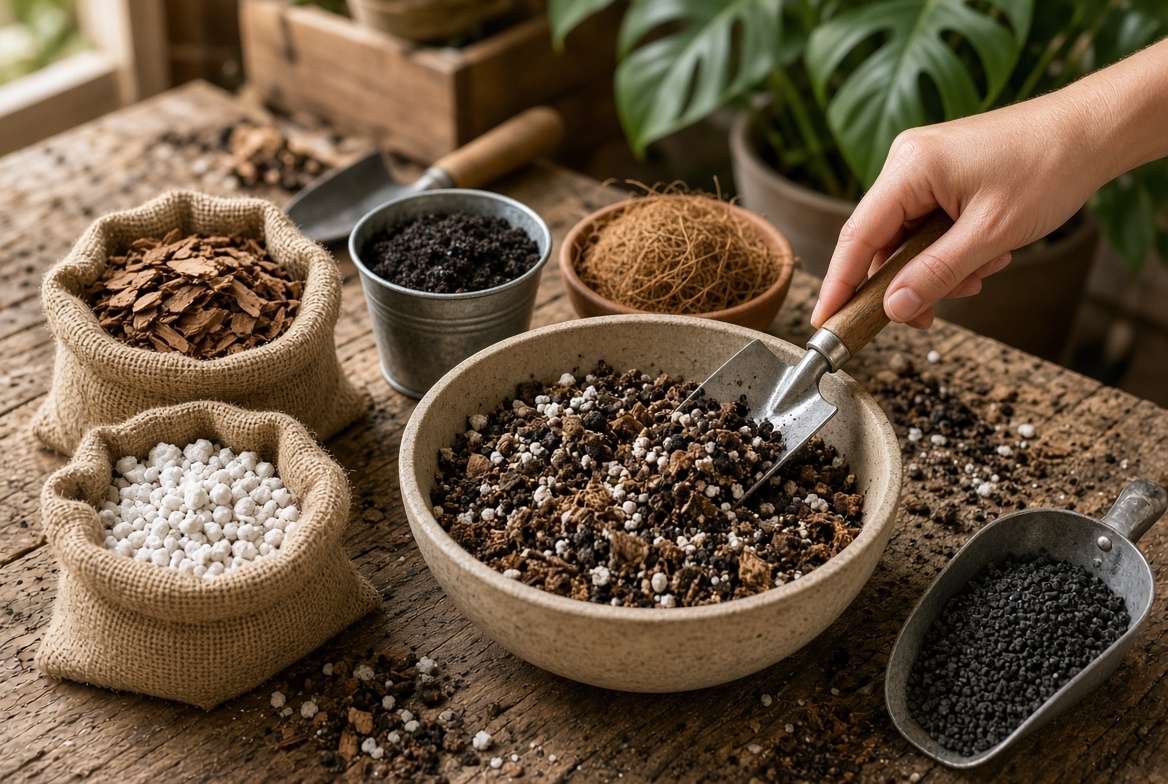
To replicate their natural environment and guarantee healthy root development, you need a custom Monstera soil mix. Here is my tried-and-true, expert-approved recipe for explosive growth:
-
40% Orchid Bark: Provides massive chunks for roots to grab onto and creates essential air pockets.
-
30% Premium Potting Soil or Coco Coir: Provides the base structure and holds just enough moisture and nutrients.
-
20% Perlite or Pumice: Ensures rapid drainage so water flushes straight through.
-
10% Horticultural Charcoal and Worm Castings: Charcoal naturally filters impurities and sweetens the soil, while worm castings provide a gentle, organic source of slow-release nitrogen.
Drainage is Non-Negotiable: You can mix the best soil in the world, but if your pot does not have drainage holes, your plant will drown. Always plant in a nursery pot with ample holes, and then place that into your decorative outer pot (a cachepot).
🧗♀️ The Game-Changer: Why Your Monstera Plant Needs to Climb
If you have perfected the light, water, and soil, but your Monstera is still sprawling across your floor with medium-sized, solid leaves, it is missing its structural cue to mature.
Because the Swiss cheese plant is a climbing epiphyte, it has a built-in biological mechanism that says: “Do not expend energy growing massive, split leaves until you are securely attached to a tall tree.” Providing a climbing pole for Monstera plants is the ultimate hack to unlock those coveted fenestrations.
Choosing Your Support System:
-
Sphagnum Moss Poles (The Gold Standard): A PVC pipe or wire mesh filled with long-fiber sphagnum moss. When kept moist, the Monstera’s aerial roots will actively grow into the moss, drinking water and absorbing nutrients all the way up the pole. This triggers the fastest maturity and the largest leaves.
-
Coco Coir Poles: These are the standard brown poles found in most garden centers. They are excellent for physical support, but because they dry out instantly, aerial roots will not embed into them.
-
Wooden Trellises or Planks: A sleek, modern option. The plant will grip the rough wood over time, mimicking a natural tree trunk.
How to Properly Attach Your Plant (The Expert Secret) 🤫
Most beginners attach their Monstera completely wrong! A Monstera has a distinct “front” (where the leaves face the light) and a “back” (where the bumps and aerial roots emerge).
-
Identify the main thick stem of the plant.
-
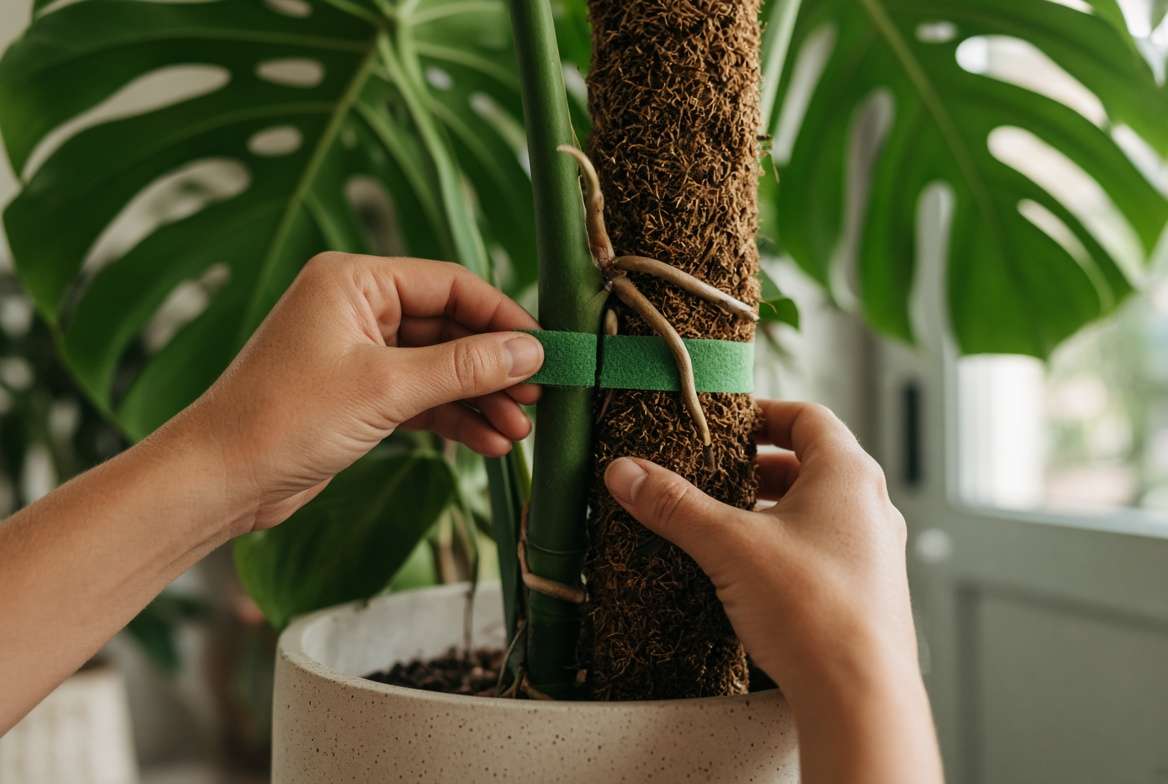
Place your moss pole securely against the back of that stem.
-
Use plant velcro, soft twine, or zip ties to secure the main stem to the pole.
-
Crucial Rule: Never tie the petioles (the thinner stalks that connect the leaf to the main stem). Petioles need to move freely to angle the leaves toward the sun. Tying them down will stunt your plant!
🧪 Feeding Your Monstera Plant for Explosive Growth
Creating those massive, two-foot-wide leaves requires a tremendous amount of energy. While a good soil mix provides a baseline, a consistent fertilizer schedule is necessary to achieve true jungle proportions.
Macronutrients Explained: You will see three numbers on any fertilizer bottle (NPK): Nitrogen (N), Phosphorus (P), and Potassium (K). For tropical foliage plants like the Monstera, Nitrogen is the star of the show. It is the primary building block for rich, green leaf growth.
The Feeding Schedule 📅
-
Spring and Summer (Active Growth): Feed your plant every 2 to 4 weeks using a high-quality, balanced liquid fertilizer (like a 3-1-2 or 20-20-20 ratio) diluted to half the recommended strength. Diluting protects the roots from chemical burn.
-
Fall and Winter (Dormancy): Stop fertilizing entirely, or reduce to once every two months. Pushing a plant to grow when natural light is low results in weak, leggy stems.
Organic vs. Synthetic: Synthetic liquid fertilizers deliver immediate nutrients, but salt can build up in the soil over time (be sure to flush the pot with pure water every few months). Organic options, like fish emulsion or kelp extract, smell a bit earthy for a day or two but feed the beneficial microbes in your soil ecosystem, resulting in stronger long-term health.
✂️ Propagation: How to Multiply Your Monstera
Once your plant is thriving, it might outgrow your space, or you might want to share a cutting with a friend. Propagating a Monstera is incredibly rewarding and surprisingly simple—if you know basic plant anatomy.
The Golden Rule: Find the Node 🔍
You cannot propagate a Monstera from just a leaf. If you cut a leaf off and put it in water, it will look pretty for months, but it will never grow a new plant. You must include a node. The node is the knobby, slightly swollen section on the main stem where aerial roots and leaves emerge. A cutting must contain at least one node and one healthy axillary bud to produce new growth.
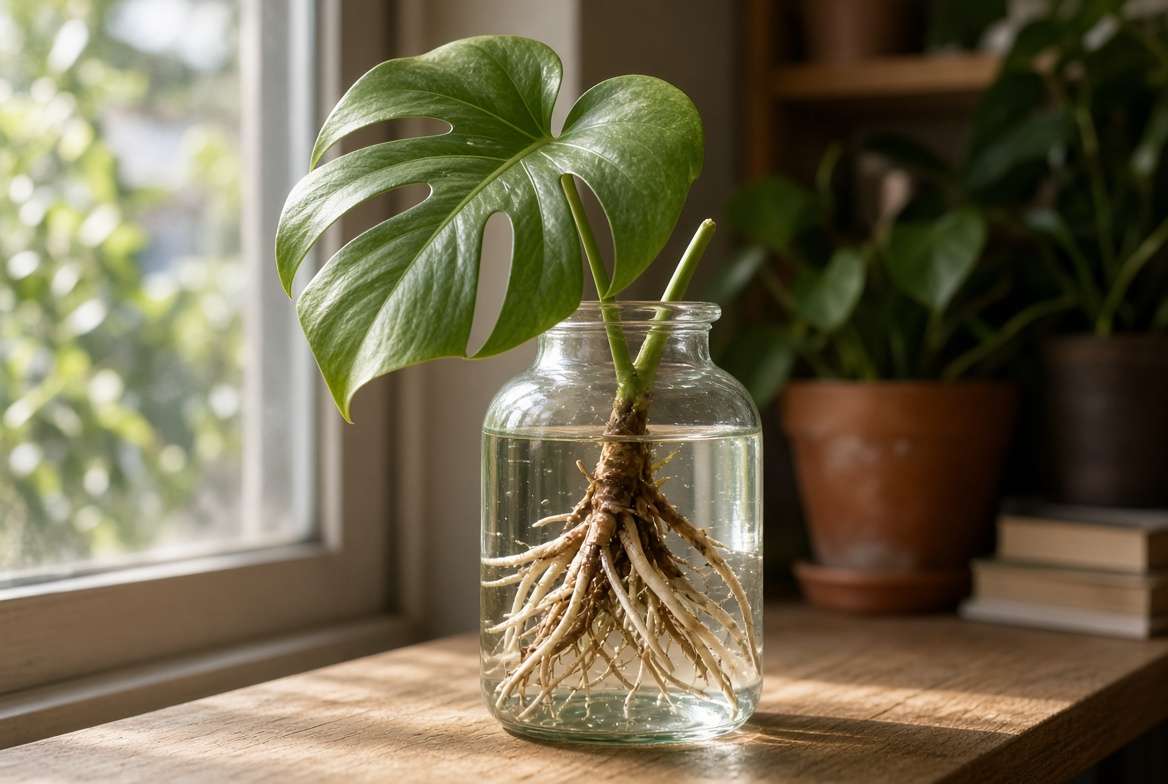
Method 1: Water Propagation (Beginner Friendly) 💧
-
Using sterilized pruning shears, make a clean cut about an inch below a node.
-
Place the cutting in a glass vase filled with room-temperature water. Ensure the node is submerged, but keep the leaf out of the water to prevent rot.
-
Place the vase in bright, indirect light and change the water weekly to replenish oxygen.
-
Within 3-6 weeks, thick white water roots will emerge. Once they are 2-3 inches long, pot the cutting in your chunky aroid mix.
Method 2: Sphagnum Moss Propagation (Advanced/Faster) 🌿
Place your cutting in a clear plastic container filled with damp (not soaking wet) sphagnum moss and perlite. Cover it with a lid to create a high-humidity greenhouse effect. This method encourages robust, soil-ready roots much faster than water and reduces transplant shock.
🚨 Troubleshooting: Common Monstera Plant Problems
Even the best indoor gardeners run into issues. Because you are cultivating a living ecosystem in your living room, occasional hiccups are normal. Here is how to diagnose and fix the most common yellow Monstera leaves and other ailments:
| Symptom | Likely Cause | The Expert Solution |
| Entire leaves turning yellow (starting at the bottom) | Overwatering / Root Rot. The soil is staying wet for too long. | Stop watering immediately. Check the drainage hole. If the soil smells sour, you must unpot the plant, trim away mushy black roots with sterile scissors, and repot in a fresh, chunky soil mix. |
| Crispy, brown edges on leaves | Low Humidity or Underwatering. The plant is losing moisture faster than it can absorb it. | Ensure you are soaking the soil thoroughly when you water. If watering is correct, add a humidifier nearby (Monsteras prefer 50-60%+ humidity). |
| Small, solid leaves (no splits) on a mature plant | Insufficient Light. The plant does not have the energy to produce complex fenestrations. | Gradually move the plant closer to a window, or invest in a full-spectrum LED grow light. Ensure it has a pole to climb. |
| Tiny white bugs crawling / Webbing on leaves | Pests (Thrips or Spider Mites). Common indoor houseplant pests. | Isolate the plant. Wipe the leaves down with a damp cloth, then treat the entire plant (front and back of leaves) thoroughly with insecticidal soap or Neem oil spray once a week for a month. |
💬 Frequently Asked Questions (FAQs)
How long does it take for a Monstera plant to get split leaves?
Age and environment dictate this. Typically, a Monstera grown from seed or tissue culture will begin producing its first primary fenestrations (the side splits) when it is about 2 to 3 years old. However, if the plant lacks bright light and a climbing structure, it may never split, regardless of its age.
Can I cut the long, brown aerial roots off my Monstera?
Yes, if they are unruly or touching the floor, you can prune them cleanly with sterile shears without harming the plant. However, a better practice for plant health is to gently tuck those aerial roots back into the soil pot. The root will transition into a subterranean root, giving your plant a massive boost in water and nutrient uptake!
Why is my Monstera plant dripping water from the tips of its leaves?
This is a perfectly normal biological process called guttation. When the soil is moist and the air is humid (usually overnight or early morning), the plant relieves internal water pressure by expelling tiny droplets of xylem sap from the tips of its leaves. It just means your plant is fully hydrated!
Are Monstera plants toxic to cats and dogs?
Yes. All parts of the Monstera deliciosa contain insoluble calcium oxalate crystals. If chewed or ingested by pets (or humans), these microscopic, needle-like crystals embed in the mouth and throat, causing severe burning, swelling, drooling, and vomiting. Keep them out of reach of curious pets!
🌟 Conclusion: Cultivating Your Indoor Jungle
Transforming a basic houseplant into a stunning, fenestrated centerpiece doesn’t require a magic green thumb; it just requires a basic understanding of tropical horticulture. By providing the Holy Trinity—bright indirect sunlight, a chunky, well-draining soil mix, and mindful watering—you are already ahead of 90% of indoor gardeners.
Add a sturdy moss pole to mimic its natural rainforest habitat, and you will unlock the true secret to those huge, split leaves. Remember that plant care is a journey of patience. Your Monstera operates on its own timeline, but when you finally see that first massive, hole-punched leaf unfurl, every ounce of effort will be worth it.
We want to hear from you! How old is your Monstera, and has it started splitting yet? Drop a comment below, or share a photo of your indoor jungle on Instagram and tag us.
Looking for more expert plant care? Check out our guide on the Best Humidifiers for Tropical Plants or learn how to mix the perfect Aroid Soil Recipe in bulk!











