
Imagine pouring months of care into your cannabis grow—perfect lighting, pristine environment, top genetics—only to watch your buds fall short of their potential because of hidden nutrient issues. It’s a frustrating scenario many growers face, but the good news is that mastering nutrients for cannabis plants can unlock 20–30% higher yields, denser buds, and superior potency. 🌱
As a horticulturist with over 15 years of hands-on experience cultivating cannabis in soil, hydroponic, and coco systems—plus consulting for licensed operations and staying current with 2024–2025 research—I’ve seen firsthand how precise nutrition transforms average harvests into exceptional ones. In this ultimate guide, we’ll dive deep into every essential nutrient, stage-specific needs, deficiency signs, and advanced strategies to achieve vigorous growth and maximum yields. Whether you’re a beginner or seasoned pro, this comprehensive resource will equip you with the knowledge to optimize your plants’ health and output. 🚀
Why Nutrients Are the Foundation of Cannabis Success 🌟
Cannabis is a high-demand crop, rapidly consuming nutrients to fuel photosynthesis, cannabinoid synthesis, and terpene production. Modern genetics, LED lighting, and CO₂ enrichment (common in 2025 grows) amplify these needs, making balanced nutrition more critical than ever.
Proper feeding supports robust root development, lush vegetative growth, and resin-packed flowers. Conversely, imbalances lead to stunted plants, reduced potency, and vulnerability to pests/diseases. Recent studies (2024–2025) show that optimized NPK ratios and micronutrients can boost yields by up to 25% while enhancing cannabinoid profiles.
Debunking myths: “More nutrients = better yields” is false—overfeeding causes toxicity and lockout. Quality, balanced formulas tailored to stages yield the best results. 💡
The Essential Macronutrients (NPK and Beyond) 💪
Macronutrients are required in larger quantities and form the backbone of cannabis nutrition.
Nitrogen (N) – The Engine of Vegetative Growth
Nitrogen drives leaf and stem development, forming chlorophyll and proteins. In vegetative stages, aim for higher N ratios (e.g., 3:1:2 NPK).
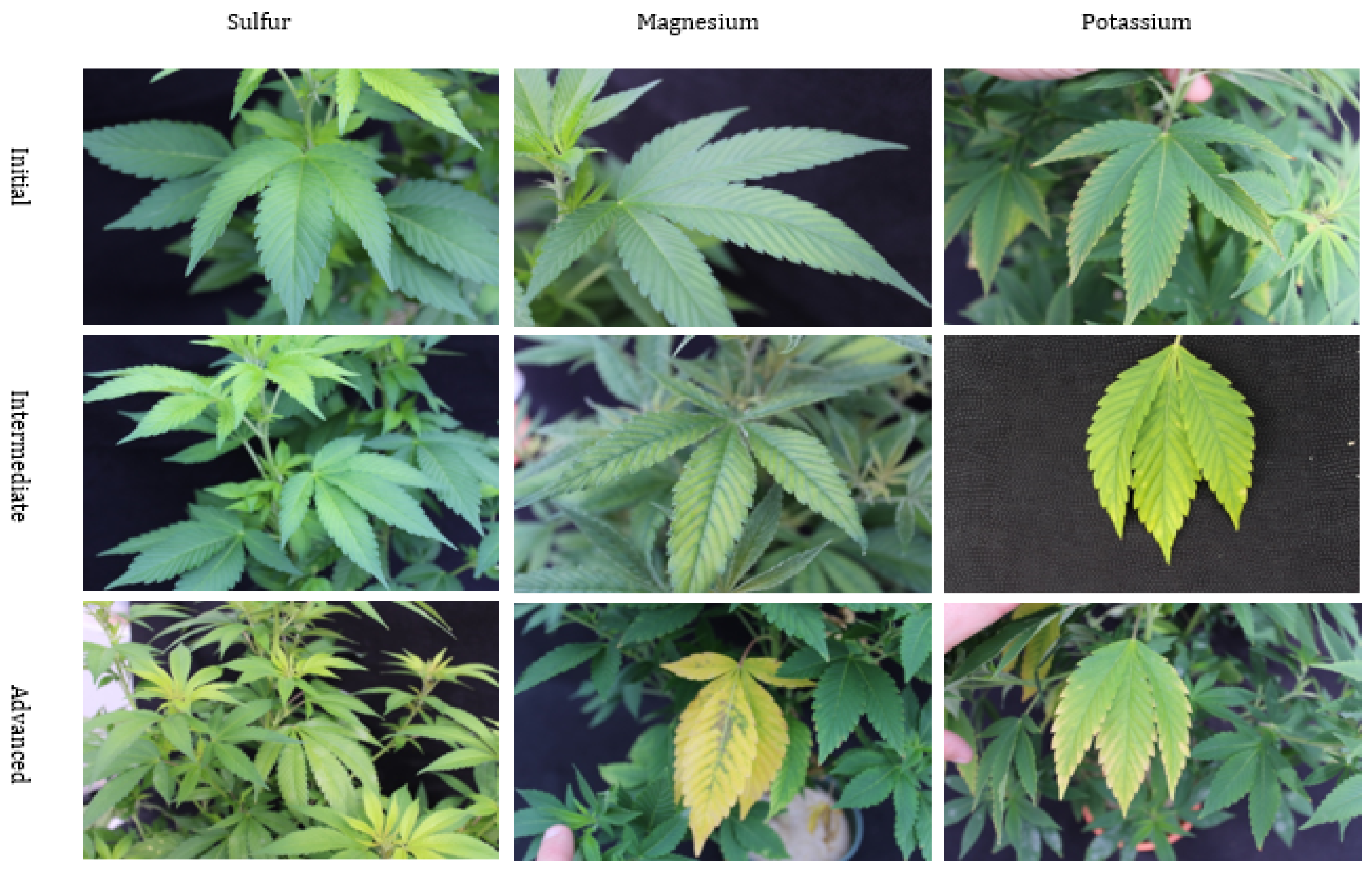
Deficiency: Yellowing lower leaves (mobile nutrient), stunted growth. Toxicity: Dark green leaves, clawing, delayed flowering.
Pro tip: Organic sources (compost teas) release slowly; synthetics act fast but risk burn.
Phosphorus (P) – Boosting Roots and Bud Development
Essential for energy transfer (ATP), root growth, and flowering. Increase P in bloom (1:3:2 NPK) for bigger buds.
Deficiency: Purple stems, slow growth, poor bud set. Often from pH lockout. Fix: Use bloom boosters sparingly to avoid excess.
Potassium (K) – Stress Resistance and Quality Enhancer
Regulates water uptake, enzyme activation, and terpene/cannabinoid production. Enhances density and aroma.
Deficiency: Burnt leaf tips, weak stems, spotted leaves. Common in late flower under LEDs.
Calcium (Cal) – Cell Wall Strength and Structure
Secondary macro; strengthens walls, prevents bud rot. Critical in coco/hydro (no natural Ca).
Deficiency: Tip burn, distorted new growth. 2025 note: LED grows often need extra CalMag due to spectrum differences.
Magnesium (Mg) – The Heart of Chlorophyll
Central to chlorophyll; deficiencies hit fast.
Deficiency: Interveinal yellowing on mid/lower leaves. Quick fix: Epsom salts foliar spray.
Sulfur (S) – Aroma and Flavor Builder
Supports essential oils and terpenes.
Deficiency: Young leaf yellowing, similar to N but starts at top.
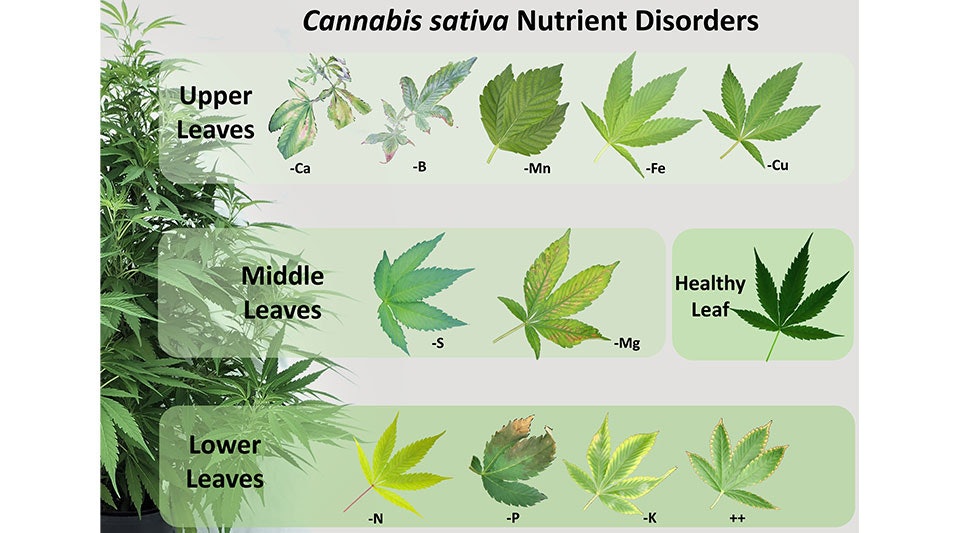
Common macronutrient deficiency symptoms – use this visual chart for quick diagnosis.
Micronutrients – Small but Mighty 🔬
Though needed in trace amounts, micros are vital for enzyme function and overall health. Chelated forms improve uptake in soilless media.
Key micros: Iron (chlorophyll), Zinc (growth hormones), Manganese (photosynthesis), Boron (cell walls), Copper (reproduction), Molybdenum (N conversion), Chlorine (osmosis).
Deficiencies: Rare in quality nutrients but show as spotting, chlorosis in new growth (immobile).
Table: Micronutrient Roles & Sources
| Micronutrient | Role | Deficiency Signs | Sources |
|---|---|---|---|
| Iron | Chlorophyll formation | Interveinal yellowing new leaves | Chelated Fe supplements |
| Zinc | Enzyme/hormone production | Twisted leaves, small buds | Zinc sulfate |
| Manganese | Photosynthesis | Brown spots | Manganese chelate |
| Boron | Cell wall/reproduction | Brittle stems, hollow | Boric acid |
| Copper | Lignin formation | Wilting, blue tint | Copper sulfate |
| Molybdenum | Nitrogen fixation | Yellow older leaves | Sodium molybdate |
Stage-Specific Nutrient Strategies 📅
Cannabis needs shift dramatically across stages—tailor feeding for optimal results.
Seedling and Clone Stage
Delicate roots; avoid burn.
- EC/PPM: 200–400
- Light feeding (25% strength) or plain pH water.
- Focus: Gentle N for roots.
Vegetative Phase Feeding Schedule
High N for bushy growth.
- NPK: 3:1:2 or higher N
- EC/PPM: 800–1200
- Feed every watering in hydro; weekly in soil.
- Foliar feeds boost uptake.
Example vegetative feeding chart – high N phase.
Flowering Phase – Transition and Peak Bloom
Shift to P/K heavy.
- Week 1–2 transition: Balanced, reduce N.
- Peak: 1:3:2 NPK, EC 1000–1400.
- Avoid excess N to prevent leafy buds.
Late Flower and Ripening
PK boosters, then flush.
- Reduce nutrients weeks 6–8.
- Flush 1–2 weeks for clean taste.

Choosing the Right Nutrient Line for Your Setup 🧪
2025 top brands: Advanced Nutrients (synthetic leader, pH-perfect tech), Lotus Nutrients (simple pro series), Cronk PuurOrganics (best organic), Fox Farm, General Hydroponics.
Organic vs. Synthetic:
- Organic: Slower release, better flavor/terpenes, microbial boost (e.g., living soil with Gaia Green).
- Synthetic: Fast uptake, precise control, higher yields in hydro (e.g., Advanced Nutrients).
For soil: Organics or hybrid. Coco/Hydro: Synthetics with CalMag.
Read labels: Look for chelated micros, stage-specific ratios.
Expert insight: Start at 50–75% recommended strength; adjust based on plant response.
Diagnosing and Fixing Nutrient Problems 🩺
pH is king—wrong range locks nutrients.
Ideal: Soil 6.0–7.0; Hydro/Coco 5.8–6.2.
pH nutrient availability chart – peak uptake around 6.0–6.5.
Step-by-step troubleshooting:
- Check pH/EC runoff.
- Identify mobile (old leaves) vs. immobile (new) symptoms.
- Flush if toxicity suspected.
- Correct specific deficiency.
Case study: LED grower with tip burn—added CalMag, resolved in days.
Advanced Tips for Maximum Yields 🚀
- Beneficial microbes/mycorrhizae: Enhance uptake in organics.
- CO₂ enrichment: Increases demand 20–30%; boost nutrients.
- Silica: Stronger stems, pest resistance.
- CalMag preventative under LEDs.
- Compost teas/top dressing for living soil.
2025 trends: Biostimulants for regenerative grows.
Sustainable and Eco-Friendly Nutrient Practices ♻️
Minimize runoff with recirculating systems. Reuse solutions, choose organics to reduce environmental impact. Emerging: Regenerative farming with cover crops.
Frequently Asked Questions (FAQs) ❓
What are the best nutrients for beginners? Single-part like Lotus or Fox Farm—easy, forgiving.
Can I make homemade nutrients? Yes—compost teas, banana peels for K—but inconsistent vs. commercial.
How often should I feed? Soil: Weekly; Hydro: Every watering; Coco: Daily light.
Is tap water okay? If EC <0.4; otherwise RO + CalMag.
Ideal PPM for flowering? 1000–1400, strain-dependent.
How do LEDs change needs? More CalMag, PK for terpenes.
Single-part vs. multi-part? Multi-part more customizable for pros.
Conclusion 🌱✨
Mastering nutrients for cannabis plants is the key to unlocking vigorous growth, potent buds, and bumper yields. By understanding macros/micros, stage needs, and troubleshooting, you’ll avoid common pitfalls and achieve professional results.
Key takeaways: Balance over excess, monitor pH religiously, tailor to your setup. Keep a grow journal—your plants will thank you with thriving health and natural resistance.
Start observing closely today, and watch your harvests soar. Bookmark this guide, share your successes, and happy growing! 🚀











