Every spring, home gardeners and landscapers face the same back-breaking ritual: pulling invasive weeds, spraying herbicides, and hauling heavy bags of wood mulch, only to watch the crabgrass and dandelions return by midsummer. Traditional mulch inevitably breaks down, leaches nitrogen, and leaves bare soil fully exposed to opportunistic seeds blowing in the wind. If you are exhausted by this endless cycle, it is time to upgrade to a self-sustaining living mulch. Strategically planting the right perennial plants for ground cover is the ultimate, low-maintenance solution to permanently choke out aggressive weeds, dramatically reduce your yard work, and naturally protect your topsoil.
Over years of testing water-wise landscape designs and botanical solutions across multiple USDA Hardiness Zones, it becomes clear that nature abhors bare dirt. If you don’t plant something there, nature will—and it will usually be a weed. Establishing a dense, mat-forming carpet of greenery starves weed seeds of the sunlight and moisture they need to germinate, saving you dozens of hours of manual labor every single season.
This comprehensive guide breaks down the science of living mulches and reveals the top 7 non-invasive, fast-spreading varieties tailored to thrive in full sun, deep shade, heavy foot traffic, and poor soil conditions. 🌸🌱
How Ground Covers Outcompete Aggressive Weeds 🔍🍃
Understanding the exact mechanisms behind weed-suppressing ground covers allows you to choose the perfect plant for your landscape’s specific microclimate. These plants do not just physically cover the dirt; they wage a microscopic war for resources and win.
Canopy Density vs. Weed Germination ☀️🚫
Most common garden weeds (like purslane and crabgrass) have photoblastic seeds, meaning they require a direct trigger of sunlight to break dormancy and germinate. When evergreen ground cover perennials interlock their leaves, they create an impenetrable canopy. By completely blocking ambient light at the soil surface, this dense foliage shuts down weed germination before it can even begin.
Below-Ground Resource Dominance 🪱💧
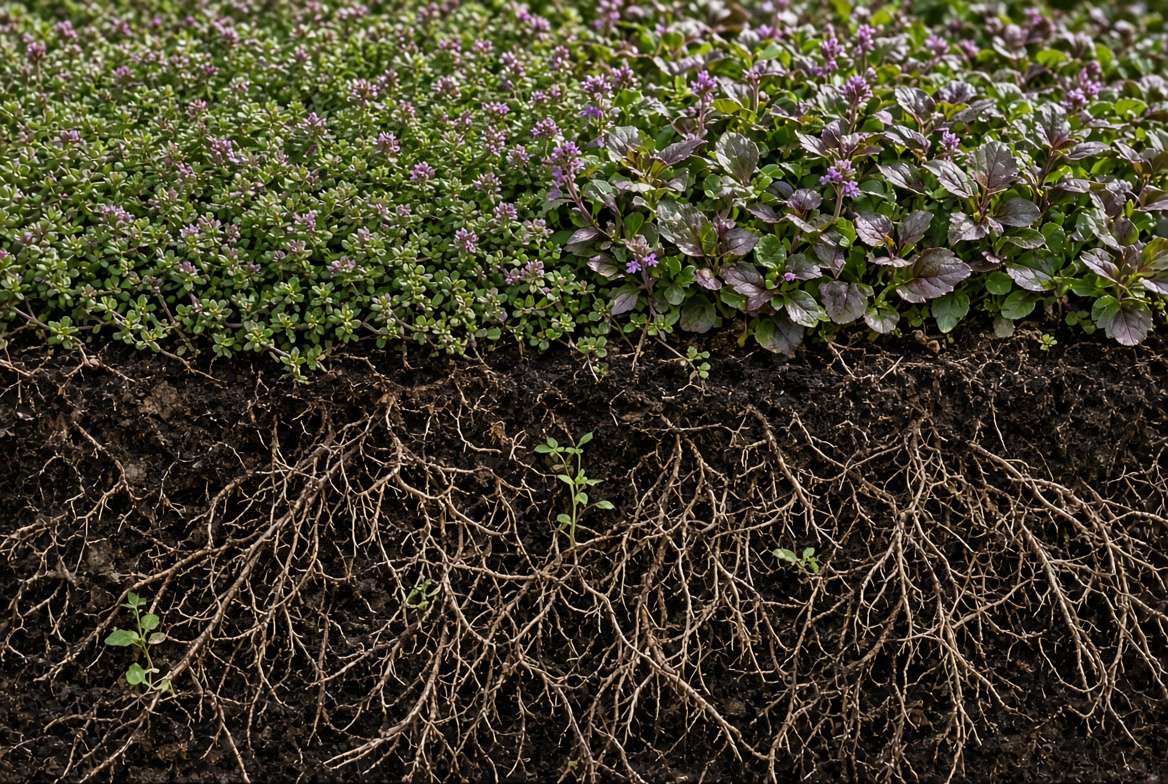
Weed suppression isn’t just a surface-level battle. Beneath the soil, aggressive ground covers utilize fibrous, mat-forming root systems that rapidly colonize available space. These expansive shallow roots outcompete weed seedlings for subterranean moisture and essential nutrients. Furthermore, some perennial ground covers exhibit allelopathic traits, naturally releasing biochemicals into the soil that inhibit the root growth of competing invasive species.
The Ecological Bonus 🐝🌼
Beyond saving you from weekend weeding duty, living mulches provide immense ecological benefits. A continuous root system stabilizes the earth, serving as the best erosion control for steep slopes. The dense vegetation prevents stormwater runoff, insulates the soil microbiome from extreme summer heat, and provides vital foraging habitats for early-season pollinators and beneficial predatory insects.
Quick Selection Cheat Sheet 📊📝
Use this scannable guide to match your specific yard conditions with the perfect weed-choking perennial.
The Top 7 Weed-Smothering Perennial Plants for Ground Cover 🏆🌿
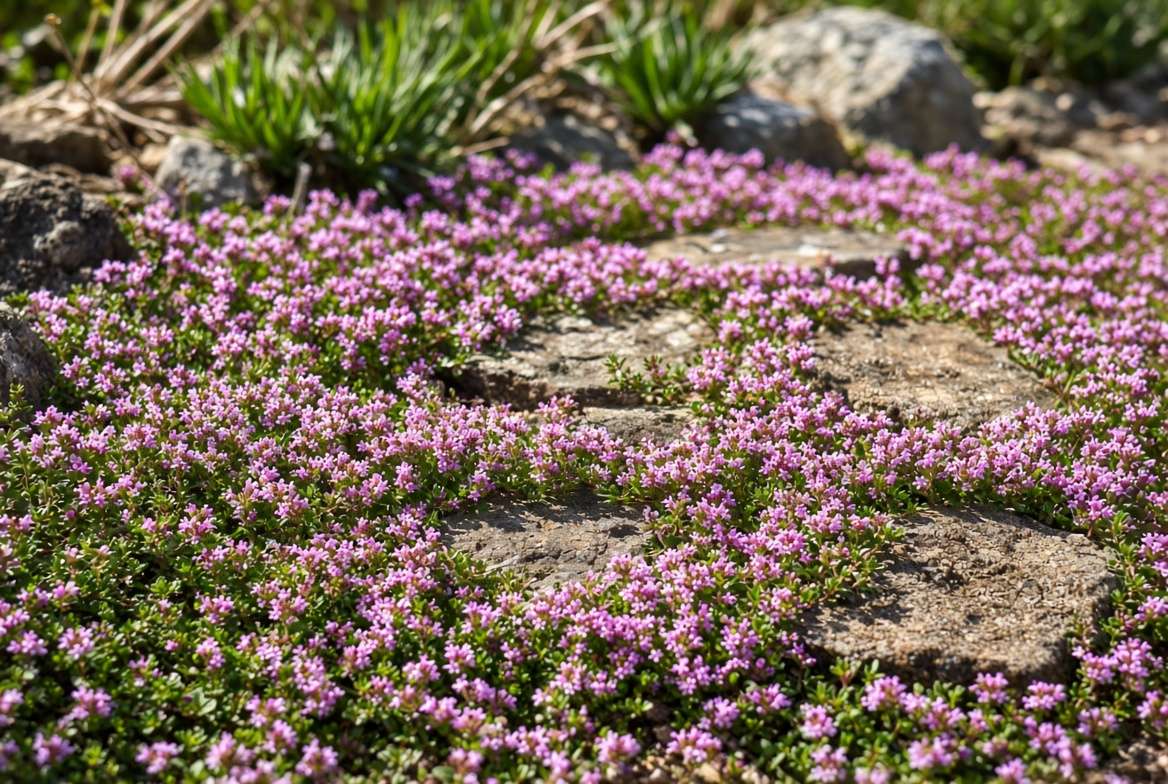
1. Creeping Thyme (Thymus serpyllum) — The Fragrant Footpath Dominator 👟🌸
If you have a hot, sun-baked area with poor, gritty soil where grass refuses to grow but weeds thrive, Creeping Thyme is your ultimate defense.
-
Best For: Full sun exposures, rock gardens, cascading over retaining walls, and filling the gaps between stepping stones.
-
Growth Profile: Staying incredibly low to the ground at just 2–3 inches tall, this semi-evergreen to evergreen perennial forms a surprisingly dense, fragrant mat. In early summer, it erupts in a carpet of tiny pink, purple, or white tubular flowers that bees absolutely adore.
-
Weed-Choking Power: The woody stems interlace tightly as they spread laterally. Once established, this woven carpet is so dense that dandelion seeds simply bounce off or fail to reach the soil.
-
Pro Tip: Lightly shear the tops of the plants with garden clippers immediately after the blooming cycle finishes. This simple trick stimulates hyper-dense vegetative regrowth, ensuring your thyme patch remains an impenetrable barrier against weeds.
2. Bugleweed (Ajuga reptans) — The Aggressive Shade Sculptor 💜🍃
Struggling with a patchy, weed-infested area under the canopy of a large oak or maple tree? Where turfgrass starves for light, Bugleweed thrives.
-
Best For: Moist shade to partial sun environments, particularly in woodland garden borders or under mature trees.
-
Growth Profile: Ajuga produces striking, glossy rosettes of foliage in deep shades of burgundy, bronze, or near-black, depending on the cultivar. In mid-to-late spring, it shoots up vibrant 6-inch spikes of blue-violet flowers.
-
Weed-Choking Power: Bugleweed spreads rapidly via horizontal stolons (above-ground runners). It roots aggressively wherever it touches the soil, forming a thick, overlapping carpet within a single growing season that easily smothers competing weeds.
-
Crucial Care Note: Because of its aggressive nature, it can sometimes creep into adjacent lawns. Choose specialized cultivars like ‘Black Scallop’ or ‘Chocolate Chip’; they offer superior, darker foliage color, tighter growth habits, and are much easier to keep within their designated borders.
3. Sweet Woodruff (Galium odoratum) — The Woodland Canopy Carpet 🤍🌲
For deep, undisturbed shade where even weeds struggle to look healthy, Sweet Woodruff provides an elegant, sweeping carpet of green.
-
Best For: Full shade, slightly acidic soils, and sprawling gracefully around the deep-rooted bases of rhododendrons, azaleas, and woodland trees.
-
Growth Profile: Featuring delicate, star-shaped whorls of vibrant green foliage, this classic woodland perennial blooms with clusters of tiny, brilliant white flowers in the spring. When its leaves are crushed or dried, it emits a delightful fragrance reminiscent of freshly cut hay and vanilla.
-
Weed-Choking Power: It expands steadily through natural rhizomatous root growth. By forming a solid, 8-inch-tall canopy of umbrella-like leaves, it completely outcompetes shallow-rooted forest weeds and prevents wind-blown seeds from settling into the soil.
-
Moisture Management: Sweet Woodruff acts as a brilliant temperature regulator. It keeps the root zones of companion shrubs remarkably cool and locks in vital soil moisture during midsummer heat spikes.

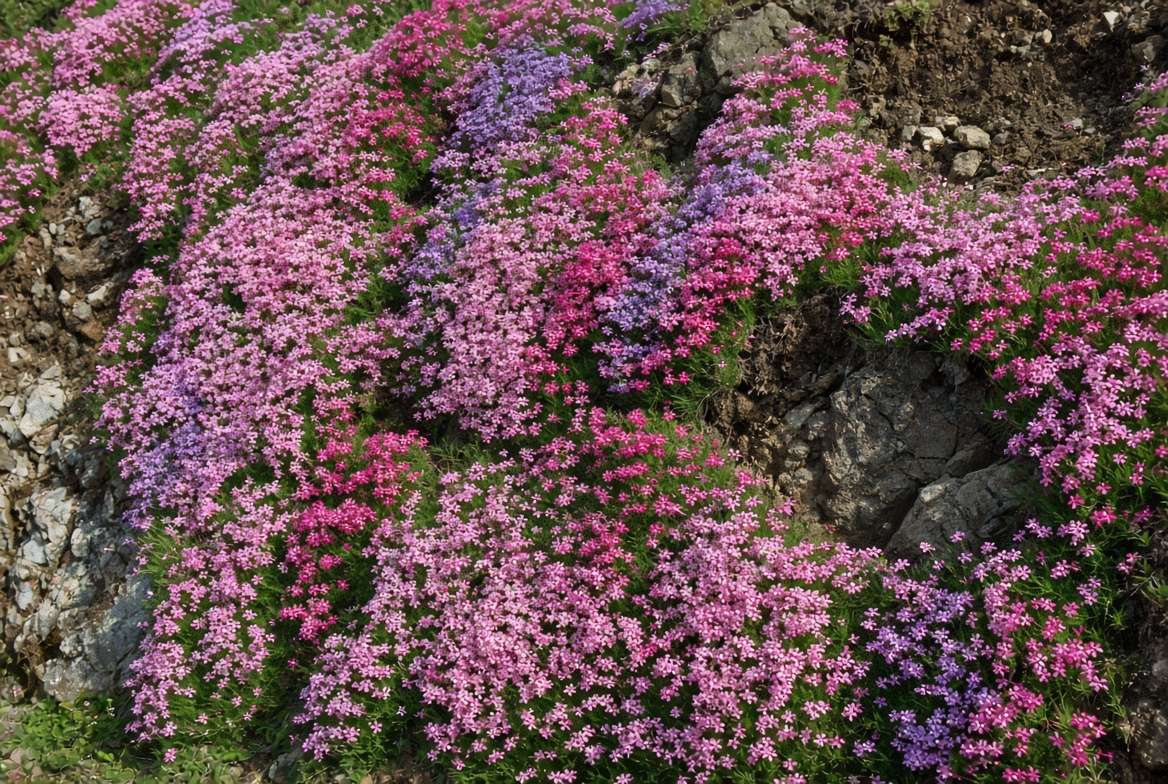
4. Creeping Phlox (Phlox subulata) — The Spring Blooming Weed Wall 🌺🧱
When you need to cover a difficult slope, secure an erosion-prone embankment, or create a stunning visual border in full sun, Creeping Phlox is an unparalleled performer.
-
Best For: Steep slopes, retaining wall edges, and dry, rocky soils in full, unabashed sunlight.
-
Growth Profile: This North American native boasts fine, needle-like evergreen foliage that looks fantastic year-round. However, its true claim to fame is the spectacular spring display, where it erupts into a vivid, solid sheet of pink, purple, magenta, or white blossoms.
-
Weed-Choking Power: As it spreads, its thick, woody stems creep along the surface, rooting deeply and creating a heavy physical barrier. It effectively blankets bare dirt, anchoring loose soil and completely shutting out windblown weed seeds.
-
Maintenance Hack: To prevent the center of the plant from turning woody and sparse (which can invite weed seeds to settle in the middle), give the plant an annual “haircut.” Trim it back by about one-third using shears immediately after the spring flowers fade. This promotes a flush of dense, compact foliage.
5. Barrenwort (Epimedium spp.) — The Dry Shade Survivor 🧚♀️🍂
Experienced landscapers know that dry shade—especially the dust-dry soil directly beneath mature, thirsty trees—is the hardest microclimate in any garden. Barrenwort is one of the few plants that thrives in this “impossible zone.”
-
Best For: Dry, nutrient-poor shade under shallow-rooted trees like maples, beeches, and mature oaks.
-
Growth Profile: Epimedium features tough, leathery, heart-shaped leaves held on delicate, wiry stems. In spring, it produces fairy-like, spurred flowers. Many varieties boast stunning foliage that emerges with red or bronze tinting in spring and turns a rich burgundy in autumn.
-
Weed-Choking Power: While it is admittedly slow to establish in its first year, patience pays off. Once the woody rhizomes anchor and spread, they create an iron-clad, thick barrier of overlapping leaves that weeds simply cannot penetrate.
-
Resilience Profile: Because the foliage is so tough and leathery, it is highly deer-resistant and practically immune to rabbit browsing. Once established, it requires zero supplemental watering, surviving severe drought with ease.
6. Stonecrop / Creeping Sedum (Sedum spurium & Sedum album) — The Drought-Proof Living Mulch 🪴☀️
If you live in a region prone to heat waves and strict water restrictions, swapping thirsty lawns for a carpet of Creeping Sedum is a strategic, eco-friendly move.
-
Best For: Baking hot sun, hellstrips (the unforgiving area between the sidewalk and the street), poor sandy soils, and rock gardens.
-
Growth Profile: These low-growing succulents feature fleshy, water-storing leaves that form tight, ground-hugging mats. Depending on the variety, they offer a stunning range of foliage colors from lime green to deep bronze-red, topped with clusters of star-shaped summer flowers.
-
Weed-Choking Power: Sedum acts like a living jigsaw puzzle, filling every available surface void completely. By covering the soil with its dense, succulent mass, it leaves absolute zero space for aggressive weed seeds to settle and sprout.
-
Low-Maintenance Scorecard: Sedum practically thrives on neglect. It requires poor soil to maintain its tight shape (rich soil makes it floppy) and will survive blistering summer temperatures without a single drop from your garden hose.
7. Wild Ginger (Asarum canadense / Asarum europaeum) — The Native Understory Guardian 🍃🍄
For a lush, tropical look in a temperate, shaded garden, Wild Ginger offers unparalleled elegance and formidable weed suppression.
-
Best For: Naturalized woodland settings, damp and organic-rich shaded gardens, and north-facing foundations.
-
Growth Profile: This plant is defined by its magnificent, broad, glossy, kidney-shaped leaves. It grows slowly but deliberately, layering its large leaves over one another like shingles on a roof.
-
Weed-Choking Power: The broad-leaf tile structure is the ultimate solar block. It successfully intercepts up to 98% of ground-level ambient light, making it biologically impossible for underlying weed seeds to photosynthesize and survive.
-
Native Advantage: Choosing North American Native Wild Ginger (A. canadense) ensures zero invasive risk to your local ecosystem. It is incredibly cold-hardy, completely unbothered by pests, and serves as a host plant for the spectacular Pipevine Swallowtail butterfly.
Step-by-Step Planting Guide: Setting Up for Zero-Weed Success 🛠️🪴
Merely tossing ground cover plants into a weed-infested yard will result in a frustrating battle. To ensure your perennials successfully establish their weed-smothering canopy, you must prepare the site correctly. Follow this horticultural protocol:
Step 1: The Blank Canvas (Eradicating Existing Weeds) 🛑 Never plant into a bed of established weeds. For a chemical-free approach, utilize the “sheet mulching” method. Cut existing vegetation down to the soil, cover the area with overlapping layers of thick, unwaxed brown cardboard, and wet it down. Plant your ground cover plugs directly through small holes cut into the cardboard. The cardboard will kill the weeds beneath it and naturally compost into the soil by the time your ground cover spreads.
Step 2: Spacing Strategy 📏 To speed up the closing of the canopy, plant your plugs in a staggered, diagonal grid pattern (usually 8 to 12 inches on-center, depending on the species’ growth rate) rather than straight rows. This geometric arrangement ensures the fastest possible lateral coverage.
Step 3: The First-Season Bridge 🌉 While your new perennial plants for ground cover are growing, there will be gaps of bare soil. You must protect these gaps. Apply a 1-to-2-inch layer of temporary organic mulch (like fine pine bark or leaf mold) strictly between the starter plugs. This suppresses early weed competition while giving the perennials time to knit together.
Step 4: Irrigation Tactics 💧 Water deeply and infrequently. If you water shallowly every day, you encourage weeds to germinate on the soil surface. Watering deeply once or twice a week forces the ground cover roots to dive deep into the soil profile, ensuring long-term drought resilience and out-competing shallow-rooted weeds.

Common Mistakes That Give Weeds an Advantage ⚠️🥀
Even with the best plants, human error can compromise a living mulch. Avoid these costly landscaping mistakes:
-
Leaving Perennial Weed Roots Behind: Taproots from dandelions or aggressive runners from bindweed and quackgrass must be meticulously removed before planting. If left in the soil, they will easily pierce right through your newly established ground cover canopy.
-
Over-Fertilizing: Ground covers bred for poor soil (like Thyme, Sedum, and Phlox) do not want synthetic fertilizers. Excess nitrogen encourages tall, weak, floppy growth that falls open in the center, immediately inviting weeds into the gaps.
-
Selecting Invasive Plants: Not all ground covers are good guys. Resist the temptation to plant English Ivy (Hedera helix), Periwinkle (Vinca minor), or Bishop’s Goutweed (Aegopodium podagraria). While they certainly kill weeds, they will also escape your yard, destroy local native ecosystems, climb and kill mature trees, and become a nightmare weed themselves.
Frequently Asked Questions ❓💬
Which perennial ground cover spreads the fastest to choke out weeds? Bugleweed (Ajuga reptans) and Creeping Thyme are among the fastest spreaders. Bugleweed utilizes above-ground runners to rapidly colonize shaded, moist areas, while Thyme vigorously spreads to form a dense mat in hot, sunny environments.
Will weeds grow through creeping thyme? Once fully established, very few weeds can penetrate a healthy mat of creeping thyme. However, during the first growing season while the thyme is still expanding to fill the gaps, some hand-weeding will be necessary.
Can perennial ground covers handle regular lawn foot traffic? No ground cover can withstand the heavy, daily wear-and-tear of a sports field or running dogs like traditional turfgrass. However, Creeping Thyme and some low-growing Sedums can handle moderate, occasional foot traffic perfectly well.
How long does it take for ground cover perennials to fully fill in and stop weed growth? Depending on your initial planting density and soil quality, fast-spreading varieties typically form a solid, weed-proof carpet within 12 to 18 months (roughly one to two full growing seasons).
What is the best evergreen ground cover for winter interest and weed suppression? Creeping Phlox and Creeping Thyme both retain their foliage through the winter in most hardiness zones, providing excellent year-round color, protecting the soil from winter erosion, and preventing early spring weed germination.
Conclusion: Reclaiming Your Weekends 🏡🌿
Swapping high-effort turf and the recurring financial drain of annual wood mulch for self-renewing, living carpets is one of the smartest investments a property owner can make. By strategically utilizing the right perennial plants for ground cover, you are not just masking a weed problem—you are out-competing it on a biological level. Once established, these dense, flowering carpets will protect your soil, support local pollinators, and give you back your summer weekends.
Ready to start planting? Drop your USDA hardiness zone, sun exposure, and soil type in the comments below, and let’s figure out the absolute best weed-smothering ground cover for your specific landscape! ✨👇