Imagine cracking open a perfectly roasted, slightly salty pistachio. Now, imagine that nut came not from a high-priced grocery store bag, but straight from a branch in your own backyard. If you live in a region with long, hot summers and moderately cold winters, growing your own Pistacia vera tree is an incredibly rewarding, albeit long-term, horticultural investment. While pistachios are famously expensive due to their specific climate requirements and lengthy maturation process, cultivating them at home is entirely achievable with the right knowledge. In this comprehensive guide, we will walk you through the exact steps to plant, maintain, and successfully harvest from your own pistachio trees.
💡 Expert’s Take: Let’s set realistic expectations right away—a grafted pistachio tree takes about 5 to 8 years to produce its first handful of nuts, and up to 15 years to reach peak production. Patience is your greatest tool here. If you are ready for the commitment, the ornamental beauty, shade, and eventual harvest are well worth the wait.
📖 What is a Pistacia Vera Tree? (Understanding Your Plant)
To successfully grow a fruiting tree, you must first understand its natural environment and genetic quirks.
Origins and Botanical Profile 🌍
Native to the arid, rugged regions of the Middle East and Central Asia, the Pistacia vera is a deciduous tree built for survival in harsh environments. Its desert genetics mean it is highly drought-tolerant once established and features an incredibly deep taproot system designed to hunt for water far beneath the soil surface. However, this same genetic makeup means it strongly dislikes high humidity and waterlogged roots.
The Golden Rule: Male vs. Female Trees 🚻
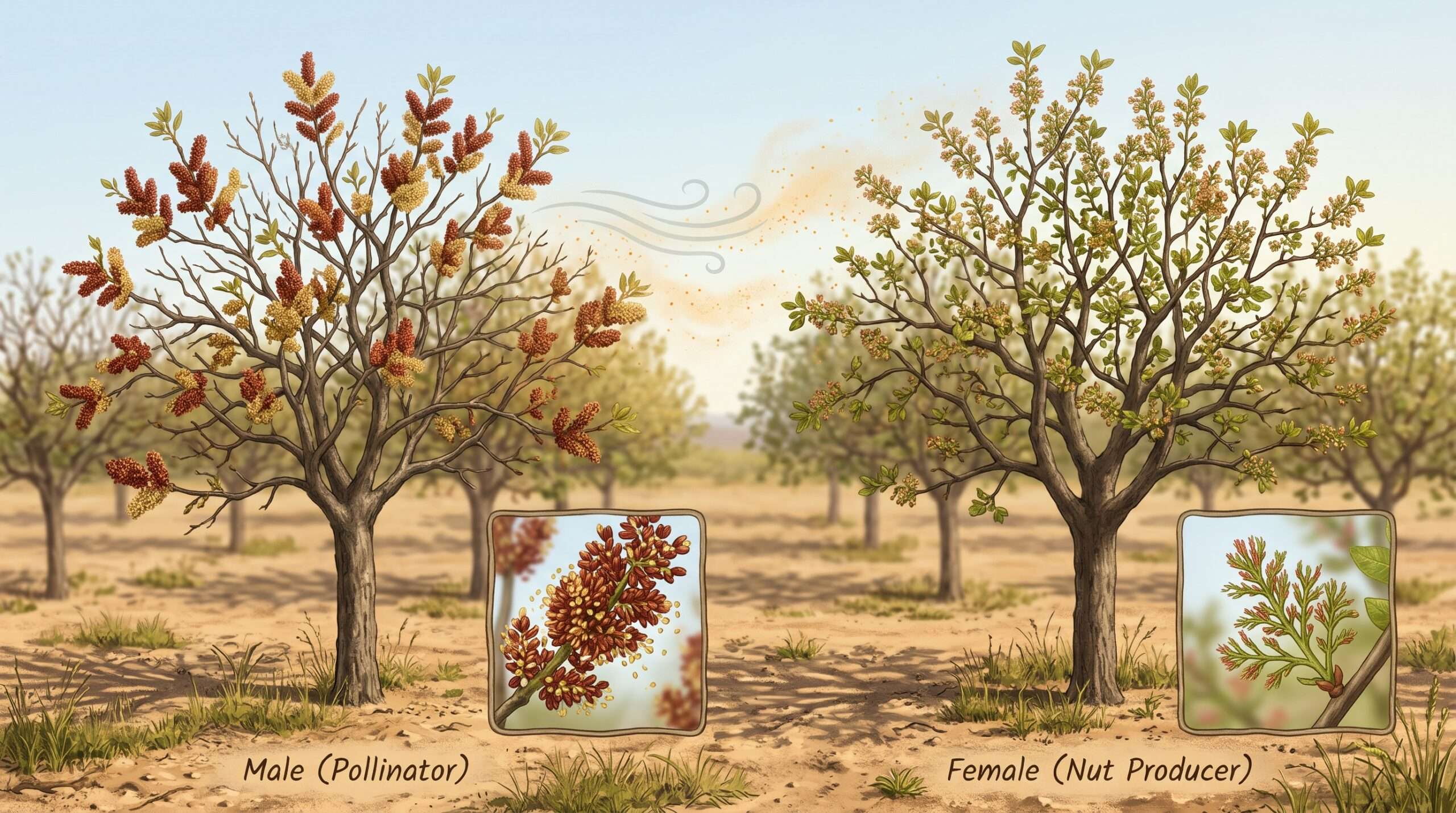
If you take away just one piece of advice from this guide, let it be this: pistachio trees are dioecious. This is a botanical term meaning that male and female flowers grow on entirely separate trees.
A female tree will never produce nuts without a male tree nearby to fertilize it. Furthermore, pistachios are wind-pollinated, not bee-pollinated. To achieve a harvest, you must plant at least one male pollinator tree (the ‘Peters’ variety is the industry standard) upwind from your nut-producing female trees (the ‘Kerman’ variety is the most popular and reliable). A single male tree can efficiently pollinate up to 10 female trees.
Image Prompt (16:9, 1280×720): A high-contrast, educational graphic showing a single male pistachio tree positioned upwind from three female pistachio trees. Gentle, stylized wind lines demonstrate pollen transferring from the male to the females. Bright, bold typography overlays. Alt text: Diagram showing wind pollination between male and female Pistacia vera trees.
☀️ Ideal Growing Conditions for a Pistachio Tree
You cannot force a pistachio tree to thrive in the wrong climate. Before investing in bare-root trees, verify that your property meets these non-negotiable environmental requirements.
Climate and Hardiness Zones (The “Chill Hour” Requirement) 🌡️
Pistachio trees perform best in USDA Hardiness Zones 7 through 10, but the zone alone doesn’t tell the whole story. These trees require a specific phenomenon known as chill hours.
To successfully break winter dormancy and produce flowers in the spring, a Pistacia vera needs between 700 and 1,000 chill hours (cumulative hours where temperatures drop below 45°F / 7°C, but stay above freezing). Without adequate winter chill, the tree will suffer from delayed foliation and poor nut yield. Following the winter chill, the tree requires a long, intensely hot, and dry summer to fully develop and mature the pistachio kernels inside their shells.
Sunlight Requirements ☀️
Do not plant this tree in partial shade. A pistachio tree requires full, unobstructed sunlight for a minimum of 8 to 10 hours a day. Shade will stunt the tree’s growth, invite fungal diseases by trapping moisture, and drastically reduce your nut yield.
Soil Type and pH 🪨
Because of its deep taproot, the Pistacia vera tree demands deep, well-draining soil. Sandy loam is ideal. While they are highly tolerant of alkaline and saline soils (capable of thriving in soil pH levels up to 8.0), they are completely intolerant of heavy, wet clay.
⚠️ Expert Warning: Planting a pistachio in waterlogged, poorly draining soil is a guaranteed death sentence. Wet roots leave the tree highly susceptible to Verticillium wilt, a fatal soil-borne fungus.
🌱 How to Plant Your Pistacia Vera Tree for Long-Term Success
The day you plant your tree dictates its trajectory for the next fifty years. Proper spacing and careful root handling are paramount.
Growing from Seed vs. Grafted Saplings 🌰
While it is tempting to plant a seed, we strongly advise against it. Grocery store pistachios are often roasted or salted, meaning the seed is dead. Even if you source raw seeds, growing from seed is a genetic gamble—you won’t know if the tree is male or female for up to a decade, and the resulting nuts may be of poor quality.
Instead, purchase grafted bare-root trees from a reputable nursery. A grafted tree fuses the high-yield fruiting wood of a ‘Kerman’ female onto a robust, disease-resistant rootstock (such as Pistacia integerrima, UCB-1, or Pioneer Gold) that actively resists soil-borne pathogens.
Spacing and Wind Pollination Layout 🌬️
Because these trees rely on the breeze to reproduce, strategic placement is vital. Determine the direction of your prevailing spring winds. Plant your male ‘Peters’ tree upwind, and plant your female ‘Kerman’ trees downwind.
Space the trees 15 to 20 feet apart. This gives the canopy room to expand (mature trees can reach 20-30 feet wide) and ensures optimal airflow to prevent fungal diseases.
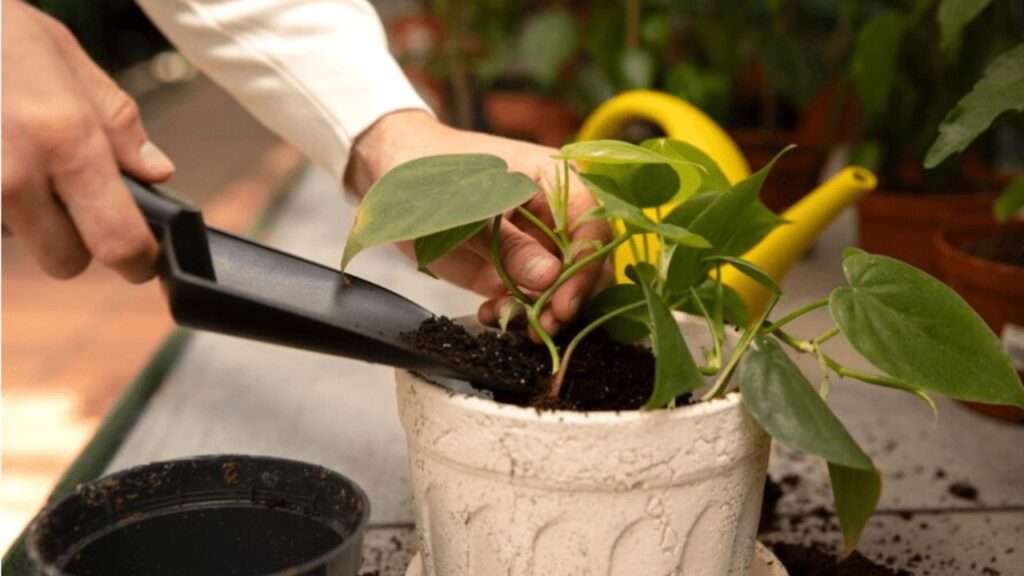
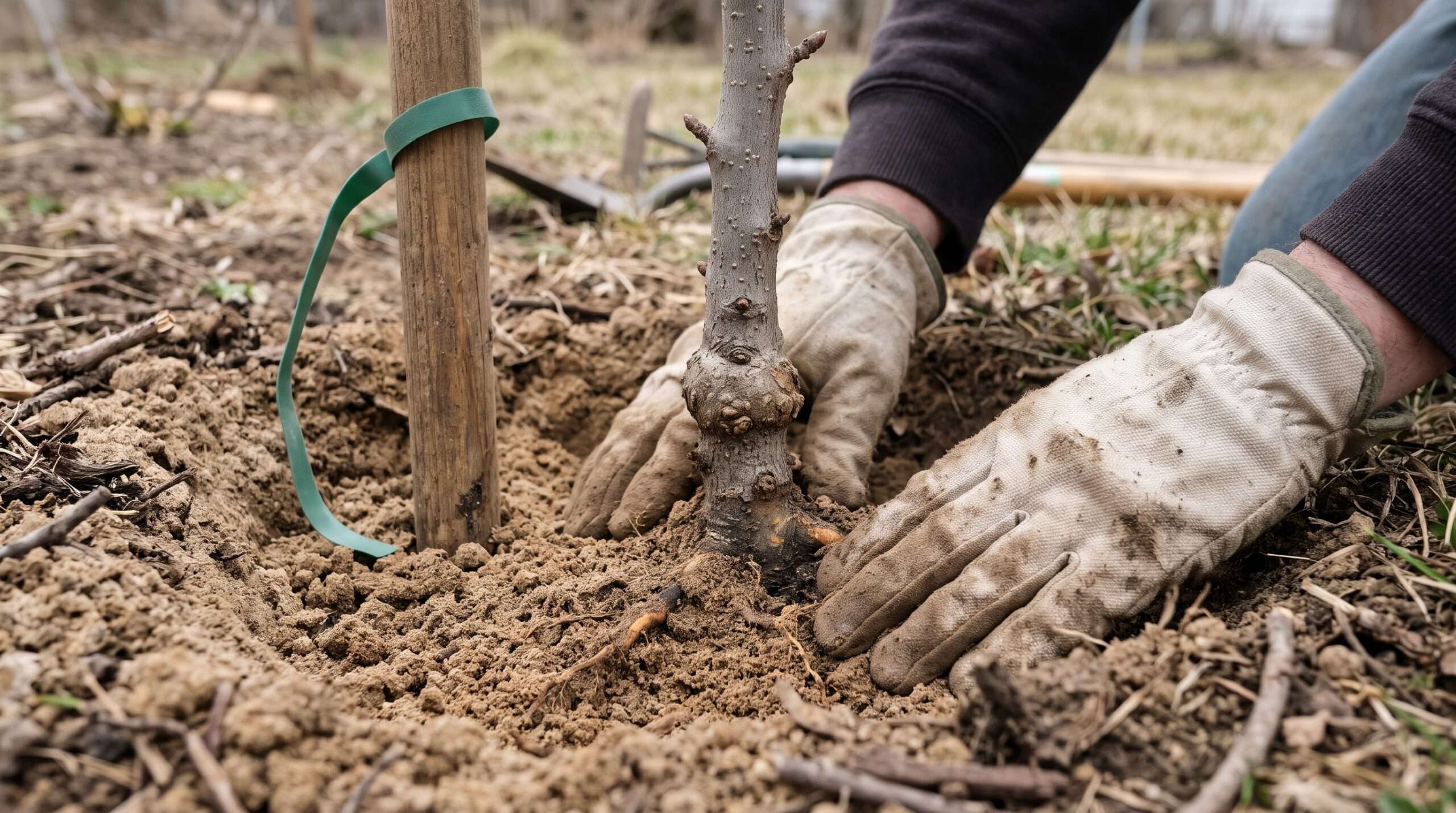
Image Prompt (16:9, 1280×720): A close-up of a gardener planting a bare-root pistachio sapling in sandy loam soil, emphasizing the prominent graft union sitting clearly two inches above the soil line. Bright, cinematic outdoor lighting with a shallow depth of field. Alt text: Proper planting depth for a grafted bare-root pistachio tree in well-draining soil.
Step-by-Step Planting Guide 🛠️
-
Timing: Plant bare-root trees in late winter or early spring while they are still dormant.
-
Digging the Hole: Dig a hole twice as wide as the root mass, but exactly as deep. Do not add rich compost to the hole; you want the roots to push outward into the native soil, not curl up in a nutrient-rich pocket.
-
Protect the Graft Union: Place the tree in the hole, ensuring the graft union (the swollen bump near the base of the trunk) sits 1 to 2 inches above the final soil line. If buried, the scion wood may root and bypass the disease-resistant rootstock.
-
Water and Stake: Backfill the soil gently, tamping it down to remove air pockets. Water deeply immediately after planting. Drive a wooden stake outside the root ball and gently tie the trunk to protect the young sapling from heavy winds.
💧 Essential Pistachio Tree Care & Maintenance
Once your sapling is in the ground, your focus shifts to long-term care. The way you water, feed, and prune your Pistacia vera tree over its first five years will permanently dictate its structural integrity and nut-bearing capacity.
Watering Schedule: From Sapling to Mature Tree 🚿
It is a common misconception that because pistachios are desert trees, they don’t need water. In reality, their drought tolerance only kicks in once their deep taproot is fully established.
-
Years 1–3: During the initial establishment phase, water your saplings deeply once a week during the hot summer months. The goal is to send water deep into the soil profile to encourage the taproot to grow downward.
-
Years 4+: As the tree matures, you can drastically reduce the frequency of watering. A mature tree thrives on deep, infrequent watering—perhaps once every three to four weeks, depending on rainfall.
-
⚠️ The Golden Rule of Watering: Always let the top few inches of soil dry out completely before watering again. Overwatering is the fastest way to kill a pistachio tree.
Fertilizing for Maximum Nut Production 🌿
Pistachio trees are moderate feeders, but they do require strategic nutrient boosts to support the heavy energy demands of producing nuts.
Wait until the tree’s second year before applying fertilizer. Once established, apply a nitrogen-rich fertilizer (like a 10-10-10 or custom orchard blend) in the early spring, just as the buds begin to swell. A second, lighter application can be done in early summer to support the developing nuts. Avoid fertilizing in late summer or fall, as this encourages a flush of new, tender growth that can be severely damaged by the first winter frost.
Pruning and Shaping (The Open-Center Method) ✂️
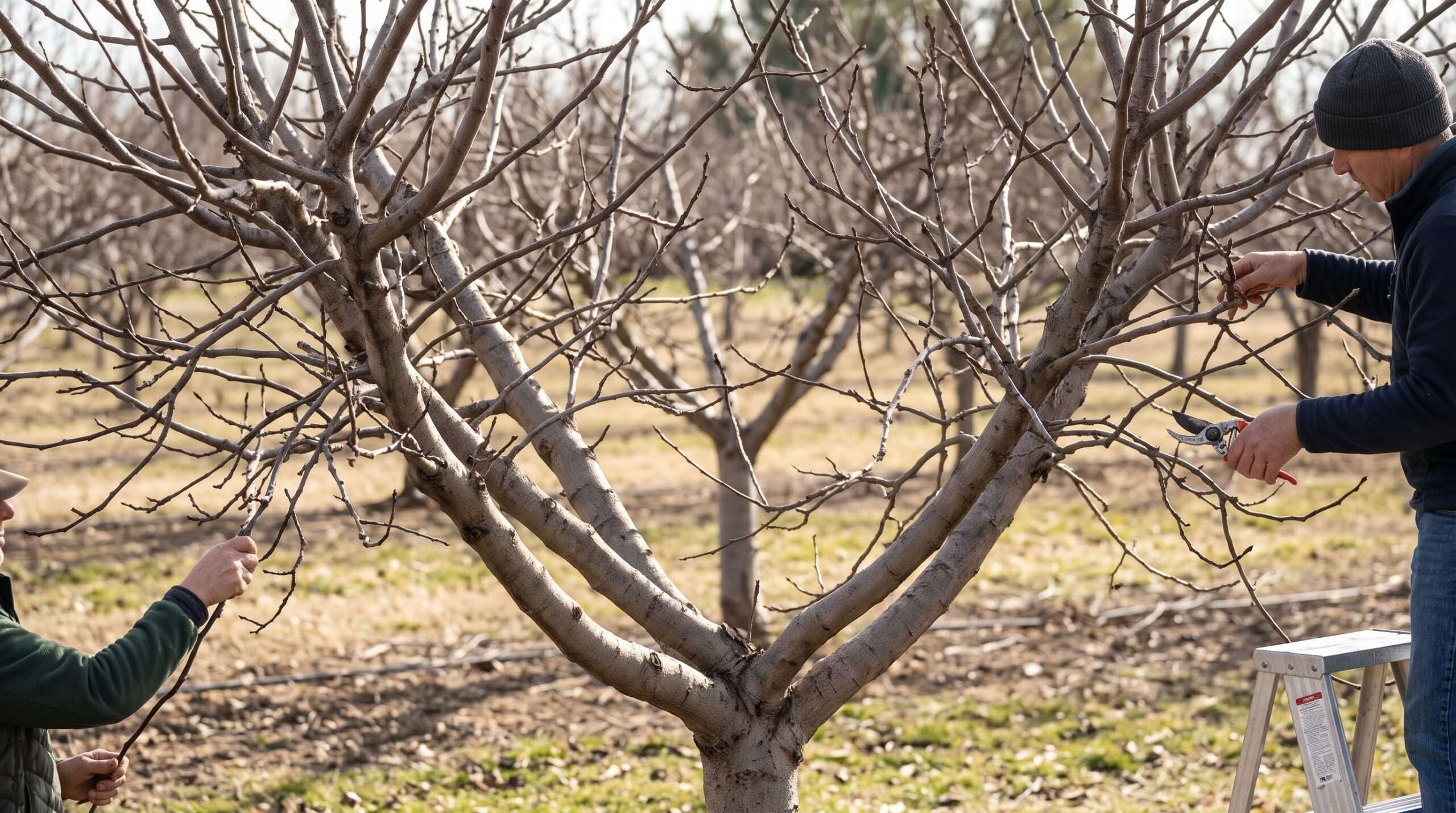
Pruning is an absolute necessity, not just for aesthetics, but for the health and yield of the tree. The industry standard for pistachio trees is the open-center pruning method (often called a “vase shape”).
-
Year 1: Head the tree back to about 30–36 inches above the ground to encourage lateral branching.
-
Years 2–3: Select 3 to 4 strong, well-spaced primary branches radiating outward from the trunk, and prune away the rest. Keep the center of the canopy completely open.
-
The Goal: An open center allows intense sunlight to penetrate the inner canopy (critical for nut development) and maximizes wind airflow (which prevents fungal diseases).
Pro Tip 💡: Proper structural pruning in these early years is what prevents catastrophic branch breakage a decade later when the tree’s canopy is burdened by hundreds of pounds of nuts.
🐛 Common Pests and Diseases (And How to Defeat Them)
Even the toughest desert trees have their enemies. Knowing how to identify and treat these issues early is the hallmark of an expert orchardist.
Verticillium Wilt (The Silent Killer) 🍄
Verticillium dahliae is a devastating soil-borne fungus that blocks the tree’s vascular system, preventing water from reaching the branches. Symptoms include sudden wilting, yellowing leaves, and rapid branch dieback—often on just one side of the tree.
-
The Fix: There is no chemical cure for Verticillium wilt. Your only defense is prevention. This is exactly why planting in well-draining soil and purchasing trees grafted onto highly resistant rootstocks (like UCB-1 or Pistacia integerrima) is so critical.
Pistachio Psyllids, Aphids, and Navel Orangeworm 🐞
While psyllids and aphids can suck sap and cause leaf distortion, the Navel Orangeworm is the most notorious pest for home growers. The female moth lays her eggs on the developing nuts, and the larvae burrow inside, ruining the kernel.
-
The Fix: Practice Integrated Pest Management (IPM). Release beneficial insects like ladybugs and lacewings to control aphids. For the Navel Orangeworm, the most effective organic control is strict orchard sanitation. Remove and destroy any “mummy nuts” (nuts left hanging on the tree after harvest) during the winter, as this is where the worms overwinter.
Fungal Issues from High Humidity 🌧️
If you live in a region with humid summers, you may battle Botryosphaeria blight, which causes lesions on shoots and blackens the developing clusters of nuts.
-
The Fix: Prune aggressively to maximize airflow, ensure your trees are in full, baking sun, and never use overhead sprinklers that wet the canopy. Keep the ground beneath the tree totally free of weeds and tall grass, which trap humidity near the trunk.
🧺 The Harvest: How and When to Pick Your Pistachios
The wait is over. You’ve nurtured your male ‘Peters’ pollinator and your female ‘Kerman’ trees for years, and now it is time to reap the rewards.
The Timeline: How Long Until Your Tree Fruits? ⏳
As mentioned, expect your first small harvest around year 5 to 8. However, you must also prepare for alternate bearing. This is a natural botanical rhythm where the tree produces an exceptionally heavy crop one year (the “on” year), followed by a very light, resting crop the next year (the “off” year). Do not panic when this happens; it is perfectly normal for the Pistacia vera.
Signs Your Pistachios Are Ready to Harvest 🎯
Pistachios generally ripen between late August and early October. Watch for these two unmistakable signs:
-
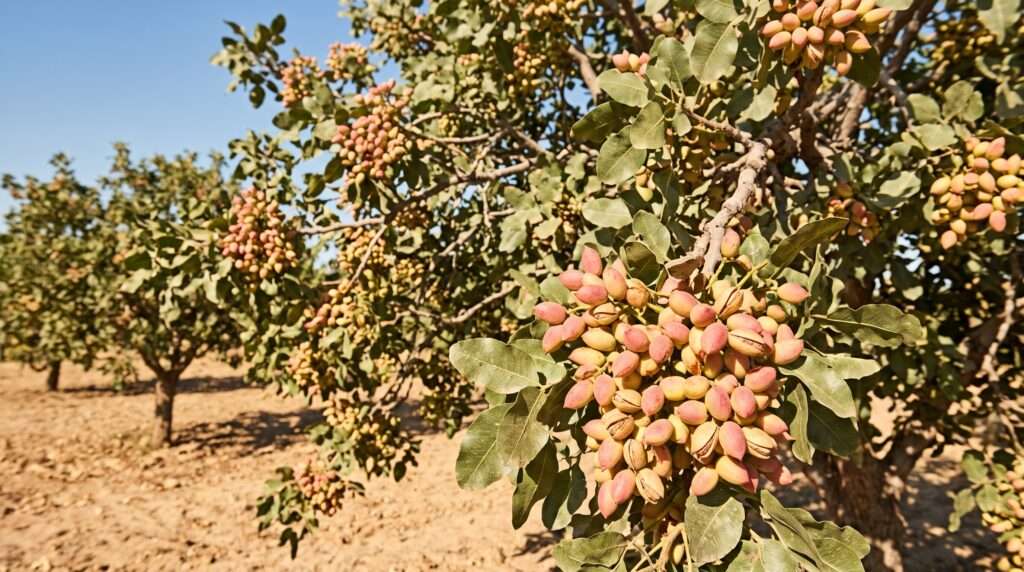
Color Change: The outer fleshy hull (the epocarp) will shift from a vibrant green to a pale, rosy pink or yellowish hue.
-
The Hull Split: The most obvious sign is the hull split. The outer hull will physically pop open on the branch, revealing the hard, beige shell inside. When the majority of the tree’s nuts have split their hulls, it’s harvest time.
Image Prompt (16:9, 1280×720): A highly detailed, macro shot of a pistachio cluster hanging from a branch in late summer. The outer fleshy rosy-pink hull is naturally splitting open to reveal the hard, beige pistachio shell inside. Rich, vibrant natural sunlight. Alt text: Ripe pistachio nuts showing natural hull split on the branch ready for harvest.
Proper Harvesting and Processing Techniques 🧤
Harvesting pistachios is a fun, physical process!
-
Lay large, clean tarps on the ground beneath the canopy.
-
Using a rubber mallet or your hands, firmly shake the branches. The ripe nuts will easily drop onto the tarp.
-
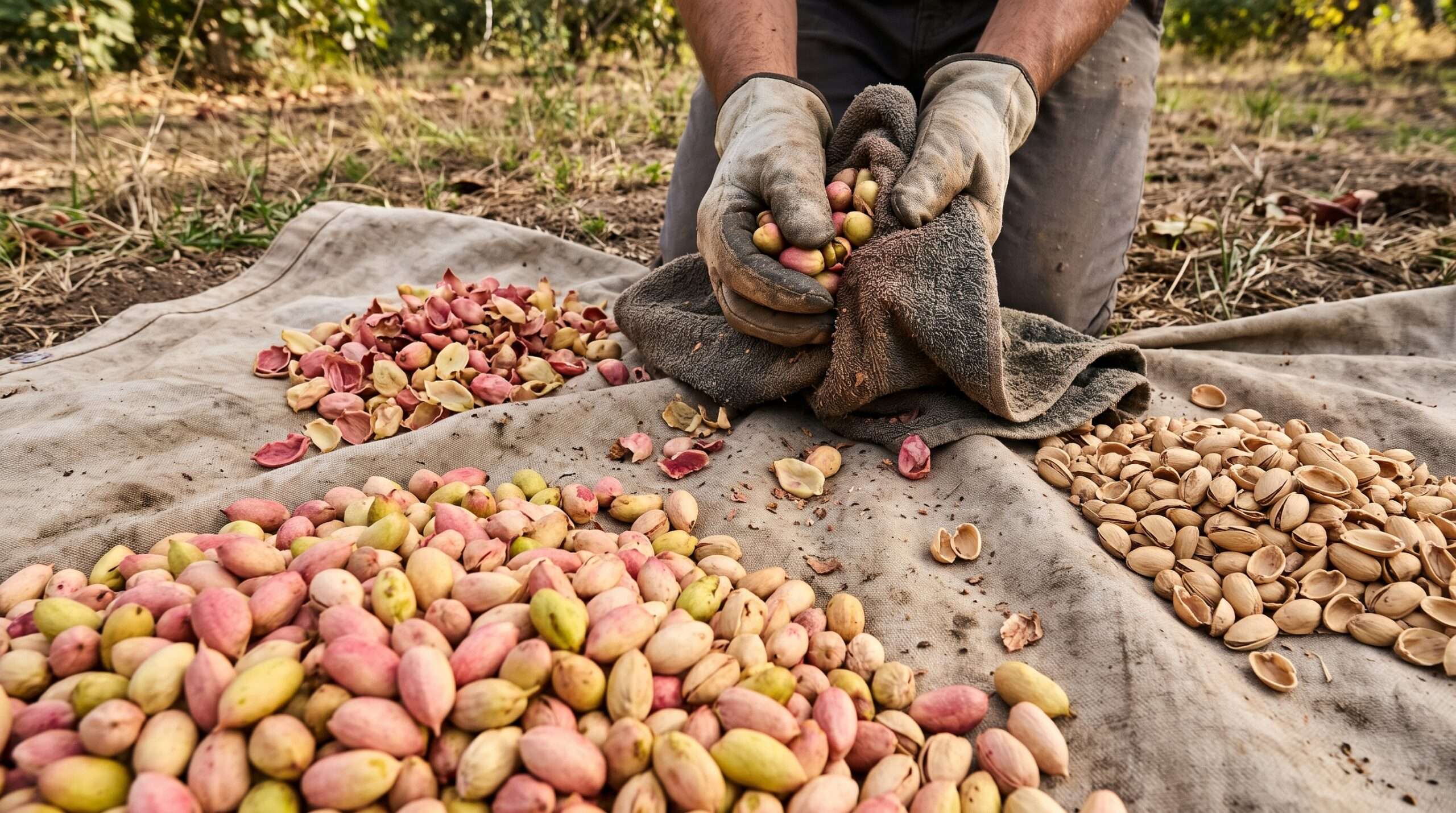
Crucial Step—The 24-Hour Rule: You must remove the rosy outer hull within 24 hours of harvesting. If left on, the hull will rapidly decay, staining the beautiful beige shell and encouraging the growth of Aspergillus flavus (a mold that produces toxic aflatoxin).
-
To remove the hulls, simply rub the nuts aggressively between two coarse towels.
-
Wash the hulled nuts in a bucket of water (discard any that float, as they are likely empty or damaged), and lay them out in the hot sun on screens for 3 to 4 days until the kernels are dry and crisp. From there, you can enjoy them raw or roast them with sea salt!
👑 Expert Tips for Maximizing Your Pistachio Yield
If you want to push your harvest from good to extraordinary, integrate these advanced tactics into your yearly routine:
-
Master the Soil Moisture Meter: Because the taproot is so deep, surface soil checks can be deceiving. Invest in a long-probe soil moisture meter. Only water when the soil is completely dry at a depth of 12–18 inches.
-
Strategic Weed Control: Keep a 4-foot radius completely bare around the base of the trunk. Weeds compete for valuable nitrogen and, worse, they elevate ambient humidity which invites fungal spores.
-
Know Your Rootstocks: When purchasing, ask the nursery specifically for the UCB-1 rootstock. Developed by the University of California, it is globally recognized as the gold standard for cold tolerance, high yield, and resistance to soil-borne pathogens.
❓ Frequently Asked Questions (FAQs)
Can I grow a Pistacia vera tree in a pot? 🪴 You can grow a pistachio tree in a very large, deep container for its first 3 to 5 years. However, because of its aggressive taproot, it will eventually become root-bound, stunted, and fail to produce nuts. They are ultimately ground-dwelling trees.
Do I really need two trees to get pistachios? 🌳🌳 Yes, absolutely. Because the trees are dioecious, a female tree cannot fruit without pollen from a male tree. While agricultural researchers are actively developing self-fruitful varieties, they are exceedingly rare and generally unavailable to home growers. Stick to the classic male-and-female pairing.
Are pistachio trees toxic to dogs? 🐕 The tree itself (leaves and bark) is not considered highly toxic to dogs. However, the true danger lies in the nuts. Pistachios left rotting on the ground can quickly develop molds containing mycotoxins, which cause severe neurological and liver damage to canines if ingested. Always rake up dropped nuts promptly.
🏁 Conclusion: Your Journey to Homegrown Pistachios
Cultivating a Pistacia vera tree is a true masterclass in patience and horticultural dedication. By understanding the critical importance of male and female pairings, honoring the strict winter chill hours, and providing the deep, well-draining soil these desert natives crave, you are setting the stage for decades of success. While you may have to wait a few years for that first hull split, the unparalleled satisfaction of harvesting, roasting, and sharing your very own pistachios makes every season worth the effort.
Are you ready to start your orchard? Check your USDA hardiness zone today, and if this guide helped you gain the confidence to plant, be sure to save it to your gardening boards on Pinterest! 📌