
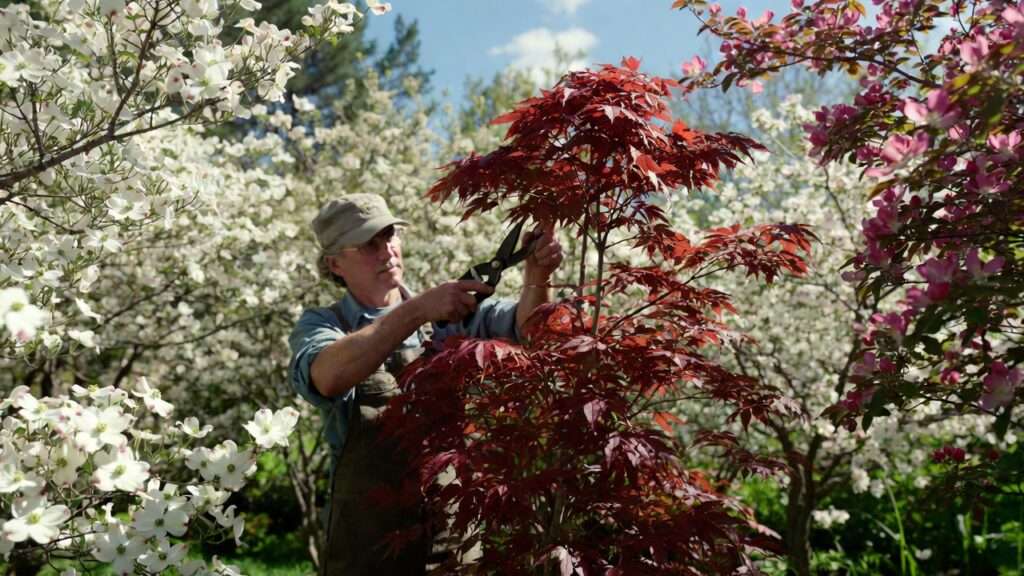
Picture this: Your backyard filled with delicate pink cherry blossoms in spring, vibrant red crabapples in fall, or the graceful, lace-like foliage of a Japanese maple glowing in autumn sunlight. Small ornamental trees bring elegance, color, and charm to any garden — but left unpruned, they can quickly become tangled, diseased, or awkwardly shaped, losing that magical appeal.
Pruning small ornamental trees is the secret to keeping them healthy, beautifully proportioned, and bursting with flowers year after year. It’s not about aggressive cutting; it’s a careful, rewarding process that mimics nature’s own shaping while preventing common issues like poor airflow, weak branches, and reduced blooming.
In this in-depth guide, we’ll walk you through everything you need — from the perfect timing to avoid losing next year’s flowers, to proven techniques that promote fast healing, and the must-have tools for clean, safe cuts. Whether you’re a new homeowner or an experienced gardener, you’ll gain the confidence to achieve professional-level results that make your landscape truly stunning. Let’s dive in and turn your small trees into showstoppers! 🌸🌳
Why Prune Small Ornamental Trees?
Pruning addresses real problems that many gardeners face with these beloved landscape stars: overcrowded canopies that block sunlight and air, leading to fungal diseases; weak, crossing branches prone to storm damage; diminished flowering due to old wood buildup; and an overall unkempt appearance that detracts from curb appeal.
When done correctly, regular pruning delivers powerful benefits:
- Stronger structure — Builds resilient branches that withstand wind and weather
- Healthier trees — Improves airflow and light penetration, reducing risks of pests like aphids, powdery mildew, or fire blight
- More spectacular blooms & foliage — Directs energy to fewer, higher-quality flowers and vibrant leaves
- Longer lifespan — Prevents stress-related decline and extends your tree’s beauty for decades
- Enhanced property value — Well-maintained ornamentals boost landscape aesthetics and real estate appeal
By pruning thoughtfully, you’re investing in a thriving, low-maintenance garden that rewards you season after season. 🌟
When to Prune: Timing for Maximum Bloom and Health
Timing is the single most important factor in successful pruning — get it wrong, and you could sacrifice an entire season of blooms! The key rule: Match your pruning schedule to your tree’s flowering habit and natural cycles.
Dormant Season Pruning (Late Winter/Early Spring)
This is ideal for most non-spring bloomers or when structural work is needed. With leaves gone, you get a clear view of the branch framework, minimal sap flow, and quick wound healing as spring growth begins.
Best for: Summer-flowering types (e.g., crape myrtle hybrids), non-flowering ornamentals like some Japanese maples, or general shaping.
Post-Flowering Pruning (Late Spring/Early Summer)
Crucial for spring-blooming trees that set buds on old wood the previous year. Prune immediately after flowers fade to preserve next year’s buds while allowing the tree to recover during active growth.
Essential for: Dogwood, flowering cherry, crabapple, magnolia. Avoid winter pruning here — you’ll cut off future blooms!
Summer Pruning (Light Maintenance)
Use this sparingly for corrective work like removing water sprouts (vigorous upright shoots) or suckers. It’s great for “bleeding” trees (maples, birches, dogwoods) to minimize sap loss.
Year-Round Rule: The “3 D’s”
Remove dead, damaged, or diseased branches anytime you spot them — this prevents problems from spreading and is the safest “emergency” prune.
Here’s a quick reference table for popular small ornamental trees:
| Tree Type | Best Pruning Time | Why? |
|---|---|---|
| Spring-flowering (dogwood, cherry, crabapple) | Immediately after flowering | Preserves next year’s flower buds |
| Summer-flowering (crape myrtle) | Late winter/early spring | Encourages strong new growth & blooms |
| Japanese Maple | Summer or dormant (avoid heavy spring) | Prevents excessive sap bleeding |
| General (non-specific) | Dormant season | Best structural view, low stress |
Pro Tip: In regions with harsh winters, wait until late winter to avoid freeze damage to fresh cuts. Always check local conditions! ❄️🌷
Essential Tools for Safe and Precise Pruning
Quality tools make all the difference — sharp blades create clean cuts that heal quickly, while dull ones tear tissue and invite infection. Invest in reliable, ergonomic options for comfort during longer sessions.
Here are the must-haves:
- Hand Pruners (Bypass preferred): For branches up to ¾ inch. Bypass types act like scissors for precise, clean cuts on live wood. Here are some excellent examples of high-quality bypass hand pruners:
:max_bytes(150000):strip_icc()/SPR-garden-pruner-preference-1403219-hero-e364c36e3a88465bbd4eced329e6aa8e.jpg)
- Loppers: Extend your reach for ¾–2 inch branches with long handles for leverage.
- Pruning Saw: Curved-blade models cut on the pull stroke for tight spaces and larger limbs.
- Pole Pruner/Saw: Reach high branches safely from the ground — no ladders needed for most small trees.
- Safety Gear: Sturdy gloves, eye protection, and disinfectant (rubbing alcohol) to sterilize tools between trees.
Sharpen regularly and clean after use — your trees (and hands) will thank you! 🔧🪚
Here are some excellent examples of high-quality bypass hand pruners in action

These sharp, clean cuts are what you want — notice how the bypass blades slide past each other like scissors, avoiding crushing the branch tissue. 🔧
Step-by-Step Pruning Techniques
Now comes the hands-on part! Follow these expert-approved methods to make precise, healing cuts that promote strong regrowth and maintain your tree’s natural form. Always prune on a dry day to reduce disease risk.
Basic Cuts Every Gardener Should Master
- Thinning Cuts (the gold standard): Remove an entire branch back to its point of origin (trunk or larger limb). This opens the canopy, improves light and air flow, and is preferred for most ornamental work.
- Heading Cuts: Shorten a branch to an outward-facing bud. Use sparingly — it encourages dense, bushy growth, which can be great for shaping but may lead to weak, crowded branches if overdone.
The Three-Cut Method: Safely Removing Larger Branches
Never attempt to cut a thick branch in one go — it can tear bark and create large wounds. Use this professional technique instead:
- First cut (undercut): About 6–12 inches out from the trunk, cut upward about 1/3 through the branch.
- Second cut (top cut): A few inches further out, cut downward completely through the branch — this removes most of the weight safely.
- Final cut: Remove the stub just outside the branch collar (the swollen area where branch meets trunk — it contains healing cells).
Here are clear visual step-by-step illustrations of the three-cut method:

Notice the branch collar in this close-up — always leave it intact for fastest healing! 🌳
Structural Pruning for Young Trees (First 3–5 Years)
Focus on building a strong framework:
- Select a strong central leader (main upright stem).
- Remove any competing leaders or vertical branches that could split the tree.
- Choose 4–6 well-spaced scaffold branches with wide crotch angles (45–60° is ideal — narrow angles are weak).
- Space scaffolds evenly around the trunk for balanced growth.
Maintenance Pruning for Mature Trees
Annual or biennial light pruning keeps things in check:
- Always start with the 3 D’s: Remove dead, damaged, or diseased wood first.
- Eliminate crossing or rubbing branches — choose the healthier, better-positioned one to keep.
- Thin out water sprouts (vigorous vertical shoots) and suckers (growth from roots/base).
- Golden rule: Never remove more than 20–25% of the live canopy in a single year to avoid shocking the tree.
Special Techniques for Ornamentals
- Crown Thinning: Selectively remove interior branches for a more open, airy look — perfect for Japanese maples.
- Deadheading: Snip off spent flower clusters on types like lilacs or some crabapples to encourage reblooming and tidiness.
Here’s a beautifully pruned Japanese maple showing the open, elegant structure that proper thinning creates:

Common Mistakes to Avoid
Even experienced gardeners sometimes make pruning errors that can set trees back years. Here are the most frequent pitfalls — and exactly how to steer clear of them:
- Topping the Tree Cutting off the top to “reduce height” creates a flat, unnatural shape and triggers a explosion of weak, vertical water sprouts. This ruins the tree’s natural form and makes it more prone to breakage. Solution: Always use thinning cuts and respect the tree’s mature size when planting.
- Over-Pruning (Lion’s Tailing) Removing too much live wood (especially from the interior) leaves a “lion’s tail” of foliage at branch ends, stressing the tree and exposing bark to sunscald. Solution: Stick to the 20–25% live canopy removal rule per year.
- Flush Cuts Cutting too close to the trunk removes the all-important branch collar, slowing healing and increasing decay risk. Solution: Always cut just outside the collar — look for the slight swelling or ridge.
- Pruning at the Wrong Time Winter pruning of spring bloomers removes next year’s flower buds; heavy summer cuts on maples cause excessive bleeding. Solution: Follow the timing chart provided earlier.
- Using Dull or Dirty Tools Torn cuts invite pathogens; unclean blades spread diseases like fire blight or canker. Solution: Sharpen after every few uses and disinfect with 70% isopropyl alcohol between trees.
Avoid these mistakes and your ornamental trees will thank you with healthier growth and more spectacular displays! 🚫🌳
Here are before-and-after photos showing the dramatic difference proper pruning makes vs. common topping mistakes:
Notice how the properly thinned tree on the right maintains its elegant shape and opens up beautifully!
Pruning Specific Small Ornamental Trees
Different species have unique needs — here are tailored guidelines for some of the most popular small ornamental trees in home landscapes:
- Japanese Maple (Acer palmatum)
- Best time: Late summer or dormant season (avoid heavy spring pruning)
- Focus: Light thinning to reveal branch structure; remove crossing branches and dead wood
- Never: Heavy heading cuts — they cause dense, weak regrowth
- Goal: Elegant, open, layered appearance
- Flowering Dogwood (Cornus florida / kousa)
- Best time: Immediately after spring bloom
- Focus: Thin out crowded interior branches, remove low branches for clearance
- Watch for: Dogwood anthracnose — prune to improve airflow
- Crabapple (Malus spp.)
- Best time: Late spring/early summer after flowering
- Focus: Remove suckers, water sprouts, and diseased wood; thin for better fruit production
- Bonus: Many modern varieties are disease-resistant — check yours!
- Flowering Cherry (Prunus spp.)
- Best time: Right after bloom (early summer)
- Focus: Light thinning; remove inward-growing or weak branches
- Caution: Prone to bacterial canker — make clean cuts and avoid wet conditions
- Redbud (Cercis canadensis)
- Best time: After flowering
- Focus: Develop strong scaffold structure in youth; thin lightly in maturity
Tailoring your approach to each species ensures maximum health and beauty — always observe your tree’s natural habit! 🌸🍒
Aftercare: Helping Your Trees Recover Quickly
Pruning is stressful, even when done perfectly. Support recovery with these simple steps:
- Mulch: Apply 2–4 inches of organic mulch in a wide ring around the base (keep it 2–3 inches away from the trunk to prevent rot)
- Watering: Provide deep, infrequent watering during the first growing season after major pruning — especially during dry spells
- Fertilization: Use sparingly — a balanced, slow-release fertilizer in early spring is usually enough. Over-fertilizing causes soft, weak growth
- Monitoring: Watch for signs of stress (wilting, dieback) or pest/disease issues in the weeks following pruning
Healthy aftercare turns pruning stress into renewed vigor! ☀️💧
FAQs: Your Pruning Questions Answered
Here are the answers to the most common questions homeowners ask about pruning small ornamental trees:
Q: Can I prune in fall? A: Light pruning of dead or damaged branches is fine, but avoid major structural work — trees store energy in fall for winter survival.
Q: How often should I prune my small ornamental trees? A: Young trees (first 3–5 years): Annual light structural pruning. Mature trees: Every 2–3 years for maintenance, plus anytime for the 3 D’s.
Q: When is it time to call a professional arborist? A: If you need to use a ladder for high branches, work near power lines, remove large limbs (>3 inches), or suspect disease.
Q: Why does my maple bleed so much sap when I prune? A: Maples and birches are “bleeders.” Prune in late summer or during full dormancy to minimize sap flow.
Q: Will pruning make my tree bloom more? A: Yes — when done correctly! Removing old, unproductive wood redirects energy to stronger buds and better flowers.
Got more questions? Drop them in the comments — I’m here to help! ❓🌱
Conclusion: Prune with Confidence for Lasting Beauty
Pruning small ornamental trees is one of the most rewarding skills any gardener can master. It’s not about drastic change — it’s about thoughtful guidance that lets your trees express their full potential: stronger branches, brighter blooms, richer fall color, and a graceful presence that enhances your entire landscape.
Armed with proper timing, sharp tools, proven techniques, and a little patience, you can transform overgrown or awkward trees into stunning focal points that bring joy for decades. Start small, observe how your tree responds, and enjoy the journey of nurturing living art in your garden.
Your trees are ready to shine — now it’s your turn to help them sparkle! Happy pruning! 🌳✨🌸











