
We’ve all been there. You bring home a stunning, vibrant houseplant, place it lovingly in your living room, and within a few weeks, it transforms into a sad, stretching shadow of its former self. The stems grow long and weak, the leaves shrink, and the vibrant colors fade. The culprit? A simple lack of adequate sunlight.
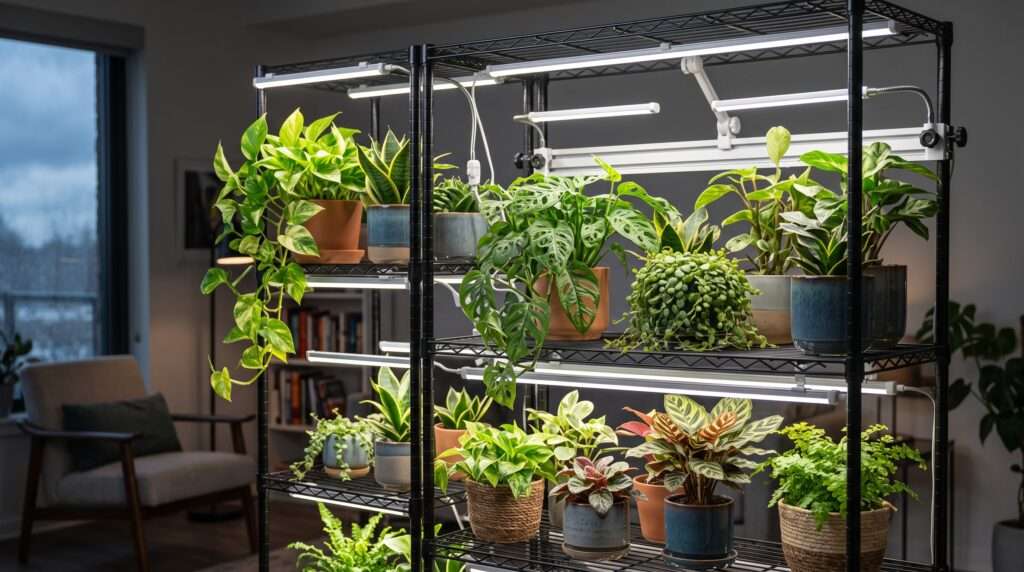
But what if you could cultivate a thriving indoor jungle in the darkest of apartments? The ultimate solution lies in mastering shelf gardening with adjustable lights. By combining vertical space with highly customizable artificial lighting, you can mimic the sun’s natural canopy right in your living room, bedroom, or basement.
As a plant care specialist who has spent years testing countless indoor gardening setups, I can tell you that transitioning to a dedicated, adjustable shelf system is the single most impactful upgrade you can make for your indoor garden. Early in my career, I nearly lost a prized collection of rare Philodendrons to a dim, north-facing apartment. It wasn’t until I built my first adjustable light shelf that my plants stopped merely surviving and finally started thriving.
In this comprehensive guide, we will break down the science, the gear, and the exact strategies you need to build the ultimate indoor plant shelf. Let’s bring the sunshine inside! ☀️
💡 The Science of Light: Why Your Plants Are Struggling
Before we start drilling holes or assembling wire racks, it is crucial to understand why lighting matters so much, and why not all artificial light is created equal. Plants are biological machines that run on light through photosynthesis. When they don’t get enough of it, they experience etiolation (the scientific term for “legginess”), stretching desperately toward the nearest light source.
Why Fixed Lights Fail 🚫
Many beginners buy a standard grow bulb, screw it into a ceiling fixture or a fixed desk lamp, and wonder why their plants are still unhappy. Here is the problem with static, immovable lighting:
-
The Inverse Square Law: In physics, light intensity drops exponentially as you move away from the source. A light that is 24 inches away from a plant provides significantly less than half the usable energy of a light that is 12 inches away.
-
Canopy Burn vs. Starvation: As your plants grow, they get closer to the fixed light. Eventually, the top leaves suffer from light burn (crispy, bleached spots), while the lower leaves remain in the dark and die off.
-
The Solution: Adjustable lights allow you to maintain the perfect “Goldilocks zone” of light intensity at every stage of a plant’s growth cycle.
Decoding Light Tech: PPFD and Spectrums 🔬
To build a skyscraper-level plant shelf, we need to look past the marketing jargon on grow light boxes and focus on the metrics that actually matter to your plants.
-
PPFD (Photosynthetic Photon Flux Density): Forget “watts” or “lumens” (which measure how bright a light looks to the human eye). PPFD measures the actual amount of usable light particles (photons) hitting your plant’s leaves every second. You want lights that offer a high PPFD output suitable for your specific plants.
-
The Color Spectrum:
-
🔵 Blue Light: Encourages dense, bushy, vegetative growth.
-
🔴 Red Light: Promotes stretching, blooming, and flowering.
-
⚪ Full-Spectrum (White): The gold standard for modern indoor shelves. It combines red, blue, and green light to mimic natural sunlight, keeping your plants healthy while making your living space look beautiful (instead of looking like an alien spaceship).
-
🪴 Choosing Your Shelf & Light Setup
Building your vertical garden starts with a solid foundation. The equipment you choose will dictate your watering routine, airflow, and how easily you can adjust your lighting.
Shelving Materials: Wire Racks vs. Wooden Bookshelves 🪜
The structure you choose to house your plants is just as important as the lights themselves. Let’s compare the two most popular options:
1. Metal Wire Racks (The Expert’s Choice) 🏆 Wire shelving units (like heavy-duty kitchen racks) are the undisputed kings of shelf gardening.
-
Airflow: Excellent. The open grate design prevents stagnant air, drastically reducing the risk of fungal infections and soil gnats.
-
Light Penetration: Ambient light from upper tiers can filter down to lower shelves.
-
Ease of Setup: You can easily mount lights, cables, and fans using simple zip-ties or S-hooks.
-
Water Resistance: Metal (especially epoxy-coated metal) won’t warp or rot when you inevitably spill water.
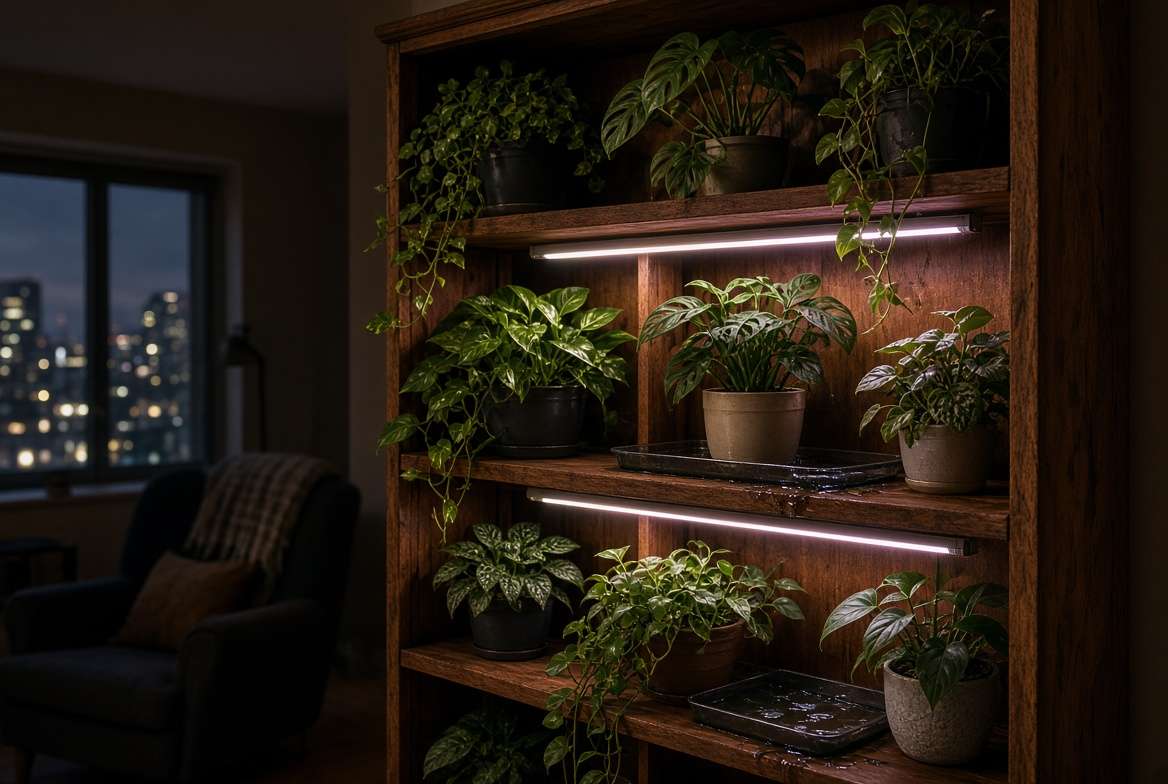
2. Wooden Bookshelves (The Aesthetic Choice) 📚 Repurposing a beautiful wooden bookshelf is tempting for interior design purposes, but it comes with distinct challenges.
-
Heat Trapping: Solid wooden shelves trap heat generated by grow lights, which can bake your plants.
-
Moisture Damage: Humidity and spilled water will warp MDF or unprotected wood over time. You must use waterproof plant trays.
-
Mounting Difficulty: You will likely need to drill holes into the wood to mount lights and manage cables safely.
Lighting Types: Which Grow Lights Actually Work? 💡
Once you have your shelving unit, it is time to select the artificial lights. The market is flooded with cheap, ineffective “blurple” (blue/purple) lights that often lack the power to sustain long-term plant growth. For a professional-grade shelf garden, you should focus on modern, full-spectrum options.
-
LED Light Bars (The Modern Standard): These are thin, sleek, and incredibly energy-efficient. Magnetic LED light bars are currently the top choice for indoor gardeners. They attach seamlessly to the underside of metal wire racks, emit very little heat, and provide a crisp, white, full-spectrum light that makes your foliage pop.
-
T5 LED Tubes: A step up from old-school fluorescent tubes, T5 LEDs are tubular lights that cover a wide surface area. They are excellent for seed starting or illuminating wide shelves filled with hundreds of small succulents or propagation boxes.
-
Quantum Board LED Panels: If you are growing large, high-light demanding plants (like large Monstera deliciosa or fruiting indoor plants) on the top shelf, a small quantum board panel might be necessary. They are intensely powerful but require careful height management to prevent leaf scorch.
The Adjustment Factor: Mastering Vertical Mobility 🎚️
The entire premise of shelf gardening with adjustable lights relies on your ability to move the light source as your plants grow. Do not permanently glue or screw your lights into place. Instead, use these expert-approved mounting methods:
-
Adjustable Ratchet Ropes: These are small pulley systems that clip onto the corners of your light panel and the top of your shelf. With a simple pull of the string, you can raise or lower the light down to the millimeter. This is the absolute best method for panels.
-
Magnetic Clips: If you are using LED light bars on a metal rack, magnetic mounts allow you to snap the light off and move it to a different tier or angle it slightly in seconds.
-
S-Hooks and Chain Links: A classic, budget-friendly approach. By hanging your lights from a small metal chain using S-hooks, you can easily move the hook up or down the links to change the height.
📏 Setup Strategy & Plant Placement
Now that you have the right gear, it is time for the fun part: putting it all together. A well-designed plant shelf doesn’t just look like a gorgeous living display; it functions as a carefully mapped ecosystem.
Zone Mapping: Grouping by Light Needs 🗺️
Not every plant wants to be blasted with intense light. The beauty of a multi-tier shelf garden is that you can create distinct microclimates on every level.
-
The Top Tier (High Light/High Heat): Heat rises, and the top shelf is often the warmest. Place your sun-loving succulents, cacti, and Ficus trees here. Position the lights closer to the canopy (about 6 to 10 inches away).
-
The Middle Tiers (Medium Light): This is the sweet spot for the vast majority of popular houseplants. Your Philodendrons, Pothos, Anthuriums, and Hoyas will thrive here. Aim for 12 to 16 inches of distance between the light and the foliage.
-
The Bottom Tier (Low Light/High Humidity): The lowest shelf is usually the coolest and receives the least ambient light. This is the perfect nursery for delicate ferns, Calatheas, and propagation bins that prefer gentler conditions.
The Distance Rule & The “Hand Test” ✋
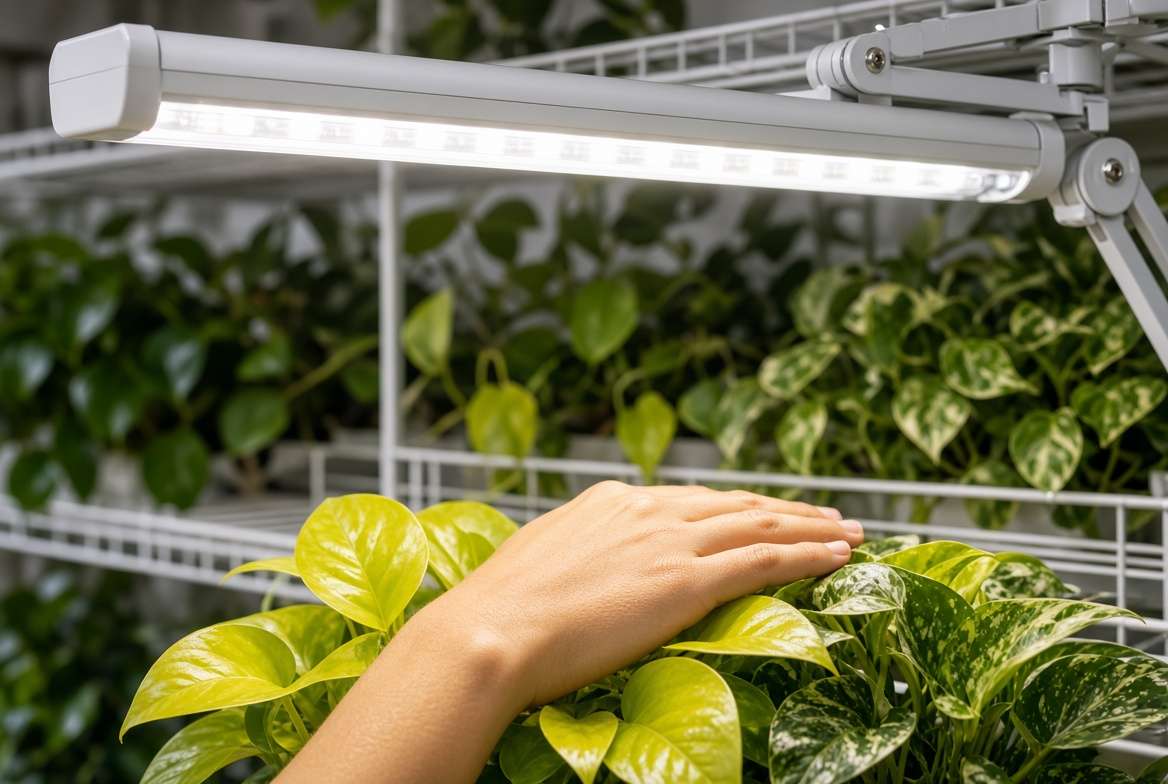
How do you know if your lights are too close? Even LED lights emit some thermal energy. As a general rule, use the “Hand Test”:
Place the back of your hand directly over the top leaves of your plant, right under the grow light. Leave it there for 30 seconds. If the light feels uncomfortably warm on your skin, it is too hot for your plant’s leaves. Use your adjustable mounting system to raise the light by two to three inches and test again.
Safety & Organization: Don’t Mix Water and Electricity ⚡
This is where E-E-A-T truly matters. As an indoor gardening expert, I cannot stress electrical safety enough. You are combining daily watering with dozens of electrical cords.
-
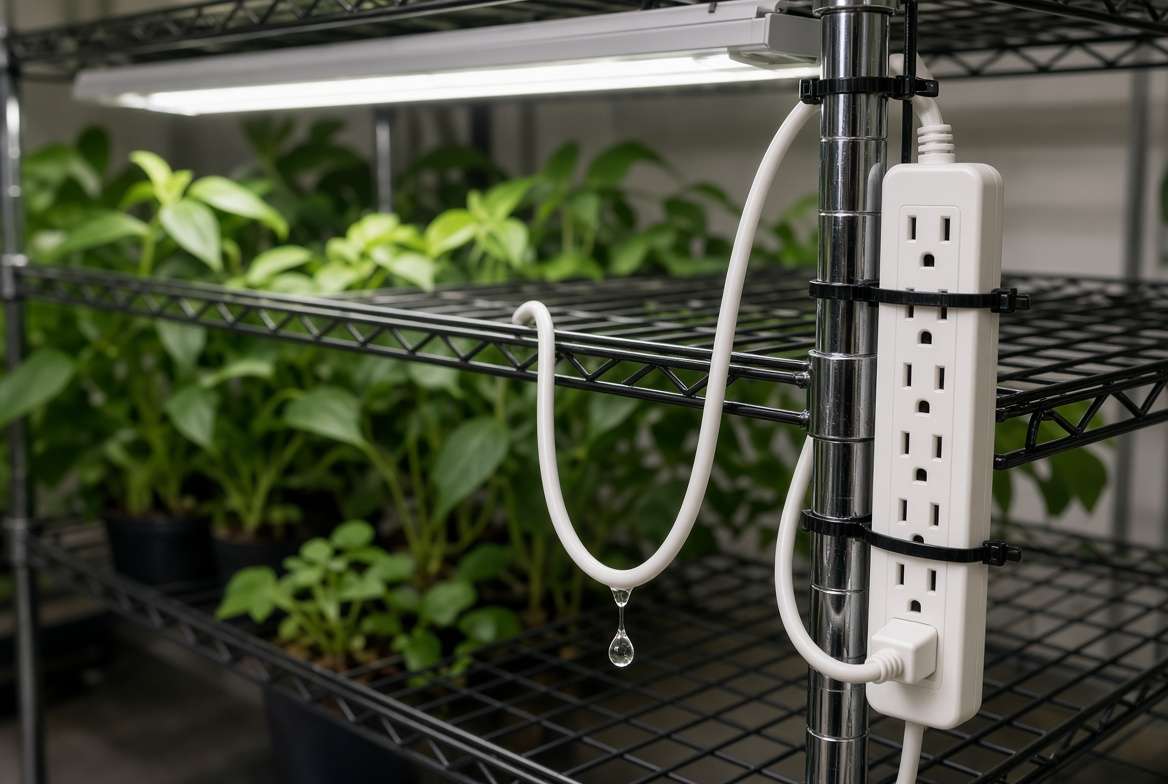
Use Drip Loops: Never let a power cord run straight down from a light to a power strip. Always let the cord dip below the outlet and come back up. This forms a “drip loop,” ensuring that if water spills, it drips off the bottom of the cord onto the floor rather than sliding directly into the electrical socket.
-
Elevate Power Strips: Never leave your surge protectors lying flat on the floor where water might pool. Mount them securely to the side or back of your shelving unit using zip ties or mounting tape.
-
Smart Timers: Consistency is key for plant growth. Plug your lights into a smart plug or digital timer. Set them to turn on and off automatically, providing your plants with a stable “sunrise and sunset” routine without you ever having to flip a switch.
Maintenance, Troubleshooting & FAQs 🛠️
A spectacular indoor shelf garden is a living, breathing ecosystem. Even with perfect shelf gardening with adjustable lights, your plants will grow and change. Mastering long-term maintenance is what separates a novice from a true plant expert.
Diagnosing Foliage 🍂
Your plants will always tell you if the lighting is off—you just need to know how to listen. Because you have an adjustable setup, fixing these issues takes seconds.
-
Signs of Light Burn: If top leaves look bleached, develop crispy brown edges, or show extreme red/purple sun-stress colors, the light is too intense. Solution: Adjust your ratchet ropes or magnetic mounts to raise the light by 3 to 4 inches.
-
Signs of Light Starvation: If new leaves are shrinking, stems are becoming long and weak (leggy), or the plant is leaning heavily to one side, it is desperate for energy. Solution: Lower the lights closer to the canopy to increase the PPFD.
Airflow Management 🌬️
A major mistake beginners make is packing dozens of plants onto a shelf without considering ventilation. High humidity, bright lights, and wet soil create the perfect breeding ground for fungus gnats and powdery mildew.
-
Clip-On Fans: Attach small, oscillating USB fans to the sides of your wire racks.
-
Micro-Breezes: Aim for a gentle rustle of the leaves, which strengthens plant stems and evaporates excess moisture from the topsoil.
Core FAQs ❓
To wrap up our skyscraper guide, let’s address the most common questions indoor gardeners have about their lighting schedules:
-
How many hours a day should adjustable grow lights be on? Aim for 12 to 16 hours. Mimicking long summer days encourages vigorous vegetative growth.
-
Can I leave my grow lights on 24/7? Absolutely not! Plants require a dark period (respiration) to process the energy they created during the day.
-
Can standard room LEDs work instead? Generally, no. Standard room lights lack the proper intensity and targeted color spectrum necessary for long-term photosynthesis.
By combining the right shelving, high-quality adjustable lights, and a keen eye for your plants’ changing needs, you can transform any dark corner into a lush, thriving indoor jungle.
Which specific indoor plant species are you planning to put on the top shelf of your new lighting setup?











