
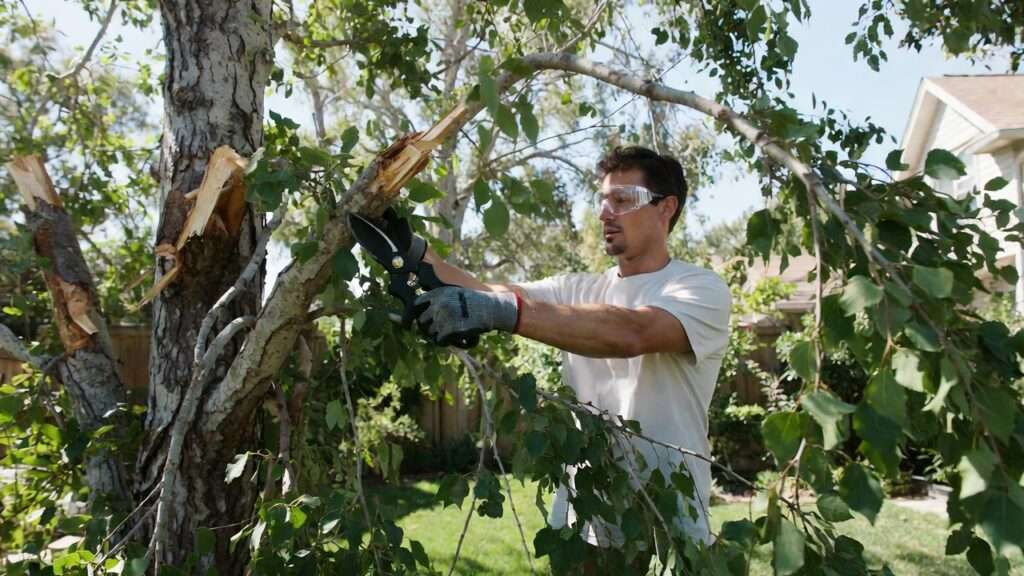
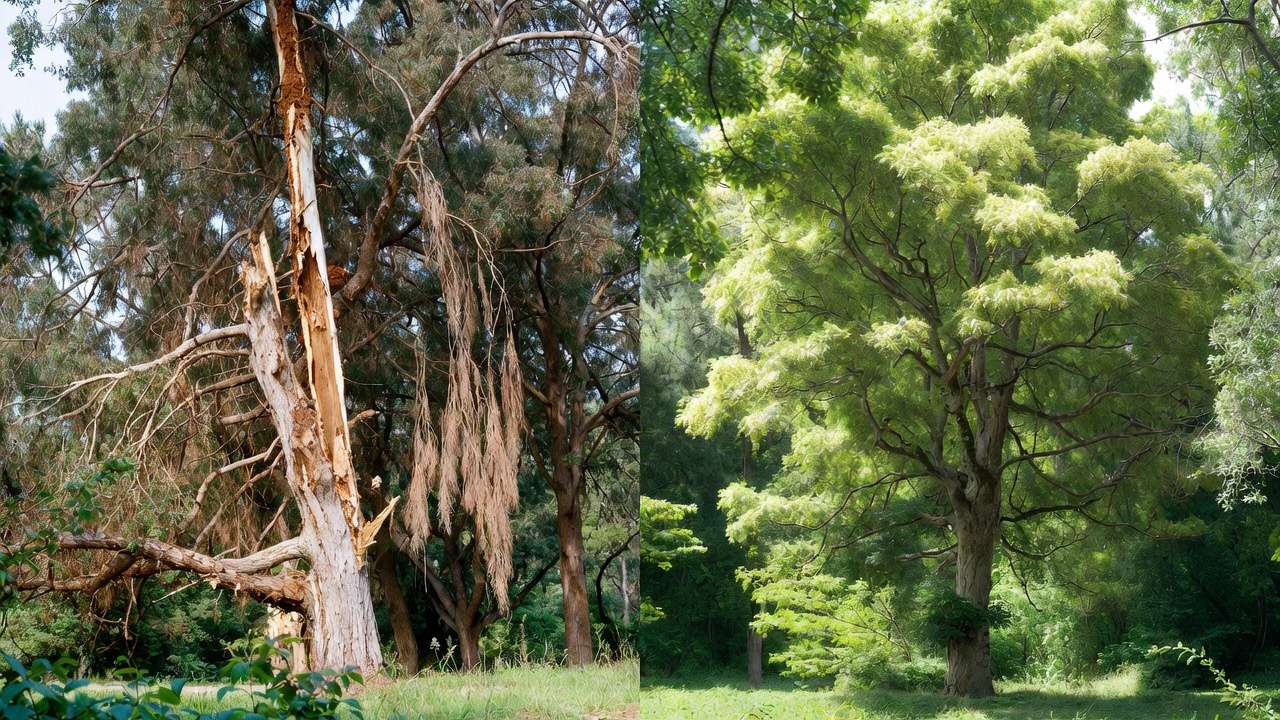
Imagine stepping outside after a night of howling winds, crashing thunder, and torrential rain—only to find your once-majestic backyard oak split down the middle, branches dangling like broken limbs, or your favorite shade tree leaning dangerously toward your roof. 😔 Your heart races with worry: Is the tree salvageable? Will it fall and cause more damage? Can proper care bring it back stronger?
You’re not alone. Severe storms—whether hurricanes, tornadoes, high winds, or ice—cause billions in tree-related damage every year, leaving homeowners scrambling for storm damage pruning solutions. The good news? Many trees can recover remarkably well with the right approach. In fact, trees that lose up to 50% of their crown often survive and thrive when pruned correctly, according to guidelines from university extensions and the International Society of Arboriculture (ISA).
As a tree care expert drawing from ISA-certified best practices, university research (like Penn State, UF/IFAS, and Purdue Extension), and real-world storm recovery experience, this in-depth guide provides proven storm damage pruning solutions to help you assess damage safely, make smart pruning decisions, promote healing, and prevent future issues. We’ll cover everything from immediate safety steps to long-term restoration—helping you protect your family, property, and beloved trees. Let’s turn that post-storm stress into confident action! 💪🌿
Understanding Storm Damage: What You’re Really Dealing With ⚡
Storms don’t just break branches—they stress trees biologically and structurally. Understanding the types of damage helps you decide if restoration is realistic.
Common Types of Storm Damage to Trees
- Broken or hanging branches — These pose immediate hazards as they can fall unexpectedly.
- Split crotches and torn bark — Where major limbs meet the trunk; these expose inner wood to decay and insects.
- Leaning or uprooted trees — Often from saturated soil and wind force on the root plate.
- Cracked trunks or major limb loss — Severe cases may compromise the tree’s vascular system.
- Twisted or bent limbs — Hidden internal cracks that weaken future stability.
Different species react uniquely: Oaks and maples often compartmentalize damage well, while fast-growing species like willows or poplars may struggle more. Palms handle defoliation differently due to their single growing point. 🌴
How Storms Weaken Trees (Biology Basics)
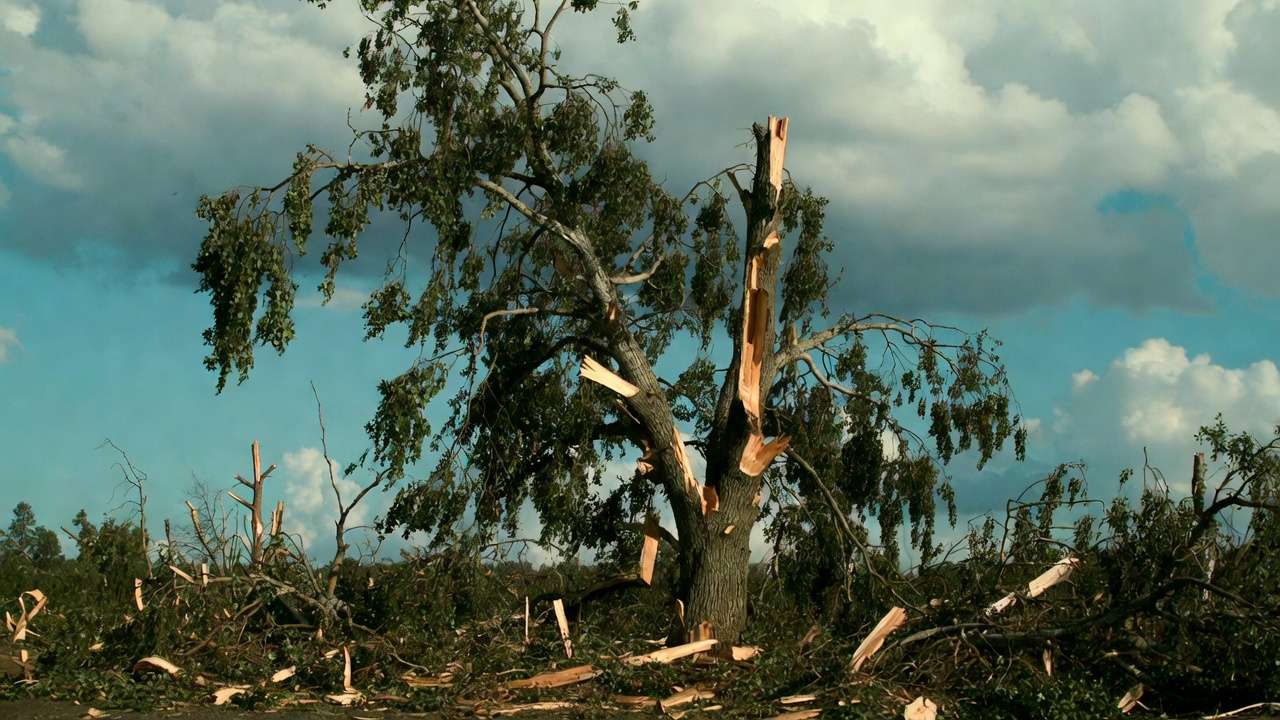
High winds create a “sail effect,” where broad canopies catch force and transfer stress to roots and trunks. Heavy rain saturates soil, loosening root plates. Lightning can scorch cambium layers. Post-storm, trees face drought stress if foliage is lost, reducing photosynthesis and energy reserves needed for healing.
Trees use CODIT (Compartmentalization Of Decay In Trees) to wall off damaged areas—proper pruning supports this natural defense.
Assessing Tree Survival Odds – A Simple Homeowner Checklist 📋
Use this quick guide (based on Arbor Day Foundation, Minnesota DNR, and extension services):
- Crown loss percentage: Under 25–30% = excellent prognosis; 30–50% = good chance with care; over 50% = poor survival odds—consider removal.
- Is the central leader (main trunk top) intact? Vital for regrowth in many species.
- Major roots severed or root plate lifted? High risk.
- Signs of vitality: Scratch the bark—green cambium underneath means life; look for buds swelling in spring.
If more than half the crown is gone or the trunk is split deeply, survival is unlikely. When in doubt, wait a few months—some trees surprise you with new sprouts!
Safety First – Before You Make a Single Cut! 🛡️
Never rush in—storm-damaged trees are unpredictable hazards.
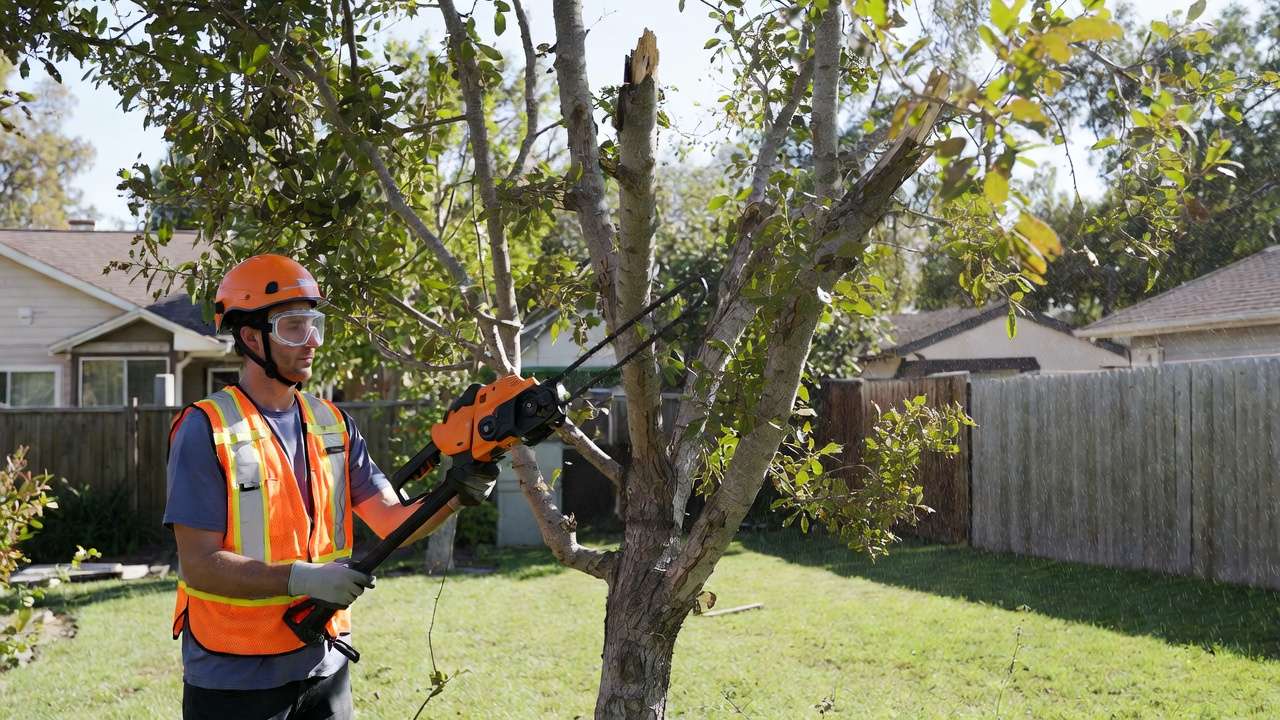
- Prioritize personal safety: Wear gloves, safety goggles, hard hat, and chainsaw chaps if using power tools.
- Stay clear of power lines—call utility companies immediately if branches contact wires.
- Avoid large trees (>20 ft), leaning specimens, or those near structures—hire pros.
- Tools checklist: Sharp bypass pruners (for small branches), loppers, pole saw, pruning saw, and chainsaw (only if trained). Keep blades clean and sharp to prevent disease spread.
- Document everything: Photos for insurance claims before cleanup.
Red flag rule: If you’re unsure, stop. Call an ISA Certified Arborist® (find one at treesaregood.org). Pros carry insurance and follow ANSI A300 pruning standards.
When to Prune After a Storm – Timing Matters ⏰
Timing minimizes stress and disease risk.
- Immediate (days after storm): Remove only hanging, loose hazards that threaten people/property. Make safe cuts to eliminate danger.
- Short-term (1–6 weeks): Clean torn stubs and obvious breaks once safe.
- Restorative pruning: Best in late winter/early spring (dormant season) for most deciduous trees—wounds dry less, healing begins with spring growth.
- Exceptions: Palms (prune green fronds only when needed); evergreens (avoid heavy cuts in growing season); severe leans (address ASAP).
- In tropical/subtropical areas like parts of Bangladesh, monitor for monsoon follow-ups and prune during drier periods.
Avoid summer pruning on stressed trees—it increases wilt and pest vulnerability.
Step-by-Step Storm Damage Pruning Solutions – The Right Way 🌟
Now comes the heart of storm damage pruning solutions: making clean, strategic cuts that help your tree heal rather than harm it further. The goal is to remove hazards while preserving as much healthy canopy as possible—trees rely on leaves for energy to compartmentalize wounds and grow new tissue.
The Golden Rule – Never Top or Lion-Tail Your Tree! ❌
One of the most damaging myths after storms is “topping” (cutting the main leader or large branches back to stubs) or “lion-tailing” (stripping inner branches, leaving foliage only at branch tips like a lion’s tail). These practices:
- Create large, open wounds that invite decay, insects, and fungal pathogens.
- Force weak, fast-growing epicormic shoots (water sprouts) that are poorly attached and prone to breaking in future storms.
- Remove too much photosynthetic surface, starving the tree and slowing recovery.
- Increase long-term failure risk—topped trees often become hazards within 5–10 years.
Modern arboriculture (per ISA and university extensions like Penn State, UNH, and UF/IFAS) strongly advises against both. Instead, focus on selective, targeted pruning to restore structure.
The Proven 3-Cut Method for Safe Branch Removal ✂️
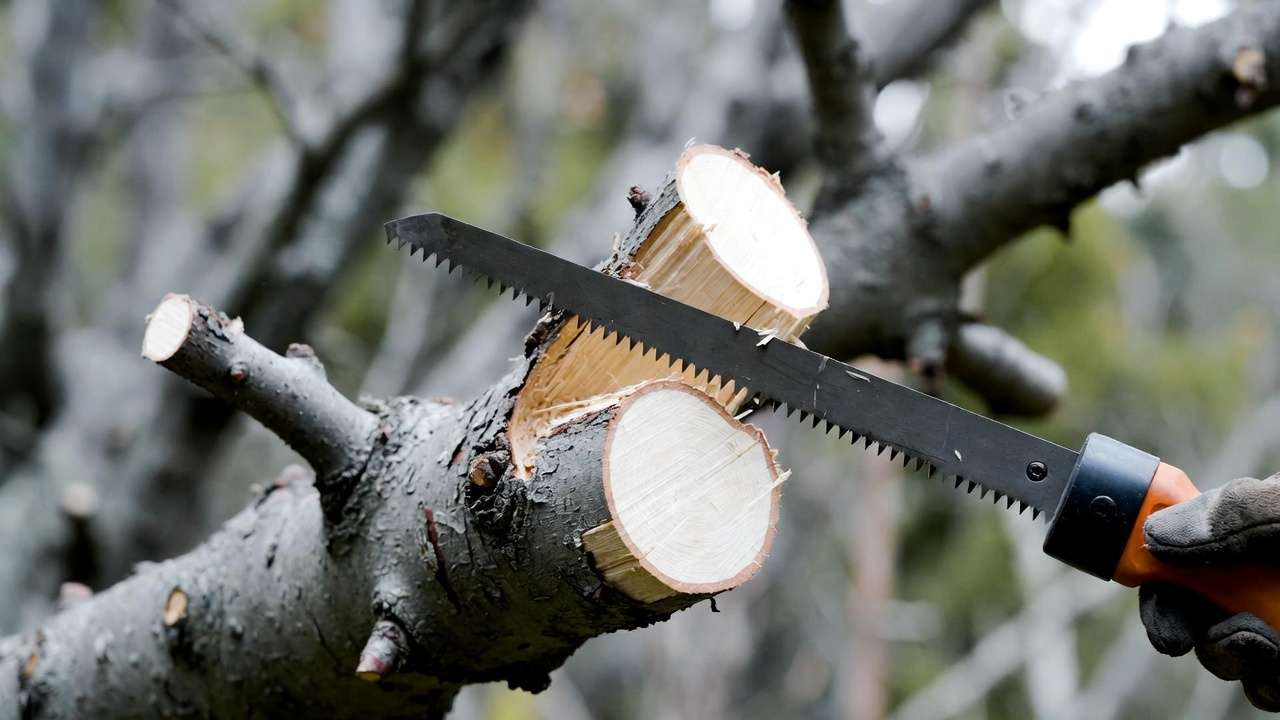
For any branch over 1–2 inches in diameter, always use the three-cut technique to prevent bark tearing and ensure a clean wound:
- Undercut (first cut): About 8–12 inches out from the trunk or parent branch, make a partial cut upward from the underside—about 1/3 through the branch. This stops the bark from ripping downward when weight is removed.
- Top cut (second cut): A few inches farther out, cut completely through from the top downward. The branch falls safely, leaving a stub.
- Final collar cut (third cut): Locate the branch collar (swollen area where branch meets trunk, often with a ridge of bark). Cut just outside this collar at a slight downward angle, avoiding flush cuts (which damage the tree’s natural healing zone) or stubs (which decay).
This method follows ANSI A300 pruning standards and is endorsed by ISA Certified Arborists. For small twigs (<1 inch), a single clean cut just outside the collar suffices with sharp bypass pruners.
(Imagine a simple diagram here: Show branch with labeled undercut → top cut → final cut at collar. In a full article, embed photos or illustrations for clarity!)
Handling Specific Damage Types
- Hanging or broken branches: Remove immediately if hazardous using the 3-cut method. Leave stubs only if they’re small and won’t tear further—then finish later.
- Torn bark & split crotches: Trim ragged edges cleanly to the living tissue boundary. For deep splits, cabling/bracing may be needed (professional only). If bark loss exceeds 1/3 circumference, the limb/trunk is structurally compromised—often best removed.
- Stub cuts & flush cuts: Avoid! Stubs invite rot; flush cuts destroy the branch collar and healing zone.
- Leaning trees: For small/young trees, gently straighten and stake with broad straps (not wire) for 1–2 years. Large leans usually require professional assessment—root damage may be irreversible.
Crown Restoration Pruning Over Time
Restoration isn’t one-and-done. Plan a multi-year approach:
- Year 1: Remove only hazards and torn material.
- Year 2–3: Selectively thin competing sprouts, favor strong leaders.
- Ongoing: Maintain balance so no side dominates (prevents future wind sail issues).
Patience pays off—many trees rebound beautifully with this gradual care.
Tools, Techniques & Best Practices from Certified Arborists 🔧
- Essential tools: Sharp bypass pruners/loppers for small cuts, curved pruning saw or pole pruner for reach, chainsaw (trained users only). Disinfect blades with 10% bleach or alcohol between trees to prevent disease spread.
- Wound care update: Skip tree wound paint or sealants—research shows they trap moisture and hinder natural compartmentalization (ISA consensus since the 1990s).
- Support options: For split crotches or weak unions, pros install steel cables/braces to redistribute stress. Never DIY this—improper installation worsens damage.
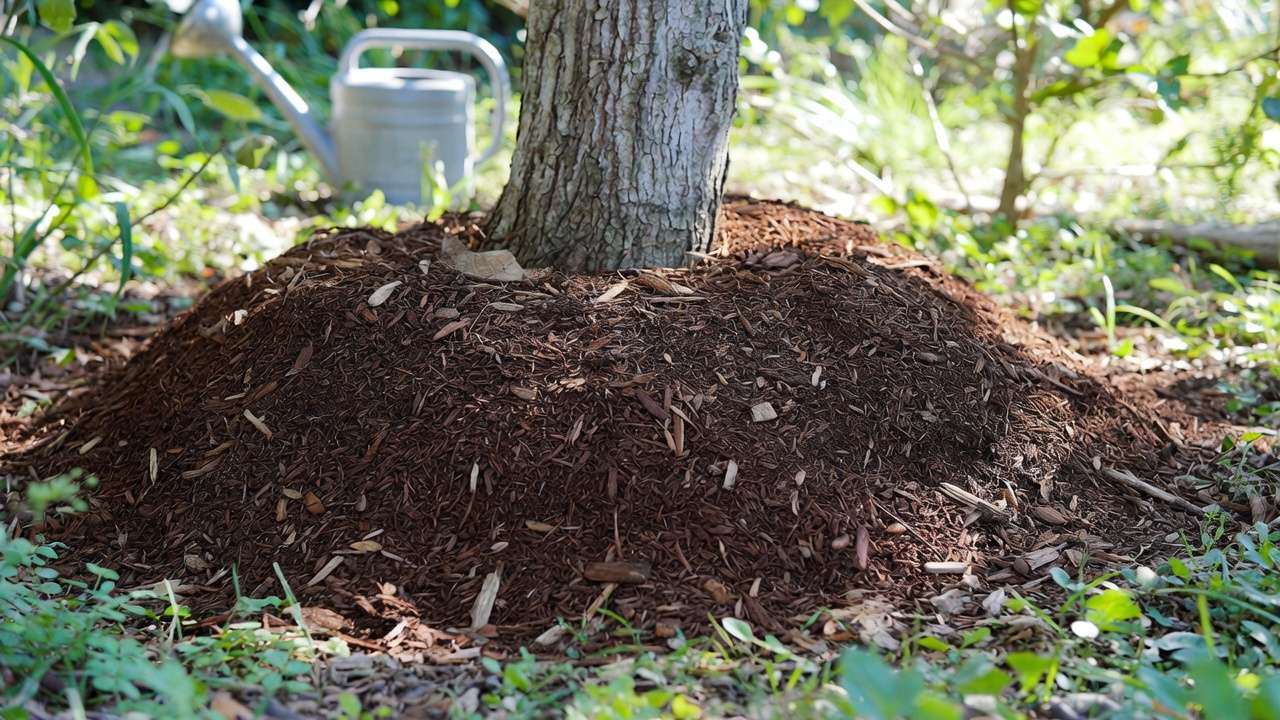
- Post-pruning support: Mulch 2–4 inches deep (keep away from trunk), water deeply during dry spells (1–2 inches/week), and avoid heavy fertilizer the first year—focus on root health.
These practices, rooted in decades of arborist research, give your trees the best shot at full recovery.
Common Mistakes That Make Things Worse (And How to Avoid Them) 🚫
Even well-intentioned homeowners can unintentionally cause long-term harm during post-storm cleanup. Here are the most frequent errors—backed by decades of arborist observations and university extension reports—and how to sidestep them:
- Over-pruning in one session Removing more than 25–30% of live canopy at once shocks the tree, reduces energy production, and invites sunscald, pests, and decay. Fix: Spread major restorative work over 2–3 years. Prioritize hazards first.
- Flush cuts and leaving long stubs Flush cuts destroy the branch collar (the tree’s natural defense barrier), while stubs rot and become entry points for pathogens. Fix: Always cut just outside the collar using the 3-cut method.
- Ignoring hidden internal damage Twisted limbs or cracked trunks may look minor but can fail catastrophically later. Fix: Inspect closely (use binoculars for high areas) and consult a pro if you see vertical cracks, oozing, or fungal brackets.
- DIY on large, hazardous, or utility-adjacent trees Falls, electrical shocks, and property damage are real risks. Fix: If the tree is taller than you can safely reach with a pole tool, leans toward structures, or involves power lines—stop and call certified help.
- Believing in outdated “wound dressing” myths Painting cuts with tar or sealants actually traps moisture and slows healing. Fix: Let nature handle it—modern science confirms trees compartmentalize best without interference.
Avoiding these pitfalls can mean the difference between a thriving tree and one that declines over the next decade.
When to Call a Professional Arborist – Red Flags 🚩
Not every storm-damaged tree is a DIY project. Here are clear indicators that you need expert intervention:
- Tree height >20–25 feet or trunk diameter >8–10 inches
- Extensive lean (>30 degrees) or major root plate upheaval
- Damage near power lines, buildings, or roads
- Deep trunk splits, large bark loss (>1/3 circumference), or visible internal decay
- Species known for poor compartmentalization (e.g., silver maple, Bradford pear)
- You lack proper tools, training, or confidence
How to choose a trustworthy tree service (especially important in regions like Bangladesh where storm seasons bring frequent calls):
- Look for ISA Certified Arborist® credentials (treesaregood.org has a verifier)
- Verify liability insurance and workers’ compensation
- Ask for references and recent storm-work examples
- Get written estimates from 2–3 companies
- Avoid “storm chasers” who appear immediately after events with high-pressure tactics
A good arborist will provide a detailed report, explain options (prune vs. cable vs. remove), and prioritize tree health over quick removal profits.
Preventing Future Storm Damage – Proactive Tree Care Tips 🌤️
The best storm damage pruning solutions start before the next storm hits. Build resilience with these ongoing practices:
- Routine structural pruning every 3–5 years (dormant season) to develop strong branch attachments and balanced canopies.
- Crown thinning (not topping!) to allow wind to pass through rather than push against a solid sail. Remove no more than 20–25% live foliage.
- Choose storm-resistant species for future planting: Native trees adapted to local winds and soils (e.g., sal, mahogany, or rain tree in Barisal Division conditions) perform better than exotics.
- Proper planting & mulching from the start—avoid volcano mulching around trunks.
- Annual inspections — Check for weak unions, deadwood, or lean during calm seasons.
- Soil & root health — Deep, infrequent watering and organic mulch help roots anchor better.
Proactive care turns vulnerable trees into storm survivors.
Frequently Asked Questions (FAQs) ❓
Can a tree with 50% crown loss be saved? Yes, in many cases—especially if the remaining branches are healthy and the trunk/roots are intact. Gradual restoration pruning over several years often works wonders.
Should I seal or paint pruning cuts? No. Research from the ISA and major universities shows sealants interfere with natural healing and can promote rot.
How much does professional storm pruning cost? Varies widely by region, tree size, and damage extent. In many areas, expect $200–800 USD per tree for moderate work (higher for large/hazardous removals). Get multiple quotes.
Is it safe to leave small broken twigs? Small (pencil-sized) stubs can be left temporarily if they’re not hazards—they’ll usually die back naturally. Clean them up during restorative pruning for best appearance and health.
What’s different for palms vs. deciduous trees? Palms have a single growing point—never remove the top (spear leaf). Prune only dead/broken fronds. Deciduous trees can handle more aggressive structural pruning.
Conclusion
Storms can feel devastating when they leave your trees broken, leaning, or stripped—but with the right storm damage pruning solutions, many can recover stronger than before. 🌳💚
Remember the sequence: Safety first → Careful assessment → Targeted hazard removal → Proper 3-cut pruning → Long-term support and prevention. By avoiding common mistakes like topping and flush cuts, timing your work thoughtfully, and knowing when to bring in a certified arborist, you protect both your property and the living landscape you love.
Your trees have remarkable natural healing abilities—given the correct help, they often rebound with new vigor. Start today by safely removing immediate hazards, document everything for insurance if needed, and plan for that important follow-up pruning in the dormant season.
If you’re in a storm-prone area like Barisal Division, consider building a relationship with a trusted local arborist now—before the next cyclone or nor’wester arrives.
You’ve got this. Your trees are counting on you—and with these expert-backed steps, you’re well equipped to help them thrive for decades to come. Share your own storm recovery story or questions in the comments below—I’d love to hear how your trees are doing! 🌿✨











