
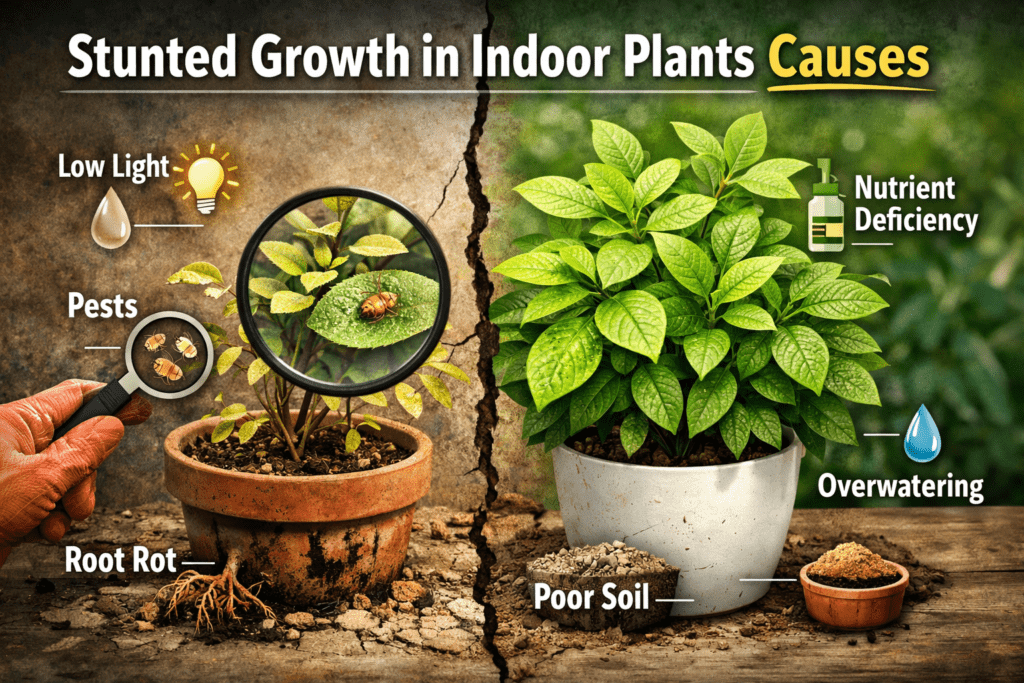
You bring home that gorgeous monstera or vibrant pothos, dreaming of lush new leaves unfurling every week. But weeks turn into months, and your plant just… sits there. No new growth. No height. Leaves stay small or start looking sad. 😩 If this sounds familiar, you’re dealing with stunted growth in indoor plants—one of the most common frustrations for houseplant parents everywhere.
Stunted growth happens when your plant stops producing new stems, leaves remain tiny compared to older ones, or the whole thing looks weak and leggy. It’s not just “slow”—it’s a sign something essential is missing or wrong. The good news? In my years of reviving hundreds of struggling houseplants (from beginner pothos to finicky fiddle leaf figs), I’ve seen that most cases of stunted growth are completely fixable—often in just a few weeks with the right tweaks.
In this in-depth guide, we’ll cover the 8 most common causes of why indoor plants stop growing, complete with clear signs to spot the problem, step-by-step fixes, and prevention tips so it never happens again. Whether you’re troubleshooting a favorite houseplant not growing new leaves or wondering how to revive stunted plants fast, you’ve come to the right place. Let’s get your green babies thriving! 🚀

(Left: A struggling, stunted pothos with yellowing and drooping leaves. Right: The same plant revived and lush after proper care!)
Understanding Stunted Growth in Indoor Plants – What It Looks Like & Why It Happens 🌱
First, let’s clarify: not all slow growth is stunted. Many tropical houseplants naturally slow down or go dormant in winter (shorter days, cooler temps ❄️). True stunted growth is persistent—no meaningful new growth for 3+ months even in growing season (spring/summer), combined with warning signs.
Common symptoms to watch for (use this quick checklist 🕒):
- No new leaves or stems for months
- New leaves emerge tiny, deformed, or much smaller than older ones
- Leggy, stretched-out stems (etiolation) reaching toward light
- Pale, yellowing, or dropping foliage
- Overall weak, spindly appearance instead of bushy and vigorous
If several of these ring true, your plant is stressed and redirecting energy from growth to survival. The root causes almost always tie back to light, water, roots, nutrients, environment, or pests—the big 8 we’ll dive into next.
The 8 Most Common Causes of Stunted Growth in Indoor Plants
1. Insufficient or Wrong Type of Light ☀️
This tops the list for a reason—most indoor spaces provide far less light than houseplants need. Low light forces plants to stretch desperately (etiolation), producing long, weak stems with small, pale leaves instead of compact, healthy growth.
Signs it’s light-related:
- Leggy stems leaning toward windows
- Small, sparse new leaves
- Overall pale or faded color
Fast fixes:
- Measure your light! Use a free phone app (like “Light Meter”) or note: bright indirect = 1000–2000+ foot-candles near east/west windows.
- Move closer to a bright window (but avoid direct harsh sun that scorches).
- Supplement with full-spectrum LED grow lights (10–12 hours/day, 12–18 inches above plant). Affordable options like Sansi or Spider Farmer work wonders.
- Rotate plants every 1–2 weeks for even growth.
Prevention tip: Choose low-light tolerant plants like snake plant or ZZ if your space is dim. For light-hungry ones (monstera, fiddle leaf fig), invest in grow lights early.

(Left: Leggy, stretched plant due to low light. Right: Bushy, even growth after better light and rotation!)
2. Overwatering & Root Rot 💦😭
Overwatering is a silent killer—soggy soil deprives roots of oxygen, leading to rot. Damaged roots can’t uptake water/nutrients, so tops stay stunted even if soil looks “wet enough.”
Signs:
- Yellowing lower/older leaves
- Mushy, black stems or base
- Foul soil smell, fungus gnats swarming
- Plant wilts despite wet soil
Fast fixes:
- Stop watering immediately.
- Gently remove from pot—healthy roots white/firm; rotten = brown/black/mushy (trim with sterilized scissors).
- Repot in fresh, well-draining mix (add perlite/orchid bark).
- Use pots with drainage holes + saucer (empty excess water).
- Water only when top 2 inches dry (finger test or moisture meter).
Pro tip: Bottom watering revives many overwatered plants gently—place pot in water tray for 20–30 min, then drain.

(Yellow, droopy leaves and root rot signs—classic overwatering damage!)
3. Underwatering & Dry Soil 🏜️
Inconsistent or too-little water shocks roots, causing them to shrink and stop supporting new growth. Crispy tips and wilting follow.
Signs:
- Crispy, brown leaf edges/tips
- Leaves curl or droop dramatically
- Soil pulls away from pot edges
- Pot feels very light
Fast fixes:
- Water thoroughly until it runs out drainage (use room-temp water).
- Try bottom watering for even moisture.
- Increase humidity (group plants, pebble tray with water).
- Set a consistent schedule—check weekly, adjust by season.
Prevention: Mulch topsoil lightly or use self-watering pots for forgetful plant parents.
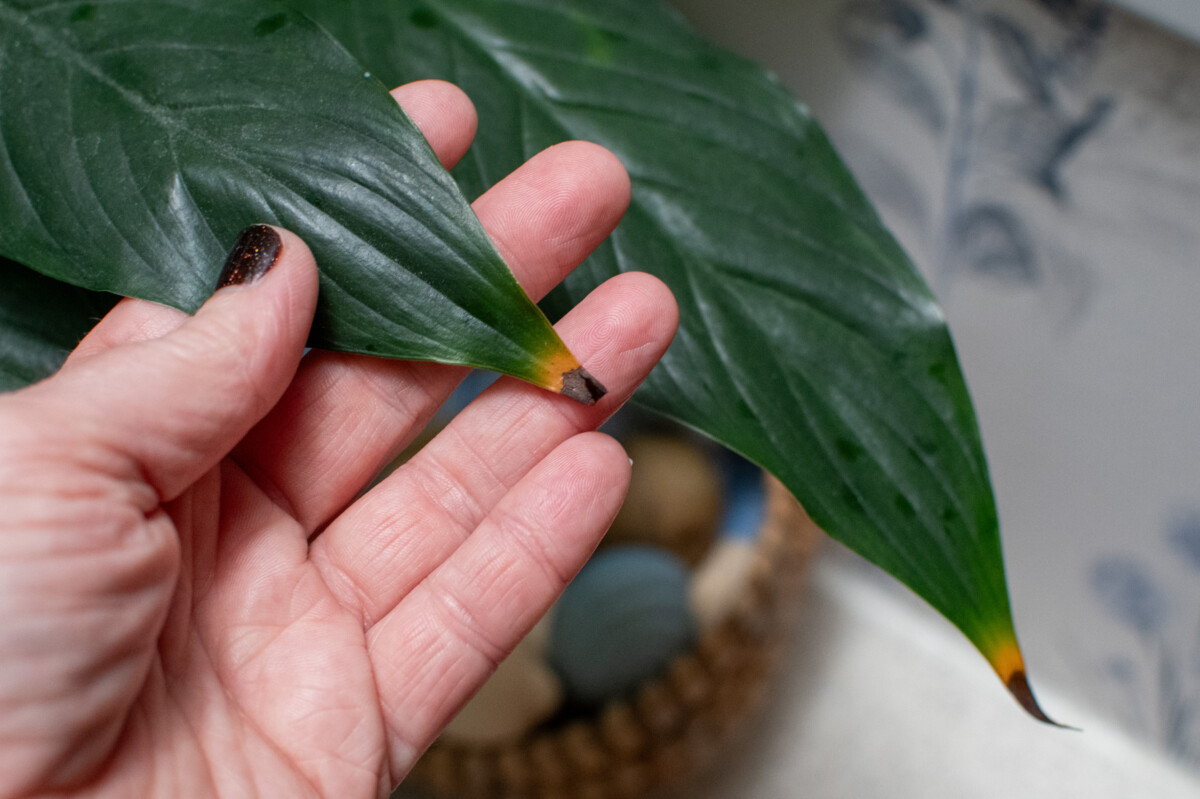
(Brown, crispy tips from underwatering or low humidity—easy to spot!)
4. Nutrient Deficiency or Wrong Fertilizer 🥦
Plants need balanced nutrients for growth. No fertilizer (or wrong type) starves them, leading to small leaves and halted progress.
Signs:
- Yellow old leaves (nitrogen lack)
- Purple/reddish undersides (phosphorus)
- Interveinal chlorosis (iron/magnesium)
Fast fixes:
- Use balanced liquid houseplant fertilizer (e.g., 20-20-20 or organic like fish emulsion) at half strength every 4–6 weeks in growing season.
- Flush soil with plain water if over-fertilized (salt buildup).
- Repot with fresh nutrient-rich mix if depleted.
Expert insight: Always fertilize only when plant is actively growing—skip winter!
5. Root-Bound / Too Small Pot 🪴
When roots fill the pot completely and start circling tightly (root-bound), they can’t expand or absorb water/nutrients efficiently. This literally chokes growth—new leaves stay small, and the plant stalls.
Signs:
- Roots poking out drainage holes or circling the surface
- Water drains straight through too quickly (no absorption)
- Plant wilts soon after watering
- Slow/no growth despite good light & watering
Fast fixes:
- Gently slide plant out of pot to inspect.
- If roots form a dense mat or circle, tease them apart carefully or score sides lightly with a knife to encourage outward growth.
- Repot into a pot 1–2 inches larger in diameter (never jump too big—oversized pots hold excess moisture and cause rot).
- Use fresh, well-draining potting mix (add 20–30% perlite or orchid bark for aeration).
- Water lightly after repotting and place in bright indirect light; avoid fertilizer for 4–6 weeks to reduce transplant shock.
Prevention tip: Repot most houseplants every 1–2 years in spring. “When in doubt, size up slowly” is the golden rule.
:max_bytes(150000):strip_icc()/how-to-tell-if-your-plant-is-rootbound-847788-hero-ea3340c2f2a549d2aec38d676ebde563.jpg)
(Left to right: Classic root-bound examples with circling roots; hands gently handling during repotting—see how dense the root ball gets!)
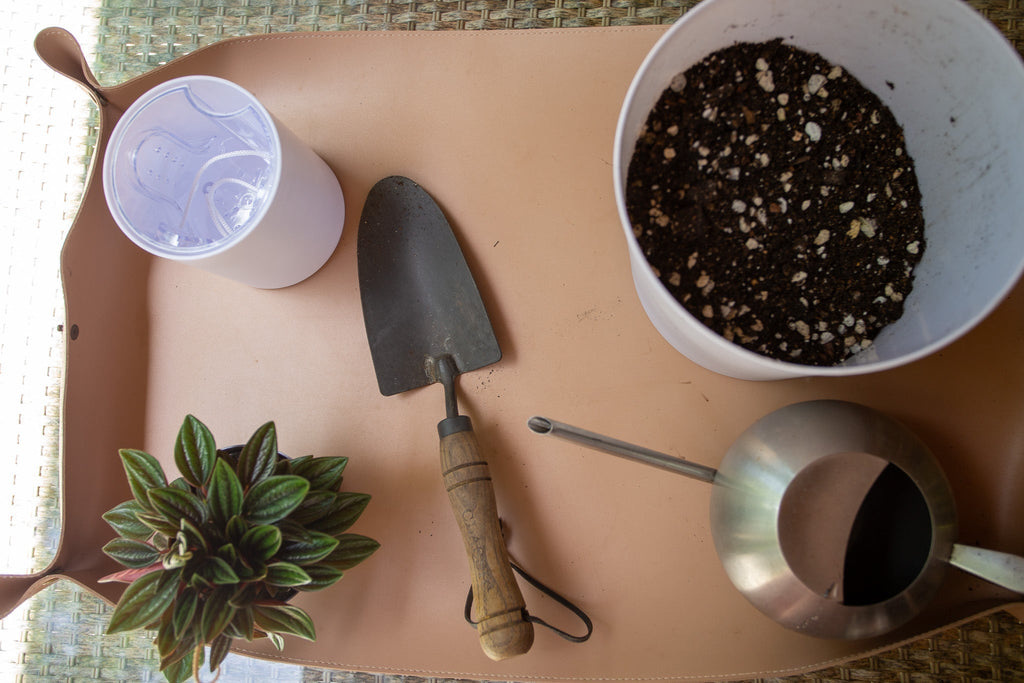
(Step-by-step repotting visuals: Checking roots, new pot setup, filling soil—perfect before/after inspiration!)
6. Temperature Stress or Cold Drafts 🌡️
Most indoor plants are tropical natives that hate sudden drops below 60°F (15°C) or cold drafts from windows, doors, or AC vents. Cold shocks slow metabolism dramatically, halting growth and damaging tissues.
Signs:
- Blackened or mushy leaf tips/edges
- Sudden leaf drop
- Wilting despite proper watering
- Slowed or no new growth in cooler months
Fast fixes:
- Move away from cold windows, doors, or vents immediately.
- Keep daytime temps 65–80°F (18–27°C) and nights above 60°F (15°C).
- Use a cheap digital thermometer/hygrometer combo to monitor.
- Group plants together or place near (not on) a heat source for a microclimate boost in winter.
- If damage occurred, prune dead parts and maintain consistent warmth—recovery can take weeks but is possible.
Prevention: Avoid placing sensitive plants (like calatheas, ferns, or monstera) near drafty spots. In Dhaka’s cooler months (if any), watch for evening drops.

(Cold shock symptoms: Wilted/blackened leaves, mushy areas—don’t let drafts hit your tropicals!)
7. Low Humidity (Especially in Dry Seasons) 💨
Tropical houseplants crave 50–70% humidity; most homes (especially with AC or heaters) sit at 30–40%. Low humidity causes leaves to lose moisture faster than roots can replace it, leading to stunted tips and halted growth.
Signs:
- Brown, crispy edges/tips on leaves
- Curling leaves
- Increased spider mite problems (they thrive in dry air)
- Slow overall growth
Fast fixes:
- Use a pebble tray: Fill tray with pebbles + water, set pot on top (never in water).
- Run a cool-mist humidifier near plants (aim for 50%+).
- Group plants closely to create a humid microclimate.
- Mist leaves occasionally (morning only—avoid evenings to prevent fungus).
- Choose humidity-tolerant plants if your space is naturally dry.
Myth busted: Frequent light misting alone isn’t enough—it’s temporary. Consistent ambient humidity wins.

(Brown crispy tips from low humidity—classic on monstera, philodendron, etc.!)
8. Pests or Hidden Diseases 🐛
Pests like spider mites, mealybugs, scale, or thrips sap plant energy, diverting it from growth to defense. Diseases (fungal issues from poor air circulation) compound the problem.
Signs:
- Fine webbing (spider mites)
- White cottony spots (mealybugs)
- Sticky honeydew or sooty mold
- Distorted, stippled, or yellowing leaves
- Stunted new growth
Fast fixes:
- Inspect weekly—use magnifying glass under leaves/stems.
- Isolate affected plant immediately.
- Wipe leaves with neem oil solution (1 tsp neem + 1 tsp dish soap per liter water) or insecticidal soap.
- For severe cases, use systemic treatments (follow label).
- Improve air circulation with a small fan and prune heavily infested parts.
- Quarantine all new plants for 2–4 weeks to prevent outbreaks.
Prevention: Regular neem foliar sprays (monthly) act as a natural deterrent.
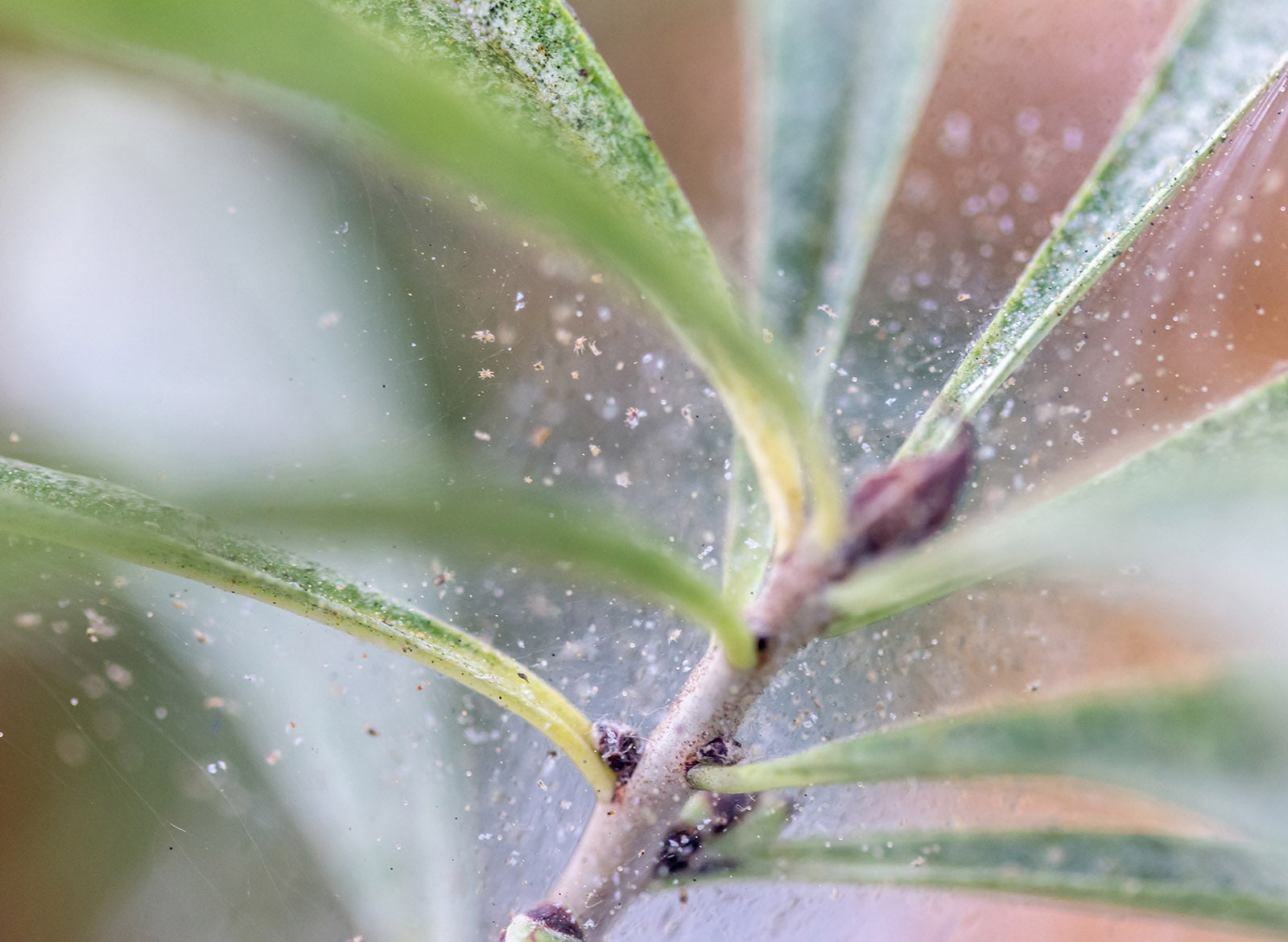
(Spider mites in action: Webbing, tiny specks—catch early before they stunt your plant!)
Quick Troubleshooting Checklist & Diagnostic Flowchart 📋
Use this step-by-step guide to diagnose fast:
- Light first — Is it bright indirect? (Move/test with grow light if no.)
- Water next — Finger test: Top 2 inches dry? Water thoroughly if yes; check for rot if soggy.
- Roots third — Roots visible/circling? Repot time.
- Environment — Temp steady? Humidity 50%+?
- Pests last — Any bugs/webbing? Treat immediately.
(For a visual version, imagine a flowchart: Start → Light? → Water? → Roots? → Temp/Humidity? → Pests? → Nutrient check.)

(Helpful troubleshooting flowcharts—print or save for quick reference!)
Bonus Expert Tips to Prevent Stunted Growth Forever 🌟
- Adjust seasonally: Winter slowdown is normal—reduce water/fertilizer.
- DIY potting mix: 50% peat/coco coir + 30% perlite + 20% bark for perfect drainage.
- Beginner-proof plants: Pothos, snake plant, ZZ, peace lily—rarely stunt.
- Prune & propagate: Trim leggy bits to encourage bushiness; root cuttings in water for backups.
- Monitor weekly: A 5-minute check prevents 90% of issues.
Frequently Asked Questions (FAQs)
Why is my plant not growing but has new leaves? New leaves but tiny/stunted usually means light or nutrient issues—boost brightness or start half-strength fertilizer.
Can stunted indoor plants recover fully? Yes! Most bounce back beautifully within 1–3 months once the stressor is fixed. Be patient and consistent.
How long to fix stunted growth? Light/water tweaks show new growth in 2–6 weeks; root-bound or pest cases take 1–3 months.
Is slow growth in winter normal? ❄️ Absolutely—many tropicals rest when days shorten. Growth resumes in spring.
Best fertilizer for stunted houseplants? Balanced (e.g., 20-20-20 or organic seaweed/fish) at half strength during active growth only.
(And more—feel free to ask in comments!)
Conclusion
Stunted growth in indoor plants is almost always a cry for help—too little light, wrong watering, cramped roots, dry air, pests, or environmental stress. By systematically checking the 8 common causes we’ve covered, you can diagnose and fix most issues fast.
Your plants aren’t being difficult—they just need the right conditions to thrive. Give them consistent care, and you’ll be rewarded with vigorous new leaves and that lush, happy vibe every plant parent dreams of. 💚 You’ve got this!
Share your revival stories below—what fixed your stunted plant? Subscribe for more expert houseplant tips, and happy growing! 🌿🚀











