
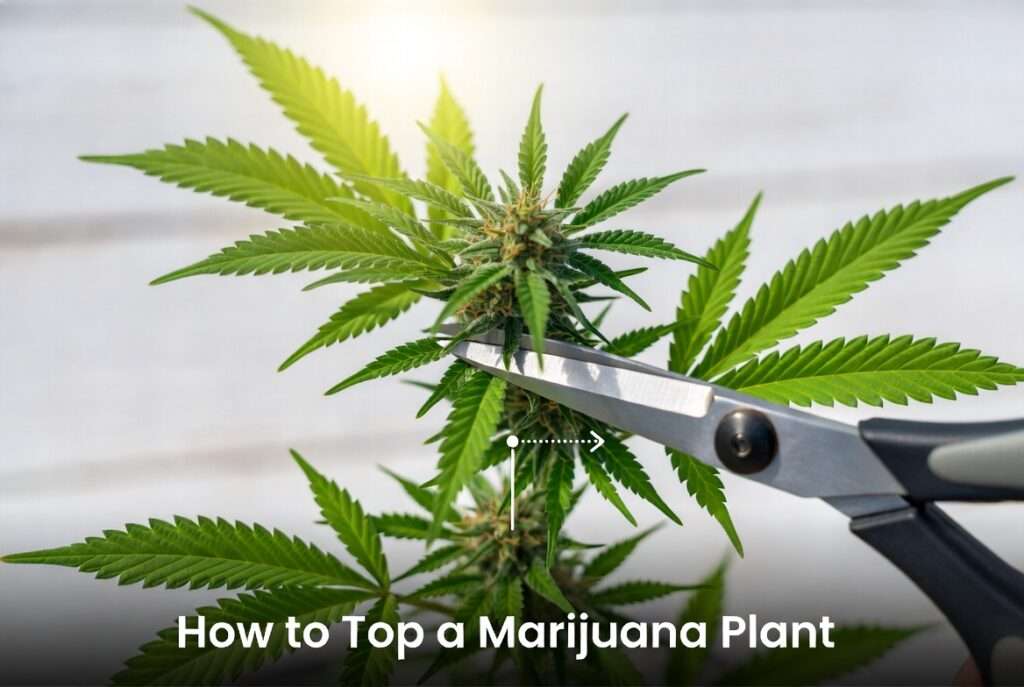
Topping is one of the most trusted cannabis training techniques used by experienced growers worldwide. When done at the right time and in the right way, it encourages multiple main colas instead of a single dominant stem. This means better light exposure, improved airflow, and potentially much larger yields.
But topping incorrectly can stress or stunt your plants — especially if you’re new to cannabis cultivation. That’s why this comprehensive guide walks you through everything step by step, from choosing the perfect timing to avoiding the most common mistakes beginners make.
Whether you grow indoors in a tent or outdoors in your garden, this guide will help you top your marijuana plants with confidence and maximize your results. 🌞🏡
🌿 What Does It Mean to Top a Marijuana Plant?
✂️ Definition of Cannabis Topping
Topping is a high-stress training (HST) method where growers cut off the main growing tip of a cannabis plant during the vegetative stage. This process interrupts the plant’s natural growth pattern known as apical dominance.
Normally, cannabis plants focus most of their energy on one central stem. After topping, the plant redirects that energy into multiple branches instead of just one. As a result, growers can develop a bushier plant with several large bud sites rather than one tall main cola.
Think of it like pruning a tree or hedge — strategic cutting encourages fuller, healthier growth. 🌱
🌞 Why Growers Top Marijuana Plants
Experienced cannabis cultivators top plants for several important reasons:
🌿 Bigger Yields
More branches mean more bud sites. Instead of one large cola, topping creates multiple productive tops.
💡 Better Light Distribution
Bushier plants allow grow lights or sunlight to reach lower branches more effectively.
🌬️ Improved Airflow
Dense, overcrowded plants can trap humidity and increase mold risk. Topping opens up the canopy.
🏡 Easier Indoor Growing
Indoor growers often struggle with height limitations. Topping keeps plants shorter and easier to manage.
🌳 Stronger Plant Structure
Multiple branches help distribute weight more evenly during flowering.
🌱 Topping vs FIMing vs Pruning
Many beginners confuse topping with other cannabis training techniques. Here’s a quick breakdown:
| Technique | Purpose | Difficulty | Stress Level |
|---|---|---|---|
| Topping | Creates multiple colas | Easy | Moderate |
| FIMing | Encourages extra branching | Medium | Moderate |
| Pruning | Removes unnecessary growth | Easy | Low |
| LST (Low-Stress Training) | Bends branches for better shape | Easy | Low |
For most beginners, topping is the best balance between simplicity and yield improvement. 🌿
🌿 Benefits of Topping a Marijuana Plant

🌱 Bigger Yields and More Bud Sites
The biggest reason growers top marijuana plants is simple: higher production.
After topping, the plant stops prioritizing one main stem and begins distributing hormones evenly among side branches. Over time, those branches develop into additional colas capable of producing dense buds.
Instead of harvesting one dominant top cola and several weak lower buds, you can create a more even canopy filled with productive flowering sites.
For indoor growers using LED grow lights, this can significantly improve overall efficiency. 💡
🌬️ Better Airflow and Light Exposure
Cannabis plants that grow naturally often become tall and crowded. Lower branches may receive very little light, leading to smaller popcorn buds.
Topping opens the plant structure and allows:
- Better light penetration ☀️
- Improved airflow 🌬️
- Reduced humidity buildup 💧
- Lower risk of mold and mildew
Healthy airflow becomes especially important during flowering when dense buds are vulnerable to bud rot.
💪 Stronger Plant Structure
Topped plants tend to grow wider and sturdier. This matters because flowering cannabis plants can become surprisingly heavy.
Without proper structure, branches may snap under the weight of large buds. Topping helps create a balanced framework that supports larger harvests naturally.
🏡 Easier Indoor Grow Management
Indoor growers often work with limited vertical space. Without topping, cannabis plants can quickly outgrow grow tents or get too close to lights.
Topping helps maintain a flatter canopy while controlling height. This creates more even light coverage and prevents heat stress near the grow lights.
⏰ When Is the Best Time to Top a Marijuana Plant?
Timing is everything when topping cannabis. Cut too early, and you risk stunting young plants. Cut too late, and recovery may slow flowering development.
🌿 Ideal Growth Stage for Topping
The best time to top a marijuana plant is during the vegetative stage, once the plant has developed:
- 4–6 healthy nodes 🌱
- Strong root development
- Vigorous upward growth
Most growers top plants when they are around 3–6 weeks old, depending on strain and growing conditions.
A healthy vegetative plant recovers much faster from stress than a young seedling or flowering plant.
👀 Signs Your Plant Is Ready
Before topping, look for these signs:
✅ Thick, healthy stem
✅ Fast new growth
✅ Rich green leaves
✅ No nutrient deficiencies
✅ No signs of pests or disease 🐛
Healthy plants recover quickly and respond better to training.
🚫 When NOT to Top Cannabis Plants
Avoid topping if your plant is:
- Too young 🌱
- Recovering from overwatering
- Nutrient deficient
- Heat stressed
- Pest infested
- Already flowering
Topping stressed plants can slow growth dramatically.
🌼 Should You Top Autoflower Cannabis Plants?
Autoflowers are different because they have a short vegetative phase. Many growers avoid topping autoflowers because recovery time can reduce yields.
However, experienced growers sometimes top vigorous autoflower strains very early — usually around the third node.
For beginners, low-stress training (LST) is usually safer for autoflowers. 🌿
🧰 Tools and Supplies You Need Before Topping
Using clean tools is critical for plant health.
✂️ Essential Tools
You’ll need:
- Sharp pruning scissors
- Small garden snips
- Razor blade or precision cutters
- Isopropyl alcohol for sterilization
Avoid dull scissors because rough cuts increase stress and infection risk.
🧼 Why Sterilization Matters
Cannabis plants are vulnerable to bacterial and fungal infections after cutting.
Before topping:
- Wash your hands
- Sterilize blades with alcohol
- Work in a clean environment
This simple step can prevent serious plant problems later.
🌿 Optional Recovery Supplies
Helpful items include:
- Plant ties
- Bamboo supports
- Organic recovery nutrients
- Humidity monitor
- Oscillating fan 🌬️
These tools help minimize stress and encourage rapid recovery.
✂️ How to Top a Marijuana Plant Step by Step

🌱 Step 1 — Inspect the Plant Carefully
Start with a healthy plant that has at least 4–6 nodes.
Choose a strong plant with vigorous growth and no signs of stress.
Weak plants should recover before any training techniques are applied.
🔍 Step 2 — Locate the Correct Node
This is the most important step.
Look at the top of the plant and identify the newest growth tip. Count downward until you find the desired node.
Most growers cut above the:
- 4th node
- 5th node
- 6th node
Leaving enough lower growth ensures strong recovery.
✂️ Step 3 — Sterilize Your Tools
Use rubbing alcohol or hydrogen peroxide to clean your scissors or blade.
Clean tools help create smooth cuts and reduce infection risk.
🌿 Step 4 — Make the Cut Properly
Carefully cut the main stem just above the selected node.
The cut should be:
✅ Clean
✅ Precise
✅ Quick
Avoid crushing or tearing the stem.
After topping, two new shoots will eventually form beneath the cut.
⏳ Step 5 — Monitor Recovery
Most healthy cannabis plants recover within 3–7 days.
During recovery:
- Maintain stable temperatures 🌡️
- Avoid overwatering 💧
- Keep humidity moderate
- Reduce plant stress
New growth should appear quickly.
🌱 Step 6 — Continue Training the Plant
Once the plant recovers, many growers combine topping with:
- Low-stress training (LST)
- ScrOG methods
- Defoliation
- Mainlining
Combining techniques can significantly improve yield potential.
🚫 Common Mistakes to Avoid When Topping Cannabis
❌ Topping Too Early
Young seedlings lack the energy reserves needed for recovery.
Wait until your plant develops several healthy nodes.
❌ Cutting the Wrong Spot
Cutting too low removes important growth sites.
Cutting too high may leave weak stems.
Always cut just above a healthy node.
❌ Using Dirty Tools
Contaminated scissors can introduce bacteria or fungus into fresh wounds.
Always sterilize before cutting.
❌ Over-Topping the Plant
Too much stress can slow development.
Beginners should limit topping frequency until they understand plant recovery patterns.
❌ Topping During Flowering
Flowering plants focus energy on bud production, not structural recovery.
Topping during bloom often reduces yields and increases stress.
🌿 How Long Does a Marijuana Plant Take to Recover After Topping?
Recovery depends on:
- Genetics
- Environment
- Nutrient health
- Grower experience
Most healthy cannabis plants recover in less than a week. 🌱
✅ Signs of Healthy Recovery
Look for:
- New side shoots
- Upright leaves
- Faster branching
- Strong color
These signs indicate the plant handled topping successfully.
🚨 Signs of Stress or Damage
Watch for:
- Drooping leaves
- Yellowing
- Growth slowdown
- Wilting
- Stem discoloration
If symptoms worsen, review watering, lighting, and nutrient conditions.
🌱 Best Cannabis Training Techniques to Combine With Topping
🌿 Low-Stress Training (LST)
LST involves gently bending branches outward to create an even canopy.
Benefits include:
- Better light distribution ☀️
- More bud sites
- Reduced height
Topping and LST together are extremely effective for beginners.
🕸️ Screen of Green (ScrOG)
ScrOG uses a screen or net to spread branches horizontally.
This technique maximizes indoor grow space and improves yields dramatically.
🌳 Mainlining / Manifolding
Advanced growers sometimes combine topping with mainlining to create perfectly symmetrical plants.
This technique requires patience but can produce exceptional harvests.
🍃 Defoliation
Removing excess fan leaves helps improve airflow and light penetration.
However, avoid excessive defoliation immediately after topping.
🏡 Indoor vs Outdoor Cannabis Topping Tips
💡 Indoor Growing Tips
Indoor growers should focus on:
- Light positioning
- Humidity control
- Temperature consistency
- Height management
Topping is especially valuable in tents with limited vertical space.
☀️ Outdoor Growing Tips
Outdoor plants often recover faster due to natural sunlight and larger root zones.
However, growers should monitor:
- Rain exposure 🌧️
- Wind damage 🌬️
- Pests 🐛
- Temperature swings
Outdoor cannabis plants can become enormous when topped correctly.
💡 Expert Tips for Maximizing Yields After Topping
🌿 Feed Plants Properly
During vegetative growth, cannabis plants need sufficient nitrogen for rapid recovery.
Balanced nutrients help prevent stress.
☀️ Optimize Lighting
Strong lighting encourages faster branching and healthier development.
Keep grow lights at safe distances to avoid heat stress.
💧 Avoid Overwatering
Freshly topped plants don’t need excessive water.
Overwatering is one of the most common beginner mistakes.
🌡️ Maintain Stable Conditions
Healthy recovery depends on environmental stability.
Ideal conditions include:
- 70–80°F temperatures
- Moderate humidity
- Good airflow
❓ Frequently Asked Questions About Topping Marijuana Plants
Does topping really increase yield?
Yes. When done correctly, topping encourages multiple colas and improves light exposure, which can significantly increase overall harvest size. 🌿
How many times can you top a marijuana plant?
Photoperiod cannabis plants can often be topped multiple times during vegetation. However, each topping session increases stress and recovery time.
Can topping kill a cannabis plant?
Healthy plants rarely die from topping. Problems usually occur when growers top stressed, unhealthy, or very young plants.
Is topping better than FIMing?
Both methods work well. Topping is generally easier and more predictable for beginners.
How long should I wait before flowering after topping?
Most growers wait at least 1–2 weeks after topping before switching to flowering.
🌿 Final Thoughts
Learning how to top a marijuana plant is one of the most valuable skills a cannabis grower can develop. With one simple technique, you can transform weak, stretchy plants into bushy, productive growers capable of producing larger, healthier harvests. 🌱✨
The key is timing, patience, and proper plant care. Start with healthy plants, use clean tools, and avoid rushing the process. Once you master topping, you’ll gain much greater control over plant shape, canopy management, and yield potential.
Whether you’re growing indoors under LEDs or outdoors under the sun, topping can dramatically improve your cannabis cultivation results when done correctly. 🌞🌿











