
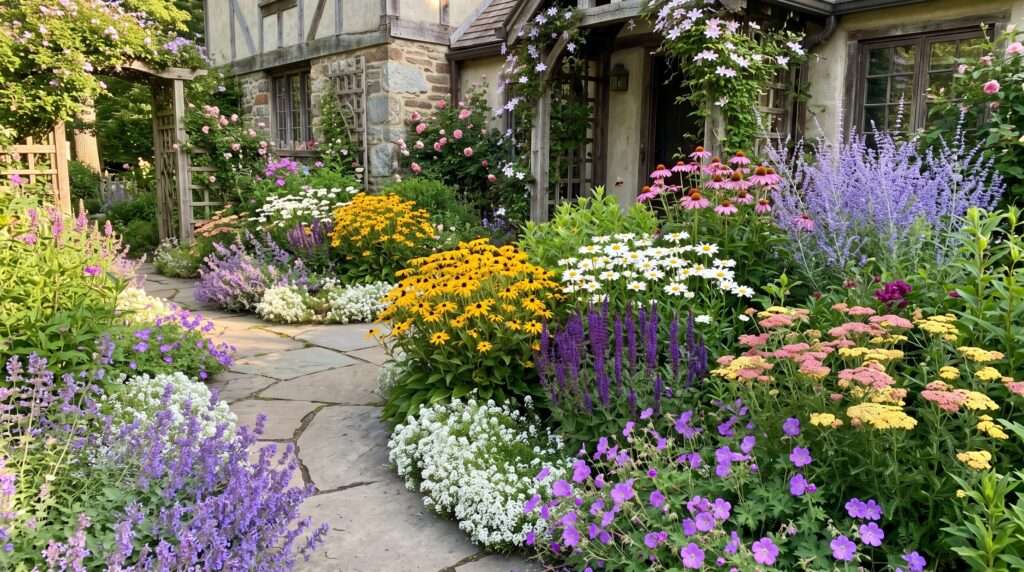
Picture this: You step out into your backyard with a morning cup of coffee, greeted by a romantic, overflowing landscape of colorful blooms, winding paths, and buzzing bees. It is the ultimate gardening dream. But let’s be honest about the reality—without the right foundation, that dream can quickly turn into a crispy, flowerless, weed-filled mess by mid-July. If you are tired of high-maintenance beds and fleeting spring blooms, you need a resilient strategy. Choosing the right plants for a cottage garden is the absolute secret to achieving that lush, informal aesthetic without becoming a slave to your yard.
Over years of hands-on soil testing, diagnosing plant diseases, and trialing countless perennials in extreme summer heat, I’ve discovered that modern cottage gardening isn’t about fussing over finicky heirlooms. It is about selecting bulletproof, disease-resistant varieties that provide continuous summer blooms from early June until the first frost.
Whether you are battling poor soil, drought, or relentless pests, this comprehensive guide will walk you through the most resilient, foolproof plants to build a stunning, low-maintenance cottage garden layout. ✨
📐 What Makes a True (and Low-Maintenance) Cottage Garden?
Before we dig into the specific plants, it is crucial to understand the philosophy behind this landscape style. The traditional cottage garden is defined by “controlled chaos”—a dense, layered mix of colors, heights, and textures that spill over pathways and blur harsh architectural lines.
However, the classic English cottage garden was designed for cool, damp climates. To replicate this romantic garden design in hotter, more unpredictable weather, we must pivot to drought-tolerant cottage flowers and robust native perennials.
💡 Pro Tip: The Secret Power of Dense Planting Many beginners worry that packing plants tightly together will cause competition. In reality, establishing a dense, layered canopy shades the soil, dramatically reduces moisture evaporation, and physically blocks weed seeds from germinating. Dense planting is your best defense against endless summer weeding!

🌺 15 Foolproof Plants for a Cottage Garden (Categorized by Garden Placement)
A professional-looking border relies on structural layering. You want towering architectural blooms in the back, bushy showstoppers in the middle, and soft groundcovers spilling out in the front. Here are the 15 absolute best performers for your garden.
🪴 The Tall Architectural Bloomers (Back of the Border)
These plants add crucial height and structure, drawing the eye upward and providing a stunning backdrop for shorter flowers.
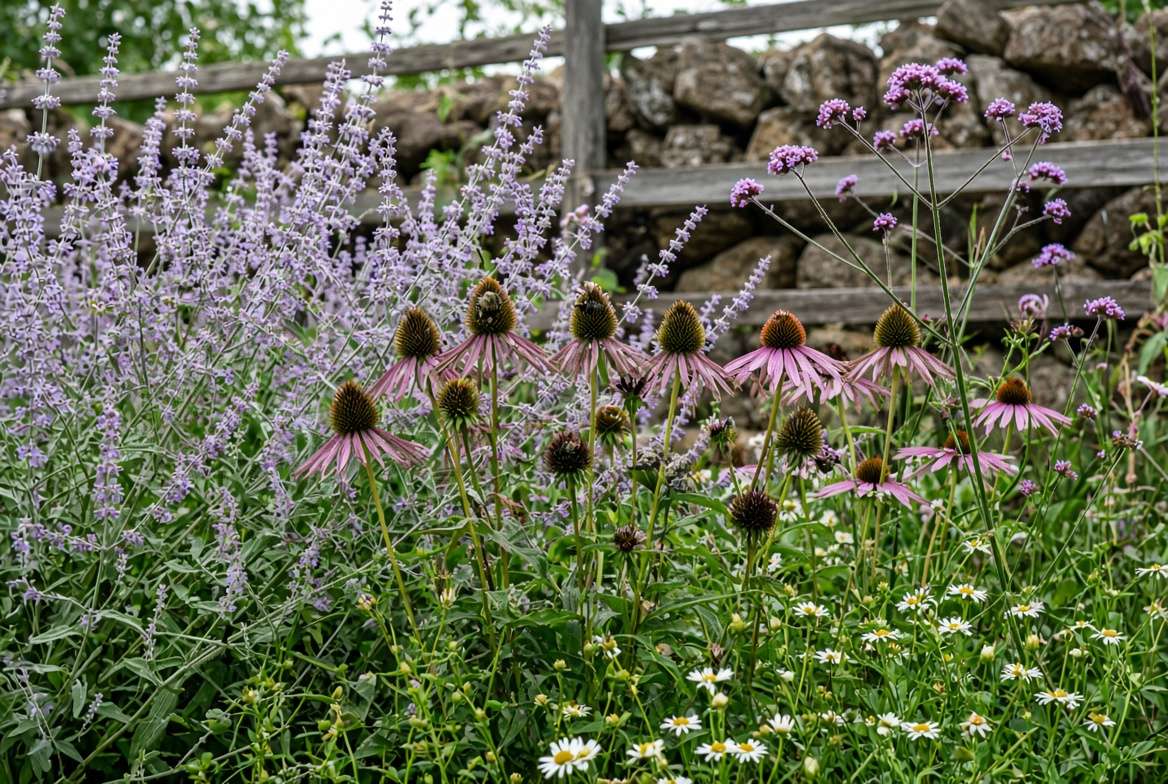
1. Russian Sage (Perovskia atriplicifolia) 💜 If you want that airy, lavender-like aesthetic without the strict soil and humidity requirements of actual lavender, Russian Sage is your best friend.
-
Why it’s foolproof: It thrives in poor, rocky soil and actually prefers dry conditions once established. Its silvery foliage and purple spires are highly drought-tolerant and completely ignored by deer and rabbits.
-
Expert Care Tip: Wait until early spring to cut the woody stems back to about 6 inches above the ground. This encourages vigorous new growth and prevents the plant from flopping over in late summer.
2. Purple Coneflower (Echinacea purpurea) 🌸 A native prairie staple that looks perfectly at home in a romantic border.
-
Why it’s foolproof: Coneflowers develop a deep taproot, making them incredibly resilient to both drought and heatwaves. They are practically immune to most pests and are a massive draw for vital pollinators.
-
Expert Care Tip: Do not deadhead the final flush of blooms in late fall. The dried, blackened seed heads provide brilliant winter interest and serve as a crucial food source for goldfinches and other overwintering birds.
3. Tall Verbena (Verbena bonariensis) 🦋 This is the ultimate “weaver” plant. It produces clusters of vibrant purple flowers atop wiry, nearly leafless stems that can reach 4 to 5 feet tall.
-
Why it’s foolproof: Because the stems are transparent, you can plant Tall Verbena anywhere—even in the front or middle of the border—without blocking the view of the flowers behind it. It is a vigorous self-seeder, meaning a single plant will naturally populate your garden year after year.
🌼 The Mid-Sized Showstoppers (Middle of the Border)
These are the workhorses of the cottage garden. They provide the bulk of your visual weight, texture, and continuous summer color.
4. Black-Eyed Susan (Rudbeckia fulgida ‘Goldsturm’) 🌻 No cottage garden is complete without the cheerful, golden-yellow daisy-like blooms of the Black-Eyed Susan.
-
Why it’s foolproof: ‘Goldsturm’ is a powerhouse that spreads via rhizomes to form a dense, weed-suppressing clump. It scoffs at humidity, thrives in full sun, and requires zero supplemental fertilizer.
-
Disease Management: Ensure good air circulation by dividing clumps every 3-4 years to prevent fungal issues in humid climates.
5. Yarrow (Achillea millefolium) 🌾 Yarrow provides a stunning textural contrast with its feathery, fern-like foliage and flat-topped flower clusters that serve as landing pads for butterflies.
-
Why it’s foolproof: Yarrow actually prefers neglect. If you plant it in rich, heavily composted soil, it will become leggy and flop over. Stick it in lean, well-draining soil, and it will reward you with months of blooms in shades of yellow, pink, or terracotta.
6. Shasta Daisy (Leucanthemum x superbum) 🤍 The quintessential cottage flower. Its crisp white petals and sunny yellow centers bring a refreshing brightness to garden borders, especially at dusk.
-
Why it’s foolproof: These perennials boast incredibly sturdy stems that stand up to summer storms.
-
Expert Care Tip: To ensure a rigorous repeat bloom all the way into September, practice selective deadheading. Snip the spent blooms down to the next lateral bud rather than just pulling off the top petals.
7. Reblooming Daylilies (e.g., Stella de Oro or Happy Returns) ☀️ While traditional daylilies have a short bloom window, modern reblooming varieties push out flushes of flowers from June through September.
-
Why it’s foolproof: Daylilies are practically invincible. They possess thick, tuberous roots that store water, allowing them to survive droughts, floods, and terrible soil compaction. They easily outcompete weeds and require almost zero maintenance.
8. Salvia / Meadow Sage (Salvia nemorosa) 🌿 Salvia provides dense, spiky wands of deep violet, blue, or pink that contrast beautifully against the rounder shapes of daisies and coneflowers.
-
Why it’s foolproof: It is entirely pest-free and highly structural.
-
Expert Care Tip: After the first massive flush of blooms fades in late June, shear the entire plant back by half. This simple trick guarantees a robust second flush of blooms by late July or early August.
🌿 The Sprawling Groundcovers & Edgers (Front of the Border)
The front of your garden border is where the magic of the cottage aesthetic truly comes alive. These low-growing perennials soften the harsh edges of brick pathways, spill beautifully over stone retaining walls, and weave the entire landscape together.
9. Catmint (Nepeta racemosa ‘Walker’s Low’) 🐈 Do not confuse this with the weedy catnip that drives your felines crazy. Ornamental catmint is one of the most reliable front-of-border plants you can grow.
-
Why it’s foolproof: It naturally rounds out into a perfect, billowing mound of soft grey-green foliage covered in periwinkle-blue flowers. It blooms relentlessly for months and emits a spicy, minty scent that deer and rabbits detest.
-
Expert Care Tip: When the first flush of flowers begins to look tired in mid-summer, grab your shears and cut the entire plant back by roughly two-thirds. It will look like a green meatball for about a week, but will rapidly push out a brand-new flush of foliage and flowers.
10. Hardy Geranium (Geranium ‘Rozanne’) 🌸 Often called Cranesbill, the ‘Rozanne’ variety is legendary in the horticultural world—and for good reason.
-
Why it’s foolproof: This is arguably the longest-blooming perennial on this list, offering continuous violet-blue flowers from June all the way until the first hard frost. Rather than standing upright, it gently weaves and scrambles through the stems of neighboring plants, creating that seamless, interlocking cottage garden look.
11. Sweet Alyssum (Lobularia maritima) 🐝 While technically a tender perennial (often grown as an annual in cooler climates), Sweet Alyssum earns its spot on this list through its sheer blooming power and self-seeding habits.
-
Why it’s foolproof: It forms a dense, low-growing carpet of tiny white, pink, or purple flowers that smell exactly like warm honey. It blooms continuously until a hard freeze and acts as a living mulch, suppressing weeds and retaining soil moisture.
12. Tickseed (Coreopsis verticillata) 💛 For a punch of cheerful, sunny color right at the front of your beds, threadleaf Coreopsis is unmatched.
-
Why it’s foolproof: The delicate, fern-like foliage perfectly masks its rugged nature. Coreopsis thrives in intense heat, poor soil, and blazing sun, producing hundreds of yellow, daisy-like blooms that require virtually zero maintenance.
🧗♀️ The Romantics (Climbers for Arbors & Trellises)
No cottage garden layout is complete without the vertical romance of climbing vines. Drawing the eye upward with trellises, arbors, or obelisks prevents the garden from looking flat and one-dimensional.
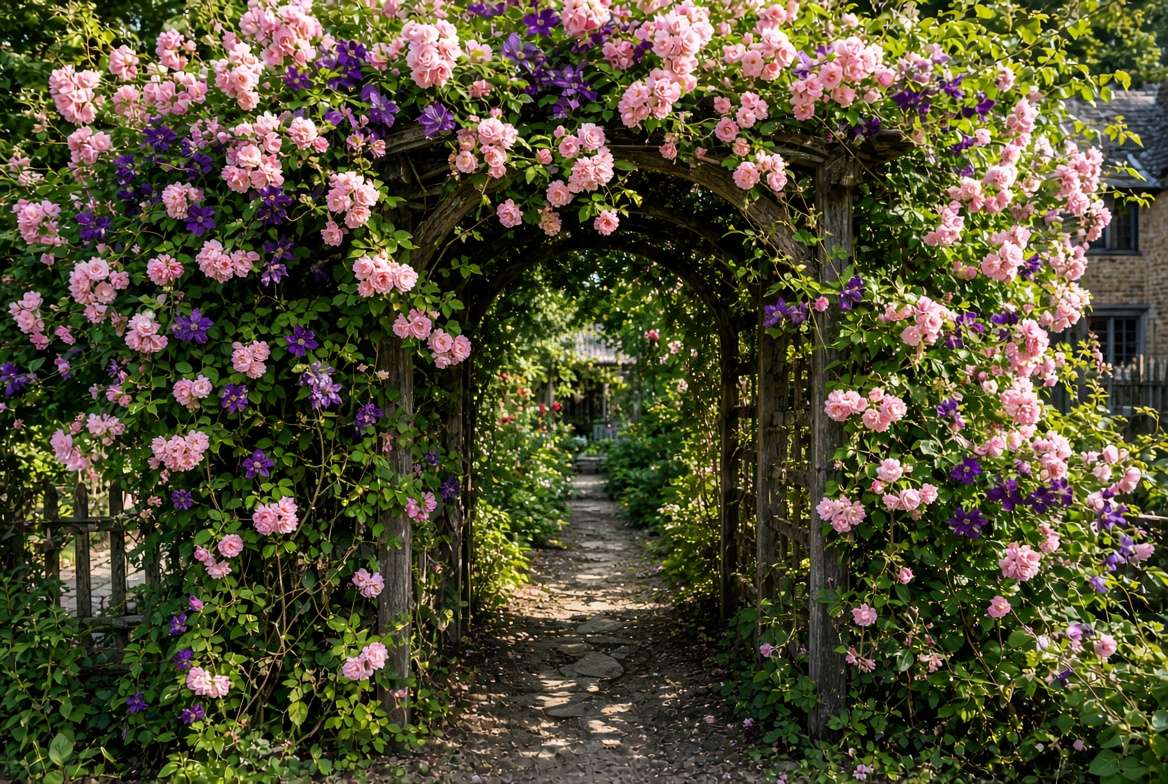
13. Repeat-Blooming Climbing Roses (e.g., ‘New Dawn’ or ‘Zephirine Drouhin’) 🌹 Older heritage roses can be notoriously prone to fungal diseases, turning into leafless, thorny sticks by August. Upgrading to modern, disease-resistant climbers solves this problem.
-
Why it’s foolproof: Varieties like ‘New Dawn’ offer classic, soft-pink double blooms with exceptional resistance to black spot and powdery mildew. ‘Zephirine Drouhin’ is a fantastic thornless option that even tolerates partial shade.
14. Clematis (Type 3 / Late-Blooming Varieties) 🌟 Clematis is known as the “Queen of the Climbers,” but its pruning rules often intimidate beginners. The secret is to exclusively plant “Type 3” (late-flowering) varieties like Clematis viticella.
-
Why it’s foolproof: Type 3 varieties bloom on new wood. This makes pruning idiot-proof: simply take your shears in late winter or early spring and chop the entire vine down to about 12 inches above the soil line. They grow back rapidly and blanket your trellis in spectacular purple, pink, or white stars all summer.
15. Honeysuckle (Lonicera sempervirens – Native varieties) 🎺 Avoid the highly invasive Japanese honeysuckle and opt for native coral honeysuckle instead.
-
Why it’s foolproof: It provides vigorous, twining growth and an enchanting fragrance. The bright red and yellow tubular flowers are an absolute magnet for hummingbirds, turning your garden into a buzzing wildlife sanctuary.
✂️ Expert Care Guide: How to Keep Your Cottage Garden Blooming All Summer
Selecting the right plants for a cottage garden is only half the battle. To maintain that lush, continuous display of flowers through the blistering heat of August, you need to employ a few professional horticultural techniques.
The Art of Deadheading Deadheading is the process of removing spent blooms before they can set seed. The biological goal of any flower is to reproduce; once it produces seeds, it stops blooming. By snipping off fading flowers, you trick the plant’s hormonal system into producing new buds. Use sharp, sterilized pruning shears to cut back to the next healthy leaf node or lateral bud to keep the garden looking tidy and vigorous.
The “Chelsea Chop” 🌿 This is a masterclass pruning technique named after the famous RHS Chelsea Flower Show in the UK. In late May or early June, take perennials like Sedum, Phlox, and Asters, and cut their stems back by one-third.
-
The Result: This delays the blooming time by a few weeks (extending your late-summer color), forces the plant to branch out, and creates bushier, sturdier stems that won’t require ugly stakes or supports when the heavy autumn rains arrive.
Watering Wisely: Deep vs. Shallow The biggest mistake beginners make in summer garden maintenance is watering lightly every single day. This encourages weak, shallow root systems that fry during heatwaves. Instead, water deeply and thoroughly at the base of the plants once or twice a week. This trains the roots to grow deep into the earth in search of moisture, making your garden genuinely drought-tolerant.

🪱 Soil & Disease Management for Crowded Gardens
Because cottage gardens rely on dense planting, airflow is naturally reduced. This creates a microclimate that can sometimes invite fungal issues if not managed properly.
Soil Prep: The Foundation of Resilience Skip the quick-fix synthetic liquid fertilizers. They encourage rapid, weak, sappy growth that pests love. Instead, focus on soil microbiology. Topdress your beds with a 2-inch layer of rich organic compost every spring. Compost acts as a slow-release fertilizer, improves soil structure, and significantly boosts the soil’s water-holding capacity, allowing your plants to endure dry spells with ease.
Fending Off Powdery Mildew 🍄 Powdery mildew looks like a dusting of white flour on your leaves and thrives in warm, humid, stagnant air.
-
Prevention: Always water at the base of the plant using drip irrigation or a soaker hose to keep foliage dry.
-
The Expert DIY Remedy: If mildew strikes, mix 1 tablespoon of baking soda, 1 teaspoon of dormant horticultural oil (or neem oil), and a few drops of mild dish soap into a gallon of water. Spray the affected foliage early in the morning to alter the pH of the leaf surface, making it inhospitable to fungal spores.
Managing Pests Naturally 🐞 The beauty of planting a highly diverse mix of full sun perennials is that you create a robust ecosystem. When you plant pollen-rich natives like Yarrow and Coneflower, you naturally attract predatory insects like ladybugs, lacewings, and parasitic wasps. These beneficial bugs act as your personal army, aggressively hunting down and consuming aphids, spider mites, and scale, completely eliminating the need for toxic chemical pesticides.
🤔 Frequently Asked Questions (FAQs)
Can I grow a cottage garden in full shade? While the classic cottage look relies heavily on full-sun bloomers, you can absolutely adapt the aesthetic for shade! Swap sun-loving daisies for structural Hostas, feathery Astilbes, Bleeding Hearts (Dicentra), and colorful Coral Bells (Heuchera). You will focus more on foliage texture and color rather than massive floral displays, but the romantic, layered effect remains stunning.
How many of each plant should I buy? To avoid a chaotic, “jumbled” look, practice the landscaping rule of odds. Always plant in drifts of 3, 5, or 7 of the same variety. A large, sweeping drift of 5 Black-Eyed Susans looks intentional and impactful, whereas planting 5 completely different single flowers looks visually cluttered.
Do I need to replant these every year? No! The beauty of this list is that it focuses primarily on hardy perennials. Unlike annuals (like petunias or marigolds) that die when winter arrives and must be repurchased, perennials go dormant in the winter and regrow from their root systems every spring, returning larger and more impressive year after year.
How do I stop my cottage garden from looking messy? Structure is the secret to organized chaos. Incorporate visual anchors to give the eye a place to rest. Use crisp lawn edging, stone borders, tall evergreen shrubs at the corners of your beds, or wooden obelisks. When you have strong structural elements framing the garden, the overflowing flowers look romantic rather than overgrown.
✨ Conclusion
Building a lush, romantic, and magazine-worthy landscape does not require endless hours of backbreaking labor or an advanced botany degree. By selecting the right plants for a cottage garden—focusing on resilient, low-maintenance perennials that naturally thrive in tough conditions—you can create an outdoor sanctuary that practically cares for itself.
Start by layering your architectural bloomers in the back, filling the middle with drought-tolerant workhorses, and softening the edges with sprawling groundcovers. Remember to focus on deep watering and rich compost, and let nature do the rest of the heavy lifting.
What is your absolute favorite flower in your garden right now? Have you struggled with keeping your blooms alive through the August heat? Drop a comment below to share your experiences, and be sure to check out our comprehensive affiliate buying guides for the best pruning shears and soil testing kits to get your new cottage garden started on the right foot! Happy gardening! 🌱🌻











