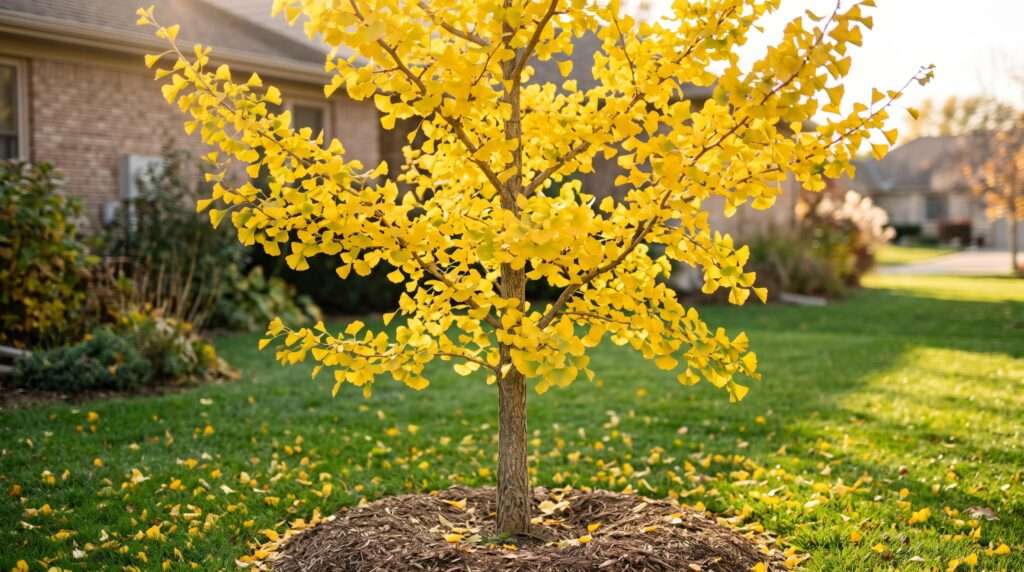
Imagine planting a tree in your backyard that once shaded dinosaurs. That isn’t a gardening exaggeration—the ginkgo biloba plant (Ginkgo biloba), commonly known as the maidenhair tree, is a genuine “living fossil” that has remained virtually unchanged for over 200 million years. 🦖🌳 With its unmistakable, fan-shaped green leaves that erupt into an electric, glowing yellow every autumn, it is easily one of the most striking ornamental trees you can grow.
Yet, if you ask most homeowners why they hesitate to plant one, you’ll hear the exact same concern: the smell. Anyone who has ever stepped on a fallen ginkgo fruit on a city sidewalk knows the unforgettable, pungent odor of rancid butter. 👃🚫
Here is the good news that many gardening guides bury at the bottom of the page: you can enjoy all the prehistoric beauty, urban toughness, and golden fall foliage of a ginkgo biloba plant without ever dealing with a single smelly fruit. It all comes down to making one smart decision before you even pick up a shovel. Whether you have a sprawling lawn or a compact patio, this complete, expert-backed guide will walk you through selecting, planting, and caring for a thriving, odor-free ginkgo tree.
📋 Quick-Glance Ginkgo Biloba Care Cheat Sheet
| Care Factor | Ideal Requirement |
| Botanical Name | Ginkgo biloba (Maidenhair Tree) |
| USDA Hardiness Zones | Zones 3–8 (tolerates Zone 9 with afternoon shade) |
| Sunlight | Full sun (6+ hours of direct sunlight daily) ☀️ |
| Soil Type | Well-draining; highly adaptable (clay, loam, sand; pH 5.0–8.0) 🪴 |
| Watering Needs | Regular deep watering for Years 1–2; drought-tolerant once established 💧 |
| Mature Size | 50–80 ft tall (standard trees) | 3–10 ft tall (dwarf cultivars) 📏 |
| Growth Rate | Slow to moderate (1–2 feet per year once established) 🐢 |
| Pet Safety | Fleshy seed coats and raw seeds are toxic to dogs & cats; leaves cause mild stomach upset 🐾 |
Why Do Some Ginkgo Biloba Plants Smell Bad? (And How to Avoid It) 👃🚫
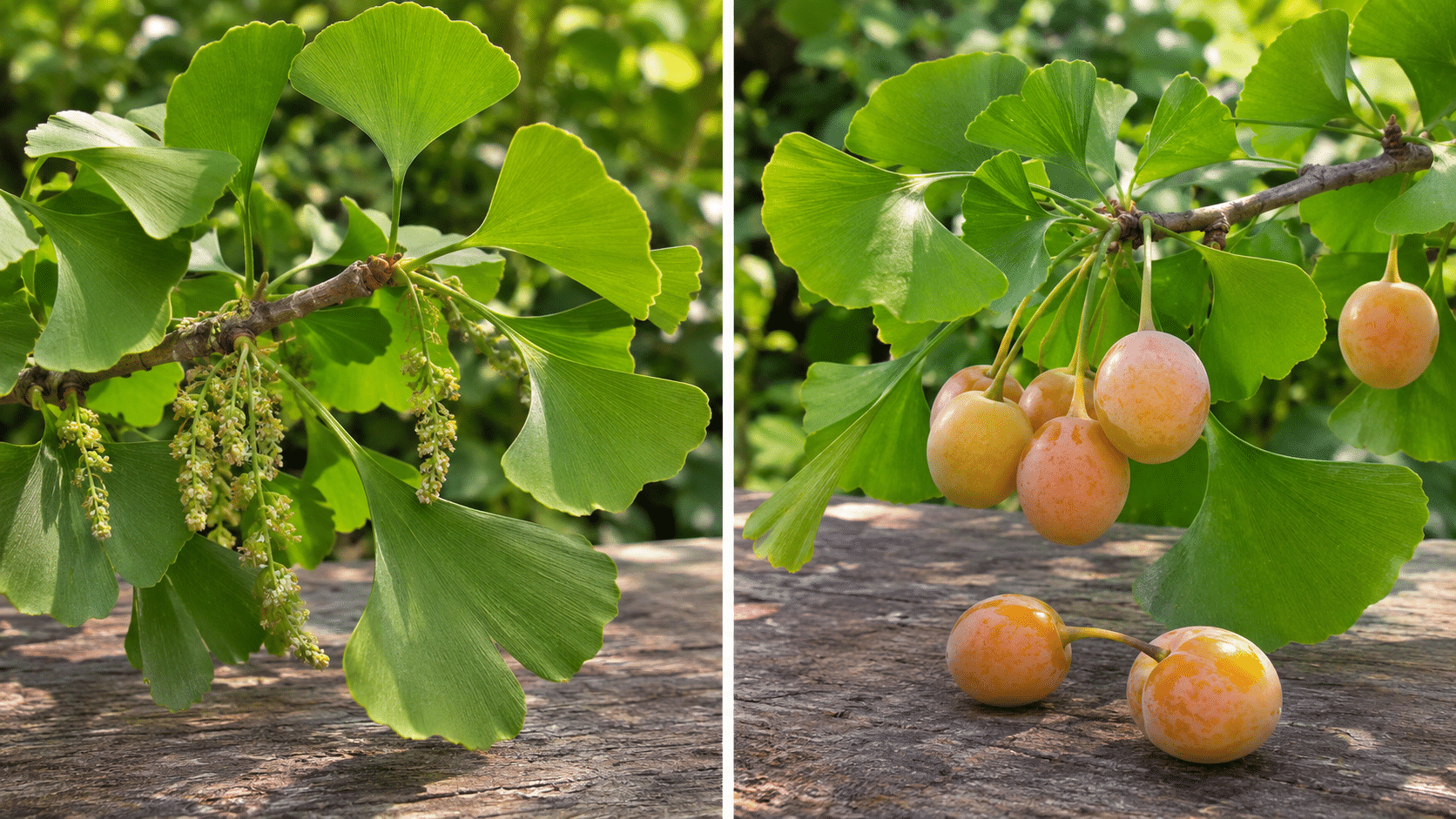
Before you buy a ginkgo, it helps to understand a bit of simple botany. Unlike maples or oaks, ginkgo trees are dioecious—meaning individual trees are either strictly male or strictly female.
Only female ginkgo trees produce the infamous “fruits” (technically fleshy seed coats called sarcotesta). As these apricot-colored seeds ripen and drop to the ground in autumn, the fleshy outer layer breaks down and releases butyric acid. This is the exact same chemical compound found in rancid butter and vomit. Worse yet, if the fruit gets squashed on your driveway or tracked inside on shoes, the odor lingers stubbornly.
The 20-Year Seedling Trap: ⚠️
If you buy a cheap, unnamed ginkgo seedling grown from seed—or grow one yourself—you are taking a 50/50 gamble. Ginkgo trees do not reach sexual maturity until they are 15 to 20+ years old. You could nurture a tree for two decades, only to discover one October that you’ve been raising a messy, foul-smelling female specimen.
How to Guarantee a Fruitless (Male) Ginkgo Tree ✅
The secret to a stink-free landscape is simple: always purchase a named, grafted male cultivar from a reputable nursery.
Because grafted trees are cloned from mature, verified male parent trees, they will never produce fleshy seeds. When shopping at a garden center, inspect the plant tag for a specific cultivar name in single quotes (like ‘Autumn Gold’), and look near the base of the trunk for a slight bump or scar—that is the graft union, your visual guarantee that the tree is a true male clone rather than a mystery seedling.
Top 5 Male Ginkgo Biloba Cultivars for Home Landscapes 🏆🌳
Not all ginkgos grow into 80-foot giants. Depending on your yard size, here are five reliable, fruitless male varieties trusted by arborists:
-
‘Autumn Gold’: The gold standard for residential shade trees. It grows into a symmetrical, broad-pyramidal shape (45–50 feet tall) and delivers the most uniform, brilliant yellow fall color of any cultivar. 💛
-
‘Princeton Sentry’: A narrow, columnar variety reaching 40–50 feet tall but only 15–20 feet wide. Its upright branching makes it ideal for tight urban yards, narrow driveways, or street-side planting. 🏙️
-
‘Saratoga’: A compact, slow-growing shade tree (30–40 feet tall) prized for its distinctive, deeply notched leaves that give the canopy a finer, more delicate texture. 🍃
-
‘Mariken’ (Dwarf): A charming, mushroom-shaped dwarf cultivar that tops out at just 3–5 feet tall and wide. It’s often grafted onto a short standard trunk, making it a showstopper for small gardens and patio containers. 🏺
-
‘Jade Butterflies’ (Dwarf): A dense, vase-shaped dwarf (10–15 feet tall) with deep blue-green, butterfly-shaped foliage that turns vivid gold in autumn. 🦋
💡 Expert Insight: In extraordinarily rare cases, mature male ginkgo trees have been documented producing a single “rogue” female branch after 40 or 50 years—an ancient evolutionary survival mechanism. If you ever spot fruit on a single limb of a male tree, simply prune that specific branch out during winter dormancy.
Essential Ginkgo Biloba Plant Care Requirements ☀️🌱
One of the reasons arborists adore the ginkgo biloba plant is its legendary resilience. Once established, it requires remarkably little fussing. Still, giving it the right foundational conditions ensures faster establishment and the brightest autumn display.
Sunlight & Placement ☀️
Ginkgos are sun-lovers. For the healthiest canopy and the most electric golden fall foliage, plant your tree in full sun—meaning at least 6 hours of direct, unfiltered sunlight per day. While a ginkgo will survive in partial shade, its growth rate will slow considerably, its branching may become sparse, and its autumn leaves will turn a duller pale yellow.
Soil Type & Drainage 🪴
Few trees are as forgiving of poor soil as Ginkgo biloba. It thrives in sandy loam, heavy clay, compacted urban dirt, and across a wide pH spectrum (acidic to moderately alkaline, pH 5.0–8.0).
However, there is one non-negotiable rule: the soil must drain well. Ginkgo roots despise sitting in soggy, waterlogged ground. If your yard has low-lying spots where puddles linger for more than 24 hours after a rainstorm, choose a higher elevation or plant the tree on a slight berm (raised mound) to prevent root rot.
Watering Schedule (Young vs. Established Trees) 💧
Your watering routine should evolve as your tree’s root system matures:
-
Years 1–2 (Establishment Phase): Newly planted ginkgos need consistent moisture to push roots into the surrounding soil. Water deeply once or twice a week during dry spells, applying roughly 10 gallons of water per inch of trunk diameter. Let the top 2–3 inches of soil dry out slightly between waterings.
-
Year 3 and Beyond (Established): Once settled in, a ginkgo biloba plant is remarkably drought-tolerant. It will survive on natural rainfall in most climates, needing supplemental deep watering only during prolonged summer droughts or extreme heatwaves.
Climate, Hardiness & Urban Resilience 🏙️❄️
Ginkgos flourish across USDA Hardiness Zones 3 through 8 (and can stretch into Zone 9 if given afternoon shade). Crucially, they are temperate deciduous trees that require a distinct winter chill period (dormancy) to rest and reset for spring growth.
If you live in a city or along a busy road, you couldn’t pick a tougher tree. Ginkgos shrug off air pollution, compacted soils, urban heat islands, and even winter road salt—which is why they line avenues from New York City to Tokyo.
Fertilizing Your Ginkgo Biloba Plant 🧪
Ginkgos are light feeders and rarely need chemical fertilizers. In fact, pumping a young ginkgo full of high-nitrogen fertilizer can force weak, leggy shoots that are vulnerable to wind damage.
If your soil is severely depleted or your tree shows stunted growth and pale green leaves during summer, apply a balanced, slow-release granular fertilizer (such as 10-10-10) in early spring just as the buds begin to swell. Otherwise, a simple annual top-dressing of compost around the drip line is all the nutrition it needs.
How to Plant a Ginkgo Biloba Tree Step-by-Step ⛏️🌳
Proper planting is the single most important factor in helping your ginkgo biloba plant establish quickly and live for centuries. The best time to plant is in early spring (after the ground thaws) or early autumn (at least 6 weeks before the first hard freeze), allowing roots to settle in without battling scorching summer heat.
-
Choose the Right Spot: Look up and around before digging. Standard ginkgo trees need at least 15 to 20 feet of clearance from your house foundation, sidewalks, and overhead utility lines. Dwarf varieties can be tucked closer—about 5 to 8 feet away.
-
Dig a Wide, Shallow Hole: Excavate a hole that is two to three times wider than the nursery pot or root ball, but no deeper than the root ball’s height. Wide, loosened soil encourages horizontal feeder roots to spread outward rapidly.
-
Locate and Expose the Root Flare: This is a critical arborist step that many DIYers miss. Gently brush away excess nursery soil at the base of the trunk until you see the root flare—the spot where the trunk widens into the main roots. When placed in the hole, this flare must sit level with or 1 inch above the surrounding soil line. Burying the trunk flare suffocates the roots and invites trunk rot.
-
Backfill with Native Soil: Gently tease apart any circling roots on the outside of the root ball, set the tree straight, and backfill using the original native soil you dug out. Avoid dumping heavy bags of rich potting mix into the hole; doing so creates a “bathtub effect” where water pools inside the hole instead of draining, and roots refuse to venture out into your yard’s native dirt.
-
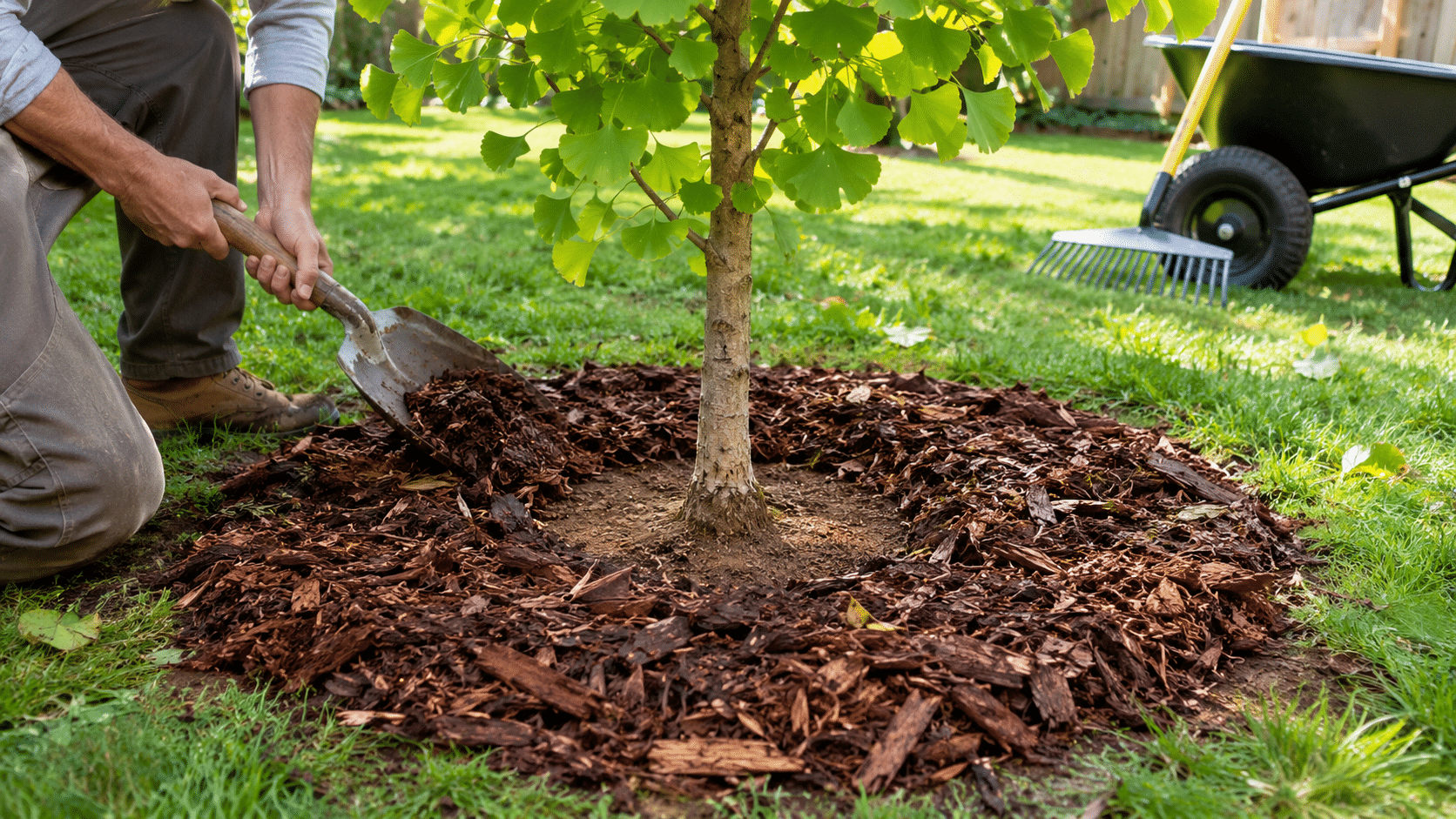
Water Deeply & Mulch Correctly: Soak the planting area thoroughly to eliminate air pockets. Finish by applying a 2- to 3-inch layer of organic mulch (like shredded hardwood bark or pine straw) in a wide “donut” shape around the tree. Always keep mulch 3 inches away from the trunk—never pile it into a “mulch volcano.”
Growing a Ginkgo Biloba Plant in a Pot or Container 🏺✨
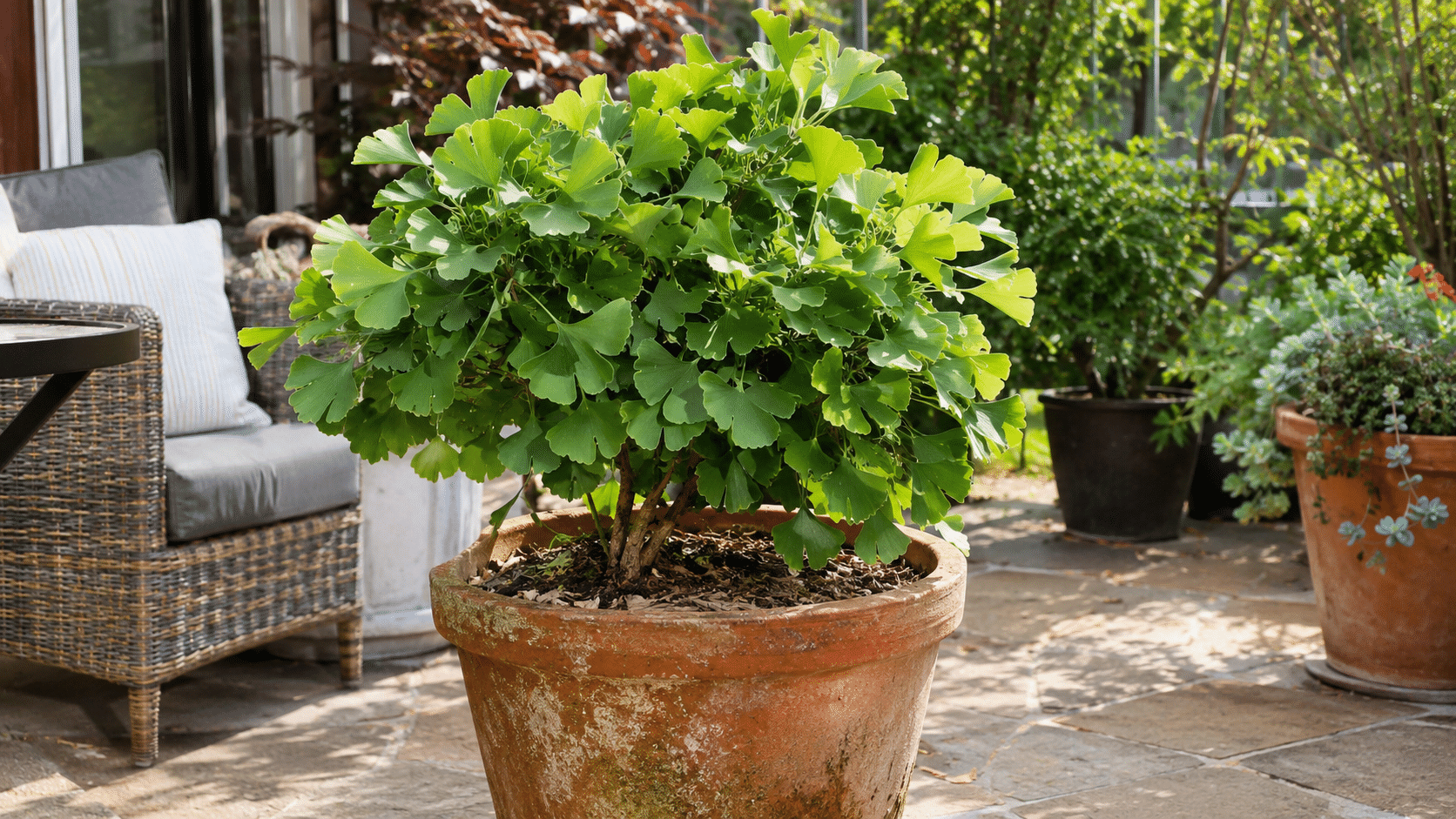
Don’t have a sprawling backyard? You can still enjoy this prehistoric beauty on a balcony, patio, or courtyard—provided you choose the right cultivar and follow a few container-specific rules.
-
Pick a True Dwarf Cultivar: Standard ginkgos will quickly outgrow even the largest planters. Stick to compact, slow-growing male varieties like ‘Mariken’, ‘Troll’, or ‘Chi-Chi’ (a favorite among bonsai enthusiasts for its fascinating, bumpy bark).
-
Choose the Right Container & Mix: Select a heavy, frost-proof pot (such as glazed ceramic, resin, or thick terracotta) that is at least 16 to 20 inches wide with generous drainage holes. Fill it with a gritty, fast-draining potting mix—blend standard potting soil with 20–30% pine bark fines or perlite to prevent compaction.
-
Watering Potted Ginkgos: Container soil dries out much faster than garden ground. Check the top 2 inches of soil every few days during summer and water thoroughly until it runs out the bottom drainage holes.
-
Winter Care (Crucial Rule): Remember that a ginkgo biloba plant is not a houseplant. Even in a pot, it must stay outdoors year-round to experience winter dormancy. If you live in USDA Zones 3–5, roots in above-ground pots are more exposed to freezing winds than roots in the earth. Insulate the pot by wrapping it in burlap or bubble wrap, or move the dormant tree into an unheated garage or sheltered porch until spring. ❄️🛡️
Pruning & Long-Term Maintenance ✂️🌿
If you dislike high-maintenance trees that demand constant shaping, you’ll love the maidenhair tree. Ginkgos naturally develop a strong, open, and architecturally pleasing branch structure with very little intervention.
-
When to Prune: Always prune in late winter to early spring while the tree is completely dormant and leafless. This makes it easy to see the branch structure and prevents unnecessary sap bleeding or heat stress.
-
What to Remove: Focus strictly on the “3 Ds”—dead, damaged, or diseased wood—along with any branches that cross or rub against one another.
-
Training Young Trees: On standard shade trees, check the top during the first 5 years to ensure the tree maintains a single central leader (one main upright trunk). If a competing double leader forms, prune the weaker one back to prevent weak branch unions later in life.
Common Ginkgo Biloba Problems & Troubleshooting 🩺🍂
One of the greatest perks of growing a ginkgo is its near-total immunity to pests and diseases. Because the leaves contain natural insect-repelling compounds (terpenoids and flavonoids), deer, Japanese beetles, aphids, and fungal blights almost completely ignore it. When issues do pop up, they are almost always environmental.
Why Is My Ginkgo Growing So Slowly? 🐢
If your newly planted ginkgo barely grew three inches in its first two years, take a deep breath—nothing is wrong! Arborists use the “Sleep, Creep, Leap” rule to describe ginkgo establishment:
-
Year 1–2 (Sleep): The tree puts almost all its energy into building a deep, anchor-like root system underground.
-
Year 3–4 (Creep): You’ll notice modest top growth of 6 to 12 inches per year.
-
Year 5+ (Leap): Once rooted, the tree hits its stride, adding 1 to 2 feet of steady, healthy growth annually.
Yellowing Leaves in Summer 💛⚠️
While golden leaves are breathtaking in October, yellowing foliage in June or July is a distress signal. The three most common culprits are:
-
Overwatering or Poor Drainage: Soggy roots suffocate and turn leaves pale yellow and limp. Check soil moisture before watering.
-
Transplant Shock: Normal during the first summer after planting; keep soil evenly moist (not soaked) and avoid fertilizing.
-
Severe Drought Stress: Crispy brown leaf edges alongside yellowing indicate the tree needs a slow, deep soak.
Sudden Autumn Leaf Drop (Don’t Panic!) 🍂✨
If you wake up one crisp November morning to find your ginkgo has dropped every single leaf overnight, don’t worry—your tree isn’t dying! You’ve just witnessed the famous “Golden Rain” phenomenon.
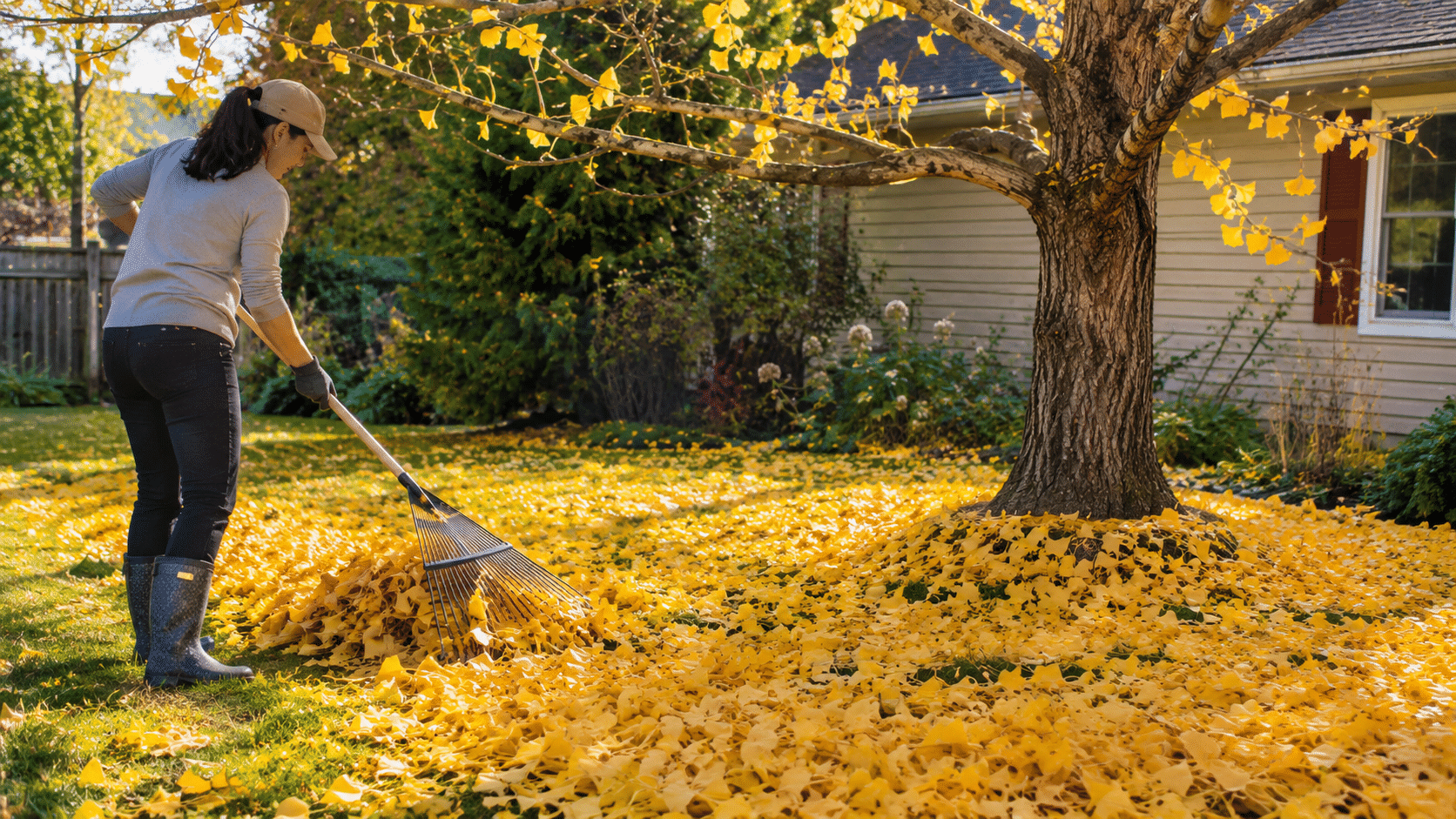
Unlike oaks or maples that shed leaves gradually over weeks, ginkgo leaf stems (petioles) form a uniform abscission layer all at once. Following the first hard autumn frost, a single breeze can trigger the entire canopy to cascade down in a shimmering carpet of gold within 24 to 48 hours. The bonus? Instead of raking every weekend for a month, you only have to rake once! 🧹💛
What If You Already Have a Female Ginkgo Tree? 🧤
If you moved into a home with a mature, fruit-dropping female ginkgo, you don’t necessarily have to cut down a healthy, majestic tree. You have two practical options:
-
Hire an Arborist for Defruiting Sprays: Certified arborists can apply a plant growth regulator (such as ethephon / Florel) directly to the blossoms in mid-spring. When timed properly, this safe treatment prevents up to 90–95% of the smelly fruit from forming.
-
Clean Up Safely: When raking fallen ginkgo fruit, always wear waterproof gloves. The fleshy outer seed coat contains ginkgolic acid, a chemical cousin to the urushiol found in poison ivy. Direct skin contact with crushed fruit can trigger an itchy, blistering rash (contact dermatitis).
Propagating Ginkgo Biloba: Seeds vs. Cuttings 🌱🔬
Want to multiply your ginkgo collection? You have two routes, and choosing the right one depends on whether you care about the tree’s gender:
-
From Seed (The Wildcard): Collect cleaned seeds in autumn (wearing gloves!), rinse away every trace of the smelly pulp, and cold-stratify them in damp sand or peat moss inside your refrigerator for 60 to 90 days before sowing in spring. It’s a fun, rewarding project—just remember you have a 50/50 chance of growing a female tree.
-
From Softwood Cuttings (The Male Guarantee): To clone a guaranteed fruitless male tree, take 4- to 6-inch softwood cuttings in early summer from a known male cultivar. Strip the lower leaves, dip the cut end in rooting hormone (IBA), and plant it in a moist, sterile mix of perlite and peat moss under a humidity dome. Roots typically form within 6 to 8 weeks.
Frequently Asked Questions (FAQs) ❓💡
1. Can you grow a ginkgo biloba plant indoors?
No. While ginkgo saplings look charming on a sunny windowsill for a few months, they are hardy temperate trees that require cold winter dormancy to survive long-term. Kept indoors in warm, dry air year-round, a ginkgo will weaken and eventually die within 1 to 2 years.
2. How far from a house should you plant a ginkgo tree?
For standard cultivars like ‘Autumn Gold’, plant at least 15 to 20 feet away from your home’s foundation, driveways, and sidewalks to give both the roots and canopy room to mature. For compact dwarf varieties like ‘Mariken’, 5 to 8 feet is plenty.
3. Are ginkgo biloba plants toxic to dogs and cats?
Yes, the seeds and fleshy fruit are toxic. If a dog or cat eats fallen female ginkgo fruit or raw seeds, it can cause vomiting, diarrhea, irritability, and—in large amounts—seizures. The leaves are not considered severely toxic, though chewing them can cause mild stomach upset. Planting a fruitless male cultivar eliminates the primary hazard for pets. 🐾
4. How long do ginkgo biloba trees live?
Ginkgos are among the longest-living trees on the planet. It is completely normal for a healthy ginkgo biloba plant to live 1,000 years or more, with several documented temple specimens in China thriving at over 2,500 years old!
A Generational Tree Worth Planting 💛🌳
Few landscape investments reward you quite like a ginkgo biloba plant. By taking one simple precaution at the nursery—choosing a named, grafted male cultivar—you completely sidestep the infamous smelly fruit while gaining a virtually pest-free, pollution-proof, living piece of natural history.
Give your young tree plenty of sunshine, well-draining soil, and a little patience during its early “sleep and creep” years. In return, it will anchor your yard with graceful, fan-shaped foliage and breathtaking golden autumns for generations to come.
Are you planning to plant a ginkgo this season, or do you already have a favorite cultivar growing in your yard? Drop a comment below with your questions or share your ginkgo story—we’d love to help your tree thrive! 🌿✨