Every plant lover knows the heartbreak of bringing home a lush, sculptural Ficus lyrata—only to watch it throw a dramatic tantrum three weeks later. One chilly draft from an air vent, a slightly overcast week, or a watering schedule off by forty-eight hours, and suddenly your pricey living room centerpiece is dropping crispy brown leaves all over the rug. It is no wonder so many homeowners and interior designers are turning to faux fiddle leaf fig trees to get that bold, architectural greenery without the constant botanical stress. 🪴
There is just one problem. Straight out of the shipping box, most artificial fiddle leaf figs look painfully fake. They stand rigidly at attention with shiny plastic foliage, perfectly symmetrical branches, and a tiny black weighted pot that wouldn’t hold the root system of a real seedling, let alone a six-foot indoor tree.
The good news? You don’t need to spend $600 on a custom designer tree to fool your guests. As a plant care specialist who has spent years studying how real Ficus lyrata trees grow, bend, and age indoors, I can tell you a secret: making a fake tree look real isn’t just an interior decorating trick—it’s a botanical one. When you apply real plant anatomy, natural growth patterns, and proper potting techniques to an artificial tree, the human brain stops questioning it. Here is the complete, step-by-step guide to transforming any faux fiddle leaf fig into a showstopper that looks straight out of a greenhouse. ✨
Why Most Faux Fiddle Leaf Fig Trees Look Fake (Through a Botanist’s Eye) 🧐
Before you start bending branches or shopping for ceramic planters, it helps to understand why our eyes immediately spot an artificial plant. Even people who don’t own houseplants have a subconscious mental blueprint of what living trees look like. When a faux tree violates those natural rules, it triggers an instant “uncanny valley” effect.
Unnatural Symmetry and “Box-Fresh” Stiffness 📦
Living trees are dynamic organisms shaped by their environment. Through a process called phototropism, a real Ficus lyrata stretches its stems and tilts its broad leaves toward the nearest window. Its canopy is slightly lopsided, some branches reach farther than others, and older lower leaves occasionally drop, leaving visible bare sections along the woody trunk.
Artificial trees, by contrast, are manufactured on an assembly line and packed tightly into narrow cardboard boxes. When you pull one out, every branch points straight upward like a closed umbrella, and the foliage is evenly distributed in an unnaturally neat cone. That rigid symmetry is giveaway number one.
The Tell-Tale Plastic Sheen ✨
Touch a healthy, living fiddle leaf fig leaf and you’ll notice it feels thick, leathery, and slightly rippled along the margins. Its surface has a waxy satin cuticle—it softly diffuses sunlight rather than bouncing it back like a mirror. Cheaper faux fiddle leaf fig trees are stamped from glossy polyester or thin vinyl that catches harsh overhead ceiling lights. That high-gloss glare screams “synthetic” from across the room.
The Tiny Black Nursery Pot Giveaway 🖤
Nothing ruins the illusion of a six-foot indoor tree faster than seeing it anchored in a 6-inch black plastic pot filled with shiny, jet-black faux glue-dirt. Anyone who has ever repotted a real tree knows that a canopy of that size requires a substantial root ball—typically a 12- to 16-inch planter—to stay upright and hydrated. Leaving your fake Ficus lyrata in its shipping base is like putting a thoroughbred horse in a doghouse; the proportions immediately give the trick away.
Step 1: Upgrade the Planter and Build a Realistic Base 🏺
If you only make one upgrade to your artificial tree, make it this one. The bottom 20% of the setup—the planter, the height, and the visible “soil” surface—does roughly 80% of the visual heavy lifting when it comes to realism.
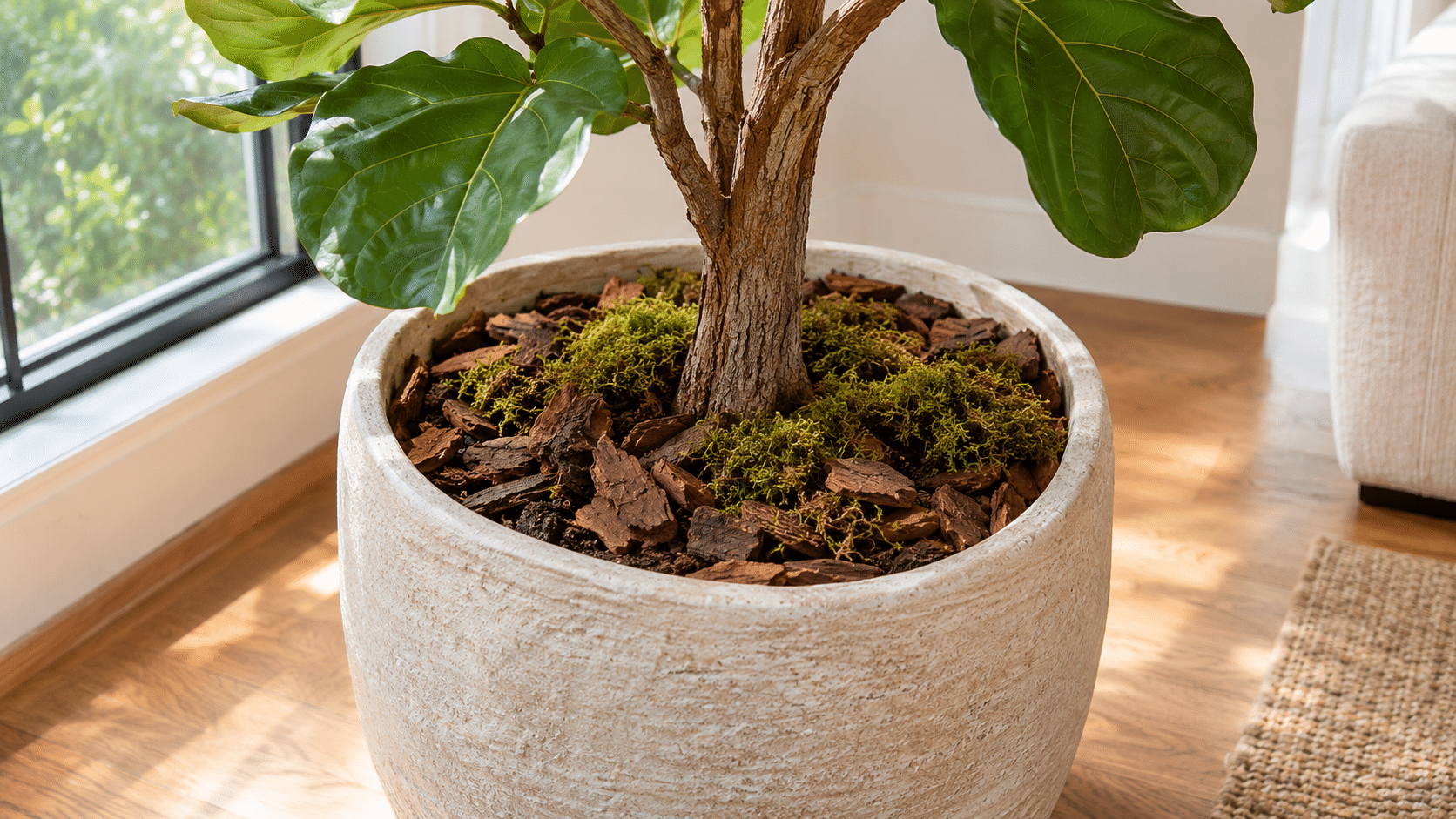
Choosing the Right Pot Size and Material
Start by ditching the undersized plastic base (you won’t remove the tree from it; you will hide it inside a proper decorative planter). Choose a vessel that matches the scale a real Ficus lyrata of the same height would genuinely need:
-
For 4- to 5-foot trees: Choose a planter that is 10 to 12 inches wide and at least 10 inches tall.
-
For 6- to 7-foot trees: Upgrade to a substantial 14- to 16-inch wide planter.
Material matters just as much as size. Terracotta, matte glazed ceramic, concrete, fluted stone, and woven seagrass belly baskets all add organic texture that grounds the tree and visually offsets synthetic foliage. Avoid glossy plastic planters, which double down on the artificial feel.
Securing and Weighting the Tree (No More Wobbling)
Real potted trees are heavy. If a pet brushes past your faux tree and the whole thing rocks back and forth like a bobblehead, the illusion is instantly broken. Follow this layering method to anchor it solidly and dial in the exact height:
-
Elevate the base: Place two or three standard red bricks, a stack of flat river stones, or an upside-down sturdy plastic pot inside the bottom of your decorative planter. This lifts your faux tree so the base of its trunk sits roughly 1 to 2 inches below the rim of the new pot—just where a real root flare would sit.
-
Center and stabilize: Set the faux tree’s original weighted black pot on top of the bricks. Check from across the room to make sure the trunk stands straight (or has a very subtle, natural lean—never a sloppy tilt).
-
Fill the empty gap: Pack the hollow space between the inner black pot and the outer decorative planter with crumpled kraft paper, bubble wrap, old plastic grocery bags, or dry floral foam blocks. Stop about 3 inches below the top rim of the pot.
-
Create a clean barrier: Lay a circle of landscape fabric, burlap, or cardboard over the packing material, cutting a slit so it wraps snugly around the trunk. This prevents your top-dressing material from sifting down into the bottom of the planter over time.
Top-Dressing the “Soil” Like a Pro 🌱
Now comes the magic touch: covering that barrier with an authentic-looking surface layer. You have three top-tier options depending on your home’s aesthetic:
-
Real Potting Mix (Most Realistic): Pour 2 to 3 inches of chunky indoor potting soil (a blend with visible white perlite and bark bits) right over the barrier. Nothing mimics dirt better than actual dirt.
-
Orchid Bark or Pine Bark Nuggets: Ideal for a clean, modern look. Real Ficus growers often top-dress their plants with bark mulch to retain moisture, so it looks 100% authentic and stays completely mess-free.
-
Preserved Forest Moss: Choose muted, earthy olive-green sheet moss or pillow moss rather than bright, neon-green craft store moss. Tuck the edges neatly down inside the rim of the planter and press it tight around the base of the trunk so no gaps show.
💡 Botanist’s Pro Tip: If you decide to use real potting soil to top-dress your faux tree, spread the soil on a rimmed baking sheet and bake it in your oven at 200°F (93°C) for 20 to 30 minutes before pouring it into the planter. This completely sterilizes the mix, killing off any dormant fungus gnat eggs or mold spores so your maintenance-free tree stays 100% pest-free!
Step 2: Master the Art of Botanical “Fluffing” and Shaping ✂️
Once your tree is solidly potted, it’s time to undo the damage of the shipping box. Take your time here—rushing this step in two minutes is the most common mistake people make. Plan to spend 15 to 20 minutes shaping your tree, stepping back six to ten feet every few minutes to evaluate the overall silhouette.
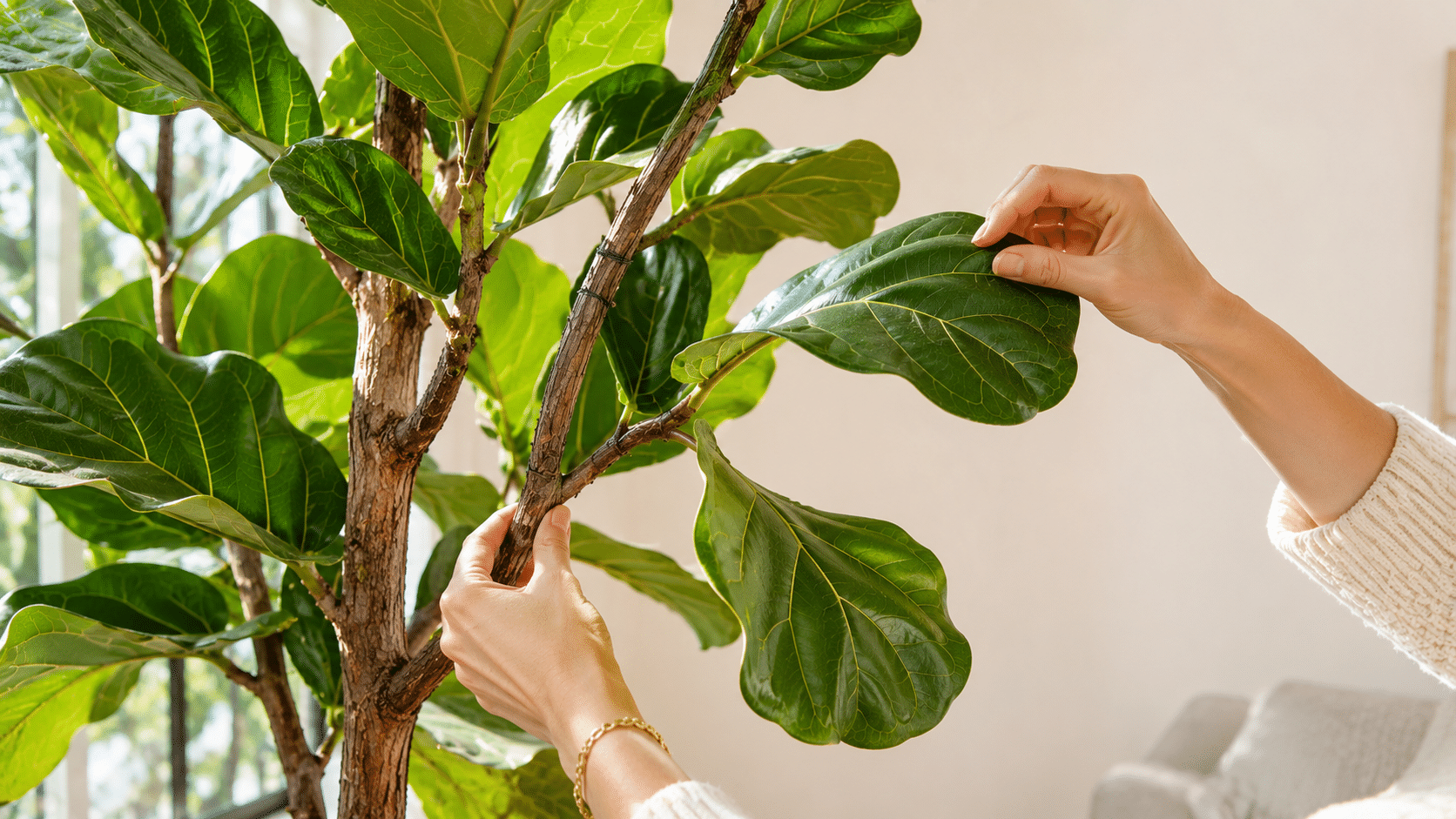
Mimicking Real Ficus lyrata Growth Patterns 🌳
To shape a realistic fake plant, picture how a living fiddle leaf fig actually grows in nature. In the tropical rainforests of West Africa—and in bright living rooms—Ficus lyrata exhibits strong apical dominance. That means it grows primarily upward on sturdy, woody stems, with secondary branches gently arching outward at roughly 30- to 45-degree angles from the main trunk.
Crucially, fiddle leaf fig branches do not droop downward like a weeping willow, nor do they stick straight out horizontally like a coat rack. Aim for a graceful, upright “V” or soft vase-like silhouette, slightly fuller toward the upper two-thirds of the tree.
How to Bend Branches Without Snapping the Wire
Most quality faux fiddle leaf fig trees have malleable steel wire running through the center of every branch and individual leaf stem (petiole). Still, aggressive yanking can snap the glue joint where a branch meets the main trunk.
-
Work from the bottom up: Start with the lowest branches and slowly progress toward the crown. This lets you see the tree’s structure take shape layer by layer.
-
Use the two-hand anchor method: Grip the base of the branch tightly with your non-dominant hand right where it attaches to the trunk. With your other hand, gently curve the branch outward and slightly upward, creating a soft, organic arc rather than a sharp 90-degree kink.
-
Stagger branch directions: Never let two adjacent branches run parallel to each other. Fan them out at slightly different heights and angles so the tree looks lush from every viewing angle in the room, not just straight-on.
Shaping Individual Leaves (The Curve Trick) 🍃
Flat, pancake-straight leaves instantly betray an artificial tree. Look closely at a real fiddle leaf fig and you’ll see its violin-shaped leaves have a slight upward cup along the midrib, while the tip of the leaf gently nods downward under its own weight.
-
Hold the leaf stem (petiole) and tilt the leaf face slightly upward—roughly 20 to 35 degrees—as if it is drinking in sunlight from your nearest window.
-
Place your thumbs on the center vein on the underside of the leaf and gently bend the outer tip downward into a soft, natural arch.
-
Rotate neighboring leaves slightly left and right so no two leaves sit flat on the exact same plane. This creates realistic micro-shadows across the canopy, giving the foliage depth and movement.
Embrace Imperfection
Here is a counterintuitive rule of plant styling: perfection looks fake. If your faux fiddle leaf fig is a dense, impenetrable wall of green leaves, it will look like a manufactured prop. Intentionally leave a few pockets of negative space—small gaps where you can see glimpses of the woody trunk, the interior branches, and the wall behind the tree. Real houseplants have airy spaces that allow light and airflow to reach the inner canopy; mimicking those gaps immediately elevates your tree from “store-bought” to “living sculpture.” 🌿
Step 3: Fix the Leaves—Shine, Color, and Finishing Touches 🎨
Even after you nail the planter and master botanical shaping, a close-up inspection can still betray an artificial tree if the factory flaws remain visible. Spending ten minutes on these finishing touches removes the final synthetic giveaways.
How to Tone Down Plastic Gloss
If your faux fiddle leaf fig has that unmistakable, mirror-like plastic shine under indoor lighting, you can fix it in under five minutes with a can of matte clear acrylic spray (such as Krylon Matte Finish or Rust-Oleum Matte Clear).
-
Carry the tree outside or into a well-ventilated garage on a dry, calm day.
-
Shake the can thoroughly for one full minute to prevent any chalky white residue.
-
Holding the nozzle 10 to 12 inches away from the foliage, apply one ultra-light, sweeping mist across the top surfaces of the leaves.
-
Let it dry completely for 20 to 30 minutes before bringing the tree back inside.
That single misty coat breaks up harsh light reflections, instantly transforming glossy vinyl or polyester into the soft, waxy satin finish of a real Ficus lyrata leaf.
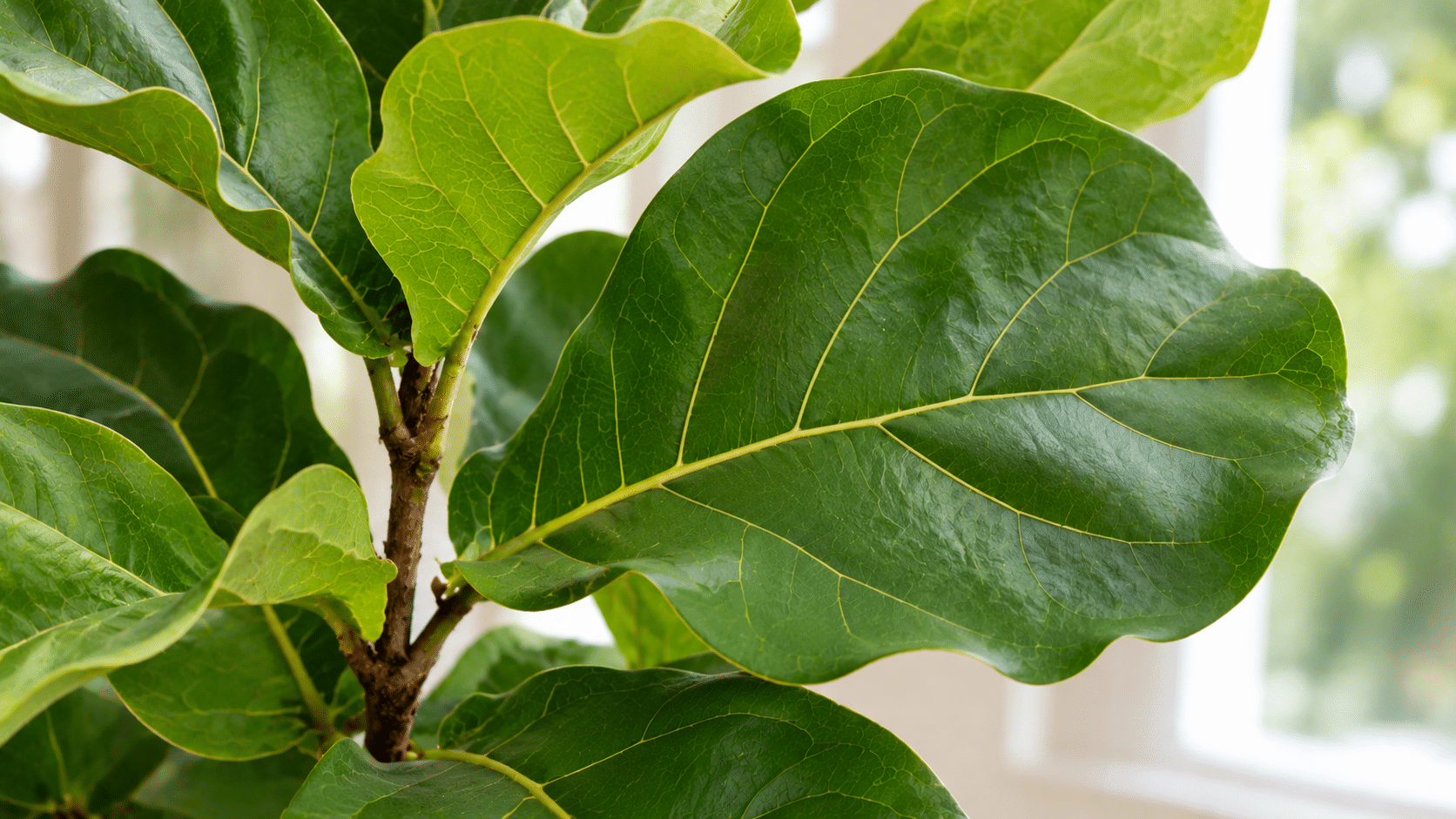
Trimming Stray Threads, Seams, and Glue Strings 🧵
Fabric-based silk leaves often arrive with tiny frayed threads along the edges, while molded plastic stems sometimes show thin raised seams or wispy cobwebs of hot glue underneath the leaf attachments.
Grab a pair of sharp manicure scissors or precision snips and do a quick lap around the canopy. Snip away any loose threads flush with the leaf margin, peel off dried glue strings, and trim any plastic nubs along the stems. If a leaf has a stubborn fold crease from shipping, pass a handheld garment steamer on low heat about 6 to 8 inches away from the leaf for a few seconds—the gentle warmth relaxes the fabric and lets you reshape it smoothly by hand.
Upgrading the Trunk Texture
If your tree has a smooth, overly uniform plastic trunk, you can add quick visual realism by dusting a tiny amount of matte brown acrylic craft paint (dry-brushed lightly with a paper towel) over the highlights to mimic natural bark variation. Alternatively, if the lower trunk looks bare or plasticky where it meets the soil, loosely wrap the bottom few inches with natural coco fiber or tuck a few small pieces of real dried moss right up against the base to soften the transition.
Step 4: Strategic Placement and Lighting Tricks ☀️
Where you place your artificial tree is just as important as how you style it. Human perception relies heavily on context—if a tree is sitting in an impossible spot, even the most expensive faux Ficus lyrata on the market will look suspicious.
Place It Where a Real Fiddle Leaf Fig Could Actually Survive
Real fiddle leaf figs are sun-lovers that require bright, filtered indirect light to stay alive. If you tuck a faux fiddle leaf fig into a pitch-black basement hallway or a windowless bathroom, guests—especially fellow plant enthusiasts—will immediately clock it as fake.
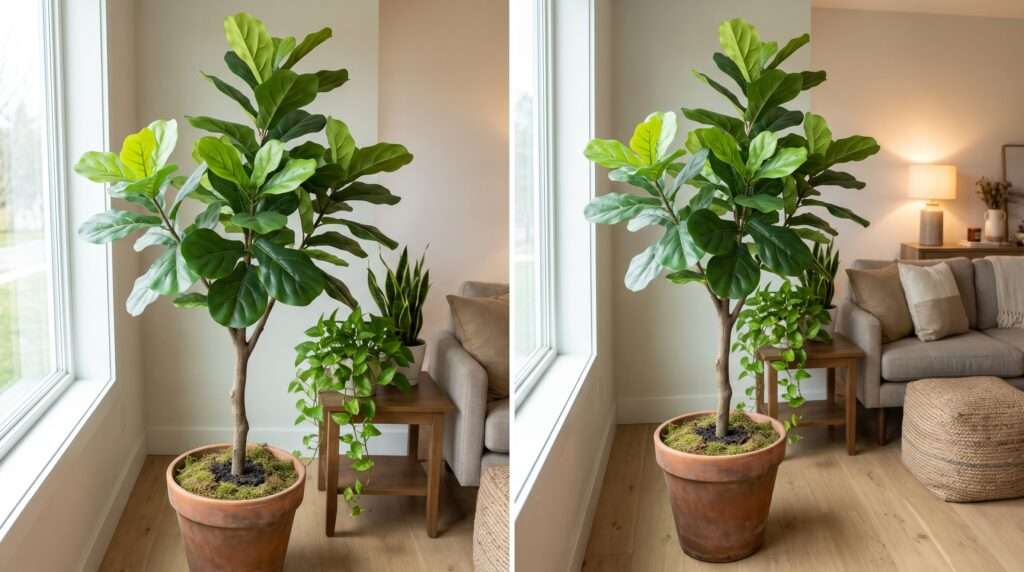
Instead, position your tree near a living room window, next to a glass patio door, or in a bright bedroom corner where natural daylight washes across the leaves. Just keep it a few feet back from harsh, direct afternoon sunbeams; prolonged direct UV exposure will eventually bleach synthetic greens into a faded bluish-yellow.
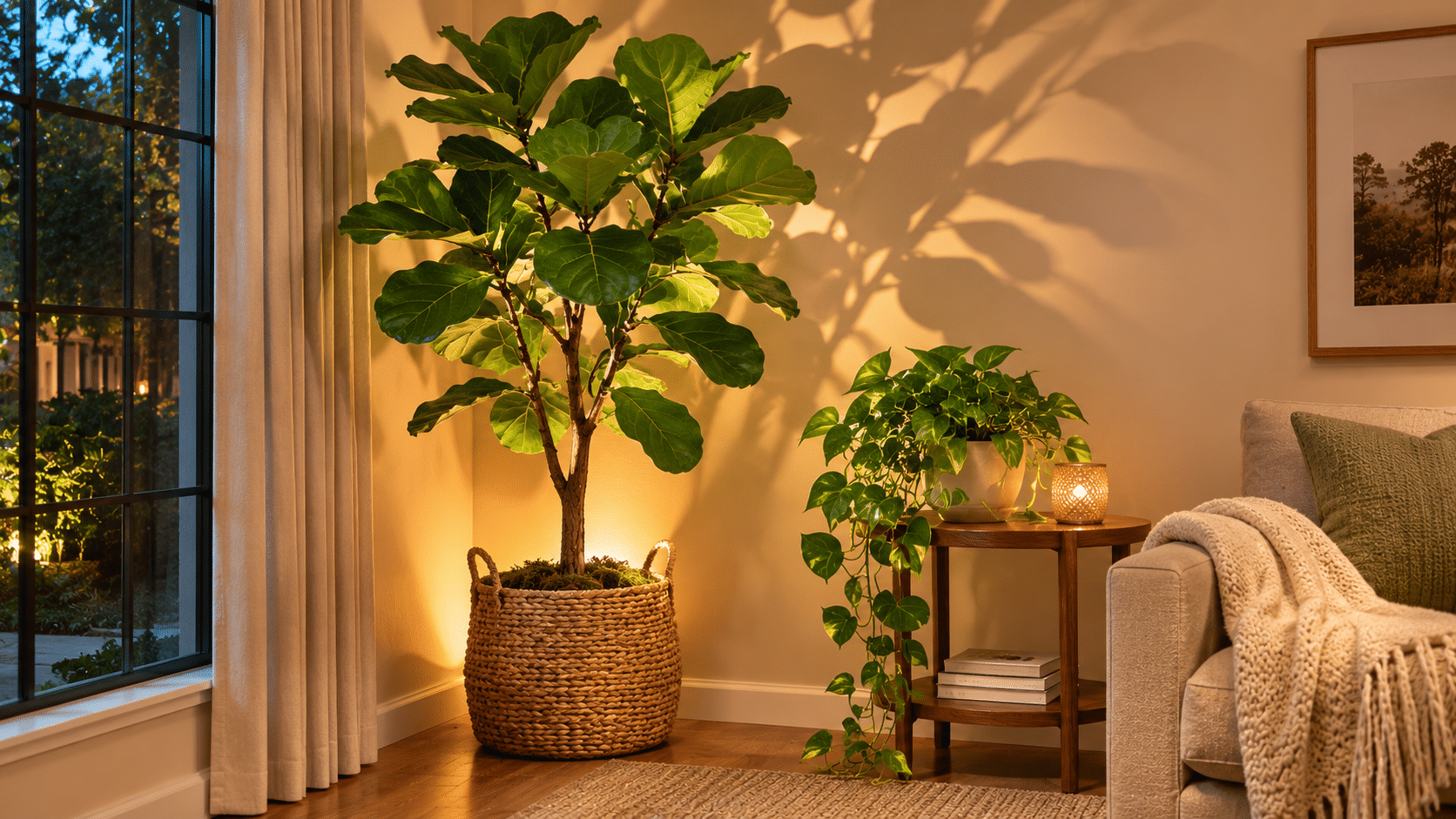
The “Halo Effect”—Grouping with Real Plants 🌿
This is one of my favorite interior styling tricks: mix your faux tree with one or two easy-care living plants. Place a trailing Pothos, a hardy Snake Plant (Dracaena trifasciata), or a glossy ZZ Plant on a nearby side table or plant stand.
When the human eye registers genuine, living foliage—with its natural imperfections and organic soil—in the same visual zone, it automatically extends that assumption to the larger tree standing right next to it. Psychologists call this the “halo effect,” and in home decor, it works like magic.
Use Uplighting for Dramatic Shadows 💡
If you want your faux tree to look like a million-dollar designer installation after sunset, tuck a small, warm-white LED floor uplight (2700K to 3000K) directly behind the planter, angled upward through the lower branches.
At night, the light filters through the staggered, curved leaves and casts dramatic, organic botanical shadows across your walls and ceiling. Those shifting shadows add depth and architectural warmth that completely distract the eye from examining the foliage up close.
Real vs. Styled Faux Fiddle Leaf Fig: At a Glance 📊
Still weighing whether to keep nursing a temperamental living tree or commit to a high-end artificial version? Here is how a properly styled faux fiddle leaf fig compares to a living Ficus lyrata in everyday home life:
| Feature | Real Ficus lyrata | Styled Faux Fiddle Leaf Fig |
| Light Needs | Bright, consistent indirect light | Anywhere (best near ambient light) |
| Maintenance | Weekly watering, pruning, pest checks | Monthly dusting |
| Pet Safety | Toxic to cats and dogs | 100% pet-safe 🐾 |
| Lifespan | Indefinite (if kept happy) | 5–10+ years with UV protection |
How to Clean and Maintain Faux Fiddle Leaf Fig Trees 🧹
Nothing makes an artificial tree look cheap faster than a thick, gray blanket of household dust. Ironically, real fiddle leaf figs also collect dust on their broad, violin-shaped leaves—and keeping your faux tree clean is the easiest way to preserve its fresh, “just-watered” vibrancy year after year.
The Best Monthly Dusting Routine
Once a month, give your tree a quick five-minute wipe-down:
-
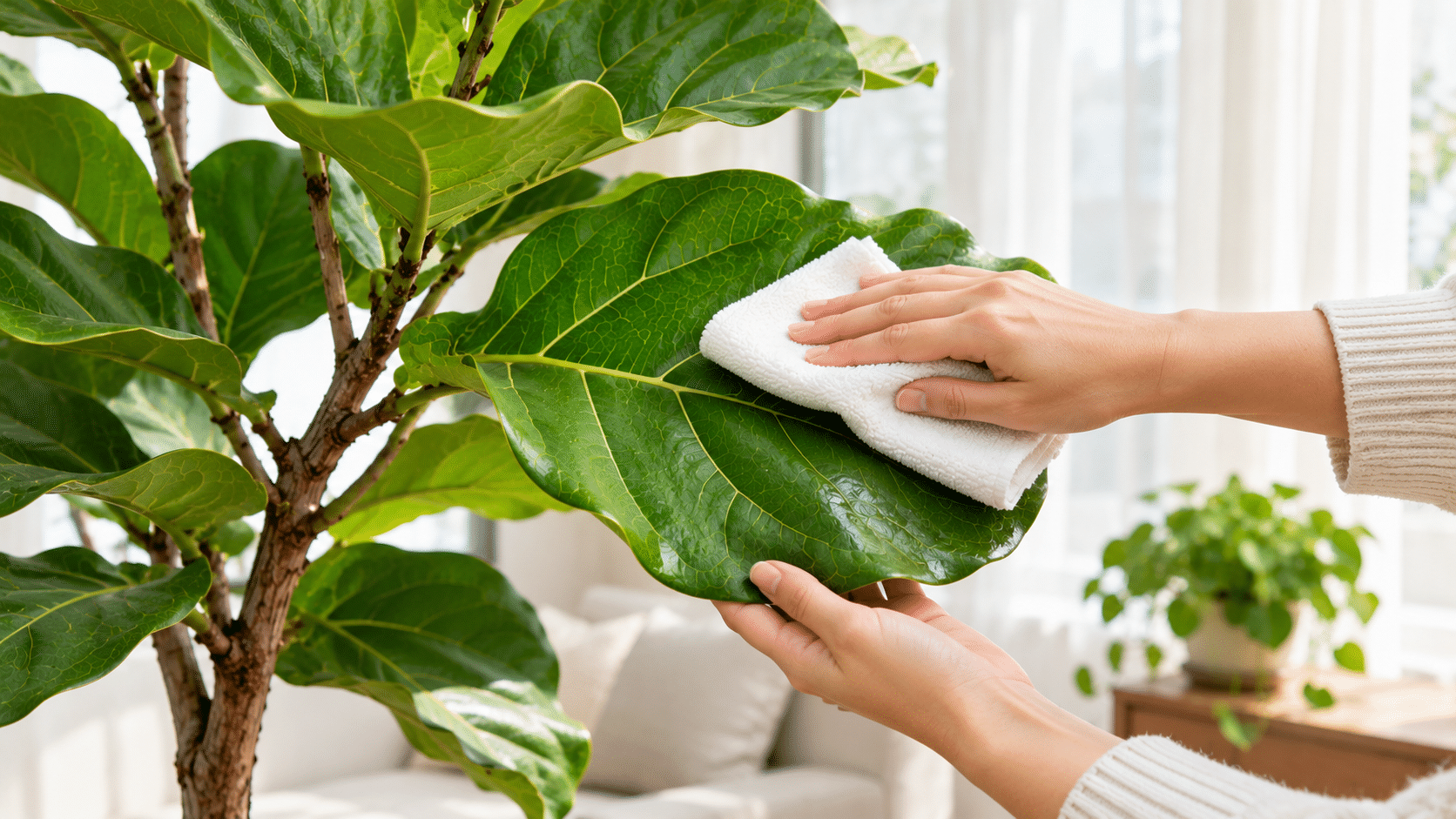
Dry dust first: Use a soft microfiber cloth or a feather duster to gently sweep loose dust off the top and underside of each leaf.
-
Damp wipe for stubborn grime: Mix a bowl of lukewarm water with two drops of mild dish soap. Dip a clean microfiber cloth into the solution, wring it out until it is barely damp, and wipe each leaf from the stem outward, supporting the underside with your free hand so you don’t bend the wire out of shape.
-
Skip commercial leaf-shine sprays: Never use aerosol plant-shine products or oily furniture polish on artificial foliage. They leave behind a sticky residue that attracts more dust and can gradually break down the painted finish on silk or PEVA leaves.
Protecting Leaves from UV Fading 🧴
If your faux fiddle leaf fig sits in a bright room with south- or west-facing windows, apply a light coat of clear UV-protectant spray (available at most craft and hardware stores) once a year. It creates an invisible sunblock barrier that keeps the greens rich and vibrant for years without yellowing.
Buying Guide: What to Look for in High-End Faux Fiddle Leaf Fig Trees 🛒
Styling can rescue almost any artificial plant, but if you haven’t bought your tree yet, starting with quality materials makes the transformation effortless. Here is what plant experts look for when shopping for realistic faux fiddle leaf fig trees:
Real Wood Trunks vs. Molded Plastic
Whenever your budget allows, choose a tree built on a real kiln-dried wood trunk (often natural eucalyptus or birch) rather than a hollow, molded plastic pole. Real wood features organic knots, subtle bends, and authentic bark texture that synthetic molds simply cannot replicate.
Leaf Material and Veining Details
Skip flat, paper-thin polyester fabric. Look for “real-touch” PEVA (polyethylene vinyl acetate) or thick silk-blend leaves. Inspect product photos closely for two botanical hallmarks:
-
Color variation: Real Ficus lyrata trees display bright, fresh lime-green leaves at the growing tips and deeper, mature forest-green leaves lower down. Uniform, single-shade green leaves look artificial.
-
Defined venation: Authentic fiddle leaf figs have prominent, light-green raised veins branching out from a sturdy central midrib. High-end faux trees emboss these veins directly into the leaf mold.
Choosing the Right Height for Your Room 📏
Scale is everything. A 4-foot tree sitting alone in a room with 10-foot ceilings will look stunted, while a 7-foot tree crammed under an 8-foot ceiling feels claustrophobic.
-
Standard 8- to 9-foot ceilings: Aim for a 5.5- to 6.5-foot tree (remembering that placing it in a decorative planter on bricks will add another 4 to 6 inches of height).
-
Vaulted or 10+ foot ceilings: Go bold with a 7- to 8-foot tree to anchor the vertical space properly.
Frequently Asked Questions (FAQs) ❓
Can you put real dirt in a faux fiddle leaf fig pot?
Yes! Real chunky potting mix is actually the most convincing top-dressing you can use. Just be sure to place a barrier (like landscape fabric or cardboard) over your packing material first so the soil doesn’t sink, and bake the soil at 200°F for 20–30 minutes beforehand to sterilize it and prevent fungus gnats.
How do you get creases out of fake fiddle leaf fig leaves?
Use a handheld garment steamer on a low setting, holding the nozzle 6 to 8 inches away from the creased area for a few seconds. Once the material relaxes, gently smooth and cup the leaf with your fingers. Avoid using a hot hairdryer on high heat, which can melt plastic coatings or loosen the glue holding the leaf to its wire stem.
Are faux fiddle leaf fig trees safe for outdoor patios?
Only if the manufacturer explicitly labels the tree as UV-rated and outdoor-safe. Standard indoor faux trees use silk fabrics, interior glues, and natural wood trunks that will quickly fade in direct sunlight, warp in high humidity, or grow mildew if exposed to rain.
How tall should a faux fiddle leaf fig be for a living room?
For most living rooms with standard 8- or 9-foot ceilings, a 6-foot faux fiddle leaf fig is the sweet spot. It is tall enough to draw the eye upward and fill an empty corner beside a sofa or media console without crowding the ceiling.
Final Thoughts: Enjoy the Greenery Without the Stress 🌱
Loving lush indoor greenery doesn’t mean you have to spend every weekend worrying about root rot, brown leaf spots, or drafty windows. With a little botanical know-how, faux fiddle leaf fig trees can bring that exact same sculptural beauty and calming energy into your home—zero watering can required.
If you remember just three things from this guide, focus on the high-impact trio: upgrade to a properly scaled planter topped with real soil or moss, bend every branch and leaf into an organic, asymmetric silhouette, and place your tree where natural light actually hits it. Take twenty minutes to style it right, step back, and enjoy a statement tree that looks freshly delivered from the nursery every single day of the year. ✨
Have a favorite faux plant styling trick of your own, or stuck trying to fix a stubborn artificial tree? Drop a comment below—I’d love to help you troubleshoot! 🪴