
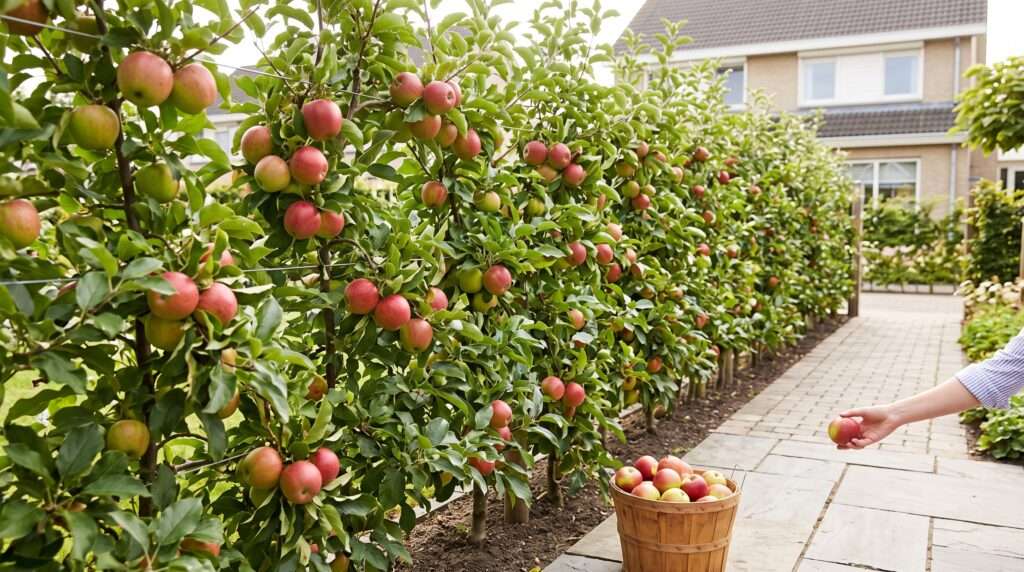
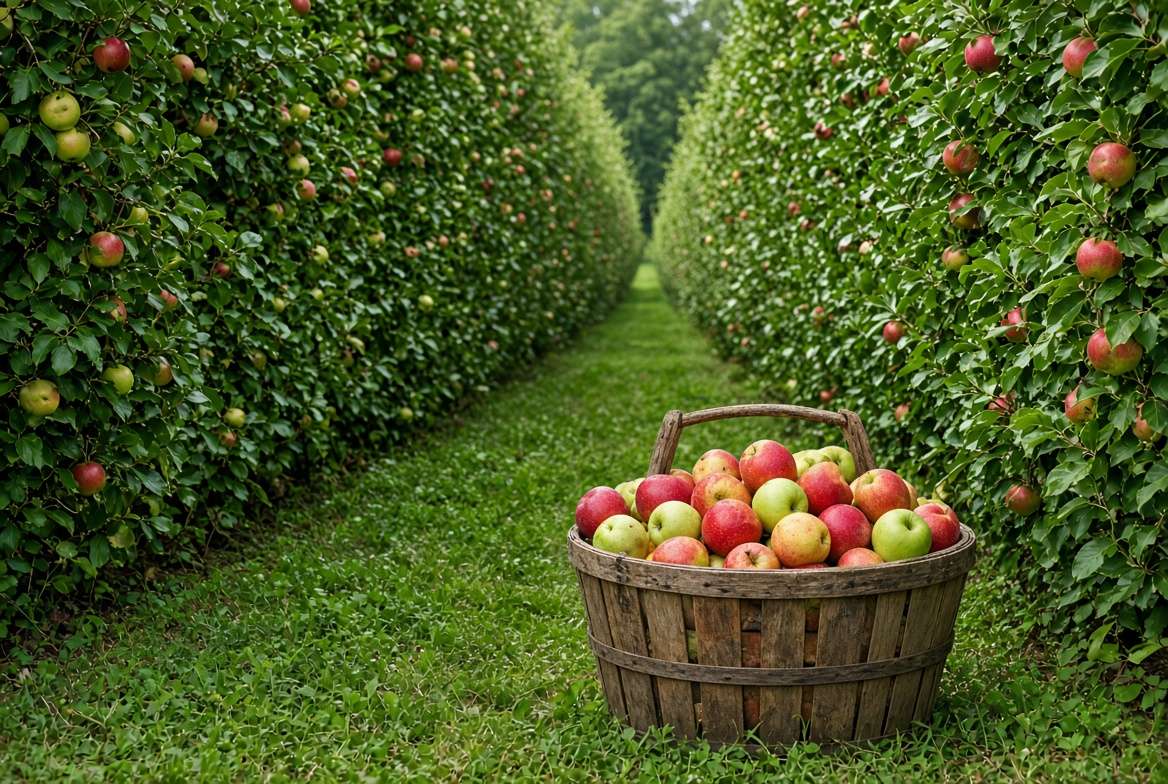
Have you ever dreamed of walking into your backyard and plucking a crisp, juicy apple straight off the branch, only to be crushed by the reality of a tiny suburban lot? Traditional orchards require acres of land, leaving many modern gardeners feeling left out. But there is a brilliant landscaping hack that solves this problem: the apple tree hedgerow. By training dwarf fruit trees into a dense, living fence, you can create a stunning visual barrier that blocks nosy neighbors while yielding baskets of fresh, organic fruit. 🏡✨
What is an Apple Tree Hedgerow? 🤔
An apple tree hedgerow is a densely planted row of apple trees trained to grow together, forming a continuous, fruitful wall. Unlike standard ornamental hedges, this method utilizes structural techniques similar to traditional European espalier to maximize vertical space. This approach is the ultimate union of form and function for urban gardens, transforming a basic boundary line into a thriving microclimate.
Selecting the Perfect Rootstocks and Varieties 🍏
Choosing the right foundation is non-negotiable for hedgerow success. You must use dwarf rootstocks to control vigor and keep the hedge manageable.
-
M27 (Extremely Dwarf): Ideal for tight urban spaces and low step-over hedges (topping out at 4-6 feet).
-
M9 (Dwarf): The standard, reliable choice for dense, easily managed privacy screens (8-10 feet).
-
Spur-Bearing Varieties: Opt for spur-bearing apples like Honeycrisp, Fuji, or Gala, which respond beautifully to the tight pruning required for a hedge.
-
Cross-Pollination: Always interplant at least two different varieties from the same flowering group to ensure a heavy fruit set. 🐝
Step-by-Step Planting and Pruning Guide 🌱
Building your edible privacy screen requires precision during the establishment phase.
-
Site Preparation: Ensure your chosen spot receives 6–8 hours of full sun daily. Dig a continuous trench and amend the soil with rich organic compost.
-
Spacing & Planting: Space M9 grafted trees about 2 to 3 feet apart. Crucially, keep the graft union 2 inches above the soil line to prevent scion rooting.
-
Trellising: Install a sturdy galvanized wire framework using treated posts to support the shallow-rooted dwarf trees against strong winds.
-
Pruning Strategy: Perform hard formative pruning in the first three winters to build a thick, interwoven base. Follow up with summer pruning (late July) to restrict leafy growth and encourage fruiting buds. ✂️
Expert Tip: Patience is key. Don’t rush the height; let the lower lateral branches weave together completely before allowing the central leaders to shoot up to your desired privacy height!
Why Choose an Apple Tree Hedgerow for Your Yard? ✨
If you are on the fence about whether high-density fruit planting is right for your property, let’s explore the transformative benefits of this edible landscaping technique. Traditional orchards space trees 15 to 20 feet apart, dedicating vast amounts of square footage to a single canopy. An apple tree hedgerow flips this outdated paradigm on its head, offering distinct advantages for the modern homeowner.
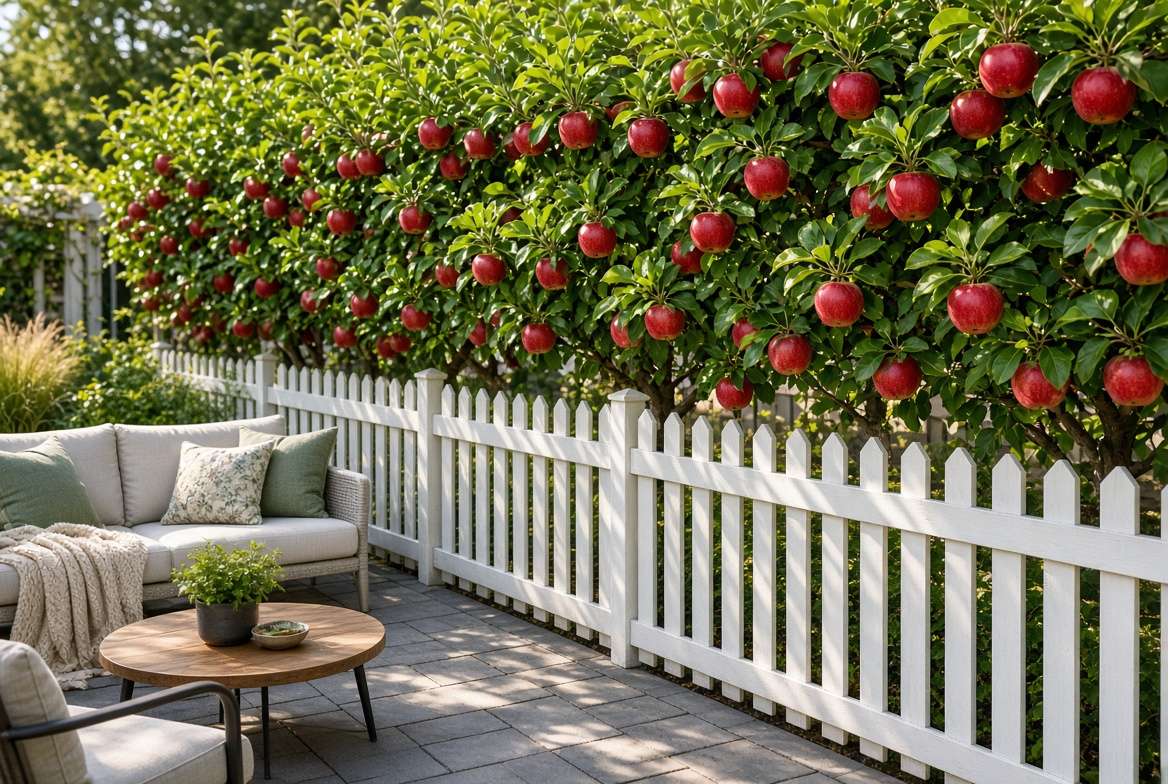
1. Ultimate Space Maximization By utilizing high-density planting techniques, you are essentially growing up instead of out. A narrow strip of land along a driveway, property line, or garden path—perhaps only two to three feet wide—can suddenly host six, ten, or even twenty different fruit trees. This vertical approach to urban gardening means you no longer have to choose between a vegetable patch, a lawn for the kids, and an orchard. You can have them all. 🌳
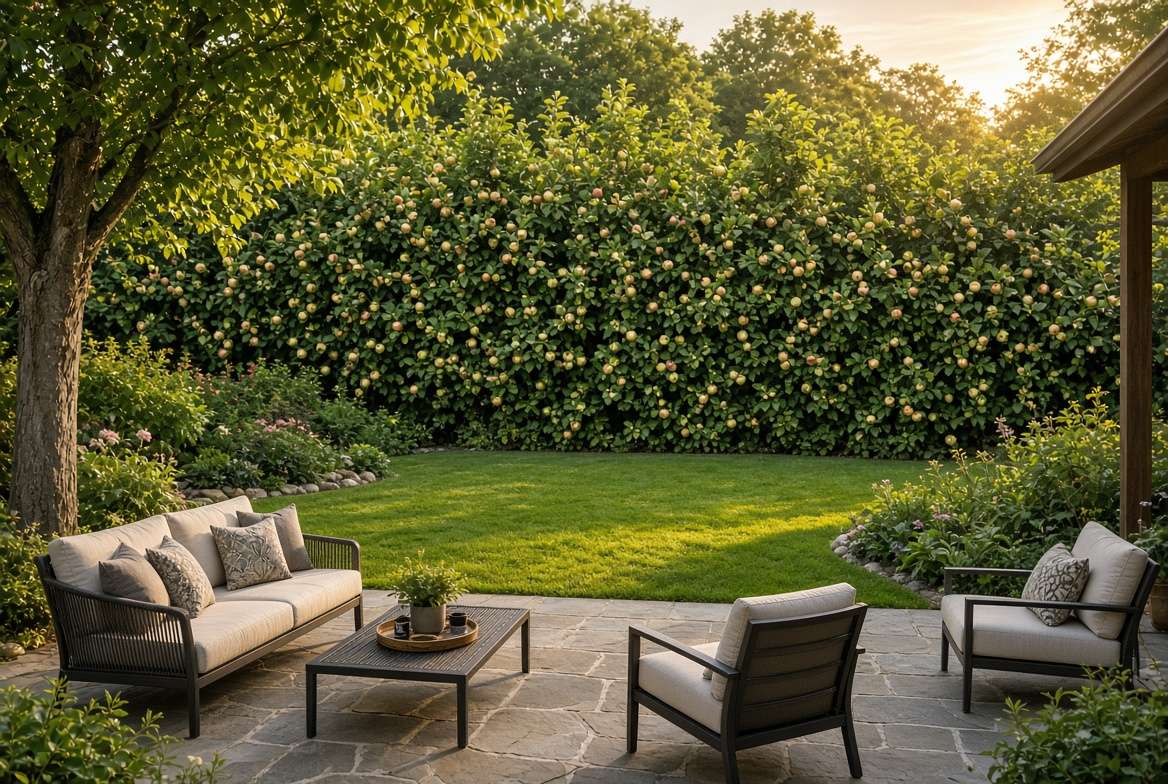
2. Beautiful, Edible Privacy We all value our privacy, but standard wooden fences can feel claustrophobic, and evergreen hedges like arborvitae offer little ecological value. A living fence made of apple trees provides a breathtaking seasonal display: delicate pink and white blossoms in the spring, lush green foliage in the summer to block unsightly views, and a vibrant tapestry of red, gold, and green fruit in the autumn. It is the pinnacle of edible landscaping—a functional property boundary that feeds your family. 🚧🍎
3. Better Microclimates and Biodiversity A densely planted hedgerow acts as a powerful windbreak, sheltering more delicate plants in your garden from harsh gusts. Furthermore, the sheer volume of spring blossoms creates a magnet for early pollinators, including mason bees, honeybees, and butterflies, boosting the overall biodiversity and health of your local ecosystem. 🦋
4. Easier, Safer Harvesting Standard apple trees require tall, unstable ladders for pruning and harvesting, which can be dangerous and physically taxing. Because a hedgerow is trained on a wire trellis and maintained at a manageable height (typically 6 to 8 feet), 100% of the fruit remains at eye and arm level. This makes monitoring for pests, thinning fruit, and harvesting a safe, enjoyable activity for the whole family. 🧺
The Science Behind the Size: Deep Dive into Rootstocks and Varieties 🔬🍏
To achieve a skyscraper-level understanding of apple tree hedgerows, we must look below the soil. The secret to a successful living screen lies entirely in the rootstock—the root system onto which the fruiting variety (the scion) is grafted. You cannot plant a standard or even semi-dwarf tree and expect it to behave in a high-density hedge; it will fight you at every pruning cut.
The Gold Standard Rootstocks for Hedgerows
-
The M9 Rootstock (The Industry Standard): For a traditional hedgerow standing 7 to 9 feet tall, M9 is the undisputed champion. It naturally limits the tree’s vigor, promotes early fruiting (precocity), and responds beautifully to the restrictive pruning required for a living fence.
-
The M27 Rootstock (The Extreme Dwarf): If you are creating a “step-over” hedge to border a kitchen garden, or if you have extremely limited vertical space, M27 restricts growth to roughly 4 to 6 feet. However, it requires impeccable soil nutrition and irrigation.
-
The M26 Rootstock (The Robust Option): If you have poor soil or need a taller screen (10 to 12 feet) to block a two-story neighboring window, M26 offers slightly more vigor. Be prepared to prune more aggressively to maintain the hedge shape.
Spur-Bearing vs. Tip-Bearing Apples: A Crucial Distinction
Not all apple varieties grow fruit in the same way, and this is where many novice orchardists make a critical error.
-
Spur-Bearing Varieties (Recommended): These apples produce fruit on small, stubby branches called “spurs” along the main lateral branches. Because the fruit develops close to the trunk, these trees are perfect for the tight, restrictive pruning of a hedgerow. Top picks: Honeycrisp, Gala, Fuji, Braeburn, and Golden Delicious.
-
Tip-Bearing Varieties (Avoid for Hedges): These varieties produce fruit at the very ends (tips) of long branches. If you prune a tip-bearer to keep your hedge neat, you will accidentally cut off all your future apples! Varieties to avoid: Granny Smith, Rome Beauty, and Cortland. 🛑
The Pollination Puzzle 🐝
Apples are not self-fertile. To get fruit, you need pollen from a completely different apple variety that blooms at the exact same time. When designing your hedgerow, group your trees by flowering groups (usually categorized from Group 1 to Group 6). For instance, a Group 3 apple will cross-pollinate beautifully with a Group 2 or Group 4 apple. By planting a diverse hedgerow, you naturally solve the cross-pollination problem while ensuring a staggered harvest from late summer through late fall.
Step-by-Step Guide to Planting Your Edible Screen 🌱
Building a living fence is a structural project as much as it is an agricultural one. Dwarf trees have shallow, brittle root systems; they cannot hold themselves up, especially when loaded with heavy fruit. Therefore, the trellis is your foundation.
Phase 1: Site Selection and Soil Preparation
-
Sunlight Mapping: Track the sun in your yard. Apple trees require a minimum of 6 to 8 hours of direct, unfiltered sunlight. If your hedgerow is shaded, foliage will be sparse, and fruit production will plummet. ☀️
-
Drainage and pH: Apple trees despise “wet feet.” Ensure your planting trench drains well. Conduct a soil test aiming for a slightly acidic to neutral pH (6.0 to 7.0).
-
Amending the Trench: Instead of digging individual holes, dig a continuous trench 2 feet wide and 1.5 feet deep. Blend the native soil with high-quality organic compost and a dusting of mycorrhizal fungi to stimulate rapid root development.
Phase 2: Designing and Building the Trellis System 🛠️
Do not plant your trees until the support structure is fully built.
-
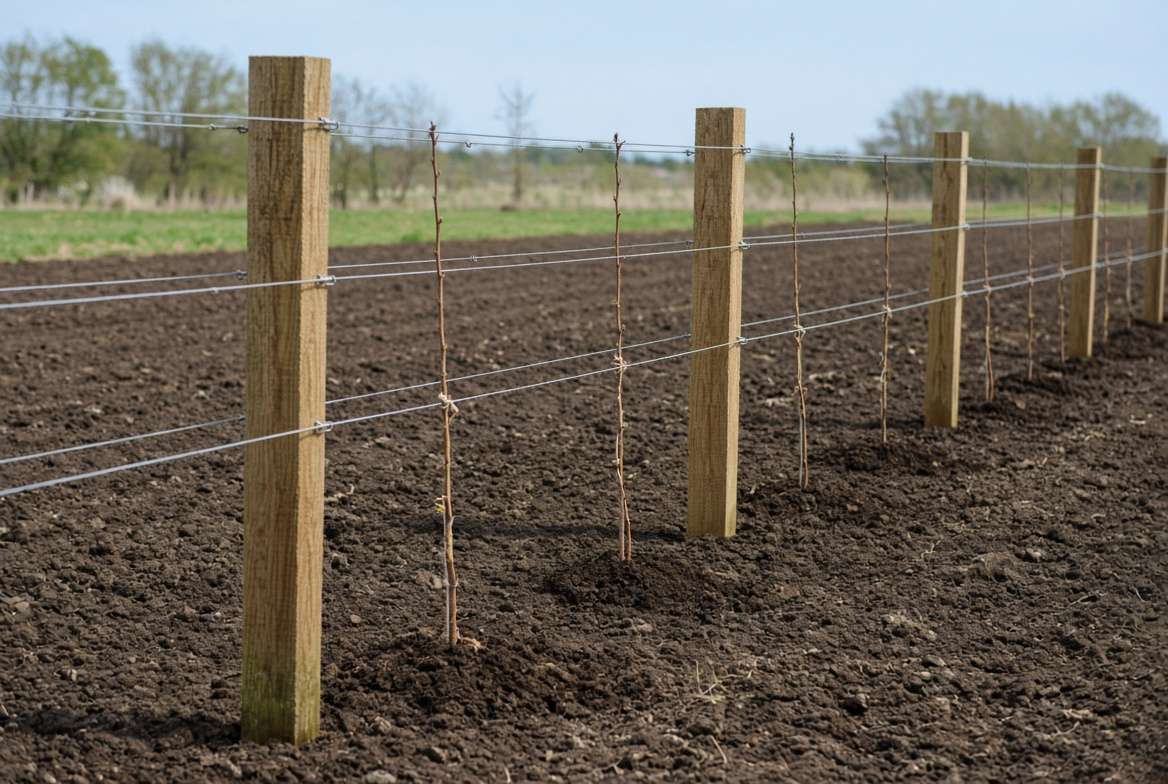
The Posts: Sink pressure-treated wooden posts (4×4 inches) at least 2 to 3 feet into the ground, spacing them every 10 to 12 feet along the trench. For longer rows, brace the end posts securely, as they will bear the tension of the wires.
-
The Wires: Run heavy-gauge galvanized steel wire horizontally between the posts. Space the wires every 18 to 24 inches starting from the ground up.
-
Tensioning: Use turnbuckles or wire strainers to pull the wires taut. A sagging trellis will lead to a sagging, messy hedge.
Phase 3: The Planting Process
-
Proper Spacing: For an impenetrable visual screen using M9 rootstocks, space the trees closely—exactly 24 to 36 inches apart.
-
The Graft Union Rule: When placing the tree in the trench, locate the graft union (the swollen bump near the base where the scion meets the rootstock). This bump must remain 2 to 3 inches above the final soil line. If buried, the vigorous scion variety will send out its own roots, bypassing the dwarfing rootstock and destroying your neatly planned hedge.
-
Initial Tying: Use soft, flexible plant ties (never wire or zip ties, which can girdle the tree) to secure the central leader (the main trunk) to the trellis wires.
Pruning and Training: The Secret to a Dense, Fruitful Hedge ✂️
If the trellis is the skeleton of your living fence, pruning is the muscle. You cannot simply plant apple trees closely together and let them grow wild; that will result in a tangled, diseased thicket with poor fruit production. To maintain an apple tree hedgerow, you must master two distinct types of pruning.
Formative Pruning (Years 1 to 3): Building the Base
During the first three years, your primary goal is not to grow apples—it is to build a robust, interwoven architectural structure.
-
The First Cut (Heading Back): Immediately after planting a bare-root whip (a young tree with no side branches), you must be brave. Cut the main trunk back to about 24 to 30 inches above the soil line, just above a healthy bud. This “heading cut” forces the tree to push out strong lateral (side) branches instead of just growing straight up.
-
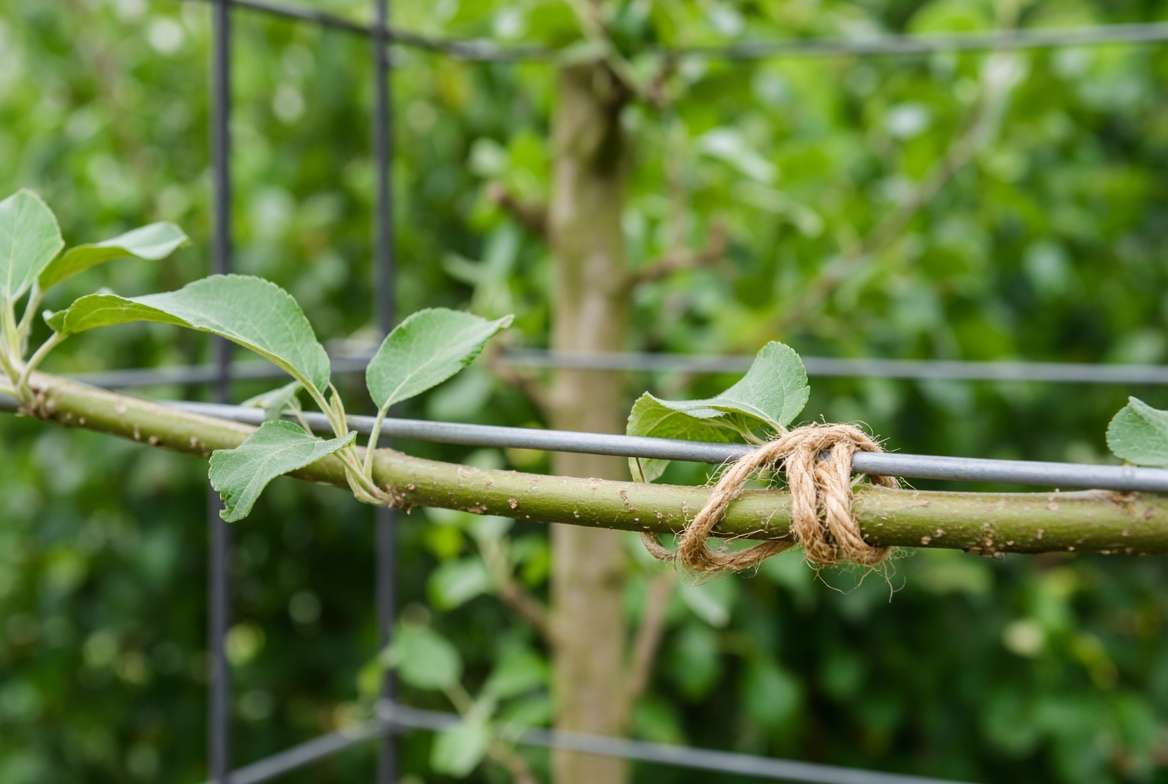
Tying In Laterals: As these new side branches grow in the spring and summer, gently bend them horizontally and tie them to your trellis wires using soft twine. Bending branches horizontally actually slows down vigorous vegetative growth and encourages the tree to produce fruiting spurs! 🌿
-
Weaving the Hedge: As the branches from neighboring trees grow toward each other, overlap them and tie them together along the wire. This creates the continuous, impenetrable screen you are aiming for.
Maintenance Pruning (Year 4 and Beyond): The Summer vs. Winter Rule
Once your hedgerow has reached your desired height and width, your strategy shifts entirely to maintenance and fruit production. The golden rule of high-density orchard management is understanding the difference between seasonal cuts.
-
Winter Pruning (Dormant Pruning): Done in late winter while the tree is asleep. Winter pruning stimulates vigorous growth. Use this time strictly to remove dead, diseased, or crossing branches. Clear out any congestion to ensure sunlight and air can penetrate the center of the hedge, but avoid heavy cuts, or the tree will explode with unwanted leafy shoots in the spring. ❄️
-
Summer Pruning (The Secret Weapon): Done in late July or early August. Summer pruning restricts growth. Because the tree has already expended its energy pushing out spring leaves, cutting it back now stops it in its tracks. Snip back the current season’s soft, green growth to just three leaves above the basal cluster. This tricks the tree into converting those lower buds into fruit buds for the following year, rather than just growing more wood. ☀️
Long-Term Care and Maintenance 💧
An edible privacy screen requires consistent, targeted care. Because dwarf rootstocks have incredibly shallow root systems, they cannot compete with grass or weeds for nutrients and water.
1. Watering Strategies Dwarf apple trees are highly susceptible to drought stress. Install a drip irrigation line along the base of your hedgerow, securing it to the lowest trellis wire. Provide deep, slow watering once or twice a week during dry spells, ensuring the soil remains moist but not waterlogged.
2. Feeding and Mulching Keep a 3-foot-wide strip at the base of your hedge completely free of turf grass. Apply a thick, 3-inch layer of organic wood chip mulch or compost every spring to suppress weeds and retain moisture. Feed your trees with a balanced organic fruit tree fertilizer just as the buds begin to swell in early spring. Avoid high-nitrogen lawn fertilizers, which will cause your hedge to push out weak, leafy growth at the expense of apples. 🍂
3. Organic Pest and Disease Management A densely planted canopy can limit airflow, making hedgerows slightly more prone to fungal issues if not pruned correctly.
-
Airflow is Key: Your summer pruning routine is your best defense against apple scab and powdery mildew.
-
Monitoring: Keep an eye out for common pests like aphids and codling moths. Employ organic methods like neem oil sprays, sticky traps, or introducing beneficial insects like ladybugs to keep pest populations in check. 🐞
Expert Insights for Hedgerow Success 🏆
Pro Tip: Don’t Be Afraid to Thin Your Fruit! One of the hardest things for a beginner to do is pluck perfectly good baby apples off their tree in early summer. However, dwarf trees often set more fruit than their shallow roots can support. If you leave every apple on the branch, the fruit will be tiny, the branches may snap, and the tree might exhaust itself so much that it won’t fruit at all the next year (a phenomenon called biennial bearing). Thin the clusters down to just one or two apples every 4 to 6 inches. You will be rewarded with massive, incredibly sweet apples come autumn! 🥇
Frequently Asked Questions (FAQs) ❓
How long does it take for an apple tree hedgerow to produce fruit? Because you are using precocious dwarf rootstocks (like M9), your hedgerow will typically begin producing a light crop in its second or third year, reaching full production by year four or five.
Can I mix different types of fruit trees in the same hedgerow? Yes! Pears grafted onto dwarfing Quince rootstocks make excellent companions for apples, as they share similar growth habits and pruning requirements. Avoid mixing in stone fruits (like cherries or peaches), as they grow much more vigorously and will quickly overshadow the apples. 🍐
Is an apple hedgerow evergreen? No, apple trees are deciduous, meaning they drop their leaves in late autumn. While you lose the solid leafy screen in winter, the densely woven architectural structure of the lateral branches against the trellis still provides an incredibly attractive, structural boundary year-round. 🌨️
Conclusion: Cultivate Your Edible Oasis 🌻
Transforming a boring property line into a thriving apple tree hedgerow is one of the most rewarding projects a home gardener can undertake. It perfectly blends the beauty of structural landscaping with the deep satisfaction of growing your own food. By selecting the right dwarf rootstocks, committing to a sturdy trellis, and mastering the rhythm of summer pruning, you can maximize your outdoor space and enjoy edible privacy for decades to come.
It is time to ditch the standard wooden fence and start planting a boundary you can actually taste.











