Every gardener and landscaper eventually faces the exact same frustrating dilemma: a dark, heavily shaded corner of the yard beneath mature trees where turf grass absolutely refuses to grow, leaving behind a muddy, weed-prone patch of bare dirt. You have likely tried shade-tolerant fescue seed mixes, delicate woodland ferns, and bags of expensive mulch, but nothing seems to offer that lush, reliable carpet of greenery year-round. Enter your new favorite landscape workhorse. The Carex Ice Dance plant is a brilliant, evergreen sedge that effortlessly transforms gloomy, difficult woodland spaces into vibrant, low-maintenance focal points. 🪴
If you are desperately seeking a weed-suppressing, deer-resistant ground cover that actually thrives where traditional turf surrenders, this robust Japanese sedge is the ultimate solution.
In this comprehensive guide, we will dive deep into everything you need to know about growing, maintaining, and designing with the Carex ‘Ice Dance’ plant. Whether you are a weekend gardener looking to fix a problematic shady border, or a professional landscape designer seeking reliable plant material for challenging microclimates, this skyscraper guide covers it all. Let’s get our hands dirty! 🧤🌱
1. Engaging Hook & Practical Quick-Start 🌱
1.1 The Shady Backyard Dilemma
Shade gardening often feels like an uphill battle against nature. Dense deciduous tree canopies block crucial sunlight, while their aggressive, established root systems ruthlessly steal water and nutrients from anything planted below them. This phenomenon, known as “dry shade,” is notoriously one of the most difficult microclimates to landscape.
Where conventional lawns thin out and succumb to moss or creeping weeds, Carex morrowii ‘Ice Dance’ steps up to the plate. Introduced from Japan and popularized by prominent horticulturists, this ornamental grass-like plant is prized for its resilience. It doesn’t just survive in the shade; it illuminates dim spaces with its striking variegated foliage, providing structure, texture, and bright contrast 365 days a year. ✨
1.2 At-a-Glance “Quick Care Cheat Sheet” 📋
Before we dive into the advanced botanical details, here is a quick-reference guide optimized for your gardening success:
-
Botanical Name: Carex morrowii ‘Ice Dance’
-
Common Names: Ice Dance Japanese Sedge, Variegated Sedge
-
Hardiness Zones: USDA Zones 5–9 (Highly frost-tolerant) ❄️
-
Sunlight Needs: Part shade to full shade (can tolerate gentle morning sun) ⛅
-
Moisture Requirements: Prefers consistent moisture but becomes surprisingly drought-tolerant once established 💧
-
Mature Size: 12 inches tall × 18–24 inches wide per clump
-
Key Features: Evergreen (or semi-evergreen in colder zones), striking white-edged foliage, deer and rabbit resistant, non-invasive ground cover.
2. Botanical Anatomy: What Makes ‘Ice Dance’ Distinct? 🔍🌿
To truly master the care of any plant, you must first understand its anatomy. While it looks remarkably like a thick, luxurious grass, ‘Ice Dance’ holds a few botanical secrets.
2.1 Sedge vs. True Grass: “Sedges Have Edges” 🌾
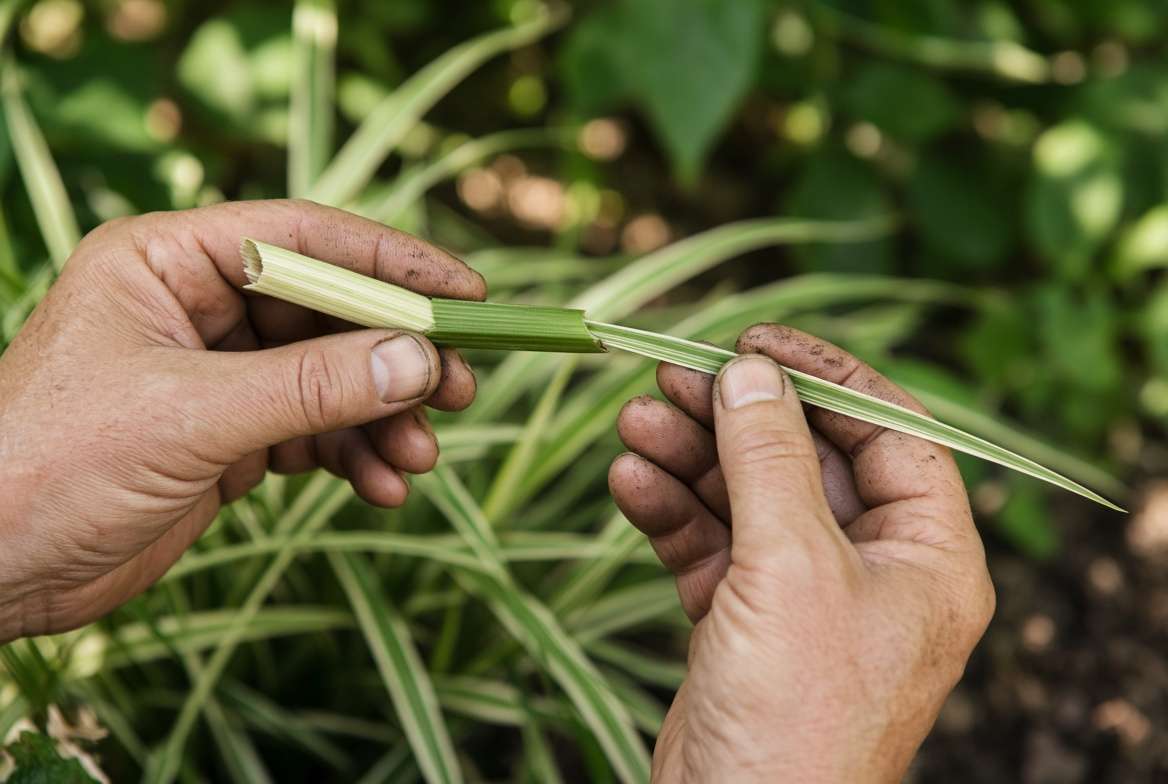
There is an old horticultural rhyme used to identify plant families: “Sedges have edges, rushes are round, and grasses are hollow right up from the ground.”
The Carex Ice Dance plant belongs to the Cyperaceae (sedge) family, not the Poaceae (true grass) family. If you roll a stem of ‘Ice Dance’ between your fingers, you will feel a distinct triangular shape with solid stems—the “edges.” This structural difference is vital. Sedge anatomy naturally equips the plant with superior shade tolerance and better moisture retention capabilities compared to conventional lawn grasses. Their robust, fibrous root systems allow them to aggressively compete for water alongside massive oak or maple trees. 🌳
2.2 Foliage Architecture & Color Contrast 🎨
The primary reason landscape architects obsess over ‘Ice Dance’ is its stunning foliage. The leaves are leathery, arching gracefully outward to form a neat, cascading fountain shape. Each ½-inch wide blade features a deep, glossy forest-green center bordered by crisp, clean, creamy-white margins.
In a shaded garden, solid dark green plants tend to visually recede and look like a black void. The white margins of ‘Ice Dance’ act like nature’s highlighter, catching ambient light and bringing a bright, luminous quality to dark corners. In early to mid-spring, the plant produces small, inconspicuous brownish flower spikes. While botanically interesting, the flowers are secondary; this plant is cultivated strictly for its elite, year-round foliage dominance. 🌼
2.3 Growth Habit: Clump-Forming vs. Rhizomatous Spreading 🪴
Understanding how a plant spreads dictates how you use it in your landscape design. Many popular sedges (like Carex oshimensis ‘Evergold’) are strictly clumping, meaning they simply grow slightly wider over time.
‘Ice Dance’, however, is rhizomatous. It spreads outward via shallow, creeping underground stems (rhizomes). This is what makes it an exceptional, weed-suppressing ground cover. It slowly knits itself together to form a dense, impenetrable carpet. But don’t let the word “spreading” scare you—unlike aggressive weeds or invasive bamboo, ‘Ice Dance’ is a gentle, deliberate spreader. It is incredibly easy to manage, contain, and divide when necessary. ✂️
3. Ideal Growing Conditions & Microclimates ☀️💧
Replicating a plant’s native environment is the golden rule of E-E-A-T (Experience, Expertise, Authoritativeness, and Trustworthiness) gardening. Carex morrowii originates from the woodland floors and low mountain slopes of Japan. Here is how to mimic those ideal conditions in your own yard.
3.1 Light Requirements: Finding the Sweet Spot ⛅
While famously known as a shade ornamental grass, “shade” is a spectrum.
-
Full Shade (Dappled Light): This is where ‘Ice Dance’ looks its best. The white variegation remains crisp, and the soil retains moisture longer.
-
Part Shade (Morning Sun): An eastern exposure with 2–4 hours of gentle morning sun is perfectly fine and can actually enhance the plant’s vigor.
-
The Danger Zone (Harsh Afternoon Sun): Avoid planting this sedge in hot, western, or southern exposures. Intense afternoon UV rays will scorch the variegated margins, turning those beautiful creamy white edges a crispy, unattractive brown. 🍂
3.2 Soil Composition & Drainage 🪨
The Carex Ice Dance plant is impressively adaptable, but it has preferences.
-
Ideal Soil: It thrives in rich, humus-heavy loams that mimic a woodland floor. An ideal pH ranges from 5.5 to 7.0 (slightly acidic to neutral).
-
Clay Tolerance: Unlike many delicate perennials that rot in heavy soils, ‘Ice Dance’ is quite tolerant of clay. However, if your clay is heavily compacted, it is highly recommended to amend the top 4 to 6 inches with organic leaf mold or compost before planting to improve aeration and drainage.
-
Sandy Soil: In overly sandy soils that drain too rapidly, you will need to water much more frequently, as sedges despise completely bone-dry roots.
3.3 Water & Moisture Benchmarks 🚿
Consistency is the secret to perfect Carex foliage.
-
The Establishment Phase: For the first 90 days after planting, the root system is vulnerable. You must water deeply once or twice a week to ensure the soil remains evenly moist (like a wrung-out sponge, not a muddy puddle).
-
Mature Moisture Needs: Once established (usually after the first full growing season), the ‘Ice Dance’ plant shifts into survival mode. It becomes remarkably drought-tolerant for short spells. However, extended droughts will cause the foliage to look tired and wilted. In the peak heat of summer, supplemental watering during prolonged dry spells will keep the foliage plump and vibrant. 💦
4. Step-by-Step Planting Guide (Professional Field Tips) 🛠️🪴
Getting your Carex Ice Dance plant into the ground correctly is the most critical step for ensuring long-term landscape success. Proper spacing and site preparation will save you hours of maintenance down the road.
4.1 Optimal Planting Windows 🗓️
Timing is everything in horticulture. The absolute best times to plant ‘Ice Dance’ are:
-
Early Spring: Planting after the last major frost allows the roots to establish in cool, moist soil before the stress of summer heat arrives.
-
Early Autumn: The undisputed champion of planting seasons. The soil is still warm from summer (encouraging rapid root growth), but the air is cool, and autumn rains naturally handle the watering for you. 🍂🌧️
-
Avoid Mid-Summer: Planting during the hottest weeks of July or August forces the plant to focus on basic survival rather than establishing new roots, increasing the risk of transplant shock.
4.2 Site Preparation & Spacing Calculations 📐
Because ‘Ice Dance’ spreads via underground rhizomes, how far apart you space your nursery pots depends entirely on your design goals.
-
For an Instant Clumping Look: If you want distinct, individual mounds as accents along a pathway, space them 24 inches apart.
-
For a Dense Groundcover Carpet: If your goal is to suppress weeds and create a solid mass of foliage, space the plants 12 to 15 inches apart. They will usually knit together into a solid mat within two growing seasons. 📏
-
Navigating Tree Roots: When planting under mature oaks or maples, never hack through major tree roots to dig a hole. Instead, locate the natural pockets of soil between the surface roots. If necessary, you can build up a shallow 3-to-4-inch mound of compost over a bare spot to accommodate the sedge, rather than digging deeply into the tree’s root plate.

4.3 Planting Protocol 🕳️
-
Dig the Hole: Dig a hole twice as wide as the nursery container, but exactly the same depth.
-
Tease the Roots: Sedge roots can become tightly wound in their pots. Gently massage and loosen the bottom of the root ball with your fingers to prevent “circling” roots that can strangle the plant over time.
-
Position and Backfill: Place the plant in the hole, ensuring the “crown” (where the stems meet the roots) sits perfectly level with the surrounding soil. Planting too deep invites crown rot.
-
Mulch Carefully: Apply a 1-to-2-inch layer of shredded hardwood bark or leaf mold around the plant to retain moisture. Crucial Tip: Keep the mulch pulled back 1 inch away from the exact center of the crown to allow for airflow and prevent fungal decay. 🪵
5. Year-Round Maintenance & Pruning Routine ✂️🍂
The beauty of the Carex Ice Dance plant lies in the phrase “low-maintenance.” However, low-maintenance does not mean no maintenance. A few simple seasonal chores will keep this sedge looking highly professional.
5.1 Late-Winter / Early-Spring Cleanup 🧤
Depending on your hardiness zone, ‘Ice Dance’ will either look perfect all winter (Zones 7–9) or slightly battered and tattered after heavy snows (Zones 5–6).
-
The “Comb-Through” Method: In early spring, before new growth begins, put on gardening gloves and gently “comb” your fingers through the foliage. This easily removes dead, brown, or loose leaves without damaging the plant.
-
Don’t Scalp It! Unlike large ornamental grasses (like Miscanthus) that require being chopped down to the ground every spring, you should never aggressively scalp a sedge. Hard shearing can severely stunt their growth. Only trim off the ugly, winter-damaged tips with hand pruners if absolutely necessary. ✂️
5.2 Feeding & Nutrition 🧪
Sedges are not heavy feeders. In fact, over-fertilizing them is a common mistake.
-
The Risk of Nitrogen: Applying high-nitrogen lawn fertilizer to ‘Ice Dance’ will cause the plant to produce weak, floppy, excessively lush foliage that easily flops over and looks untidy.
-
The Right Approach: A single, light application of a balanced, slow-release granular fertilizer (like a 10-10-10) in early spring is sufficient. Better yet, simply top-dress the surrounding soil with a half-inch of rich, organic compost once a year. The organic matter will break down slowly, feeding the plant naturally. 🍎
5.3 Division & Propagation (Every 3–4 Years) ✂️🌱
Because ‘Ice Dance’ creeps outward, the very center of an old clump can sometimes become woody or die out over several years, creating a “donut” effect.
-
When to Divide: Spring is the best time for division.
-
How to Divide: Dig up the entire clump with a sharp spade. Use the blade of the spade (or an old wood saw) to cut the root mass into quarters. Discard the dead, woody center, and replant the healthy outer sections.
-
Free Plants! This division process invigorates the plant and gives you free nursery stock to expand your groundcover into new areas of the garden. 🪴✨

6. Landscaping & Design Applications: Creative Pairings 🏡🌸
A single Carex Ice Dance plant is lovely, but mass plantings and clever botanical pairings are what elevate a yard from basic to breathtaking. Here are the best ways to utilize this sedge in your landscape design.
6.1 High-Contrast Companion Plants in Shade 🌿✨
To create a magazine-worthy woodland garden, pair ‘Ice Dance’ with plants that offer contrasting textures and colors.
-
Bold, Broad Foliage: The thin, grassy ribbons of ‘Ice Dance’ look spectacular next to massive, corrugated blue hostas (like Hosta ‘Halcyon’ or ‘Elegans’). The structural contrast is a classic landscape design trick. 💙
-
Feathery Textures: Pair the rigid sedge with the delicate, lacy fronds of Autumn Ferns (Dryopteris erythrosora) or silvery Japanese Painted Ferns.
-
Floral Color Accents: For pops of color above the foliage, plant ‘Ice Dance’ alongside coral bells (Heuchera), feathery Astilbe, or architectural Solomon’s Seal (Polygonatum). 🌸

6.2 Functional Landscape Roles 🚶♂️
Beyond aesthetics, this plant serves serious functional purposes:
-
Living Mulch: When planted en masse beneath mature trees, it acts as a living, green mulch. It cools the soil, prevents soil erosion during heavy rains, and naturally crowds out aggressive broadleaf weeds.
-
Hardscape Softening: Use ‘Ice Dance’ to line the edges of winding stone walkways, brick patios, or formal paver edging. It naturally gently spills over the hard edges, softening the harsh geometry of masonry work. 🧱
-
Container Gardening: Because it remains evergreen, it is a fantastic “spiller” and “filler” element in large, shaded patio planters, providing reliable structure long after summer annuals have died back. 🪴
7. Troubleshooting: Pests, Diseases, and Common Mistakes 🐛🩺
Even the toughest landscaping plants encounter occasional hiccups. Fortunately, the Carex Ice Dance plant is remarkably robust and generally free from serious diseases. If you do notice a decline in health, it is almost always related to environmental stress or improper site placement.
7.1 Browning Leaf Tips: Diagnosis & Solutions 🍂
The most common complaint from homeowners growing ‘Ice Dance’ is the sudden appearance of crispy, brown leaf tips. Before you panic, check these three usual suspects:
-
Dry Wind Scorch: If the sedge is planted in a breezy corridor or an exposed corner, harsh winter winds can literally suck the moisture out of the evergreen leaves faster than the dormant roots can replace it.
-
Inconsistent Moisture: A sudden drought after a period of heavy watering can stress the tips. Maintain an even watering schedule.
-
Chemical Sensitivity: Municipal tap water heavy in chlorine or fluoride can sometimes cause tip burn on sensitive grass-like plants.
The Fix: Simply take a sharp pair of bypass pruners and snip off the brown tips at an angle to mimic the natural leaf shape. ✂️
7.2 Overwatering & Crown Rot Risks 💧
Sedges love moisture, but they absolutely despise standing in stagnant water. If planted in heavy, unamended clay in a low-lying area of the yard, the center crown can succumb to fungal rot.
-
The Symptoms: The foliage will turn mushy, yellow, and collapse outward from the center. You may smell a foul, swampy odor near the soil.
-
The Fix: If crown rot sets in, you must dig up the plant, cut away the rotting black roots, and replant the surviving healthy sections in soil amended with coarse sand or leaf mold to improve drainage. 🪨
7.3 Pest Resistance: Deer, Rabbits, and Slugs 🦌🐰
Here is the absolute best news for woodland gardeners: deer and rabbits actively avoid eating ‘Ice Dance’. The leaves of the sedge family contain microscopic silica crystals, making the foliage stiff, leathery, and highly unpalatable to grazing mammals. It is a fantastic, worry-free choice for unfenced properties.
However, the dense, humid microclimate created by the clumps can attract slugs and snails during wet spring weather. If you notice ragged holes chewed into the lower foliage, lightly scatter an iron-phosphate-based organic slug bait around the base of the plant. 🐌
8. ‘Ice Dance’ vs. Popular Alternatives ⚖️📊
When planning a shade garden, you have several grassy-textured options. Here is how ‘Ice Dance’ stacks up against the competition to help you make the best structural choice for your yard.
9. Frequently Asked Questions ❓💬
Is the Carex Ice Dance plant invasive? No. While ‘Ice Dance’ spreads via underground rhizomes to form a dense colony, it is an obedient, slow-to-moderate spreader. It is not classified as an invasive ecological threat like running bamboo or English ivy. It stays exactly where you want it and is easily controlled with an annual spade edging. 🪴
Does Carex Ice Dance stay green all winter? In USDA Zones 6 through 9, it is fully evergreen and provides gorgeous winter interest. In severe Zone 5 winters without snow cover, it behaves as a semi-evergreen, meaning the outer leaves may batter and brown, requiring a quick spring trim to look fresh again. ❄️
Can it grow in full sun? It is highly discouraged. While it might survive in cooler Northern climates if given constant, daily watering, full sun exposure will inevitably bleach the vibrant white margins and cause severe leaf scorch. It is a shade-lover at heart. ☀️
Can I mow Carex Ice Dance like a traditional lawn? Absolutely not. Rotary lawn mowers will violently tear the fibrous sedge leaves rather than cutting them cleanly, resulting in ragged, brown, shredded tips that take months to recover. If you need to manage a massive colony, use sharp manual hedge shears in early spring before new growth emerges. 🚜
10. The Final Takeaway 🌿🪴
Successfully landscaping a shaded yard does not require resigning yourself to bare dirt, patchy moss, or endless battles with struggling turf. The Carex Ice Dance plant brilliantly bridges the gap between functional weed suppression and high-end aesthetic elegance. Its sweeping, brightly variegated foliage instantly lifts the mood of a dark woodland garden, while its tough, adaptable, and deer-resistant nature makes it a zero-stress investment for your landscape.
By following the proper planting techniques and minimal maintenance routines outlined in this guide, you can establish a permanent, glowing carpet of greenery that will anchor your shade beds for decades to come.
What is your biggest struggle when it comes to shade gardening, and where are you planning to plant your very first drift of ‘Ice Dance’? Let us know in the comments below, and happy planting! 🌸✨