

You buy a mesmerizing, spiraled beauty at the local nursery, place it proudly on your windowsill, and a month later, the leaves are sad, limp, and totally straight. 😫 It is a universal frustration for anyone who brings home a unique curly plant. Why do these architectural marvels lose their signature twists, and why are they so notoriously finicky compared to standard houseplants? After years of cultivating exotic indoor jungles and observing how environmental stressors impact leaf morphology, the answer is clear: a plant’s curl is a living barometer of its environment. We will explore seven show-stopping varieties that offer incredible texture, alongside the botanist-backed secrets to maintaining those perfect, bouncy coils year-round.
The Science of the Swirl: What Makes a Curly Plant “Curly”? 🧬🪴
Understanding why a plant curls is the first step in preventing it from straightening out. Foliage does not twist by accident; it is the result of either precise environmental adaptations or carefully cultivated genetic mutations.
In the wild, plants evolve curled or spiraled leaves primarily as a survival mechanism against extreme conditions. Desert natives often develop tight coils to minimize the surface area exposed to scorching sun, reducing water loss through transpiration. By curling inward, the leaf creates tiny micro-shadows over its own surface, keeping the plant’s core cooler. Conversely, some tropical trailing plants have been selectively bred by horticulturists to isolate a natural genetic mutation. These mutated cells grow at different rates—the cells on the outer edge of the leaf reproduce faster than the cells on the inner vein—forcing the leaf to buckle, twist, and fold over itself.
Turgor pressure also plays a critical structural role. Turgor pressure is the force of water stored inside the plant’s cells pushing outward against the cell walls. When a curly plant is perfectly hydrated, maximum turgor pressure acts like a strong internal skeleton, holding the twists rigidly in place. If the environment shifts—such as a sudden drop in light or a prolonged drought—turgor pressure drops, cellular growth rates equalize, and the plant abandons its energy-intensive coils, resulting in flat, straightened leaves.
7 Breathtaking Curly Plant Varieties for Your Collection 🪴💫
Adding texture to your indoor jungle requires the right mix of specimens. The following seven varieties span from arid succulents to moisture-loving tropicals, each offering a completely different take on swirling foliage.
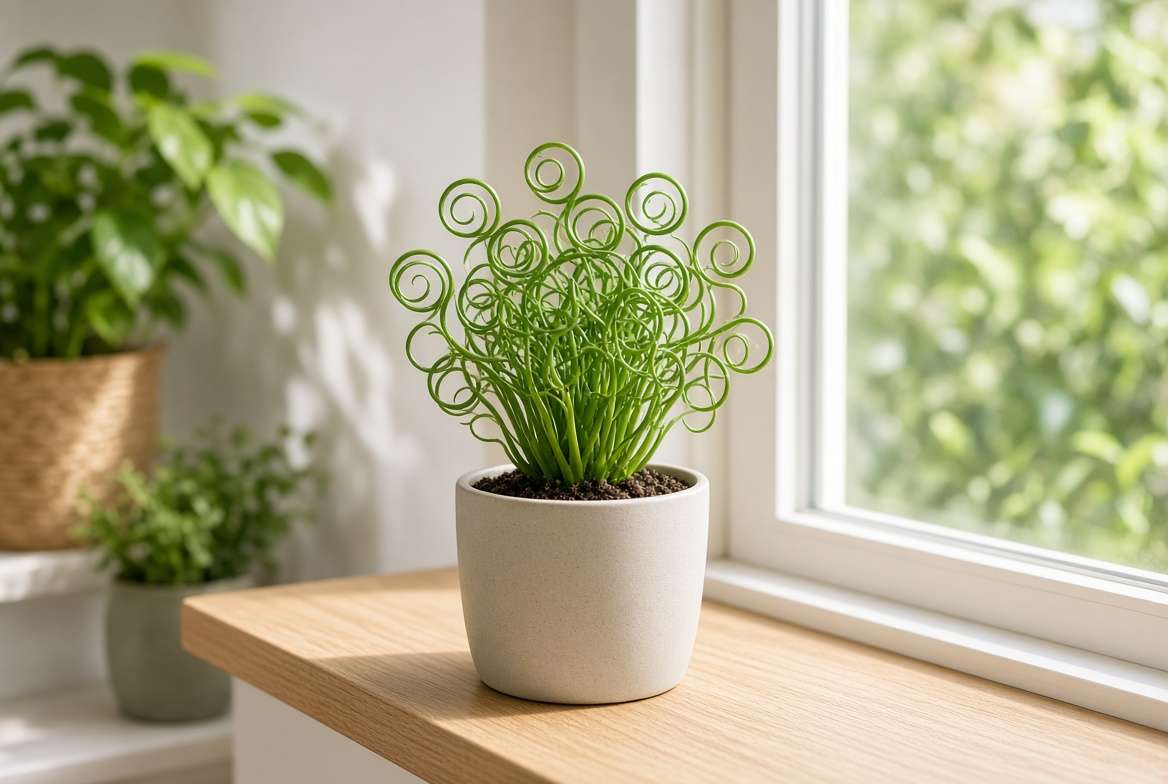
1. The Frizzle Sizzle (Albuca spiralis) 🧅💚 Looking like it was plucked straight from a Dr. Seuss illustration, the Frizzle Sizzle is a bulbous succulent native to the deserts of South Africa. It produces thick, glandular leaves that corkscrew tightly at the tips, mimicking the look of green spring wire. In late winter to early spring, it sends up a tall flower spike bearing nodding, bell-shaped yellow blooms that smell distinctly of warm vanilla.
-
Growth Habit: This is a winter-growing succulent. It goes dormant in the summer, during which time it may lose some or all of its foliage.
-
Care Snapshot: It requires maximum sun exposure. Place it in your brightest south-facing window. Water thoroughly only when the soil is completely dry, and drastically reduce watering during its summer dormancy.
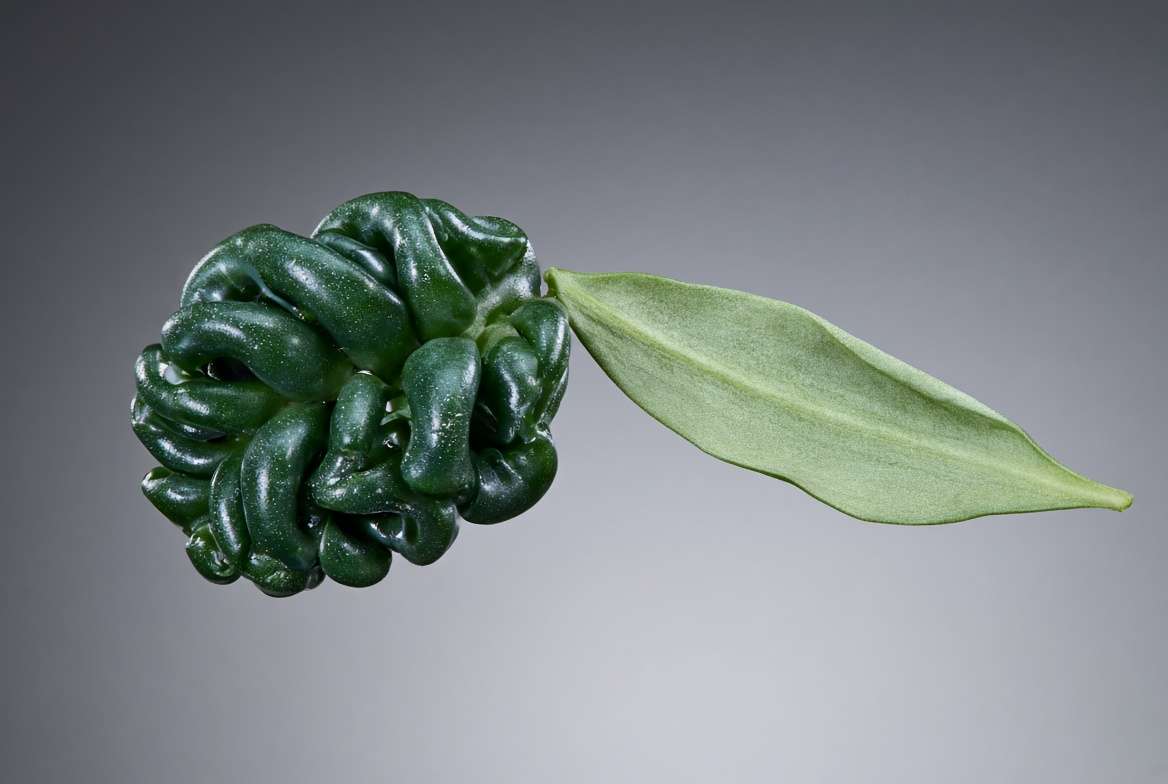
2. Hindu Rope Plant (Hoya carnosa ‘Compacta’) 🪢🌸 A favorite among trailing plant enthusiasts, the Hindu Rope Plant is a slow-growing epiphyte with vines that look like thick, tortuous green braids. The waxy leaves are tightly densely packed, folded, and crinkled, completely hiding the stem beneath. When mature and root-bound, it rewards patient growers with clusters of star-shaped, pale pink flowers that produce a sweet, chocolate-like fragrance at night.
-
Growth Habit: Extremely slow-growing. The dense folds of the leaves are prone to hiding pests like mealybugs, making regular inspections necessary.
-
Care Snapshot: Provide bright, indirect light. As a semi-succulent epiphyte, it demands a highly porous orchid-bark mix and must dry out completely between waterings.
3. Curly Spider Plant (Chlorophytum comosum ‘Bonnie’) 🕷️🌀 For those who want a low-maintenance classic with a modern twist, the ‘Bonnie’ spider plant is the ideal candidate. It retains the recognizable green and white variegation and air-purifying qualities of a traditional spider plant, but every leaf curls inward toward the center of the pot. This creates a much more compact, globe-like silhouette. It still prolifically produces runners with curly baby “pups” that dangle like botanical ornaments.
-
Growth Habit: Fast-growing and resilient, making it perfect for beginners.
-
Care Snapshot: Thrives in medium to bright indirect light. Keep the soil evenly moist but never waterlogged. It is highly sensitive to the fluoride in tap water, which can cause brown, crispy tips, so filtered or rainwater is preferred.
4. ‘Emina’ Boston Fern (Nephrolepis exaltata ‘Emina’) 🌿✨ Often sold under the nickname “Dragon Tail Fern,” the ‘Emina’ transforms the traditional, feathery Boston Fern into something highly sculptural. Its fronds stand upright and are intensely crinkled, twisted, and ruffled. The texture is dense and almost stiff compared to standard ferns, bringing a lush, Victorian-era drama to low-light corners.
-
Growth Habit: Upright, bushy, and relatively slow-growing compared to standard Boston ferns.
-
Care Snapshot: High humidity is non-negotiable. Aim for 60% relative humidity or higher. The soil must remain consistently damp; if the root ball dries out completely, the fronds will crisp and shed rapidly.
5. Curly Lipstick Plant (Aeschynanthus radicans ‘Curly’) 💄🌺 If you want dynamic, cascading foliage with a surprising pop of neon color, the Curly Lipstick Plant delivers. Its waxy leaves undulate, wave, and curl along long, trailing vines. When the plant is happy, bright red, tubular flowers emerge from dark maroon calyxes—perfectly resembling lipstick twisting out of a tube.
-
Growth Habit: Excellent for hanging baskets where the twisted vines can drape gracefully.
-
Care Snapshot: It thrives in bright, indirect light and warm temperatures. As a tropical epiphyte, it prefers a well-aerated potting mix. Allow the top two inches of soil to dry out before watering again, and protect it from cold window drafts.
6. Curly Weeping Fig (Ficus benjamina ‘Barok’) 🌳🌪️ The ‘Barok’ is a rare, fascinating mutation of the traditional Weeping Fig. Instead of flat, teardrop-shaped leaves, every single leaf on this miniature indoor tree curls inward on itself. The result is a highly textured, bubbling canopy that looks almost like it is shivering.
-
Growth Habit: Upright, branching tree structure. Like most Ficus varieties, it is highly sensitive to environmental changes and may drop leaves if moved.
-
Care Snapshot: Find a spot with bright, indirect light and leave it there. Keep it away from AC vents, heating grates, and drafty doorways. Water when the top inch of soil feels dry.
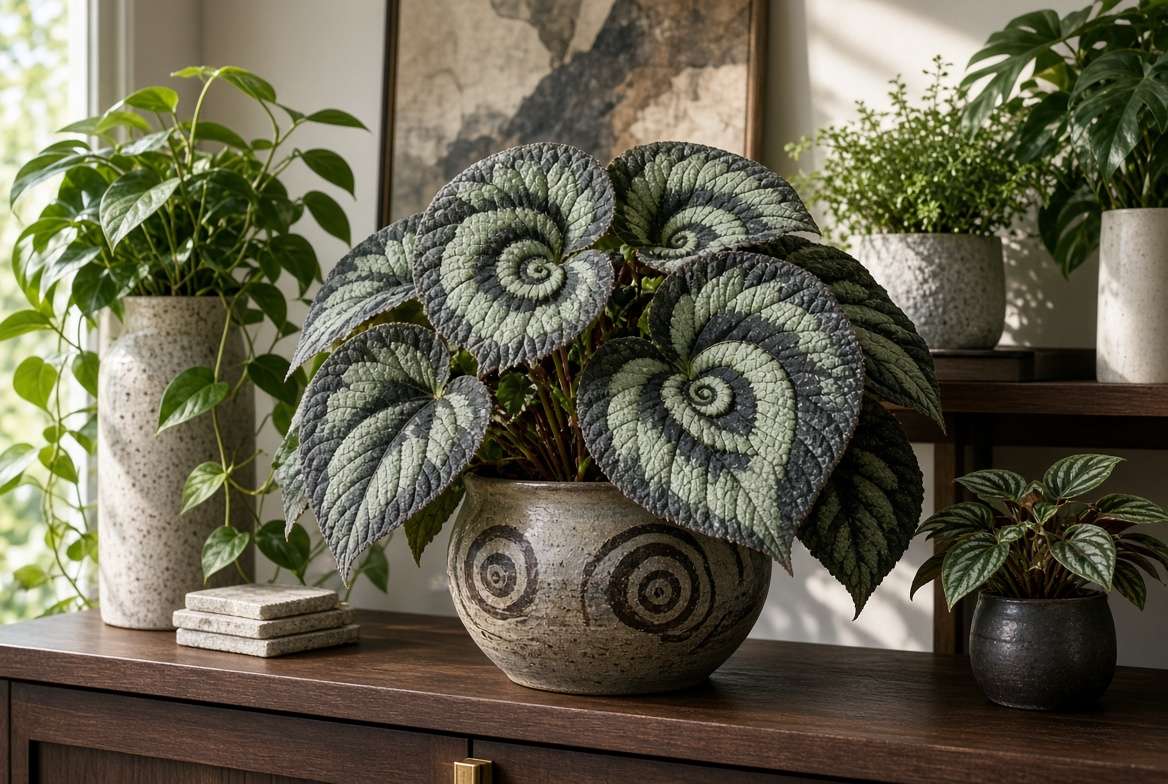
7. Snail Begonia (Begonia rex ‘Escargot’) 🐌🍃 While the surface of this leaf is relatively flat, its overall structure performs one of the most unique tricks in the botanical world. The base of the leaf spirals inward in a hypnotic, perfect circle, closely mimicking a snail’s shell. The swirling bands of silvery-green and deep charcoal only enhance the optical illusion.
-
Growth Habit: Grows low and wide, spreading via rhizomes just below the soil surface.
-
Care Snapshot: High humidity is crucial, but keeping the leaves dry is equally important to prevent powdery mildew. Bottom-watering is highly recommended. Provide medium to bright indirect light.
The “Secret Sauce”: How to Keep Your Curly Plant Leaves Perfectly Coiled 💧☀️
The most common complaint from indoor gardeners is that their curly foliage gradually straightens out over time. When a plant loses its curl, it is communicating stress. Here is the expert protocol for maintaining those photogenic spirals.
1. The Light Equation: Sun Exposure Dictates the Curl ☀️
For succulents like the Albuca spiralis, sunlight is the primary curl trigger. In low light, the plant is forced to stretch out its foliage to capture more photosynthesis-fueling rays—a process called etiolation. Once a leaf stretches, it loses its tension and straightens permanently.
-
The Fix: Measure your light. Desert natives need robust, direct sunlight (a south-facing window or a strong full-spectrum grow light). Tropical varieties like Hoyas and Ferns need bright, indirect light. If new growth is coming in flat, immediately increase the light exposure.
2. Watering Rhythms: Avoiding the “Limp Leaf” 🚿
Watering directly impacts turgor pressure. If you severely underwater a tropical curly plant, the cells deflate, and the leaf wilts and unbends. Conversely, overwatering a succulent swells the water-storing cells to their maximum capacity, puffing the leaf out so much that the tight coils are forced to relax and unroll.
-
The Fix: Tailor your watering to the species. Use the “Soak and Dry” method for Hoyas, Frizzle Sizzles, and Lipstick plants (saturate fully, then allow to dry 100%). Use the “Always Damp, Never Soggy” rule for your Ferns and Begonias.
3. Humidity & Temperature Shocks 🌡️🌫️
Tropical curls are sensitive to ambient moisture. When the air is too dry, the thin edges of ferns and begonias lose moisture rapidly. The plant responds by curling up in distress (a dry, crispy curl) or by going limp and flat.
-
The Fix: Grouping plants together creates a humid microclimate, but the most reliable solution is a smart humidifier. Aim for 55-65% relative humidity for tropical varieties. Avoid placing these plants near HVAC vents, as sudden temperature fluctuations destroy delicate cellular structures.
4. The Right Soil Mix for Twisted Roots 🪨
A struggling root system cannot support complex foliage. Standard potting soil is often too heavy and holds too much water, suffocating the roots of epiphytes and succulents alike.
-
The Fix: Upgrade to a custom “Chunky Mix.” A professional standard is 1 part high-quality indoor potting soil, 1 part orchid bark, and 1 part coarse perlite or pumice. This ensures excellent aeration, allowing roots to breathe while retaining just enough moisture.
Troubleshooting: Why Did My Curly Plant Straighten Out? 🚑🔍
Use this quick diagnostic guide to decode what your foliage is trying to tell you:
-
Symptom: Leaves are straightening out and turning a paler shade of green.
-
Diagnosis: Insufficient light. Move the plant closer to a window or add a grow light.
-
-
Symptom: Leaves are curly, but the tips are turning brown, crispy, and breaking off.
-
Diagnosis: Humidity is drastically low, or your tap water contains high levels of chlorine/fluoride. Switch to filtered water and increase ambient moisture.
-
-
Symptom: The plant is dropping flat, yellowing leaves, and the base feels mushy.
-
Diagnosis: Root rot caused by overwatering or dense soil. Unpot the plant, trim rotted roots, and repot in fresh, chunky soil.
-
Expert Tips for Propagating Your Curly Houseplants 🌱✂️
Once you have mastered the care of your swirling specimens, multiplying them is a rewarding next step.
-
Propagating by Division: This is the easiest method for Curly Spider Plants and ‘Emina’ Ferns. Gently unpot the mother plant and tease the root ball apart into two or three smaller sections, ensuring each section has a healthy root system and foliage. Repot immediately.
-
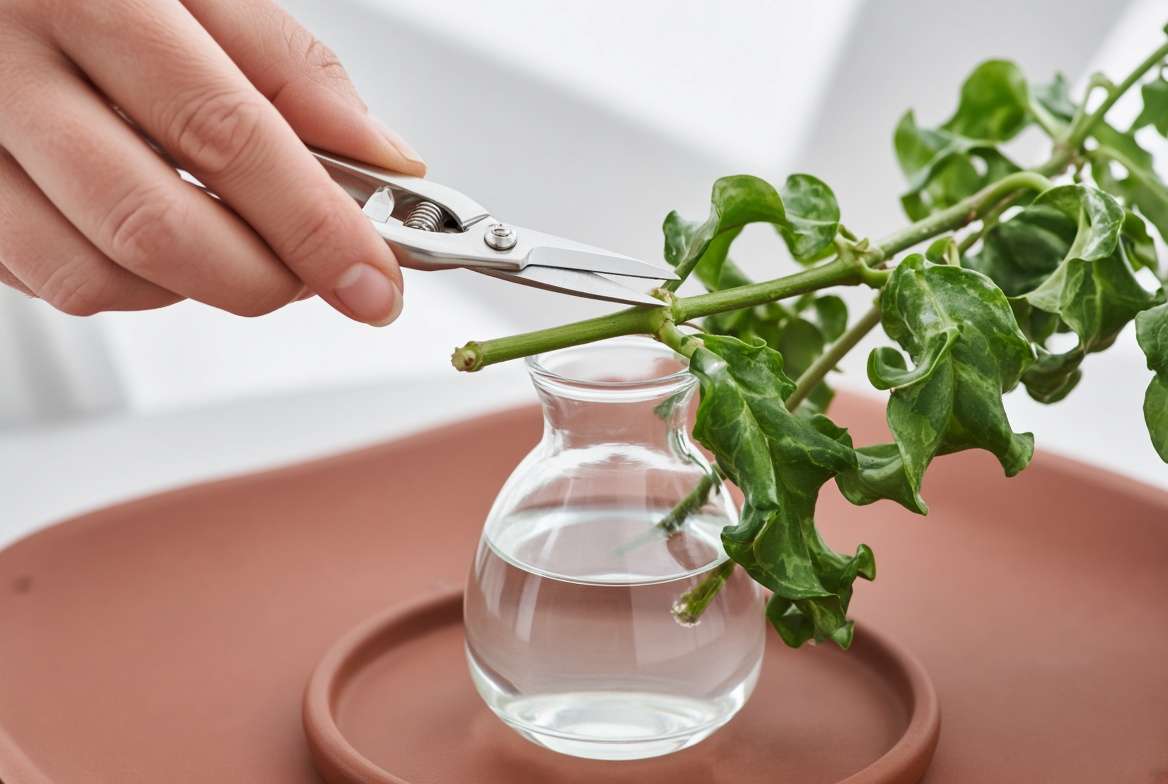
Stem Cuttings: Ideal for Hindu Ropes and Lipstick plants. Take a cutting that includes at least two nodes (the bump on the stem where leaves attach). Remove the bottom leaves and root the bare node in water, damp sphagnum moss, or perlite. Node placement is crucial, as roots will only emerge from these points.
-
Bulb Offsets: The Frizzle Sizzle naturally produces tiny “bulblets” around the base of the mother bulb. During its active winter growing season, gently separate these baby bulbs and pot them in a gritty succulent mix.
Frequently Asked Questions (FAQs) About Curly Plants 🙋♀️🪴
Can a straightened Frizzle Sizzle become curly again? Unfortunately, no. Once a leaf has straightened due to low light or overwatering, its physical cell structure has permanently changed. However, correcting the environment (increasing light and reducing water) guarantees that all new growth will emerge perfectly curled.
Are curly plants toxic to cats and dogs? It depends entirely on the species. The Curly Spider Plant and Hindu Rope Plant are non-toxic and pet-safe. However, the Curly Weeping Fig, Snail Begonia, and Frizzle Sizzle contain compounds that are toxic if ingested. Always verify the safety of a specific species before bringing it around pets.
Should I mist my curly fern to increase humidity? Misting is a common myth that experts advise against. Misting only increases humidity for a few minutes and leaves water sitting on the complex folds of curly leaves, which invites fungal infections and leaf spot diseases. Use a humidifier instead for consistent, safe ambient moisture.
Embrace the Curves 💚
Cultivating a curly plant requires a slightly sharper eye than caring for your average Pothos. Because their foliage is so specialized, these plants demand that you pay close attention to light levels, turgor pressure, and soil aeration. But when you get the balance right, the reward is an architectural, living sculpture that instantly elevates your space.
Which of these swirling beauties are you adding to your wish list? Let us know your favorite in the comments below, or subscribe to our newsletter for a free, downloadable Houseplant Watering Schedule cheat sheet! 💌👇











