
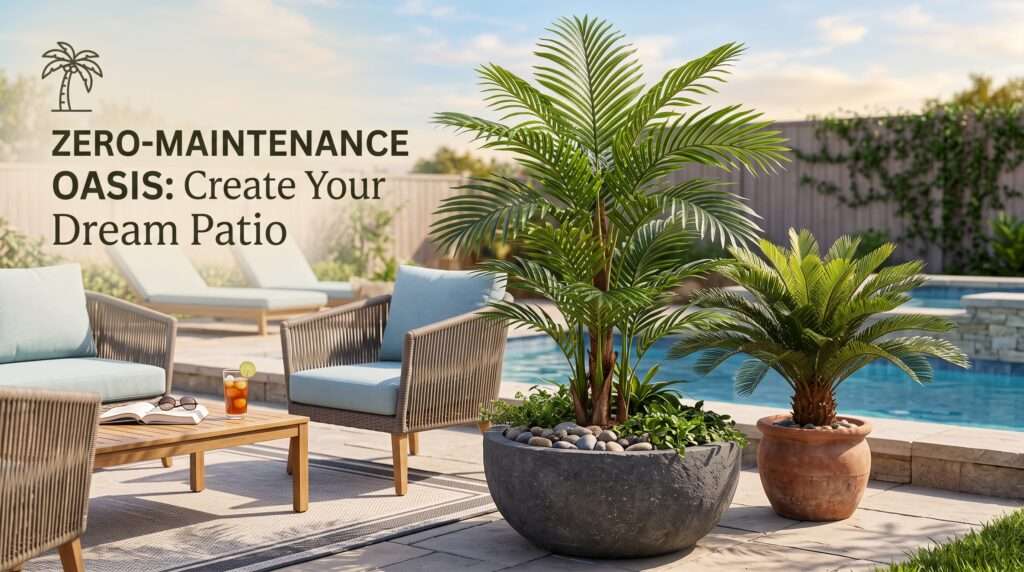
Let’s face it: there is nothing quite as heartbreaking as spending hundreds of dollars on a lush, tropical patio setup, only to watch your prized live palms turn brown, crisp, and lifeless after a sudden frost or a single missed watering. As a plant care specialist, I have spent years diagnosing failing tropicals. The reality is, unless you live in hardiness zones 9 through 11, keeping live palms thriving outdoors year-round is a constant, uphill battle. But what if you could bypass the climate restrictions, the expensive soil amendments, and the winter heartbreak? Enter fake outdoor palm trees—the ultimate landscaping hack for modern homeowners who want a resort-style aesthetic without the grueling upkeep.
For a long time, artificial outdoor plants carried a stigma of looking cheap, plastic, and unnatural. Today, advances in synthetic botany have completely changed the landscape design game. High-quality faux tropicals are now a strategic choice used by professional landscapers, boutique hotels, and savvy homeowners.
In this comprehensive guide, we will explore exactly how to select premium artificial palms, how to style them so flawlessly that even your neighbors will think they are real, and how to weatherproof your investment to last for years. 🌺
🪴 Why Choose Fake Outdoor Palm Trees? (The Smart Landscaper’s Secret)
When I consult with clients about patio design, the conversation often shifts from “How do I keep this plant alive?” to “Is a live plant actually the right choice for this space?” Opting for artificial palms is no longer a compromise; for many, it is the superior choice. Here is why:
🧊 Defeating the Climate Barrier
Live palm trees are incredibly finicky about their environment. A Majesty Palm, for instance, requires high humidity, bright but indirect light, and temperatures consistently above 65°F (18°C). If you live in New York, the UK, or the Pacific Northwest, your outdoor season for tropicals is frustratingly short. High-quality faux outdoor palms ignore the weather report. They allow you to maintain a vibrant, Miami-style pool deck or patio 365 days a year, regardless of snow, sleet, or gloom.

✂️ Zero Maintenance Required
The hidden cost of live outdoor palms is the labor. Real trees require regular watering schedules, specialized palm fertilizers (rich in magnesium and iron), and constant vigilance against pests like spider mites, scale insects, and mealybugs. Furthermore, as live palms grow, they require pruning of dead, heavy lower fronds. Synthetic palm fronds require zero watering, zero pruning, and zero pest control. You get 100% of the aesthetic value with 0% of the horticultural anxiety.
💰 Long-Term Return on Investment (ROI)
While a premium artificial tree comes with a higher upfront cost than a live nursery plant, the long-term ROI is undeniable. A live $150 patio palm that dies over the winter must be replaced the following spring. Over five years, you could easily spend $750 just replacing dead trees, not including the cost of potting soil, oversized planters, and plant food. A single $250 premium faux palm, properly cared for, will look stunning for years, making it a highly cost-effective landscaping asset.
🕵️♀️ The Expert Buyer’s Guide: What Makes a Faux Palm Look Real?
Not all artificial plants are created equal. If you buy a cheap, indoor-rated silk plant and stick it on your sunny deck, it will turn a ghastly shade of neon blue within a few months. To achieve a flawless, high-end look, you must know what to look for. Here are the four non-negotiable criteria for buying convincing fake outdoor palm trees.
☀️ UV-Resistant Technology (The Most Critical Factor)
This is where the majority of buyers make a critical mistake. You must purchase a palm that is explicitly engineered with UV-resistant materials.
-
Inherent UV Protection: The best faux plants have UV-blocking chemicals mixed directly into the plastic or poly-blend resin before the leaves are molded. This prevents the synthetic polymers from breaking down and prevents the green pigments from fading to blue or purple.
-
Post-Production Sprays: Cheaper trees only have a UV coating sprayed on the outside, which washes off in the rain. Always look for “inherently UV resistant” in the product specifications.
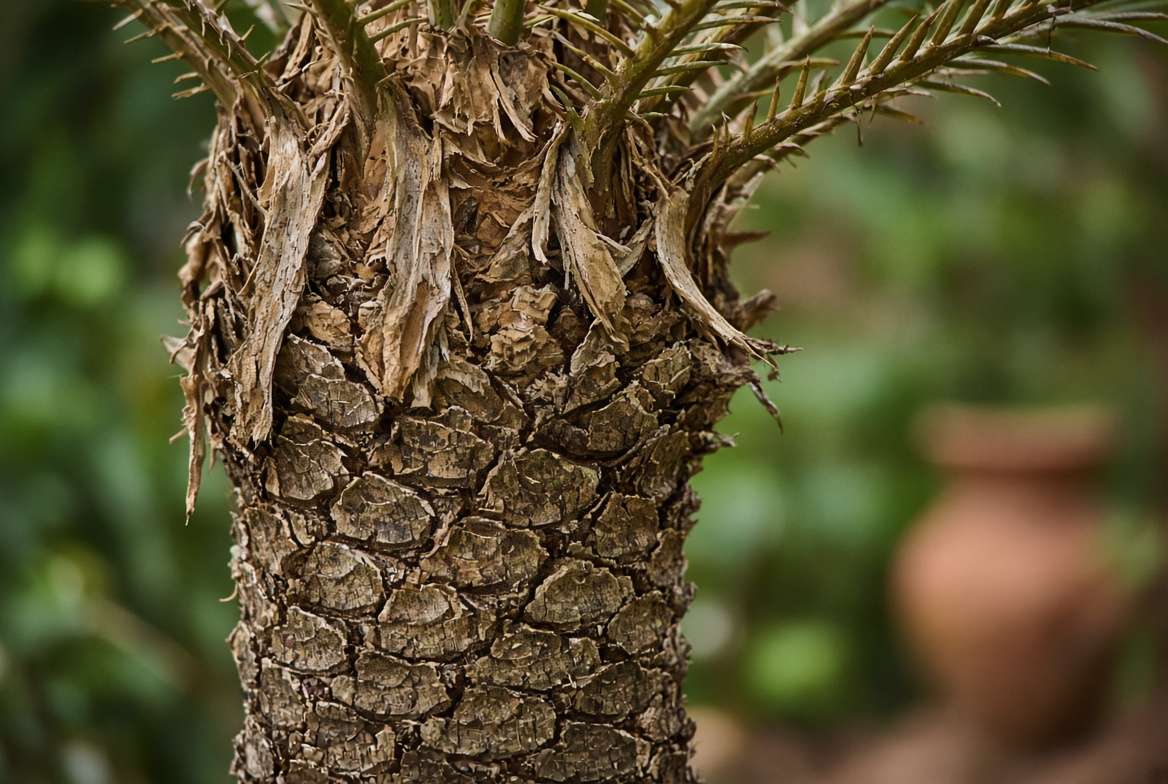
🪵 Trunk Texture and Botanical Accuracy
A fake tree is often given away by its trunk. Low-quality options feature smooth, shiny green plastic trunks that immediately look synthetic. Premium models mimic nature flawlessly by using one of two methods:
-
Real Bark Wraps: Some high-end faux palms actually use preserved, natural palm bark and real dried husk fibers wrapped around a steel core.
-
Hand-Painted Resin: Others use highly texturized, molded resin that is hand-painted to replicate the irregular, rough, and fibrous texture of a real palm trunk.
🍃 Frond Density and Wire Flexibility
Real palm trees have weight and movement. Stiff, perfectly straight leaves are a dead giveaway of a fake plant. Look for fronds that contain hidden internal wiring (often down the center spine of the leaf). This allows you to physically bend and shape each branch. High-quality trees also feature varying shades of green—lighter, brighter greens at the top to simulate new growth, and deeper, darker greens toward the bottom for mature fronds.
⚖️ Base Weight and Structural Integrity
Outdoor elements are unforgiving. A sudden gust of wind can easily topple a lightweight faux plant, breaking the fronds. Ensure the tree comes seated in a heavily weighted starter pot (usually filled with concrete). While you will eventually place this into a larger decorative planter, that dense, heavy center of gravity is crucial for outdoor stability.
🏆 The Best Fake Outdoor Palm Trees for Every Space
Navigating the market of artificial foliage can be overwhelming. Based on strict criteria for botanical accuracy, durability, and UV resistance, here is a curated breakdown of the best faux palm styles to elevate your patio landscaping.
🌿 1. Best Overall for Privacy: The Artificial Areca Palm
The Areca palm (often called the butterfly palm) is famous for its dense, feathery, and arching fronds. In the faux landscaping world, this is your go-to choice for creating natural-looking privacy screens around a hot tub or a neighbor-facing balcony.
-
Pros: High volume of leaves provides excellent coverage; naturally multi-trunked design looks very authentic.
-
Cons: The individual thin leaves can sometimes tangle in extremely high winds.
-
Ideal Placement: Lined up in long, rectangular planter boxes along the edge of a deck.
-
E-E-A-T Quality Check: A premium fake Areca will feature varying shades of yellow-green on the outer fronds to mimic new growth, rather than a uniform, artificial dark green.
🍍 2. Most Realistic Texture: The Faux Sago Palm
Technically a cycad rather than a true palm, the Sago is beloved for its stiff, prehistoric-looking leaves and thick, textured trunk. Because real Sago leaves are naturally stiff and glossy, the synthetic versions often look 100% identical to the living plant.
-
Pros: Incredibly realistic trunk detailing; very wind-resistant due to its low profile and rigid fronds.
-
Cons: Typically shorter in stature (usually maxing out around 3 to 4 feet), so it won’t provide vertical scale.
-
Ideal Placement: Flanking a front doorway in matching urns, or serving as a low-level anchor in a larger garden bed.
-
E-E-A-T Quality Check: Look for a Sago with a “pineapple-like” trunk base adorned with real dried husk material.
🪭 3. Best for High Winds: The Artificial Fan Palm (Washingtonia)
If you live in a coastal area or a high-rise apartment with a wind-swept balcony, broad-leaf palms can act like sails and tip over. The Fan Palm features distinct, hand-shaped leaves with gaps that allow wind to pass through more easily.
-
Pros: Handles turbulent weather beautifully; offers a distinct, architectural shape.
-
Cons: The broad leaves require careful “fluffing” out of the box to avoid looking flat.
-
Ideal Placement: Modern, minimalist patios where the unique leaf structure can serve as a focal point.
-
E-E-A-T Quality Check: High-end models will feature the characteristic “thorns” or teeth along the petiole (leaf stem), mimicking the natural defenses of the real plant.
🌴 4. Best Statement Tree: The 6-to-8 Foot Robellini (Date Palm)
When you want to anchor a large pool deck or fill an empty, soaring patio corner, you need vertical scale. The Robellini, or Pygmy Date Palm, offers a beautiful, textured central trunk topped with an explosion of elegant, cascading fronds.
-
Pros: Provides instant, dramatic resort-style height; beautiful shadow-casting in the sun.
-
Cons: Requires a very heavy base to remain stable at that height; higher price point.
-
Ideal Placement: The corners of a pool deck, or beside an outdoor kitchen to draw the eye upward.
-
E-E-A-T Quality Check: The best faux Robellinis utilize actual palm bark wrapped around a reinforced steel core, making the trunk virtually indistinguishable from a living tree.
🪄 Pro Landscaping Secrets: How to Make Fake Palms Look 100% Real
Purchasing a high-quality tree is only half the battle. The most realistic faux palm in the world will still look fake if it is sitting in a tiny, bare plastic nursery pot on your concrete slab. As a landscaping expert, here is my masterclass on staging artificial outdoor plants to fool even the most discerning eye. 🧐
🕳️ Secret #1: Bury the Plastic Pot
The single biggest giveaway of fake outdoor plants is the black plastic starter pot. You must completely hide it. You have two options:
-
Plant it in the earth: Dig a hole in your garden bed and bury the starter pot completely, just as you would a live root ball.
-
Use a decorative planter: Place the faux tree into a much larger, stylish outdoor planter (terracotta, glazed ceramic, or concrete).
🪨 Secret #2: Top-Dress with Organic Matter
Once your tree is in its new planter, do not leave the plastic base exposed. Fill the empty space around the starter pot with rocks or packing peanuts for stability, and then cover the top two inches with real landscaping material. Use authentic potting soil, rich cedar mulch, sphagnum moss, or decorative river rocks. When people look down and see real dirt or mulch at the base, their brain automatically assumes the tree growing out of it is alive.

🌱 Secret #3: The “Blend” Technique
This is a high-level designer trick. Mix the fake with the real. If you place a faux palm in a large planter, plant real, low-maintenance trailing plants around the base. Hardy varieties like Creeping Jenny, English Ivy, or Sweet Potato Vine will spill over the edges of the pot. The presence of living, growing foliage at the base successfully tricks the eye into believing the entire arrangement is alive and thriving.
👐 Secret #4: The Art of Fluffing
When you unbox a synthetic botanical, the branches will be pointed straight up to save space in shipping. Real palm fronds are heavy; they succumb to gravity and arch downward. Spend at least 15 to 20 minutes gently bending each individual frond outward and slightly down.
-
Expert Insight: Start from the bottom of the tree and work your way up. The lowest fronds should droop the most, while the highest, newest growth should stand more upright.
🛡️ Weatherproofing: How to Protect Your Investment
Even premium fake outdoor palm trees need a little TLC to survive the harsh outdoor elements year after year. Implementing a basic maintenance routine will double the lifespan of your artificial landscaping.
🧴 Apply UV-Protectant Sprays
Even if your tree is marketed as inherently UV-resistant, the sun is a powerful force. To prevent the leaves from becoming brittle or fading, apply a specialized botanical UV-protectant spray (often found at floral supply stores or marine/boating shops).
-
Application: Spray a light, even coat over the top and bottom of the fronds every 6 to 8 months, preferably at the start of spring and the height of summer.
💨 Fortify Your Wind Defense
Nothing ruins the illusion of a stately palm tree like it blowing across the yard in a thunderstorm. To properly anchor your tree:
-
The Quikrete Method: If keeping the tree in a decorative pot, place the starter pot inside, fill the surrounding void with gravel, and pour in a layer of fast-setting concrete (Quikrete).
-
The Stake Method: If burying the pot in the ground, drive two wooden landscaping stakes into the earth next to the buried pot and secure them to the faux trunk with heavy-duty zip ties hidden by the mulch.
🧽 Establish a Cleaning Routine
Live plants naturally shed dust when it rains or when they drop old leaves. Fake plants, however, will accumulate outdoor dust, pollen, and the occasional bird dropping. A dusty plant is an obvious fake. Every few weeks, simply take your garden hose and give the fronds a gentle shower using the “mist” or “shower” setting. For stubborn grime, wipe the leaves down with a microfiber cloth and a highly diluted solution of mild dish soap and water.
🤔 Frequently Asked Questions (FAQs)
Can I leave fake palm trees outside in the winter? Yes, but with caveats. High-quality poly-blend plastics are engineered to withstand freezing temperatures without cracking. However, heavy snow loads can permanently bend or break the internal wires of the fronds. If you live in an area with heavy winter snowfall, it is best to gently tie the fronds together with twine or cover the tree with a burlap landscaping sack until spring.
How long do artificial outdoor plants last before fading? This depends entirely on quality and sun exposure. A cheap, indoor-rated silk plant will fade outdoors in less than a single season. A premium, UV-treated faux palm placed in a shaded patio can easily last 5 to 7 years. In direct, scorching sunlight (like a Southern California pool deck), expect a high-quality tree to maintain its color for about 3 to 4 years before showing signs of degradation.
Do fake outdoor palm trees attract bugs? Synthetic plants do not attract pests in the way live plants do—you will never have to fight an infestation of aphids or scale. However, outdoor faux trees provide excellent structural support for spiders to build webs, and the dense canopies can occasionally shelter wasps. Your regular hosing-down routine (mentioned above) is more than enough to keep these opportunistic critters away.
🌅 Bringing Your Tropical Oasis to Life
Creating a lush, green, resort-style retreat in your own backyard shouldn’t be a source of stress, endless physical labor, or financial drain. By investing in premium, UV-treated faux botanicals and applying professional styling techniques—like burying the nursery pot and top-dressing with real organic matter—you can completely bypass the limitations of your local climate and your own gardening skills.
You no longer have to sacrifice style just because you lack a green thumb or live in a frost-prone zone. Take back your weekends, skip the expensive fertilizers, and enjoy the permanent, zero-maintenance beauty of a perfectly curated outdoor space. 🍹🌴











