
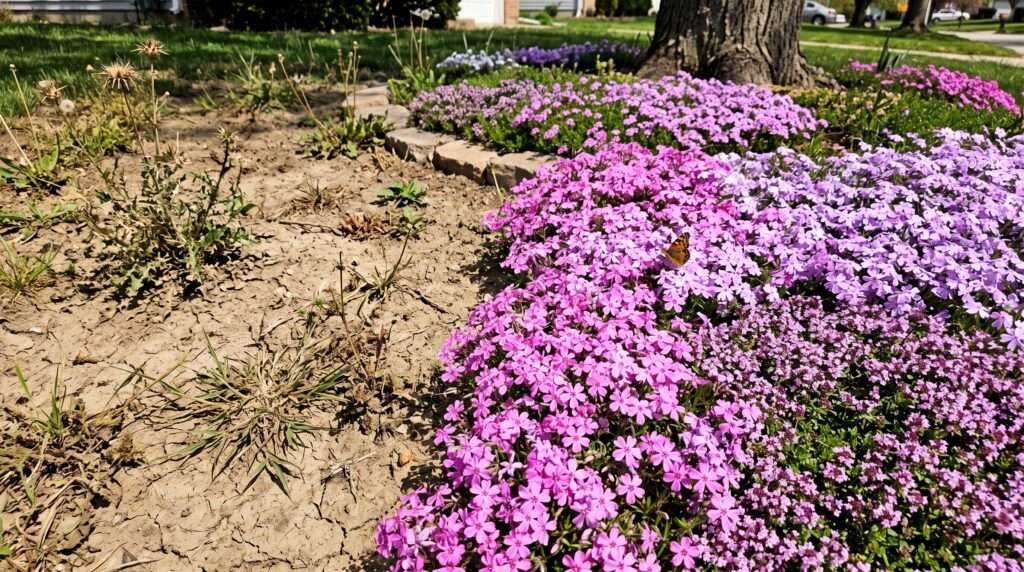
Are you exhausted from hauling heavy, expensive bags of bark mulch every spring, only to spend your summer weekends pulling crabgrass and dandelions out of bare dirt? The endless cycle of weeding, mulching, and battling soil erosion is a landscape nightmare. But there is a better, more beautiful way. Instead of fighting nature, the secret to a lush, zero-maintenance yard is utilizing flowers ground covering plants.
By swapping exposed soil for a dense, living carpet of blooms, you can permanently eliminate the space weeds need to grow. As a landscape and plant care specialist, I have spent years testing various low maintenance perennial ground cover solutions across different soil types and microclimates. The verdict is clear: planting a flowering weed-suppressing ground cover is the ultimate landscaping “hack.”
In this comprehensive guide, we will explore exactly why bare soil is your garden’s biggest enemy, the science behind “living mulches,” and my top 10 expert-selected blooming ground covers that will transform your yard into a colorful, weed-free paradise. 🏡✨
🌿 Why Traditional Mulch & Turf Fail Where Flowering Ground Covers Excel
Before diving into the specific plants, it is crucial to understand the biological mechanics of why standard landscaping practices often fail, and why a drought-tolerant flowering ground cover succeeds.

The Living Carpet: Soil Cooling & Moisture Retention 💧
Bare dirt is unnatural. When sunlight directly hits exposed topsoil, surface temperatures can skyrocket, baking the beneficial microbes and evaporating essential moisture. Traditional wood chips break down and need constant replacement. Turf grass, on the other hand, requires endless mowing, aerating, and watering.
A continuous canopy of low-growing flowers acts as a “living mulch.” These dense mats of foliage shade the earth, dropping surface soil temperatures by up to 15°F during peak summer heat. This shade prevents soil crusting, mitigates rain compaction, and acts as a sponge on sloped land to stop nutrient runoff. Shrubs and trees planted nearby actually thrive better when their root zones are blanketed by these living mulch perennials! 🌳
Natural Weed Suppression: The Science of Canopy Density 🛡️
Weed seeds are everywhere—blowing in the wind and dropped by birds. However, to germinate, dormant weed seeds require light and soil contact.
When you install high-density flowers ground covering plants, you are essentially starving weeds of light. But the battle is also won underground. Ground covers spread via rhizomes and dense, fibrous root mats that claim all available subterranean territory. By the time a dandelion seed tries to establish a taproot, the ground cover has already monopolized the water and nutrients in the topsoil. It’s a brilliant, natural defense system! 🛑🌱
🌸 10 Elite Flowers Ground Covering Plants That Smother Weeds
Ready to ditch the mulch? Here are ten spectacular, hardworking ground covers that offer incredible floral displays while aggressively outcompeting weeds.
1. Creeping Phlox (Phlox subulata) 🌺
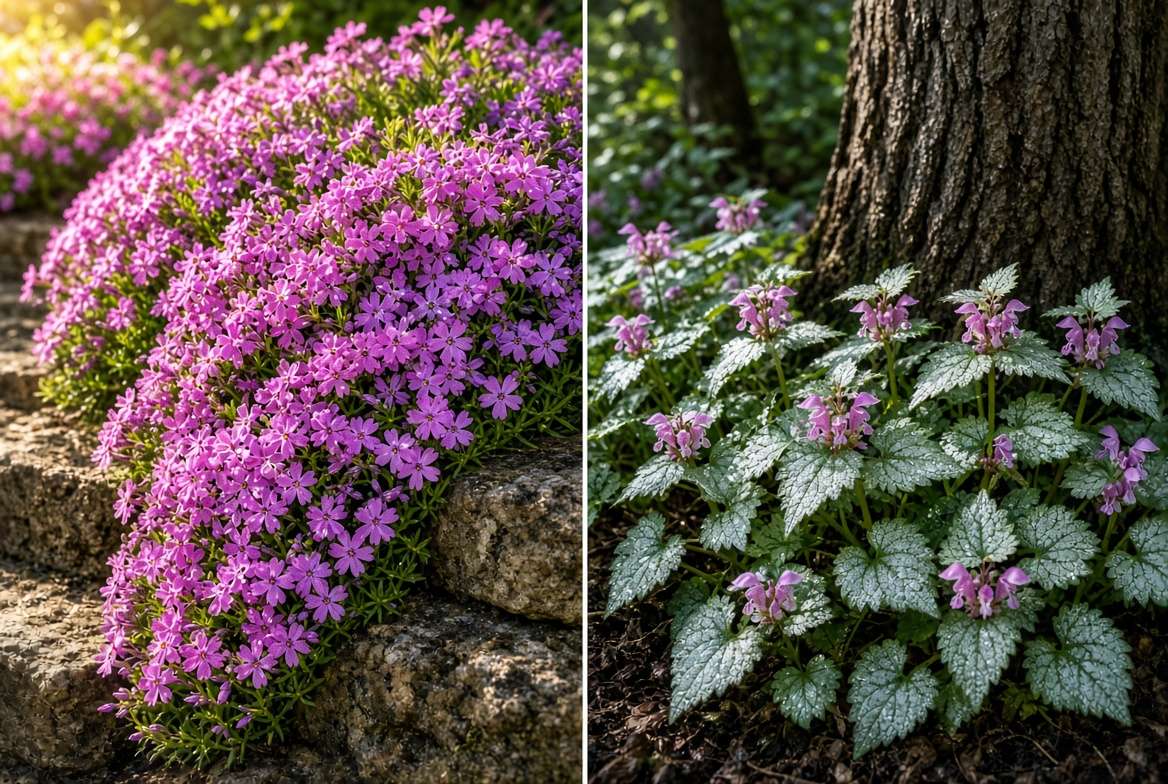
If you want a breathtaking, neon-colored carpet that announces the arrival of spring, Creeping Phlox is the undisputed champion. It cascades beautifully over retaining walls, rock gardens, and stone borders.
-
The Vibe: A vibrant, cascading spring blanket in shades of pink, purple, white, and candy-stripe.
-
Key Specs: USDA Zones 3–9 | Full Sun | Sandy, well-draining soil.
-
Weed-Choking Power: 5/5 🌟 (Its needle-like evergreen foliage forms an impenetrable mat that blocks weeds 365 days a year).
-
Expert Tip: To keep it dense and weed-proof, shear the plant back by about one-third immediately after it finishes flowering in late spring. This stimulates compact, dense lateral branching and prevents the center from dying out. ✂️
2. Sweet Woodruff (Galium odoratum) 🍃
Finding a weed-smothering plant that thrives in deep shade can be difficult, but Sweet Woodruff is the perfect solution for those dark, bare patches beneath large deciduous trees.
-
The Vibe: Delicate, starry white blossoms resting on whorled green leaves that emit a sweet, vanilla-hay fragrance when crushed.
-
Key Specs: USDA Zones 4–8 | Full to Partial Shade | Rich, moist soil.
-
Weed-Choking Power: 4.5/5 🌟
-
Expert Tip: Sweet Woodruff is the ultimate companion plant for mature trees. Its shallow, non-invasive runner root system coexists harmoniously with fibrous tree feeder roots, providing weed suppression without robbing the tree of necessary nitrogen or water. 🌳🤍
3. Creeping Thyme (Thymus serpyllum) 🐝
For areas that receive blazing hot afternoon sun and lean, rocky soil, Creeping Thyme is a miracle worker. It is highly drought-tolerant and incredibly aromatic.
-
The Vibe: Dense, fragrant tapestries of pink and purple that release a delightful herbal oil scent when you walk on them. Plus, it’s an absolute magnet for native bees and butterflies! 🦋
-
Key Specs: USDA Zones 4–9 | Full Sun | Lean, rocky, sharply drained soil.
-
Weed-Choking Power: 4/5 🌟
-
Expert Tip: Do not pamper this plant! Avoid high-nitrogen fertilizers or overly rich potting soils. If the soil is too rich, creeping thyme will grow leggy and hollow out in the center, creating gaps where opportunistic weeds can sprout. It thrives on neglect! 🚫💩
4. Spotted Deadnettle (Lamium maculatum) 🤍
When dealing with dim courtyard corners or the shadowed side of a house where turf grass refuses to grow, Spotted Deadnettle is an absolute lifesaver. This fast-spreading perennial brings incredible light to dark spaces through its highly reflective foliage.
-
The Vibe: Two-toned silver and green foliage topped by striking, hooded pink, purple, or white blooms that brighten up the darkest landscape corners.
-
Key Specs: USDA Zones 3–8 | Partial to Full Shade | Moderately moist, organic soil.
-
Weed-Choking Power: 4.5/5 🌟
-
Expert Tip: Look for specific cultivars like ‘Beacon Silver’ or ‘Pink Pewter’. Their high foliage reflectivity visually expands small, shaded spaces while forming a dense, interlocking root system that locks out shade-tolerant weeds like wild violet. 🌤️
5. Basket of Gold (Aurinia saxatilis) ☀️
Erosion control on steep hillsides is a major landscaping challenge, but Basket of Gold turns problem slopes into a highly visible, stunning feature. It thrives where other plants wash away.
-
The Vibe: Intense, high-visibility golden-yellow floral sheets tailor-made for sloped embankments, rocky outcroppings, and cascading over retaining walls.
-
Key Specs: USDA Zones 4–7 | Full Sun | Dry to medium, gravelly soil.
-
Weed-Choking Power: 4/5 🌟
-
Expert Tip: This plant strictly demands to be ignored. Over-watering or planting in heavy clay leads to root rot and crown dieback, which inevitably opens up the soil canopy for weed colonization. Keep it dry and well-drained! 🏜️
6. Periwinkle (Vinca minor) 💜
For sheer reliability across almost any lighting condition, Periwinkle is a powerhouse. It roots quickly at the leaf nodes, creating an extensive, nearly indestructible carpet.
-
The Vibe: Glossy, dark evergreen foliage studded with delicate, pinwheel-shaped lavender-blue blooms that appear heavily in spring and sporadically through summer.
-
Key Specs: USDA Zones 4–9 | Partial Sun to Dense Shade | Highly adaptable to poor soils.
-
Weed-Choking Power: 5/5 🌟 (Absolutely nothing penetrates a mature Vinca stand).
-
Expert Tip & Containment Warning: Because its root nodes form such rapid, aggressive carpets, it is crucial to install deep edging borders when planting near native woodlands or curated vegetable plots. It is an elite weed-suppressor, but you must keep it contained. 🚧
7. Bugleweed (Ajuga reptans) 🫐
If you want to move away from standard green ground covers, Bugleweed offers some of the most spectacular, moody foliage in the landscaping world, acting as a dramatic backdrop to brighter garden elements.
-
The Vibe: Deep bronze, burgundy, or chocolate-colored rosettes that shoot up striking cobalt-blue floral spikes in mid-to-late spring.
-
Key Specs: USDA Zones 3–10 | Sun to Partial Shade | Moist, fertile soil.
-
Weed-Choking Power: 5/5 🌟
-
Expert Tip: Ensure good airflow around the base of the plants and space the crowns properly according to their mature spread. In sweltering, humid summer regions, overcrowding Ajuga can lead to crown rot, which ruins the weed barrier. 🌬️
8. Snow-in-Summer (Cerastium tomentosum) ❄️
Blazing-hot median strips, south-facing slopes, and curbside garden beds often scorch traditional turf to a crisp. Snow-in-Summer thrives in these extreme heat zones, creating a cool, frosty visual effect even in July.
-
The Vibe: A dazzling sea of pristine white flowers resting on a bed of woolly, silver-gray foliage that looks like fresh snowfall.
-
Key Specs: USDA Zones 3–7 | Full Sun | Poor, rocky, well-draining soil.
-
Weed-Choking Power: 4/5 🌟
-
Expert Tip: Avoid planting this in rich compost. The silver, hairy leaves are designed to conserve moisture in poor soils. Over-fertilizing makes the plant weak, stringy, and susceptible to fungal issues, compromising its ability to shade out weed seeds. 🪨
9. Hardy Ice Plant (Delosperma cooperi) 🌵
Integrating succulent ground covers adds a modern, architectural texture to your yard. Hardy Ice Plant offers unparalleled drought tolerance and blindingly bright colors that last for months.
-
The Vibe: Jewel-toned, neon-magenta succulent blooms that shimmer like crystals under the intense summer sun, attracting countless pollinators.
-
Key Specs: USDA Zones 6–10 | Full Sun | Sandy, gritty, drought-prone soils.
-
Weed-Choking Power: 4/5 🌟
-
Expert Tip: Winter drainage is the single most critical factor for survival. Soggy, freezing winter ground kills ice plants much faster than sub-zero air temperatures. Amend heavy soil with coarse sand or gravel before planting. ❄️💧
10. Creeping Mazus (Mazus reptans) 🌸
Many homeowners want a ground cover they can actually walk on. While most flowering ground covering plants crush underfoot, Creeping Mazus bounces right back, making it the premier choice for active pathways.
-
The Vibe: Tiny, snapdragon-like violet-blue blossoms with white and yellow throats, forming a lush, mossy green runner mat that stays incredibly low to the ground.
-
Key Specs: USDA Zones 5–9 | Full Sun to Partial Shade | Consistently moist soil.
-
Weed-Choking Power: 4.5/5 🌟
-
Expert Tip: Take advantage of its exceptional foot-traffic resistance by tucking it into flagstone walkways, patio crevices, and stepping stone gaps where running a lawnmower or weed-whacker is impossible. 👟
🛠️ Site Prep & Planting Matrix: Fast-Tracking Canopy Closure
Planting living mulch perennials into unprepared soil is a recipe for disaster. To achieve a zero-maintenance carpet, the initial foundation must be flawless.
The Clean-Slate Protocol: Clearing Persistent Weeds First 📦
You cannot plant ground covers directly into weed-infested soil and expect them to win the fight immediately. Existing perennial weeds have established taproots that will outcompete your new plugs.
-
Sheet Mulching: Mow the existing area as low as possible. Lay down thick, overlapping layers of plain brown cardboard (removing all tape). Wet the cardboard thoroughly, then top it with 3-4 inches of compost. This smothers existing weeds while feeding the soil microbes. You can cut small “X” shapes into the cardboard to plant your ground cover plugs directly through it.
-
Solarization: For severe infestations of bindweed or Bermuda grass, pin clear UV-resistant plastic over the damp, bare soil for 6 weeks during the hottest part of summer. The extreme heat will bake and destroy the weed seed bank naturally. ☀️

Spacing Math: Balancing Budget vs. Canopy Closure Speed 📐
The closer you plant your plugs, the faster the canopy closes, but the more it will cost upfront.
-
6-Inch Spacing: Closes canopy in 3–6 months. Best for aggressive slopes needing immediate erosion control.
-
12-Inch Spacing: Closes canopy in 12–18 months. The industry standard for balancing cost and speed.
-
18-Inch Spacing: Closes canopy in 24+ months. Requires significant hand-weeding in the first two years while you wait for the plants to merge.
-
Pro Layout: Always use a staggered, triangular planting layout rather than a square grid. Triangles close diagonal gaps much faster, leaving less bare soil exposed to sunlight. 🔺
Mycorrhizal Inoculants & Starter Root Care 🪱
To accelerate lateral root spread, pre-treat your plant root balls with a high-quality endomycorrhizal fungi inoculant powder or a liquid compost tea dip. This biological boost allows the roots to access water and phosphorus much faster, giving them the immediate upper hand over germinating weed seeds.
✂️ Year-Round Maintenance: Protecting the Barrier
The beauty of a flowering weed-suppressing ground cover is that the labor decreases dramatically over time.
Year 1 vs. Year 3 Management 📅
-
Year 1 (The Establishment Phase): Do not expect miracles on day one. You must provide supplemental drip irrigation and apply a light, 1-inch layer of fine wood chips between the newly planted plugs. Plan to do selective hand-weeding monthly until the plants touch.
-
Year 2 & 3 (The Closed Canopy Phase): Once the foliage merges, maintenance drops by 90%. You will require zero supplemental mulch and only occasional watering during extreme, prolonged droughts.
Shearing & Rejuvenation Schedule ✂️
To prevent creeping perennials from developing woody, dead centers (thatch buildup), use a string trimmer or hedge shears to trim them back by a couple of inches immediately after their primary bloom cycle ends. This simple 10-minute chore forces the plant to push fresh, dense green growth from the base, keeping the weed-blocking canopy perfectly tight.
🚨 Troubleshooting Common Ground Cover Dilemmas
-
What if stubborn taproot weeds punch through? Occasionally, a rogue dandelion or thistle will manage to navigate through the foliage. Do not rip it out by hand, which can uproot your ground cover. Instead, use a narrow dandelion weeder tool or a hori-hori knife to surgically slice the taproot below the soil line without disturbing your runner roots. 🔪
-
Dealing with bare center patches (Crown Rot): If an area dies out due to poor drainage or winter damage, do not leave the soil bare. Dig up a healthy runner from the outer edge of the bed and transplant it directly into the bald spot to patch the hole before weeds find it.
-
Root zone harmony around trees: When planting under trees, do not pile thick soil over the tree’s root flare to accommodate the ground cover. Plant small, 2-inch plugs directly into the existing soil surface to avoid suffocating the tree bark. 🌳
❓ High-Intent Frequently Asked Questions
Which flowering ground covers can tolerate moderate foot traffic? 👟 If you need a living mulch that can handle being walked on by humans or pets, Creeping Thyme, Creeping Mazus, and dwarf varieties of sweet woodruff are your best options. Their flexible stems and tiny leaves bounce back quickly from compression, unlike brittle-stemmed plants like Phlox.
How long does it take for ground cover to fully cover bare ground? ⏳ Depending on the initial spacing and the vigor of the specific species, expect a realistic timeline of 12 to 24 months for total canopy closure. You can accelerate this to a single growing season by planting plugs 6 inches apart and utilizing mycorrhizal root inoculants.
Are any of these flowering ground covers toxic to dogs or cats? 🐾 Pet owners must be selective. Creeping Thyme and Creeping Phlox are widely considered non-toxic and safe for dogs and cats. However, Periwinkle (Vinca minor) is toxic to pets if ingested and should be avoided in enclosed dog runs or heavily trafficked pet areas. Always verify specific toxicity with the ASPCA database.
Will flowering ground covers choke out my mature tree roots? 🌳 No. Most flowering perennial ground covers utilize the top 2 to 4 inches of topsoil, utilizing fine, runner-type root systems. Mature trees pull their water and nutrients from much deeper, thicker root networks. In fact, ground covers benefit trees by stabilizing soil temperatures and reducing water evaporation around the tree base.
Reclaiming your weekends from the endless chore of weeding and mulching begins with a single step. By assessing your soil type, evaluating your sunlight exposure, and choosing the right plants from this list, you can permanently transition away from high-maintenance landscapes. Calculate the square footage of your most frustrating garden patch, pick your favorite low-maintenance perennial, and prepare to watch your bare dirt transform into an impenetrable, blooming carpet this season.











