
Imagine waiting all winter for that vibrant explosion of golden-yellow flowers, only to be greeted by a giant, unruly green bush with absolutely zero blooms. If you have experienced this frustrating spring disappointment, you are not alone. As a landscape consultant with over a decade of experience rehabilitating overgrown and neglected gardens, I see this exact scenario play out in front yards every single year. The culprit is rarely a mysterious disease, poor soil, or bad luck. Instead, the lack of blooms on forsythia plants is almost always due to one specific, highly common pruning mistake.
In this comprehensive guide, we will uncover exactly why your shrub isn’t flowering, how to fix it, and how to master the complete lifecycle of these resilient landscape staples to guarantee a spectacular, traffic-stopping spring display. 🌼
🌱 What Makes Forsythia Plants the Ultimate Harbingers of Spring?
Long before the tulips open or the dogwood trees bloom, forsythia breaks the dreary gray of late winter. Belonging to the Oleaceae (olive) family, these deciduous shrubs are famous for producing dense clusters of brilliant yellow bell-shaped flowers along their bare arching branches before their green leaves even emerge.

Botanical Basics and Growth Habits
These are incredibly vigorous growers. Under the right conditions, a healthy shrub can add up to 24 inches of new growth in a single season. Depending on the specific cultivar, mature plants range anywhere from a compact 2 feet tall to a towering 10 feet tall and wide. Because of this rapid, sprawling growth habit, they are frequently utilized as fast-growing privacy hedges, slope stabilizers, or structural background borders.
Ideal USDA Hardiness Zones
Forsythias thrive in USDA Hardiness Zones 3 through 8. They are uniquely adapted to temperate climates because they actually require a period of winter dormancy. The plant needs a certain amount of cold weather—often referred to as chilling hours—to trigger its flowering cycle. This is why gardeners in tropical or consistently warm climates (Zone 9 and above) struggle to get them to bloom; without the winter chill, the flower buds simply will not open.
✂️ The #1 Pruning Mistake That Ruins Forsythia Blooms (And How to Avoid It)
If your shrub is growing healthy green leaves but failing to produce yellow flowers in the spring, it is highly likely that you are pruning it at the wrong time of year.
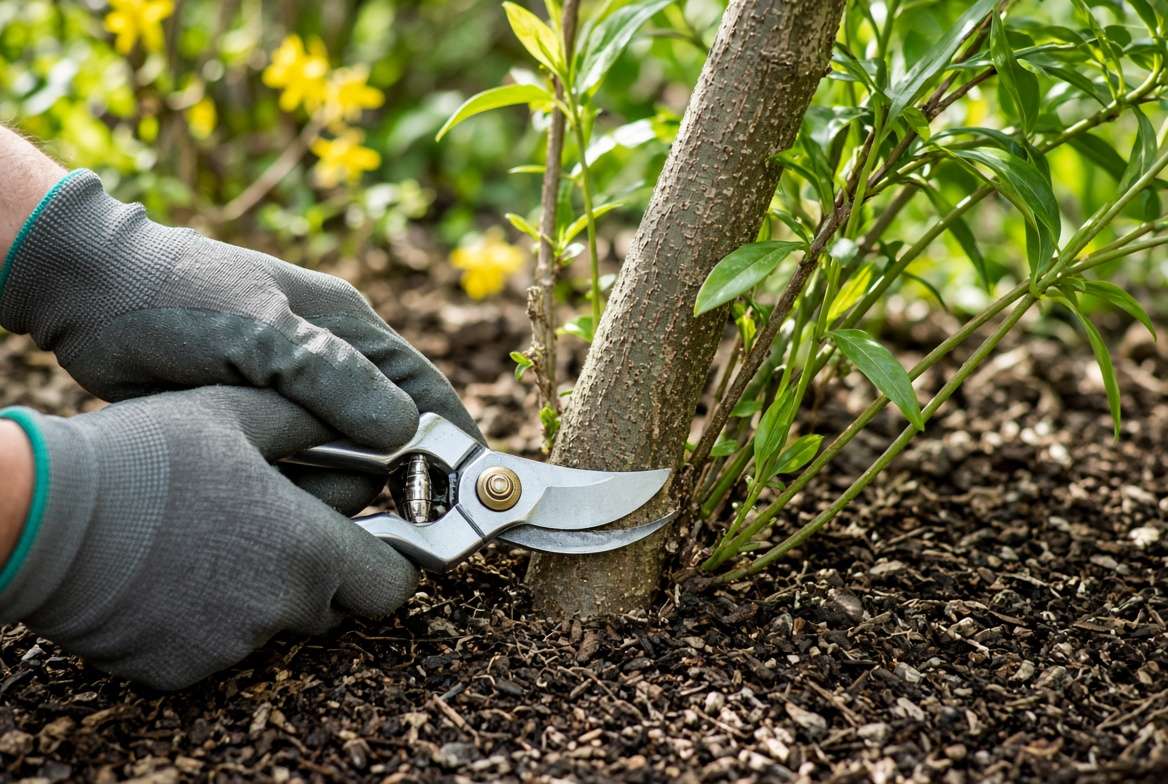
The biggest mistake you can make is pruning in late summer, fall, or winter.
To understand why this is so devastating to your spring display, you have to understand how this specific plant reproduces.
The Science of “Old Wood” vs. “New Wood”
Forsythias are part of a category of flowering shrubs that bloom on “old wood.” This means that the plant sets its flower buds for the following spring during the summer immediately after it finishes blooming.
By July or August, your shrub has already created thousands of microscopic flower buds along its branches, perfectly packaged and ready to sleep through the winter. If you walk out into your yard in October with a pair of hedge trimmers and shear the plant to make it look tidy for winter, you are literally cutting off next spring’s flowers.
When is the Exact Right Time to Prune?
The golden rule of pruning forsythia plants is this: Prune them immediately after the yellow flowers fade, but before the green leaves fully expand.
This incredibly brief window—usually a few weeks in mid-to-late spring—gives you time to shape the plant and control its size without touching the new growth that will eventually house next year’s blooms.
Step-by-Step: How to Prune for Shape and Health
To keep your shrub vigorous, flowering heavily, and gracefully arched (rather than looking like a rigid, woody meatball), follow the one-third rule.
-
Remove the Dead and Damaged: Start by cutting away any completely dead, diseased, or severely broken branches, taking them all the way back to the base.
-
Thin the Center: Identify the thickest, oldest, and most woody canes in the center of the plant. Using loppers or a pruning saw, cut up to one-third of these massive canes completely to the ground. This opens up the center of the shrub to sunlight and air circulation, which prevents fungal diseases and stimulates fresh, flexible basal shoots.
-
Shape the Exterior: Step back and look at the overall shape. Trim back the remaining erratic or overly long branches by cutting them back to an outward-facing bud or a lateral branch. Try to maintain the plant’s natural, weeping fountain shape.
Expert Insight: Never use electric hedge shears to prune a forsythia into a perfect square or globe. Shearing promotes a dense outer shell of weak twigs that block sunlight from the interior, leading to a hollow, dead center and significantly fewer flowers.
Hard Rejuvenation Pruning for Neglected Shrubs
If you have inherited a massive, overgrown, woody monster of a bush that hasn’t been maintained in a decade, you do not have to dig it up. You can perform a “hard rejuvenation” prune. In late winter (February or early March), cut the entire plant down to about 4 to 6 inches above the ground.
The caveat: Because you are doing this in late winter, you are cutting off all the buds. You will completely sacrifice that year’s spring blooms. However, the plant’s massive root system will push up rapid, healthy new growth that summer, resulting in a perfectly sized, highly floriferous shrub the following year.
☀️ Planting and Growing Conditions: Setting Your Shrub Up for Success
While these plants are famous for surviving near-total neglect, giving them optimal conditions will ensure they look like a premium landscape feature rather than a wild weed.
Sunlight Requirements for Maximum Flowers
Sunlight is the primary fuel for flower production. Plant your shrub in full sun, meaning it receives at least six to eight hours of direct, unobstructed sunlight every day. While they can technically survive in partial shade, the results are rarely aesthetically pleasing. Shade-grown plants become “leggy,” stretching out thin, weak branches in search of light, and they will produce a fraction of the blooms compared to their full-sun counterparts.
Soil Preferences and Drainage
These are highly adaptable plants that will tolerate heavy clay, rich loam, or sandy soils with varying pH levels. However, their one non-negotiable requirement is good drainage. They despise “wet feet.” If planted in a low-lying depression where water pools after a rainstorm, the roots will quickly succumb to rot.
Spacing and Landscape Uses
Because they grow so quickly, always plant according to their mature size, not the size of the nursery pot. Space large varieties at least 4 to 6 feet apart when planting a continuous hedge. If planted too closely, they will compete for nutrients and airflow, leading to sparse lower foliage and an increased risk of fungal issues.
💧 Year-Round Care: Watering, Fertilizing, and Mulching
Once established, forsythia plants are remarkably low-maintenance.
-
Watering: During their first growing season, water deeply once a week to help the root system establish itself in the surrounding soil. Once mature, they are highly drought-tolerant and typically survive entirely on natural rainfall, requiring supplemental watering only during extreme, prolonged summer droughts.
-
Fertilizing: Heavy feeding is rarely necessary and can actually be counterproductive. Applying a high-nitrogen lawn fertilizer near your shrub will cause an explosion of green leaves at the expense of yellow flowers. If your soil is notably poor, apply a light dressing of a balanced, slow-release organic fertilizer (like a 10-10-10) once a year in early spring.
-
Mulching: Apply a 2-to-3-inch layer of organic mulch (like shredded bark or compost) over the root zone to retain soil moisture and suppress weeds. Ensure the mulch is pulled a few inches away from the actual stems at the base of the plant to prevent trapping moisture against the wood, which invites disease and pests.
🌼 Choosing the Right Cultivar: Top Forsythia Varieties for Every Yard
Not all varieties are created equal. Choosing the right cultivar for your specific space will save you years of frustrating maintenance.
For Large Hedges and Privacy Screens:
-
Forsythia x intermedia ‘Lynwood Gold’: The classic standard. Reaches 8 to 10 feet tall, grows upright, and produces prolific, deep golden-yellow flowers. Excellent for property lines.
-
‘Spectabilis’: Known for having some of the largest and brightest individual flowers of the large-scale cultivars.
For Small Gardens and Tight Borders:
-
‘Show Off’ (Forsythia x intermedia ‘Mindor’): A spectacular compact variety that stays between 3 and 5 feet tall. It is incredibly dense with flowers from the base to the tips of the branches.
-
‘Gold Tide’ (Forsythia x intermedia ‘Courtasol’): A true dwarf variety that stays under 2 feet tall but spreads outwards, making it an excellent groundcover or slope stabilizer.
For Extreme Cold Climates (Zone 3 & 4):
-
‘Meadowlark’ & ‘Northern Sun’: In very harsh winters, standard flower buds can freeze and die, leaving the plant green the next spring. These specific cultivars were bred by universities to possess extreme bud-hardiness, guaranteeing flowers even after brutal deep freezes.
🛡️ Troubleshooting Common Forsythia Problems
These shrubs are notably deer-resistant and largely impervious to serious damage, but they are not entirely immune to issues.
Why Isn’t My Forsythia Blooming? (A Quick Checklist)
If spring arrives and your shrub remains bare or exclusively green, run through this diagnostic checklist:
-
Improper Pruning: Did you trim it after mid-summer? (Most likely culprit).
-
Winter Kill: Did you experience an unusually late, brutal frost that froze the dormant buds?
-
Shade Encroachment: Has a nearby tree grown larger over the years, casting your once-sunny shrub into deep shade?
-
Excess Nitrogen: Are you fertilizing your adjacent lawn heavily, causing the shrub to absorb too much nitrogen?

Pests and Diseases to Watch For
-
Forsythia Gall: This is the most common issue—a fungal/bacterial infection that causes hard, warty, tumor-like growths along the branches. It cannot be cured with sprays. You must sterilize your pruners with rubbing alcohol and cut the infected branches off at least 3 inches below the visible gall, destroying the clippings (do not compost them).
-
Leaf Spot and Twig Blight: Fungal issues that cause brown spots on leaves or sudden dieback of small twig tips. This is almost always a sign of poor airflow. Thinning the plant out during your spring pruning usually resolves the issue entirely.
-
Root-Knot Nematodes: Microscopic soil worms that attack the roots, causing the plant to slowly lose vigor and yellow. Ensuring proper soil drainage and adding rich organic compost can help the plant naturally outgrow mild nematode pressure.
🌿 How to Propagate Forsythia Plants (Grow Free Shrubs!)
If you want to extend your hedge or share a beloved plant with a neighbor, forsythias are among the easiest shrubs in the world to propagate.
Method 1: Ground Layering (The Lazy Gardener’s Method) Because the branches naturally weep, they often root themselves if they touch the dirt. You can force this by taking a long, flexible branch in early spring, bending it to the ground, and making a shallow scratch on the underside of the bark where it touches the soil. Bury that scratched section under an inch of dirt, placing a rock on top to hold it down. By late fall, it will have grown its own root system. Simply sever it from the mother plant, dig it up, and transplant it.
Method 2: Softwood Cuttings In early summer (June), cut a 4-to-6-inch piece of soft, new, flexible green growth from the tips of the branches. Strip the leaves off the bottom half of the cutting. Dip the cut end in a powdered rooting hormone, and stick it into a small pot filled with moist potting soil and perlite. Cover the pot with a clear plastic bag to create a mini-greenhouse, keep it moist, and in four to six weeks, you will have a rooted clone ready for the garden.

❓ Frequently Asked Questions (FAQs)
Can I keep my forsythia small by pruning it constantly? Technically yes, but it is a losing battle. Because they grow so fast, trying to keep a 10-foot ‘Lynwood Gold’ pruned down to 3 feet will require constant shearing, which ruins the natural shape and destroys the blooms. If you want a small plant, dig up the large one and plant a dwarf cultivar like ‘Gold Tide’ or ‘Show Off’ instead.
Do forsythia plants have invasive roots? No. While their root systems are robust and sprawling to support their fast upper growth, they are not considered highly aggressive or destructive to house foundations or deep plumbing lines like willow or poplar trees.
Are forsythia plants toxic to dogs or cats? No, they are entirely non-toxic and pet-safe. According to the ASPCA, neither the stems, leaves, nor the bright yellow flowers pose any poisoning threat to dogs, cats, or horses.
Do they bloom more than once a year? Typically, they bloom only once in early-to-mid spring. However, during highly unusual weather patterns—such as a severe summer drought followed by heavy autumn rains and a sudden warm spell—they can get “confused” and produce a sparse, unexpected second flush of blooms in November.
What is the biggest challenge you’ve faced with your spring landscape? Have you ever fallen victim to the late-summer pruning trap, or do you have a specific cultivar thriving in your yard right now? Share your experiences in the comments below!











