
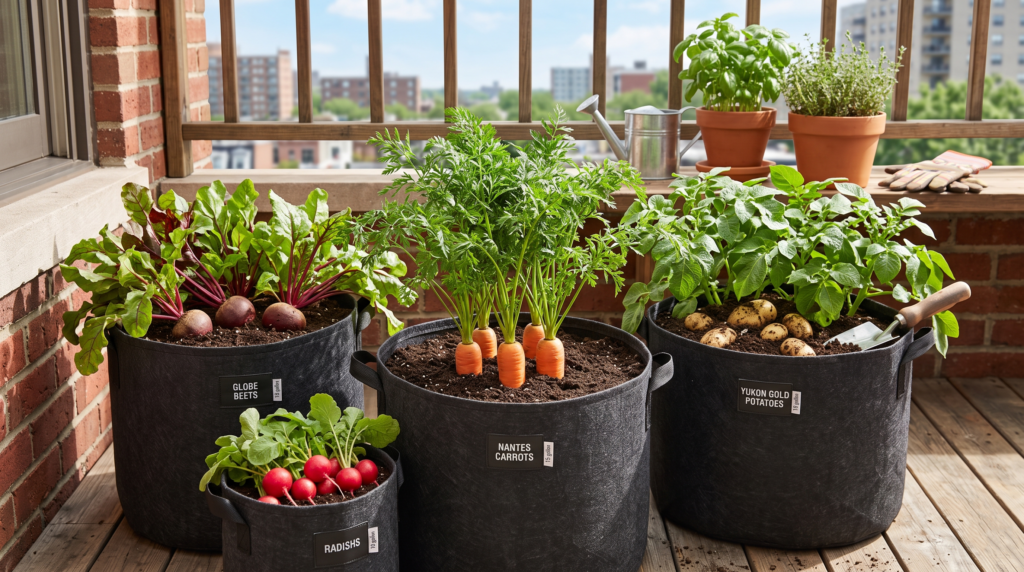
Imagine stepping out onto your sunlit patio, balcony, or rooftop garden with a harvesting basket in hand. You reach into a deep container, gently loosen the soil, and pull out a cluster of perfectly straight, vibrant carrots, ruby-red beets, and plump, golden potatoes. There is no heavy clay to dig through, no rocks to break your tools, and no underground pests devouring your hard work before you get to harvest it.
Many gardeners assume that underground crops require expansive suburban plot beds or deeply tilled farmland. When urban growers try sowing root crops in shallow window boxes or standard 6-inch patio pots, the results are almost always disappointing: twisted, stunted roots, rotted tubers, or dense foliage with zero harvest beneath the surface.
Fortunately, mastering the art of growing root vegetables in deep containers unlocks a world of high-yield urban agriculture without needing an acre of land!
┌─────────────────────────────────────────────────────────────┐
│               THE CONTAINER DEPTH RULE OF THUMB             │
│                                                             │
│   Shallow Pots (6-8")   ➔ Leafy Greens & Radishes Only      │
│   Medium Pots (10-12")  ➔ Round Beets & Short Carrots      │
│   Deep Pots (14-24"+)   ➔ Full-Size Carrots, Potatoes,     │
│                            Parsnips & Daikon                │
└─────────────────────────────────────────────────────────────┘
Early in my master gardening journey, I made the mistake of jamming Chantenay carrot seeds into shallow window boxes. The result? A tangled mess of knotted, two-inch roots that looked more like mini octopuses than vegetables! It was only when I transitioned to 15-gallon deep fabric bags and tailored a high-aeration soil mix that I began harvesting professional-grade, crisp crops.
In this skyscraper guide, we will break down the science of container depth, building custom soil blends, managing nutrients, and mastering step-by-step care for the top 5 root crops so you can enjoy massive harvests in minimal spaces. 🍅🧺
Why Choose Deep Containers for Root Crops? 🪣🌿
Root crops are unique in the plant world: the portion of the plant you harvest grows entirely underground and develops through soft hydraulic pressure. This means the soil environment dictates the shape, flavor, and size of your yield.
Growing root crops in deep containers offers distinct advantages over traditional ground beds:
-
Complete Control Over Soil Texture: Native backyard soil often contains heavy clay, tight compaction, or jagged rocks. Deep containers let you engineer a soft, fluffy growing medium where taproots can expand downwards without resistance. 🪨➡️☁️
-
Total Defense Against Soil-Borne Pests: Burrowing pests like voles, moles, wireworms, and root-knot nematodes love underground crops. Elevating your vegetables in deep pots acts as a physical barrier that keeps pests out completely. 🐛🛡️
-
Superior Aeration and Root Respiration: Oxygen is just as critical for roots as water. Deep containers—especially porous materials like felt grow bags—allow oxygen to penetrate the root zone, preventing anaerobic conditions and root rot. 💨🌱
-
Space Optimization & Vertical Yields: Deep containers maximize volume by expanding upward rather than horizontally across your yard. You can produce dozens of pounds of food in a single footprint under 2 square feet! 📐
-
Microclimate Control & Mobility: Cold spring snap or scorching heat wave? Heavy containers on wheeled plant caddies can be moved into the shade or under shelter to keep root temperatures stable. ☀️🚚
Choosing the Right Home: The Ultimate Guide to Deep Containers 📏🪴
Selecting the right container is the most critical decision you will make. If your container lacks adequate vertical depth or proper drainage, even the best soil mix cannot save your crop.
                  ┌───────────────────────────────┐
                  │      DEEP CONTAINER SPEC      │
                  ├───────────────────────────────┤
                  │  Top Aeration / Foliage Zone  │
                  │  ░░░░░░░░░░░░░░░░░░░░░░░░░░░  │
                  │  Root Elongation Zone         │
                  │  ▒▒▒▒▒▒▒▒▒▒▒▒▒▒▒▒▒▒▒▒▒▒▒▒▒▒▒  │
                  │  Hydration & Nutrient Base    │
                  │  ▓▓▓▓▓▓▓▓▓▓▓▓▓▓▓▓▓▓▓▓▓▓▓▓▓▓▓  │
                  │  Drainage Holes (CRITICAL!)   │
                  └───────────┬───────┬───────────┘
                              │       │
Size and Depth Matter: How Deep is “Deep”? 📐
A container’s minimum depth must accommodate two things: the maximum length of the mature root and a 3-to-4-inch moisture reserve zone below it.
Here is an expert chart to guide your container purchasing decisions:
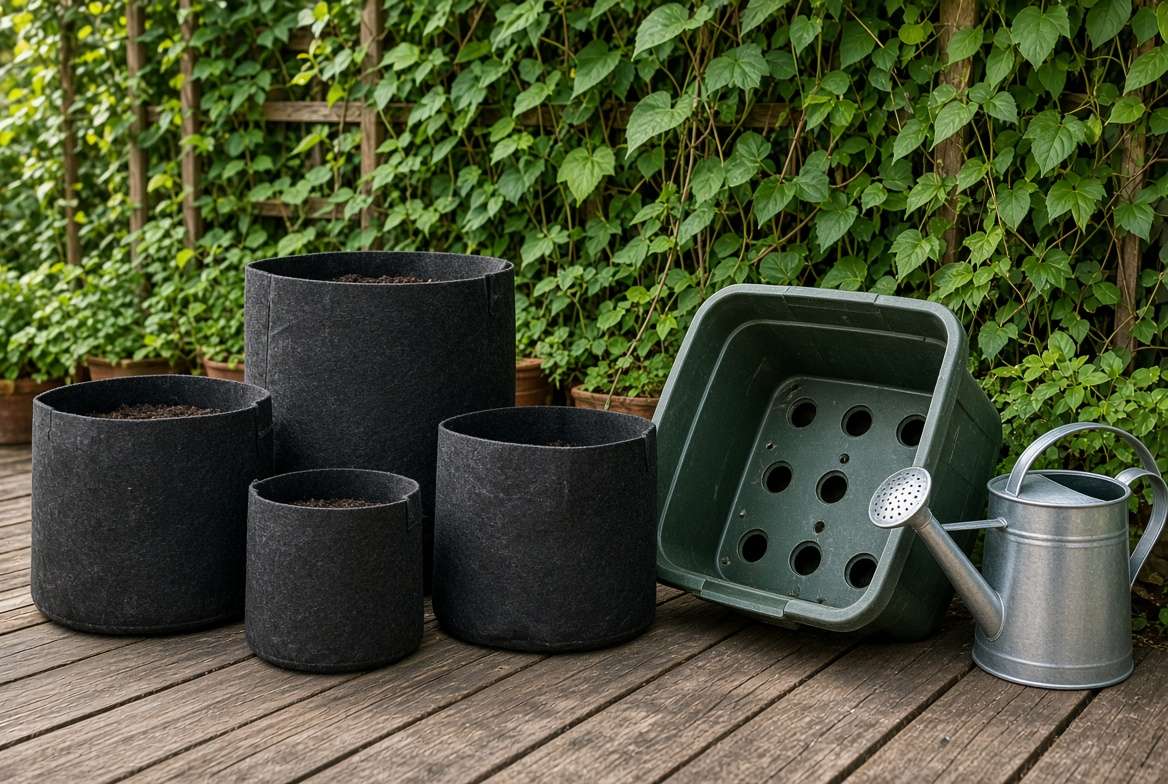
Material Pros & Cons: Fabric vs. Plastic vs. Terra Cotta 🧵🪵
Not all container materials perform the same. The chemical composition, porosity, and thermal transfer of your vessel play key roles in soil moisture management.
   ┌───────────────────┐    ┌───────────────────┐    ┌───────────────────┐
   │  FABRIC GROW BAG  │    │  HDPE PLASTIC TUB │    │ TERRA COTTA / CLAY│
   ├───────────────────┤    ├───────────────────┤    ├───────────────────┤
   │ • Air Pruning     │    │ • Holds Moisture  │    │ • Great Aesthetics│
   │ • High Aeration   │    │ • Durable & Light │    │ • Insulates Roots │
   │ • Needs Water +   │    │ • Requires Holes  │    │ • Heavy & Fragile │
   └───────────────────┘    └───────────────────┘    └───────────────────┘
1. Smart Fabric Grow Bags (Top Recommendation) 🧵
-
Pros: Breathable non-woven felt allows “air pruning.” When a root tip reaches the edge of the bag, it senses the air and stops growing straight, branching into thousands of fibrous feeder roots instead of circling around inside the pot.
-
Cons: Soil dries out faster, requiring more frequent watering during summer peaks.
2. Food-Grade Heavy-Duty Plastic Tubs 🪣
-
Pros: Outstanding moisture retention, highly durable, and cost-effective. Excellent for moisture-loving tubers like potatoes.
-
Cons: Material traps heat under direct sunlight; requires custom drainage hole drilling.
-
Safety Note: Always ensure plastic containers are food-safe. Look for Recycling Codes #2 (HDPE), #4 (LDPE), or #5 (PP). Avoid Code #3 (PVC) and Code #7 (Other/BPA-containing) which can leach chemicals into edible roots.
3. Terra Cotta and Unglazed Ceramic 🏺
-
Pros: Beautiful aesthetic appeal and thick walls that insulate root systems from ambient temperature swings.
-
Cons: Heavy, easily cracked by frost, and porous enough to wick water away from dry soil quickly.
The Golden Rule of Containers: Drainage 💧
Expert Warning: Standing water is the ultimate enemy of root crops. Soil saturation starves underground taproots of oxygen, triggering soft rot bacterial disease within 48 hours! 🦠💧
❌ MYTH: Adding Gravel to the Bottom Aids Drainage
[ Soil Mix ] ───> Creates a sharp boundary layer
[ Gravel Layer ] ───> Water stops and accumulates ABOVE the gravel
Result: "Perched Water Table" rots the lowest roots!

✅ FACT: Uniform Soil + Open Bottom Holes
[ Uniform Loose Soil Mix Throughout ]
[ Direct Drainage Holes At Lowest Point ]
Result: Free movement of water and oxygen!
Ensure your deep containers have at least 4 to 6 large drainage holes ( inch diameter) located at the bottom base. Avoid laying gravel, rocks, or broken pottery shards at the bottom of your containers. Hydro-geologic principles prove that adding coarse materials to the bottom creates a perched water table, holding soggy water higher up in the root zone rather than releasing it! Keep your potting mix uniform from the top down to the bottom.
The Expert Soil Recipe for Flawless Roots 🧑🌾🤎
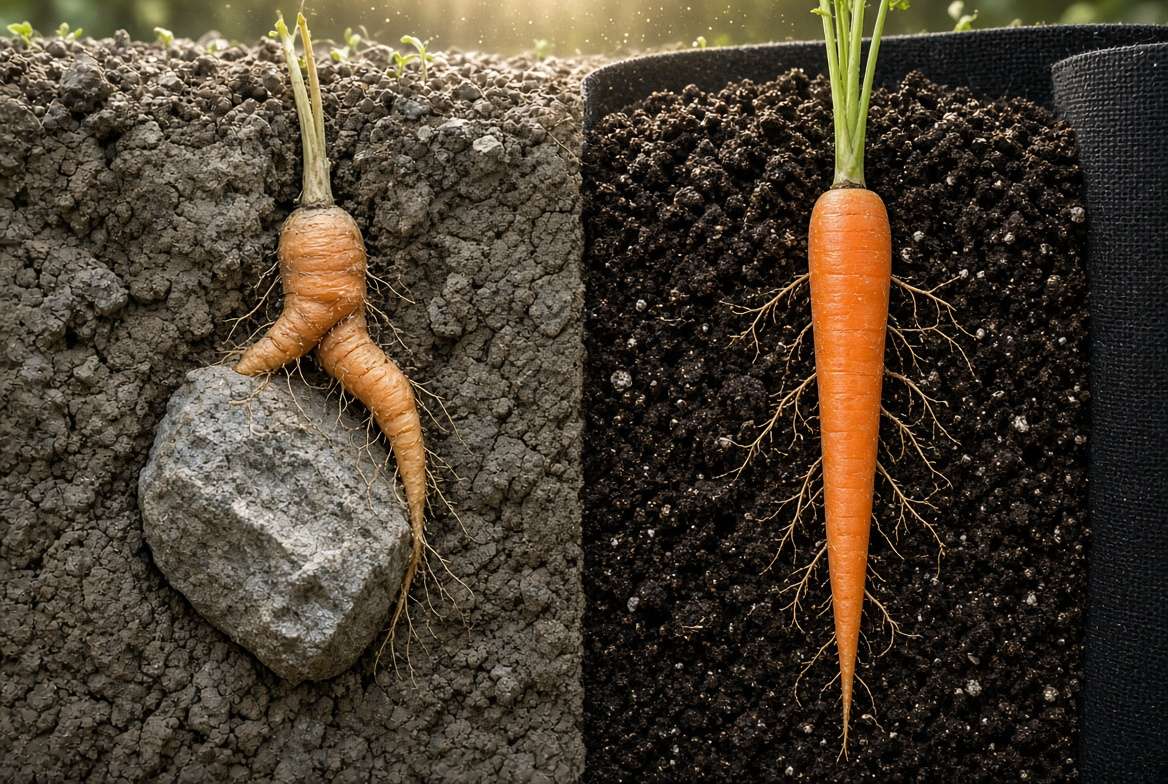
If you scoop native soil from your backyard and fill a 15-inch container with it, you will end up with a solid block of concrete within two weeks. Native topsoil relies on earthworms, organic decay cycles, and deep subsoil layers to drain water. Inside a closed container system, clay and silt particles collapse and pack tightly together under irrigation pressure.
       SOIL STRUCTURE COMPARISON FOR CONTAINERS

   Native Backyard Clay           Custom Fluffy Mix
  ┌───────────────────────┐     ┌───────────────────────┐
  │ █ █ █ █ █ █ █ █ █ █ █ │     │ ░ ▒ ░ ▒ ░ ▒ ░ ▒ ░ ▒ ░ │
  │ █ █ █ █ █ █ █ █ █ █ █ │     │ ▒ ░ ▒ ░ ▒ ░ ▒ ░ ▒ ░ ▒ │
  │ (Compacted, Dense)    │     │ (Aerated, Porous)     │
  └───────────────────────┘     └───────────────────────┘
   Taproots Bend & Fork           Taproots Grow Straight
DIY Potting Mix Recipe for Root Veggies 🥣
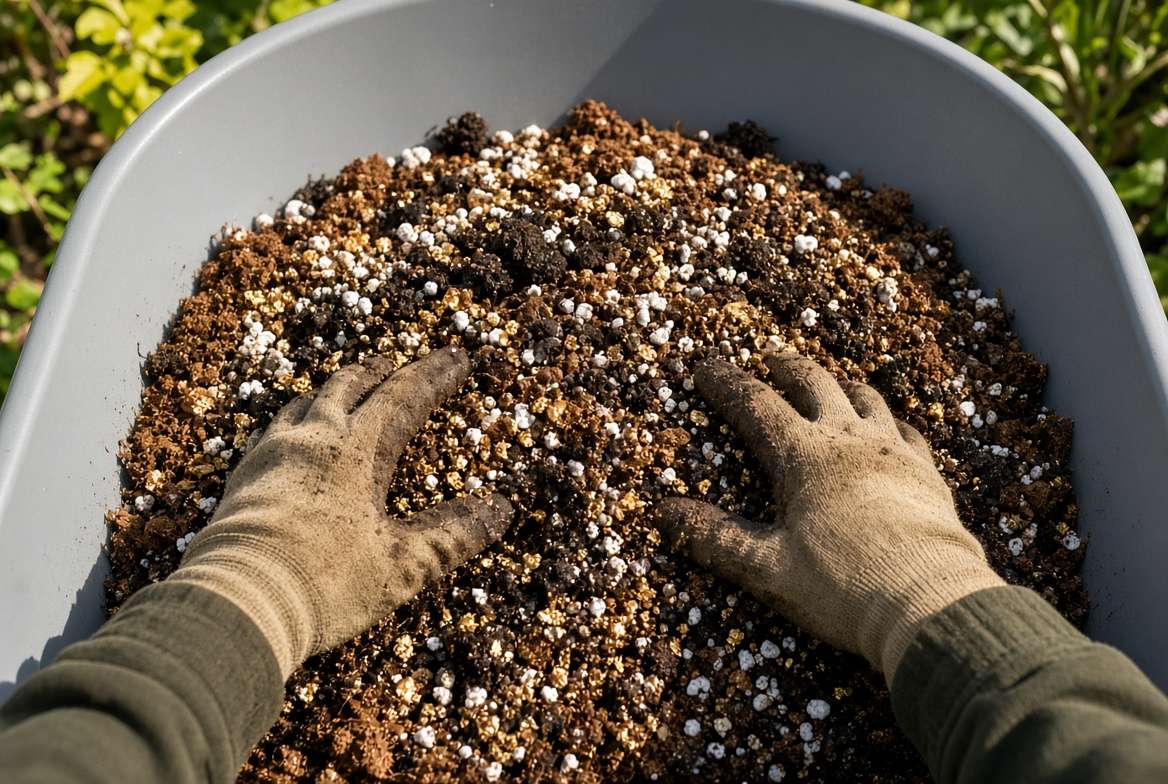
To grow long, crisp, perfectly shaped taproots, you need a substrate that balances moisture retention, high structural aeration, and gentle, slow-release nutrition.
Here is my field-tested custom blend for growing root vegetables in deep containers:
  ┌───────────────────────────────────────────────────────────┐
  │               THE ULTIMATE CONTAINER ROOT MIX              │
  ├───────────────────────────────┬───────────────────────────┤
  │ 40% Coco Coir or Peat Moss    │ Base & Moisture Retention │
  │ 30% Perlite or Fine Pumice    │ Aeration & Drainage       │
  │ 20% Screened Aged Compost     │ Slow-Release Nutrition    │
  │ 10% Vermiculite               │ Nutrient Exchange (CEC)   │
  └───────────────────────────────┴───────────────────────────┘
Ingredients & Measure:
-
40% Coco Coir (or Sphagnum Peat Moss): Provides lightweight structure and consistent moisture absorption. Coco coir is preferred as it is pH-neutral () and re-wets easily.
-
30% Coarse Perlite or Fine Pumice: Essential for building non-compressible pore space so young root tips encounter zero resistance as they extend downward.
-
20% Screened Organic Compost or Worm Castings: Supplies balanced microbial life and steady, gentle nitrogen without burning delicate root tips.
-
10% Vermiculite: Holds moisture and cationic nutrients (, , ) right in the active feeder zone.
Pro Tip 💡: Sift your compost! Always pass your compost or worm castings through a -inch hardware cloth screen before mixing. Small un-decayed wood chips, twigs, or bark chunks present in commercial potting soils will cause carrot taproots to split into two, resulting in “forked” carrots! ✂️🥕
Top 5 Root Vegetables to Grow in Deep Containers (And How to Succeed) 🥔🥕
Let’s dive into detailed care routines for five popular root crops, tailored specifically for deep container growing!
┌─────────────────────────────────────────────────────────────┐
│                 TOP CROP CONTAINER SUMMARY                  │
│                                                             │
│  🥕 Carrots   : Depth 14-18" | Spacing 2" | Surface Sown   │
│  🥔 Potatoes  : Depth 18-24" | Spacing 12"| Hill Up Soil   │
│  🔴 Radishes  : Depth 6-8"   | Spacing 1-2"| Quick 25 Days  │
│  🥬 Beets     : Depth 10-12" | Spacing 3" | Dual Harvest   │
│  🧅 Turnips   : Depth 12-14" | Spacing 4" | Cool Season    │
└─────────────────────────────────────────────────────────────┘
1. Carrots (The Deep Soil Lovers) 🥕
Carrots are the classic test of container gardening skills. Because taproots are sensitive to physical barriers, deep container culture is actually superior to ground soil for growing pristine carrots!
                  CARROT SOWING & SPACING

   Surface Seeds Under Vermiculite / Board Trick
   ───────────────────────────────────────────── (Top Layer)
     ┆   2"   ┆   2"   ┆   2"   ┆   2"   ┆
     ▼        ▼        ▼        ▼        ▼
   [🥕]     [🥕]     [🥕]     [🥕]     [🥕]   (14-18" Deep)
-
Best Container Varieties: Danvers 126, Royal Chantenay, Nantes Half Long, and Little Finger.
-
Container Depth Needed: Minimum 14 to 18 inches.
-
Sowing Technique: Direct sow seeds onto the surface of damp potting mix. Do not bury them deep! Dust a thin -inch layer of vermiculite over the seeds.
-
The Moisture Board Trick: Carrot seeds take 10–14 days to germinate and must never dry out during this period. Place a wet wooden board or sheet of cardboard over the container top for the first 7 days to trap humidity. Remove it immediately when green shoots appear! 🪵
-
Spacing & Thinning: Thin seedlings aggressively to 2 inches apart once they reach 2 inches tall. Overcrowded carrots will wrap around each other like ropes!
2. Potatoes (The High-Yield Kings) 🥔
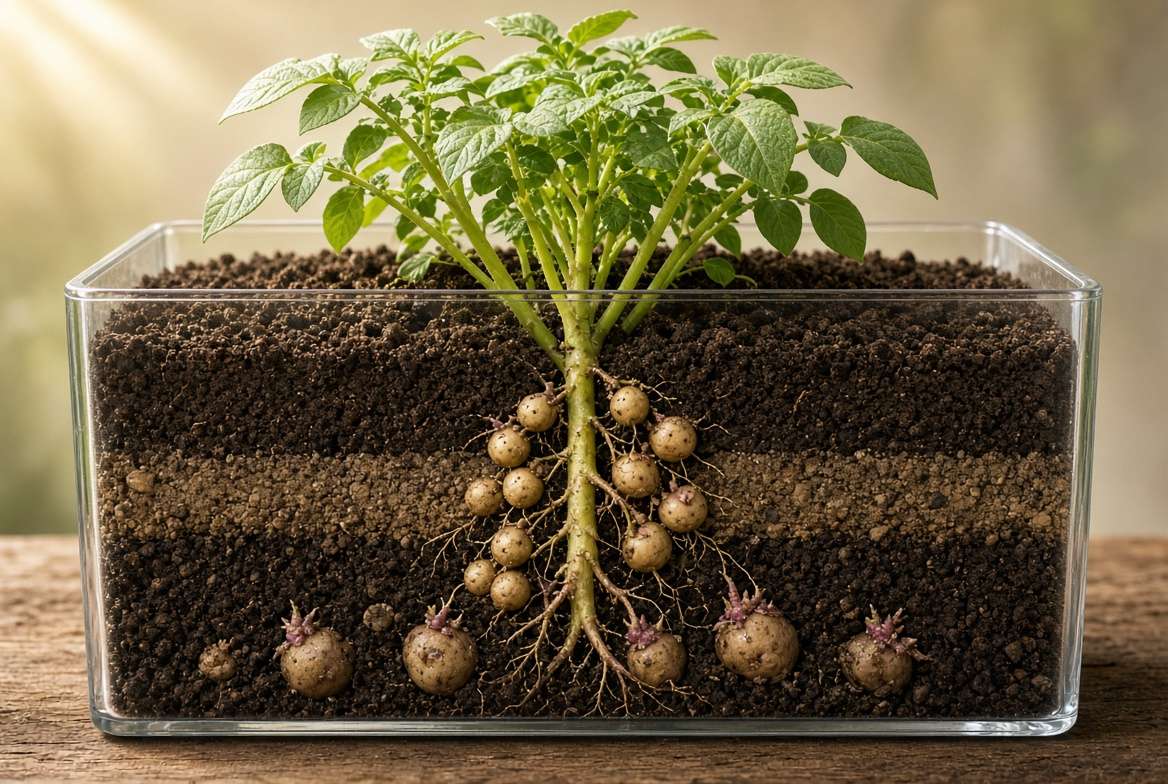
Potatoes do not grow from taproots; they grow from underground stems called stolons that emerge above the seed piece. This makes deep containers perfect for using the vertical “hilling” technique.
                  THE POTATO HILLING PROCESS

   Phase 1: Planting          Phase 2: First Hill        Phase 3: Mature Tubers
   ┌─────────────────┐        ┌─────────────────┐        ┌─────────────────┐
   │                 │        │                 │        │ 🌿 🌿 🌿 🌿 🌿  │
   │                 │        │   🌱   🌱   🌱  │        │ 🥔 🥔 🥔 🥔 🥔  │
   │  🌱   🌱   🌱   │ ────>  │  ▒▒▒▒▒▒▒▒▒▒▒▒▒  │ ────>  │ ▒▒▒▒▒▒▒▒▒▒▒▒▒▒▒ │
   │ ▒▒▒▒▒▒▒▒▒▒▒▒▒▒▒ │        │ ▒▒▒▒▒▒▒▒▒▒▒▒▒▒▒ │        │ ▒▒▒▒▒▒▒▒▒▒▒▒▒▒▒ │
   └─────────────────┘        └─────────────────┘        └─────────────────┘
    6" Soil Base               Add 4" Soil Mix            Fill to Container Rim
-
Best Container Varieties: Yukon Gold, Dark Red Norland, Fingerling Austrian Crescent.
-
Container Depth Needed: Minimum 18 to 24 inches (15 to 20-gallon grow bags work best).
-
Step-by-Step “Hilling” Method:
-
Fill the bottom of your deep container with just 6 inches of your custom soil blend.
-
Place seed potato tubers (chitted with small green sprouts facing up) onto the soil layer, spaced 10–12 inches apart.
-
Cover tubers with 4 inches of soil mix and water thoroughly.
-
As green stems emerge and grow 6–8 inches tall, add another 4 inches of soil mix, leaving only the top leaves exposed.
-
Repeat this process until the soil level reaches 2 inches below the top rim of the container. Each covered stem node will produce additional edible tubers! 🥔✨
-
3. Radishes (The Quick Rewards) 🔴
Radishes are ideal companion crops for container gardeners who want quick results while waiting for slower crops like carrots or potatoes.
-
Best Container Varieties: French Breakfast, Cherry Belle, Watermelon Radish, and Daikon (requires deep pots).
-
Container Depth Needed: 6 to 8 inches for standard red radishes; 14–18 inches for long Daikon radishes.
-
Growth Cycle: Ready to harvest in as little as 22 to 30 days!
-
Succession Sowing: Sow a new small batch of radish seeds every 10–14 days inside container corners to maintain a continuous harvest throughout spring and fall. 🗓️
4. Beets (The Dual-Harvest Crop) 🥬
Beets yield a double return on investment: sweet tender underground roots and highly nutritious foliage leaves above ground!
                  BEET SEED CLUSTER & THINNING

     1 Multigerm Seed Pod ───> Sprouts 3 to 5 Seedlings!
                                   │
                                   ▼
                   Must Thin To 1 Strongest Stem!
                              ✂️ 🌱 🌱 🌱
-
Best Container Varieties: Early Wonder, Detroit Dark Red, Bull’s Blood, and Golden Beet.
-
Container Depth Needed: Minimum 10 to 12 inches.
-
Understanding Beet Seeds: Most beet seeds are actually small “fruit clusters” containing 3 to 5 distinct seeds. Once germinated, you must snip off all but the strongest shoot using fine embroidery scissors.
-
Spacing: Leave 3 inches of space between individual plants to give roots ample room to swell into uniform spheres. 🎈
5. Turnips & Rutabagas (The Hardy Choices) 🧅
These cool-weather root crops thrive in deep container setups, producing high yields during late autumn, winter, and early spring.
-
Best Container Varieties: Tokyo Bekana, Purple Top White Globe (Turnip), American Purple Top (Rutabaga).
-
Container Depth Needed: Minimum 12 to 15 inches.
-
Temperature Management: These crops thrive in cool weather ( or ). Cold spells make the roots convert stored starches into sugars, giving them a sweeter flavor! ❄️🍯
Essential Care Guide: Watering, Feeding, and Lighting ☀️💦
Successful container gardening requires careful management of light, water, and nutrient inputs. Containers create isolated root environments, making them dependent on the grower for ongoing care.
                        CONTAINER CARE TRIAD

                             ☀️ SUNLIGHT
                            (6-8 Hours/Day)
                                 / \
                                /   \
                               /     \
                              /       \
              💦 WATERING 🚢 ───────── 🧪 FERTILIZER
          (Keep Consistently         (Low N, High P-K)
                Moist)
Moisture Management: The “Goldilocks” Zone 🐻
Inconsistent moisture causes more root vegetable failures than pests and diseases combined.
-
Under-watering: Causes soil to dry out, making carrots and radishes woody, fibrous, and bitterly spicy. Dry soil layers can also snap tender expanding taproots.
-
Over-watering: Suffocates root zones and encourages fungal rot pathogens like Pythium and Rhizoctonia.
-
Fluctuating Water: If plants stay dry for a week and then receive heavy watering, the sudden rush of water pressure expands internal tissues faster than the skin can grow, causing carrots and beets to split down the center! ⚡💔
               HOW TO TEST SOIL MOISTURE

  1. Insert index finger 2 inches into container soil.

     [ Dry & Dusty Topsoil ] ───> 🚿 Water Immediately!

     [ Cool & Slightly Damp ] ───> ✅ Perfect Moisture Level!

     [ Muddy & Saturated ] ───> 🛑 Hold Off On Watering!
-
The Finger Moisture Test: Insert your index finger 2 inches into the soil. If it feels dry and warm, water gently until liquid drains out of the bottom holes. If it feels cool and damp, leave it alone!
Fertilizing for Roots, Not Leaves 🧪
Understanding macronutrients () is vital when growing subterranean crops in containers.
                   THE N-P-K BALANCING ACT

   HIGH NITROGEN (10-2-2)              HIGH PHOSPHORUS/POTASSIUM (3-10-10)
  ┌───────────────────────┐           ┌───────────────────────┐
  │   🌿 🌿 🌿 🌿 🌿      │           │       🌿 🌿 🌿        │
  │   🌿 🌿 🌿 🌿 🌿      │           │                       │
  │       (Tiny Root)     │           │    🥕 🥔 🥬 🔴        │
  │            🥕         │           │    (Big Bulky Roots)  │
  └───────────────────────┘           └───────────────────────┘
   ❌ Giant Leaves / No Crop           ✅ Perfect Root Yields!
-
Nitrogen (): Drives top leaf and foliage growth. Excess nitrogen creates bushier leafy top greens while leaving underground taproots small and thin. 🍃
-
Phosphorus (): Stimulates early root elongation, cell division, and taproot expansion. 🦴
-
Potassium (): Manages sugar transport, starch storage (essential for large potatoes), and cell wall thickness. 🍇
Fertilizer Protocol: Avoid high-nitrogen liquid lawn or houseplant fertilizers! Use organic dry amendments low in nitrogen and high in phosphorus/potassium (e.g., an ratio of 2-8-8 or 3-10-10). Mix bone meal, kelp meal, and sulfate of potash into the container substrate at planting time.
Sunlight Requirements ☀️
Root crops need light energy to synthesize sugars and store them underground:
-
Full Sun (Ideal): 6 to 8 hours of direct unfiltered sunlight per day yields the largest root mass.
-
Partial Shade (Minimum): 4 to 5 hours of bright direct sun can work for radishes, beets, and short carrot varieties, though harvest maturation will take 2–3 weeks longer.
Troubleshooting Common Problems (Expert Diagnostics) 🔍🐛
Even with the perfect soil and deep containers, urban gardening can occasionally throw a curveball. In my years of consulting for patio and balcony gardeners, I have found that diagnosing root crop issues is a bit tricky because the problem is hidden underground.
Here are the most common issues you might encounter when growing root vegetables in deep containers, and exactly how an expert fixes them.
“Why Are My Carrots Deformed and Forked?” 🥕🔄
Pulling up a carrot only to find it twisted into a knot, split into three tiny legs, or covered in “hairy” feeder roots is a classic container gardening frustration.
The Expert Diagnosis:
-
Physical Obstructions: The primary taproot hit a pebble, a hard clump of un-composted wood, or compacted clay. As soon as the delicate root tip sustains damage, it splits into multiple directions. (Solution: Always sift your compost and use the fluffy soil recipe provided earlier!)
-
Transplant Shock: Did you start your seeds in a plastic tray and transplant them into your deep container later? Never transplant root crops! Moving a young carrot or radish almost always snaps the microscopic taproot. Always direct-sow seeds into their final container.
-
Hot Manure: Adding fresh or un-aged manure to your container soil introduces aggressive microbial activity and high salt levels that burn the root tip, causing immediate forking. Always use fully aged, fine compost. 💩🚫
“Why Do I Have Huge Leaves but Tiny Roots?” 🌿🤏
You have a container overflowing with gorgeous, lush, two-foot-tall green foliage. But when you pull up a beet or radish, the root is the size of a golf pencil.
The Expert Diagnosis:
-
Overcrowding (The #1 Culprit): If seeds are sown too densely and not thinned out, the plants compete fiercely for water and nutrients. The roots become stressed and simply stop expanding. (Solution: Be ruthless with your thinning! Give radishes 2 inches and beets 3 inches of breathing room.) ✂️
-
Excess Nitrogen: As discussed in our fertilizer section, a diet too high in nitrogen tricks the plant into prioritizing leaf production over root storage.
-
Heat Stress: Cool-weather crops like radishes and turnips will completely stop root development if soil temperatures exceed 80°F (27°C). Instead, they will “bolt” (send up a flower stalk to produce seeds) and turn the tiny root bitter and woody. Move your containers to a shaded, cooler spot during heat waves. 🌡️
Keeping Pests Away Naturally 🛡️
While deep containers elevate your crops away from ground-dwelling voles and wireworms, flying insects can still find your urban garden.
-
Fungus Gnats: These tiny black flies love the rich, moist environment of container potting soil. Their larvae feed on tender root hairs. Solution: Allow the top 2 inches of soil to dry completely between waterings, and apply yellow sticky traps just above the soil line to catch the adults. 🪰
-
Aphids: These sap-suckers cluster on the undersides of carrot and radish leaves, stunting plant growth. Solution: Spray the foliage with cold water or a gentle, organic neem oil solution in the early evening to smother the pests without harming beneficial pollinators. 🐞
-
Root Maggots: Adult flies lay eggs at the base of the plant, and the hatched maggots burrow into the roots, ruining your harvest. Solution: Cover your deep containers with a lightweight floating row cover or insect netting immediately after sowing the seeds. 🕸️
The Best Part: Harvesting Your Container Bounty 🧺🎉
After weeks of careful watering, watching the green tops flourish, the moment of truth finally arrives! Harvesting from deep containers is incredibly satisfying—and much cleaner than traditional backyard digging.
                  SIGNS YOUR CROP IS READY TO HARVEST

   🥕 Carrots ──> "Shoulders" (top of root) push out of the soil and show deep color.
   🥔 Potatoes ──> The green foliage turns yellow, wilts, and completely dies back.
   🔴 Radishes ──> The top of the bulb is visibly swollen and 1 inch wide.
   🥬 Beets ──> Leaves look mature, and the root crown is round and protruding.
The “Dump and Sort” Harvesting Method 🔄🪣
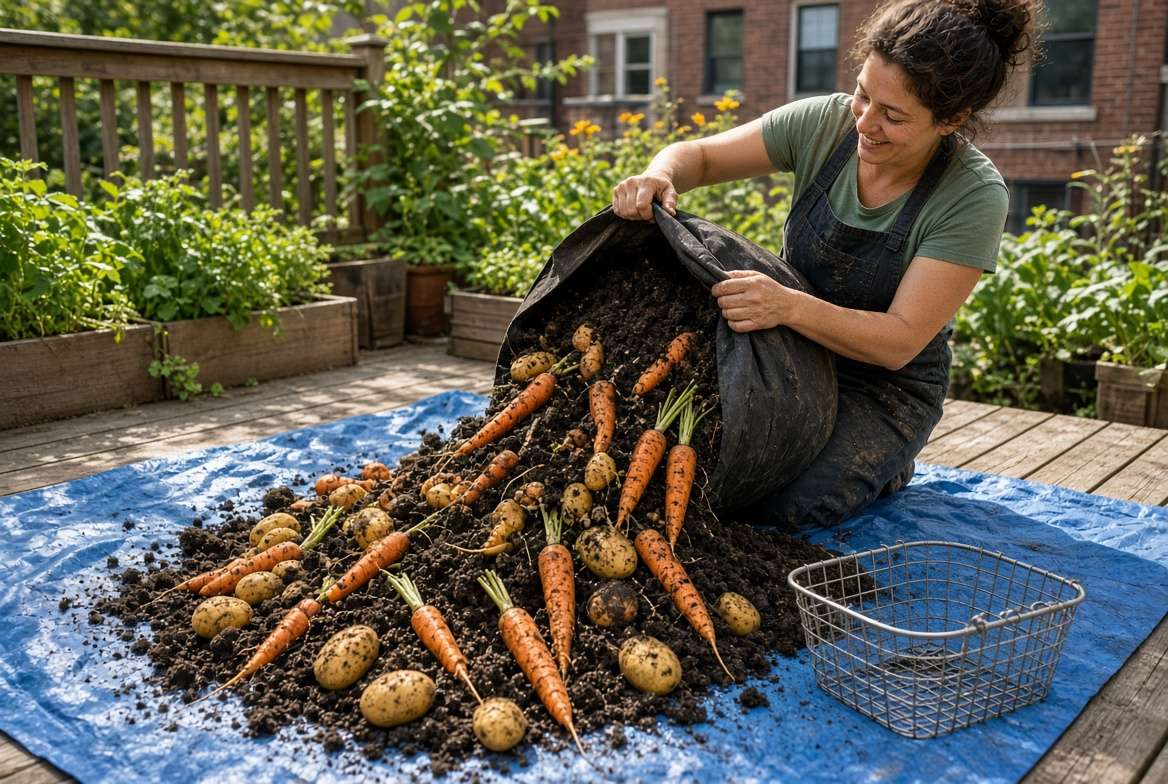
One of the greatest joys of growing root crops in deep containers, especially fabric grow bags, is the harvest process. Instead of getting on your hands and knees with a digging fork—and risking slicing your beautiful potatoes or carrots in half—you can use the Dump Method.
-
Stop watering the container 3 to 4 days before your planned harvest to allow the soil to dry slightly.
-
Spread a large plastic tarp across your patio or balcony.
-
Carefully tip the deep container over onto the tarp.
-
Gently massage the bottom of the container or grow bag until the soil block slides out.
-
Use your hands to effortlessly sift through the loose, fluffy potting mix and retrieve every single spotless vegetable! ✨
Expert Tip: Once you have harvested your crop, you can sweep the potting soil right back into the container for the next season!
Frequently Asked Questions (FAQs) ❓
Can I reuse the soil in my deep containers next year? Yes! However, root crops are heavy feeders that deplete the soil of phosphorus and potassium. You must amend the used soil with fresh compost, worm castings, and an organic organic fertilizer blend before replanting. Additionally, practice crop rotation: if you grew potatoes in a container this year, plant beans or leafy greens in it next year to break disease cycles. 🔄
Can I start root vegetables indoors in small pots and transplant them into deep containers later? No. With the rare exception of onions or carefully handled beet seedlings, you should never transplant root crops like carrots, parsnips, or radishes. The primary taproot begins forming the moment the seed sprouts. Any disturbance to that taproot will result in severely deformed, stunted vegetables. Always direct-sow. 🚫🌱
Do deep containers need more water than shallow ground beds? Yes, significantly more. Above-ground containers are exposed to wind and ambient air on all sides, causing rapid evaporation. Fabric grow bags, while excellent for root health, dry out the fastest. During the peak heat of summer, you may need to water your deep containers daily. Always use the “finger test” to check moisture levels 2 inches below the surface! 💧
Are 5-gallon buckets deep enough for root vegetables? A standard 5-gallon bucket is about 14 inches deep, which is an excellent depth for beets, turnips, radishes, and medium-length carrots (like Danvers or Nantes varieties). However, they are a bit too shallow for maximizing potato yields or growing exceptionally long roots like Daikon radishes or Parsnips. If using buckets, ensure you drill plenty of drainage holes! 🪣
Conclusion: Start Your Container Garden Today 🌻💚
The dream of pulling fresh, crunchy, home-grown food from your own space is entirely within reach, regardless of whether you live in a high-rise apartment or a home with a tiny concrete patio. By understanding the science of growing root vegetables in deep containers, you are equipped to bypass the common pitfalls that plague beginner urban gardeners.
Remember the three golden rules of the expert container gardener:
-
Choose a container with sufficient depth and aggressive bottom drainage.
-
Ditch the heavy native dirt and build a light, fluffy, porous potting mix.
-
Feed the root, not the leaves, by managing your nitrogen and phosphorus inputs.
With a little patience and the right setup, small spaces truly can produce big yields. Your future harvests of flawless carrots, earthy beets, and golden potatoes are just a few handfuls of seeds away!
Happy Planting! 🧑🌾✨











