

If you have ever stared at a small patio, balcony, or modest backyard and wished for a lush, highly productive garden, you are not alone. Space is the ultimate premium in modern gardening. But what if there was a scientifically backed method to double your harvest, drastically reduce pests, and improve soil vitality—all without buying a single extra container? Understanding the benefits of companion planting in pots is the secret weapon for urban and small-space gardeners.
For years, I treated my container plants as solitary residents, giving each tomato, pepper, and herb its own distinct pot. It wasn’t until I began focusing deeply on soil health and the natural symbiotic relationships between plant species that everything changed. By combining the right plants in a single container, my patio garden transformed from a collection of struggling, isolated pots into a thriving, interconnected ecosystem.
In this comprehensive guide, we will dive deep into the science behind plant pairings, uncover the actionable rules for mixing species in containers, and reveal proven combinations you can plant today. Whether you are a seasoned horticulturist or a weekend balcony gardener, these strategies will completely change the way you grow. ✨
[📌 Image Opportunity: Insert a vertical, highly visual Pinterest pin here summarizing the “Top 3 Container Companions” to help readers save and share this guide!]
What is Companion Planting, and Why Do It in Pots? 🤔
At its core, companion planting is the strategic placement of different plant species in close proximity so they can mutually benefit each other. In traditional row gardening or raised beds, this age-old practice has been used by indigenous cultures and master gardeners for centuries to maximize yields and minimize the need for chemical fertilizers or pesticides.
However, doing this in a container environment introduces a unique set of challenges and massive opportunities. A pot is a closed ecosystem. Unlike a massive garden bed where roots can endlessly stretch out to find water or escape a dominant neighbor, plants in a pot are forced to share a very confined volume of potting soil, moisture, and nutrients.
Because of this confinement, strategic pairings in containers are actually more critical than in the ground. When done incorrectly, plants will compete and starve. But when done correctly, you create a self-sustaining micro-environment where plants protect one another from sunscald, share root space efficiently, and even enhance each other’s flavor.
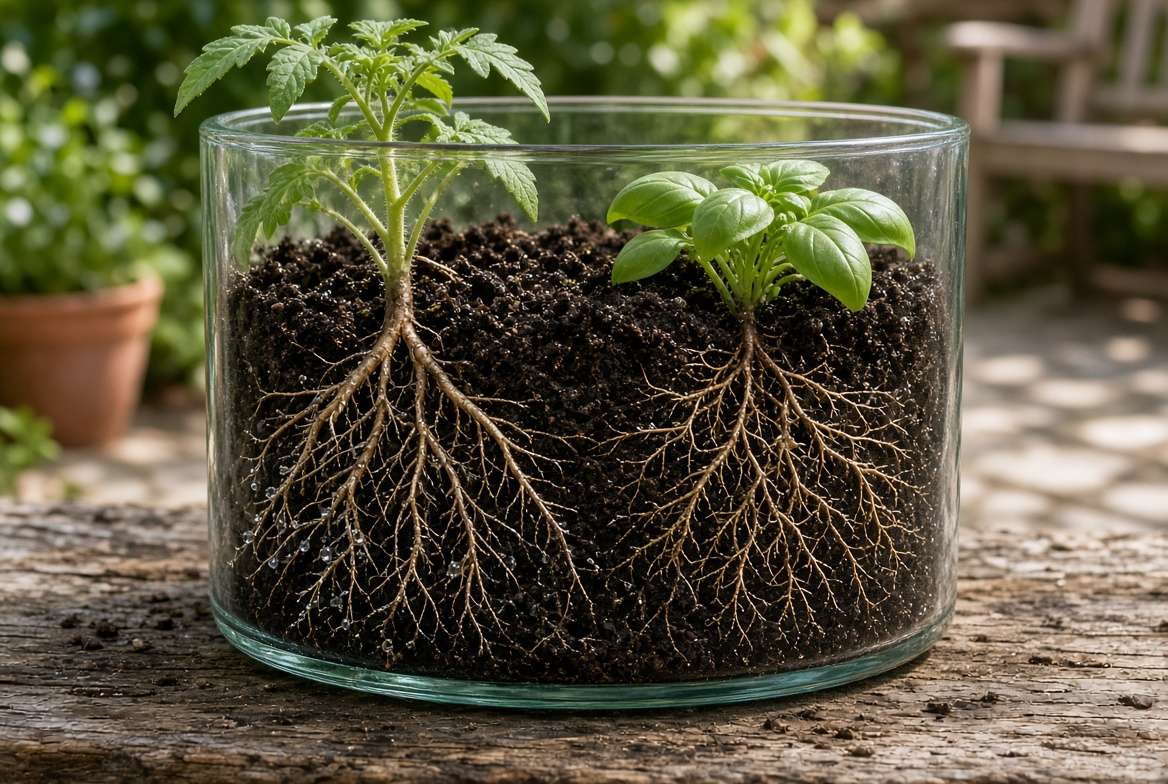
The 5 Core Benefits of Companion Planting in Pots 🌟
If you are going to invest your time, high-quality potting soil, and energy into container gardening, you want the highest possible return on investment. Here is the science behind why mixing your plants is the ultimate gardening hack.
1. Maximizing Limited Space and Yield 📈
The most immediate and tangible benefit of companion planting in pots is spatial efficiency. When you are limited to a balcony or a sunny corner of a patio, every square inch of potting soil matters.
The secret lies in vertical layering and growth timing.
-
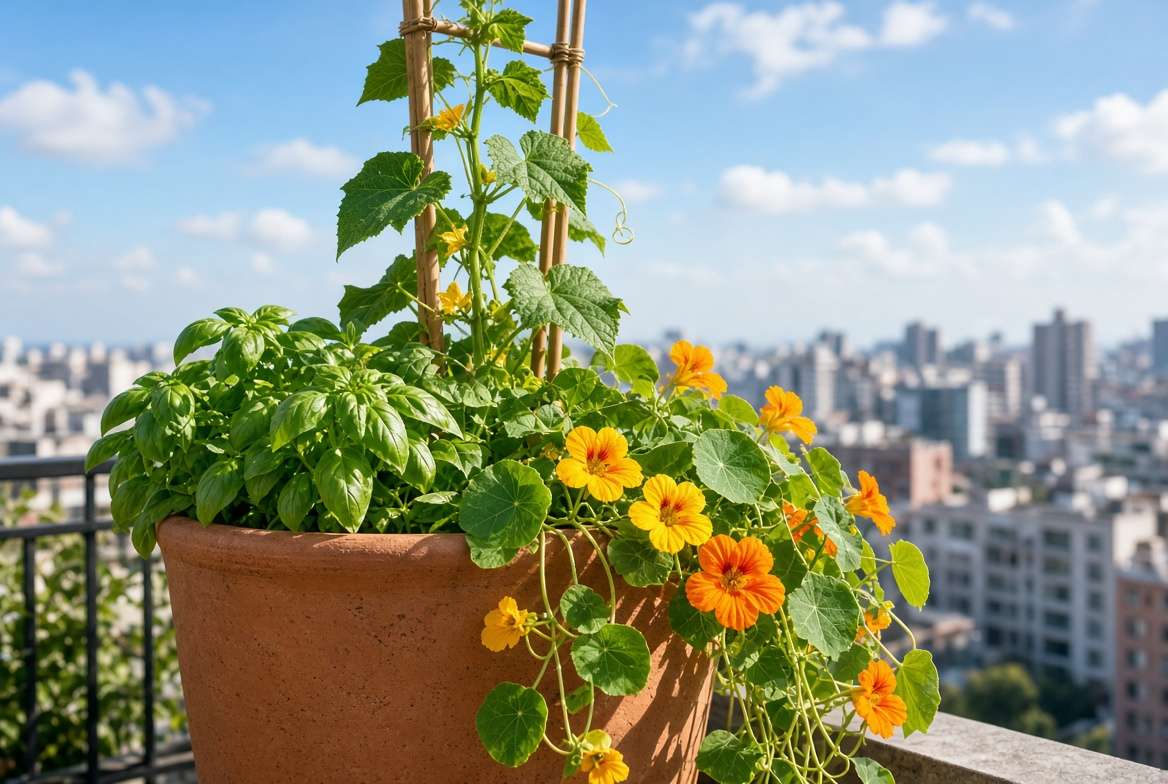
Vertical Layering: Instead of planting one bushy plant that leaves the topsoil bare, you can stack your pot. Plant a tall, structural crop (like a climbing trellis cucumber or an indeterminate tomato) in the center. Surround the base with a bushy, medium-height companion (like basil or bush beans). Finally, drape a trailing plant (like creeping thyme or nasturtiums) over the edges of the pot. You have just grown three distinct crops in the footprint of one.
-
Growth Timing (Succession Planting): By mixing fast-growing crops with slow-growing crops, you maximize the timeline of your container. For example, radishes mature in just 30 days. If you plant them around the base of a slow-growing pepper plant, you can harvest an entire crop of radishes before the pepper plant’s canopy even gets large enough to shade them out.
2. Natural Pest Control and Deterrence 🐛
Pest management is notoriously difficult in container gardens because isolated pots lack the natural predators found in a wild, diverse ecosystem. A single aphid infestation can decimate a potted plant in days. Fortunately, nature has provided its own pest repellents.
Companion planting utilizes two main strategies for organic pest control:
-
Olfactory Masking: Many insects find their host plants through scent. Pungent herbs like chives, garlic, mint, and rosemary release strong volatile oils into the air. When planted at the base of a vulnerable vegetable, these potent aromas literally mask the scent of the host crop, confusing pests like aphids, spider mites, and whiteflies so they fly right past your container.
-
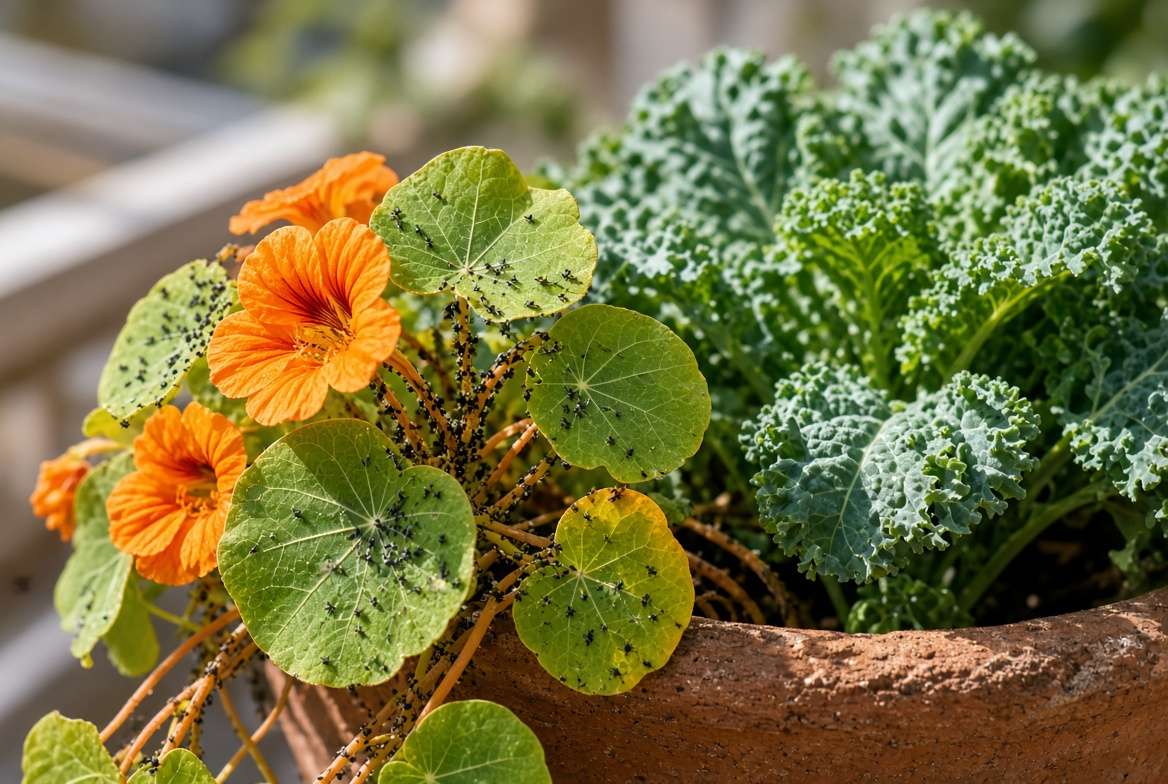
Trap Cropping: This is the sacrificial method of pest control. Nasturtiums are a classic example; they are highly attractive to aphids. By planting a trailing nasturtium in the same pot as your prized kale or tomatoes, the aphids will flock to the flowers, leaving your food crop completely untouched.
3. Improved Soil Health and Nutrient Sharing 🌍
As someone who focuses heavily on soil health management, I cannot overstate how quickly a single, heavy-feeding plant (like a tomato or eggplant) will deplete the nutrients in a closed container.
Companion planting allows you to create a dynamic, living soil web within your pot.
-
Nitrogen Fixers: Plants in the legume family, such as bush beans or dwarf peas, share a symbiotic relationship with Rhizobia bacteria in the soil. They actually pull nitrogen from the atmosphere and fix it into the soil in nodules on their roots. When you pair a nitrogen-fixer with a heavy feeder, the legume naturally replenishes the surrounding potting mix, acting as a slow-release, organic fertilizer.
-
Root Diversity: Different plants have different root structures. A deep-taproot plant (like a carrot) reaches far down into the pot, pulling up deep moisture and breaking up compacted soil. A shallow-rooted plant (like lettuce) spreads across the topsoil. Together, they prevent soil compaction, improve water drainage, and ensure that every layer of the potting mix is utilized efficiently without direct competition.
4. Creating Beneficial Microclimates 🌤️
Containers left on hot concrete patios often suffer from extreme temperature fluctuations. The sun bakes the soil, evaporating moisture incredibly quickly.
By strategically pairing plants, you can engineer a beneficial microclimate directly inside your pot. A tall, sun-loving plant acts as a living parasol for more delicate, cool-season crops. For instance, cilantro and spinach are notorious for “bolting” (going to seed and turning bitter) when the summer sun hits them. By planting them on the shaded side of a tall, heat-loving tomato or pepper plant, the taller plant takes the brunt of the harsh afternoon UV rays. This natural shade lowers the soil temperature, retains critical moisture, and extends the harvest window of your delicate greens by weeks.
5. Enhanced Flavor and Growth Vigor 🍅
While it might sound like gardening folklore, there is strong, scientifically supported anecdotal evidence that certain companions actually improve the chemical profile and flavor of their neighbors.
The most famous pairing is tomatoes and basil. Beyond just tasting incredible together on a plate, growing them in the exact same soil produces fascinating results. Basil naturally exudes compounds into the soil that are believed to slightly alter the nutrient uptake of the tomato plant, resulting in tomatoes with enhanced vigor and a noticeably sweeter flavor profile. Similarly, chamomile is known as the “plant doctor” because its presence in a container can increase the essential oil production of neighboring herbs, making your mint or thyme taste even stronger.
The Golden Rules for Successful Container Pairings 📏
While the benefits of companion planting in pots are vast, success isn’t as simple as throwing random seeds into a single bucket. Because a pot is a closed environment, mistakes in plant pairing are magnified quickly. To guarantee a thriving, lush mini-ecosystem, always follow these four non-negotiable golden rules.
       ┌────────────────────────────────────────────────────────┐
       │   GOLDEN RULES FOR MIXED CONTAINER SUCCESS             │
       ├────────────────────────────────────────────────────────┤
       │ 1. Align Sun Requirements   ☀️ ↔️ ☀️                     │
       │ 2. Match Moisture Habits    💧 ↔️ 💧                     │
       │ 3. Balance Root Systems     🌱 (Shallow) + 🥕 (Deep)   │
       │ 4. Choose Adequate Pot Size 🪴 (Min. 10–15 Gallons)    │
       └────────────────────────────────────────────────────────┘
1. Match Lighting Requirements ☀️
Never pair a sun-worshipper with a shade-lover unless the taller plant is explicitly intended to provide necessary protection.
-
Full-Sun Plants (6+ hours daily): Tomatoes, peppers, basil, marigolds, cucumbers, thyme.
-
Partial-Shade / Cool-Season Plants (3–5 hours daily): Lettuce, spinach, cilantro, mint, pansies.
If you place a shade-loving hosta in a pot with a sun-baking rosemary bush, one of them will inevitably suffer. Keep full-sun companions together and shade-loving species grouped in a separate shaded container.
2. Align Watering Needs 💧
This is the single most common mistake container gardeners make. In a single pot, all roots share the exact same soil moisture level. You cannot keep half the pot bone-dry while saturating the other half.
-
The Drought Squad: Rosemary, thyme, oregano, lavender, and sage prefer well-draining, slightly dry soil.
-
The Thirsty Brigade: Cucumbers, tomatoes, leafy greens, and mint require consistently moist, humus-rich soil.
Pairing a drought-tolerant herb like Mediterranean rosemary with a water-guzzling cucumber will lead to either root rot in the rosemary or severe drought stress in the cucumber.
3. Respect Root Space and Depth 🌿
Root competition can silently kill your potted garden. Roots compete for two main things: spatial volume and oxygen.
-
Shallow-Rooted Plants (Top 4–6 inches): Lettuce, radishes, spinach, strawberries, alyssum.
-
Medium-Rooted Plants (6–12 inches): Bush beans, peppers, onions, basil, chives.
-
Deep-Rooted Plants (12–18+ inches): Tomatoes, cucumbers, winter squash, carrots.
To create a harmony in your pot, pair plants with contrasting root architectures. A deep taproot plant will draw nutrients from the bottom of the container, while shallow-rooted greens explore only the upper soil layer, preventing root tangling and oxygen starvation.
4. Upgrade Your Pot Size 🪴
Do not attempt companion planting in a standard 6-inch nursery pot! Companion planting requires a container large enough to support the mature root structures of multiple living plants.
-
Small Companion Pots (3–5 Gallons): Ideal for lettuce, radishes, and small trailing herbs.
-
Medium Companion Pots (7–10 Gallons): Perfect for pepper plants surrounded by basil and chives.
-
Large Companion Pots (15+ Gallons / Half Wine Barrels): Necessary for heavy feeders like tomatoes paired with marigolds, bush beans, and herbs.
Winning Plant Combinations for Your Pots 🏆
To help you get started right away, here are three battle-tested, plug-and-play recipes designed for maximum yield, pest defense, and beauty.
+-----------------------------------------------------------------------------------+
|                           PROVEN CONTAINER PAIRINGS                               |
+--------------------------+----------------------------------+---------------------+
| Combo Name               | Key Plants Included              | Primary Benefit     |
+--------------------------+----------------------------------+---------------------+
| 1. The Caprese Pot       | Bush Tomato + Basil + Marigold   | Pest Defense & Flavor|
| 2. Pollinator Paradise   | Lavender + Thyme + Sweet Alyssum | Draws Beneficials   |
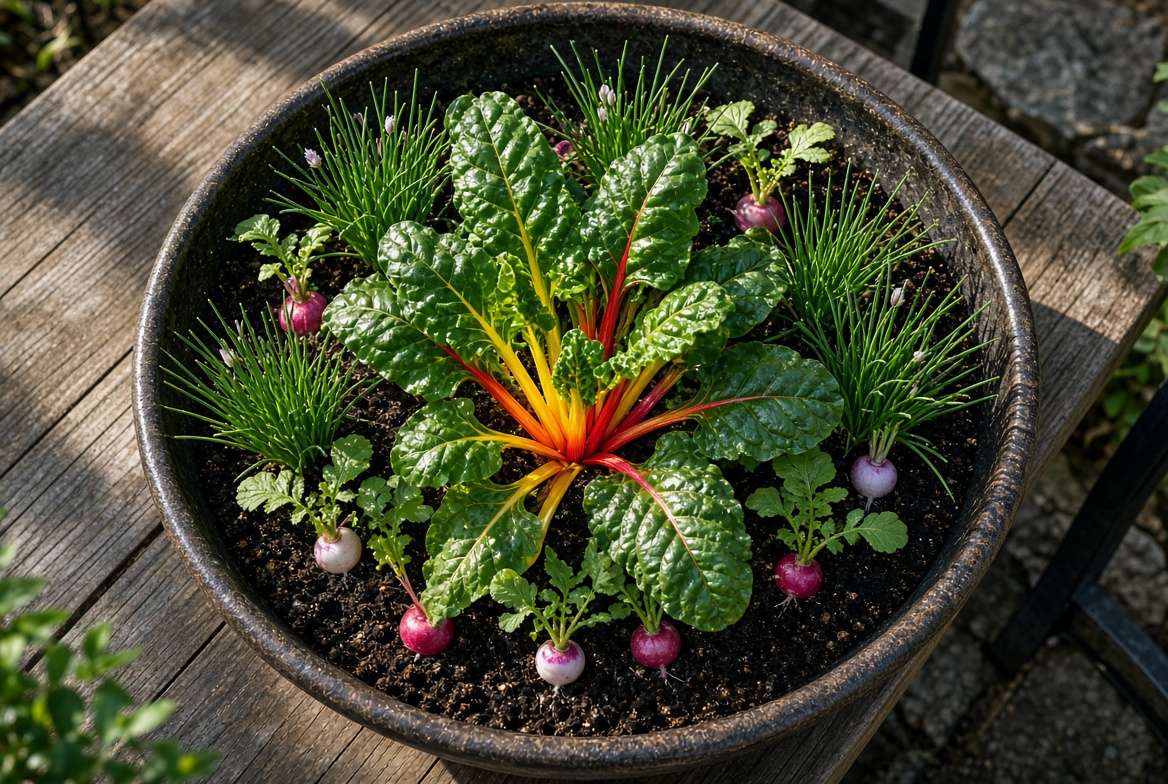
| 3. The Salad Bowl        | Swiss Chard + Radish + Chives    | High-Yield Harvest  |
+--------------------------+----------------------------------+---------------------+
The Classic Caprese Pot (Food Focus) 🍝
-
Ideal Container Size: 15–20 Gallons (or a large half-barrel).
-
Plant Trio: 1 Bush Tomato (‘Patio Choice’ or ‘Celebrity’) + 2 Sweet Basil plants + 2 French Marigolds (Tagetes patula).
-
Why It Works: This is the undisputed king of edible companion planting. Bush tomatoes grow tall and central. The French marigolds produce alpha-terthienyl, a compound exuded by their roots that suppresses microscopic root-knot nematodes in the pot, while their aromatic leaves deter whiteflies and aphid clusters. Meanwhile, sweet basil fills out the middle canopy, masking the scent of the tomato from hornworms and boosting overall plant vigor.
-
Bonus: You have all the fresh ingredients for a Caprese salad growing in a single container!
The Pollinator Paradise (Aesthetic & Ecological Focus) 🐝
-
Ideal Container Size: 7–10 Gallons.
-
Plant Trio: 1 English Lavender + 2 Creeping Thyme + 3 Sweet Alyssum (Lobularia maritima).
-
Why It Works: If you want to boost flower pollination across your entire patio or balcony, this low-maintenance combo is an ecological powerhouse. All three plants thrive in drier, lean soil with full sunlight. Lavender provides vertical structure and rich violet blooms, thyme trails over the edges, and sweet alyssum forms a dense carpet of tiny white, honey-scented flowers. This combination actively attracts hoverflies, lacewings, and wild bees—natural predators that will police your other garden pots for pests!
The Salad Bowl (High Yield Focus) 🥗
-
Ideal Container Size: 5–7 Gallons (Wide, shallow bowl pots work best).
-
Plant Trio: 1 Swiss Chard (‘Bright Lights’) + 4 Radishes (‘French Breakfast’) + 3 Chives.
-
Why It Works: This pairing utilizes space and time efficiency perfectly. Swiss chard acts as the colorful vertical anchor, producing continuous leaves for months. Chives repel flea beetles and aphids with their mild onion aroma. Radishes are fast-growing root crops that loosen the soil surface for the chard before being harvested in as little as 25 days—leaving the pot wide open for the chard to expand.
Bad Neighbors: Plant Combinations to Avoid 🚫
Knowing what not to plant together in a pot is just as vital as knowing good combinations. In a restricted pot volume, negative plant interactions (known as allelopathy) can quickly stunt or kill your crops.
       ┌────────────────────────────────────────────────────────┐
       │             CONTAINER COMBOS TO AVOID                  │
       ├────────────────────────────────────────────────────────┤
       │ ❌ Fennel + Anything       → Stunts surrounding growth │
       │ ❌ Mint + Slow Growers     → Smothers root systems     │
       │ ❌ Alliums + Legumes       → Inhibits nitrogen roots   │
       │ ❌ Potatoes + Tomatoes     → Spreads early blight      │
       └────────────────────────────────────────────────────────┘
1. Fennel and… Almost Anything 🌿❌
Fennel is notorious in horticulturist circles for being a toxic neighbor. It secretes a chemical compound called anethole through its roots and foliage that inhibits the growth of almost all surrounding plants, causing them to yellow, wilt, and die. Always give fennel its own isolated pot far away from your main garden containers.
2. Mint and Slow-Growing Crops 🌿☠️
Mint (spearmint, peppermint, chocolate mint) is an incredibly aggressive invasive perennial. It spreads rapidly through underground horizontal stems called runners. If you place mint in a shared pot with slow-growing herbs or vegetables, the mint’s root network will choke out the neighbor’s roots and take over the entire container within weeks. Rule of thumb: Always grow mint in its own dedicated, solitary pot!
3. Onions/Garlic and Legumes (Beans & Peas) 🧅🫛
Alliums (onions, garlic, shallots, chives) produce natural antibacterial compounds. While this is great for repelling insect pests, it is destructive to legumes like beans and peas. Legumes rely on beneficial nitrogen-fixing bacteria (Rhizobia) attached to their root system. The antibacterial exudates from onions disrupt these bacterial colonies, severely stunting bean growth and reducing your yield.
4. Nightshade Relatives Together (Tomatoes + Potatoes) 🍅🥔
While they are family relatives, planting potatoes and tomatoes in the same container is a recipe for fungal disaster. Both are susceptible to early and late blight (Phytophthora infestans) as well as shared pests like the Colorado potato beetle. Stacking them together in a confined space multiplies disease risk exponentially.
Expert Tips for Maintaining a Mixed Container 🛠️
Once you have chosen your companions and potted them, a mixed container requires slightly different maintenance routines than a single-crop pot.
1. Feeding the Pot (Fertilization Strategy) 🧪
Because a mixed pot contains multiple active root systems feeding off a finite amount of soil, soil nutrients deplete much faster than in single-plant containers.
-
Avoid High-Nitrogen Chemical Fertilizers: Heavy nitrogen causes leaf growth at the expense of fruit/flowers and can alter herb essential oil concentrations.
-
Use Organic Liquid Emulsions: Feed every 2–3 weeks with a balanced organic liquid fertilizer, such as a 1:1 mixture of fish emulsion and liquid kelp meal. This feeds both the plants and the beneficial microorganisms in the potting mix.
2. Deep Watering Techniques 💦
Dense foliage from multiple companion plants can act as an umbrella, deflecting light rainfall or quick hose sprays away from the soil surface.
-
The Finger Test: Always insert your finger 2 inches deep into the soil mix beneath the plant canopy to check true moisture levels before watering.
-
Soak Until Drainage: Water slowly and deeply around the base of the plants until liquid drains freely from the bottom drainage holes. This ensures that deep roots (like tomatoes or carrots) receive adequate hydration.
3. Airflow Pruning ✂️
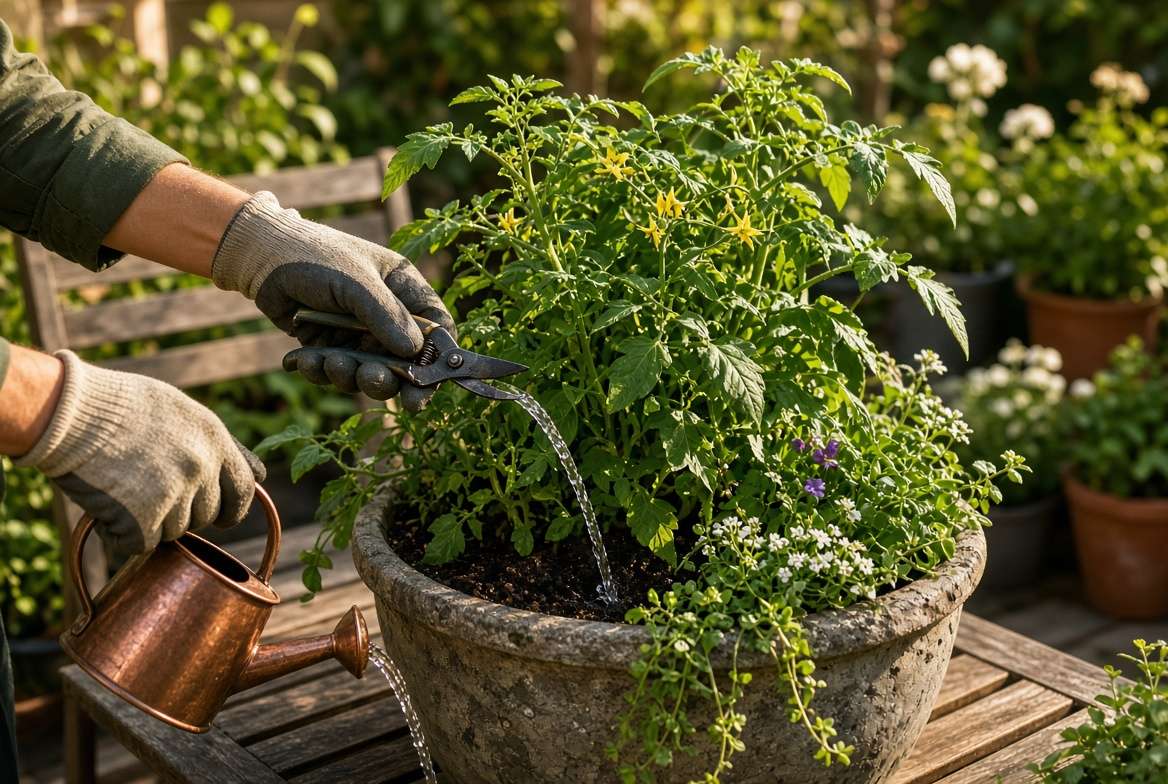
When multiple plants flourish in a tight space, air circulation inside the container drops. Low airflow creates the ideal humid microclimate for powdery mildew and fungal leaf spot.
-
Periodically prune away the lower 6–8 inches of foliage on tall plants (like tomatoes).
-
Trim back sprawling herbs to ensure sunlight still penetrates to the soil surface and reaches shallow-rooted companions.
Frequently Asked Questions (FAQs) ❓
Can I plant flowers and vegetables in the same pot?
Yes, absolutely! In fact, it is highly recommended. Edible flowers like nasturtiums, marigolds, and sweet alyssum attract pollinators, deter pests, and improve the visual appeal of vegetable containers without competing aggressively for root space.
How big should a pot be for companion planting?
For simple combinations (like leafy greens and radishes), a 5- to 7-gallon pot works well. For larger, food-bearing crops like tomatoes, peppers, or squash paired with herbs and flowers, aim for at least a 10- to 15-gallon container to accommodate mature root structures.
Do companion plants compete for water?
If paired correctly based on root depth and water needs, competition is minimal. Shallow roots absorb moisture near the surface while deep taproots pull water from lower in the pot. However, because overall plant density is higher, companion-planted pots will require more frequent watering checks during peak summer heat.
What is the best companion plant for potted peppers?
Sweet basil and chives are the ultimate companion plants for potted peppers. Basil protects peppers from aphids and thrips while maintaining soil humidity, and chives ward off spider mites while improving overall flavor vigor.
Conclusion: Transform Your Container Garden Today 🌱
Container gardening does not mean you have to settle for small yields, bare potting soil, or bland harvests. By unlocking the benefits of companion planting in pots, you turn small balconies, patios, and decks into high-yielding, biologically diverse powerhouses.
By pairing crops with compatible light and water needs, layering root systems, and utilizing natural pest deterrents like marigolds and basil, you can grow more food and flowers in less space than ever before.
Ready to get started? Choose one winning combination—like the classic Caprese Pot—and set it up this weekend. Your plants (and your tastebuds) will thank you!
What are your favorite plant combinations for containers? Have you tried mixing herbs and veggies in the same pot? Let us know in the comments below, and don’t forget to subscribe to our newsletter for more expert plant and tree care guides! 🪴✨











