
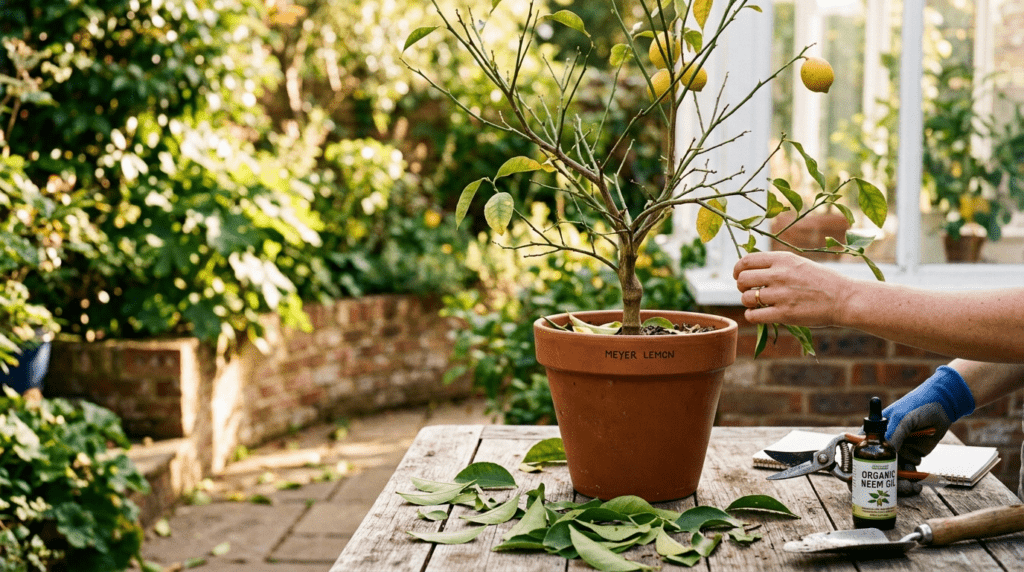
If you have walked out to your patio or living room only to find your prized meyer lemon tree standing over a sad carpet of fallen green foliage, your heart probably skipped a beat. You are not alone. Waking up to a rapidly thinning citrus tree is a universal right of passage for plant parents. Because Meyer lemons are unique hybrids—a cross between a regular lemon and a sweet mandarin orange—they possess a distinct, slightly dramatic personality.
As a seasoned horticulturist who has spent over a decade cultivating citrus in both ground orchards and indoor containers, diagnosing soil health anomalies, and managing organic pest control, I am here to tell you: do not panic. A leafless citrus tree is not a dead tree. Leaf drop is simply your tree’s loudest way of screaming for help.
In this comprehensive, skyscraper-level guide, we are going to unpack the biological mechanics behind why your tree is shedding, systematically diagnose the five primary culprits behind this phenomenon, and provide a clinical, step-by-step triage protocol to stop the drop and stimulate lush, vibrant new growth. Let’s save your citrus! 🍊
The Biology Behind the Drop: Why Citrus Trees Shed 🍂
Understanding “Citrus Stress Response” 🔬
To effectively solve this issue, we must first understand what is happening at a cellular level. Unlike deciduous trees that intentionally drop their leaves to prepare for winter dormancy, the Meyer lemon is a broadleaf evergreen. Its leaves are not just aesthetic decorations; they are active, living solar panels and nutrient storage units. The tree invests massive amounts of metabolic energy into creating and maintaining each leaf.
When a environmental shift or physical stressor occurs, the tree enters survival mode. If the roots cannot supply enough water or oxygen to match the evaporation happening through the leaves (transpiration), or if light levels plummet, the plant undergoes a hormonal shift.
The tree produces increased levels of abscisic acid (ABA) and ethylene at the base of the leaf petiole, creating what botanists call an “abscission layer.” This layer effectively cuts off vascular connection to the leaf, causing it to fall off perfectly green. By dropping its foliage, the tree dramatically reduces its surface area, conserving internal moisture and protecting its core wood and root system from total collapse.
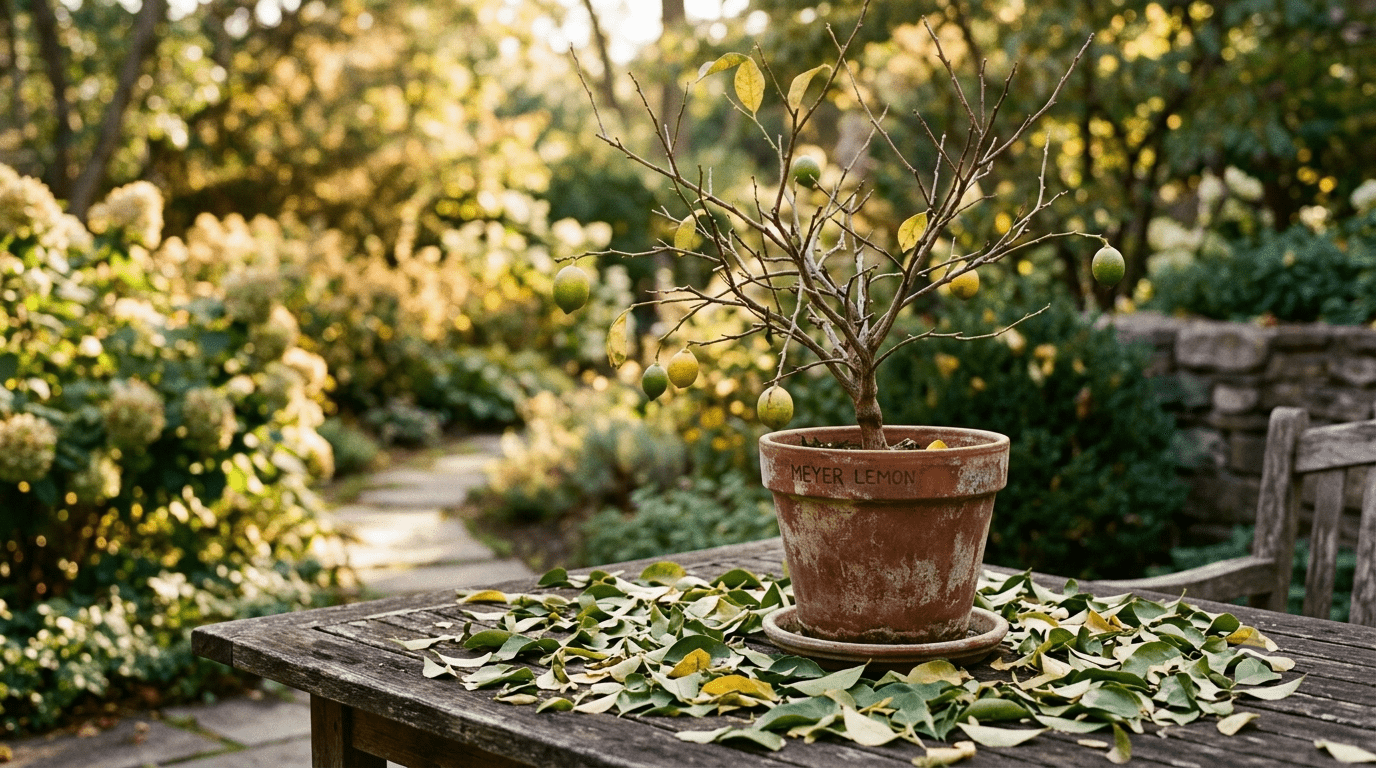
💡 Expert Insight: It is vital to distinguish between natural shedding and acute shock. Citrus trees naturally shed older leaves (usually 2 to 3 years old) in small quantities, typically during early spring right before a new growth flush. If your tree is losing more than 15% to 20% of its canopy rapidly over a week or two, you are dealing with an acute stress response that requires immediate intervention.
The 5 Main Culprits (And How to Identify Them) 🕵️♀️
Diagnosing a ailing plant requires a systematic, elimination-based approach. Below are the five most common reasons your tree is losing its leaves, complete with precise biological context and diagnostic clues.
1. The Indoor/Outdoor Shock (Temperature and Light Fluctuations) ☀️❄️
By far the most common catalyst for sudden leaf drop occurs in late autumn or early spring when container gardeners move their trees between the outdoors and indoors.
When your tree spends summer outside, it enjoys raw, unfiltered sunlight—often exceeding 10,000 foot-candles of light intensity—alongside high ambient humidity and excellent ambient airflow. When moved indoors for the winter, even the brightest south-facing window rarely provides more than 500 to 800 foot-candles of light.
Simultaneously, indoor heating systems drop the relative humidity of a home down to 10% or 20%, which mimics an arid desert environment. The sudden combination of a low-light environment (which slows down photosynthesis) and ultra-dry air (which increases transpirational stress) shocks the plant’s vascular system. The tree realizes it can no longer metabolically support its massive canopy under these new constraints, resulting in a sudden, massive shed of perfectly green leaves.
-
Diagnostic Clues:
-
The leaf drop begins within 3 to 14 days of moving the tree to a new location.
-
Leaves drop while still completely green, plump, and structurally sound.
-
Twigs and branches remain green, pliable, and alive when scratched with a fingernail.
-
2. Overwatering and Poor Soil Health (Root Rot) 💧⚠️
Citrus trees love moisture, but they absolutely despise sitting in saturated, stagnant water. The root architecture of a Meyer lemon requires a high concentration of oxygen within the soil matrix to facilitate nutrient uptake.
When a tree is grown in a heavy, dense potting mix that lacks coarse structural elements (like perlite, pumice, or orchid bark), or if the container lacks sufficient drainage holes, water fills all the microscopic air pockets in the soil. This creates a completely anaerobic (oxygen-depleted) environment.
Under these conditions, the delicate root hairs literally suffocate and drown. Once weakened, opportunistic soil-borne pathogens—most notably water molds like Phytophthora—attack the root system, causing severe root rot. Because the damaged roots can no longer absorb water or nutrients, the upper canopy starves and sheds its leaves, ironically presenting symptoms that look exactly like dehydration.
-
Diagnostic Clues:
-
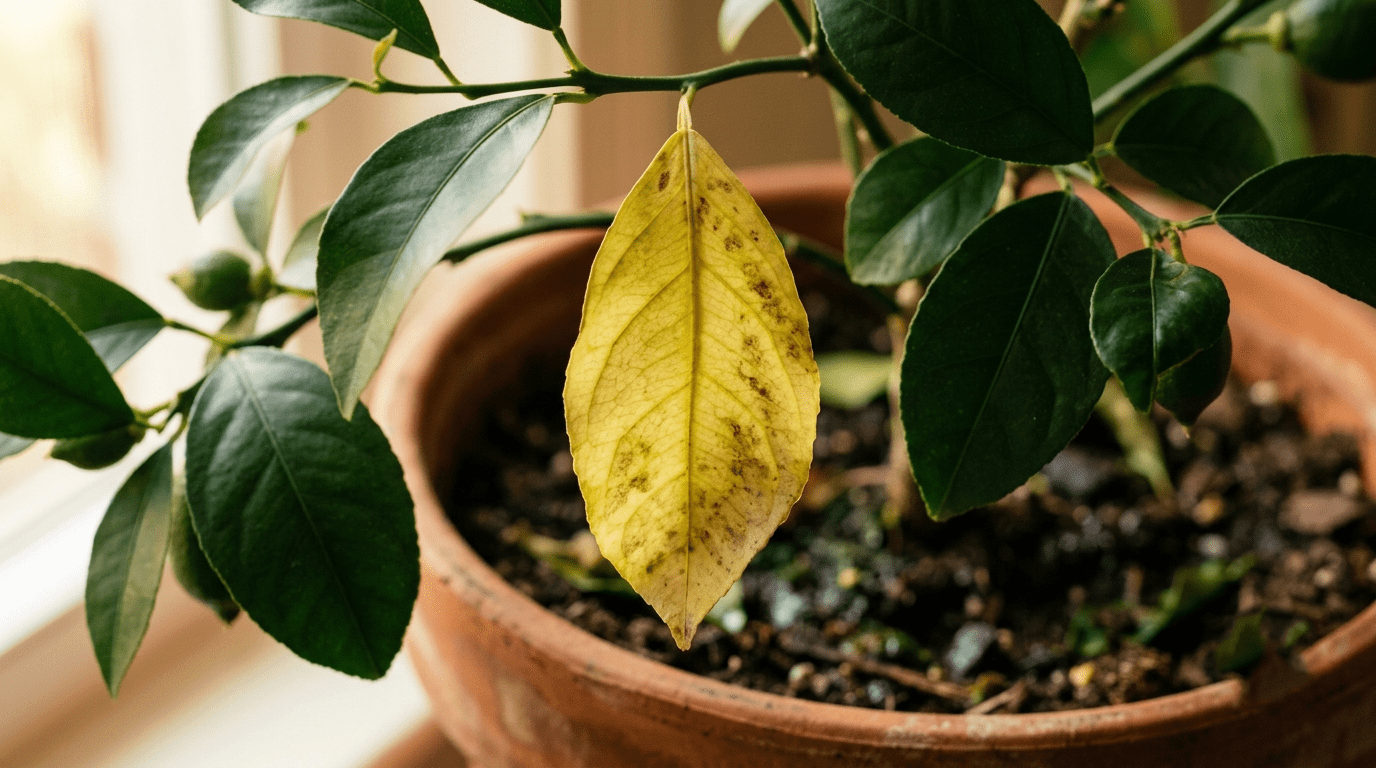
Leaves turn a pale, washed-out yellow color across the entire plant before dropping.
-
Fallen leaves feel soft, limp, or slightly mushy rather than crisp.
-
The soil emits a sour, swampy, or musty odor when you get close to the container.
-
The top two inches of soil remain wet for more than 7 to 10 days after a watering session.
-
3. Underwatering and Drought Stress 🏜️
While overwatering is more common, severe underwatering triggers an equally devastating response. When a Meyer lemon tree’s root system exhausts the available moisture in the soil, the plant immediately goes into self-preservation mode. Without water to facilitate transpiration and nutrient transport, the tree pulls whatever residual moisture it can from its extremities (the leaves) to protect its vital organs (the main trunk and root ball).
A hidden danger here is the development of hydrophobic soil. Many commercial citrus and potting soils are heavily peat-based. When peat moss dries out completely, it shrinks away from the sides of the container and becomes water-repellent. When you attempt to water the plant, the liquid simply cascades down the gaps between the soil and the pot, rushing out the drainage holes. You might think you have deeply watered the tree, but the core root ball remains bone-dry.
-
Diagnostic Clues:
-
Leaves turn brown, dry, and crispy at the edges before falling off.
-
Fallen leaves curl inward and snap easily when crushed in your hand.
-
The container feels suspiciously lightweight when lifted.
-
Water drains out of the bottom of the pot almost instantly after watering.
-
4. Sneaky Sap-Sucking Pests 🕷️🐛
When we bring our citrus trees indoors, we leave behind their natural predators (like ladybugs, lacewings, and predatory wasps). In this safe, climate-controlled, predator-free environment—particularly one with dry indoor heating—pest populations can explode in a matter of days.
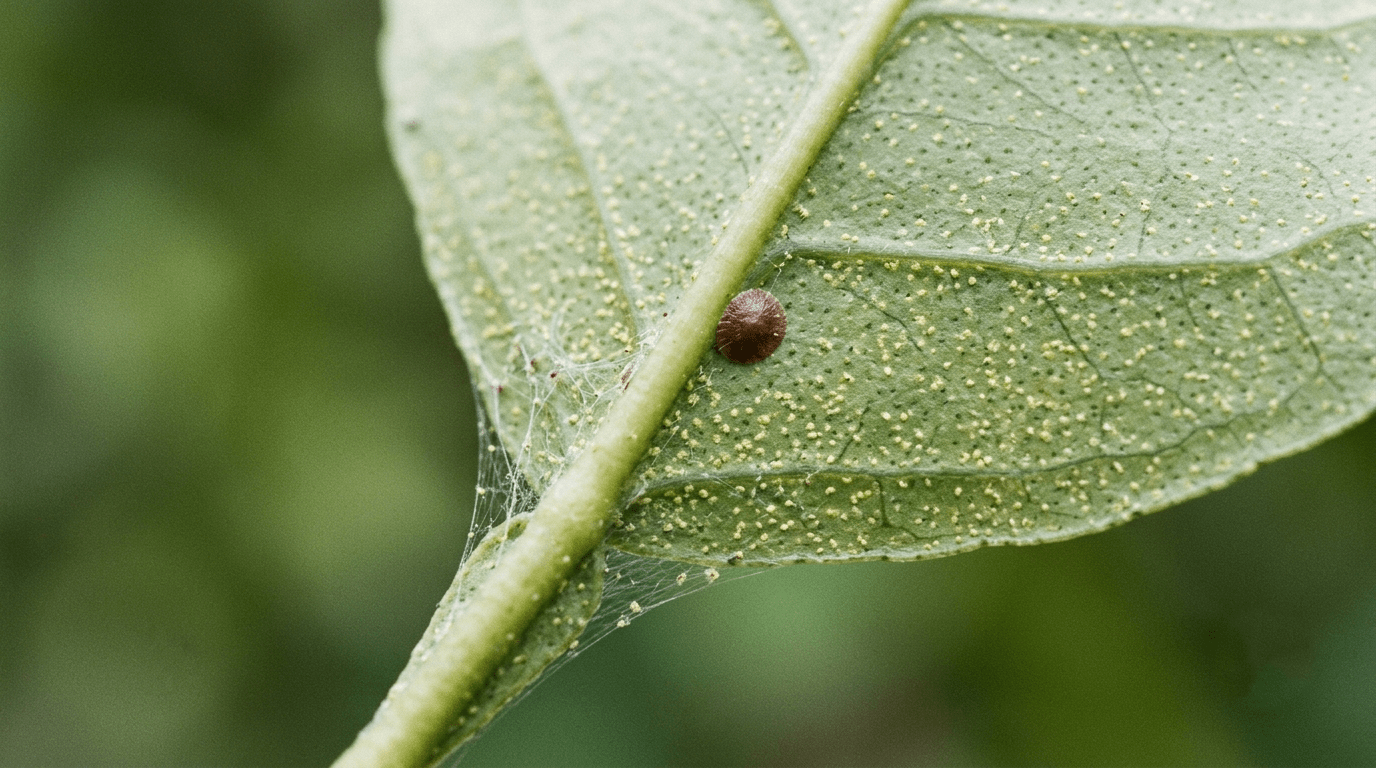
The two most notorious culprits for Meyer lemon leaf drop are spider mites and scale insects. These pests do not eat chunks out of the leaves; instead, they have piercing-sucking mouthparts that penetrate the plant tissue and drain the sap, which contains the tree’s vital sugars and chlorophyll. As the plant is literally drained of its lifeblood, the damaged leaves necrotize (die) and drop.
-
Diagnostic Clues:
-
Spider Mites: Look for microscopic, dust-like specks on the undersides of leaves and faint, ultra-fine webbing concentrated where the leaf meets the stem. The leaves will often look stippled (covered in tiny yellow or white dots) before dropping.
-
Scale: Look for small, raised brown or tan bumps clinging tightly to the stems, twigs, and the central veins of the leaves. They look like weird scabs rather than bugs. You will also notice a sticky residue called “honeydew” coating the lower leaves or the floor around the pot, often accompanied by black sooty mold.
-
5. Nutrient Deficiencies 🧪
Meyer lemon trees are famously heavy feeders. Because they are often in a state of simultaneous blooming and fruiting, they burn through macronutrients and micronutrients at an astonishing rate. If the soil is depleted, or if the soil pH is too high or low (which “locks out” nutrients so the roots cannot absorb them), the tree will cannibalize its older leaves to funnel nutrients to new growth and developing fruit.
The triad of essential nutrients that citrus trees struggle with most often are Nitrogen, Magnesium, and Iron.
-
Diagnostic Clues:
-
Nitrogen Deficiency: The entire plant—starting with the oldest leaves—takes on a uniform, pale yellow-green hue before dropping.
-
Magnesium Deficiency: Leaves display a distinct, inverted green “V” shape at the base of the leaf near the stem, while the outer edges turn yellow.
-
Iron Deficiency (Chlorosis): The leaf tissue turns bright yellow or almost white, but the network of leaf veins remains a stark, dark green. This usually shows up on the newest growth first.
-
The Meyer Lemon Rescue Plan (Step-by-Step) 🚑✨
Now that you have cross-referenced the diagnostic clues and identified the likely source of your tree’s distress, it is time to intervene. Gardening is an exercise in patience; saving a struggling citrus tree requires a methodical approach. Follow this step-by-step triage protocol exactly.
Step 1: Immediate Triage and Environment Stabilization 🌡️
Your tree is currently in shock. The absolute worst thing you can do right now is move it from room to room trying to find a “better” spot. Every relocation resets the tree’s acclimatization process, compounding its stress.
Find a permanent location that boasts bright, indirect light (or use a dedicated grow light) and is completely free from cold drafts from doors or hot blasts from heating vents. Leave the tree there. Next, address the humidity. Misting your tree with a spray bottle is highly ineffective—the water evaporates in minutes and can encourage fungal spores. Instead, place a digital hygrometer near the plant and aim for 50% to 60% ambient humidity. The most reliable way to achieve this is by running a small cool-mist humidifier directly next to the tree.
Step 2: The Soil Health Check and Watering Reset 🪴
Forget watering on a schedule (e.g., “every Sunday”). Watering schedules are the fastest way to kill a citrus tree. You must water based on the soil’s moisture content, which changes based on temperature, humidity, and the tree’s metabolic rate.
Push a wooden chopstick or your index finger three inches deep into the soil.
-
If it feels wet and muddy: Do not water! If the pot is sitting in a drainage saucer full of runoff, empty it immediately. Your tree’s roots need to breathe. Allow the top three inches of soil to dry out completely before watering again. If the soil smells swampy, you may need to gently unpot the tree, trim away any black, mushy roots with sterilized shears, and repot it in fresh, well-draining citrus mix (a 50/50 blend of premium potting soil and coarse perlite or orchid bark).
-
If it is bone dry and pulling away from the pot: You are dealing with hydrophobic soil. You need to rehydrate the root ball via bottom-watering. Place the entire pot in a basin or bathtub filled with a few inches of room-temperature water. Let it sit for 45 to 60 minutes so the soil can wick the moisture up through capillary action. Once the topsoil feels damp, remove it and let it drain completely.
Step 3: Implementing Organic Pest Control 🐞
If you spotted webbing, sticky honeydew, or scale bumps, you must act swiftly but gently. Avoid harsh synthetic pesticides, especially if you plan to eat the lemons eventually!
-
The Shower: Move the tree to the shower or outdoors and gently spray down the remaining foliage and branches with lukewarm water. This physically dislodges up to 70% of the adult spider mites.
-
The Treatment: Once the tree is dry, apply a high-quality Cold-Pressed Neem Oil solution or an Insecticidal Soap. Thoroughly coat the tops and bottoms of every remaining leaf, the twigs, and the main trunk.
-
Manual Removal: For stubborn scale insects, dip a cotton swab in rubbing alcohol and gently dab the hard bumps to dissolve their protective armor and kill them instantly.
-
Repetition: Pests have lifecycle stages (eggs, nymphs, adults). One treatment will not kill the unhatched eggs. You must repeat your neem oil or insecticidal soap application every 5 to 7 days for at least a month to break the life cycle.
Step 4: Pruning and Feeding Protocol ✂️
When a tree looks terrible, our natural human instinct is to over-nurture it by dumping a heavy dose of liquid fertilizer into the soil. Do not do this.
Fertilizing a highly stressed, leafless tree is like forcing a person who just ran a marathon and is severely dehydrated to eat a four-course steak dinner. The high concentration of nitrogen and salts in the fertilizer will burn the already compromised root system. Wait to apply a balanced, citrus-specific fertilizer until you see visible signs of new, green growth emerging from the nodes.
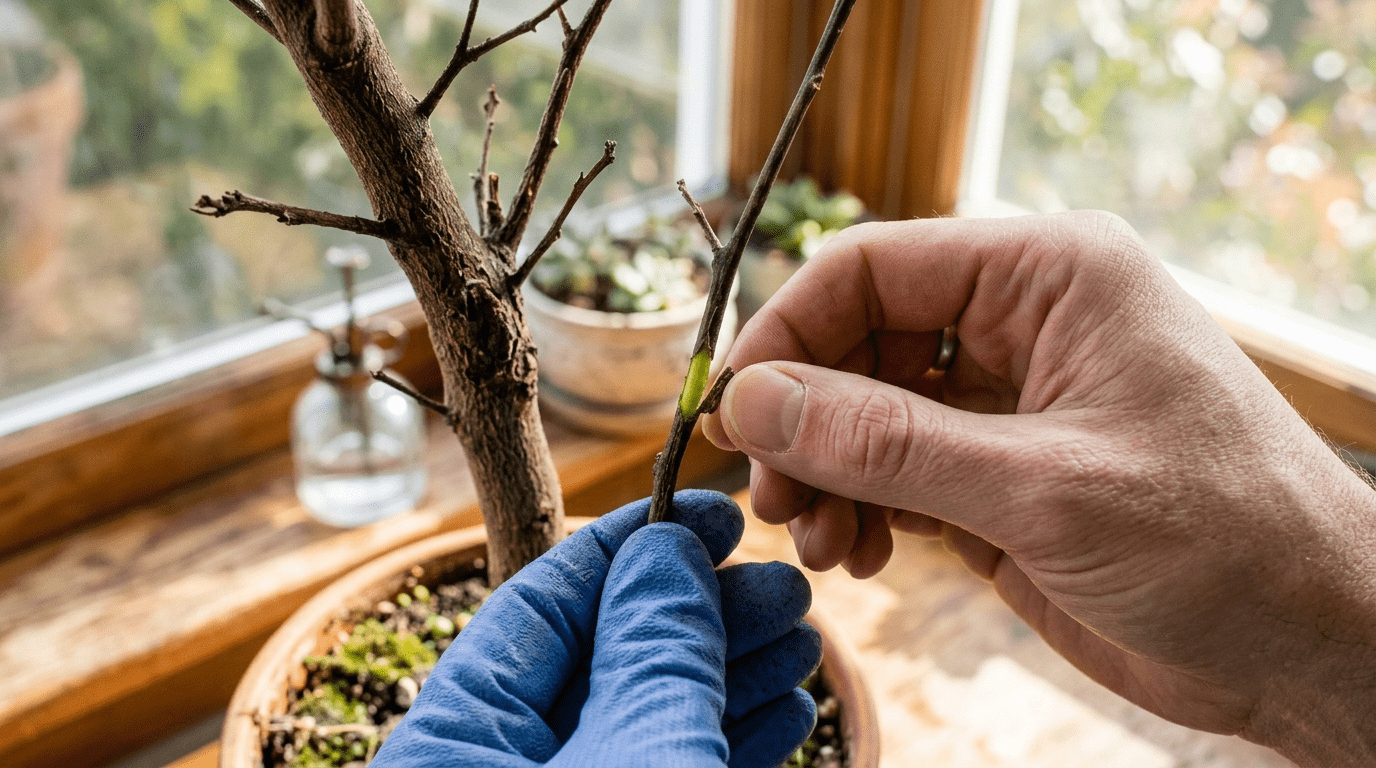
As for pruning, wait. Do not immediately hack away at leafless branches. A branch without leaves is often still alive and capable of pushing out new buds. To check if a branch is dead, lightly scratch the bark with your thumbnail. If you reveal a bright green, moist layer (the cambium layer), the branch is alive—leave it alone! If the branch is brown, dry, and brittle all the way through, you can safely prune it back to the nearest living green wood using sterilized secateurs.
Pro Tips for Long-Term Meyer Lemon Success 🌱
Rescuing a struggling Meyer lemon tree is a fantastic achievement, but proactive care is always better than reactive triage. Once your tree has stabilized and pushed out fresh, lime-green foliage, you want to bulletproof its environment so you never have to sweep up a pile of dropped leaves again. Here are the three non-negotiable pillars for long-term citrus success, specifically focused on optimizing soil health and lighting.
Invest in High-Quality Grow Lights 💡
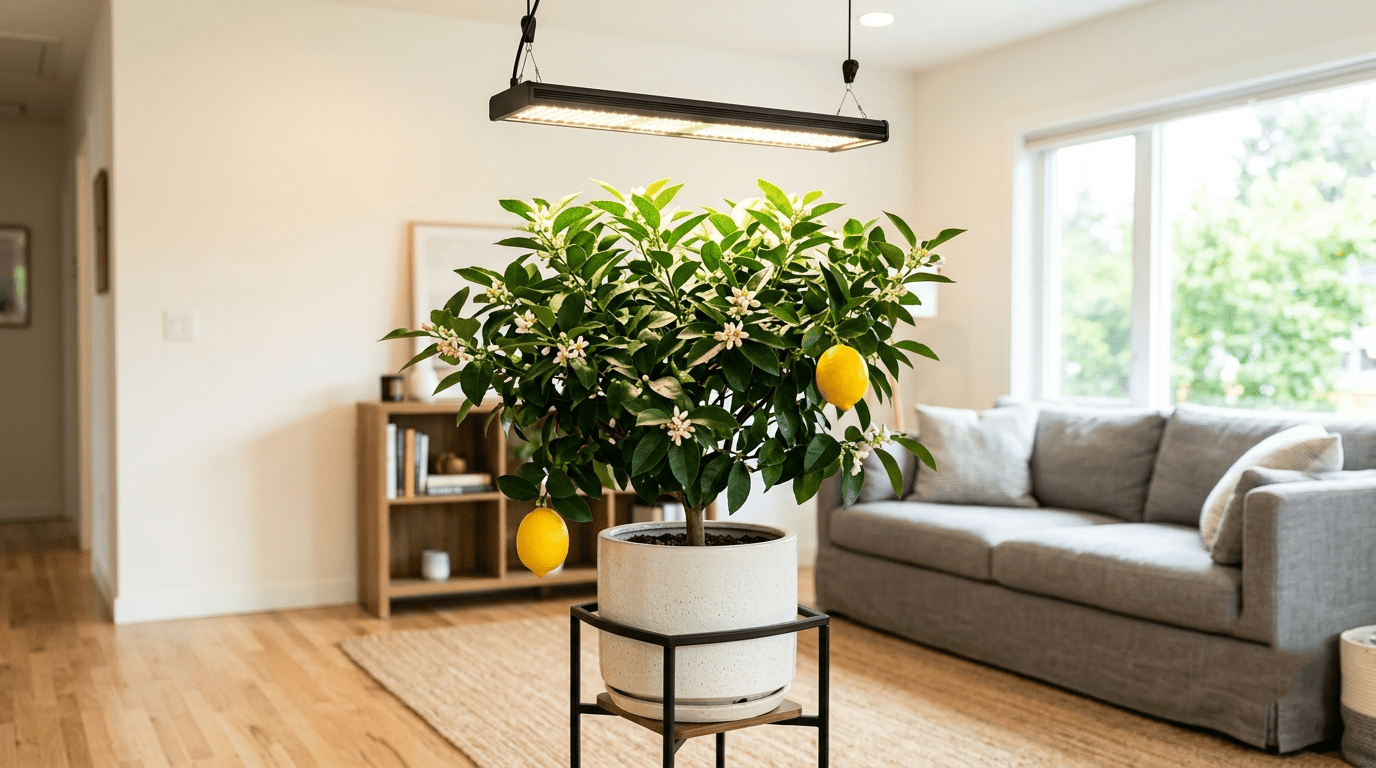
If you live in a climate with distinct seasons, your Meyer lemon will inevitably spend months indoors. The ambient light from a window is almost never enough to sustain a heavy-fruiting citrus tree through the winter.
Invest in a dedicated, full-spectrum LED grow light. Do not get caught up in cheap purple/blurple lights; look for a light that explicitly lists its PAR (Photosynthetically Active Radiation) output or provides a high PPFD (Photosynthetic Photon Flux Density) footprint. Position the light 12 to 18 inches above the canopy and run it on an automatic timer for 12 to 14 hours a day. This artificial sun will keep the tree actively photosynthesizing and prevent winter leaf drop entirely.
Master the Consistent Feeding Schedule 🍽️
Because citrus trees are heavy feeders grown in confined containers, they quickly exhaust the organic matter and nutrients available in their potting mix. Maintaining robust soil health is the key to disease resistance and vigorous growth.
During the active growing season (early spring through late summer), establish a strict feeding protocol. Use a premium, organic citrus-specific fertilizer rich in nitrogen, but equally packed with essential trace minerals like iron, zinc, and magnesium. Look for an N-P-K ratio around 5-2-6.
-
Pro Tip: To further boost soil health, incorporate worm castings or water with compost tea once a month. This introduces beneficial microbes into the soil, which form a symbiotic relationship with the tree’s roots, enhancing nutrient uptake and breaking down organic matter more efficiently.
The Art of Acclimatization (Hardening Off) 🌤️
When the danger of the last spring frost has passed, you will want to move your tree back outdoors to enjoy the summer sun. Do not just drag it directly onto the patio! Moving a tree from low indoor light straight into blazing afternoon sun will cause severe sunburn (white, bleached spots on the leaves) and trigger another massive leaf drop due to shock.
You must “harden off” the tree over a two-week period.
-
Days 1–4: Place the tree in total, deep shade (under a porch or a larger tree) for just a few hours a day, bringing it back inside at night.
-
Days 5–9: Introduce the tree to dappled morning sunlight, protecting it from harsh afternoon rays. Leave it out overnight if temperatures remain above 50°F (10°C).
-
Days 10–14: Gradually increase the hours of direct sunlight until the tree is fully acclimated to its permanent summer spot.
Real Grower Q&A (Community Insights) 💬
Scouring active plant care communities and popular Reddit threads reveals that everyday growers face the same recurring panic when their citrus trees throw a tantrum. Here are the most highly requested answers to your most urgent troubleshooting questions:
Q: Can my Meyer lemon tree actually survive if it drops absolutely every single leaf? A: Yes! It looks terrifying, but as long as the structural wood remains alive, the tree can fully recover. A naked canopy is essentially the tree hitting the “pause” button on its metabolism to survive a crisis. Keep the soil slightly moist (never soggy), ensure it has adequate warmth and light, and be extremely patient. It can take 4 to 8 weeks for new buds to break through the bark.
Q: My tree is dropping its flowers and tiny baby lemons along with the leaves. Is this normal? A: It is heartbreaking, but completely normal. When a tree is stressed enough to drop its primary energy source (leaves), it will absolutely abort its reproductive efforts (flowers and fruit). The tree knows it cannot metabolically support developing fruit when it is fighting for its life. Focus on stabilizing the plant and restoring its foliage; the blooms will return in the next cycle.
Q: Should I mist my leafless tree with a spray bottle to help increase the humidity? A: No, put the spray bottle down! Misting provides only a fleeting, two-minute spike in humidity before the water evaporates. Worse, if your tree is already stressed, sitting water on the branches or remaining leaves creates the perfect breeding ground for fungal and bacterial infections. Always use a cool-mist humidifier to raise the ambient relative humidity of the entire room instead.
Conclusion 💚
Watching your Meyer lemon tree drop its leaves can feel like a devastating failure, but it is crucial to reframe this event. Leaf drop is not the end of your tree’s life; it is a highly evolved, biological defense mechanism designed to keep the plant alive during periods of intense stress.
By systematically checking off the five primary culprits—environmental shock, improper watering, poor soil aeration, stealthy organic pests, and nutrient lock-out—you can swiftly identify the root cause of the problem. Remember that gardening, especially indoor horticulture, is a practice of observation and patience. Implement the immediate triage steps, stabilize the environment, hold off on the heavy fertilizers, and trust in the resilience of nature.
With a little detective work and a lot of care, your Meyer lemon tree will bounce back, pushing out a flush of fragrant new leaves and, eventually, a heavy harvest of golden, sweet-tart lemons.











