
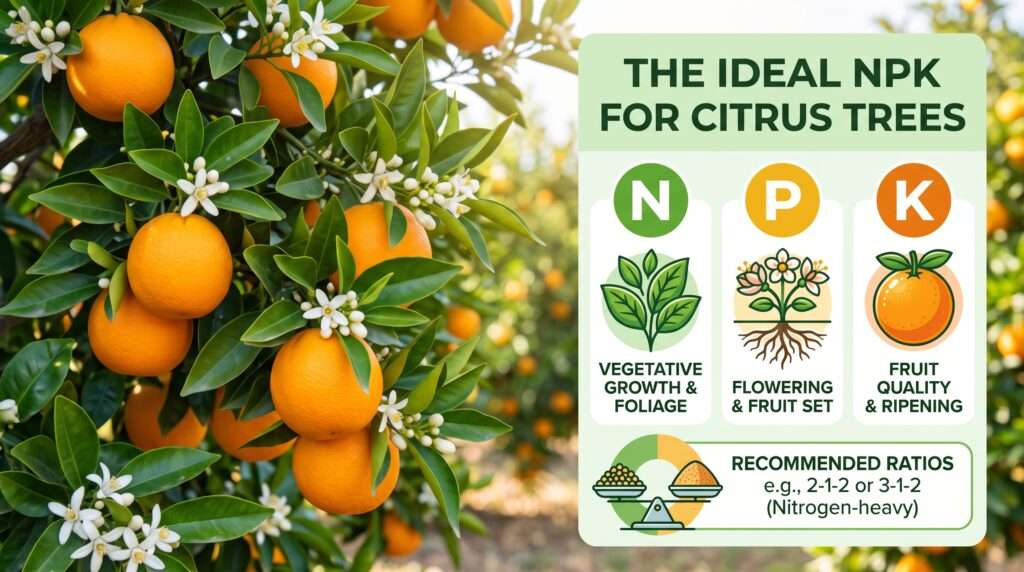
There is nothing quite as frustrating as nurturing a lemon, orange, or lime tree all year, only to be rewarded with pale, yellowing leaves, dropped blossoms, or fruit that is dry and pithy inside. If your tree is struggling to produce that picture-perfect, juice-heavy harvest, the issue rarely lies with your watering schedule or sunlight. Instead, it almost always comes down to plant nutrition. Specifically, dialing in the perfect npk for citrus trees is the single most critical factor separating a weak, struggling plant from a prolific, heavy-bearing producer.
Citrus trees are notoriously “heavy feeders.” Because they are evergreen and expend massive amounts of energy producing dense wood, fragrant blossoms, and water-heavy fruit, they rapidly deplete the soil of essential macronutrients. Over my years working alongside soil agronomists and reviving failing backyard orchards, I have seen countless gardeners make the same well-intentioned mistake: throwing a generic “all-purpose” fertilizer at their Meyer lemon or Valencia orange and hoping for the best.
This guide strips away the guesswork. Based on proven botanical science and commercial orchard practices, we will explore exactly what nutrient ratios your citrus actually needs, how to read your tree’s leaves to diagnose hidden deficiencies, and the precise feeding schedule required to trigger your heaviest harvest yet. 🪴✨
🧬 Understanding NPK Basics: What Do Citrus Trees Actually Need?
To understand how to feed your tree, you first need to understand the biology of how it uses food. The letters N-P-K on a bag of fertilizer stand for Nitrogen, Phosphorus, and Potassium—the three primary macronutrients required for plant life. However, citrus trees consume these nutrients at vastly different rates compared to your tomatoes, roses, or apple trees.
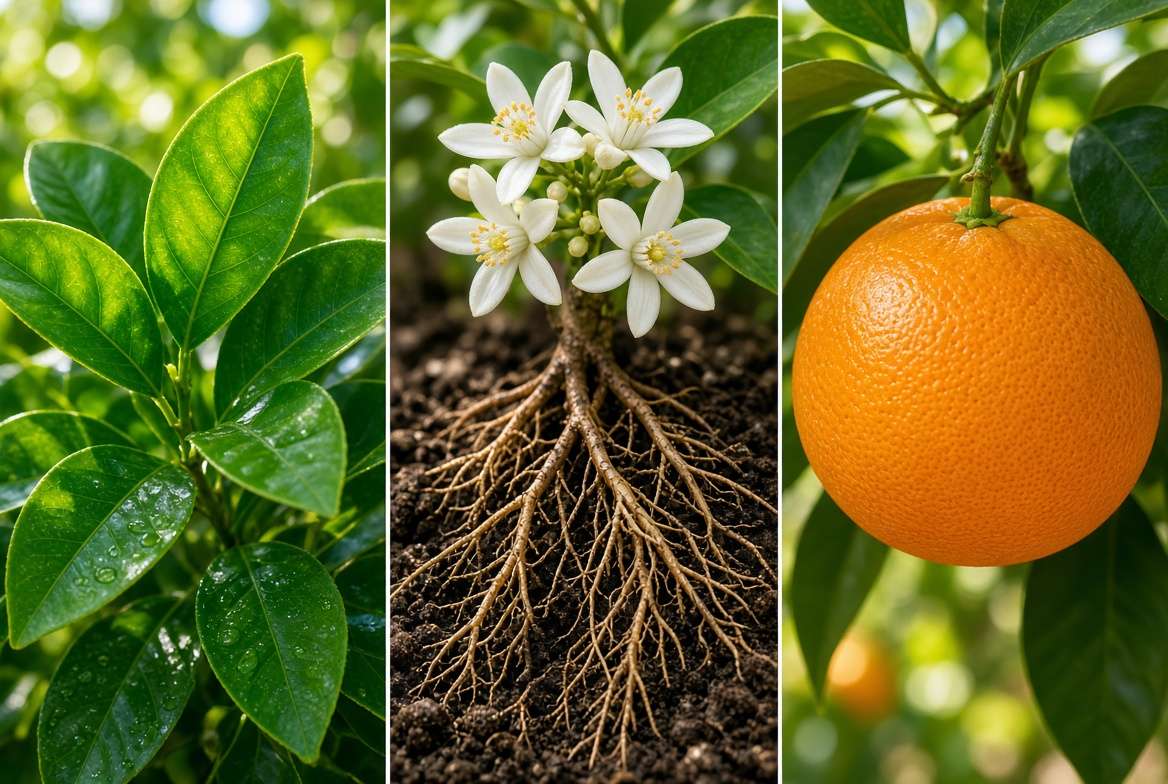
Nitrogen (N): The Engine of Canopy Growth 🍃
Nitrogen is the most critical element for citrus health, and these trees require it in significantly higher volumes than almost any other fruit-bearing plant. Nitrogen is the foundational building block of chlorophyll, the green pigment responsible for photosynthesis.
Because citrus trees do not drop their leaves in the winter, they must maintain a massive, energy-producing canopy year-round. A steady supply of nitrogen fuels robust vegetative growth, allowing the tree to push out new branches (flushes) that will eventually bear fruit. When nitrogen is lacking, the tree cannot photosynthesize efficiently, leading to a thin, sparse canopy and a drastic reduction in fruit yield.
Phosphorus (P): Root Strength & Blossom Development 🌸
While nitrogen builds the leaves, phosphorus builds the foundation. Phosphorus is vital for energy transfer within the plant (ATP production) and is heavily utilized during two specific phases: root expansion and blooming.
Citrus trees actually require relatively little phosphorus compared to nitrogen. However, the small amount they do need is non-negotiable. Without adequate phosphorus, a citrus tree will struggle to establish a deep, drought-resistant root system. More importantly for the home gardener, phosphorus deficiency leads to poor blossom formation. If your tree isn’t flowering, or if the blossoms are weak and immediately fall off the branch, a lack of available phosphorus is often the culprit.
Potassium (K): Fruit Size, Quality, and Disease Resistance 🍊
If nitrogen is the engine and phosphorus is the foundation, potassium is the ultimate quality-control manager. Potassium regulates the opening and closing of stomata (the pores on the leaves), which controls water retention and drought tolerance.
For the fruit itself, potassium is the magic ingredient. It is directly responsible for cell division and sugar transport. High potassium levels lead to larger, sweeter, and juicier fruit. Furthermore, it promotes a thick, resilient rind that resists splitting during heavy rains and protects the fruit from piercing insects and fungal diseases. A tree deficient in potassium will yield small, sour fruit with incredibly thin, easily damaged skins.
⚖️ The Golden Rule: The Ideal NPK Ratio for Citrus Trees
Walking into a garden center and looking at walls of fertilizer bags can be overwhelming. You will see numbers like 10-10-10, 4-3-4, or 24-8-16. To choose the right one, you must follow the golden rule of citrus agronomy: Citrus requires roughly twice as much nitrogen as phosphorus, and an equal or slightly higher amount of potassium compared to phosphorus.
Why the 2-1-1, 3-1-1, or 5-1-3 Ratio Wins Out 🏆
Because citrus pulls nutrients from the soil in very specific proportions, your fertilizer must match that exact appetite. The ideal NPK ratio for citrus generally falls around 3-1-1 or 5-1-3.
Expert Insight: One of the most common mistakes is applying a “balanced” fertilizer, such as a 10-10-10 or 20-20-20 formula. While these work wonderfully for general vegetable gardens, they are actually detrimental to citrus trees over time. Because citrus only uses a fraction of the phosphorus provided in a 10-10-10 mix, the excess phosphorus remains in the soil. Over several seasons, this unused phosphorus builds up to toxic levels, which then chemically binds with soil iron and zinc, locking those vital micronutrients away from the tree’s roots. This creates a cascade of nutritional deficiencies, simply because the initial NPK ratio was wrong.
Reading the Label: Examples of Winning Formulas 🏷️
When shopping for citrus food, ignore the marketing on the front of the bag and look directly at the guaranteed analysis (the NPK numbers). You want a fertilizer where the first number (N) is the highest, followed by a much lower second number (P), and a third number (K) that is equal to or slightly higher than the second.
Excellent examples of commercial or organic citrus ratios include:
-
6-3-3 (Perfectly aligned with the 2-1-1 ratio)
-
8-3-9 (Excellent for mature trees needing extra potassium for heavy fruit sets)
-
13-7-13 (A stronger synthetic ratio that requires careful application to avoid root burn)
When calculating how much to apply, you are always calculating based on the actual pounds of nitrogen. For example, a 10-pound bag of 6-3-3 fertilizer contains 0.6 pounds of actual nitrogen (10 lbs x 0.06). Mature, in-ground citrus trees generally require about 1 to 1.5 pounds of actual nitrogen per year, split across multiple feedings.
🔬 Beyond NPK: The Crucial Role of Citrus Micronutrients
While getting the macronutrient ratio right is your first priority, citrus trees are highly sensitive to micronutrient deficiencies. You can apply the perfect NPK blend, but if your tree is missing trace minerals, it will still look sickly and refuse to produce.
Iron, Zinc, and Manganese: The Chlorosis Fighters 🍂
Citrus trees are notorious for developing “chlorosis”—a condition where the leaves turn pale yellow or white while the veins remain starkly dark green. This is rarely a nitrogen issue; it is almost always a lack of iron, zinc, or manganese.
These micronutrients are essential for enzyme function and chlorophyll synthesis. However, they are highly sensitive to soil pH. In alkaline soils (pH above 7.0), iron and zinc become chemically locked in the soil, meaning the tree’s roots cannot absorb them, even if they are present. To combat this, look for a citrus fertilizer that explicitly includes chelated iron and zinc. Chelation is a chemical process that wraps the metal ion in an organic molecule, protecting it from alkaline soil and keeping it bioavailable to the roots.

Calcium & Magnesium: Preventing Fruit Drop & Splitting 🛑
Calcium and magnesium act as secondary macronutrients. Magnesium is the central atom in the chlorophyll molecule—without it, the tree simply cannot process sunlight. Magnesium deficiency is easily identifiable: the older leaves will turn yellow starting at the tip, leaving a distinct green, inverted “V” shape at the base of the leaf.
Calcium, on the other hand, is the biological mortar that holds plant cell walls together. A lack of calcium leads to weak cell structures, which manifests in citrus as premature fruit drop (where marble-sized green fruit rains down from the tree) or severe fruit splitting as the fruit expands in late summer. Ensure your chosen fertilizer includes calcium, or supplement gently with agricultural gypsum (calcium sulfate) which adds calcium without altering your soil’s pH.
🗓️ When and How to Apply Fertilizer for Maximum Fruit Yield
Having the perfect NPK for citrus trees is only half the battle; timing your application is what actually drives results. Citrus roots do not absorb nutrients at a constant rate year-round. Instead, their nutrient uptake spikes during specific phases of active growth, known as “flushes.” If you fertilize at the wrong time, the nutrients will simply wash away in the soil before the tree can use them.
The 3-Part Citrus Feeding Schedule (Spring, Summer, Fall) 📅
To keep nutrient levels consistent during active growth periods, it is best to divide your tree’s total annual nitrogen requirement into three separate applications.
-
February/March (The Pre-Bloom Push): This is the most important feeding of the year. Apply your first round of fertilizer just as the soil begins to warm, right before the tree pushes out its spring flush of leaves and blossoms. This ensures the roots have immediate access to nitrogen and phosphorus to support heavy flowering.
-
May/June (Supporting Fruit Set): By early summer, the blossoms have dropped, and tiny green fruit (fruitlets) are beginning to swell. The tree is expanding a massive amount of energy to hold onto this fruit. A second feeding during this time provides the necessary potassium to support fruit cell division and prevent premature dropping.
-
August/September (Maturing Fruit & Winter Prep): The final feeding supports the sizing up of the fruit as it prepares to ripen. Expert Warning: Do not apply heavy nitrogen after September/October in frost-prone areas. Late-season nitrogen pushes tender, new leafy growth that is highly susceptible to freeze damage in the winter.
Step-by-Step: Applying Granular Fertilizer at the “Drip Line” 📏
One of the most frequent mistakes beginners make is piling fertilizer directly against the trunk of the tree. This can cause severe chemical burns to the bark, leading to rot and inviting fungal diseases like Phytophthora (foot rot).
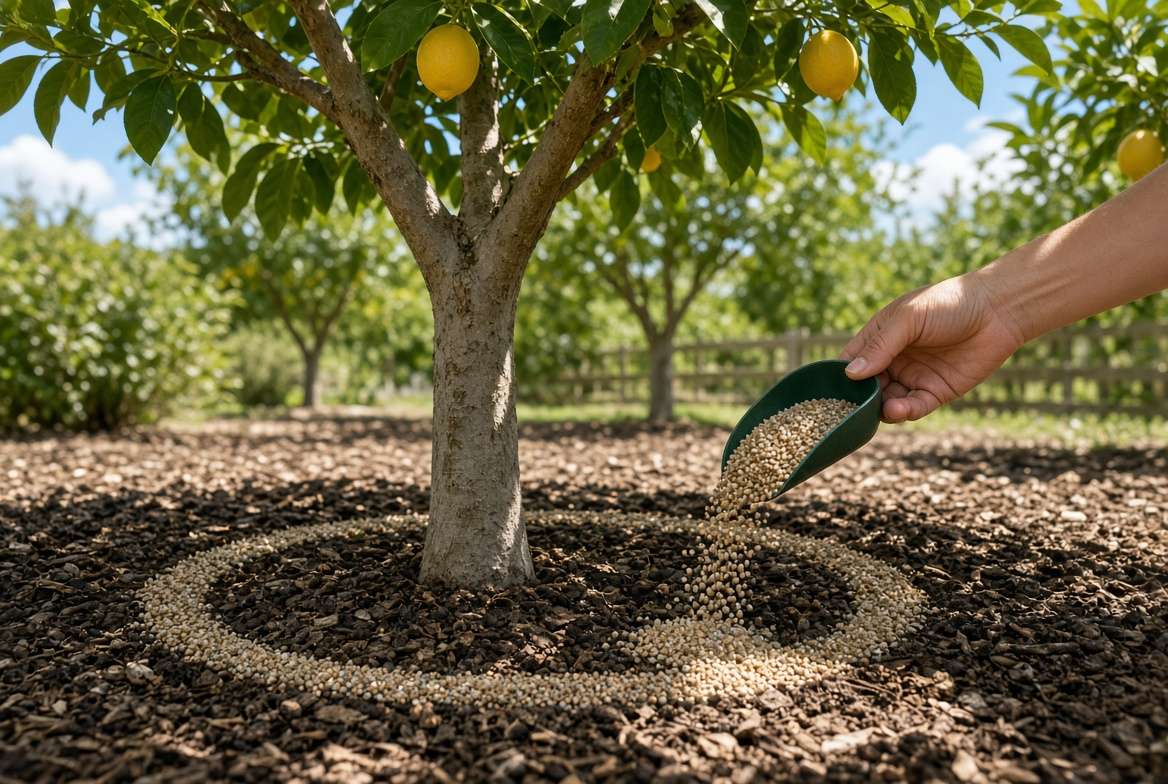
Instead, fertilizer must be applied at the drip line. Imagine the tree canopy as an umbrella during a rainstorm. The drip line is the circular ring on the ground where the water would drip off the outermost leaves. This is exactly where the tree’s fine, nutrient-absorbing feeder roots are located.
-
Measure the correct amount of fertilizer based on the tree’s age and the NPK label instructions.
-
Broadcast the granules evenly in a wide ring around the drip line, extending a foot or two past it. Keep the trunk completely clear.
-
Scratch the fertilizer lightly into the top inch of mulch or soil.
-
Water deeply: Granular fertilizers must be activated by water. Soak the area thoroughly to carry the nutrients down into the root zone.
Granular vs. Liquid vs. Foliar Feeding: Which is Best? 💧
-
Slow-Release Granules: This should be your primary method for delivering NPK. Granules break down slowly over several weeks, providing a steady baseline of nutrition that aligns with the 3-part schedule.
-
Liquid Drenches: Liquid fertilizers offer an immediate, short-term boost. They are highly effective for potted citrus trees (which need more frequent feeding) but are generally too labor-intensive and short-lived to be the sole fertilizer for large, in-ground orchards.
-
Foliar Sprays: Foliar feeding involves spraying liquid nutrients directly onto the leaves. While leaves cannot absorb enough NPK to sustain the tree, they are incredibly efficient at absorbing micronutrients. If your tree shows sudden signs of iron or zinc chlorosis, a foliar spray is the fastest way to correct the deficiency, often greening up the leaves in just days.
🌱 Tailoring NPK Based on Your Tree’s Age and Environment
A newly planted sapling has drastically different goals than a mature, 15-year-old grapefruit tree. Your feeding strategy must adapt as the tree matures.
Young, Non-Bearing Trees (Years 1-3) 👶
During the first three years in the ground, a citrus tree’s sole priority should be establishing a massive root system and a sturdy structural canopy.
-
The Strategy: Focus on higher nitrogen ratios. You want vigorous vegetative growth.
-
Expert Tip: If a tree under three years old produces fruit, you should ideally pinch it off. Allowing a young tree to expend energy ripening fruit stunts its overall growth and can permanently weaken the branches, which won’t be thick enough to support heavier harvests later.
Mature, Fruit-Bearing Trees (Years 4+) 🌳
Once the tree’s scaffolding is built, the goal shifts from canopy expansion to fruit production.
-
The Strategy: While nitrogen is still vital, phosphorus and potassium become the stars of the show. Mature trees benefit from blends like 8-3-9 to ensure the massive fruit loads reach their maximum size and sweetness without exhausting the tree’s internal reserves.
Potted vs. In-Ground Citrus: Key Differences 🪴
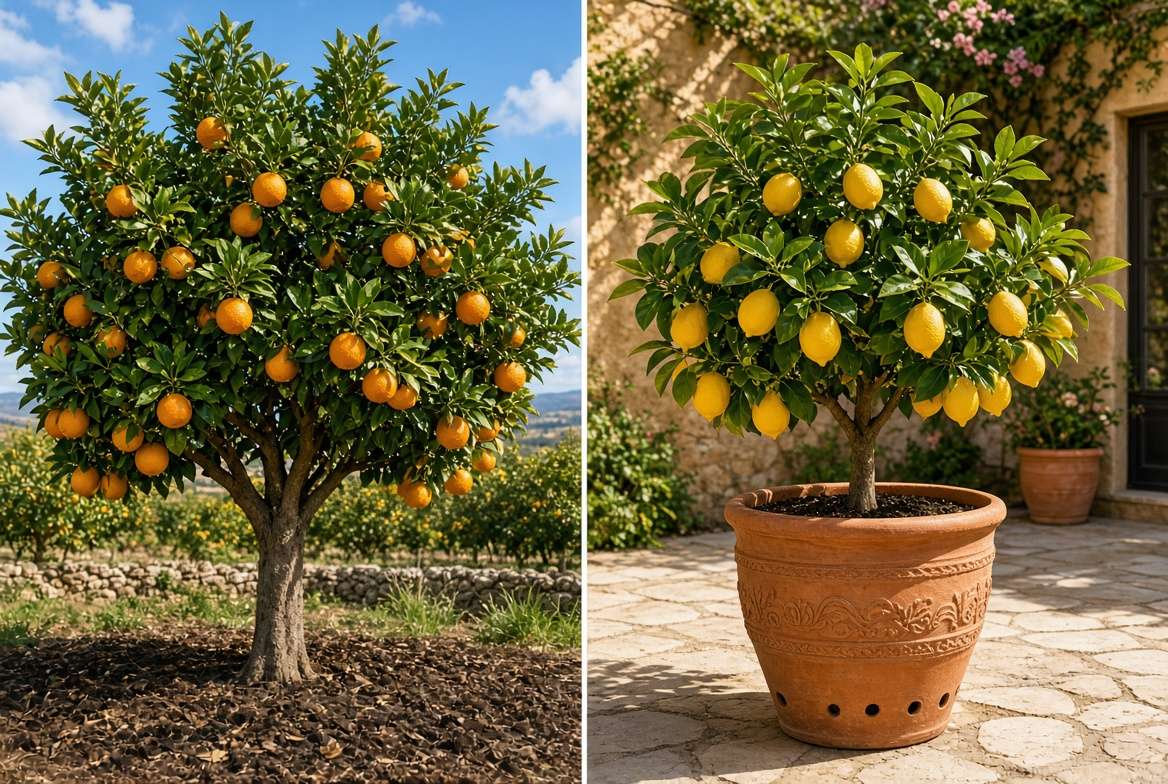
Growing citrus in containers is wildly popular, but it completely changes the nutrient dynamic. Every time you water a potted lemon or lime tree until water runs out the drainage holes, you are flushing dissolved NPK out of the soil.
-
The Strategy: Potted citrus needs to be fed much more frequently than in-ground trees—often every 4 to 6 weeks during the growing season. Use a slightly weaker, water-soluble fertilizer or specialized slow-release citrus spikes designed for containers to prevent the roots from starving in depleted potting soil.
🚑 Troubleshooting: Reading the Leaves (A Visual Diagnosis Guide)
Your citrus tree will constantly communicate its nutritional needs to you; you just need to know how to read the foliage.
Nitrogen Deficiency vs. Iron Deficiency 🤔
These two issues are often confused, but the visual cues are distinct:
-
Nitrogen Deficiency: The tree will pull nitrogen from old growth to support new growth. You will see the older leaves lower down on the branches turning a pale, uniform, sickly yellow overall.
-
Iron or Zinc Deficiency (Chlorosis): This affects the newest leaves at the tips of the branches. The leaves will turn pale yellow or almost white, but the network of veins will remain sharply, distinctly dark green.

Magnesium Deficiency (The “V” Shape) 🔽
Magnesium is highly mobile within the plant. If the tree is lacking, it will sacrifice older leaves to protect new ones. You will see the older leaves yellowing from the tip inward, leaving a very distinct, dark green triangle or inverted “V” shape at the base of the leaf near the stem. A quick application of Epsom salts (magnesium sulfate) dissolved in water usually corrects this quickly.
🧪🌿 Organic vs. Synthetic Citrus Fertilizers: An Expert Verdict
The debate between organic and synthetic fertilizers is fierce, but both have a place in a high-yielding citrus grove.
The Slow Burn of Organics 🐛
Organic fertilizers (derived from bone meal, blood meal, feather meal, and kelp) feed the soil microbiome, which in turn feeds the tree.
-
Pros: They improve soil structure, increase earthworm activity, and carry zero risk of chemical “fertilizer burn.”
-
Cons: They are highly dependent on soil temperature. The soil microbes must break down the organic matter to make the NPK bioavailable. If the soil is cold in early spring, an organic fertilizer will sit dormant precisely when the tree needs the pre-bloom push the most.
The Rapid Relief of Synthetics ⚡
Synthetic fertilizers provide precise, chemically formulated nutrients that are instantly available to the roots upon watering.
-
Pros: Exact NPK control, rapid correction of deficiencies, and immediate absorption regardless of soil temperature.
-
Cons: Synthetics do nothing to improve long-term soil health. Over-application can easily burn delicate feeder roots and leave behind heavy salt accumulations in the soil.
Actionable Tip: The most successful orchardists use a hybrid approach. Use rich organic compost and slow-release organic granular feeds to build long-term soil health and provide a steady baseline of nutrients. Then, step in with targeted synthetic foliar sprays or liquid drenches if the tree shows specific, acute micronutrient deficiencies.
❓ Frequently Asked Questions (FAQs) About Citrus Tree NPK
Can I use a generic fruit tree fertilizer or tomato food for citrus? While generic fruit or vegetable fertilizers will provide basic NPK, they generally lack the heavy doses of zinc, iron, manganese, and magnesium that citrus trees specifically require. Long-term use of tomato food on citrus will almost always result in micronutrient chlorosis. Stick to citrus-specific blends.
What happens if I over-fertilize with Nitrogen? More is not always better. Excessive nitrogen forces the tree to put all its energy into rapid, weak leafy growth at the expense of fruit production. The fruit that does form will often have incredibly thick, puffy rinds and very little juice inside. Furthermore, excessive succulent new growth is a magnet for aphids, citrus leafminers, and scale insects.
Are coffee grounds good for citrus trees? Coffee grounds are a fantastic soil amendment. They add excellent organic matter and slightly lower the soil pH, which citrus trees love (they prefer a slightly acidic pH between 5.5 and 6.5). However, coffee grounds contain very low levels of usable nitrogen (around 2% by volume). They are a great addition to your mulch ring, but they do not replace a true, formulated NPK fertilizer.
🧺 Preparing for Your Heaviest Harvest Yet
Cultivating a thriving, highly productive citrus tree doesn’t require a degree in horticulture—it simply requires listening to the science of plant nutrition. By selecting the ideal NPK for citrus trees (aiming for that perfect 2-1-1 or 3-1-1 ratio), timing your applications to match the tree’s natural growth flushes, and keeping a close eye on the leaves for micronutrient deficiencies, you remove the guesswork from your garden.
A well-fed tree is naturally more resilient against pests, more tolerant of drought, and exponentially more generous with its harvest. Take the time to measure your tree’s drip line, invest in a quality citrus-specific blend, and get ready to enjoy the heaviest, juiciest harvest your backyard has ever produced.
What has been your biggest struggle with your citrus trees this year? Are you seeing yellow leaves, dropped blossoms, or undersized fruit? Share your experiences or photos of your harvest in the comments below, and let’s get those trees thriving! 🍋🌳











