
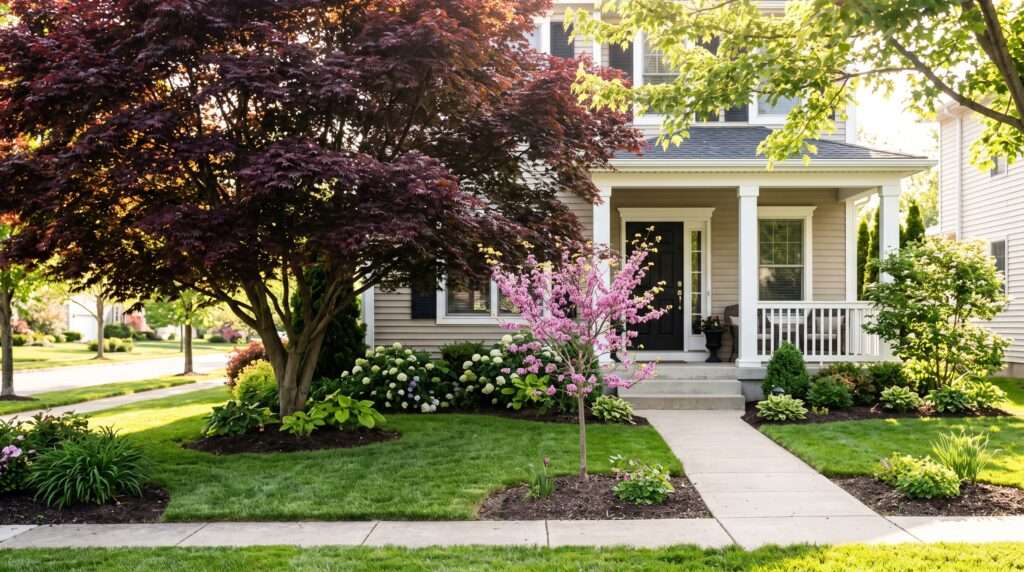
Picture this: You carefully plant a gorgeous sapling in your landscaping bed. Ten years later, it has grown into a stunning focal point—but its aggressive roots have cracked your concrete driveway, invaded your underground plumbing, and fractured your home’s foundation. It is a nightmare scenario I see all too often when consulting with homeowners. Choosing the right landscaping goes far beyond just aesthetics; it requires an understanding of botany and root behavior. If you want to elevate your home’s exterior without compromising its structural integrity, you need the best trees for front yard planting that combine breathtaking beauty with polite, non-invasive root systems.
In my years as a plant care specialist, I have watched countless property owners accidentally plant “foundation destroyers” like Weeping Willows or Silver Maples simply because they were unaware of how roots behave underground. You do not have to choose between a beautifully landscaped property and a safe home. Let’s explore the science of tree roots and break down the top ornamental trees that will safely boost your property value for decades to come. ✨
Why Do Some Tree Roots Destroy Foundations? (The Science of Roots) 🔬
To understand why some trees are safe for front yards while others are ticking time bombs, we have to look beneath the soil. Many homeowners mistakenly believe that tree roots mirror the canopy, growing straight down into the earth like a giant carrot. In reality, arboriculture science tells us a very different story.
Taproots vs. Lateral Roots 🪴
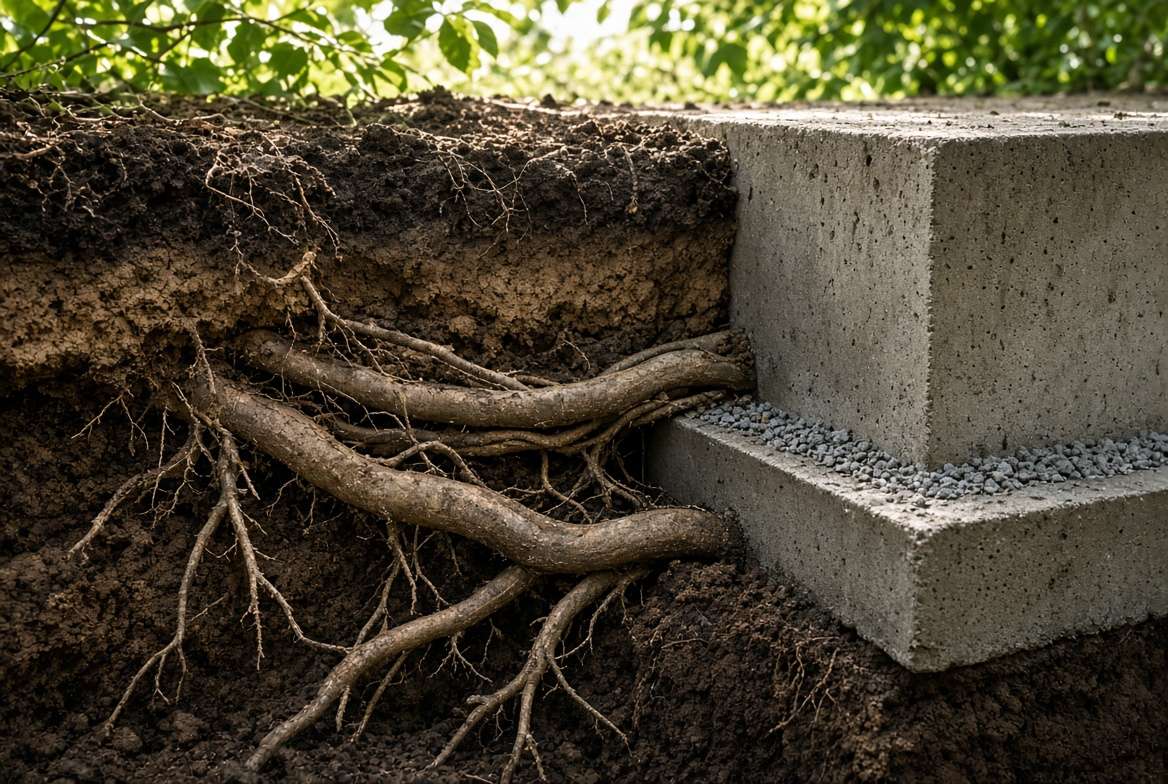
When a seed first sprouts, it sends down a primary taproot to anchor the plant. However, as the tree matures, oxygen and nutrients are almost exclusively found near the soil surface. Because roots actively seek out these vital resources, up to 90% of a tree’s root system develops in the top 18 to 24 inches of soil. These are called lateral roots, and they spread outward horizontally.
Aggressive, fast-growing trees send their lateral roots sprawling three to seven times the width of their canopy. When these thick, powerful roots encounter a solid object—like a concrete driveway, a sidewalk, or a basement wall—they do not simply stop. As the roots expand in diameter (secondary growth), they exert immense hydraulic pressure, capable of lifting concrete slabs and exploiting micro-cracks in foundation walls.
The Soil Shrink-Swell Cycle 💧
Direct root pressure is only half the battle. The secondary cause of foundation damage is the soil shrink-swell cycle, particularly in regions with heavy clay soils. Large, thirsty shade trees can absorb hundreds of gallons of water per day. During a dry summer, these aggressive root systems drain the moisture from the soil directly abutting your foundation. As clay soil dries out, it shrinks and subsides. Your foundation settles into this void, leading to structural cracks. When the rains return, the soil swells, pushing the compromised foundation back up.
💡 Expert Insight: Never plant Weeping Willows, Poplars, Aspens, or Silver Maples anywhere near a residential structure. These are riparian species, meaning they are evolutionarily designed to aggressively seek out massive amounts of water. Their roots will relentlessly track the condensation on the outside of your plumbing pipes until they crush them.
The 9 Best Trees for Front Yard Curb Appeal (Safe & Non-Invasive) 🏆
The following selections have been carefully vetted not just for their visual impact, but for their predictable, slow-growing, and well-behaved root structures.
1. Japanese Maple (Acer palmatum) 🍁
The Japanese Maple is the undisputed king of architectural landscaping. With its delicate, lacy leaves and stunning structural branching, it provides an immediate sense of high-end design to any front yard.
-
Why it’s safe: Japanese maples have an exceptionally compact, fibrous root system. They do not develop massive, woody lateral roots that heave concrete, making them incredibly safe to plant near entryways, porches, or decorative retaining walls.
-
Key Specs: USDA Zones 5-8 | Height: 10-25 ft | Sun: Dappled shade to morning sun.
-
Expert Care Tips: These trees thrive in slightly acidic, well-draining soil. They are highly susceptible to leaf scorch, so avoid planting them in areas with harsh, late-afternoon sun or heavy wind exposure. To protect their shallow fibrous roots, maintain a 3-inch layer of organic mulch over the root zone, ensuring the mulch does not touch the trunk to prevent bark rot. If you want guaranteed deep-red color from spring to fall, seek out the ‘Bloodgood’ or ‘Emperor I’ cultivars.
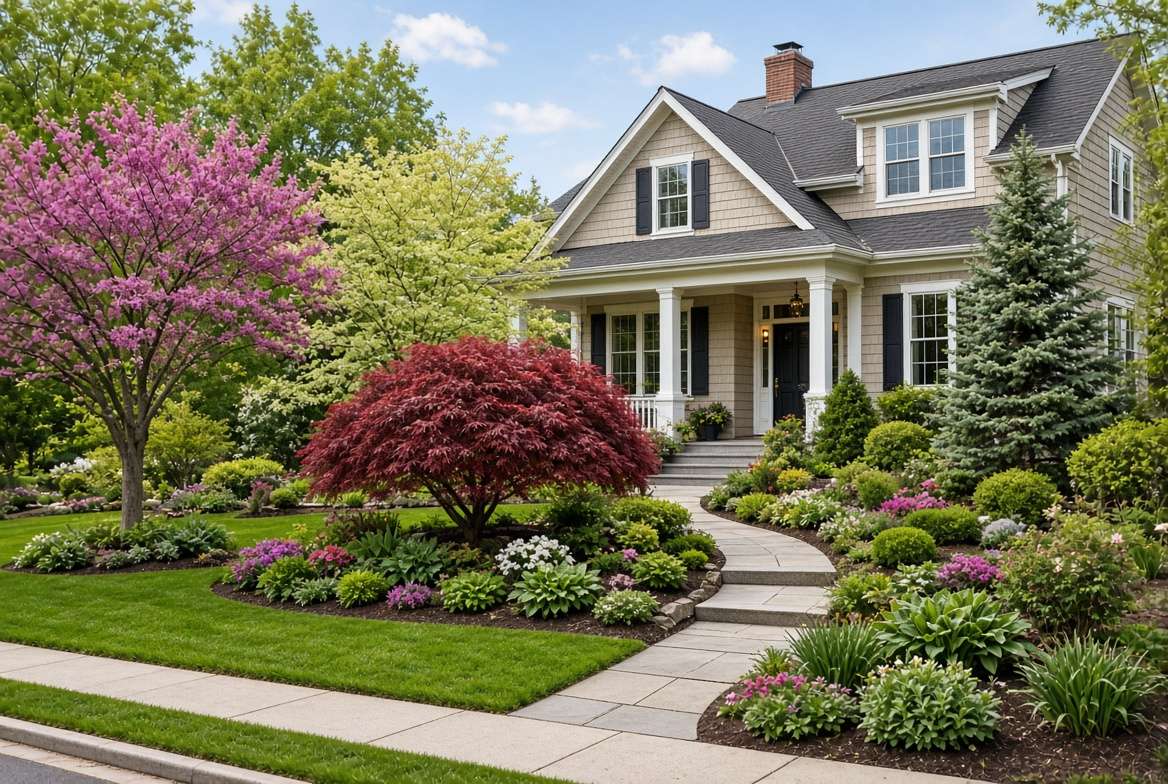
2. Crape Myrtle (Lagerstroemia) 🌸
If you live in a warmer climate and want an explosion of summer color, the Crape Myrtle is unparalleled. These trees offer months of vibrant, paper-like blooms followed by stunning exfoliating bark that provides beautiful winter interest when the tree drops its leaves.
-
Why it’s safe: Crape Myrtles have a dense but non-aggressive root system that stays highly localized. Furthermore, because they are so tolerant of heavy pruning, it is incredibly easy to manage their canopy size, which naturally keeps the root system in check.
-
Key Specs: USDA Zones 7-10 | Height: 15-25 ft | Sun: Full sun.
-
Expert Care Tips: Crape Myrtles require at least 6 to 8 hours of direct sunlight to bloom prolifically. While drought-tolerant once established, they need deep watering during their first two growing seasons. Beware of “crape murder”—the terrible landscaping practice of chopping the tree down to ugly stumps every winter. Instead, selectively prune crossing branches to maintain a natural vase shape. Look for disease-resistant hybrids named after Native American tribes (like ‘Natchez’ for white blooms or ‘Tuscarora’ for coral pink) to avoid powdery mildew issues.
3. Eastern Redbud (Cercis canadensis) 💜
The Eastern Redbud is a springtime showstopper. Before its heart-shaped leaves even emerge, the bare branches are completely covered in tight clusters of vivid magenta or soft pink flowers. It is an extraordinary early-season pollinator magnet.
-
Why it’s safe: In the wild, the Redbud is an understory tree. It has evolved to share root space with massive forest giants without competing aggressively. Its roots are relatively shallow and polite, posing zero threat to masonry or underground pipes.
-
Key Specs: USDA Zones 4-9 | Height: 20-30 ft | Sun: Full sun to part shade.
-
Expert Care Tips: Redbuds prefer moist, rich soil but are surprisingly adaptable to clay as long as it does not stay waterlogged. They have a naturally multi-stemmed, sprawling growth habit. Structurally prune them when young to establish one or two strong central leaders. Because they are susceptible to Botryosphaeria canker—a fungal disease that enters through bark wounds—always prune during dry weather and sanitize your shears with rubbing alcohol between cuts.
4. Kousa Dogwood (Cornus kousa) 🌼
While the native Flowering Dogwood (Cornus florida) is lovely, the Kousa Dogwood is a far superior choice for front yard durability. It blooms slightly later in the spring, producing distinctive, pointed, star-shaped “flowers” (which are actually bracts). In autumn, it yields edible red berries and fiery reddish-purple foliage.
-
Why it’s safe: Kousa Dogwoods are slow growers. Their root systems expand at a very manageable pace and remain highly contained within the tree’s drip line.
-
Key Specs: USDA Zones 5-8 | Height: 15-25 ft | Sun: Full sun to part shade.
-
Expert Care Tips: The primary reason arborists recommend the Kousa over the native Dogwood is its high resistance to Dogwood Anthracnose, a devastating fungal disease. Kousas prefer slightly acidic soil and consistent moisture. They do not handle prolonged urban drought well, so install a drip irrigation ring for the hot summer months.
5. Star Magnolia (Magnolia stellata) ⭐
When people think of Magnolias, they usually envision the massive Southern Magnolia, which has a notoriously aggressive, surface-level root system that destroys sidewalks. The Star Magnolia, however, is its polite, compact cousin. It produces masses of delicate, ribbon-like white blossoms in early spring before the foliage appears.
-
Why it’s safe: The Star Magnolia is essentially a large shrub that can be trained into a small, multi-trunked tree. Its roots are soft, fleshy, and stay close to the planting hole, lacking the woody density required to damage concrete.
-
Key Specs: USDA Zones 4-9 | Height: 15-20 ft | Sun: Full sun.
-
Expert Care Tips: Because it blooms so early in the spring, the Star Magnolia’s buds are highly susceptible to late frost damage. Plant it in a slightly sheltered location, preferably avoiding southern exposures which might encourage it to bloom too early in a false spring. The fleshy roots resent being disturbed, so avoid underplanting it with heavy ground covers that require deep digging.
6. Serviceberry (Amelanchier) 🫐
If you want true four-season interest in your landscape design, the Serviceberry is an arboriculture triumph. It delivers delicate white blossoms in early spring, delicious edible berries in the summer (which taste similar to blueberries and attract local songbirds), brilliant fiery orange and red foliage in the fall, and elegant, smooth gray bark that stands out in the winter snow.
-
Why it’s safe: Serviceberries have a very modest, non-destructive root footprint. They are often planted in narrow urban parkways or small courtyard gardens without ever disturbing nearby hardscaping.
-
Key Specs: USDA Zones 4-9 | Height: 15-25 ft | Sun: Part shade to full sun.
-
Expert Care Tips: Serviceberries are relatively low-maintenance but perform best in well-drained, slightly acidic soil. The biggest issue they face is rust diseases (such as cedar-apple rust). To mitigate this, ensure the tree has good air circulation by selectively pruning the inner canopy, and avoid planting it near wild Juniper trees, which act as the alternate host for the rust fungus.
7. American Fringe Tree (Chionanthus virginicus) ☁️
Often overlooked in commercial nurseries, the American Fringe Tree is a native gem that deserves a prime spot in your front yard. In late spring, it produces cascading clusters of feathery, white, cloud-like flowers that emit a remarkably sweet fragrance.
-
Why it’s safe: This is a very slow-growing tree that rarely exceeds 20 feet in height. Its roots are incredibly polite, expanding at a glacial pace, meaning it will never aggressively push toward your home’s foundation to seek out moisture.
-
Key Specs: USDA Zones 3-9 | Height: 12-20 ft | Sun: Full sun to part shade.
-
Expert Care Tips: The Fringe Tree is remarkably tolerant of urban air pollution, making it an excellent choice if your front yard faces a busy street. It prefers moist, fertile soil and requires very little pruning. Because it is dioecious (having separate male and female plants), only the female trees produce the attractive blue-black olive-like fruits in late summer—though both sexes produce the stunning flowers.
8. Disease-Resistant Crabapple (Malus) 🍎
A flowering Crabapple brings a classic, storybook cottage garden aesthetic to any property. In spring, they are smothered in pink, white, or red blossoms, followed by colorful small fruits that persist into winter, providing critical food for overwintering birds.
-
Why it’s safe: Crabapple trees develop deep-anchoring roots rather than shallow, surface-heaving lateral roots. When placed properly, they are highly unlikely to impact sidewalks or masonry.
-
Key Specs: USDA Zones 4-8 | Height: 15-25 ft | Sun: Full sun.
-
Expert Care Tips: The secret to success with Crabapples is entirely in the cultivar selection. Older varieties are notoriously susceptible to apple scab, fire blight, and powdery mildew, which can defoliate the tree by August. As an expert, I exclusively recommend planting modern, disease-resistant cultivars such as ‘Prairifire’, ‘Sugar Tyme’, or ‘Sargent’. Additionally, look for “persistent” fruit varieties; these hold onto their small apples through the winter rather than dropping them on your lawn, making them incredibly clean trees.
9. Emerald Green Arborvitae (Thuja occidentalis) 🌲
Not all front yard trees need to be deciduous flowering specimens. If you are looking for formal, evergreen structure—perhaps to frame a front door, anchor the corners of a home, or create a privacy screen from the street—the Emerald Green Arborvitae is an impeccable choice.
-
Why it’s safe: Conifers like Arborvitae have extremely tight, dense, fibrous root systems. The root zone rarely spreads far beyond the tree’s drip line, making them perfectly safe to plant near foundation walls or concrete walkways.
-
Key Specs: USDA Zones 3-8 | Height: 10-15 ft (width only 3-4 ft) | Sun: Full sun to part shade.
-
Expert Care Tips: Emerald Greens are highly susceptible to winter burn if they go into the colder months dehydrated. Give them a deep, slow soaking right before the ground freezes in late autumn. If you live in an area with heavy snowfall, gently wrap the tree with twine in late fall to prevent heavy ice and snow from splitting the tight, upright branches.
The Golden Rule of Placement: How Far from the House Should You Plant? 📏
Even with the safest, most polite root systems, proper spacing is critical for the long-term health of both your home and the tree. Planting a tree too close to a house restricts air circulation, invites pests to jump from branches to your roof, and stunts the tree’s natural growth habit.
The “Mature Canopy” Formula 🧮
A standard rule of thumb in landscape architecture is to plant a tree at a distance equal to at least half of its mature canopy width.
-
If a tree is expected to grow 20 feet wide at maturity, it must be planted a minimum of 10 feet away from the foundation.
-
This ensures that the canopy will perfectly graze the side of the house at full maturity without overlapping the roof, while keeping the densest part of the root system safely distanced from your concrete footings.
Beware of Utilities (Call Before You Dig!) ⚠️
Roots are not the only underground hazard. Your front yard is a web of buried utility lines, including gas, water, sewer, and fiber-optic cables. In the United States, dialing 811 connects you to a free national service that will dispatch technicians to mark your underground utilities with spray paint or flags. Never dig a planting hole without calling first—striking a gas line is a catastrophic and expensive mistake.
Plant Care Expert Secrets: How to Train Roots to Grow Down, Not Out 💧
Once you have selected from the best trees for front yard planting, how you care for it during its first three years dictates how its root system will behave for the rest of its life. You can actually “train” tree roots to dive deep away from your foundation using these expert techniques.
Deep, Infrequent Watering The biggest mistake homeowners make is lightly sprinkling their trees with a hose for five minutes every day. This traps all the moisture in the top two inches of soil, encouraging roots to grow upward to the surface where they ruin lawns and crack sidewalks. Instead, water your new tree deeply (a slow trickle from a hose for 45 minutes) just once or twice a week. This allows water to percolate deep into the subsoil, forcing roots to grow downward to chase the moisture.
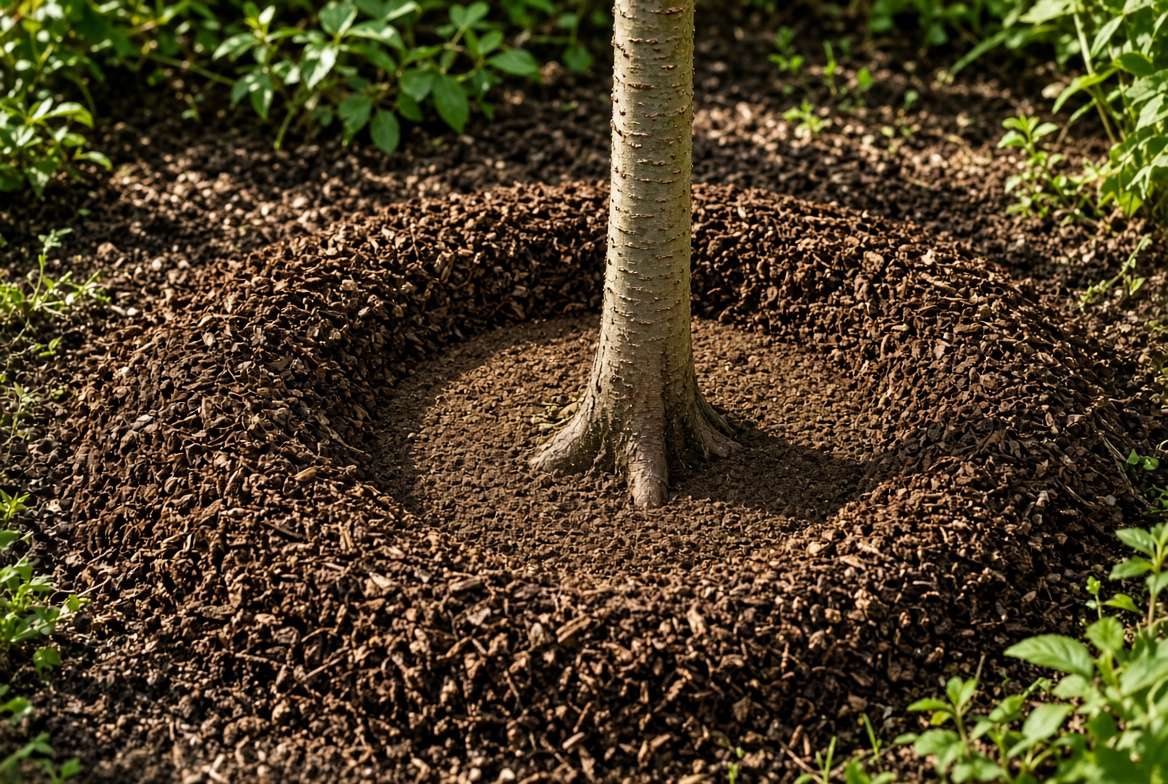
Banish the “Mulch Volcano” Take a drive through any neighborhood, and you will see trees with mulch piled high against their trunks like a volcano. This is a lethal landscaping practice. Mulch volcanoes suffocate roots, trap moisture against the bark (causing crown rot), and trick roots into growing up into the mulch rather than down into the soil.
-
The Pro Method: Use the “donut method.” Apply a 3-inch layer of organic mulch out to the tree’s drip line, but leave a 3-to-4-inch gap of bare soil right around the trunk flare.
Avoid the “Teacup Effect” When planting in heavy clay soil, people often fill the planting hole with rich, fluffy potting soil and compost. Because the surrounding clay is so dense, water easily drains into the fluffy soil of the planting hole but cannot drain out into the clay. This creates a literal underground teacup, drowning the tree’s roots in a puddle of stagnant water. Always plant the tree using the native soil you dug out, amending it with no more than 10-20% compost, so the roots are forced to adapt and push outward into the native environment.
Frequently Asked Questions (FAQs) ❓
What is the cleanest tree for a front yard?
If you hate raking up seed pods, dropped fruit, or sticky sap, the cleanest trees are those with compact growth habits and sterile flowers. The Kousa Dogwood and Japanese Maple are exceptional choices. They drop their leaves predictably in the fall but do not litter your lawn with messy debris during the spring and summer.
Can I plant a tree 5 feet from my house?
Generally, no. Most trees need a minimum of 10 to 15 feet of clearance from a foundation. If you only have a 5-foot clearance, you must opt for large shrubs or strictly columnar evergreen varieties, like the Emerald Green Arborvitae or a Sky Pencil Holly, which grow straight up without sprawling lateral roots.
Which trees increase property value the most?
According to real estate studies, healthy, mature shade and ornamental flowering trees can increase a home’s property value by up to 15%. Trees that offer year-round interest—like the Crape Myrtle or Eastern Redbud—provide massive curb appeal that immediately signals to buyers that the home and landscape have been meticulously cared for.
Conclusion: Ready to Boost Your Curb Appeal? 🌟
Transforming your landscape doesn’t have to mean risking your home’s structural integrity. By understanding how roots behave and selecting the right species, you can enjoy decades of shade, flowers, and architectural beauty with zero stress. The secret is simply choosing from these best trees for front yard landscapes, spacing them correctly using the mature canopy formula, and watering deeply to encourage downward root growth.
Which of these 9 trees is your favorite for your specific hardiness zone? Are you leaning toward the floral explosion of the Crape Myrtle or the delicate elegance of the Japanese Maple?
If you are planning a landscape overhaul, don’t stop here. Ensuring your new tree thrives requires excellent soil prep and seasonal maintenance. Be sure to explore my comprehensive guides on How to Prune Japanese Maples for perfect structural growth, or check out The Best Organic Fertilizers for Spring Blooms to give your new front yard centerpiece the ultimate head start!











