

Seeing the vibrant green palm tree palms in your living room or garden suddenly fade to a sickly yellow is enough to send any plant parent into a panic. Whether you are nurturing a majestic indoor Kentia or tending to outdoor Sago palms, those lush, tropical fronds are the star of the show. When they lose their color, it is a clear distress signal that something in their environment or care routine is fundamentally off-balance.
But before you rush to drown your plant in water or douse it in generic fertilizer, take a deep breath. 🌿
Yellowing palm leaves are incredibly common, and while they can indicate a critical root emergency, they can also simply mean your plant is going through a normal aging process. The secret to restoring your palm’s vibrant, tropical health lies in accurate diagnosis.
In this comprehensive, horticulturist-backed guide, we will break down the exact reasons why your palm fronds are losing their green. From decoding nutrient deficiencies to mastering your watering schedule, you’ll learn the expert way to troubleshoot, treat, and prevent yellowing leaves so your palm can thrive for years to come. Let’s dive in! 💦
🍂 Natural Aging vs. True Distress: Knowing the Difference
The very first step in diagnosing a yellowing palm tree is understanding how these magnificent plants actually grow. If you misdiagnose natural aging as a disease, you might accidentally kill your plant by “over-treating” it.
The Golden “Bottom-Up” Rule of Palms
Palms are unique in the botanical world. Unlike branching trees, most palms grow from a single central point at the top of the trunk, known as the apical meristem (or crown). Because all new growth emerges from the very top center, the oldest leaves are always pushed outward and downward toward the base of the plant.
If you notice that only the oldest, lowest fronds are turning yellow, and eventually brown, while the new growth at the top is vibrant and green—congratulations! Your plant is perfectly healthy. 🪴 This is natural shedding.

💡 Expert Insight: Why You Shouldn’t Cut Yellow Leaves Too Soon
When an old palm frond begins to die, it doesn’t just stop working. The palm actively pulls valuable nutrients (like potassium) out of that dying leaf and translocates them up to the crown to fuel the growth of new fronds. If you prune that yellowing leaf off too early for aesthetic reasons, you are literally stealing food from your plant! Wait until the frond is completely brown and dry before snipping it.
When to Worry: Signs of True Distress
If your palm is experiencing an environmental or health crisis, the yellowing will look different. It is time to intervene if you see:
-
New growth (the spears at the top) turning yellow or opening with necrotic (dead) tips.
-
Yellow spotting, mottling, or streaks across the middle fronds.
-
The entire canopy turning a pale, washed-out yellow simultaneously.
-
Yellowing accompanied by mushy stems, foul odors, or sticky residue.
🔍 5 Common Reasons Your Palm Tree Palms Are Turning Yellow
If you’ve ruled out natural aging, it’s time to play plant detective. Here are the five most common culprits behind yellowing palm fronds, starting with the most frequent offender.
💧 1. Watering Woes: The Over vs. Under Debate
Improper watering is the number one killer of both indoor and outdoor palms. These tropical beauties prefer consistently moist soil, but they absolutely despise “wet feet” (roots sitting in stagnant water).
The Overwatering Crisis (Root Rot) When palm roots sit in soggy, poorly draining soil, they suffocate from a lack of oxygen. This leads to fungal root rot.
-
The Symptoms: The entire plant may begin to look droopy and limp. The fronds will turn a pale yellow, sometimes feeling soft or slightly mushy rather than dry. If you smell the soil, it might have a swampy, rotting odor.
-
The Fix: You must check the drainage. Ensure your pot has drainage holes and that the soil is aerated with perlite or coarse sand. If root rot has set in, you will need to repot the plant, trimming away any black, slimy roots before placing it in fresh, dry palm-specific soil.

The Underwatering Crisis On the flip side, if the soil becomes bone dry, the palm cannot pull up the moisture required to maintain its massive fronds.
-
The Symptoms: The yellowing usually starts at the very tips of the leaflets and works its way inward. The yellow areas will quickly turn brown, crispy, and brittle to the touch.
-
The Fix: Implement the “Knuckle Test.” Stick your finger into the soil up to your second knuckle (about 2 inches deep). If it feels completely dry, it’s time for a deep, thorough watering until water runs out the bottom of the pot.
🍽️ 2. Nutrient Deficiencies (The Big Three)
Palms are heavy feeders, and they require a very specific balance of macronutrients and micronutrients. Generic houseplant fertilizers often lack the heavy trace minerals that palms desperately crave.
-
Nitrogen (N) Deficiency: This causes a uniform, overall pale green or yellowing of the entire canopy. The plant simply stops growing, and the leaves look washed out.
-
Potassium (K) Deficiency: This is arguably the most common palm deficiency. It presents as translucent yellow, orange, or bronze spotting on the oldest leaves. As it progresses, the tips of the fronds will turn black and die, while the base of the leaf remains green.
-
Magnesium (Mg) Deficiency: This has a very distinct, classic look. The edges of the older leaves will develop a broad, bright yellow band, while the center vein of the leaf remains distinctly dark green.

☀️ 3. Lighting Issues: Sunburn or Shade Starvation?
Palms have specific light requirements depending on their species. A Parlor Palm loves the understory shade, while a Date Palm thrives in baking, full sun.
-
Indoor Palms (Shade Starvation): If a light-loving palm is shoved into a dark corner, the plant cannot photosynthesize enough energy to support its massive canopy. The fronds will stretch (etiolation) and turn a pale, sickly yellow as the plant starves for light.
-
Outdoor/Transitioning Palms (Sunburn): If you take an indoor palm and suddenly place it outside in direct summer sunlight without slowly acclimatizing it, the intense UV rays will literally scorch the leaves. This results in large, bleached-yellow or white patches that eventually turn brown and crispy.
🌡️ 4. Temperature Shock and Drafts
Most popular palm varieties—such as the Areca, Majesty, and Parlor palms—originate from tropical or subtropical climates. They thrive in stable, warm environments and possess almost zero tolerance for freezing temperatures or icy drafts.
When a palm experiences severe temperature shock, its cellular structure is damaged, hindering its ability to photosynthesize and transport water.
-
Indoor Drafts: Placing your indoor palm right next to an aggressive air conditioning vent or a drafty, unsealed window during winter can cause rapid yellowing. The constant blast of cold, dry air strips moisture from the leaves faster than the roots can replenish it.
-
Outdoor Freezes: For outdoor palms, an unexpected frost can cause entire sections of the canopy to turn a sickly yellow and droop almost overnight.
-
The Fix: Keep indoor palms in rooms where temperatures hover consistently between 65°F and 80°F (18°C–27°C). If you are overwintering an outdoor potted palm, bring it inside before the first frost hits, not after.
🐛 5. Pests and Fungal Infections
Unfortunately, the lush foliage of your palm is highly attractive to sap-sucking insects. As these pests drain the life-giving sap from the plant tissue, localized yellowing occurs.
-
Spider Mites: These are the bane of indoor palm tree care. Spider mites thrive in dry indoor air. If you look closely, you will see microscopic webbing nestled where the leaflets meet the stem, accompanied by tiny, stippled yellow dots across the fronds.
-
Scale Insects: Scale looks like small, hard brown or waxy bumps stuck to the stems and leaves. They secrete a sticky substance called honeydew, and you will often see distinct yellow halos forming around their feeding sites.
-
Fungal Leaf Spots: Poor air circulation and wet leaves (often from improper misting) invite fungal pathogens. These start as yellow spots that rapidly turn into dark brown or black necrotic lesions with yellow borders.
🛠️ Step-by-Step Revival: The Expert Way to Fix Yellowing Palms
Now that we have diagnosed the root cause, it is time to take action. Treating yellowing palm leaves requires a targeted approach. Applying fertilizer to an overwatered palm tree, for example, will only burn the remaining healthy roots. Follow these expert protocols based on your diagnosis.
🚿 Correcting Your Watering Regimen
If watering is your issue, you must reset the moisture balance in the root zone immediately.
To Save an Overwatered Palm Tree:
-
Unpot and Inspect: Gently remove the palm from its pot. Inspect the roots. Healthy palm roots are firm and tan/white. Rotted roots are mushy, black, and smell like a swamp.
-
Prune the Rot: Using sterilized pruning shears, cut away all the slimy, dead roots.
-
Repot with Aeration: Replant the palm in a fresh, dry potting mix specifically formulated for palms and citrus. If making your own, combine 2 parts standard potting soil, 1 part perlite, and 1 part coarse horticultural sand to guarantee rapid drainage.
-
Hold the Water: Wait several days before watering to allow the remaining roots to callous over and heal.
To Revive an Underwatered Palm: Do not drown it all at once! Severely desiccated soil often becomes hydrophobic (repelling water). Instead, place the entire pot in a basin of room-temperature water and let it soak from the bottom up for 30 to 45 minutes. This allows the peat and soil to slowly rehydrate without shocking the root system.
🪴 Prescribing the Right Fertilizer
If you identified a nutrient deficiency, specialized feeding is non-negotiable.
-
The Magnesium Quick-Fix: A severe magnesium deficiency in palms can be temporarily treated with an Epsom salt drench. Dissolve 1 tablespoon of Epsom salts in a gallon of water and apply it to the soil. This provides an immediate, bioavailable magnesium boost while you wait for granular fertilizers to break down.
-
Long-Term Feeding: Invest in a high-quality, slow-release outdoor palm fertilizer (or an indoor equivalent) with an N-P-K ratio of approximately 8-2-12, plus added micronutrients (Magnesium, Manganese, and Iron). Apply this to the soil surface strictly according to package instructions during the active growing season.
-
Crucial Warning: Never fertilize a dry, thirsty plant. Always water your palm thoroughly before applying fertilizer to prevent chemical root burn.
🏡 Perfecting Placement and Environment
To elevate your indoor palm tree care, mimic the plant’s natural, humid jungle environment.
-
Light: Find the “Goldilocks” zone. Most palms prefer bright, filtered, indirect light. An East-facing or South-facing window with a sheer curtain is generally perfect.
-
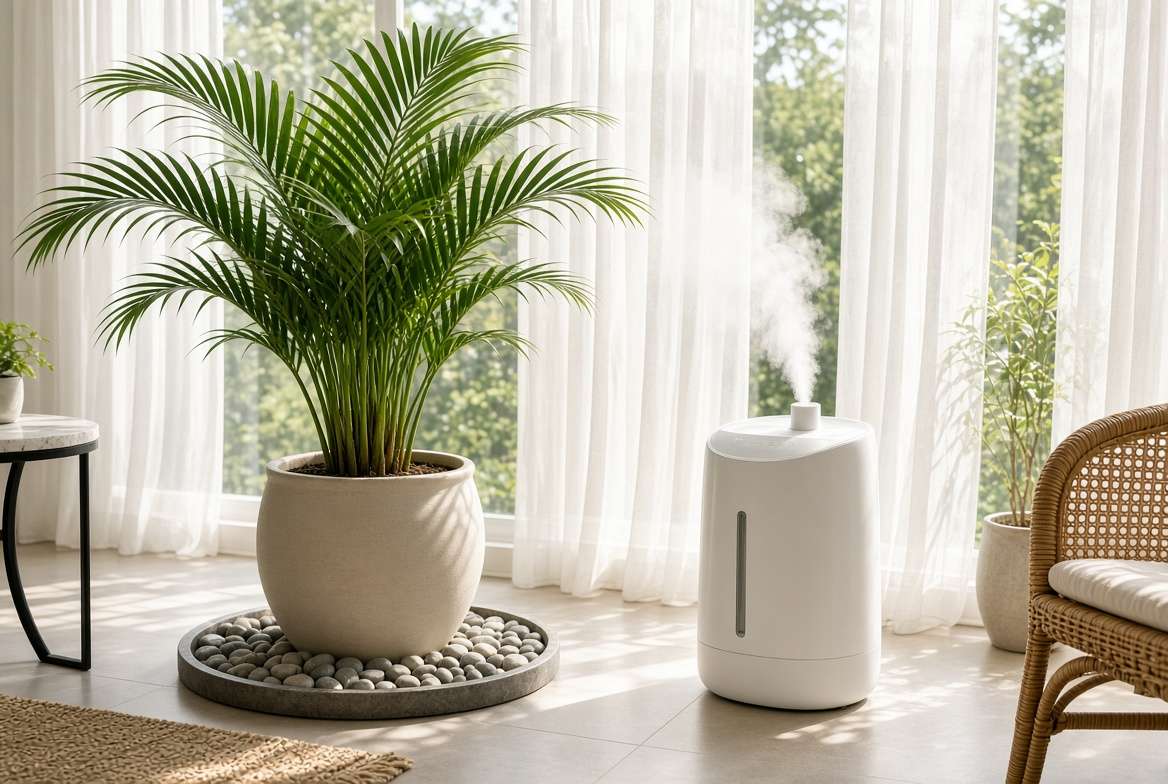
Humidity: Palms suffer in the dry air of modern, climate-controlled homes. Instead of misting the leaves (which evaporates quickly and invites fungus), place a humidifier nearby to keep ambient humidity above 50%. Alternatively, set the palm’s pot on a wide pebble tray filled with water, ensuring the bottom of the pot rests above the water line, not in it.
🛡️ Safe and Effective Pest Eradication
Because “palm tree palms” have a delicate, waxy cuticle, harsh chemical pesticides can cause more harm than good.
-
The Shower Method: For spider mites, take the plant to your shower or outdoors and gently spray down the fronds with lukewarm water. This physically dislodges the pests.
-
Neem Oil Application: Wipe down the front and back of the affected leaves with a diluted solution of cold-pressed Neem oil or a gentle insecticidal soap. Repeat this every 5 to 7 days for three weeks to break the pests’ life cycle completely.
✂️ Should You Cut Off Yellow Palm Leaves? (The Pruning Dilemma)
When a plant looks sickly, our first instinct is to grab the scissors and tidy it up. With palms, this is a dangerous impulse.
The “Wait and See” Approach As long as there is green tissue remaining on a yellowing frond, the palm is actively using it. The plant is salvaging carbohydrates, potassium, and other mobile nutrients from the dying leaf to push out a healthy new spear at the crown. Pruning dead palm leaves too early cuts off this vital food supply, forcing the plant to pull nutrients from the next healthy leaf up the trunk, accelerating the decline.
When and How to Prune
-
When: Wait until the frond is 100% brown, dry, and brittle.
-
How: Never pull or tear the leaf away from the trunk, as this opens wounds susceptible to fungal infections. Instead, take a pair of sharp, sterilized pruning shears and cut the frond off leaving about 1 to 2 inches of the base attached to the main trunk.

📅 Preventative Care: Keeping Your Palm Canopy Green Year-Round
The secret to expert plant care is transitioning from reactive troubleshooting to proactive maintenance. Follow this simple seasonal checklist to keep your palm thriving:
-
Spring/Summer (Active Growth): Water consistently when the top 2 inches of soil are dry. Apply your slow-release palm fertilizer every 2 to 3 months. Monitor for pests as temperatures rise.
-
Fall/Winter (Dormancy): Palms slow their growth dramatically in the winter. Cut your watering frequency in half and completely stop fertilizing. Keep them away from heating vents.
-
Annual Soil Check: Every 12 to 18 months, check if your indoor palm is rootbound. If roots are circling the bottom of the pot or pushing the plant up out of the soil, it is time to upgrade to a pot 2 inches larger in diameter.
❓ Frequently Asked Questions (FAQs)
Can a yellow palm leaf turn green again? No. Once a palm frond has turned yellow due to aging, nutrient deficiency, or environmental damage, the chlorophyll in that specific leaf has broken down permanently. It will not revert to green. Your goal is to correct the underlying issue so that new growth emerges healthy and green.
Are coffee grounds good for palm trees? Coffee grounds can be a decent soil amendment as they add slight acidity and a very mild dose of nitrogen as they break down. However, they should never be used as a replacement for a balanced, micronutrient-rich palm fertilizer. If used indoors, uncomposted coffee grounds can also invite fungus gnats and mold, so use them sparingly.
How often should I water my indoor palm tree? You should never water a palm on a strict calendar schedule (e.g., “every Sunday”). Environmental factors like sunlight, humidity, and temperature change how quickly the plant uses water. Instead, water only when the top 2 to 3 inches of the soil feel completely dry to the touch.
✨ Patience is Your Best Tool
Diagnosing why your palm is turning yellow is the hardest part of the journey. Once you have pinpointed whether the issue stems from an overwatered root system, a lack of magnesium, or an uninvited spider mite colony, you hold the exact blueprint for its recovery.
Palms are famously slow-growing plants. They do not bounce back overnight. It may take several weeks or even a few months for your plant to fully stabilize and push out a vibrant, healthy new green spear from its crown. Trust the process, follow these expert horticultural guidelines, and resist the urge to over-care for it. With consistency and patience, your palm will return to its former tropical glory, bringing life and lushness back into your space. 🌱











