
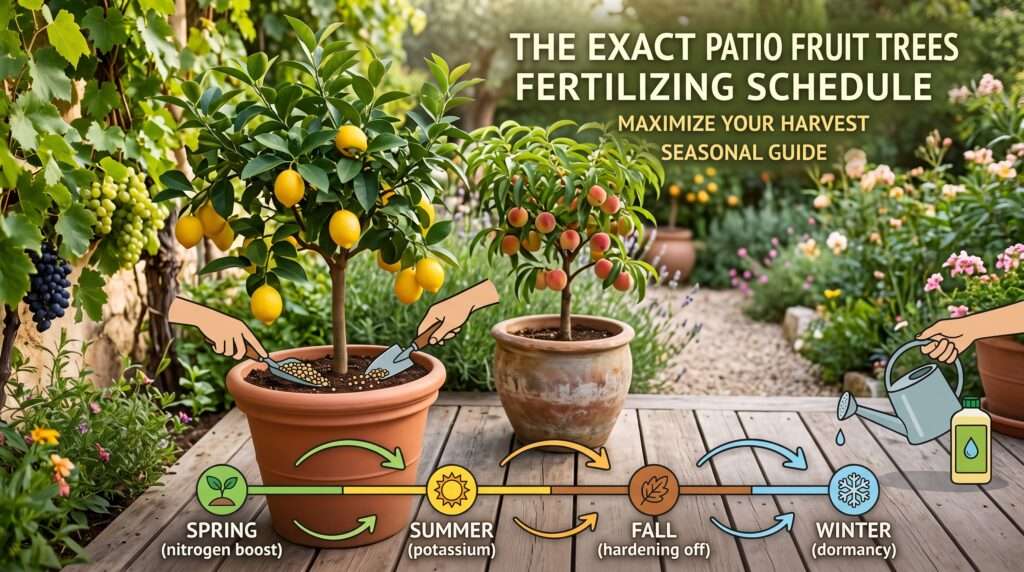
There is a unique kind of heartbreak in meticulously watering and watching a beautiful container tree all season, only to be rewarded with a handful of sad, tiny, flavorless fruits. You envision plucking juicy, sun-warmed lemons or perfectly ripe peaches right off your patio while drinking your morning coffee, but the reality often falls short. If your potted trees are pushing out plenty of leaves but zero produce, the problem isn’t your climate or your watering habits—it is your feeding routine. To transform your container garden into a heavy-bearing mini-orchard, you must implement a precise patio fruit trees fertilizing schedule.
Growing fruit in a confined space is entirely different from orchard farming. Potted trees are completely dependent on you for their survival. Every single nutrient they consume must come from what you provide, and timing those nutrients correctly is the difference between a barren shrub and a picture-perfect, Pinterest-worthy harvest. With years of hands-on experience reviving nutrient-deficient container trees and optimizing soil health, I can tell you that the “secret” to massive yields isn’t a magical product; it is a structured, season-by-season timeline.
Here is your foolproof, step-by-step guide to feeding your potted fruit trees so they stop just surviving, and start aggressively thriving. 🌱
Why Potted Fruit Trees Need a Different Approach Than Orchard Trees 🪴
It is a common mistake to read general tree-care guidelines and apply them to container gardening. If you treat a potted Meyer lemon or a dwarf peach tree like an established tree in the ground, you are on a guaranteed path to stunted growth and poor fruit set. Container horticulture operates under a different set of rules.
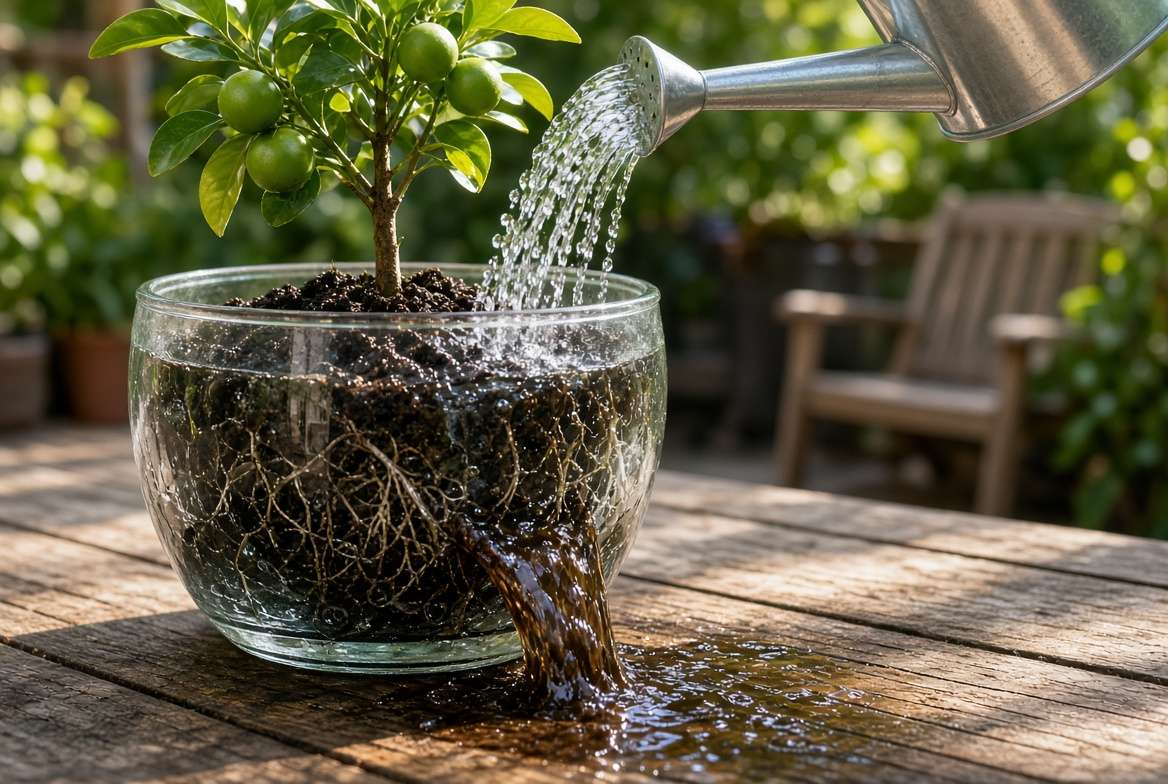
The Nutrient Leaching Problem 💧
In a traditional garden, the soil acts as a massive sponge and reservoir, holding onto essential minerals for months. When it rains, nutrients disperse but largely remain accessible in the vast subterranean network.
In a pot, every time you water your tree until liquid runs out the drainage holes, you are washing away water-soluble nutrients. This process, called leaching, means that the rich compost or premium potting soil you started with in April can be almost completely depleted of nitrogen by June. Frequent watering is non-negotiable for containers, especially in the heat of summer, which means a continuous, managed replacement of those washed-away minerals is equally non-negotiable.
Root Zone Restrictions 🧱
An in-ground fruit tree will send feeder roots dozens of feet outward and downward to forage for exactly what it needs. If the topsoil lacks calcium, the roots dig deeper to find it.
Your patio tree has a hard stop. The plastic or terracotta walls dictate its entire universe. When the soil in that pot runs out of potassium, the tree cannot go looking for more; it simply aborts its developing fruit to save energy. This confined root architecture makes a consistent feeding schedule the absolute most critical component of your plant care routine.
Decoding Fertilizer: What Do Your Patio Fruit Trees Actually Need? 🔬
Walking down the fertilizer aisle can be overwhelming. Before establishing your timeline, you must understand what you are actually feeding your trees and how to read the labels.
Understanding the N-P-K Ratio for Fruit Production 🔢
Every fertilizer bottle or bag displays three numbers (e.g., 10-10-10 or 5-10-5). This is the N-P-K ratio, representing the macronutrients your tree uses in the highest volumes.
-
Nitrogen (N – The First Number): This fuels leafy, green growth. It is crucial in the early spring when the tree is waking up and building the solar panels (leaves) it needs to generate energy. However, too much nitrogen late in the season will result in a massive, bushy tree with absolutely no fruit.
-
Phosphorus (P – The Second Number): This promotes strong root health and is the primary driver for blossom development. Without sufficient phosphorus, your tree will not produce the flowers necessary to set fruit.
-
Potassium (K – The Third Number): This is the fruit-builder. Potassium dictates the size, color, and sugar content (sweetness) of your harvest, while also bolstering the tree’s immune system against diseases and drought stress.
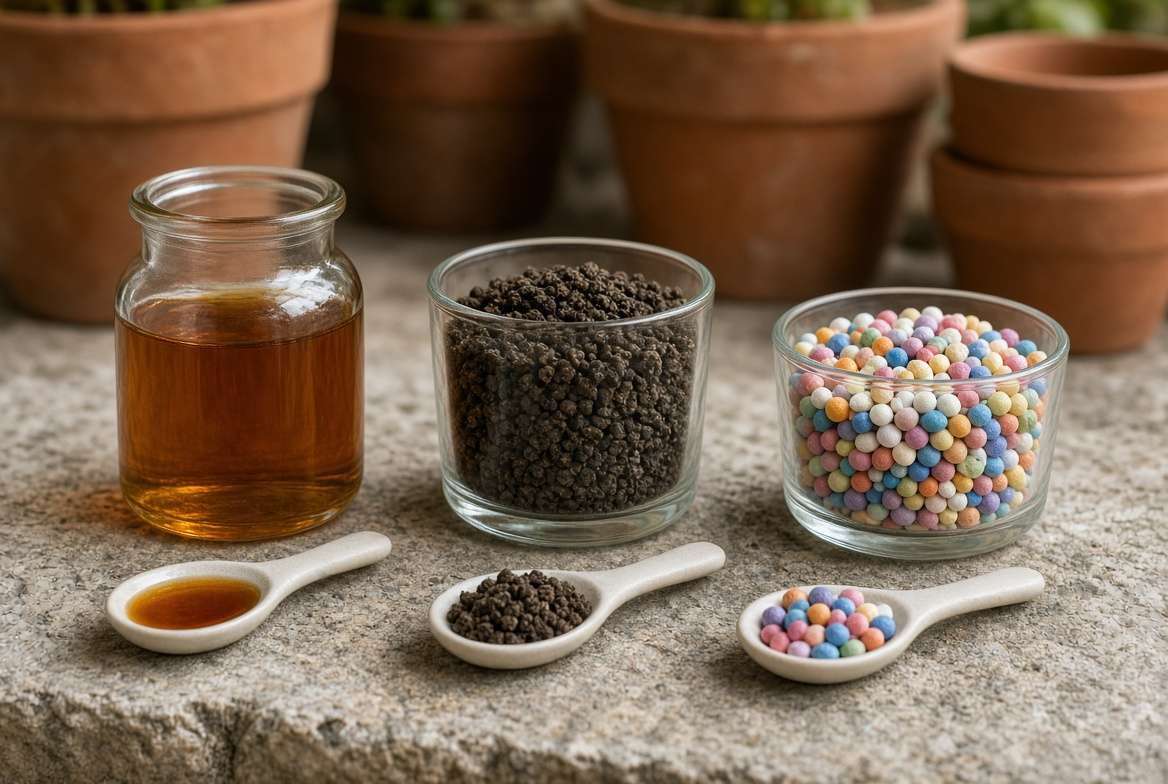
Liquid vs. Granular vs. Slow-Release Options ⚖️
For the most robust soil health and tree vitality, a hybrid approach works best.
Granular Slow-Release Fertilizers act as your foundation. You mix these organic granules into the top inch of the soil. As you water, they slowly break down over 4 to 8 weeks, providing a steady baseline of nutrition without the risk of chemically burning the roots.
Liquid Fertilizers are your targeted boosters. They are mixed with water and delivered instantly to the root zone for immediate uptake. These are perfect for mid-summer when the tree is working incredibly hard to swell its fruit and needs instant energy.
The Unsung Heroes: Micronutrients ✨
While N-P-K gets all the glory, micronutrients are what prevent catastrophic failures in patio trees. Because container soil breaks down quickly, micronutrient deficiencies are incredibly common.
-
Calcium & Magnesium: Essential for cell wall structure. A lack of calcium causes blossom end rot and split fruits.
-
Iron & Zinc: Particularly critical for citrus trees. A lack of iron leads to chlorosis, where the leaves turn pale yellow while the veins remain stark green, eventually halting photosynthesis entirely. Always choose a fertilizer that explicitly states it includes “micronutrients” or “trace minerals.”
The Exact Patio Fruit Trees Fertilizing Schedule (Season-by-Season) 🗓️
This is the core of your strategy. A successful container orchard relies on rhythm. Because potting soil degrades over time, active soil health management is the only way to sustain long-term yields. By timing your nutrient applications to match the tree’s natural biological rhythms, you encourage vigorous blooming and robust fruit set while preventing toxic salt buildup in the root zone.
🌱 Spring: The Awakening (Late February to April)
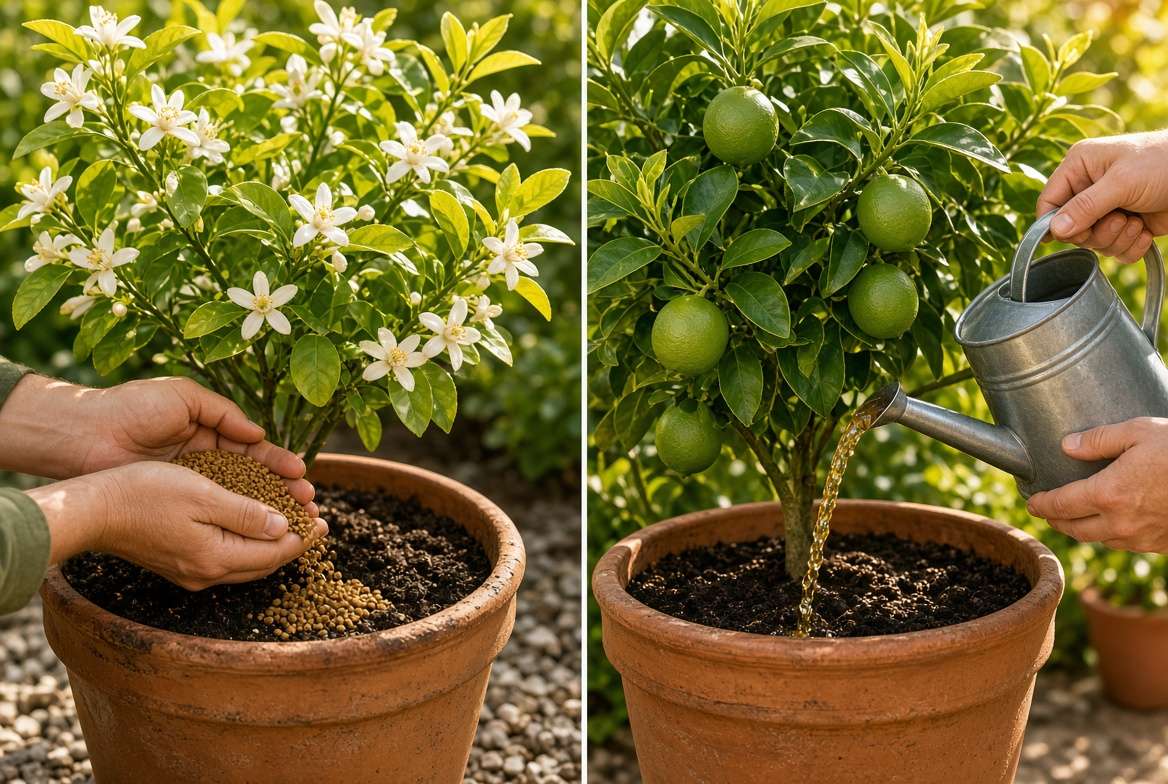
The Timing: The exact moment to begin your spring feeding is just before “bud break”—when you first notice the buds swelling but before the tree has fully leafed out or broken dormancy. The Action: Apply a balanced, slow-release organic granular fertilizer. Work it gently into the top inch of the potting mix and water it in thoroughly. The Why: As the tree wakes up from winter, it is incredibly hungry. It needs a sustained nitrogen push to manufacture the lush, photogenic foliage required for photosynthesis. Simultaneously, it demands a heavy dose of phosphorus to support the energetic marathon of blooming. An organic granular option is ideal here because it breaks down slowly through microbial action in the soil, providing a steady, gentle buffet of nutrients exactly when the tree is pulling water most aggressively.
☀️ Summer: Fruit Development (May to August)
The Timing: Depending on your chosen product, this means liquid feeds every 2 to 4 weeks, or a secondary granular top-up in mid-June. The Action: Shift your ratio. Switch to a lower-nitrogen, higher-potassium formula. If you use a liquid fertilizer, apply it to already-damp soil to prevent root burn. The Why: This is the make-or-break season for patio fruit trees. Once the blossoms drop and the tiny fruits set, the tree’s priorities shift. If you continue hammering the tree with high nitrogen in the summer, the tree will prioritize vegetative growth. It will literally drop its developing fruit on the patio to spend that energy growing more leaves. By switching to potassium, you direct the plant’s energy into swelling the fruit, increasing the sugar content (Brix level), and strengthening the skin against pests.
🍂 Fall: Winding Down (September to October)
The Timing: Early fall, ideally four to six weeks before your region’s first expected frost. The Action: Hard stop on all nitrogen applications. Apply a very light dose of liquid kelp extract or a small handful of bone meal. The Why: Your tree is preparing to sleep. Applying nitrogen now is a fatal error; it encourages a flush of tender, new, bright green growth that will be instantly killed by the first freezing temperatures, severely stressing the plant. Instead, a final touch of phosphorus (bone meal) and potassium (kelp) helps harden off the existing wood, fortifies the root system against winter cold, and stores carbohydrates for the following spring’s bloom.
❄️ Winter: The Rest Period (November to February)
The Timing: Full dormancy. The Action: Absolute zero fertilizer. The Exception: If you are growing tropical or evergreen trees (like a Meyer lemon or Calamondin orange) indoors under heavy grow lights, they do not go fully dormant. They may require a highly diluted, half-strength feeding every 6 to 8 weeks if they are actively pushing new growth, but err on the side of under-feeding.
Customizing the Schedule by Tree Type 🍎🍊
While the seasonal rhythm applies universally, different fruit trees have incredibly distinct dietary preferences. Tailoring your approach to the specific species guarantees those vibrant, picture-perfect results you want to achieve.
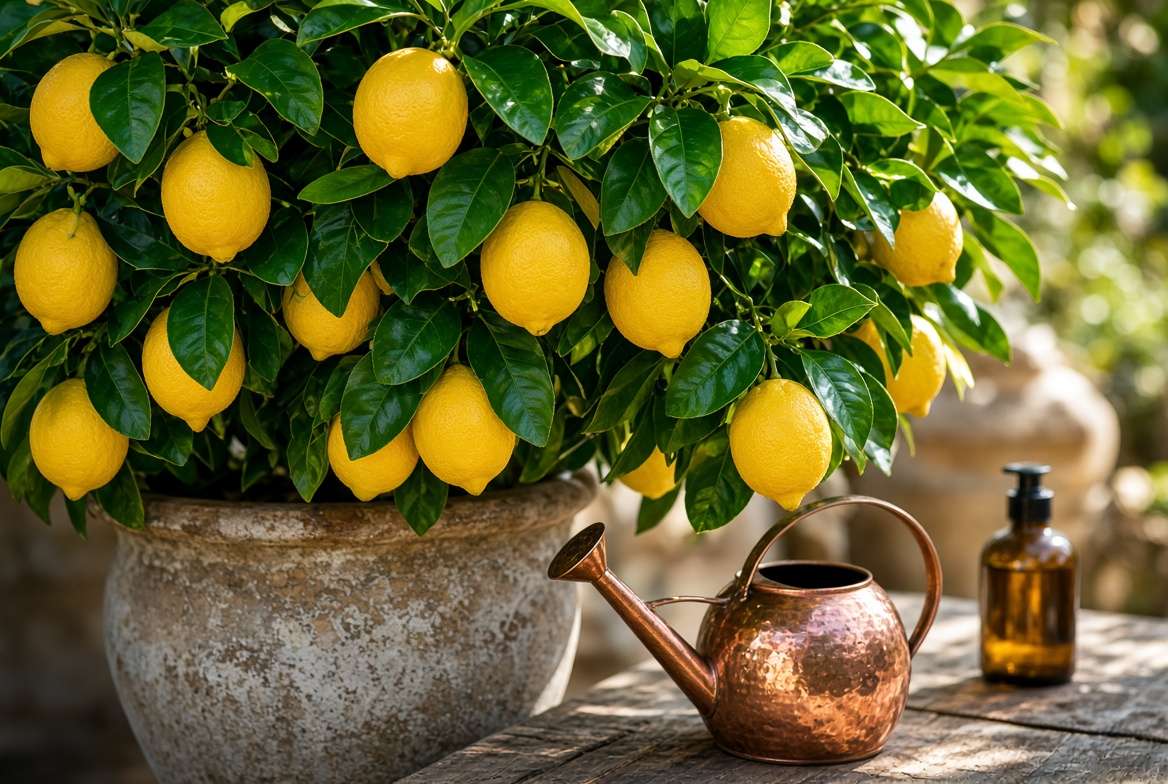
Citrus Trees (Lemons, Limes, Oranges) 🍋
Citrus trees in containers are notoriously heavy feeders. They are ravenous for nitrogen and highly susceptible to trace mineral deficiencies. You cannot use a generic tomato or vegetable fertilizer for citrus and expect great results. You must use a dedicated citrus formula that is heavily fortified with iron, zinc, and magnesium. Without these micronutrients, citrus leaves rapidly develop chlorosis—a condition where the leaf turns a sickly yellow while the veins remain dark green. A dedicated citrus feed applied strictly on schedule keeps the foliage a deep, glossy, vibrant green.
Stone Fruits (Peaches, Cherries, Plums) 🍑
Dwarf peaches, cherries, and plums grown in pots need a massive, singular push in the early spring. Because they bloom so early in the season—often before they even push leaves—that initial granular application at bud break is critical. However, stone fruits are intensely sensitive to late-season nitrogen. If you feed a potted peach tree nitrogen past mid-July, the wood will stay too soft, significantly increasing the risk of winter dieback and bacterial canker.
Pome Fruits (Apples, Pears) 🍏
Apples and pears are highly susceptible to a cellular disorder known as “bitter pit,” which manifests as ugly, dark, sunken lesions on the skin and brown, corky spots inside the flesh. This is almost exclusively caused by a localized calcium deficiency during fruit development. For container apples, supplementing your summer feeding schedule with a liquid calcium spray (foliar feed) directly on the developing fruit and leaves can completely prevent this issue, yielding flawless, market-quality apples.
Figs 🌿
Figs are the ultimate exception to the rule. Compared to fussy citrus or hungry peaches, figs thrive on neglect. They actually prefer slightly poorer soils. If you over-fertilize a container fig tree with nitrogen, you will end up with an absolutely massive, beautiful, sprawling bush that produces zero figs. For patio figs, apply a light, balanced organic fertilizer once in the early spring, and then step away. Let the root restriction and moderate nutrient levels stress the tree just enough to force it into heavy fruit production.
🚨 Signs You Are Doing It Wrong (Troubleshooting Nutrient Issues)
Even with the best intentions, container gardening can be a delicate balancing act. Because the volume of soil is so small, mistakes amplify quickly. Learning to read your tree’s leaves is the most vital skill you can develop as a grower. Here is how to diagnose and fix the two most common feeding errors before they ruin your harvest.
Symptoms of Over-Fertilizing (Fertilizer Burn) 🔥
More is not always better. The most common mistake new growers make is aggressively applying harsh, synthetic fertilizers, assuming it will force the tree to grow faster. Instead, the excess mineral salts draw moisture out of the tree’s roots, causing literal chemical burns.
What it looks like:
-
The margins (edges) of the leaves turn crispy, brown, and brittle, as if they were torched by a lighter.
-
Sudden, massive dropping of seemingly healthy green leaves.
-
A crusty, white or yellowish salt buildup on the surface of the potting soil or around the drainage holes.
The Solution: If you suspect fertilizer burn, you must perform a “soil flush” immediately. Place the pot in an area with excellent drainage and water it continuously with fresh, pure water for 5 to 10 minutes. Allow the water to pour freely out of the bottom to leach out the toxic buildup of excess fertilizer salts. Do not feed the tree again for at least a month.
Symptoms of Under-Fertilizing 📉
When a tree exhausts the nutrients in its pot, it goes into survival mode, cannibalizing its older leaves to support new growth and abandoning any hopes of reproduction.
What it looks like:
-
Overall pale green or yellowing leaves (chlorosis), starting with the oldest leaves at the bottom of the tree.
-
An exaggerated “June Drop.” While it is normal for trees to drop a few unpollinated fruits, a starving tree will aggressively drop almost all of its marble-sized fruits because it lacks the energy to mature them.
-
Zero new vegetative growth during the peak spring season.
The Solution: Do not panic and dump a massive dose of heavy fertilizer into the pot, which can shock the weakened roots. Instead, apply a half-strength, balanced liquid fertilizer to gently introduce nutrients back into the system, followed by a standard granular application a week later.
Expert Tips for Maximizing Container Fruit Yields 🏆
To elevate your patio orchard from amateur to expert, integrate these professional nursery practices into your routine.
-
Tip 1: Never Fertilize Dry Soil 💧 Applying liquid fertilizer to bone-dry potting mix is a recipe for instant root burn. Dry roots absorb water rapidly and indiscriminately, taking in toxic levels of minerals. Always water your container thoroughly with plain water first, wait an hour for the roots to hydrate and the soil to moisten, and then apply your liquid feed.
-
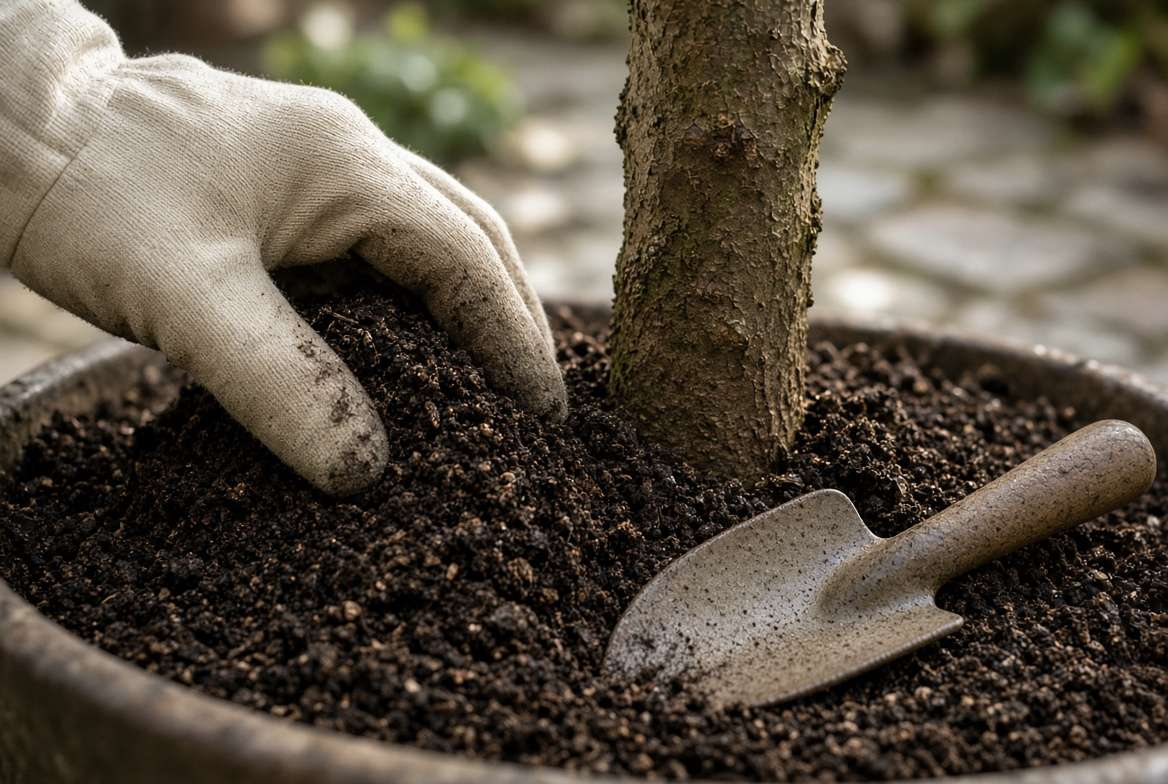
Tip 2: The Magic of Annual Top-Dressing 🍂 Every spring, before your first fertilizer application, gently scrape away the top two inches of old potting soil (being careful not to disturb the surface roots). Replace it with a rich, high-quality organic compost. This top-dressing introduces fresh beneficial microbes into the pot, which are essential for breaking down organic granular fertilizers so the tree’s roots can actually absorb them.
-
Tip 3: Adjust for Your Potting Mix Density 🪴 Heavily aerated potting mixes (those with lots of perlite, pine bark, or sand) drain exceptionally fast. This is great for preventing root rot, but it means nutrients leach out much quicker. If you use a very fast-draining mix, you may need to fertilize a little more frequently but at a slightly weaker dilution to maintain a steady nutrient baseline.
Frequently Asked Questions (FAQs) 🙋♀️
Can I use regular houseplant fertilizer on my patio fruit trees? You should avoid it. Standard indoor houseplant fertilizers are typically formulated to push lush green foliage, meaning they are very high in nitrogen but severely lacking in the phosphorus, potassium, and trace minerals (like calcium and iron) required for fruiting plants. Using it will give you a beautiful, leafy tree that produces zero fruit.
What is the best time of day to apply liquid fertilizer? Always feed your trees in the early morning or late evening. Applying liquid fertilizer during the midday heat when the sun is blazing can stress the plant and cause rapid evaporation, leaving behind concentrated salts that burn the shallow feeder roots.
How do I know if my tree is suffering from a nutrient deficiency or a watering issue? They often mimic each other! Yellowing leaves can mean a lack of nitrogen, or it can mean the roots are drowning in waterlogged, poorly draining soil. Always check the soil moisture first. Stick your finger two inches into the dirt; if it is sopping wet, withhold water and improve drainage. If it is moderately moist but the leaves are still yellowing, it is time to look at your feeding schedule.
Should I fertilize a newly potted fruit tree right away? No. Whether you just brought it home from the nursery or you just repotted it into a larger container, give the tree at least three to four weeks to acclimate to its new environment. Repotting causes minor root trauma; applying fertilizer immediately can burn these damaged roots. Let it settle in, then begin your patio fruit trees fertilizing schedule.
Transitioning your potted fruit trees from surviving to thriving is rarely about luck; it is entirely about consistency. By shifting away from random, sporadic feedings and embracing a structured timeline that respects the tree’s biological needs, you eliminate the guesswork. Mark these crucial seasonal shifts on your calendar, watch how the leaves respond, and prepare your kitchen—because if you stick to this regimen, your patio is about to produce a heavier, sweeter harvest than you ever thought possible.











