
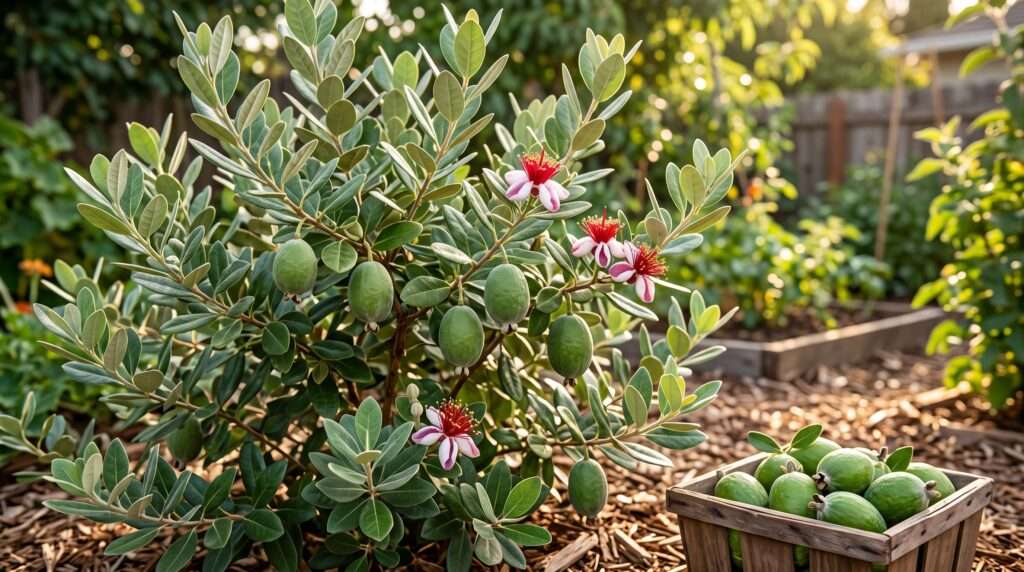
Imagine walking into your garden and plucking a fruit that tastes like a vibrant, tropical blend of sweet pineapple, fresh strawberry, and a hint of zesty mint. That is the magic of the pineapple guava plant (Acca sellowiana, also widely known as Feijoa). This stunning evergreen shrub doesn’t just offer an incredible harvest; it also produces breathtaking, edible flowers that look like exotic orchids blooming right in your backyard. 🌺
However, many gardeners face a common, frustrating problem: “My shrub is growing beautifully with lush green leaves, but why isn’t it producing any fruit?” It is a heartbreaking scenario, especially when you have dedicated seasons to nurturing your plant.
The good news? Cultivating a heavy harvest isn’t about luck; it’s about understanding the specific biological needs of this unique South American native. In this comprehensive guide, we are going to dive deep into the science and practice of perfect plant care. From balancing soil chemistry and establishing precise watering schedules to mastering the little-known pollination tricks required for a heavy harvest, you are about to learn exactly how to transform your ornamental shrub into a highly productive fruit tree. Let’s get growing! 🌱
1. Getting to Know Your Pineapple Guava Plant (Acca sellowiana) 📖
Before you can master the care of any plant, you need to understand where it comes from and how it naturally grows. The Acca sellowiana is an incredibly resilient species, but it has specific preferences that dictate whether it will merely survive or truly thrive.
Origins and Ideal Climate ☀️
Native to the highlands of southern Brazil, eastern Paraguay, Uruguay, and northern Argentina, the pineapple guava is accustomed to subtropical and mild temperate climates. It performs spectacularly in USDA Hardiness Zones 8 through 11.
Unlike purely tropical fruit trees (like mangoes or papayas), the pineapple guava actually requires a modest amount of winter chill (around 100 to 200 chill hours) to set fruit properly. It is remarkably frost-tolerant once established, capable of surviving temperature dips down to 15°F (-9°C) without sustaining severe wood damage. However, late spring frosts can damage delicate flower buds, so positioning your plant in a sheltered microclimate can be beneficial if you live in the cooler margins of Zone 8. ❄️
Landscape Value vs. Orchard Value 🏡
One of the biggest mistakes novice growers make is misunderstanding the plant’s dual nature. Because of its dense, silvery-green foliage, the pineapple guava is frequently sold at nurseries as an ornamental privacy screen or windbreak hedge.
Expert Insight: Treating this plant purely as an ornamental hedge often destroys your fruit yields. Why? Because hedges are typically sheared flat and pruned aggressively multiple times a year. Pineapple guavas fruit on new wood. If you are constantly hedging the shrub into a neat, boxy shape, you are continuously cutting off the very branches that are preparing to bloom and bear fruit. If your goal is a heavy harvest, you must treat this plant with the respect of an orchard tree, allowing it to maintain a more open, natural canopy. 🌳
2. Planting for Long-Term Success 🌱
The foundation of a prolific fruit-bearing plant is established on day one. Proper planting techniques and site selection dictate the health of the root system for decades to come.
Choosing the Perfect Location 📍
Sunlight is the primary driver of fruit production. For the best fruiting results, site your plant in a location that receives full sun (at least 6 to 8 hours of direct, unfiltered sunlight per day).
However, in regions with brutal, scorching summers, providing partial afternoon shade can prevent the foliage from stressing and protect developing fruit from sunscald.
Additionally, these plants are highly wind-tolerant and incredibly salt-tolerant, making them one of the absolute best fruit trees for coastal gardeners who battle salty ocean breezes. 🌊
Soil Requirements & Preparation 🪨
The pineapple guava is adaptable, but it has boundaries. It prefers soil that is slightly acidic to neutral, with a target pH level resting comfortably between 5.5 and 7.0.
The absolute, non-negotiable requirement for this plant is well-draining soil. Their root systems are highly susceptible to root rot (Phytophthora) if left sitting in waterlogged conditions.
-
Actionable Tip for Clay Soil: If you are dealing with heavy, compacted clay soil, do not simply dig a hole and drop the plant in. The clay will act like a bathtub, holding water and drowning the roots. Instead, you must amend the native soil heavily with organic compost, expanded shale, or coarse horticultural sand to improve porosity. Better yet, plant on a slight mound or in a raised berm to ensure gravity pulls excess water away from the root crown. 🪱
Spacing and Planting Techniques 📏
How far apart you plant your guavas depends entirely on your end goal:
-
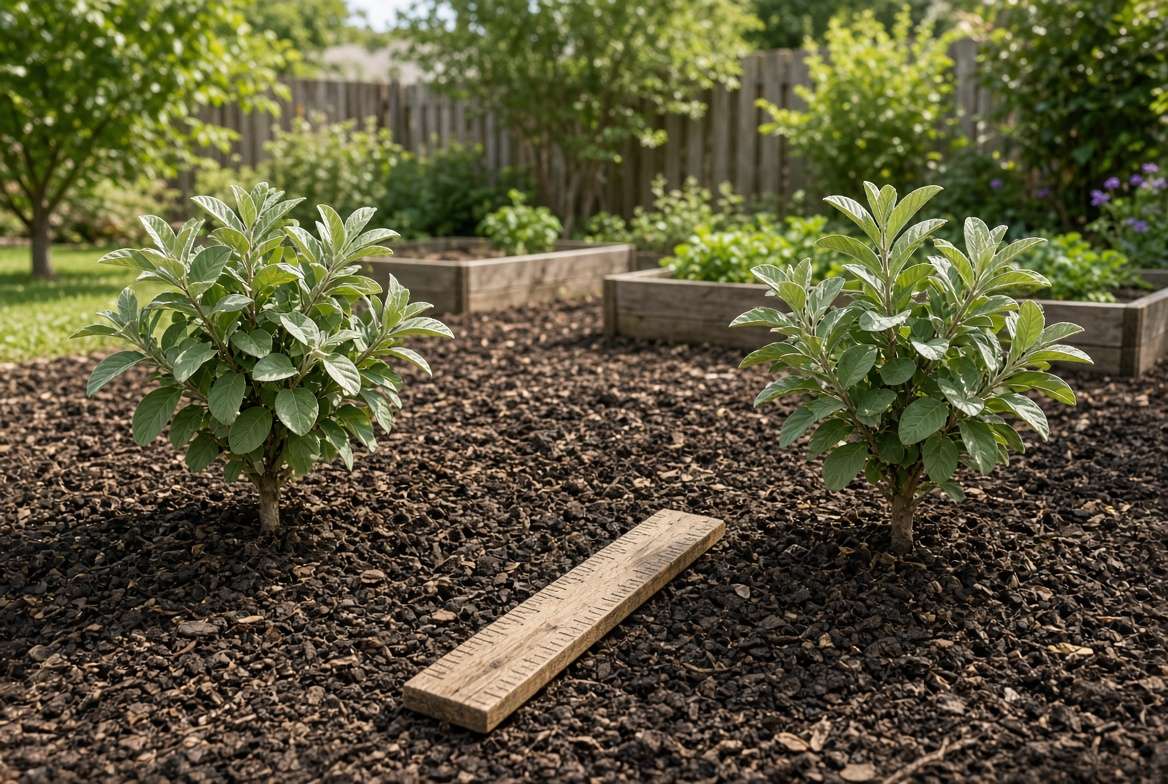
For a Dense Hedge: Space the plants about 3 to 5 feet apart. They will quickly weave together into an impenetrable, gorgeous screen (though, as mentioned, this sacrifices maximum fruit yield).
-
For Orchard-Style Fruit Production: Space the plants 10 to 15 feet apart. This spacing allows ample room for the canopy to spread out, ensures adequate airflow to prevent fungal diseases, and allows sunlight to penetrate all sides of the plant, triggering abundant blooming on every branch. 🌿
3. Core Care Guide: Watering, Feeding, and Maintenance 💧
Once your plant is in the ground, your ongoing care routine will determine the size, flavor, and quantity of your fruit.
Precision Watering for Fruit Development 🚿
Mature pineapple guavas are surprisingly drought-tolerant. If you just want the plant to survive as a green bush, you can largely ignore it once established. But if you want plump, juicy fruit, water is your most critical tool.
During the active flowering and fruiting stages (typically mid-spring through late summer), the plant requires consistent, even moisture. If the plant experiences severe drought stress while holding immature fruit, it will undergo “fruit drop,” aborting the harvest to conserve energy.
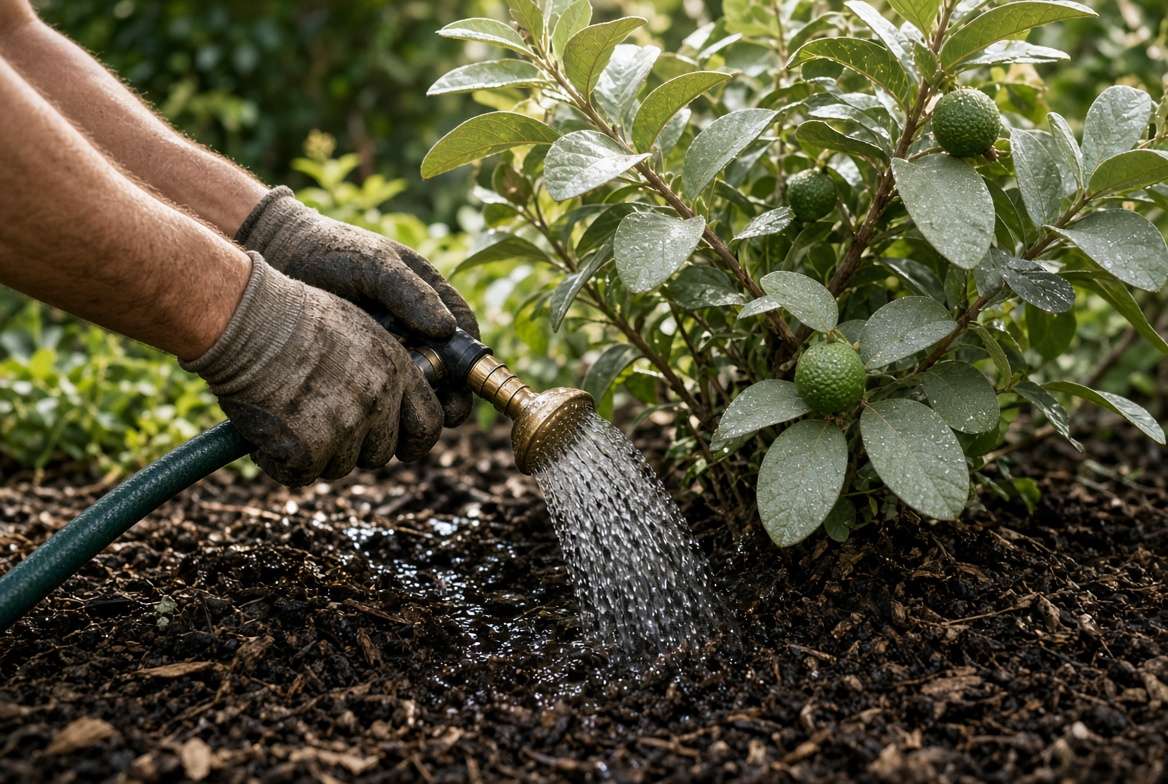
Utilize the deep watering method: Rather than giving the plant a light sprinkle every day, provide a slow, deep soaking once or twice a week (depending on your climate). This encourages the roots to grow deep into the soil profile in search of moisture, making the plant significantly more resilient during heat waves. ☀️
Fertilizing Secrets for Maximum Yield 🪴
Pineapple guavas are not heavy feeders, but strategic fertilization is key to supporting a large harvest without compromising the plant’s health.
-
When to Feed: The optimal time to fertilize is in early spring, just before the new flush of growth begins, followed by a second, lighter application in early summer as the fruit is actively developing.
-
What to Use: Apply a high-quality, organic, balanced fruit tree fertilizer. Look for an N-P-K (Nitrogen-Phosphorus-Potassium) ratio like 5-5-5 or 8-8-8.
-
The Nitrogen Warning: Beware of high-nitrogen lawn fertilizers near your fruiting plants! If you apply a fertilizer with massive amounts of nitrogen (e.g., 20-5-5), the plant will dedicate all its energy to producing beautiful, lush green leaves at the absolute expense of flowers and fruit. If your plant is massive and green but never blooms, excessive nitrogen is likely the culprit. 🚫🌿
Mulching to Protect Shallow Roots 🍂
While the taproot seeks deep moisture, the plant also maintains a delicate network of shallow feeder roots just below the soil surface. These roots are easily stressed by extreme heat and rapid moisture loss.
Apply a 2-to-3-inch layer of organic mulch (like shredded cedar, pine straw, or composted leaves) around the base of the plant. This simple act regulates soil temperature, suppresses competing weeds, and retains vital moisture during the peak summer months.
-
Crucial Rule: Never let the mulch touch the actual trunk of the plant. Leave a 3-inch gap around the base. Piling mulch against the trunk retains excess moisture against the bark, which will eventually lead to crown rot and kill the plant. 🪵
4. The Secret to Fruit: Pollination & Pruning Strategies 🐝
If you have great soil, perfect watering, and beautiful growth, but still no fruit, you have likely run into the great pollination puzzle. This is where most growers fail, but it is incredibly easy to fix.
The Pollination Puzzle (Why You Need Two!) 🧬
Here is the most critical piece of information for fruit production: Most pineapple guava plants require cross-pollination to produce fruit.
While some modern cultivars (like ‘Coolidge’ or ‘Apollo’) are labeled as “partially self-fruitful,” relying on a single plant will almost always result in a disappointing, meager harvest of small fruit. To guarantee a heavy, bountiful yield, you absolutely must plant at least two different varieties near each other.
When you purchase your plants, look for strong pairings. Planting a ‘Mammoth’ next to a ‘Triumph’, or an ‘Apollo’ near a ‘Gemini’, ensures that you have compatible genetics blooming at the same time. The birds and bees will move the pollen between the distinct plants, resulting in significantly larger fruit and dramatically higher yields. 🕊️🐝
How to Hand-Pollinate for Guaranteed Fruit 🖌️
In their native South America, these plants are often pollinated by birds eating the sweet flower petals. If you live in an urban environment where natural pollinators (like bees or specific bird species) are scarce, you may need to intervene to secure your harvest.
Hand-pollination is simple and highly effective:
-
Purchase a small, soft, clean artist’s paintbrush.
-
Wait for a warm, dry afternoon when the flowers are fully open.
-
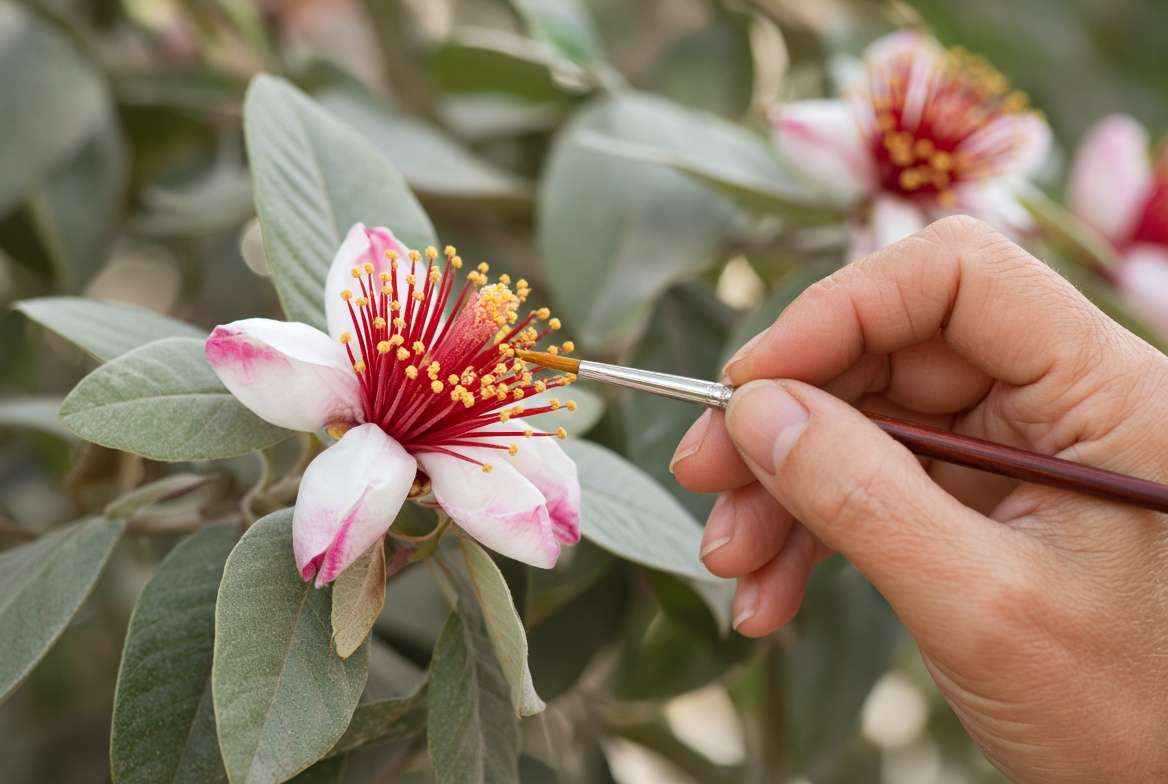
Gently swirl the brush inside the center of a flower on Plant A, collecting the yellow pollen on the bristles.
-
Walk over to Plant B and gently brush the pollen onto the prominent, sticky center stalk (the stigma) of its flowers.
-
Repeat back and forth. You are acting as a highly efficient bee, guaranteeing cross-pollination. 🎨
Pruning Techniques to Encourage Fruiting Wood ✂️
As mentioned earlier, shearing your plant into a formal hedge is the fastest way to eliminate your fruit yield. However, strategic pruning is still necessary to maintain plant health and encourage production.
-
When to Prune: The best time to prune is in late winter or very early spring, just before the new growth begins.
-
How to Prune: Your goal is to increase sunlight penetration and airflow into the center of the canopy. Remove any dead, diseased, or crossing branches. Then, thin out some of the older, dense interior growth.
-
The Fruiting Wood Rule: Remember that flowers and fruit only form on new growth (the wood that emerges in the current season). By thinning the canopy, you stimulate the plant to push out healthy new shoots across the entire structure, maximizing the number of potential fruiting sites. Do not simply trim the tips; remove select branches all the way back to the main trunk to maintain an open, natural shape. 🌿
5. Harvesting and Enjoying the Yield 🍽️
The reward for your precise care is an autumn harvest that is truly unlike anything else you can grow.
Edible Flowers: A Sweet Spring Bonus 🌸
Before the fruit even sets, you get an incredible culinary bonus. The fleshy, pink-and-white petals of the pineapple guava flower are completely edible and taste remarkably like sweet cotton candy or marshmallows.
You can gently pluck the petals off the flowers to toss into spring salads or use as stunning garnishes for desserts.
-
Expert Tip: Only pluck the petals! Be careful not to damage the center stamens or the base of the flower, as this is where your fruit is currently forming. 🥗
How to Tell When Pineapple Guavas are Ripe 🟢
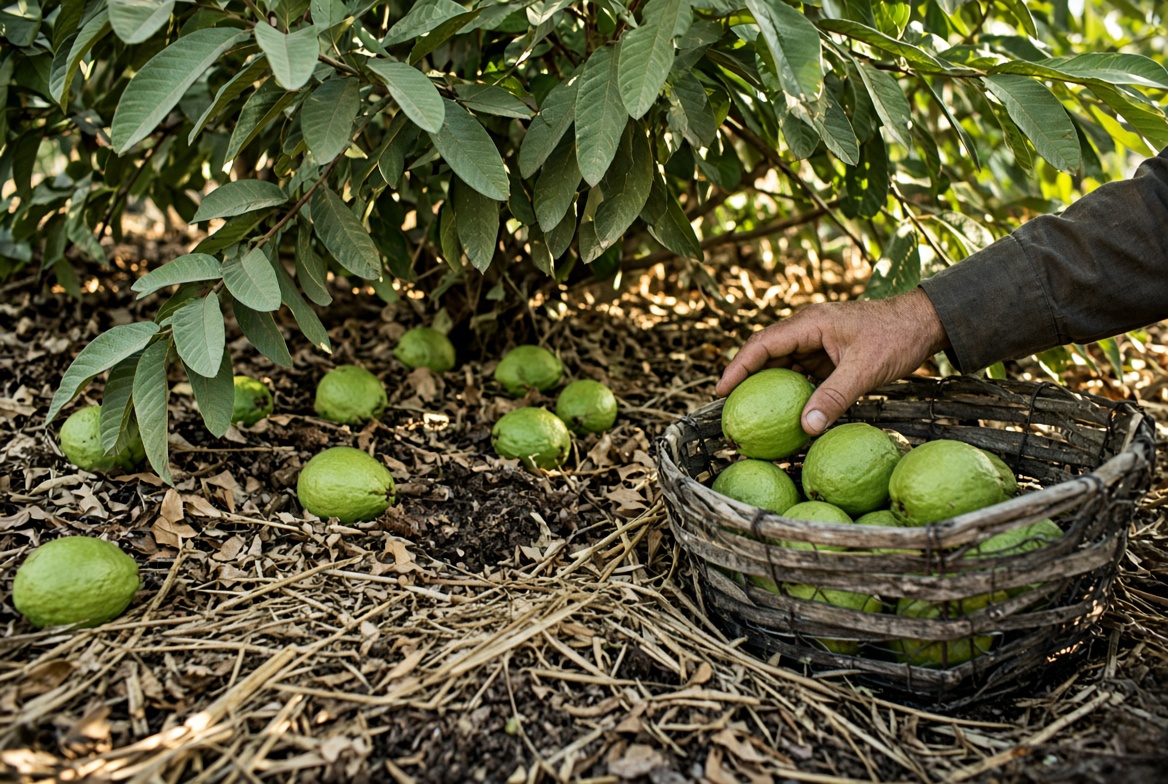
This is the trickiest part of the harvest: the fruit stays perfectly green even when fully ripe, so color is not a reliable indicator.
The Golden Rule: Never pull a pineapple guava off the branch. If you have to tug it, it is not ripe.
These fruits naturally detach and drop to the ground the moment they reach peak ripeness. The best way to harvest is the “drop test.” You can gently shake the branches; whatever falls is ready to eat. To prevent the fruit from bruising when it hits the ground, many growers lay down soft netting, old blankets, or a thick layer of soft straw mulch beneath the canopy during harvest season. 🍂
Storing and Eating 🥄
Once collected from the ground, the fruit has a relatively short shelf life. They will keep on the kitchen counter for a few days, or up to two weeks in the crisper drawer of your refrigerator.
The classic way to eat a pineapple guava is simple: slice it in half with a knife and use a spoon to scoop out the gelatinous, fragrant center, just like a kiwi. The flavor is complex, aromatic, and deeply tropical—a true reward for your horticultural efforts! 🥝
6. Troubleshooting Common Pests and Diseases 🐛
Even the most robust plants encounter occasional hurdles. Fortunately, the pineapple guava is remarkably pest-resistant compared to many other traditional fruit trees. When issues do arise, they are typically easy to diagnose and remedy with organic, proactive care.
Scale Insects and Black Sooty Mold 🐜
If you notice the leaves of your plant turning a dull, sticky black, you are likely dealing with black sooty mold. However, the mold itself is not the actual disease—it is a secondary symptom of a pest infestation.
Inspect the undersides of the leaves and the tender green stems. You will likely find tiny, brown, armor-like bumps. These are scale insects. As they feed on the plant’s sap, they secrete a sticky substance called “honeydew,” which provides the perfect breeding ground for sooty mold.
-
The Solution: Do not reach for harsh chemical pesticides. Instead, apply a thorough coating of organic horticultural oil or Neem oil in the early evening (to prevent sun burning the oily leaves). The oil naturally smothers the scale insects. Once the pests are eliminated, the black sooty mold will eventually wash away with the rain or your next watering. 🌿
Fruit Drop Before Ripening 📉
Seeing your plant set dozens of tiny green fruits, only to watch them prematurely drop to the ground halfway through the summer, is incredibly disheartening.
Premature fruit drop is almost always an environmental stress response. The most common culprit is inconsistent watering—specifically, letting the soil dry out completely during a severe heat spike. If the plant feels it does not have the moisture reserves to sustain both itself and the developing harvest, it will abort the fruit to survive.
-
The Solution: Reinforce the deep watering strategy mentioned earlier and ensure your mulch layer is thick enough to buffer the soil against rapid moisture evaporation. 💧
Root Rot Issues 🍄
The pineapple guava’s Achilles’ heel is “wet feet.” If the plant is situated in heavy, poorly draining clay or is receiving daily, shallow watering from a lawn sprinkler system, the roots will begin to suffocate.
Symptoms of root rot (Phytophthora) are paradoxically similar to drought stress: the leaves will turn yellow, droop, and drop off, even though the soil is soaking wet.
-
The Solution: Stop watering immediately. If the plant is in a pot, repot it with fresh, dry citrus-blend soil. If it is in the ground, you must urgently improve the drainage by aerating the surrounding soil or rerouting nearby irrigation heads. 🛑
7. Expert FAQs About Pineapple Guava Plants ❓
To round out your expertise, here are the most common questions growers ask when cultivating this unique species:
-
Can I grow a pineapple guava plant in a pot? Absolutely! They make excellent container plants for patios and balconies. Choose a large container (at least a half-barrel size) with ample drainage holes. Use a high-quality, well-draining citrus or cactus potting mix, and remember that container plants dry out much faster than in-ground plants, so you will need to monitor moisture closely. 🪴
-
How long does it take for a pineapple guava to bear fruit? This depends on how the plant was propagated. A plant grown from seed may take 3 to 5 years (or longer) to produce its first harvest. However, if you purchase a named cultivar propagated from a cutting or graft (like ‘Mammoth’ or ‘Apollo’), you can often expect fruit within 1 to 3 years of planting. ⏳
-
Do deer eat pineapple guava? The thick, slightly fuzzy, silvery-green leaves are generally unappealing to deer, making this plant highly deer-resistant. However, as any veteran gardener knows, a starving deer will eat almost anything, so young saplings may still benefit from temporary protective caging in areas with intense deer pressure. 🦌
-
Are the roots invasive? No. The root system is relatively fibrous and well-behaved. They do not send out aggressive, foundation-cracking taproots, making them entirely safe to plant near sidewalks, driveways, or the walls of your home. 🏡
Cultivating Your Tropical Oasis 🌴
Transforming a standard evergreen bush into a highly productive, striking focal point in your edible landscape is entirely within your reach. The journey from planting to harvesting requires patience, but by mastering the core principles of precise cross-pollination, strategic pruning to encourage new fruiting wood, and consistent watering during the peak growing season, you will unlock the full potential of this incredible species.
Whether you are enjoying the marshmallow-sweet flower petals in a spring salad or scooping out the tropical, fragrant flesh of the autumn fruit, the Acca sellowiana offers a multi-season reward that few other plants can match. Grab a second cultivar, prepare your well-draining soil, and get ready to enjoy one of the most uniquely delicious harvests your garden will ever produce.
Have you had success hand-pollinating your plants, or do you have a favorite recipe for the fruit? Share your garden progress and tropical harvest tips in the comments below! 👇✨











