

If you have ever dreamt of crafting the perfect, rich, authentic Italian pasta sauce from scratch, you quickly realize that standard round slicing tomatoes simply won’t cut it. To achieve that thick, naturally sweet, and low-acidity base, you need to cultivate authentic san marzano tomato plants. Known globally as the undisputed “King of Sauce Tomatoes,” this legendary Italian heirloom offers dense, meaty flesh, incredibly low seed counts, and exceptional flavor concentration.
However, growing these culinary treasures can quickly turn into a gardener’s biggest heartbreak when the dreaded black, sunken spots of Blossom End Rot (BER) appear right before harvest day. Because of their unique elongated geometry, these paste tomatoes are exceptionally vulnerable to physiological disorders if not managed correctly.
In this comprehensive masterclass, I am going to share the exact strategies—honed through years of multi-season trials across raised beds, native soil, and high-capacity containers—to prevent rot and maximize your yield. We will cover deep planting mechanics, steady hydration schedules, targeted nutrition, and structural pruning to ensure your vines produce massive, flawless clusters all season long.
📌 Executive Summary / “Quick Sheet” Card
Before we dive into the deep horticulture, here are the non-negotiable baseline requirements for your plants:
-
Plant Type: Mostly indeterminate vining heirloom / heritage standard (though some modern dwarf/determinate patio cultivars exist) 🌱
-
Sun Requirements: Full sun (minimum 6–8 hours daily, ideally 8+ for maximum yield) ☀️
-
Soil Parameters: Well-draining, organically rich loam; target pH 6.2–6.8 🪵
-
Watering Cadence: Consistent, deep watering; 1–2 inches per week (drip irrigation strongly preferred over overhead) 💧
-
Primary Vulnerability: Blossom End Rot (BER) driven by moisture swings and erratic calcium uptake ⚠️
🔍 Section 2: Understanding the San Marzano Plant Profile
What Makes San Marzano Tomato Plants Unique? 🇮🇹
To master this crop, you first have to understand what you are actually growing. Authentic San Marzano dell’Agro Sarnese-Nocerino is a heritage clone originating from the volcanic soils near Mount Vesuvius. When shopping for seeds or starts, you will often encounter offshoots and variations like San Marzano #2, San Marzano Redorta, or Nano. While authentic heritage lines are prized for their specific genetic profile, most reputable nursery cultivars will deliver the classic thick-walled, dry-fleshed fruit you need for canning and sauce.
Growth Habit Check: Determinate vs. Indeterminate 🌿
There is a widespread point of confusion among hobby growers regarding the growth habit of these plants.
-
Indeterminate (The Standard): Traditional heritage San Marzanos are vigorous, indeterminate vines. This means they will continue to grow upward (often reaching 6 to 8+ feet) and produce fruit continuously until killed by frost. They require serious trellising and structural support.
-
Determinate (The Bush): Some modern breeders have developed determinate (bush) varieties (like the ‘Nano’). These stay compact (usually 3-4 feet) and set their entire crop within a concentrated two-to-three-week window, making them ideal for gardeners who want to do one massive weekend of sauce canning.
Knowing which type you have dictates your entire pruning and support strategy.
Anatomy of an Elongated Plum Tomato
Why are these tomatoes so perfect for sauce, yet so finicky to grow? It comes down to their anatomy. San Marzanos have exceptionally high dry-matter content and low water content. When you cook them down, you aren’t waiting hours for excess water to evaporate.
However, this elongated, plum-like shape creates a botanical bottleneck. Calcium, a vital mineral for cell wall development, moves very slowly through the plant’s vascular tissue (xylem). Because the fruit is long, it takes longer for calcium to travel from the stem attachment down to the distal tip (the blossom end). If any stress interrupts that vascular flow—even for a few hours—the cells at the bottom of the fruit collapse, resulting in Blossom End Rot.
🪴 Section 3: Pre-Planting & Soil Chemistry
Building the Foundation: Soil, Sun, and Spacing 🪱
The secret to a heavy, rot-free harvest begins weeks before your seedlings ever touch the garden bed. San Marzano tomato plants demand a premium root environment.
Soil pH, Microbial Health, and the Calcium Myth 🧪
Let’s address the most pervasive gardening myth right now: tossing crushed eggshells into the planting hole will not instantly cure Blossom End Rot. Eggshells take months, if not years, to break down into bioavailable calcium. Furthermore, most garden soils already have plenty of calcium. The issue is rarely a lack of calcium in the dirt; it is almost always an issue of transport physics—the plant’s ability to uptake that calcium through its roots.
To facilitate effortless nutrient uptake, your soil needs to be loamy, loose, and teeming with microbial life. Amend your beds heavily with aged leaf mold and high-quality compost. Test your soil and aim for a pH range of 6.2 to 6.8. If your soil is too acidic or too alkaline, nutrients become chemically locked out, regardless of how much fertilizer you apply.
The Deep-Planting Technique for Heavy Root Networks 🕳️
Tomatoes are unique in their ability to grow adventitious roots—meaning roots can sprout from anywhere along the main stem. To build a massive, drought-resistant root system for your San Marzanos, you must practice deep planting or trenching.
-
Strip the Stem: Carefully pinch off the bottom sets of leaves from your seedling, leaving only the top tuft of foliage.
-
Bury it Deep: Dig a deep hole (or a horizontal trench if your soil is shallow/heavy clay) and bury the plant up to its top leaves. The entire buried stem will transform into a thick, fibrous root network.
-
Inoculate: At transplant time, dust the root ball with mycorrhizal fungi. This beneficial fungus forms a symbiotic relationship with the plant, acting as a microscopic extension of the root system to scavenge water and phosphorus from deep within the soil profile.
-
Space for Airflow: Fungal diseases love crowded, humid canopies. Space your plants 24–36 inches apart in rows spaced 3–4 feet apart to ensure critical airflow and sunlight penetration.

💧 Section 4: The Hydration Protocol (The Rot-Free Core)
Watering Strategy: The Proven Defense Against Blossom End Rot 🚿
If there is a single section of this guide you must master, it is this one. How you water your san marzano tomato plants will ultimately determine whether you harvest bushels of pristine paste tomatoes or handfuls of ruined, black-bottomed fruit.
The Mechanics of Calcium Transpiration 🔬
To understand why watering is so critical, we need to look at how a tomato plant “drinks.” Plants do not pump nutrients; they pull them up through a process called transpiration. As water evaporates from the leaves on a hot day, it creates a vacuum that pulls water (and dissolved minerals like calcium) up from the roots through the plant’s vascular tissue (the xylem).
Here is the fatal flaw for elongated tomatoes: calcium moves exclusively via this water stream. If the soil suddenly dries out during a heatwave, the transpiration stream stops. The plant panics and shunts whatever moisture remains to the vital leaves, cutting off the developing fruit. The rapidly dividing cells at the distal end (the blossom end) of the tomato are starved of calcium, the cell walls collapse, and necrosis begins.
The dreaded dry-wet cycle—allowing the soil to become bone dry, followed by a soaking deluge of rain or heavy watering—is the number one trigger for Blossom End Rot.
Practical Irrigation Tactics & Mulching Systems 🪵
Consistency is your ultimate weapon. You must maintain an even, sponge-like moisture level in the root zone throughout the entire growing season.
-
Ditch the Sprinkler: Overhead watering is the enemy of the tomato grower. It fails to penetrate deeply into the root zone, wastes water to evaporation, and splashes soil-borne fungal spores (like early blight) onto the lower leaves.
-
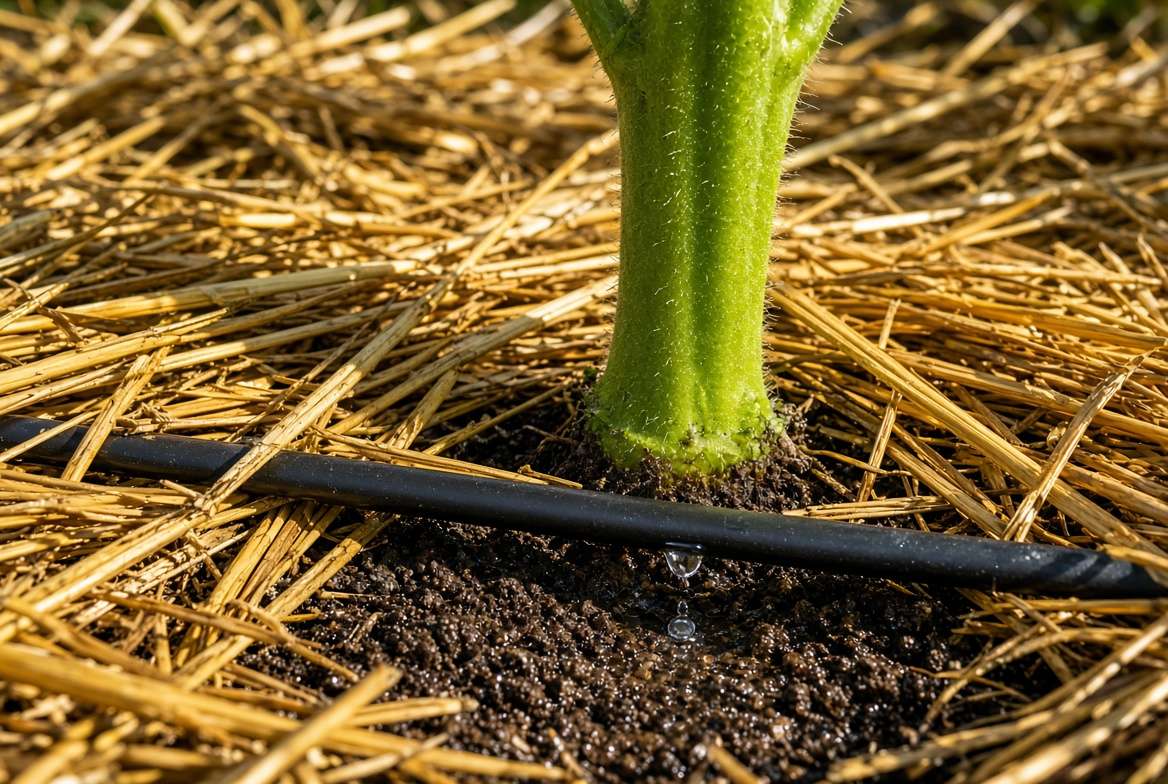
Install Drip Irrigation: The gold standard for tomato care is installing drip lines or soaker hoses directly at the soil level. This delivers water slowly, deeply, and directly to the root zone without wetting the foliage. Aim for 1 to 2 inches of water per week, adjusting for extreme heat or heavy rainfall.
-
The 3-Inch Mulch Rule: Never leave your soil bare. Once your soil has warmed in the late spring, apply a thick, 3-inch layer of organic mulch around the base of your plants. Clean straw, shredded leaves, or untreated wood chips work beautifully. Mulch acts as an insulating blanket, dramatically slowing evaporation, regulating wild temperature swings in the root zone, and suppressing weed competition.
🥩 Section 5: Feeding for Fruit Density, Not Just Foliage
Fertilizer Scheduling: From Seedling to Heavy Fruiting 🌸
Feeding san marzano tomato plants is a balancing act. These vigorous vines are heavy feeders, but giving them the wrong nutrients at the wrong time can ruin your harvest.
Stage 1: Root Establishment to First Flower Flush
During the first 4 to 6 weeks after transplanting, the plant’s primary job is to build a strong frame and a deep root system. Provide a balanced, slow-release organic fertilizer (such as a 5-5-5 NPK ratio) or apply nutrient-dense compost tea.
Warning: Do not over-apply nitrogen! High-nitrogen synthetic fertilizers (often sold as “miracle” vegetable growers) will trigger explosive, lush green leaf growth at the expense of flowers and fruit. Worse, excessive vegetative sprawl creates intense competition for calcium within the plant, significantly increasing the risk of BER.
Stage 2: Fruit Set Through Swelling & Color Break 🍅
Once the first yellow blossoms open and tiny green fruit begin to set, the plant’s nutritional demands shift. It is time to back off the nitrogen and dial up the phosphorus and potassium.
-
Potassium (K): Crucial for moving water and carbohydrates through the plant, resulting in denser, sweeter, and larger fruit. Side-dress with sulfate of potash or liquid kelp extract.
-
Phosphorus (P): Vital for continued root health and robust blossom development. Bone meal is an excellent slow-release source.
-
Micronutrients: Ensure your soil has adequate magnesium (critical for photosynthesis) and boron (which aids in flower retention and structural integrity).
-
Expert Note on Foliar Calcium Sprays: Garden centers aggressively market foliar calcium sprays as a quick fix for Blossom End Rot. However, horticultural science shows that tomato skins are covered in a waxy cuticle that absorbs very little calcium. While a foliar spray might provide a minor, temporary localized boost, it will never replace the necessity of consistent root uptake via proper soil moisture.
🪜 Section 6: Support, Training, and Canopy Management
Pruning and Trellising Vining San Marzanos ✂️
If you are growing traditional indeterminate san marzano tomato plants, prepare for a jungle. Left to their own devices, these vines will sprawl across the ground, inviting pests, rot, and fungal decay.
Structural Support Systems That Won’t Collapse 🏗️
Standard three-ring wire cages from the hardware store are woefully inadequate for indeterminate heirlooms. A fully loaded San Marzano vine can easily weigh 20 to 30 pounds and will crush a flimsy cage by mid-July. Instead, invest in serious infrastructure:
-
Cattle Panel Trellises: Heavy-duty, galvanized steel cattle panels arched over pathways or staked vertically provide invincible support.
-
The Florida Weave: If you are growing long rows, drive heavy T-posts every 4 to 5 feet and weave high-tensile agricultural twine back and forth between the plants as they grow.
-
String Training (Roller Hooks): Popular in commercial high-tunnels, this involves dropping a strong string from an overhead wire and wrapping the main stem of the tomato around it weekly.

Sucker Pruning & Leaf Stripping for Airflow 🍃
Canopy management is crucial for disease prevention and channeling the plant’s energy into fruit production rather than endless foliage.
-
Sucker Management: “Suckers” are the small vegetative shoots that sprout in the “V” joint (axil) between the main stem and a side branch. For optimal yield and airflow, pinch out most suckers. Many experts recommend pruning indeterminate San Marzanos to a strictly maintained single or double main stem.
-
Bottom Defoliation: Once the lowest trusses of fruit have set and reached the size of a golf ball, strip away all foliage from the bottom 12 to 18 inches of the main stem. This creates a physical barrier that prevents soil-borne fungal spores from splashing up onto the leaves during heavy rain.
-
Topping the Vine: About 4 weeks before your anticipated first autumn frost, physically cut off the growing tip (the apical meristem) at the top of the plant. This process, called “topping,” forces the plant to stop producing new flowers that will never have time to mature, redirecting all remaining energy into ripening the existing green fruit on the vine.
🛡️ Section 7: Pest, Disease, and Environmental Diagnostics
Troubleshooting San Marzano Pitfalls 🐛
Even with immaculate soil preparation and perfect irrigation, outdoor gardens are dynamic ecosystems. Early detection is your best defense against the common pests and pathogens that specifically target heirloom paste tomatoes. Here is a diagnostic cheat sheet to keep your crop thriving:
| Issue | Primary Symptom | Immediate Fix | Long-Term Prevention |
|---|---|---|---|
| Blossom End Rot (BER) ⚠️ | Flat, leathery black spot on the base of green or ripening fruit. | Harvest and discard affected fruit immediately to redirect energy; deeply soak the root zone. | Consistent drip irrigation, heavy mulching, and avoiding high-nitrogen synthetic fertilizers. |
| Early Blight 🍂 | Concentric “bullseye” rings with yellow halos on the lowest leaves. | Remove and bag infected leaves immediately; sanitize pruning shears between cuts. | Apply a preventative copper fungicide spray; maintain strict bottom leaf clearance (12–18 inches). |
| Tomato Hornworm 🐛 | Rapidly stripped stems, chewed green fruit, and large black droppings (frass) on lower leaves. | Handpick caterpillars at dawn or dusk (a blacklight flashlight makes them glow in the dark). | Plant companion crops like dill and borage; encourage parasitic braconid wasps. |
| Sunscald ☀️ | Pale, paper-thin, bleached patches on the exposed “shoulders” of the fruit. | Drape a lightweight shade cloth (30-40%) over the trellis during extreme heatwaves. | Maintain adequate leaf canopy over hanging clusters; do not over-prune top foliage in mid-summer. |

🧺 Section 8: Harvesting, Ripening, and Culinary Handling
From Vine to Kitchen: Capturing Peak Flavor 🍝
After months of careful cultivation, the harvest window is where the magic happens. Knowing exactly when and how to pick your San Marzanos ensures maximum flavor concentration for your sauces and preserves.
Determining Optimal Harvest Windows 🌈
While pulling a deeply crimson, sun-warmed tomato straight from the vine is a romantic notion, it is not always the most practical horticultural strategy—especially if you battle pests or harsh weather.
-
The “Breaker Stage” Advantage: Tomatoes are climacteric fruit, meaning they continue to ripen off the vine once they reach a specific physiological milestone called the “breaker stage.” When a green tomato begins to show a 50% color shift (usually a blushing starburst of pink or light red at the blossom end), it has already sealed itself off from the main plant. Harvesting at this stage protects the fruit from splitting after sudden rain, prevents bird/rodent damage, and avoids sunscald. The fruit will finish ripening flawlessly on a kitchen counter without sacrificing any flavor compounds or natural sugars.
-
Vine-Ripening Criteria: If you choose to leave them on the plant, wait until the fruit achieves a deep, uniform crimson color from shoulder to tip. The skin should remain taut, but the flesh should yield slightly under gentle thumb pressure.

Post-Harvest Storage & Processing Notes 🫙
-
Never Refrigerate: Storing fresh tomatoes in the refrigerator is a cardinal sin of culinary gardening. Temperatures below 50°F (10°C) permanently halt the enzyme activity that creates flavor and physically alter the cellular structure, turning the dense flesh mealy and flavorless. Keep ripening fruit at room temperature, out of direct sunlight.
-
Processing Basics: San Marzanos are celebrated because their skins slip off effortlessly after a quick blanch. Drop scored tomatoes into boiling water for 60 seconds, transfer to an ice bath, and peel. The resulting dense, dry flesh is perfect for slow-simmered passata, whole-peeled pressure canning, or even dehydrating into intense “sun-dried” tomato halves.
❓ Section 9: Frequently Asked Questions (FAQ)
Q: Are San Marzano tomatoes determinate or indeterminate?
The vast majority of authentic, heritage San Marzano tomato plants are indeterminate, meaning they will climb 6 to 8 feet tall and produce continuously until frost. However, some modern hybridizers have developed determinate (bush-type) cultivars specifically for patio containers or single-harvest canning. Always check your seed packet or nursery tag to confirm which growth habit you are planting.
Q: Can you grow San Marzano tomatoes successfully in 5-gallon containers?
While it is technically possible, a 5-gallon bucket is highly discouraged for indeterminate varieties. The constrained root space leads to violent moisture fluctuations, making the plant incredibly susceptible to Blossom End Rot. If you must grow in containers, use fabric grow bags (minimum 15 to 20 gallons) and set up an automated drip emitter to maintain consistent soil moisture.
Q: Why are my San Marzano tomatoes dropping blossoms without setting fruit?
Blossom drop is almost always an environmental stress response. When daytime temperatures consistently exceed 85–90°F (29–32°C), or nighttime temperatures drop below 55°F (13°C), tomato pollen becomes sticky and sterile. The unpollinated flowers simply dry up and fall off. Once temperatures normalize, the plant will resume fruit set naturally.
Q: Do crushed eggshells or Epsom salts cure blossom end rot quickly?
No. Blossom End Rot is a transport issue caused by inconsistent watering, not a sudden soil deficiency. Eggshells take months to decompose, and Epsom salts provide magnesium, not calcium (in fact, excess magnesium can actually block calcium uptake). The fastest and only genuine cure is regulating your irrigation schedule to ensure even, deep soil moisture.
📋 Section 10: Seasonal San Marzano Care Checklist
To keep your cultivation efforts on track, follow this straightforward seasonal roadmap:
-
🌱 Spring (Planting & Establishment): Wait for soil temperatures to reach 60°F (15°C). Practice deep trench planting, install heavy-duty cattle panel trellises immediately to avoid disturbing future root growth, and apply a 3-inch layer of organic mulch once the soil has fully warmed.
-
☀️ Early Summer (Growth & Training): Establish a consistent drip irrigation schedule. Begin weekly sucker pruning to maintain a single or double stem. Once the first bottom fruit clusters set, strip the lowest 12–18 inches of leaves to improve airflow and prevent fungal splash-up.
-
🍅 Mid-to-Late Summer (Fruiting & Maintenance): Shift feeding to potassium- and phosphorus-heavy organic fertilizers. Monitor daily for hornworms and early blight. Harvest fruit at the breaker stage to secure your yield against pests and weather cracking.
-
🍂 Autumn (Winding Down): Approximately four weeks before your first expected frost, “top” the vines by cutting off the highest growing shoots. Process your final large harvests into sauces and pastes. Once frost kills the vines, remove all plant debris from the garden to break overwintering disease cycles.
By respecting the unique anatomy of these heritage paste tomatoes and prioritizing consistent hydration, you can bypass the heartbreak of rot and disease. Your reward will be heavy, cascading clusters of the finest culinary tomatoes in the world, ready to elevate your kitchen garden to new heights.











