
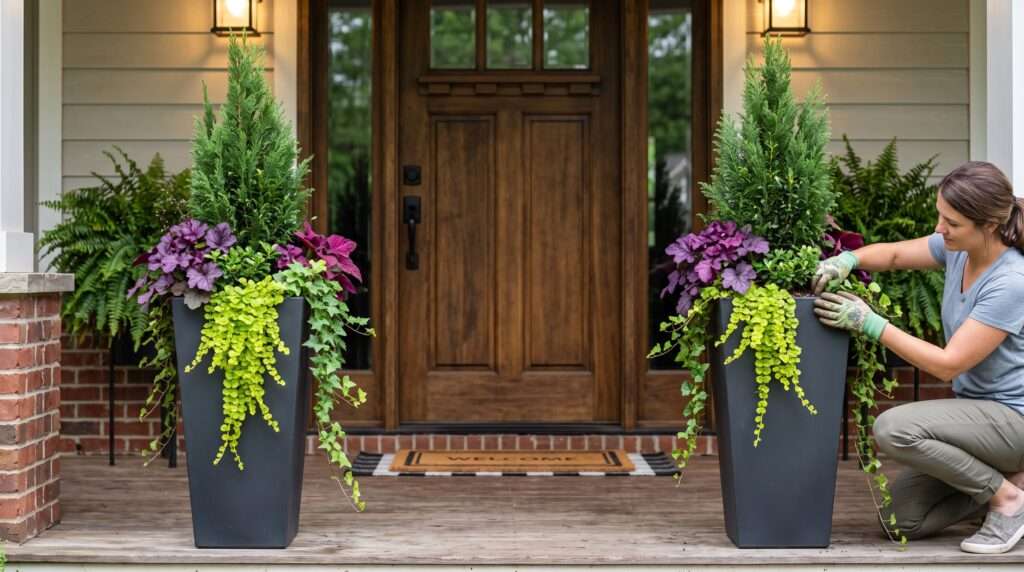
Tall, elegant containers have the power to instantly elevate a front porch, frame a doorway, or add dramatic architectural flair to a stark living room corner. But as any experienced container gardener knows, successfully styling a tall skinny planter comes with a hidden set of dirty secrets. While they look magnificent on the surface, these deep, narrow pots are notorious for causing two major headaches: they are highly prone to tipping over in a slight breeze, and they create a perfect, suffocating environment for catastrophic root rot at the bottom.
Filling an entire three-foot-tall pot with premium potting soil is not only incredibly expensive, but it also practically guarantees that your plants will suffer. The sheer weight of that much wet soil compacts the roots, drains poorly, and makes the container virtually impossible to move.
As a container gardening specialist, I’ve seen countless expensive ornamental trees and beautiful trailing vines perish simply because the planter’s internal structure was ignored. In this comprehensive guide, we are going completely below the surface. I will show you exactly how to engineer the inside of your tall planter to balance the weight, improve soil aeration, save money on potting mix, and ultimately select the perfect resilient plants that will thrive in this unique micro-environment.
The Hidden Dangers of Tall Skinny Planters (And How to Beat Them) ⚠️
Before we get to the fun part of choosing plants, we have to address the structural and horticultural challenges of deep container gardening. A tall, narrow pot behaves very differently than a standard nursery pot or a wide garden bed. Understanding these three hidden dangers is the key to unlocking long-term plant health.
The Perched Water Table Explained 💧
One of the most misunderstood concepts in container gardening is the “perched water table.” When you water a potted plant, gravity pulls the moisture downward. However, capillary action (the soil’s ability to hold onto water) fights against gravity.
In any container, a layer of heavily saturated soil will form at the very bottom, right above the drainage holes. Because a tall skinny planter is so deep, this saturated zone is pushed far out of reach of the sun and air, meaning it almost never dries out. If a plant’s roots grow down into this permanently soggy, anaerobic layer, they will suffocate, rot, and turn into mush. Fungal pathogens thrive in this environment, eventually killing the plant from the bottom up.
The Top-Heavy Tipping Hazard 🌬️
From a purely physical standpoint, tall skinny planters suffer from a dangerous center of gravity. Modern planters are often made of lightweight, weather-resistant materials like fiberglass, resin, or high-density plastic.
When you place a tall, bushy “thriller” plant (like an evergreen or a palm) into a lightweight tall pot, the container becomes a sail. A single strong gust of wind on an exposed patio or front porch can easily topple the planter. This not only damages your expensive plants and shatters pots, but it can also scratch flooring or cause injuries. Controlling where the weight sits inside the planter is absolutely critical.
The Soil Compaction Problem 🧱
Imagine stacking 30 inches of wet, heavy sponges on top of one another. The sponges at the very bottom will be crushed flat by the weight above them. The same thing happens to potting soil in a deep container.
The sheer weight of three feet of damp soil crushes the microscopic air pockets in the lower layers. Plant roots need oxygen just as much as they need water. When soil compacts, it loses its aeration, further contributing to root rot and preventing healthy root expansion.
How to Fill a Tall Skinny Planter (The “False Bottom” Method) 🛠️
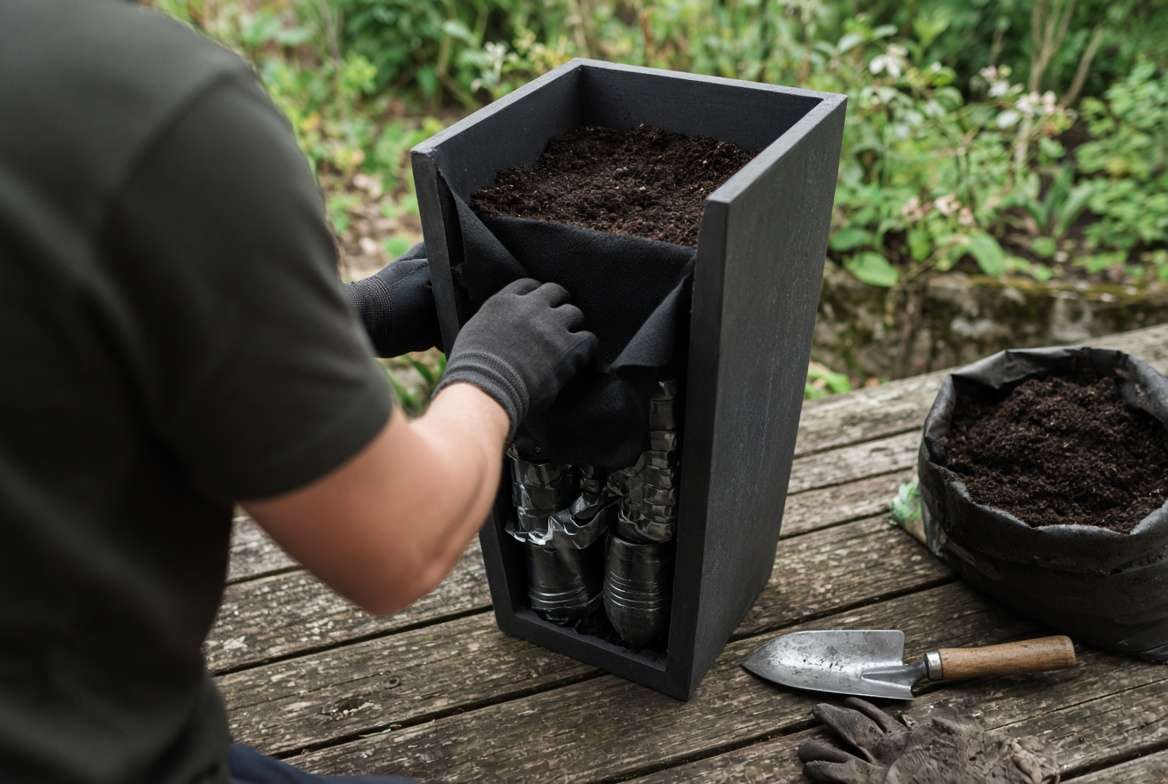
To eliminate the perched water table, stop soil compaction, and prevent your planter from tipping over, you need to create a “false bottom.” This professional landscaping technique takes up the empty space in the lower half to two-thirds of the pot, allowing you to use less soil while perfectly calibrating the container’s weight.
Step 1: Establish Your Weight Strategy (Heavy vs. Light Base) ⚖️
Before you add a single piece of filler, you must decide how heavy you want the final planter to be. Your strategy depends entirely on where the planter will live.
-
The Heavy Base Strategy (For Outdoor & Windy Areas): If your planter is going on a front porch, an uncovered patio, or a windy balcony, you want it to be heavy at the bottom. The lower the center of gravity, the more wind-resistant it becomes. For the very bottom layer (the first 4 to 6 inches), use heavy materials like gravel, river rocks, brick pieces, or heavy shards of broken terracotta pots.
-
The Light Base Strategy (For Indoors & Mobile Pots): If your tall planter is going in a living room, hallway, or on a delicate wooden deck where it might need to be moved frequently, you need to keep it as light as possible. Skip the rocks entirely and rely purely on lightweight structural filler.
Step 2: Choose Your Filler Materials (What Works vs. What Rots) ♻️
The goal of filler is to take up volume without breaking down over time. You should fill the planter until you have about 10 to 14 inches of space remaining at the top—this is the perfect depth for the root zones of most annuals, perennials, and small structural shrubs.
The Best Materials for a False Bottom:
-
Inverted Nursery Pots: The absolute best, most structurally sound filler. Take sturdy plastic pots (like the ones small shrubs come in) and place them upside down at the bottom of the tall planter.
-
Capped Empty Water Bottles or Milk Jugs: A great way to upcycle. Ensure the caps are screwed on tight so they don’t crush under the weight of the soil.
-
Aluminum Soda Cans: Crush-resistant and lightweight.
-
Closed-Cell Foam Blocks: Use structural packing foam (not peanuts).
What You Must NEVER Use as Filler:
-
Biodegradable Packing Peanuts: Modern packing peanuts are made from cornstarch. If they get wet, they instantly dissolve into a stinking, glue-like mush that will clog your drainage holes.
-
Wood Chunks, Twigs, or Pinecones: While it might seem like a good idea to use organic garden waste, these materials decompose. As they rot, they cause the soil above them to suddenly sink. Worse, the decomposition process steals vital nitrogen away from your plant’s roots.
Step 3: The Landscape Fabric Barrier ⬛
Once your filler is in place, you cannot simply pour potting soil over the top. Every time you water, the soil will wash down through the cracks of your filler, eventually settling at the bottom, clogging the drainage hole, and leaving your roots exposed.
To prevent this, you must separate the filler from the soil. Cut a piece of permeable, high-quality landscape weed barrier fabric. Lay it directly over your filler materials, ensuring it extends an inch or two up the inner walls of the planter. This acts as a filter: it allows water to drain freely through the bottom, but keeps every ounce of your expensive potting soil securely contained in the top section.
Step 4: Adding the Right Soil Mix 🪱
With your false bottom secured, it’s time to add soil. Because the root zone is somewhat restricted in a narrow pot, you need a premium, well-aerated potting mix. Do not use heavy garden soil or raised bed soil.
Create a fluffy, nutrient-rich blend by combining a high-quality commercial potting mix with extra perlite (to guarantee excellent drainage and prevent compaction) and a few handfuls of rich compost or worm castings to provide a slow release of vital nutrients. Fill the soil up to about two inches below the rim of the planter to leave room for watering.
The Best Plants for a Tall Skinny Planter 🌺
Once you have successfully engineered the drainage, weight distribution, and soil structure of your tall skinny planter, you are ready for the ultimate container design technique: the “Thriller, Filler, Spiller” method.
Because narrow planters have a limited surface area, every plant you choose must pull its weight aesthetically. The goal is to create visual balance by pairing vertical height with lush, cascading foliage that softens the hard, geometric lines of the tall container. Here are the most resilient, visually stunning plants tailored specifically for deep, narrow environments.
“Thrillers” (Architectural Height) 🌴
The “thriller” is your focal point. It provides the central vertical structure and dictates the overall vibe of the arrangement. When dealing with a tall skinny planter, you generally want a thriller that grows upwards rather than outwards, maintaining that sleek, modern column look.
-
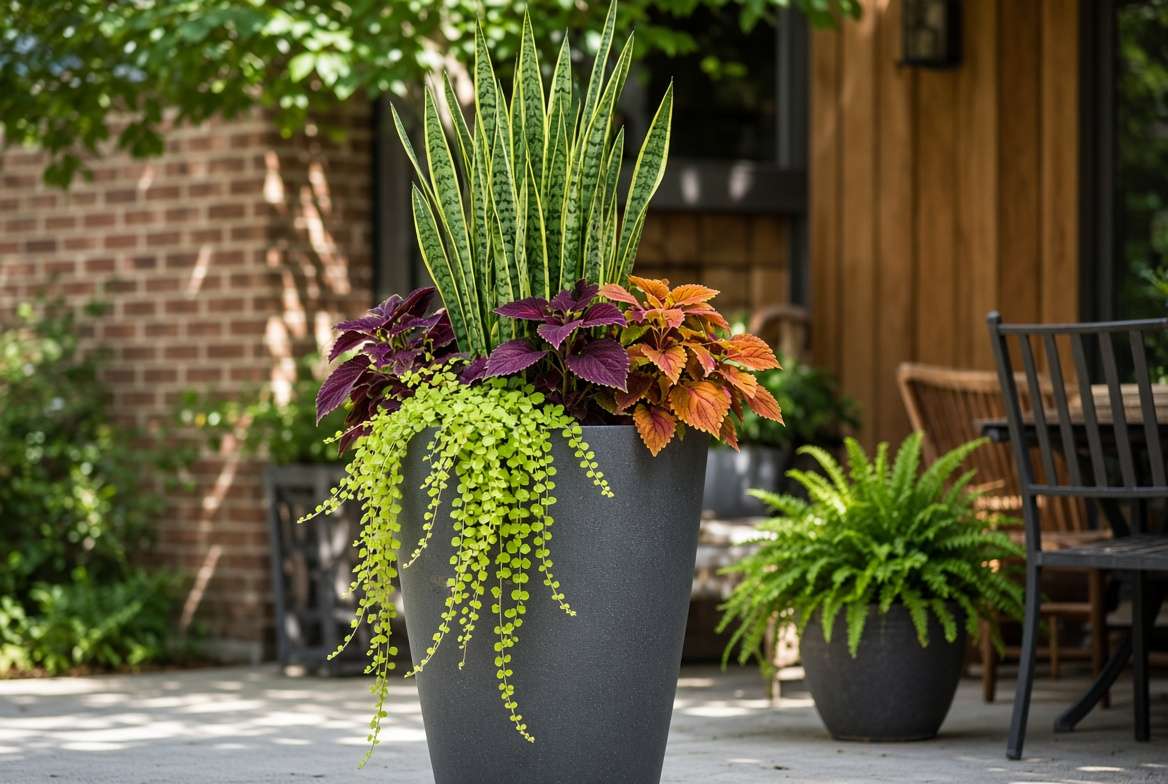
Snake Plant (Sansevieria trifasciata): If you are styling an indoor planter or a shaded outdoor patio, the Snake Plant is the ultimate structural thriller. Its stiff, sword-like leaves naturally grow straight up, perfectly echoing the vertical lines of a tall pot. More importantly, it is highly drought-tolerant and features a shallow root system, making it incredibly forgiving if you are using a heavy false bottom.
-
Sky Pencil Holly (Ilex crenata ‘Sky Pencil’): For formal outdoor entryways, this evergreen shrub is a masterpiece. It naturally grows in a tight, narrow column without requiring constant pruning. It handles wind beautifully and provides sophisticated, year-round greenery that frames a front door perfectly.
-
Emerald Green Arborvitae (Thuja occidentalis): Another outstanding cold-hardy outdoor option. Arborvitaes provide dense, feathery texture and create a stately, classic look. They have a compact root ball that easily adapts to the 12-to-14 inches of soil depth provided in a modified tall planter.
-
Bird of Paradise (Strelitzia reginae): If you are looking for a dramatic, tropical aesthetic for a brightly lit sunroom or a warm climate patio, this plant delivers massive, paddle-shaped leaves that instantly draw the eye upward.
“Spillers” (Cascading Vines to Soften Hard Lines) 🌿
A tall planter can look a bit stiff and monolithic on its own. Spillers are trailing plants planted near the edges of the pot that tumble downward over the rim. They break up the sheer vertical face of the planter and integrate it naturally into the surrounding space.
-
Creeping Jenny (Lysimachia nummularia): One of the most effective spillers on the market. Its brilliant, chartreuse-neon green foliage provides a striking contrast against dark-colored planters (like matte black or charcoal resin). It grows aggressively and drapes beautifully down the sides.
-
Sweet Potato Vine (Ipomoea batatas): Available in deep purple, bronze, and bright lime green, this vigorous grower will quickly create a lush, trailing skirt around the top third of your planter. It handles full sun well and loves the well-draining soil mix we created in the previous steps.
-
String of Pearls (Senecio rowleyanus): For indoor or highly sheltered outdoor planters with excellent light, this succulent is a showstopper. Its delicate, bead-like foliage cascading down a smooth, modern white planter creates a breathtaking minimalist aesthetic. Just ensure the soil is drying out adequately between waterings.
-
English Ivy (Hedera helix): The classic choice for shade-tolerant draping. It provides a timeless, traditional feel and is incredibly hardy in cooler climates where other spillers might struggle.
“Fillers” (Volume and Color) 🌸
Fillers are the mounding, medium-height plants that bridge the gap between the tall thriller and the trailing spiller. They hide the bare soil, cover the base of the taller plants, and inject seasonal color.
-
Coleus (Plectranthus scutellarioides): If your tall planter is positioned in partial shade, Coleus offers an explosion of vibrant, patterned foliage in shades of burgundy, pink, lime, and orange. It mounds beautifully and fills empty gaps within weeks.
-
Coral Bells (Heuchera): An incredible perennial filler that provides rich, dark hues (purples, reds, and bronzes) and unique ruffled textures. They are cold-hardy and feature shallow root systems, making them ideal companions for deeper-rooted thrillers.
-
ZZ Plant (Zamioculcas zamiifolia): For indoor planters in low-light environments, the ZZ plant is virtually indestructible. Its glossy, dark green leaves add immediate volume and elegance, acting as an excellent filler beneath taller indoor palms or dracaenas.
Watering and Maintenance Guide for Deep Containers 🚿
Maintaining a tall skinny planter requires a slightly different approach than typical garden pots. Because the soil volume is unique and the drainage is concentrated at the bottom, your watering routine needs to be intentional to prevent root rot and salt buildup.

How to Check for Moisture (Beyond the Finger Test) 📏
In standard gardening, the age-old advice is to stick your finger two inches into the soil; if it’s dry, water it. In a tall planter, this advice is a recipe for disaster. The top two inches can be bone dry from sun and wind exposure, while the bottom six inches of soil (just above your false bottom) remain completely saturated.
To check the true moisture level, use an extra-long wooden dowel. Push it gently down into the soil until you hit the landscape fabric barrier, let it sit for a minute, and pull it out. Just like checking the oil in a car, if the bottom of the wood is dark and damp, hold off on watering. Alternatively, invest in a probe-style moisture meter to get an instant, accurate reading of the deep root zone.
Flushing Built-Up Salts 🧂
When we water plants in containers, the dissolved minerals from tap water and the chemical salts from liquid fertilizers tend to accumulate in the soil over time. In a narrow, deep pot, these salts can easily build up and chemically burn the delicate feeder roots of your plants.
To prevent this, you must “flush” the tall planter thoroughly at least twice a growing season (or every few months for indoor setups). Take the planter outside (or place a large catch tray underneath if indoors) and slowly pour a large volume of fresh, unfertilized water over the soil. Allow the water to run freely out of the bottom drainage hole for a full minute, effectively washing away the toxic salt buildup.
Winterizing Outdoor Tall Planters ❄️
If you live in a region that experiences freezing temperatures, the freeze-thaw cycle can be brutal on tall planters. When wet soil freezes, it expands. In a rigid, narrow container, this outward expansion can easily crack and shatter expensive ceramic, fiberglass, or terracotta pots.
To winterize, ensure you are using frost-proof resin or reinforced fiberglass containers. Stop watering entirely right before the first hard freeze—the soil should be relatively dry going into winter to minimize expansion. For delicate perennials, wrap the outside of the planter with burlap or bubble wrap to insulate the root zone against harsh, freezing winds.
Frequently Asked Questions (FAQ) ❓
Do tall planters really need drainage holes if they are kept indoors? Absolutely yes. A drainage hole is non-negotiable for plant health, regardless of whether the pot is indoors or outdoors. Without one, water pools at the bottom, creating a toxic, anaerobic swamp that guarantees root rot. For indoor planters, simply place a waterproof saucer or a heavy-duty floor protector underneath the pot to catch the excess runoff.
How deep should the actual potting soil be in a tall planter? For the vast majority of ornamental plants, annuals, and small shrubs, 10 to 14 inches of high-quality potting soil is more than sufficient. Unless you are trying to grow a massive, deep-taproot tree (which shouldn’t be in a narrow pot anyway), filling the bottom two-thirds of the planter with lightweight filler is the smartest, healthiest horticultural practice.
Can I put a potted plant directly inside a tall planter without unpotting it? Yes! This is known as the “cachepot” method, and it is the ultimate low-maintenance hack. Simply build your false bottom up to the required height, place a waterproof drainage saucer on top of the filler, and set your plant (still in its original black plastic nursery pot) directly inside. You can then cover the top with a layer of decorative moss or Spanish moss to hide the plastic rim. This makes swapping out seasonal plants incredibly fast and mess-free.
Ultimately, styling a tall skinny planter is an exercise in combining strong architectural form with smart horticultural function. By taking the time to properly engineer the interior with a false bottom, a reliable landscape fabric barrier, and a well-draining soil mix, you permanently solve the most common frustrations of deep container gardening. Once the structural mechanics and drainage are perfectly dialed in, your tall planter transforms from a top-heavy, waterlogged liability into a stunning, low-maintenance feature that highlights your home’s exterior landscape or interior design for years to come.











