

Picture this: You have just poured a fresh cup of coffee, stepped out onto your beautiful backyard patio to enjoy a quiet morning, and immediately locked eyes with your neighbor peering out from their second-story window. Suddenly, your private outdoor sanctuary feels like a public fishbowl. 🐟👀
As homes are built closer together and lot sizes shrink, finding natural, beautiful ways to block out nosy neighbors, unsightly views, or noisy streets has become a top priority for homeowners. The traditional solution—planting a sprawling privacy hedge or a massive shade tree—often creates a new problem. Massive conifers and wide-spreading shrubs eat up precious square footage, leaving you with little to no room for your actual outdoor living space, garden beds, or children’s play areas.
If you are trying to reclaim your yard without sacrificing its footprint, planting tall thin evergreen trees is the ultimate landscaping hack. Often referred to as “columnar evergreens,” these natural green skyscrapers provide a lush, living wall that blocks sightlines year-round while taking up a fraction of the horizontal space required by standard hedges.
In this comprehensive guide, we are going to dive deep into the top 7 fast-growing, space-saving evergreen varieties that thrive in tight side yards, narrow property lines, and cramped urban environments. Drawing on years of arboriculture and landscape design principles, I’ll share insider planting formulas, spacing matrices, and expert maintenance secrets to help your privacy screen thrive for decades to come. Let’s get planting! 🌱✨
II. Why Choose Columnar Evergreens? (The Space-Saving Advantage) 📐
Before we jump into the specific tree varieties, it is crucial to understand why columnar evergreens are the undisputed champions of small-yard landscaping. As a tree care specialist, I frequently steer clients away from popular but problematic screens like the Leyland Cypress, which can quickly swallow a small yard and require exhausting, constant shearing.
Columnar trees possess a genetic trait called strict apical dominance. This means their central leader (the main trunk) grows vigorously upward, while the lateral (side) branches remain short, tightly packed, and naturally upward-sweeping. This creates a pillar-like silhouette without the need for constant human intervention. 🧬🌳

Here is a breakdown of the key benefits these skinny trees bring to your landscape:
1. Zero Footprint, Maximum Height 📏
The math is simple but magical: many columnar evergreens can shoot up to 15, 20, or even 40+ feet into the sky while maintaining a modest width of just 2 to 4 feet. This allows you to plant them in incredibly tight corridors, such as the narrow strip between your foundation and the property line fence, without worrying about branches aggressively encroaching on your walkways or your neighbor’s yard.
2. Reliable Four-Season Interest ❄️☀️
Unlike deciduous trees that drop their leaves and leave you exposed for six months of the year, evergreens provide a steadfast, dense canopy of needles or scales 365 days a year. Whether coated in a delicate layer of winter frost or providing a lush, emerald backdrop for your summer perennials, they offer consistent color, structure, and screening. Plus, no messy autumn leaf cleanup! 🍂🚫
3. Superior Windbreak and Noise Mitigation 🌬️🔇
Urban and suburban environments can be loud. The dense, multi-layered branching structure of narrow evergreen trees acts as a highly effective acoustic baffle, absorbing and deflecting traffic noise. Additionally, when planted in a row, they act as a formidable windbreak, protecting your delicate patio plants and outdoor furniture from harsh, damaging gusts.
III. The Top 7 Fast-Growing Tall Thin Evergreen Trees 🌿
Selecting the right tree requires matching the species to your specific climate, soil type, and aesthetic preferences. Below are the seven best tall, thin evergreen trees carefully curated for their growth speed, resilience, and tight profiles.
1. Emerald Green Arborvitae (Thuja occidentalis ‘Smaragd’) 🌲
-
Quick Stats:
-
Mature Height: 10–15 ft
-
Mature Width: 3–4 ft
-
Hardiness Zones: 3–7
-
Sunlight: Full sun to partial shade
-
Why It’s a Landscaping Favorite: If there is a gold standard for tight, formal privacy hedges, the Emerald Green Arborvitae is it. Originating in Denmark, this cultivar is beloved for its incredibly dense, soft, feathery foliage that forms a near-perfect cone shape naturally. Unlike older arborvitae varieties that tend to turn a sickly brownish-yellow in the dead of winter (a process known as bronzing), the ‘Smaragd’ retains its rich, bright emerald-green hue even through harsh, freezing temperatures. ❄️💚
Expert Insights on Growth & Care: While considered a moderate grower (putting on about 9 to 12 inches of vertical growth per year), its sheer density makes up for its slightly slower pace compared to wilder conifers. It rarely needs pruning, making it exceptionally low-maintenance.
-
Pro Tip: To create a solid, impenetrable privacy wall, space your Emerald Greens exactly 2.5 to 3 feet apart (measuring from the center of one trunk to the center of the next). They prefer well-draining soil and benefit greatly from a layer of organic mulch to keep their shallow root systems cool and moist during hot summer months.
2. ‘Skyrocket’ Juniper (Juniperus scopulorum ‘Skyrocket’) 🚀
-
Quick Stats:
-
Mature Height: 15–20 ft
-
Mature Width: 2–3 ft
-
Hardiness Zones: 3–9
-
Sunlight: Full sun (Absolute must!)
-
Why It’s a Landscaping Favorite: If you want to add a striking, modern architectural element to your garden, the ‘Skyrocket’ Juniper is your tree. It is exceptionally narrow—often growing no wider than a standard doorway—and features stunning, silvery-blue foliage that creates a beautiful contrast against dark green lawns or traditional red brick homes. It truly looks like a living pencil stroke drawn across your landscape. ✏️💙
Expert Insights on Growth & Care: The ‘Skyrocket’ is a fast-growing survivalist. Once established, it is fiercely drought-tolerant and thrives in poor, rocky, or sandy soils where other trees would starve. It demands full, blazing sun; planting it in the shade will cause it to thin out and lose its tight form.
-
Pro Tip: Junipers are generally deer-resistant, making this an excellent choice for rural or suburban edges where deer pressure is high. 🦌🚫 However, ensure your soil drains quickly, as junipers are highly susceptible to root rot in soggy, waterlogged conditions.

3. American Pillar Arborvitae (Thuja occidentalis ‘American Pillar’) 🏛️
-
Quick Stats:
-
Mature Height: 20–30 ft
-
Mature Width: 3–4 ft
-
Hardiness Zones: 3–8
-
Sunlight: Full sun to partial shade
-
Why It’s a Landscaping Favorite: Do you have a two-story house next door looking directly into your backyard pool or hot tub? You need height, and you need it fast. Discovered as a mutation of the standard arborvitae, the American Pillar is a powerhouse of vertical growth. It shoots straight up like a green rocket, providing a towering wall of dense greenery without spreading outward and eating up your lawn. 🏡🛡️
Expert Insights on Growth & Care: Under ideal conditions, the American Pillar can grow a staggering 2 to 3 feet per year. Its rapid growth rate makes it the ultimate solution for impatient homeowners who need a privacy screen yesterday. Furthermore, it has a slightly stronger central leader than the Emerald Green, making it highly resistant to bending or breaking under heavy snow and ice loads.
-
Pro Tip: Because it grows so quickly, ensuring the tree receives adequate water deeply at the root zone during its first two formative years is critical. Drip irrigation is highly recommended for a long row of American Pillars.
4. Italian Cypress (Cupressus sempervirens) ☀️
-
Quick Stats:
-
Mature Height: 35–40+ ft
-
Mature Width: 2–3 ft
-
Hardiness Zones: 7–10
-
Sunlight: Full sun
-
Why It’s a Landscaping Favorite: When you think of the sun-drenched hills of Tuscany or glamorous Mediterranean estates, you are picturing the Italian Cypress. Unmatched for dramatic, ultra-slim vertical elegance, these majestic trees are the ultimate solution for lining hot driveways, framing grand entryways, or defining property borders in warmer climates. They grow exceptionally tall while maintaining a remarkably tight, pencil-thin profile that rarely exceeds three feet in width. 🍷✨
Expert Insights on Growth & Care: The Italian Cypress is a fast grower in warm, arid climates and is highly heat and drought-tolerant once its root system is established. It absolutely demands full sun and sharp, fast-draining soil.
-
Pro Tip: If you live in a region with high humidity or heavy rainfall, this tree might struggle with root rot or fungal issues. For those in dry, hot zones (like California or Texas), it is a practically maintenance-free powerhouse. Keep an eye out for spider mites during dry spells, which can easily be managed with a strong blast of water from the hose or horticultural oil. 🕷️💦
5. Sky Pencil Holly (Ilex crenata ‘Sky Pencil’) 🌿
-
Quick Stats:
-
Mature Height: 6–10 ft
-
Mature Width: 2 ft
-
Hardiness Zones: 5–8
-
Sunlight: Full sun to partial shade
-
Why It’s a Landscaping Favorite: If you are working with an ultra-compact space—think tiny urban courtyards, narrow townhouse balconies, or tight entryway beds—the Sky Pencil Holly is your best friend. While technically a broadleaf evergreen shrub rather than a conifer, its strict columnar habit earns it a top spot on this list. It features small, densely packed, deep green leaves that resemble boxwood, providing a sophisticated, formal look year-round. It even produces tiny, inconspicuous white flowers followed by cute black berries in the fall. 🐝🖤
Expert Insights on Growth & Care: This is a slow-to-moderate grower, which is actually an advantage in micro-spaces where you don’t want a plant to outgrow its welcome too quickly. It prefers moist, slightly acidic soils and can handle partial shade much better than junipers or arborvitaes.
-
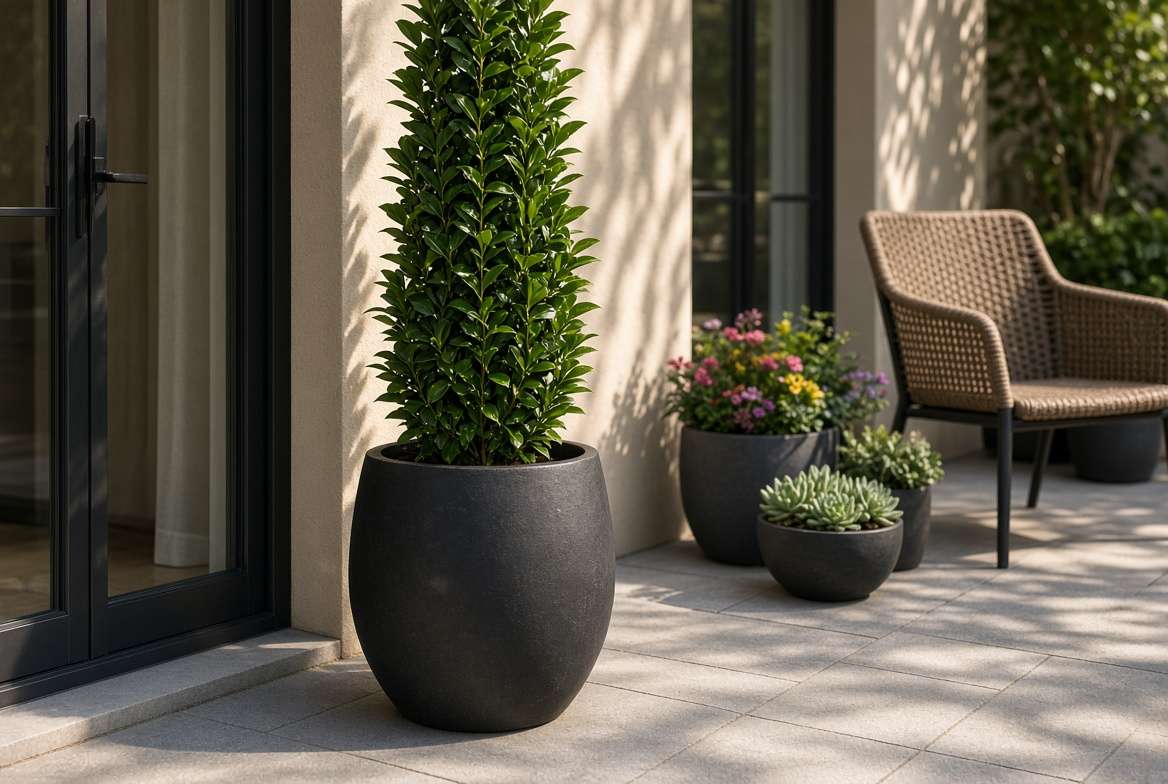
Pro Tip: The Sky Pencil Holly is exceptional for container planting. Flank your front door with two large, elegant planters housing Sky Pencils for an instant, high-end architectural upgrade that takes up virtually zero walking space. 🪴🚪
6. Columnar Norway Spruce (Picea abies ‘Cupressina’) 🏔️
-
Quick Stats:
-
Mature Height: 20–30 ft
-
Mature Width: 4–5 ft
-
Hardiness Zones: 3–7
-
Sunlight: Full sun
-
Why It’s a Landscaping Favorite: Most spruce trees are magnificent giants that require massive acreage to thrive. The Columnar Norway Spruce brings that majestic, traditional alpine look into a tight, upright frame that won’t swallow your suburban yard. It offers gorgeous, dark green needles and a commanding presence, making it an excellent choice for a rugged, textured privacy screen in colder climates. 🌲❄️
Expert Insights on Growth & Care: This tree is the ultimate cold-weather champion, shrugging off freezing temperatures and harsh winter winds with ease. Its upward-pointing branches are specifically adapted to shed heavy snow, preventing the splitting and breakage that can ruin other evergreens during a blizzard.
-
Pro Tip: While it is slightly wider (up to 5 feet) than a ‘Skyrocket’ Juniper, its dense, impenetrable branching makes it a superior windbreak. Plant these 4 feet apart along your property line to completely block out a busy road or an open, windy field. 🌬️🛡️
7. ‘Moonglow’ Juniper (Juniperus scopulorum ‘Moonglow’) 🌙
-
Quick Stats:
-
Mature Height: 15–20 ft
-
Mature Width: 2–3 ft
-
Hardiness Zones: 3–9
-
Sunlight: Full sun
-
Why It’s a Landscaping Favorite: Rounding out our list is the mesmerizing ‘Moonglow’ Juniper. Similar in shape to the ‘Skyrocket’, the ‘Moonglow’ offers slightly denser branching and a truly brilliant, reflective silver-blue foliage that seems to glow under the moonlight (hence the name!). If you are tired of standard green hedges and want your privacy screen to double as a striking visual feature, this evergreen delivers. 🌌✨
Expert Insights on Growth & Care: ‘Moonglow’ is incredibly tough, thriving in poor soils and resisting intense heat, drought, and deer browsing. It provides a solid, impenetrable wall of color that remains vibrant throughout the darkest days of winter.
-
Pro Tip: Because of its intense blue-silver coloration, ‘Moonglow’ pairs beautifully with deep purple or dark green companion plants. Use it as a tall backdrop for burgundy Japanese maples or purple fountain grass to create a high-contrast, professional landscape design. 💜🌿
IV. Master Sizing & Spacing Matrix 📊
To help you design the perfect privacy screen, use this quick-reference table. When planting a continuous hedge, use the “Ideal Center-to-Center Spacing” metric (measuring from the trunk of one tree to the trunk of the next) to ensure they overlap just enough to block sightlines without stunting each other’s root growth.
V. How to Plan and Plant Your Narrow Living Wall 🛠️
Selecting the right tall thin evergreen trees is only half the battle. How you plant them dictates whether you get a lush, vigorous privacy screen or a sparse, struggling row of sad trees. Follow these expert arboriculture steps to guarantee success.
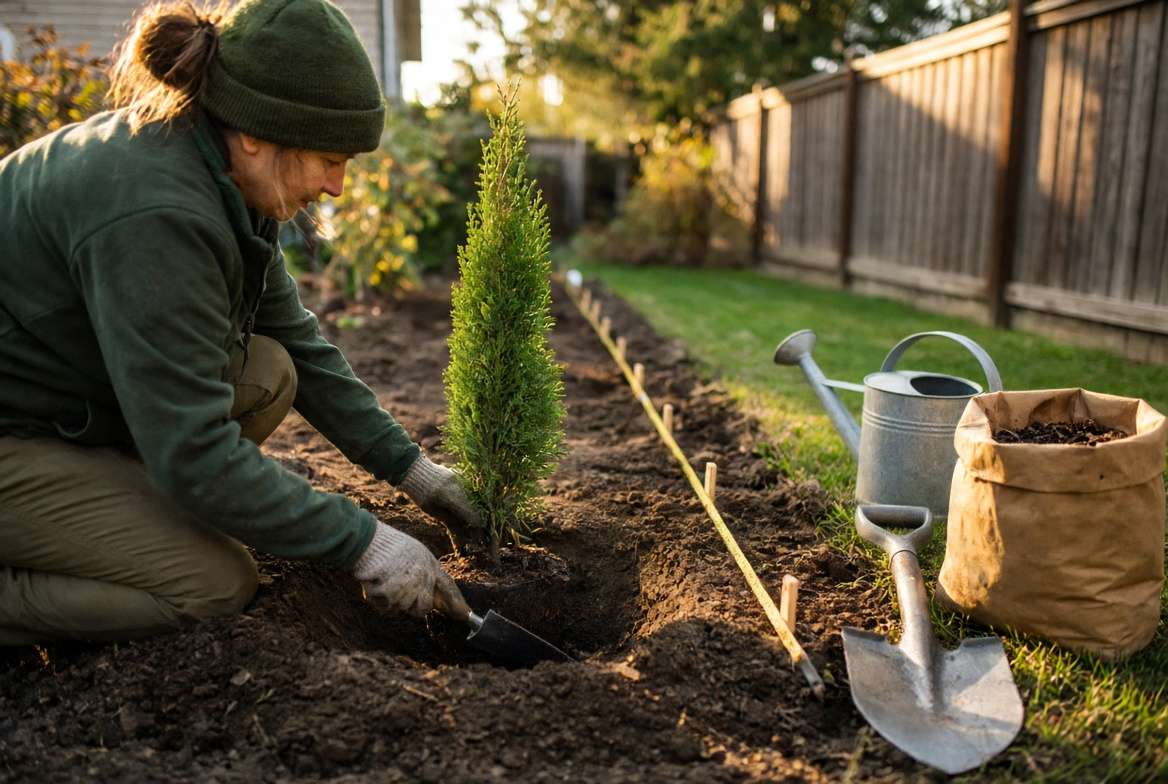
Step 1: Soil Prep and the Drainage Test 💧
Virtually all columnar evergreens share one common enemy: “wet feet” (waterlogged roots). Before you dig a trench for your new privacy line, test your soil’s drainage. Dig a hole 12 inches deep and fill it with water. If the water hasn’t drained away after 12 hours, you have heavy clay or a drainage issue. You will need to amend the soil heavily with compost and pine bark fines, or consider planting your trees in a raised berm to keep the root flare elevated and dry.
Step 2: The Golden Spacing Rule 📏
It is tempting to plant your trees incredibly close together for instant privacy, but this is a fatal landscape design flaw. Overcrowding leads to fierce root competition for water and nutrients. Worse, it restricts airflow, creating a breeding ground for fungal diseases. Always adhere to the spacing matrix above. The trees may look a bit gappy on day one, but within two to three growing seasons, their lateral branches will gracefully interlock, forming a seamless, healthy living wall. 🧱🌿
Step 3: Planting Best Practices ⛏️
-
Dig Wide, Not Deep: Dig the planting hole two to three times as wide as the root ball, but only as deep as the root ball itself.
-
Find the Root Flare: Never bury the trunk! The root flare (the widened base where the trunk transitions into roots) must sit slightly above the surrounding soil level to prevent suffocating the tree.
-
Mulch Like a Pro: Apply a 3-inch layer of organic mulch (like shredded cedar or pine needles) around the base of the trees to retain moisture and suppress weeds. Keep the mulch pulled back at least 2 inches from the actual trunk to prevent rot. 🍩 (Think donut, not volcano!)
VI. Ongoing Care, Watering, and Pruning Secrets 💧✂️
Irrigation Realities for Fast Growth
While trees like Junipers and Italian Cypress are famously drought-tolerant at maturity, no tree is drought-tolerant on the day you plant it. During the first two critical years of establishment, your evergreens need deep, consistent watering. A slow drip irrigation line laid at the base of your hedge is the most efficient way to encourage deep root systems. Water deeply once or twice a week rather than lightly sprinkling them every day. 🚿
To Prune or Not to Prune? ✂️
The beauty of tall thin evergreen trees is that their strict apical dominance does the shaping for you. Heavy shearing ruins their natural columnar form. However, if you want your privacy screen to stop at a specific height (for instance, exactly 12 feet to match a roofline), you can carefully trim the top central leader once the tree reaches your desired height. This process, called “topping,” will permanently cap the vertical growth and slightly encourage the tree to fill out horizontally. Note: Only do this if absolutely necessary, as it alters the tree’s natural growth habit.
Winter Protection for Narrow Branches ❄️🧣
In zones that receive heavy, wet snow, the upright branches of arborvitaes and junipers can sometimes splay open under the weight. To prevent your skinny trees from looking like peeled bananas after a blizzard, gently wrap the trees with green garden twine or heavy-duty bird netting in late autumn. This binds the branches together softly, providing structural support against ice loads.
VII. Frequently Asked Questions (FAQs) 🙋♂️
Q1: How fast do tall thin evergreen trees actually grow? Growth rates vary heavily by species and soil quality. Rapid growers like the American Pillar Arborvitae can push 2 to 3 feet of new growth per year under optimal conditions. Moderate growers like the Emerald Green will add about 9 to 12 inches annually. Consistent watering and an annual application of slow-release evergreen fertilizer in the spring will maximize their growth speed. 🚀
Q2: Will their roots damage my underground pipes, foundation, or neighboring fences? One of the major benefits of columnar evergreens is their contained root systems. Because their canopy is narrow, their root spread is proportionally smaller and generally less invasive than large, sprawling shade trees (like maples or willows). However, always err on the side of caution: keep plantings at least 3 to 4 feet away from hardscapes and foundations, and always call your local utility marking service before digging near property lines. 🛑🚧
Q3: What is the absolute narrowest evergreen tree available? For micro-spaces, the Sky Pencil Holly (2 feet wide) and the ‘Skyrocket’ Juniper (2 to 3 feet wide) are your best bets. They offer maximum vertical screening while taking up less ground space than a standard garbage can. 🗑️✨
Q4: Can I grow these trees in pots on a balcony or patio? Yes! Varieties with slower growth rates, such as the Sky Pencil Holly or the Emerald Green Arborvitae, do exceptionally well in large containers. Just ensure the planter has massive drainage holes, use a high-quality potting mix, and remember that potted trees require much more frequent watering and winter root protection than trees planted in the ground. 🪴🏙️
VIII. Conclusion & Next Steps 🌅
Reclaiming your backyard privacy does not require sacrificing your valuable lawn space, building an expensive fortress-style fence, or living in the dark shadows of massive, sprawling conifers. By strategically incorporating tall thin evergreen trees into your landscape design, you can block out second-story windows, muffle street noise, and create a lush, elegant living wall that enhances your property value.
From the cold-hardy resilience of the Columnar Norway Spruce to the sleek, modern aesthetic of the ‘Skyrocket’ Juniper, there is a perfect columnar evergreen for every climate and design style.
Now it’s your turn! Are you dealing with a nosy neighbor, trying to screen an eyesore view, or working with a frustratingly narrow side yard? Drop a comment below with your yard’s width or your USDA hardiness zone, and I’ll personally help you pick the exact right tree variety for your space! 👇💬











