

Biting into a crisp, sun-warmed apple picked straight from your own backyard is one of life’s greatest simple pleasures. But for decades, a persistent myth has held urban and suburban gardeners back: the belief that you absolutely need a sprawling, multi-acre lawn and at least two compatible trees blooming at the exact same time to get a single piece of fruit.
If you are dealing with a modest patio, a tight suburban lot, or even just a sunny balcony, the solution is much simpler. By planting self pollinating apple trees paired with modern dwarfing rootstocks, you can cultivate a heavy, reliable harvest from just one solitary tree 🏡.
Having spent years evaluating chill hours, testing rootstock resilience, and tracking annual yields in ultra-compact spaces, I can confidently tell you that you don’t need to sacrifice flavor or yield just because you lack acreage. These highly photogenic, space-saving varieties are not only incredibly productive but also look picture-perfect framing a garden walkway or taking center stage in a decorative patio pot 📸🌿.
Here is your complete guide to the science behind single-tree fruiting, the critical importance of rootstocks, and the seven absolute best varieties to start your one-tree backyard orchard.
How Do Self-Pollinating Apple Trees Work? 🐝🌸
Before you start digging, it is helpful to understand exactly how a single tree manages to produce fruit without a partner nearby.
Perfect Flowers & Anther-to-Stigma Transfer
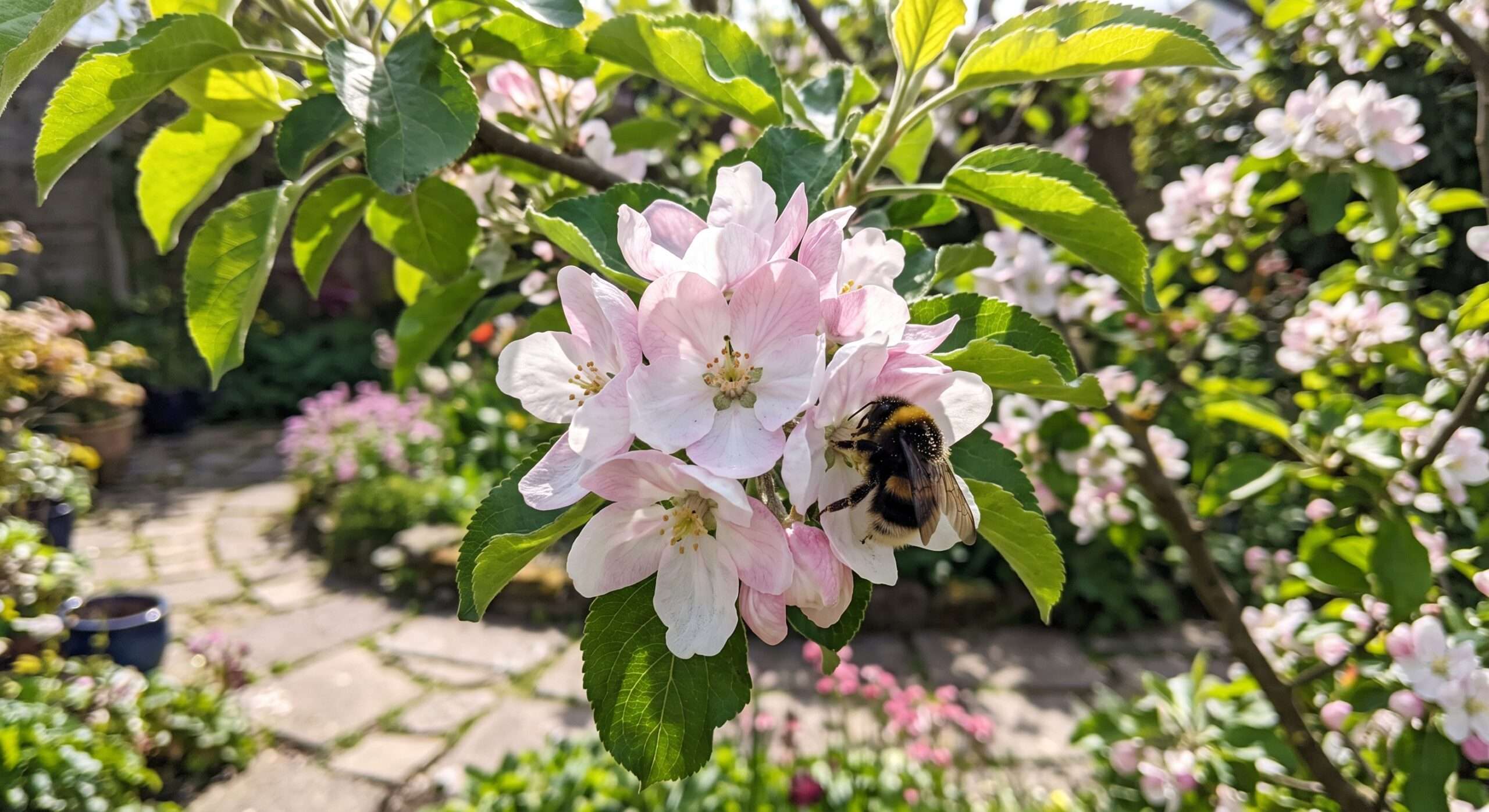
In botanical terms, apple blossoms are considered “perfect flowers.” This means that every single delicate pink and white blossom on the tree contains both male reproductive organs (the pollen-producing stamens) and female reproductive organs (the pistil and stigma) 💮.
However, most traditional apple varieties have an evolutionary defense mechanism called self-incompatibility, which prevents their own pollen from fertilizing their own flowers. They require pollen from a completely different apple cultivar to travel via bees or wind to set fruit. Self-pollinating (or self-fertile) trees have a genetic quirk that bypasses this rule, allowing their own pollen to successfully fertilize their own blossoms.
Self-Fruitful vs. Partially Self-Fertile
When shopping for trees or planning your garden layout, you will encounter two industry terms that are vital to understand:
-
Fully Self-Fruitful: These trees produce a robust, heavy crop entirely on their own. They are the true solitary performers of the apple world.
-
Partially Self-Fertile: These trees will produce a modest crop if planted alone. However, if a neighboring tree (or even a crabapple tree down the street) happens to share its pollen, the yield can increase by 30% to 50% 📈.
The Role of Pollinators & Wind
Even if a tree is perfectly self-fertile, the pollen still has to physically move from the anther to the stigma. Gentle spring breezes help, but native pollinators are your true garden allies. Cultivating a habitat for solitary native bees, such as mason bees, ensures that every blossom is thoroughly pollinated, leading to beautifully uniform, perfectly round fruit 🐝🍎.
Sizing Down: Selecting the Right Dwarf Rootstock 🌳🪴
When optimizing a small yard, selecting a self-fertile cultivar is only half the battle. The other half—and arguably the more important half—is the rootstock.
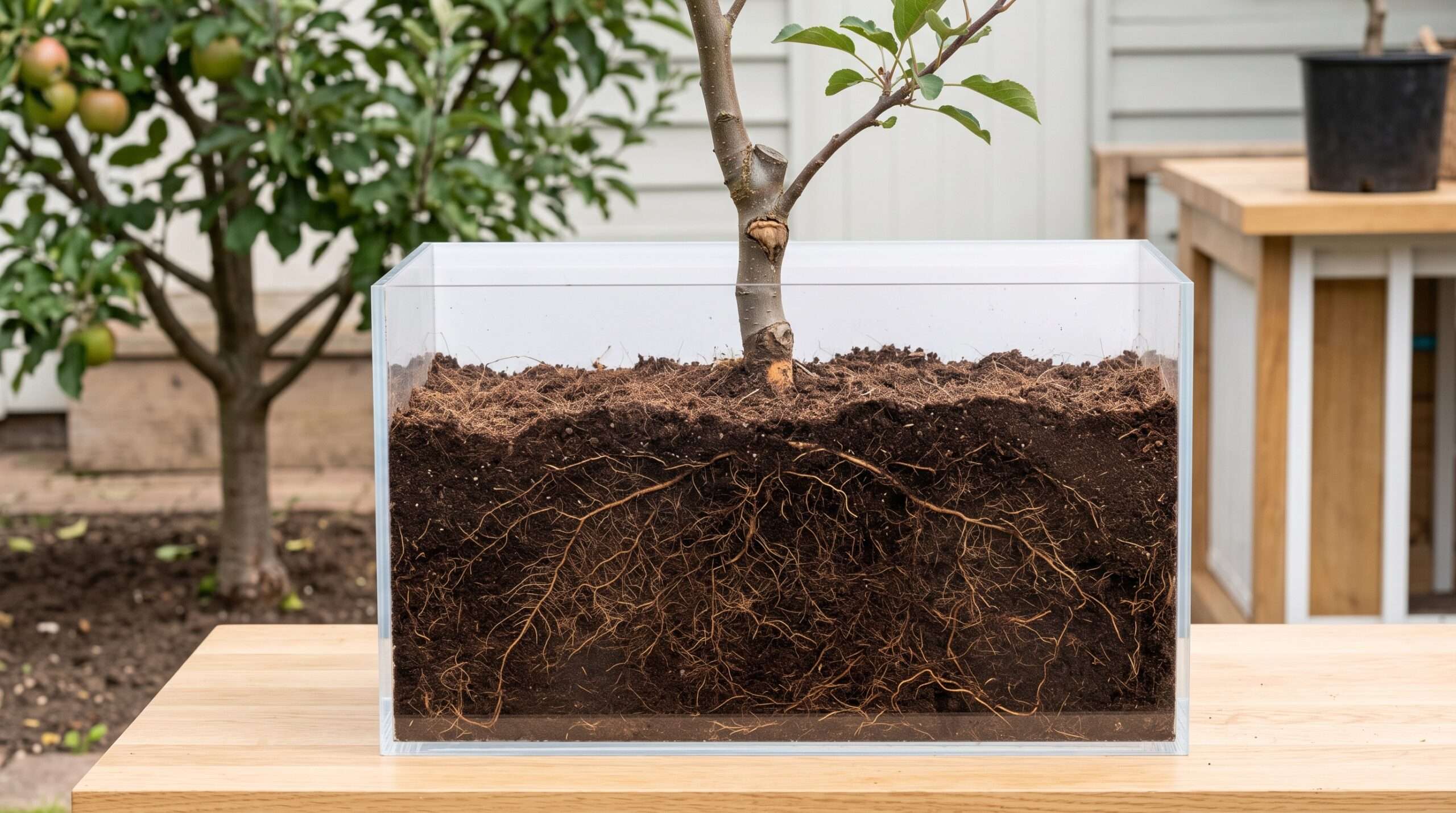
Apple trees are grafted. The top part (the scion) determines the type of apple you get (like a Granny Smith or a Braeburn). The bottom part (the root system, or rootstock) dictates exactly how tall and wide the tree will ultimately grow. If you buy a self-pollinating scion grafted onto a “standard” seedling rootstock, it will still grow into an unwieldy 25-foot giant that shadows your entire yard!
For small spaces, patios, and containers, you must choose a dwarfing rootstock.
Rootstock Comparison Guide 📏
-
M27 (Extreme Dwarf): Keeps the tree remarkably small, maxing out at just 4 to 6 feet tall. This is the absolute best choice for permanent container planting, balconies, and tiny courtyard borders. It requires permanent staking because the root system is quite shallow.
-
M9 / Bud 9 (Dwarf): Reaches about 8 to 10 feet in height. It is a heavy, early producer that fits perfectly into small raised garden beds or narrow side yards. Like the M27, it generally needs a stake or trellis for support.
-
M26 (Semi-Dwarf): Grows to about 10 to 12 feet tall. It is incredibly cold-hardy and develops a stronger root system, making it freestanding and highly resilient in sheltered suburban yards.
💡 Pro-Tip for Patio Gardeners: If you are growing your apple tree in a decorative pot, always look for the M27 or M9 rootstock. Their fibrous root profiles thrive in the confined space of a container, ensuring your tree won’t become rootbound and stressed after just a few seasons.
Top 7 Self-Pollinating Apple Tree Cultivars 🏆
Ready to choose your tree? Here are the seven best self-pollinating apple trees specifically chosen for their compact growing habits, reliable solo harvests, and phenomenal flavor profiles.
1. Golden Delicious – The Backyard Classic 🍯
-
Flavor Profile: Intensely sweet, mellow, and honeyed with a crisp bite.
-
Chill Hours: 600 – 700 hours
-
USDA Zones: 5 – 8
-
Why it fits: The Golden Delicious is the gold standard for self-fruiting trees. It is dependably self-fruitful and a famously heavy producer, meaning even a small dwarf tree will be dripping with golden fruit by late summer. As an added bonus, it is a “universal donor”—if you ever decide to expand your garden and add another variety later, the Golden Delicious will pollinate almost anything.
-
Best for: Eating fresh off the branch, making smooth applesauce, and capturing gorgeous golden-hour garden photos.

2. Granny Smith – The Crisp, Tart Heavy-Yielder 🍏
-
Flavor Profile: Tangy, firm, and packed with a highly acidic, refreshing snap.
-
Chill Hours: 400 – 500 hours (Low chill!)
-
USDA Zones: 6 – 9
-
Why it fits: The Granny Smith is partially self-fertile, but it performs incredibly well solo in warmer, long-season climates where other apples struggle. It requires fewer winter chill hours, making it an excellent choice for southern and coastal gardeners.
-
Best for: Classic apple pies, tart baking recipes, and storing in the crisper drawer for months on end.
3. Falstaff / Red Falstaff – The Compact Heavy Cropper 🎈
-
Flavor Profile: Exceptionally juicy and crisp, offering a perfectly balanced sweet-sharp bite.
-
Chill Hours: ~800 hours
-
USDA Zones: 4 – 8
-
Why it fits: Pomologists and orchard experts widely consider the Falstaff to be one of the most reliable purely self-fertile apples in existence. It produces massive clusters of beautiful red-blushed fruit entirely on its own. Furthermore, it flowers over a very long window in the spring, which helps it escape sudden late-frost damage.
-
Best for: Beginner gardeners and those living in regions with highly unpredictable spring weather.
4. Braeburn – The Sweet-Tart Supermarket Alternative 🛒
-
Flavor Profile: A highly complex, refreshing blend of sweet and sharp notes with exceptionally dense, crisp flesh.
-
Chill Hours: ~700 hours
-
USDA Zones: 5 – 8
-
Why it fits: If you love the premium apples sold at high-end grocers, growing your own Braeburn is incredibly rewarding. It is highly productive when grafted onto dwarf rootstocks and establishes a very reliable solo fruit-set without needing a pollinator partner. Because it is a slightly later-season bloomer, it is ideal for regions that suffer from unpredictable spring frosts.
-
Best for: Modern dessert apple enthusiasts, fresh snacking, and pairing with sharp cheeses on a summer charcuterie board 🧀.
5. Northpole Columnar Apple – The Ultimate Patio Pillar 🗼
-
Flavor Profile: Crisp, aromatic, and remarkably juicy, closely resembling the classic McIntosh apple.
-
Chill Hours: 800 – 1,000 hours
-
USDA Zones: 4 – 8
-
Why it fits: Columnar apples are a marvel of modern horticultural breeding. Instead of developing a wide, spreading canopy, the Northpole grows straight upward like a pillar. It typically reaches only 8 to 10 feet tall and a shockingly narrow 2 feet wide. Even better, it requires absolutely zero complicated pruning. The fruit grows on short spurs directly along the main trunk!
-
Best for: Patios, deck pots, tight walkway borders, and modern minimalist landscape designs.
6. Golden Sentinel Columnar – Big Fruit, Zero Canopy 🌞
-
Flavor Profile: Gorgeously sweet, golden fruit that tastes nearly identical to full-size standard Golden Delicious varieties.
-
Chill Hours: ~400 – 600 hours
-
USDA Zones: 4 – 9
-
Why it fits: Like the Northpole, the Golden Sentinel offers an extremely narrow footprint, making it the perfect architectural companion for small spaces. Despite the tree’s tiny stature, the apples it produces are massive, sweet, and uniform. Because it produces clusters directly along its central leader (the main trunk), you can plant three of these in half barrels along a single balcony rail.
-
Best for: Container gardening in urban micro-yards and warm-climate vertical gardens.
7. Queen Cox (Self-Fertile Sport of Cox’s Orange Pippin) 👑
-
Flavor Profile: Renowned vintage aromatic complexity; an intense, rich, and slightly spicy heirloom flavor.
-
Chill Hours: ~800 hours
-
USDA Zones: 5 – 8
-
Why it fits: The original Cox’s Orange Pippin is legendary for its gourmet flavor, but it is notoriously finicky and completely self-sterile. Enter the Queen Cox: a naturally occurring “sport” (genetic mutation) that fixes the self-sterility issue while keeping the antique, gourmet flavor perfectly intact.
-
Best for: Gourmet fruit lovers, artisanal cider enthusiasts, and gardeners who want to grow a rare heirloom variety you can never find in a standard grocery store 🥂.
🪄 Bonus Expert Alternative: Multi-Grafted “4-in-1 Family Trees”
If you truly only have space for one single pot but desperately want different apple varieties, look for a multi-grafted family tree. Nursery experts graft three or four different compatible apple varieties (like Fuji, Gala, and Granny Smith) onto a single dwarfing rootstock. The branches cross-pollinate each other on the exact same trunk, giving you a staggered harvest of different apples from mid-summer through late fall!
At-a-Glance: Comparing the Best Self-Fertile Cultivars 📊
Use this quick-reference guide to match the perfect tree to your specific microclimate and culinary preferences.
| Variety Name | Mature Size (on Dwarf) | Chill Hours Needed | USDA Zones | Flavor & Primary Use |
| Golden Delicious | 8 – 10 ft | 600 – 700 | 5 – 8 | Sweet / Fresh eating, sauce |
| Granny Smith | 8 – 10 ft | 400 – 500 | 6 – 9 | Tart / Baking, long storage |
| Falstaff | 8 – 10 ft | ~800 | 4 – 8 | Sweet-Sharp / Reliable beginner crop |
| Braeburn | 8 – 10 ft | ~700 | 5 – 8 | Sweet-Tart / Gourmet snacking |
| Northpole Columnar | 8 – 10 ft x 2 ft wide | 800 – 1000 | 4 – 8 | Crisp, McIntosh-like / Tight patios |
| Golden Sentinel | 8 – 10 ft x 2 ft wide | 400 – 600 | 4 – 9 | Sweet, Large / Balcony containers |
| Queen Cox | 8 – 10 ft | ~800 | 5 – 8 | Aromatic, Rich / Artisanal cider |
Space-Saving Training Methods for Tight Quarters 🌿✂️
If you want to maximize your yield without sacrificing an inch of your lawn, the way you train your tree’s canopy is just as important as the rootstock you select.
The Art of Espalier 🧱
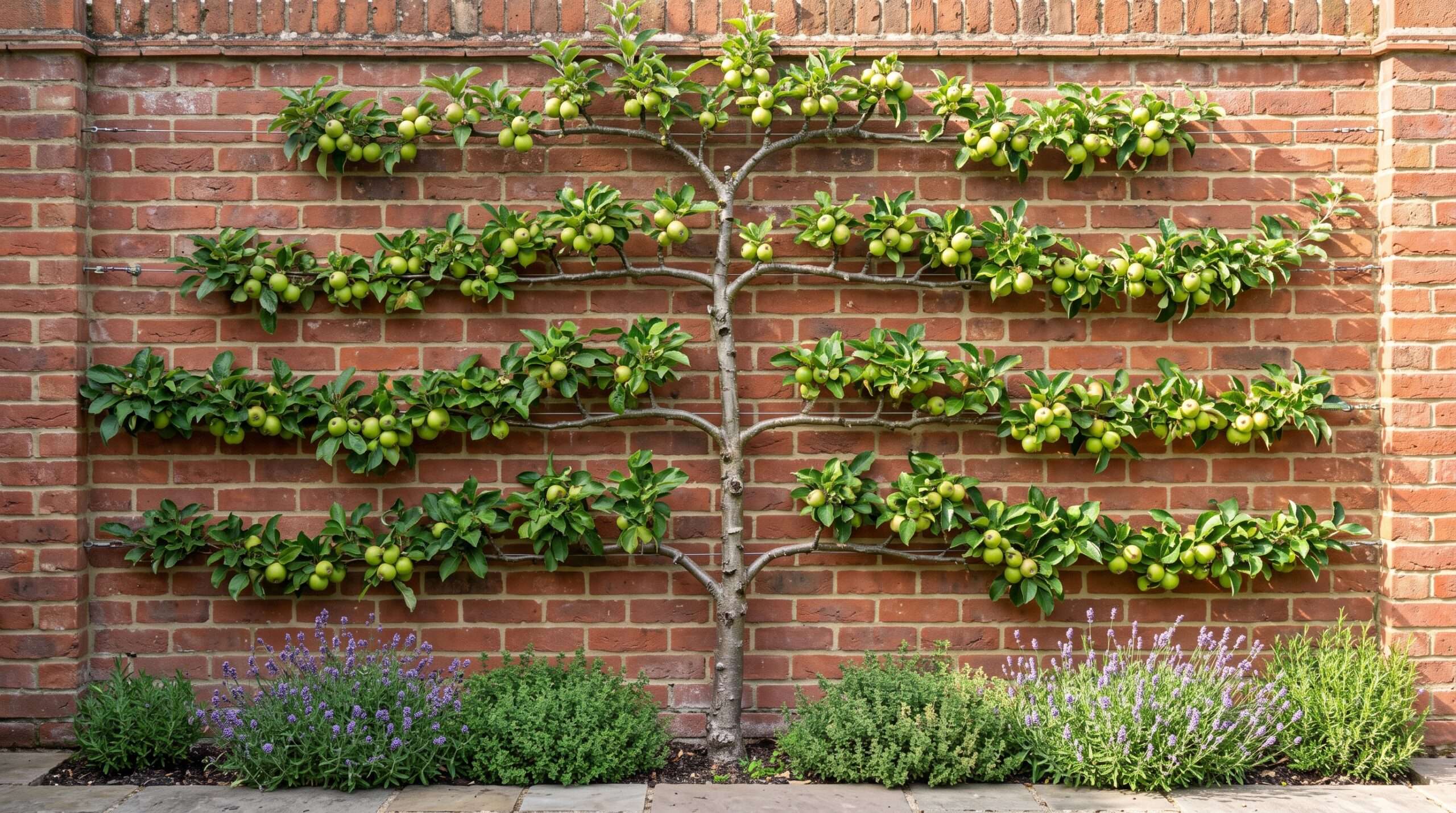
Espalier (pronounced es-pal-yay) is a centuries-old European pruning technique where tree branches are trained to grow completely flat against a boundary wall, fence, or wire trellis. By tying the flexible young branches horizontally, you encourage the tree to produce more fruit-bearing spurs rather than leafy vegetative growth. An espaliered self-pollinating apple tree takes up virtually zero yard depth. Furthermore, planting against a south-facing brick wall absorbs the sun’s heat during the day and radiates it back to the tree at night, creating a microclimate that sweetens the fruit.
Stepover Apples 🚶
Imagine an apple tree that only reaches your knees! A stepover tree is a highly specialized, single-tier espalier. The main trunk is bent at a 90-degree angle about 18 inches off the ground and trained horizontally along a single low wire. Stepover apples make incredibly charming, fruit-bearing borders for raised vegetable garden beds or decorative stone pathways.
Container Culture 101 🪴
Growing a self-pollinating apple tree in a pot is incredibly rewarding if you follow a few strict rules:
-
Size Matters: Choose a container that is at least 15 to 20 gallons (or 24 inches in diameter) to accommodate the root mass.
-
Soil Composition: Never use heavy garden dirt. Use a lightweight, premium potting soil blended with 30% perlite or pine bark fines to ensure rapid drainage.
-
Avoid Perched Water Tables: Ensure your pot has multiple large drainage holes. Do not put gravel at the bottom of the pot—this actually impedes drainage and drowns the lower roots.
Seasonal Care Guide for Maximum Harvests 💧☀️
Even the most resilient self-pollinating apple trees require a targeted seasonal care routine to produce large, unblemished fruit in a small space.
Sun & Soil Foundations ☀️
Apple trees are sun-worshippers. Ensure your chosen location receives a minimum of 6 to 8 hours of direct, unfiltered sunlight daily. Morning sun is particularly valuable because it rapidly dries the morning dew off the leaves, drastically reducing the risk of fungal infections like powdery mildew. Ensure your soil pH sits comfortably between 6.0 and 6.8 (slightly acidic to neutral).
The Critical Fruit-Thinning Rule ⚖️
This is the hardest rule for beginners to follow, but it is entirely non-negotiable: You must aggressively thin your fruit. In early summer, your self-fertile tree may set clusters of four or five tiny apples in a single bunch. You must ruthlessly pinch off all but the largest, healthiest apple in each cluster.
If you allow the tree to carry all of them, the fruit will be tiny and underdeveloped. Worse, the tree will exhaust so much energy that it will completely refuse to blossom the following spring—a frustrating cycle known as biennial bearing.
Watering & Mulching Routines 🚿
-
In-Ground Trees: Provide a deep, slow soaking once a week during the hot summer months.
-
Container Trees: Potted trees dry out rapidly. During July and August, you may need to water them every single day until water runs freely out of the bottom drainage holes.
-
Mulching: Apply a 3-inch layer of organic wood chip mulch around the base of the tree (keeping it a few inches away from the trunk bark to prevent rot). Mulch stabilizes delicate feeder roots against temperature spikes and retains vital moisture.
Organic Pest & Disease Management 🐛
Small-yard growers have a distinct advantage: a single dwarf tree is incredibly easy to monitor and treat organically!
-
Codling Moths: Hang non-toxic pheromone traps in the canopy in early spring to prevent the infamous “worm in the apple.”
-
Aphids: Wash them off with a strong blast from the garden hose or apply cold-pressed neem oil in the evening.
-
Apple Scab: To avoid relying on heavy copper fungicide sprays, always prioritize scab-resistant cultivars and practice good garden hygiene by raking up fallen leaves every autumn.
Common Questions About Self-Pollinating Apple Trees ❓
Q1: Do self-pollinating apple trees produce less fruit than cross-pollinated trees?
Not necessarily. A fully self-fruitful tree like a Golden Delicious will produce a remarkably heavy crop all on its own. However, almost all apple trees—even self-fertile ones—will see a slight bump in fruit size and overall yield if a compatible pollen partner is introduced.
Q2: How many years until a dwarf self-pollinating apple tree bears fruit?
Because dwarfing rootstocks push the tree to mature faster, you can typically expect your first light harvest within 2 to 3 years after planting a young nursery whip.
Q3: Can I plant a self-pollinating apple tree in a container permanently?
Yes, absolutely! As long as you select an extreme dwarf rootstock (like M27) or a columnar variety, refresh the potting soil every few years, and aggressively prune the canopy, the tree can thrive in a container for decades.
Q4: Will adding a second tree increase the yield of a self-fertile apple tree?
Yes. While a self-pollinating tree works perfectly well alone, cross-pollination provides a wider genetic mix to the blossoms, which often results in slightly larger, rounder, and more abundant apples.
Q5: What are chill hours and why do they matter for small-yard apples?
Chill hours are the total number of winter hours where the temperature drops between 32°F and 45°F (0°C to 7°C). Apple trees need this deep winter sleep to properly reset their biological clocks and blossom in the spring. Always check your local climate’s average chill hours and select a tree that matches!

Start Your One-Tree Backyard Orchard 🌱🍏
You do not need acres of rolling hills or complex orchard management charts to enjoy homegrown fruit. The secret to success lies entirely in picking the right cultivar, insisting on a dwarf rootstock, and giving your tree a sunny corner to thrive.
Whether you opt for the crisp snap of a solitary Granny Smith, the elegant architecture of a Northpole Columnar on your patio, or the gourmet vintage flair of a Queen Cox, growing self pollinating apple trees is entirely within your reach.
Your Next Step: Determine your local USDA hardiness zone and average winter chill hours. Measure that sunny, empty spot on your patio or lawn, and order your bare-root dwarf tree for early spring planting. Your future harvests are waiting! ✨🥧











