
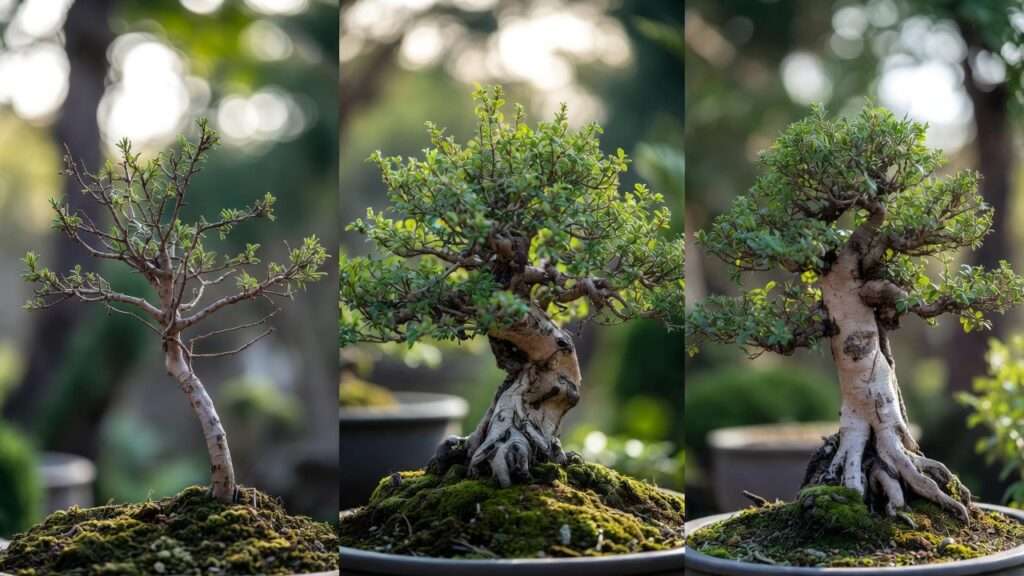
Have you ever looked at your bonsai and wondered why the top branches shoot up so vigorously while the lower ones stay weak and sparse? 😕 Or why your trunk thickens beautifully at the base but tapers awkwardly higher up? These aren’t random quirks — they’re the tree’s natural growth patterns at work! 🌿
Understanding bonsai growth patterns is the single most powerful skill any bonsai enthusiast can develop. It turns frustrating guesswork into confident, intentional decisions that respect the tree’s biology while guiding it toward stunning, aged-looking artistry. In this in-depth guide, we’ll explore the science behind how bonsai trees grow, the key developmental stages from seedling to masterpiece, and practical techniques to harness (rather than fight) these patterns for faster, healthier results. Whether you’re battling leggy growth, poor ramification, or slow trunk development, this article will give you the expert-level insights to transform your bonsai journey. Let’s unlock the secrets together! 🚀
The Fundamentals of Bonsai Growth: How Trees Really Work
Bonsai aren’t miniature trees in the genetic sense — they’re full-sized species kept small through careful root restriction, pruning, and training. But their growth follows the same biological rules as any tree in nature.
What Drives Bonsai Growth Patterns? ⚡
At the heart of it all is apical dominance, a hormonal phenomenon where the growing tip (apex) produces auxin — a growth hormone that suppresses buds lower down. This is why your bonsai’s top leader often grows fastest and strongest, while lower branches lag behind. Photosynthesis in the leaves sends energy downward, fueling trunk and root thickening, but strong apical growth pulls most resources upward.
The roots (especially the nebari or surface root flare) play a starring role too. A well-developed nebari not only anchors the tree aesthetically but supports overall vigor by absorbing water and nutrients efficiently.
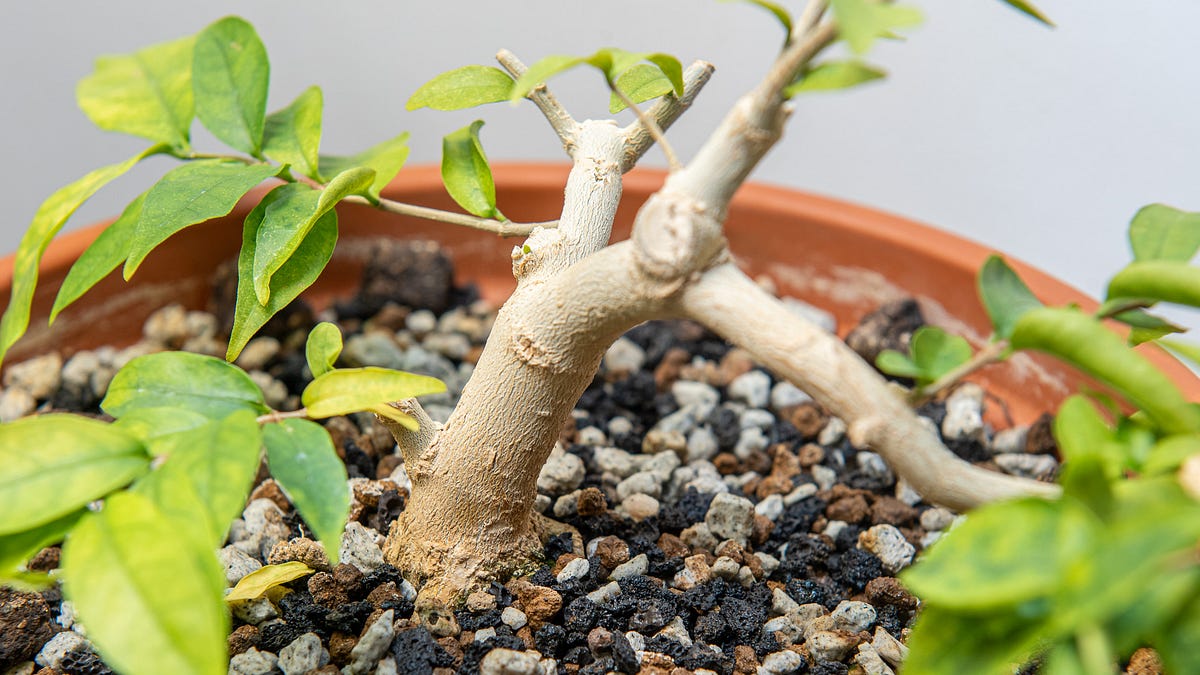
Seasonal Growth Cycles Every Bonsai Owner Must Know 🌸❄️
Trees follow predictable seasonal rhythms:
- Spring explosion — New buds swell, shoots extend rapidly, and energy surges for leaf production. This is prime time for vigorous growth and sacrifice branches.
- Summer consolidation — Leaves mature, storing carbohydrates in roots and woody tissues. Branch thickening accelerates here with proper feeding.
- Autumn refinement — Energy shifts to root growth and hardening wood. Leaves may change color in deciduous species.
- Winter dormancy — The tree rests, conserving energy. Protect from extreme cold, but plan major structural work.
Ignoring these cycles leads to weak trees; aligning your care with them accelerates beautiful development.
Key Biological Principles for Bonsai Success
- Leaves are the powerhouses — more healthy foliage means thicker trunks and branches over time.
- Strong, unrestricted growth builds size quickly; controlled pinching refines details but never thickens.
- Small, twiggy growth remains small forever — never try to refine a thin trunk too early!
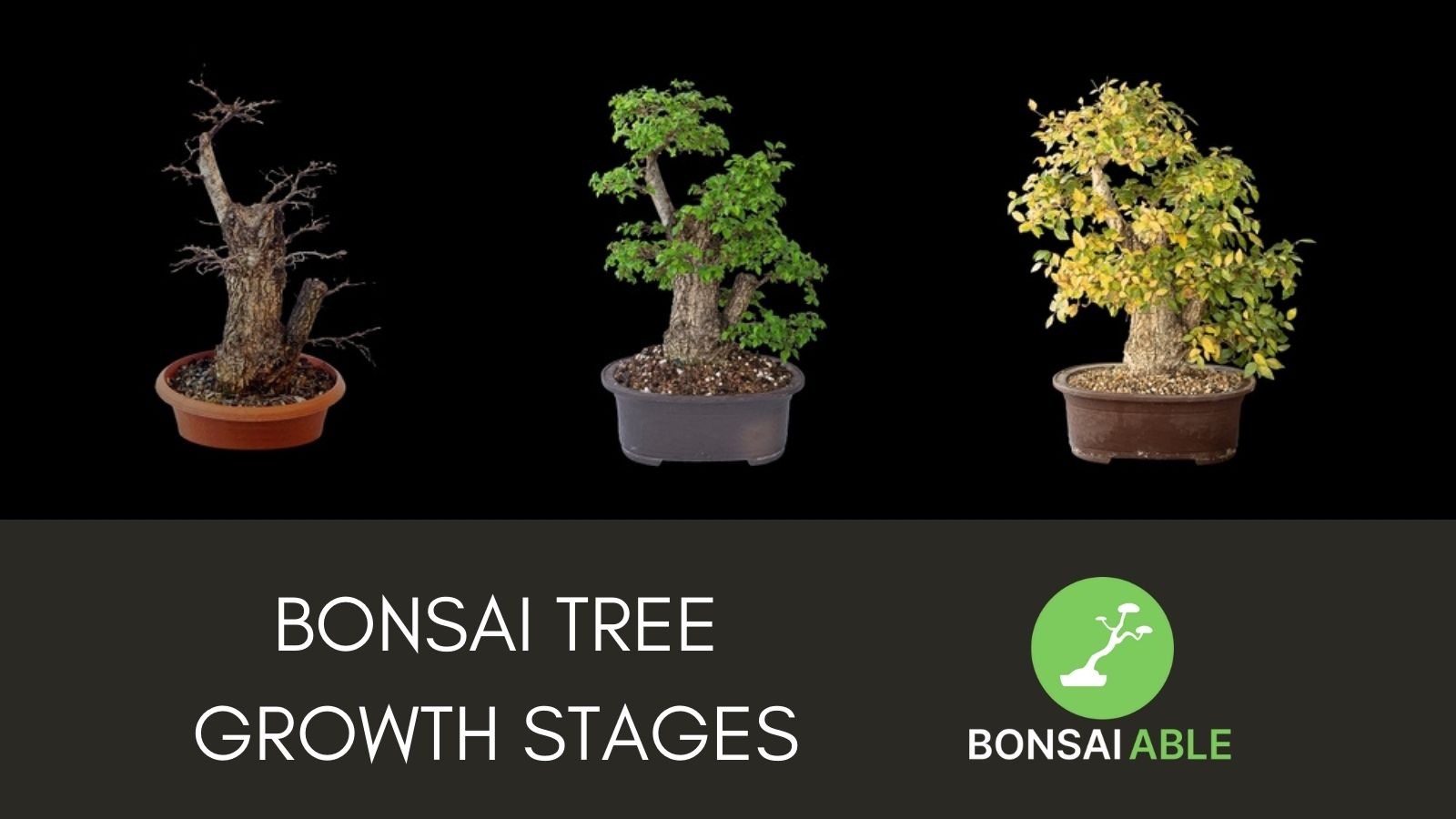
The Three (or Four) Main Stages of Bonsai Development
Bonsai development isn’t linear, but most experts divide it into clear phases. Recognizing your tree’s current stage prevents common mistakes like over-pruning too soon.
Stage 1: Propagation & Early Establishment (Years 0–3) 🌱
Start strong here! Whether from seed, cutting, air-layer, or young nursery stock, focus on building a robust root system and a basic trunk line.
- Prioritize free growth in larger pots or the ground.
- Avoid early wiring or heavy pruning — let the tree build vigor first.
- Common mistake: Potting into tiny bonsai pots prematurely, starving roots and stunting growth.
Stage 2: Primary Development / Trunk & Structure Building (Years 3–10+) 💪🌲
This is where magic happens — turning a stick into a tapered, powerful trunk.
- Use sacrifice branches or leaders: Let one or more strong shoots grow freely to add girth via cambium activity.
- Grow in the ground or large training pots for maximum thickening.
- Build movement early with gentle bends; inverse taper is hard to fix later!

Stage 3: Secondary Branching & Mid-Development 🌿
With a solid trunk and primary branches in place, develop the secondary and tertiary structure.
- Balance energy so no single branch dominates.
- Introduce wiring to set angles and create pads.
- Encourage back-budding for denser branching.
Stage 4: Refinement & Maintenance (Mature Bonsai Phase) 🎨
Now the tree is a canvas — focus on fine ramification, small leaves, and elegant pads.
- Techniques like pinching, selective defoliation, and controlled fertilizing keep it compact and refined.
- Maintenance pruning preserves the design while allowing subtle evolution.

How Natural Growth Patterns Influence Bonsai Styling
Once you understand that trees naturally prioritize upward and outward growth, every styling decision becomes strategic rather than arbitrary. The goal is never to force a shape against biology — it’s to gently redirect energy where you want it most.
Apical Dominance in Action ⚡
The strongest auxin flow comes from the highest tip. That’s why:
- The apex grows fastest and thickest if left unchecked
- Lower branches receive less energy and stay thinner/weaker
- Removing or weakening the apex (via pinching, pruning, or decandling in pines) redistributes hormones downward, waking dormant buds and strengthening lower structure
Pro tip: In formal upright (chokkan) style, you preserve strong apical dominance for perfect taper. In informal upright (moyogi) or cascade (kengai), you repeatedly cut back the leader to force side branches to compete and create movement.
Branch Placement & Alternation
Nature rarely places branches directly opposite each other or in perfect whorls. Bonsai looks most convincing when branches alternate left-right and decrease in thickness toward the apex (roughly following the “1/3 rule”: bottom third has the thickest branches, middle third medium, top third thinnest/finest).
Taper, Movement & Bark Development
Taper (wider base narrowing upward) is accelerated by:
- Letting lower sacrifice branches grow long and thick before removal
- Creating controlled “stress points” (gentle wire bends + pruning) that stimulate bark thickening and texture
- Allowing free growth periods in spring/summer to add girth quickly
Bark develops character faster on vigorous, sun-exposed surfaces. Older-looking bark comes from time + sun + repeated minor wounding (shari/jin creation) rather than magic shortcuts.
Species-Specific Growth Quirks
Not all trees behave the same — here are patterns worth memorizing:
- Japanese Maple (Acer palmatum) — Excellent back-budding, fast ramification, but fragile new shoots. Prone to long internodes if overfed.
- Chinese Elm (Ulmus parvifolia) — Aggressive grower, strong back-budding even on old wood. Forgiving for beginners.
- Black Pine (Pinus thunbergii) → Decandling (removing spring candles) forces summer back-buds and controls vigor.
- Juniper (Juniperus spp.) → Slow but responds dramatically to pinching new tips; hates heavy root pruning.
- Ficus (indoor common species) — Grows year-round in warm conditions, excellent for beginners but weak nebari unless ground-grown.
Knowing these quirks prevents disappointment and lets you design with the tree’s strengths.
Practical Techniques to Work WITH Growth Patterns
Theory is great — application is better. These proven methods accelerate desirable traits while respecting biology.
Encouraging Trunk Thickening & Taper 💪
- Plant in ground or very large training pot (collar pot) for unrestricted roots.
- Feed generously (high-nitrogen spring/summer) and water deeply.
- Grow one or two strong sacrifice leaders/branches freely for 2–4 seasons.
- Monitor cambium expansion — remove sacrifices only when desired taper is achieved.
- After removal, let wounds callus naturally or carve slight shari for character.
Developing Ramification & Fine Branching 🌿
- Pinching timing — Evergreen conifers: pinch candles when needles start to open. Deciduous: cut back to 2–3 leaves after extension.
- Partial defoliation — Remove outer leaves mid-summer (maples, elms) to force inner/lower back-buds without shocking the tree.
- Full defoliation — Riskier, used selectively on healthy vigorous trees to reduce leaf size and improve ramification density.
Wiring & Positioning Branches
- Wire in late winter/early spring (before buds swell) or during active growth for deciduous.
- Use aluminum wire on conifers — copper on maples/elm for stronger hold.
- Remove wire before it bites in (check every 4–8 weeks depending on species vigor).
Pruning Strategies to Counter Apical Dominance
- Always prune back to a side bud facing the desired direction.
- Prioritize lower branches: feed them first by pinching apex more aggressively.
- Use directional pruning: cut to outward-facing buds to open the tree; inward for density.
Common Problems & How Growth Patterns Explain Them (With Fixes)
Many bonsai frustrations stem directly from misunderstanding or fighting natural patterns. Here are the most frequent issues — and biologically sound solutions.
Problem 1: Top-heavy growth & weak lower branches ❌ Why it happens: Unchecked apical dominance funnels almost all auxin and energy upward. Lower buds stay suppressed. Fixes:
- Pinch or prune the apex aggressively every 2–4 weeks during active growth.
- Let lower branches grow longer than the leader for a season to build strength.
- Wire lower branches downward slightly to increase light exposure and photosynthesis on those leaves.
- Use directional pruning: always cut back to an outward- or lower-facing bud on the apex.
Problem 2: Uneven trunk thickening or inverse taper Why it happens: Energy flows strongest where leaves are densest. If upper branches dominate, the upper trunk thickens more than the base. Fixes:
- Grow strong basal sacrifice branches for 2–5 years.
- Remove upper sacrifices first; keep lower ones longer.
- Ground-layer or approach-graft new basal branches if the mistake is already advanced.
Problem 3: Poor back-budding & bare interiors Why it happens: Old wood loses budding capacity faster in some species; excessive apical dominance starves inner buds of light/energy. Fixes:
- Partial or full defoliation (species-dependent) forces inner buds to activate.
- Increase light penetration by thinning pads annually.
- For conifers: candle-prune rigorously to stimulate dormant buds along branches.
Problem 4: Overly long internodes & leggy appearance Why it happens: Excessive nitrogen + shade = rapid, weak extension growth. Fixes:
- Reduce nitrogen in late spring/summer; switch to balanced or low-N fertilizer.
- Maximize direct sunlight (especially morning sun).
- Pinch new shoots early and often to shorten internodes.
Expert Insights & Real-World Examples
After 15+ years working with hundreds of trees (from collected yamadori to nursery stock), here are patterns I see repeated across climates and species.
Case Study 1: Japanese Black Pine – From stick to powerful shohin in 7 years Started as thin 1-year-old seedling → grown in ground with single sacrifice leader for 4 years → thick base formed → decandled annually → refined pads developed in training pot. Key insight: Never decandle until trunk is 80% of desired thickness — otherwise energy is wasted on weak branching.
Case Study 2: Trident Maple – Fixing a top-heavy disaster Nursery stock wired too early → top dominated → lower branches died back. Solution: Hard prune apex in late winter, let lower shoots run free one full season, then rebalance. Now has beautiful nebari and even branching after 3 recovery years.
Pro Tip from Experience: Always ask yourself before any major cut: “Where do I want energy to go next?” If the answer is “lower branches,” weaken the apex immediately. If the answer is “thicken trunk,” let the apex run wild.
Seasonal Care Calendar Aligned with Growth Patterns
Spring 🌷 (March–May in temperate zones)
- Heavy feeding (high N) starts after first flush
- Pinch new candles/shoots early
- Major wiring & structural pruning when buds swell but before full leaf-out
- Repotting window (before or right after bud break)
Summer ☀️
- Switch to balanced or low-N fertilizer mid-summer
- Partial defoliation on vigorous deciduous trees
- Pinch continuously to control extension
- Protect from intense midday sun if leaves scorch
Autumn 🍂
- Reduce watering slightly; let soil dry more between waterings
- Final feeding with high-P/K fertilizer for root & wood hardening
- Light pruning to refine silhouette
- Prepare protection for winter
Winter ❄️
- Protect roots (insulate pots, move to cold frame/greenhouse)
- Minimal watering — only when soil is almost dry
- Plan next year’s design; study branch structure without leaves
- Major carving/jin/shari work when tree is dormant
Frequently Asked Questions (FAQs)
How long does it really take to thicken a bonsai trunk? 2–10+ years depending on species, starting size, and growing method. Ground growing + sacrifice branches can add 1–3 cm diameter in 3–5 years on fast species like pine/elm.
Can I speed up ramification without harming the tree? Yes — consistent pinching, partial defoliation, and balanced light/fertilizer do this safely. Avoid full defoliation every year on the same tree.
Why does my bonsai grow faster at the top? Apical dominance + better light exposure at the apex. Counter it with regular apex pinching and stronger lower-branch development.
When should I stop letting it grow freely? Only after the trunk and primary branches have reached 80–90% of your target size and taper. Refining too early keeps the tree small and weak forever.
Do indoor bonsai follow the same growth patterns? Yes, but slower and weaker due to lower light. Ficus, schefflera, and serissa still show apical dominance and seasonal slowdown — just less dramatically.
Conclusion: Master the Patterns, Create Living Art
Understanding bonsai growth patterns is what separates frustrated hobbyists from confident artists who create trees that look and feel alive. By observing seasonal cycles, respecting hormonal signals, and strategically directing energy, you work in harmony with the tree instead of against it. The result? Healthier roots, stronger nebari, faster taper, denser ramification — and bonsai that evolve beautifully for decades.
Your next step is simple: go look at your trees right now. Which stage are they in? Where is energy flowing strongest? Start small — pinch one apex today or let one sacrifice branch run free this season — and watch how dramatically the tree responds.
Share a photo or describe your current bonsai project in the comments below — I’d love to give you tailored advice based on its growth stage! 🌟❤️











