
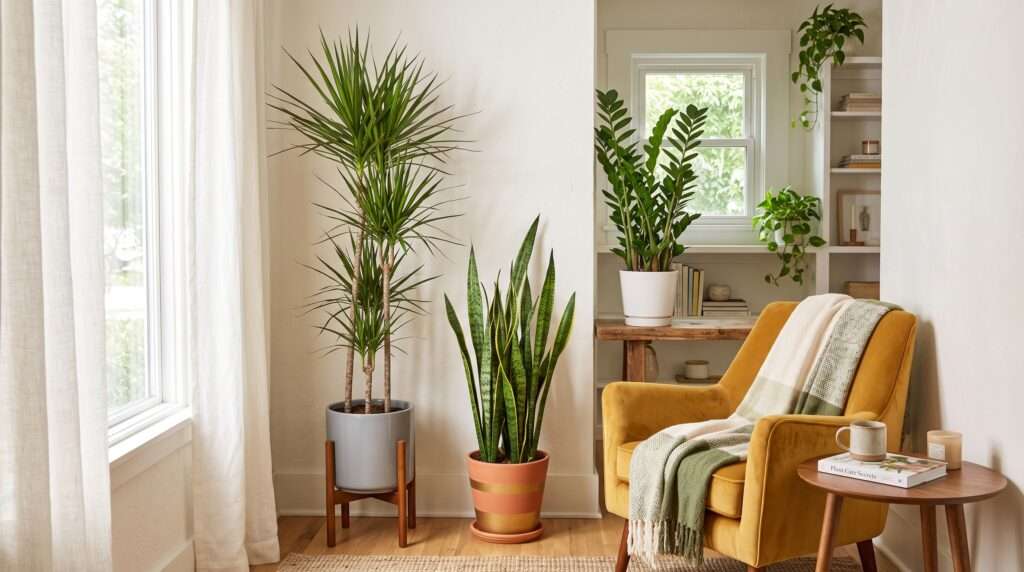
We all have them: that awkward, narrow gap between the sofa and the wall, the sterile hallway corner that feels devoid of life, or the tight entryway that desperately needs a touch of green. You want to bring nature indoors, but sprawling, bushy foliage would swallow your limited floor space whole. The ultimate design solution is incorporating tall skinny plants. These space-saving botanical marvels draw the eye upward, instantly making ceilings appear higher while injecting lush, vibrant life into the most challenging dead zones of your home.
As a horticulturist and indoor plant designer, I have spent years meticulously selecting and testing space-saving species that thrive in tight quarters. The secret to flawless indoor landscaping isn’t just buying any plant—it is selecting species with an inherently columnar or upright growth habit that will not outgrow their welcome.
Whether you are dealing with a dim indoor corner or a narrow outdoor side yard that needs a privacy screen, this comprehensive guide covers the top 15 narrow plants, categorized by light needs and location, complete with expert care instructions to keep them growing up, not out. 🪴
📏 Why Choose Tall Skinny Plants? (The Design Magic)
Before diving into the specific species, it is important to understand why columnar plants are a staple in modern interior design and landscape architecture.
-
Architectural Appeal 🏛️: Tall, narrow houseplants introduce strong vertical lines that beautifully complement modern, minimalist, and mid-century interior design styles. They add structural interest without adding visual clutter.
-
Space Optimization 📐: In urban apartments and cozy homes, floor space is a premium commodity. Upright plants maximize your greenery per square foot, giving you the jungle aesthetic without requiring you to sacrifice precious living space.
-
Creating Natural Dividers 🚪: Slender, towering plants can be arranged in long, narrow planter boxes to act as living walls. They are the perfect way to softly partition an open-concept room or create a green privacy screen along a narrow outdoor patio.
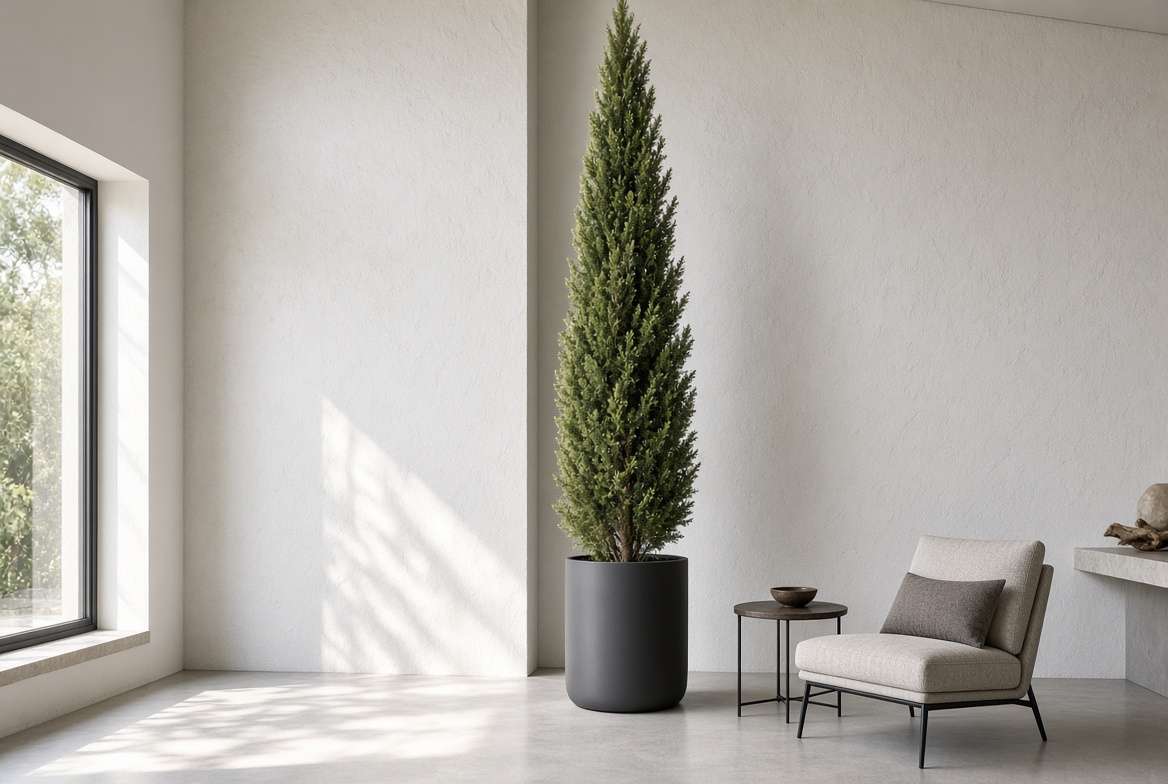
🌑 Top 5 Tall Skinny Plants for Low-Light Indoor Corners
Expert Note: In the horticultural world, “low light” does not mean a windowless room or absolute darkness. It refers to moderate to low indirect sunlight—typically a north-facing window or a corner several feet away from a brighter light source. If you can comfortably read a book in the space without turning on a lamp, these shade-tolerant survivors will thrive.
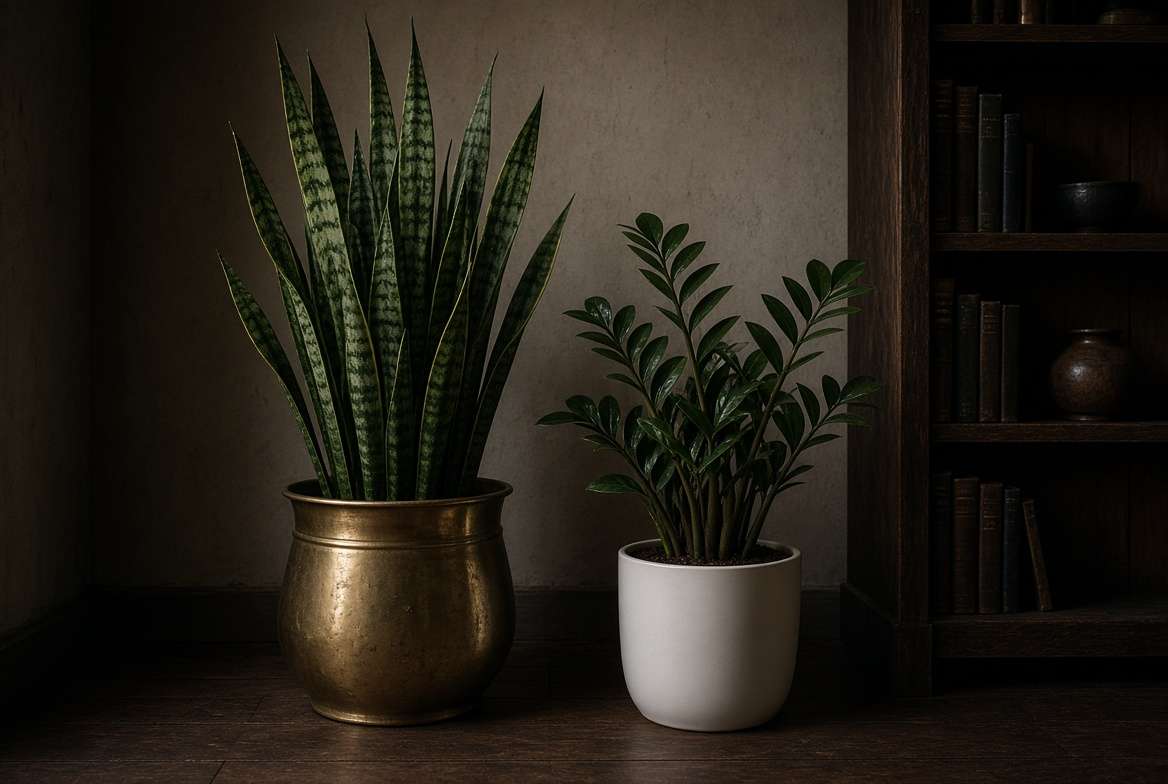
1. Snake Plant (Sansevieria trifasciata) 🐍
The Snake Plant is the undisputed champion of vertical growth and low-maintenance care. Its stiff, fleshy, sword-like leaves shoot straight up from the soil, displaying striking patterns of dark green, light green, and sometimes yellow margins.
-
Growth Habit: Strictly vertical. Even at maturity, a tall Snake Plant rarely exceeds a footprint of 10 to 12 inches across, while easily reaching 3 to 4 feet in height.
-
Care Snapshot: Highly drought-tolerant. Water only when the soil is 100% dry (usually every 2-4 weeks). Thrives in almost any lighting condition.
-
Expert Tip 💡: To keep your Snake Plant growing taller rather than wider, keep it slightly root-bound. Restricting the root space encourages the plant to push its energy upward into existing leaves rather than spreading lateral rhizomes.
2. ZZ Plant (Zamioculcas zamiifolia) 🌿
If you have a dim, neglected corner, the ZZ Plant is your best friend. It features upright, gently arching wands lined with thick, waxy, dark green leaflets that reflect whatever ambient light is available in the room.
-
Growth Habit: Upright and architectural. It grows via thick rhizomes beneath the soil, sending up structural stems that reach 2 to 3 feet tall.
-
Care Snapshot: Requires excellent drainage. Overwatering is the only way to kill a ZZ Plant. Wait until the soil is completely dry before soaking.
-
Expert Tip 💡: For a stunning visual contrast against light-colored walls, seek out the Zamioculcas zamiifolia ‘Raven’ variety. Its new growth emerges bright green before maturing into a dramatic, deep purple-black shade.
3. Cast Iron Plant (Aspidistra elatior) 🛡️
True to its name, the Cast Iron Plant is practically indestructible. Popularized during the Victorian era for its ability to withstand coal dust and deep shade, it remains a premier choice for challenging indoor spaces.
-
Growth Habit: Features tall, elegant, paddle-shaped leaves that grow straight up on stiff stems, reaching up to 3 feet tall.
-
Care Snapshot: Incredibly hardy. It tolerates temperature fluctuations, dry air, and sporadic watering schedules.
4. Dracaena Janet Craig (Dracaena deremensis) 🌴
The ‘Janet Craig’ is a lush, tropical-looking plant that adds significant height without demanding much light. As it ages, it drops its lower leaves, exposing a slender vertical cane topped with a cascading tuft of dark, glossy foliage.
-
Growth Habit: Tall, bare vertical canes that can reach 4 to 6 feet indoors, staying extremely compact in width.
-
Care Snapshot: Prefers to dry out slightly between waterings. Highly sensitive to fluoride and chlorine.
-
Expert Tip 💡: Always use filtered water or rainwater for Dracaenas. Tap water chemicals cause the tips of their long leaves to turn brown and crispy.
5. Parlor Palm (Chamaedorea elegans) 🥥
The Parlor Palm brings a delicate, feathery texture to narrow spaces. Unlike massive, sprawling palms (like the Majesty or Areca palm), the Parlor Palm stays slender and refined.
-
Growth Habit: Multiple thin, bamboo-like stems produce arching, pinnate fronds. Usually tops out around 3 to 4 feet indoors.
-
Care Snapshot: Prefers medium, indirect light and slightly moist (but not soggy) soil.
-
Expert Tip 💡: This plant loves high humidity. It is the absolute perfect addition to a tight, low-light bathroom corner where it can soak up the steam from your shower.
☀️ Top 5 Tall Skinny Plants for Bright, Sunny Spots
Expert Note: These plants require strong, indirect sunlight or even a few hours of direct morning sun. They are ideal for flanking a large south-facing or west-facing window, adding drama to a brightly lit sunroom, or filling a prominent living room corner.

6. Ficus Audrey (Ficus benghalensis) 🌳
Move over, Fiddle Leaf Fig—the Ficus Audrey is the new “it” plant for interior designers. It is much more forgiving than its finicky cousin and naturally boasts a more upright, tree-like structure.
-
Growth Habit: Features a strong, light-colored vertical trunk with deep green, velvet-textured leaves adorned with striking pale veins.
-
Care Snapshot: Needs consistent, even moisture and bright, indirect light. Do not let the root ball dry out completely.
-
Expert Tip 💡: To maintain a strict columnar shape, prune any lateral (side) branches early in the growing season. This encourages a classic “tree standard” silhouette that saves space.
7. Bird of Paradise (Strelitzia nicolai) 🦜
If you want to create a soaring tropical canopy in a bright room, the White Bird of Paradise is unmatched. It grows incredibly fast in optimal conditions, producing massive, glossy, paddle-shaped leaves.
-
Growth Habit: Tall, highly vertical stalks. Can easily reach 6 to 8 feet indoors.
-
Space Warning ⚠️: While the stalks grow straight up, the massive leaves do fan out slightly at the top. Ensure your corner has at least 2 to 3 feet of upper clearance, even though the base remains very narrow.
8. Madagascar Dragon Tree (Dracaena marginata) 🐉
The Dragon Tree is a sculptural masterpiece. It features slender, twisting vertical canes topped with spiky, red-edged, grass-like leaves.
-
Growth Habit: Very skinny and highly vertical. You can fit a large, 6-foot Dragon Tree into a corner that is only 18 inches wide.
-
Care Snapshot: Super easy to care for; allow the top half of the soil to dry out between waterings. Enjoys bright, indirect light.
9. African Milk Tree (Euphorbia trigona) 🌵
Often mistaken for a cactus, this stunning architectural succulent adds an edgy, desert-chic vibe to tight spaces. It features vertical, three-sided ridges lined with thorns and small, teardrop-shaped leaves.
-
Growth Habit: Highly columnar. Branches grow straight up, parallel to the main stem, reaching 6 to 8 feet tall.
-
Care Snapshot: Loves direct, bright sunlight. Water thoroughly only when the soil is completely bone dry.
-
Safety Warning ⚠️: If snapped or punctured, this plant leaks a toxic, milky white sap that is highly irritating to the skin and eyes. Handle with gloves and keep away from pets and small children.
10. Norfolk Island Pine (Araucaria heterophylla) 🌲
This elegant, coniferous plant looks like a miniature evergreen tree but thrives indoors. It brings a soft, woodland texture to bright rooms.
-
Growth Habit: Grows via a perfectly straight central trunk with symmetrical, tiered branches covered in soft, bright green needles.
-
Care Snapshot: Requires bright light and, crucially, high humidity. If the air is too dry or light is too low, it will drop its lower branches, which will never grow back.
🏡 Top 5 Outdoor Tall Skinny Plants for Privacy & Narrow Yards
When dealing with a narrow side yard, an apartment balcony, or a property line situated uncomfortably close to a neighbor, wide-spreading shrubs won’t work. These outdoor columnar plants provide height and privacy without eating up your yard space.
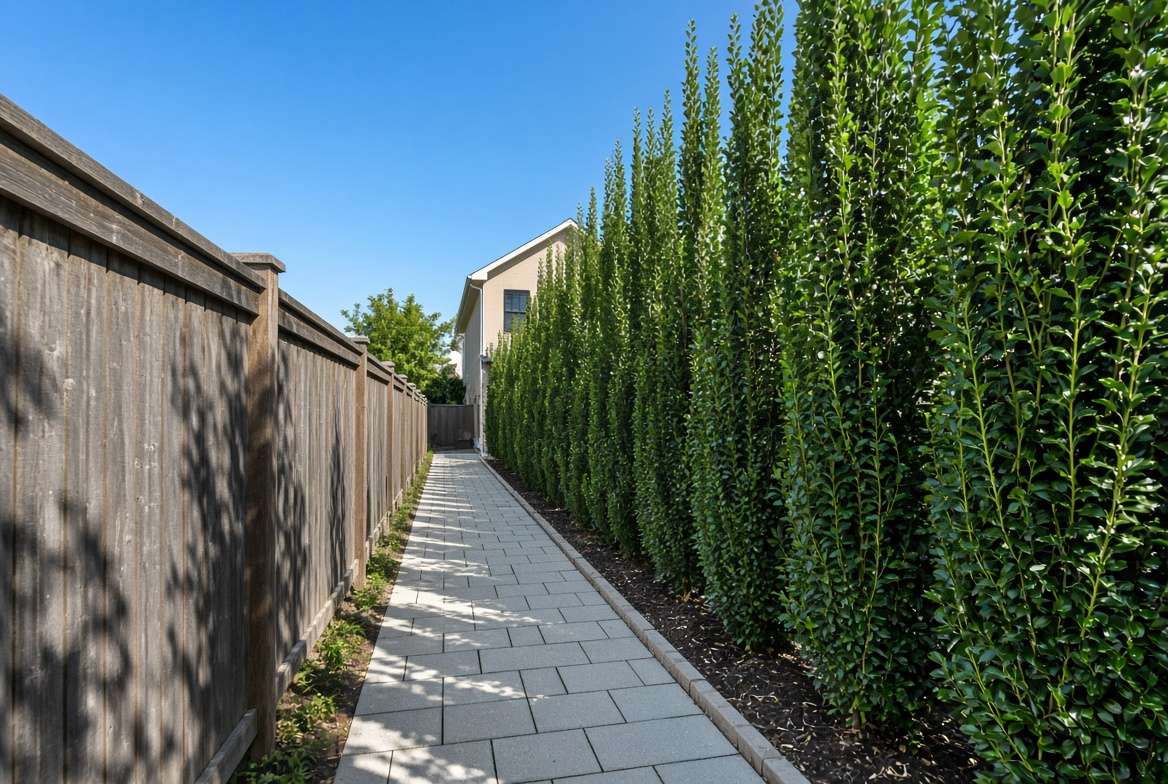
11. Sky Pencil Holly (Ilex crenata ‘Sky Pencil’) ✏️
This Japanese holly cultivar is a landscape designer’s dream for tight spaces. It naturally grows into a perfect, slender column without any pruning required.
-
Growth Habit: Literally shaped like a pencil. It grows 6 to 10 feet tall but rarely exceeds 2 feet in width.
-
Landscape Use: Perfect for framing front doors, planting along tight fence lines, or adding structural elegance to formal container gardens.
12. Italian Cypress (Cupressus sempervirens) 🏛️
The iconic tree of the Mediterranean landscape. The Italian Cypress creates immense vertical drama and sophisticated, classical geometry.
-
Growth Habit: Extremely tall and slender, growing up to 40 feet tall while staying just 3 to 4 feet wide.
-
Landscape Use: Highly drought-tolerant. Use them to line long driveways, create striking privacy walls, or accentuate the vertical lines of tall homes.
13. Blue Arrow Juniper (Juniperus virginiana ‘Blue Arrow’) 🔵
If you live in a colder climate where Italian Cypress won’t survive, the Blue Arrow Juniper is your best alternative. It features striking, silvery-blue foliage.
-
Growth Habit: A very tight, narrow evergreen that grows 12 to 15 feet tall and only 2 feet wide.
-
Landscape Use: Exceptionally cold-hardy and low maintenance. Ideal for creating a dense, space-saving privacy screen in northern climates.
14. Emerald Green Arborvitae (Thuja occidentalis) 🌲
This is perhaps the most popular privacy tree in North America, and for good reason. It provides a dense, impenetrable wall of lush green foliage year-round.
-
Growth Habit: Features a narrow, pyramidal shape. Grows 10 to 15 feet tall and roughly 3 to 4 feet wide at the base.
-
Landscape Use: Plant them 3 feet apart along a property line for the ultimate, space-saving privacy screen.
15. Bamboo (Clumping Varieties like Bambusa multiplex) 🎋
Bamboo is famous for its rapid vertical growth, instantly transforming a sterile patio into a lush, Zen-like retreat.
-
Growth Habit: Fast-growing vertical canes that shoot straight up, topped with wispy, rustling leaves.
-
Expert Tip 💡: You must be absolutely certain you are purchasing clumping bamboo (which stays contained in a tight cluster) rather than running bamboo. Running bamboo is highly invasive and will aggressively spread throughout your entire yard and your neighbor’s yard if not planted in reinforced concrete barriers.
✂️ Pro Care Tips: Keeping Your Plants Growing Up, Not Out
Even plants with naturally columnar genetics sometimes need a little horticultural discipline to maintain their narrow footprint. Here is how the experts keep plants tall and skinny:
-
The Art of Pruning 🌿: Do not be afraid to prune. If your Ficus or Dracaena starts pushing out wide lateral branches, prune them back to the main trunk just above a leaf node. This redirects the plant’s growth hormones (auxins) back to the top of the plant, forcing vertical height.
-
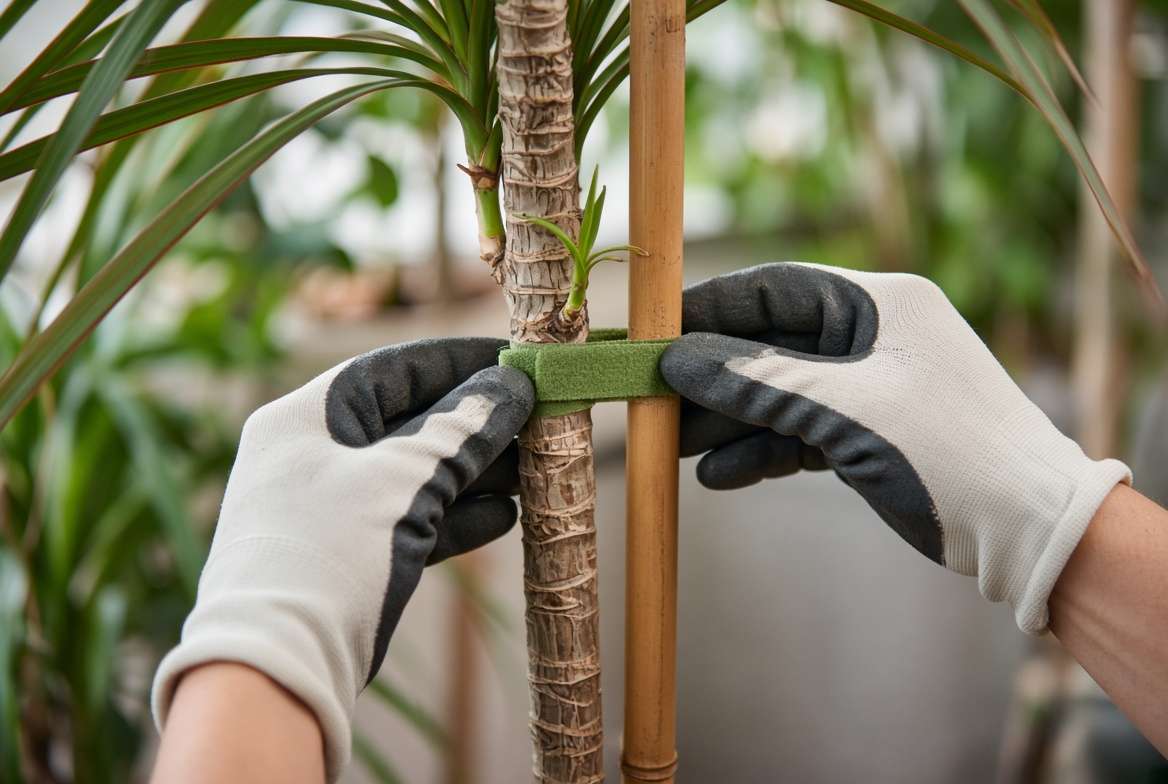
Staking and Support 🪵: As tall indoor plants reach for the ceiling, they can become top-heavy. Insert a sturdy bamboo stake, a moss pole, or a metal plant support deep into the soil at the time of repotting. Loosely secure the main stem to the stake using soft velcro plant ties to keep it growing perfectly straight.
-
Pot Sizing (The Squeeze Method) 🪴: Roots mirror the canopy. If you put a plant in a massive, wide pot, it will grow a massive, wide root system, resulting in a wider canopy. By keeping your tall plants slightly root-bound (repotting only when absolutely necessary, and only going up 1 to 2 inches in pot diameter), you restrict outward canopy growth while still allowing vertical climbing.
-
Rotating for Light 🔄: Plants are naturally phototropic; they will lean heavily toward the nearest light source. If left unrotated in a dark corner near a window, your tall skinny plant will quickly become a crooked, leaning plant. Give the pot a quarter-turn every single time you water it to ensure perfectly straight, symmetrical growth.
🎨 Expert Design Ideas: Styling Tall Narrow Plants
Choosing the right plant is only half the battle; how you style it dictates how well it elevates your interior space.
-
Layering Heights: A tall, slender plant with bare lower stems (like a Dracaena or Ficus Audrey) can look slightly awkward in a corner on its own. Create depth by planting a trailing “spiller” plant (like Pothos or trailing Philodendron) in the same pot, allowing it to cascade over the edge while the tall plant shoots upward.
-
Choosing the Right Planter: The planter is just as important as the plant. To accentuate verticality, avoid squat, bowl-shaped pots. Instead, opt for tall, tapered, or square column planters. A 3-foot tall Snake plant placed in a 2-foot tall modern cylinder planter instantly becomes a commanding 5-foot architectural feature.
-
Uplighting 🔦: This is a classic interior design secret. Place a small, discreet LED floor spotlight behind the base of your tall skinny plant, aimed upward into the foliage. In the evening, this casts magnificent, soaring, jungle-like shadows onto your ceiling, amplifying the feeling of height in the room.
🤔 Frequently Asked Questions (FAQs)
How do I make my indoor plant grow taller faster? Light and fertilizer are the engines of growth. Ensure your plant is getting the absolute maximum amount of light it can tolerate without burning. During the active growing seasons of spring and summer, feed the plant with a balanced, water-soluble liquid fertilizer diluted to half strength every two to four weeks.
Are tall skinny plants more prone to falling over? Yes, as they gain vertical height, their center of gravity shifts upward, making them top-heavy. To prevent them from tipping over, use a heavy ceramic, terracotta, or concrete outer decorative pot. If you are using a lightweight fiberglass or plastic planter, place a layer of heavy river rocks or bricks at the bottom before setting the nursery pot inside.
What is the tallest indoor plant that requires the least floor space? The Snake Plant and the Madagascar Dragon Tree tied for this title. Both can easily reach 5 to 6 feet in height while comfortably residing in a pot that is only 10 to 12 inches in diameter.
Can I put a tall skinny plant in a dark hallway? No living plant can survive in absolute darkness. If your narrow hallway has zero natural light, even a hardy ZZ Plant or Cast Iron Plant will eventually slowly decline. To successfully keep a plant in a windowless space, you must install an overhead LED grow light (many modern grow bulbs screw right into standard track lighting or pendant fixtures) and leave it on for 10 to 12 hours a day.











