

We’ve all been there. You buy a gorgeous, compact, and lush houseplant from the nursery, proudly display it on your coffee table, and congratulate yourself on being a great plant parent. But a few months later, you wake up, look over, and realize something has gone terribly wrong. Your once-bushy beauty now looks like a stretched-out beanstalk, with pale, weak stems reaching desperately toward the nearest window.
If you are currently staring at a spindly, stretched-out houseplant, take a deep breath. You are dealing with leggy plants, one of the most common and universally frustrating issues in indoor gardening.
First, let me reassure you: you haven’t failed. In my years of experience cultivating both indoor jungles and outdoor gardens, I’ve seen countless growers panic and throw their stretched plants into the compost bin. But here is the good news—with a little botanical know-how and three incredibly simple, actionable steps, you can reverse the damage. In this comprehensive guide, we are going to dive deep into exactly why your leafy friends are stretching, how to fix them, and how to encourage the lush, bushy foliage you actually want. Let’s bring your plants back to life! ✨
What Are Leggy Plants? The Science of Etiolation 🔬
Before we can start chopping and fixing, we need to understand exactly what is happening on a cellular level. Diagnosing the problem correctly is the cornerstone of expert plant care.
Defining “Legginess”
When botanists and horticulturists refer to a “leggy” plant, they are describing a specific type of abnormal growth. The most obvious symptoms include:
-
Elongated Stems: The stems grow unusually long and often look frail or floppy.
-
Large Gaps Between Leaves: In healthy plants, leaves grow relatively close together. In leggy plants, the space between the leaves (known as the internode) becomes drastically stretched.
-
Pale or Yellowing Foliage: New growth often lacks that deep, healthy green color.
-
Smaller Leaves: The plant produces miniature versions of its normal leaves because it lacks the energy to grow full-sized foliage.

The Botanical Term: Etiolation
To truly master plant care, it helps to know the science. The botanical term for this stretching phenomenon is etiolation (pronounced ee-tee-oh-LAY-shun). It is directly linked to another biological process called phototropism—the way a plant physically moves and grows toward a light source.
When a plant is placed in a dark corner, its light receptors (phytochromes) send an alarm signal. The plant realizes it isn’t getting enough energy to photosynthesize and survive. In a desperate bid for life, it redirects all of its cellular energy away from producing wide, healthy leaves and instead pumps growth hormones into elongating its stems. It is literally trying to “walk” across the room to reach the sun.
💡 Expert Insight: Legginess is not a disease, a fungus, or a pest infestation. It is a brilliant, evolutionary survival mechanism! Your plant is sacrificing its aesthetic beauty to save its own life. Understanding this changes how we care for them—we aren’t curing a sickness; we are correcting an environment.
Why Do Plants Get Leggy? The 4 Root Causes 🕵️♀️
To permanently fix the issue, you must identify the root cause. While one culprit stands head and shoulders above the rest, there are actually four distinct reasons your plants might be getting leggy.
1. The #1 Culprit: Insufficient Light ☀️
Let’s not bury the lead: 90% of the time, your plant is leggy because it is starving for light. Different plants have different light requirements, but a common mistake is overestimating how much light a room actually receives.
Humans have incredibly adaptive eyes; what looks like a “bright room” to us is often a dark cave to a plant. Light intensity drops exponentially for every foot you move away from a window. If your light-loving succulent is sitting ten feet away from a north-facing window, it is slowly starving. Without adequate photons to fuel photosynthesis, the plant hits the panic button and begins to etiolate.
2. Temperature Fluctuations and Heat Spikes 🌡️
While light is the primary driver, temperature plays a sneaky, secondary role. Plants naturally grow faster in warmer environments. However, if a plant experiences a sudden spike in heat (like being placed too close to a heating vent, a radiator, or a heat mat for seedlings) without a corresponding increase in light, disaster strikes.
The heat tricks the plant’s metabolism into overdrive, forcing rapid growth. But because there isn’t enough light to support strong, dense cellular development, that rapid growth comes out weak, floppy, and leggy.
3. Fertilizer Imbalances (The Nitrogen Trap) 🧪
Nitrogen is a crucial macronutrient responsible for pushing leafy green growth. However, more is not always better.
If you are heavily fertilizing a plant—especially with a high-nitrogen liquid fertilizer—while keeping it in a low-light environment, you are essentially force-feeding it. The nitrogen signals the plant to grow, grow, grow! But without the sunlight needed to synthesize carbohydrates and build strong cell walls, the resulting stems are thin, watery, and stretched out. This is a common mistake eager beginners make during the winter months when plants should naturally be resting.
4. Overcrowding and Competition 🌱
This cause is incredibly common for those who grow vegetables, herbs, or start seeds indoors. In nature, plants are highly competitive. If you plant too many seeds in one small starter pot, or if you cluster your houseplants so tightly that their leaves overlap, they will sense the shade cast by their neighbors.
Triggered by the competition, they will rapidly stretch straight up in a race to break through the canopy and claim the light. The loser gets shaded out; the winner gets the sun (but usually ends up tall and spindly in the process).
How to Fix Leggy Plants: 3 Simple Steps ✂️
Now that we understand the science and the root causes behind stem elongation, it’s time to take action. Fixing a leggy plant requires a bit of bravery, but I promise you that these three steps are the proven, horticulturally sound way to restore dense, lush foliage.
Step 1: Pruning and Pinching Back (Don’t Be Afraid!) 🪴
The hard truth is that stretched-out, etiolated stems will never shrink back down. Once the internode is elongated, it stays elongated. To fix the plant, you have to physically remove the leggy growth. For many plant parents, taking scissors to their beloved houseplant feels terrifying, but pruning is actually an act of rejuvenation.
The Method: Examine your plant’s stem and locate the leaf nodes (the small bumps or joints where leaves and roots emerge). Using a clean pair of pruning shears, make a clean cut about ¼ inch above a node on the lower, healthier portion of the stem.
The “Why” (The Magic of Apical Dominance): Plants naturally want to grow taller to reach the sun, a concept called apical dominance. The top bud (the apical meristem) produces a hormone called auxin, which travels down the stem and suppresses the growth of side branches. When you snip off that top growth, you remove the auxin supply. Without that hormone holding them back, the dormant lateral buds on the sides of the stem suddenly wake up and start growing outward. This is exactly how you force a plant to branch out and become bushy!
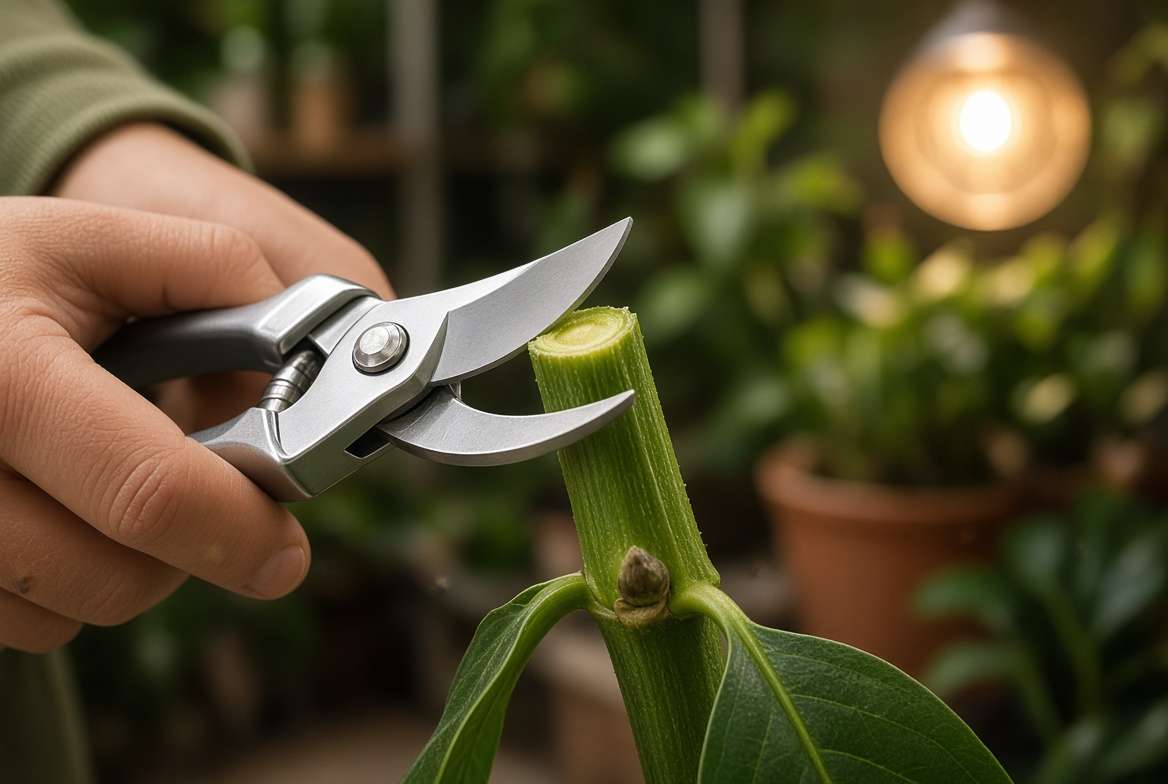
🛠️ Pro Tip: Always sterilize your pruning shears or scissors with rubbing alcohol before making a cut. This prevents the spread of bacterial or fungal infections into the fresh, open wound of the plant.
Step 2: Optimizing Light Exposure 🪟
Pruning will force new growth, but if you don’t fix the environment, the new growth will just become leggy again. You must provide the energy the plant needs to build compact, healthy leaves.
Relocating Your Plant: Assess your current light situation. If your plant is in a dark corner or a north-facing window, it needs an upgrade. Moving the plant to an east-facing window provides gentle, bright morning light. A south-facing or west-facing window provides intense, direct sunlight, which is perfect for sun-lovers like succulents and cacti, provided you acclimate them slowly to avoid sunburn.
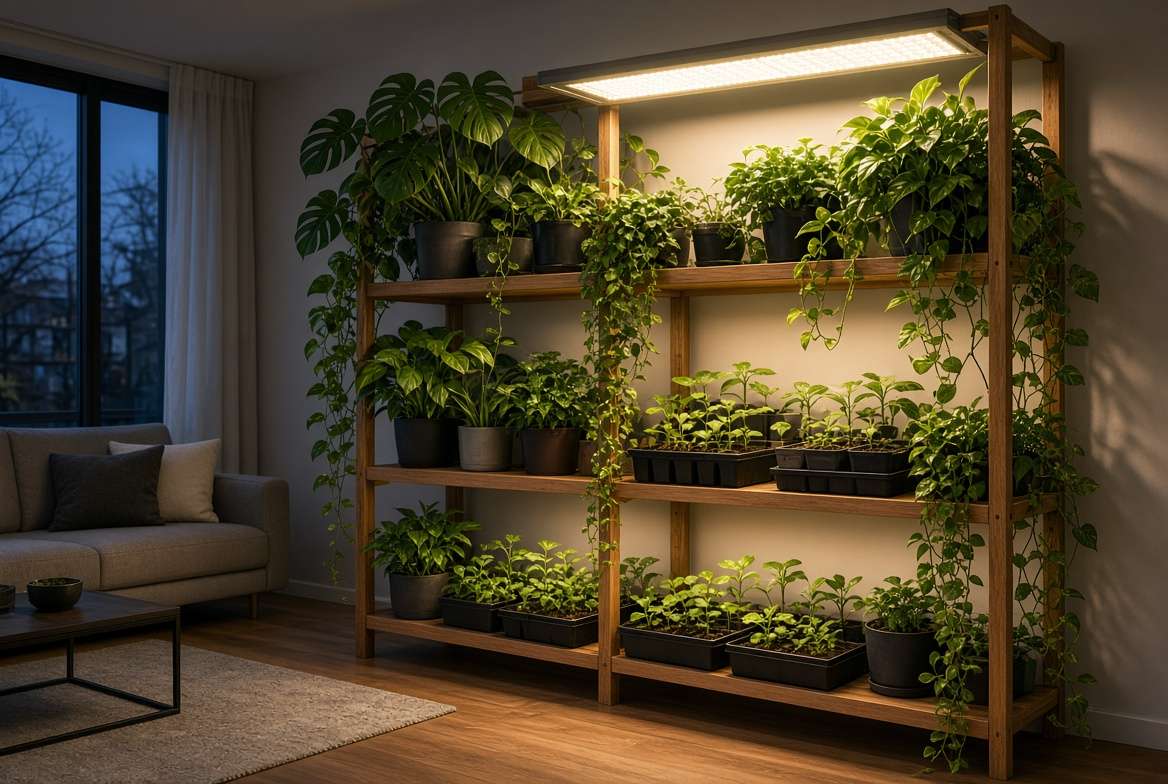
The Grow Light Solution: If you live in a dark apartment or are battling the short, gloomy days of winter, modern technology is your best friend. Full-spectrum LED grow lights are an incredibly helpful, energy-efficient solution. They replicate the natural spectrum of the sun, providing the exact wavelengths plants need for dense vegetative growth. Placing a grow light 12 to 18 inches above your plant can completely halt etiolation.
Step 3: Propagating the Cuttings (Bonus Plants!) 💧
The best part about fixing a leggy houseplant is that the parts you chop off don’t have to go in the trash. You can easily turn that stretched-out top growth into brand-new plants!
Water vs. Soil Propagation: Take the stem you just pruned and remove the bottom few leaves to expose the nodes.
-
Water Propagation: Place the cut stem into a glass jar filled with room-temperature water, ensuring the exposed nodes are submerged. Keep it in bright, indirect sunlight and change the water weekly. Within a few weeks, you will see white roots sprouting!
-
Soil Propagation: Dip the cut end in a rooting hormone and plant it directly into a small pot with fresh, moist potting mix.
Once your cuttings have established a healthy root system (about 2 inches long for water propagations), you can pot them up independently. Better yet, plant them back into the exact same pot as the original mother plant to instantly create a fuller, bushier aesthetic.

Plant-Specific Rescue Guides: Fixing Popular Leggy Houseplants 🌿
Different botanical families require slightly different approaches. Here is how to handle legginess in some of the most common houseplants and garden favorites.
Rescuing Leggy Succulents & Cacti 🌵
Succulents like Echeverias and Graptopetalums are notorious for stretching out indoors, losing their tight, beautiful rosette shape.
-
The Fix: Use the “beheading” method. Snip the compact rosette off the top of the tall stem. Let the cut end callous over for two days to prevent rotting, then place it directly on top of dry succulent soil. It will grow new roots. Leave the bare, rooted stem in its pot—it will often sprout tiny baby succulents along the sides!

Reviving Spindly Pothos and Philodendrons 🍃
Trailing plants often end up with a single, incredibly long vine that is mostly bare stem with a few leaves at the very end.
-
The Fix: Instead of chopping it off, use the “bobby pin” or layering method. Gently wrap the long, bare vine in a circle along the top of the potting soil. Use a sterilized bobby pin or floral pin to secure the nodes into the dirt. The nodes will root directly into the soil and shoot up new vines, giving you a phenomenally bushy top.
Fixing Leggy Vegetable Seedlings (Tomatoes & Peppers) 🍅
Indoor gardeners starting seeds for spring often struggle with thin, floppy seedlings caused by weak window light.
-
The Fix: Tomatoes are magical because they can grow adventitious roots anywhere along their main stem. When you transplant your leggy tomato seedlings into larger pots (or out into the garden), bury them deep! Dig a hole deep enough to bury the entire spindly stem up to the first set of true leaves. The buried stem will shoot out a massive, robust root system, saving the plant.
Pro Tips to Prevent Legginess in the Future 🛡️
Once you have restored your plant’s bushy growth, you want to keep it that way. Implement these daily and seasonal habits to ensure your indoor jungle stays compact and healthy.
The Quarter-Turn Rule 🔄
Plants will always reach toward the light. If a plant sits in the same position for months, the front will grow dense while the back stretches and thins out, creating a lopsided, leaning plant. Get into the habit of rotating your plant pots 90 degrees every single time you water them. This ensures even 360-degree light distribution and perfectly symmetrical growth.
Seasonal Adjustments 🍂
The sun’s angle shifts dramatically throughout the year. A spot that receives bright, indirect light in mid-July might be draped in shadows by December. Pay attention to how the light moves through your home. You will likely need to shift your houseplants closer to the windows during the darker winter months to prevent them from stretching.
Proper Feeding Schedules 🗓️
Align your fertilizer routine with your plant’s natural growth cycles. Feed them with a balanced, water-soluble fertilizer during their active growing season (spring and summer). As the days get shorter in autumn, scale back dramatically. Pumping nitrogen into a dormant plant during low-light winter conditions is a guaranteed recipe for weak, leggy growth.
Frequently Asked Questions (FAQs) About Leggy Plants ❓
Can a leggy plant ever shrink back to normal? No. Once a plant’s stem has elongated and the internodal spacing has stretched, it is physically impossible for the stem to shrink or compress. The only way to remove the leggy sections and restore a compact look is through pruning.
Will my plant die if I cut off all the leggy growth? As long as you don’t remove 100% of the plant’s foliage, it will survive. Leaves are the plant’s solar panels; they need them to create food. Always leave a few healthy leaves below your pruning cut so the plant has the energy it needs to push out new lateral growth.
Are leggy seedlings doomed? Not necessarily! While extreme legginess can make seedlings susceptible to “damping off” (a fatal fungal disease), catching it early can save them. Immediately lower your grow lights to just 2-3 inches above the top of the seedlings, and when repotting, bury the stems deeper into the soil to provide physical support and encourage stem-rooting.
Embrace the Chop! 🎉
Watching a beloved plant grow pale, thin, and spindly can be disheartening, but it is rarely a death sentence. By understanding that leggy plants are simply crying out for more light, you are already halfway to solving the problem. Remember the three golden rules: don’t be afraid to prune back the weak growth, immediately correct your light situation, and use those cuttings to propagate a whole new generation of leafy friends.
Pruning isn’t a punishment; it is an act of love that redirects your plant’s energy toward a healthier, more vibrant future. Grab your shears, find a sunnier windowsill, and embrace the chop!
Which plant in your collection is currently struggling with legginess? Are you dealing with a stretching succulent or a trailing pothos? Drop a comment below, or share your pruning before-and-after photos with us on social media!











